

The DOI matches its Crossref record; 106 of the 107 references it cites were found in a registry or an index.
Methods in cognitive pupillometry: Design, preprocessing, and statistical analysis
Open accessPublished version of a preprint
Abstract
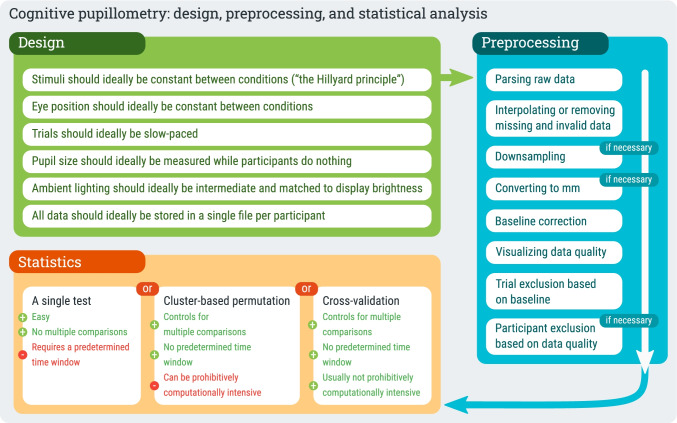
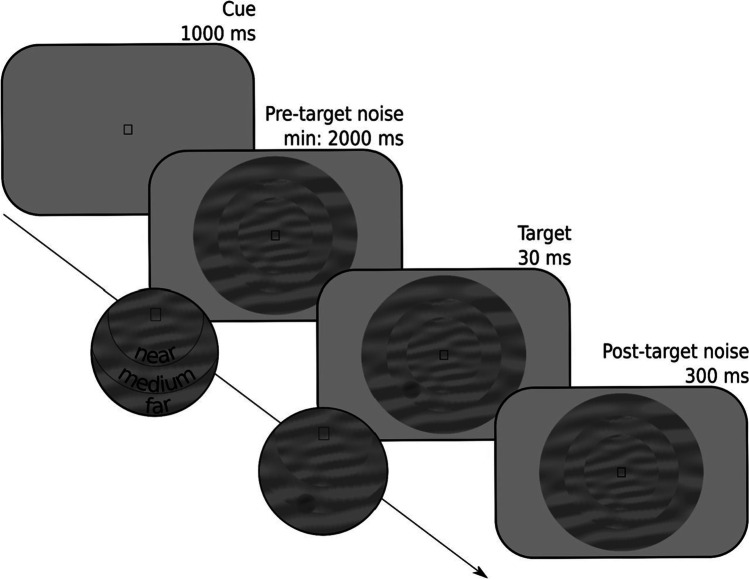
Cognitive pupillometry is the measurement of pupil size to investigate cognitive processes such as attention, mental effort, working memory, and many others. Currently, there is no commonly agreed-upon methodology for conducting cognitive-pupillometry experiments, and approaches vary widely between research groups and even between different experiments from the same group. This lack of consensus makes it difficult to know which factors to consider when conducting a cognitive-pupillometry experiment. Here we provide a comprehensive, hands-on guide to methods in cognitive pupillometry, with a focus on trial-based experiments in which the measure of interest is the task-evoked pupil response to a stimulus. We cover all methodological aspects of cognitive pupillometry: experimental design, preprocessing of pupil-size data, and statistical techniques to deal with multiple comparisons when testing pupil-size data. In addition, we provide code and toolboxes (in Python) for preprocessing and statistical analysis, and we illustrate all aspects of the proposed workflow through an example experiment and example scripts.
Overview
The claims and statistics of this paper haven’t been checked yet.
Run the check — free, no account needed. It reads the open-access text and checks the sources it cites.
Integrity signals
Registry
Cites
Statistics
Figures
Verification
Claims the paper makes
The claims and statistics of this paper haven’t been checked yet.
Run the check — free, no account needed. It reads the open-access text and checks the sources it cites.
Claims other papers make about this one
Each is checked against this paper’s own text: does it say what the citing paper says it does?
The cited source says what the claim attributes to it.
In the citing paper
“We did not preregister a specific time window to assess our hypotheses regarding the effect of expectancy on pupil sizes; thus, we use cross-validation to extract samples from the whole response time window as recommended by Mathôt and Vilotijević [39].”
From Predicting emotional valence in autism: a preregistered study in the Bayesian Brain framework (2026) · cites this paper as [39]
Self-check
Percentages, sums and reported differences re-computed from the paper’s own numbers.
The self-check needs the paper’s full text.
Citations
Cites
Random effects structure for confirmatory hypothesis testing: Keep it maximal
Barr, D. J., Levy, R., Scheepers, C., & Tily, H. J. (2013) · Journal of Memory and Language · doi:10.1016/j.jml.2012.11.001 · Cited by 10,328
Nonparametric statistical testing of EEG- and MEG-data
Maris, E., & Oostenveld, R. (2007) · Journal of Neuroscience Methods · doi:10.1016/j.jneumeth.2007.03.024 · Cited by 8,496
(2001) · doi:10.1017/cbo9780511546396 · Cited by 4,482
Aston-Jones, G., & Cohen, J. D. (2005) · Annual Review of Neuroscience · doi:10.1146/annurev.neuro.28.061604.135709 · Cited by 4,472
Circular analysis in systems neuroscience: the dangers of double dipping
Kriegeskorte, N., Simmons, W. K., Bellgowan, P. S. F., & Baker, C. I. (2009) · Nature Neuroscience · doi:10.1038/nn.2303 · Cited by 2,696
OpenSesame: An open-source, graphical experiment builder for the social sciences
Mathôt, S., Schreij, D., & Theeuwes, J. (2011) · Behavior Research Methods · doi:10.3758/s13428-011-0168-7 · Cited by 2,648
Self-citationThe pupil as a measure of emotional arousal and autonomic activation
Bradley, M. M., Miccoli, L., Escrig, M. A., & Lang, P. J. (2008) · Psychophysiology · doi:10.1111/j.1469-8986.2008.00654.x · Cited by 1,919
Pupil Diameter and Load on Memory
Kahneman, D., & Beatty, J. (1966) · Science · doi:10.1126/science.154.3756.1583 · Cited by 1,617
Power Analysis and Effect Size in Mixed Effects Models: A Tutorial
Brysbaert, M., & Stevens, M. (2018) · Journal of Cognition · doi:10.5334/joc.10 · Cited by 1,420
Joshi, S., Li, Y., Kalwani, R. M., & Gold, J. I. (2016) · Neuron · doi:10.1016/j.neuron.2015.11.028 · Cited by 1,387
Research works printed but not linked: 2
- Van de Kraats, J., Smit, E. P., & Slooter, J. H. (1977). Objective perimetric measurements by the pupil balance method. Documenta Ophthalmologica Proceedings Series, 14, 213–219.
- Vilotijević, A., & Mathôt, S. (2022). Covert shifts of attention towards the visual periphery induce pupil dilation (p. 2022.07.14.500035). bioRxiv. https://doi.org/10.1101/2022.07.14.500035 · DOI
Cited by
Sorted by citations
Items 101–200 of 234
Phonological discrimination and contrast detection in pupillometry
Chiossi, J. S. C., Patou, F., Ng, E. H. N., Faulkner, K. F., & Lyxell, B. (2023) · Frontiers in Psychology · doi:10.3389/fpsyg.2023.1232262 · Cited by 2
Pupil Responses as Indicators of Learning and Adaptation in Human-Robot Collaboration Scenarios
Zanardi, D., Nenna, F., Orlando, E. M., Nannetti, M., Mingardi, M., Buodo, G., & Gamberini, L. (2024) · International Conference on PErvasive Technologies Related to Assistive Environments (PETRA) · doi:10.1145/3652037.3663909 · Cited by 2
Perceived Asynchrony of Rhythmic Stimuli Affects Pupil Diameter and Smooth Pursuit Eye Movements
Klass, L., Lammert, A. B., Simon, L., Froehlich, B., Hornecker, E., & Ehlers, J. (2025) · CHI Conference on Human Factors in Computing Systems · doi:10.1145/3706598.3713152 · Cited by 2
Stimuli are perceived as lasting longer when there is something bright on the screen
Karşılar, H., Mathôt, S., & van Rijn, H. (2025) · Attention Perception & Psychophysics · doi:10.3758/s13414-025-03120-8 · Cited by 1
Self-citationPupil Fluctuations Signal Intentional Forgetting of Natural Scenes
Ding, H., Whitlock, J., & Sahakyan, L. (2025) · Psychophysiology · doi:10.1111/psyp.70119 · Cited by 1
Phasic and tonic arousal distinctly shape human decision bias
Nuiten, S. A., de Gee, J. W., Zantvoord, J. B., Sterzer, P., Fahrenfort, J. J., & van Gaal, S. (2026) · Communications Biology · doi:10.1038/s42003-026-09776-8 · Cited by 3
Changes in pupil size track self-control failure
O’Bryan, S. R., Price, M., Alquist, J. L., Davis, T. H., & Scolari, M. (2024) · Experimental Brain Research · doi:10.1007/s00221-024-06781-3 · Cited by 2
Early roots of information-seeking: Infants predict and generalize the value of informationPreprint
Ghilardi, T., Poli, F., Meyer, M., Colizoli, O., & Hunnius, S. (2024) · eLife · doi:10.7554/elife.92388 · Cited by 2
Experimenting with the past: an integrative approach to early symbolic evolutionPreprint
Wisher, I., & Tylén, K. (2024) · doi:10.31234/osf.io/u2jgz · Cited by 2
Attention Modulates the Effects of Stimulus Brightness and Contrast on Time PerceptionPreprint
Karşılar, H., van Rijn, H., & Mathôt, S. (2024) · doi:10.31234/osf.io/rj6nc · Cited by 2
Self-citationEffort Drives Saccade SelectionPreprint
Koevoet, D., Zantwijk, L. V., Naber, M., Mathôt, S., der Stigchel, S. V., & Strauch, C. (2025) · eLife · doi:10.7554/elife.97760.2 · Cited by 2
Self-citationBussu, G., Portugal, A. M., Wilsson, L., Kleberg, J. L., & Falck‐Ytter, T. (2023) · Scientific Reports · doi:10.1038/s41598-023-49373-x · Cited by 2
Brittenham, C., DiCriscio, A. S., Troiani, V., Hu, Y., & Wagner, J. (2025) · Scientific Reports · doi:10.1038/s41598-025-92904-x · Cited by 1
Xu, J., Vancleef, L. M. G., Bongaerts, E., & Ryckeghem, D. M. L. V. (2025) · Pain · doi:10.1097/j.pain.0000000000003640 · Cited by 1
Hallman, A. E. Z., Willfors, C., Fawcett, C. A., Frick, M. A., Nordgren, A., & Kleberg, J. L. (2025) · Journal of Neurodevelopmental Disorders · doi:10.1186/s11689-025-09639-z · Cited by 1
Pupil Diameter for Student Engagement Classification and Assessing Content Sequence Effect
Luhaybi, A. A., Hossain, M. Z., Caldwell, S., & Gedeon, T. (2025) · IEEE International Conference on Computing and Machine Intelligence (ICMI) · doi:10.1109/icmi65310.2025.11141293 · Cited by 1
AI-driven pupillary–computer interface via binary-coded flickering stimuli
Park, S., & Mun, S. (2025) · Computers in Biology and Medicine · doi:10.1016/j.compbiomed.2025.111057 · Cited by 1
Dissociating Spatial Attention and Working Memory Storage with Pupillometry
Koevoet, D., Jones, H. M., der Stigchel, S. V., & Awh, E. (2025) · Journal of Cognitive Neuroscience · doi:10.1162/jocn.a.2395 · Cited by 1
Pupil Old/New Effect Is Modulated by Task Instruction—Evidence for an Attentional Saliency Account
Albi, Á., & Pajkossy, P. (2025) · European Journal of Neuroscience · doi:10.1111/ejn.70349 · Cited by 1
Li, Z., & Zhu, C. (2025) · Frontiers in Neuroscience · doi:10.3389/fnins.2025.1697053 · Cited by 2
PupEyes: An interactive Python library for eye movement data processing
Zhang, H., & Jonides, J. (2026) · Behavior Research Methods · doi:10.3758/s13428-025-02830-z · Cited by 1
Exploration vs. Exploitation in a Novel Complex Card Matching Task: Evidence from Pupillometry
Sordo, G. C. D., & Papesh, M. H. (2026) · Cognitive Affective & Behavioral Neuroscience · doi:10.3758/s13415-025-01377-y · Cited by 1
Evaluating the potential of profiling users from visual behavior data in pedestrian navigation
Liao, H., Lu, B., Qin, T., Wei, Z., & Dong, W. (2026) · Cartography and Geographic Information Science · doi:10.1080/15230406.2026.2619028 · Cited by 1
Fang, H., Guo, H., Nie, D., Yang, N., & Un, K. (2026) · ISPRS International Journal of Geo-Information · doi:10.3390/ijgi15040153 · Cited by 1
Exploring how textual complexity affects cognitive load during reading: an eye-tracking study
Vaněček, D., Kursch, M., Şen, E., Rehman, I. U., & Yorulmaz, Y. İ. (2026) · Scientific Reports · doi:10.1038/s41598-026-51704-7 · Cited by 1
Visual Patterns of Attention in Prehistoric Central Germany: An Eye-tracking Study on Pottery Styles
Vindrola-Padrós, B., Scholtus, L., Nuthmann, A., Furholt, K., & Müller, J. (2026) · Cambridge Archaeological Journal · doi:10.1017/s0959774326100572 · Cited by 1
Asuku, A. O., & Ajibare, A. J. (2026) · Ibrain · doi:10.1002/ibra.70021 · Cited by 1
Zhang, S., Ferry, A. L., Brandt, S., Warren, E., & Theakston, A. (2026) · Applied Psycholinguistics · doi:10.1017/s014271642610085x · Cited by 1
Behaviour of Pupil Diameter during Authoritative Control Interventions in Driving Automation
Sivakumar, L., & Dixon, L. (2024) · International Conference on Automotive User Interfaces and Interactive Vehicular Applications (AutomotiveUI) · doi:10.1145/3641308.3685020 · Cited by 1
Mayer, M., & Liszkowski, U. (2024) · Journal of Experimental Child Psychology · doi:10.1016/j.jecp.2024.106060 · Cited by 2
Grzadzinski, R., Carpenter, R. S., Rutsohn, J., Jatkar, A., Mata, K., Bhatt, A., Ortiz-Juza, M. M., Dennehey, M. R., Gilleskie, D., Elison, J. T., et al. (2025) · Journal of Neurodevelopmental Disorders · doi:10.1186/s11689-025-09628-2 · Cited by 1
Spontaneous Fluctuations in Pupil Size Shape Retinal Responses to Visual StimuliPreprint
Mathôt, S., Weiden, D., & Dimigen, O. (2024) · bioRxiv (Cold Spring Harbor Laboratory) · doi:10.1101/2024.05.14.593932 · Cited by 1
Self-citationIndexing prediction error during syntactic priming via pupillometry
Kumarage, S., Malko, A., & Kidd, E. (2025) · Language Cognition and Neuroscience · doi:10.1080/23273798.2025.2506634 · Cited by 1
Visual working memory precision is under voluntary controlPreprint
Sahakian, A., Koevoet, D., Paffen, C. L. E., Gayet, S., & der Stigchel, S. V. (2025) · bioRxiv (Cold Spring Harbor Laboratory) · doi:10.1101/2025.05.29.656854 · Cited by 1
Dongpeng, P., & Seeber, K. (2026) · Research Square · doi:10.21203/rs.3.rs-9294880/v1 · Cited by 1
Predicting emotional valence in autism: a preregistered study in the Bayesian Brain framework
Plank, I. S., Pior, A., Yurova, A., Nowak, J., Shi, Z., & Falter-Wagner, C. M. (2026) · Molecular Autism · doi:10.1186/s13229-026-00730-3 · Cited by 2
“We preprocessed the data following the recommendations published in Mathôt and Vilotijević [39] and using the DataMatrix package (for details see S2.”
Concealed identity information detection with pupillometry in rapid serial visual presentationPreprint
Chen, I. Y., Karabay, A., Mathôt, S., Bowman, H., & Akyürek, E. G. (2021) · bioRxiv (Cold Spring Harbor Laboratory) · doi:10.1101/2021.06.18.448944
Self-citationLinking vestibular, tactile, and somatosensory rhythm perception to language development in infancy
Russo, S., Carnovalini, F., Calignano, G., Arfé, B., Rodà, A., & Valenza, E. (2023) · Cognition · doi:10.1016/j.cognition.2023.105688
Hasshim, N., Carruthers, M., Ferrand, L., Augustinova, M., & Parris, B. A. (2024) · Quarterly Journal of Experimental Psychology · doi:10.1177/17470218241235671
Vrettou, C. S., & Kominis, I. K. (2024) · Neurocritical Care · doi:10.1007/s12028-024-02023-0
Ghidelli, M., Gatto, G., Alberti, G., Abeni, N., Rasulo, F. A., & Lancini, M. (2024) · IEEE International Symposium on Medical Measurements and Applications (MeMeA) · doi:10.1109/memea60663.2024.10596725
Patch-leaving decisions and pupil-linked arousal systemsPreprint
Marzecová, A., Vernaillen, B., Hoxhaj, D., Kaiser, L. F., Verguts, T., & Jocham, G. (2024) · bioRxiv (Cold Spring Harbor Laboratory) · doi:10.1101/2024.09.06.611272
Prosocial reward relates to performance in difficult speech-on-speech listening conditionsPreprint
Oakeson, R. J., Rosen, S., Herbert, J., Roper, S., Zhang, H., & Scott, S. K. (2024) · bioRxiv (Cold Spring Harbor Laboratory) · doi:10.1101/2024.10.02.616312
Pupillary Responses Reflect Image Memorability
Niimi, R. (2025) · Psychophysiology · doi:10.1111/psyp.70007
Akimoto, Y., & Yamaguchi, T. (2025) · Perceptual and Motor Skills · doi:10.1177/00315125251329965
Eckhoff, D., Schnupp, J. W. H., Wong, P. C., & Cassinelli, Á. (2025) · IEEE Conference on Virtual Reality and 3D User Interfaces (VR) · doi:10.1109/vr59515.2025.00031
PupEyes: An Interactive Python Library for Pupil Size and Eye Movement Data ProcessingPreprint
Zhang, H., & Jonides, J. J. (2025) · doi:10.31234/osf.io/h95ma_v1
Grzadzinski, R., Carpenter, R. S., Rutsohn, J., Jatkar, A., Mata, K., Bhatt, A., Ortiz-Juza, M. M., Dennehey, M. R., Gilleskie, D., Elison, J. T., et al. (2025) · bioRxiv (Cold Spring Harbor Laboratory) · doi:10.1101/2025.05.30.656675
eyeris : A Flexible, Extensible, and Reproducible Pupillometry Preprocessing Framework in R
Schwartz, S. T., Yang, H., Xue, A. M., & He, M. (2026) · Psychophysiology · doi:10.1111/psyp.70375
Eyes wide open: Object-scene congruency and the pupillary response
Agrawal, A., & Nuthmann, A. (2025) · Neuropsychologia · doi:10.1016/j.neuropsychologia.2025.109203
Sridevi, N., Vardhan, B. B. V., & Reddy, B. R. K. (2025) · AIP conference proceedings · doi:10.1063/5.0266850
See what i mean? Reading visual verbs modulates ocular dynamics
Orenes, I., García‐Marco, E., de Vega, M., & García, A. M. (2025) · Language Cognition and Neuroscience · doi:10.1080/23273798.2025.2529333
Pupil Size Tracks the Effects of Global Context and Semantic Ambiguity on Word-Meaning Processing
Laurino, J., & Kaczer, L. (2025) · Journal of Cognition · doi:10.5334/joc.454 · Cited by 1
Eye-Tracking Metrics and Visuospatial Task Complexity: A Comparative Analysis
Karunathilake, S., Meissner, C., & Saravanan, P. (2025) · Proceedings of the Human Factors and Ergonomics Society Annual Meeting · doi:10.1177/10711813251357917 · Cited by 1
Greenaway, A.-M., Hwang, F., Nasuto, S. J., & Ho, A. K. (2025) · Psychological Reports · doi:10.1177/00332941251370235
(2025) · Natural language processing · doi:10.1075/nlp.16.c4
(2025) · Natural language processing · doi:10.1075/nlp.16.c3
(2025) · Natural language processing · doi:10.1075/nlp.16.pre
(2025) · Natural language processing · doi:10.1075/nlp.16.c9
(2025) · Natural language processing · doi:10.1075/nlp.16.index
(2025) · Natural language processing · doi:10.1075/nlp.16.c8
(2025) · Natural language processing · doi:10.1075/nlp.16.toc
Acartürk, C. (2025) · Natural language processing · doi:10.1075/nlp.16.c6
(2025) · Natural language processing · doi:10.1075/nlp.16.refs
(2025) · Natural language processing · doi:10.1075/nlp.16.c1
Acartürk, C. (2025) · Natural language processing · doi:10.1075/nlp.16 · Cited by 1
(2025) · Natural language processing · doi:10.1075/nlp.16.c5
(2025) · Natural language processing · doi:10.1075/nlp.16.prelim
(2025) · Natural language processing · doi:10.1075/nlp.16.c7
(2025) · Natural language processing · doi:10.1075/nlp.16.c2
(2025) · Natural language processing · doi:10.1075/nlp.16.ded
Chernyshev, B., Poznyak, L. A., Pultsina, K. I., Prokofyev, A. O., Kruychkova, A. G., & Ushakov, V. (2025) · Cognitive Systems Research · doi:10.1016/j.cogsys.2025.101415
Dimensionality reduction techniques in pupillometry research: A primer for behavioral scientists
Castellotti, S., Petrizzo, I., Arrighi, R., & Blini, E. (2025) · Behavior Research Methods · doi:10.3758/s13428-025-02786-0 · Cited by 2
Pupil size reveals the perceptual quality and effortless nature of synesthesia
Strauch, C., Leenaars, C., & Rouw, R. (2026) · eLife · doi:10.7554/elife.110390.4
van Leer, E., Ribas, L., Won, M., Luan, T., & Curtis, M. L. (2025) · Journal of Speech Language and Hearing Research · doi:10.1044/2025_jslhr-25-00001
Meth, E. M. S., Nôga, D. A., Wedzinga, F., Almajni, A., Pacheco, A. P., Rossi, V., Simonsson, P. C., Heel, C., Zetterlund, C., Noory, S. F. M., et al. (2025) · BMC Medicine · doi:10.1186/s12916-025-04508-x
Subjective Versus Objective Measures of Listening Effort in Multilingual Individuals
Bsharat-Maalouf, D., Degani, T., & Karawani, H. (2025) · Journal of Speech Language and Hearing Research · doi:10.1044/2025_jslhr-25-00307
Real-time thematic role assignment in Pitjantjatjara: an eye-tracking study
Malko, A., Wilmoth, S., Thanabalan, T., Bornkessel‐Schlesewsky, I., Nordlinger, R., Schlesewsky, M., & Kidd, E. (2025) · Language Cognition and Neuroscience · doi:10.1080/23273798.2025.2593904
Quantitative Biomarkers of Prosthetic Embodiment Based on Rubber Limb Illusion Paradigms
Mariani, G., Fenoglio, E., Lupo, M., Patrucco, F., Laffranchi, M., Giuseppe, S. D., Boccardo, N., & Semprini, M. (2025) · Annual International Conference of the IEEE Engineering in Medicine and Biology Society (EMBC) · doi:10.1109/embc58623.2025.11252909
Pupillometry Analysis of Emotional Responses to Visual Stimuli
Pino, E. J., Troncoso-Seguel, M. P., Gutiérrez, B., & Urrutia, M. (2025) · Annual International Conference of the IEEE Engineering in Medicine and Biology Society (EMBC) · doi:10.1109/embc58623.2025.11254969
Pupillary responses to invisible brightness escape from attentional modulation
Yang, Y., & Liao, H. (2026) · iScience · doi:10.1016/j.isci.2026.115919
The Role of Spontaneous Eye Blinks in Temporal Perception: An Eye Tracking Study
Abad-Malo, D., Alvarado-Cando, O., & Karşılar, H. (2025) · Journal of Eye Movement Research · doi:10.3390/jemr18060076
Attention hijacked: How social media notifications disrupt cognitive processingPreprint
Gaujoux, V., Pâris, F., Ringeval, F., Fournier, H., Koenig, O., Osiurak, F., & Fournel, A. (2025) · PsyArXiv (OSF Preprints)
Early Arousal Signals Drive Reward Learning and Subsequent Choice BehaviourPreprint
Ban, K., Fouragnan, E. F., & Philiastides, M. G. (2025) · bioRxiv (Cold Spring Harbor Laboratory) · doi:10.1101/2025.11.25.690494
Küçün, N. T. (2025) · Dokuz Eylül Üniversitesi İşletme Fakültesi Dergisi · doi:10.24889/ifede.1725774
Vanbuckhave, C., Eikner, J. S., Laeng, B., Onnis, L., & Mathôt, S. (2026) · bioRxiv (Cold Spring Harbor Laboratory) · doi:10.64898/2026.01.13.699205
Self-citationNANAKUBO, M., Honda, K., 藤井, 剛., Hasebe, D., Matsuzaki, Y., & Fukui, R. (2025) · Conference proceedings/Conference proceedings - IEEE International Conference on Systems, Man, and Cybernetics · doi:10.1109/smc58881.2025.11343416
Albi, Á., & Pajkossy, P. (2026) · Scientific Reports · doi:10.1038/s41598-026-40350-8
A confound-free method to manipulate pupil size in psychological experiments
Snell, J., Wagner, L., & Vilotijević, A. (2026) · Psychonomic Bulletin & Review · doi:10.3758/s13423-026-02872-0
Self-citationNeurophysiological metrics of surprise during locomotor uncertainty
Roberts, B., & Seidler, R. D. (2026) · Journal of Neuroscience Methods · doi:10.1016/j.jneumeth.2026.110722
Converting color memory toward a spatial format to benefit behaviorPreprint
Rawal, A., Wolff, M. J., & Rademaker, R. L. (2026) · bioRxiv (Cold Spring Harbor Laboratory) · doi:10.64898/2026.02.27.708515
A pupil-dilation method to test developmental differences in visual synchrony during free viewing
Ghilardi, T., & Ossmy, O. (2026) · Methods in Psychology · doi:10.1016/j.metip.2026.100239
Wang, S., van der Mijn, R., Karabay, A., & Akyürek, E. G. (2026) · Neuropsychologia · doi:10.1016/j.neuropsychologia.2026.109418
Pupil size reveals the perceptual quality and effortless nature of synesthesiaPreprint
Strauch, C., Leenaars, C., & Rouw, R. (2026) · eLife · doi:10.7554/elife.110390.1
Pupil size reveals the perceptual quality and effortless nature of synesthesiaPreprint
Strauch, C., Leenaars, C., & Rouw, R. (2026) · eLife · doi:10.7554/elife.110390
Culemann, W., Hooge, I. T. C., Niehorster, D. C., Heine, A., & Nyström, M. (2026) · Behavior Research Methods · doi:10.3758/s13428-026-02984-4
Attention modulates the effects of stimulus brightness and contrast on time perception
Karsilar, H., van Rijn, H., & Mathôt, S. (2026) · Psychonomic Bulletin & Review · doi:10.3758/s13423-026-02893-9
Self-citationAlcan, E., Sharvashidze, N., Melzig, C. A., & Schütz, A. C. (2026) · Behaviour Research and Therapy · doi:10.1016/j.brat.2026.105018
Snip & Stitch: a simple and accessible correction for the pupil foreshortening error
Stribos, K. H., Koevoet, D., Cai, Y., Naber, M., & Strauch, C. (2026) · Behavior Research Methods · doi:10.3758/s13428-026-02980-8
Age-related differences in memory encoding as a function of pupillary dynamics
CHIAPELLO, A. R., BUSCATO, E., Mescam, M., Berry, I., Pressigout, A., Alamia, A., & Rémy, F. (2026) · Neurobiology of Aging · doi:10.1016/j.neurobiolaging.2026.03.007
Metadata
- Authors
- Mathôt, S., & Vilotijević, A.
- Affiliations
- University of Groningen (NL)
- Corresponding author
- Mathôt, Sebastiaan
- Venue
- Behavior Research Methods
- Published
- 2022-08-26
- Volume
- 55
- Issue
- 6
- Pages
- 3055-3077
- ISSN
- 1554-351X (ISSN-L)
- 1554-3528
- PMC
- PMC10556184
- OpenAlex
- W4293794846
- Cited by
- 235
- References
- 107
- Citations by year
- 2026: 65 · 2025: 95 · 2024: 46 · 2023: 22 · 2022: 5
- FWCI
- 20.78
- Type
- journal article
- Language
- en
- Open access
- hybrid
- doi.org
- Locations
- Behavior Research Methods (publishedVersion, cc-by)
- bioRxiv (Cold Spring Harbor Laboratory) (acceptedVersion, cc-by)
- PubMed Central (publishedVersion, cc-by)
- PubMed (publishedVersion)
- University of Groningen research database (University of Groningen / Centre for Information Technology) (submittedVersion, cc-by)
- OSF Preprints (OSF Preprints) (submittedVersion)
- Funders
- Nederlandse Organisatie voor Wetenschappelijk Onderzoek (VI.Vidi.191.045)
- Topics
- Physical Sciences › Computer Science › Human-Computer Interaction › Gaze Tracking and Assistive Technology
- Life Sciences › Neuroscience › Cognitive Neuroscience › Neural and Behavioral Psychology Studies
- Social Sciences › Human Factors and Ergonomics › Human-Automation Interaction and Safety
- Keywords
- pupil size, experimental design, multiple comparisons, statistical analysis, attention, cognitive effort, working memory, Python library
- MeSH terms
- Attention, Cognition, Humans, Memory, Short-Term, Pupil, Research Design
About these checks
Registry, retraction, Cites and statistics results are computed, not judged, with one exception: a printed reference that no index lists is read once by a model before it counts as a citation error. Claims are extracted by a model and kept only when their quote appears verbatim in the text; each cited source is then checked, with a model’s help, for whether it says what the claim relies on. Those verdicts can be wrong — read the claim’s quote and the cited source before relying on one.
Statistics and arithmetic are recomputed, not judged.
Confidence bands are shown only for fields calibrated on our annotated test set. None is calibrated yet, so no band is shown.
What counts as a claim ›How we measure confidence ›How we check this ›
Are you an author, or do you see a problem with this page? Request a review
