

Application of Project Management using CPM (Critical Path Method) and Pert (Project Evaluation and Review Technique) in the Nava House Bekasi Cluster Housing Development Project
Open accessThe DOI matches its Crossref record, with a small difference in title or year; 34 of the 35 references it cites were found in a registry or an index; 3 of the 5 sources its claims cite were checked for support.
Abstract
Housing development projects are developing very rapidly. Housing development projects will increase people's income and standard of living. One of the housing development projects in Bekasi City is the Nava House Cluster housing complex. Nava House housing is a Cluster type housing complex. When working on a development project, project scheduling is required. In project scheduling, there are several methods that can be used, namely the CPM and PERT methods. Both methods can be used to minimize the time lag in project work. This thesis aims to determine the path formed in the network, the activities included in the critical path and the completion time contained in the critical path. The results of this research on the Nava House housing development project are: first, there are 3 routes in the network. second, the activities included in the critical path are A, B, C, D, E, G, H, I, J, L, M, N, O, P. Third, the house that has been worked on is analyzed using the CPM method, getting results The critical path is 57 days. Meanwhile, houses that are still early in construction or houses that are about to begin construction are analyzed using the PERT method, obtaining critical path results of 66 days.
Overview
CoChat Summary
## TL;DR
This paper applies CPM and PERT to the Nava House Bekasi cluster housing project to identify critical-path activities and estimate completion time. It reports 3 network paths, a CPM critical-path duration of 57 days, and a PERT critical-path duration of 65.83 days (rounded in the conclusions to 66 days).
## Key findings
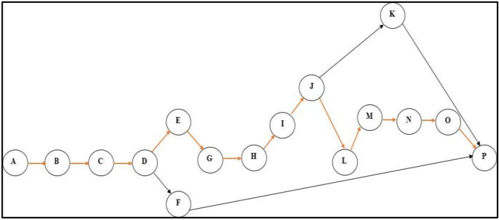
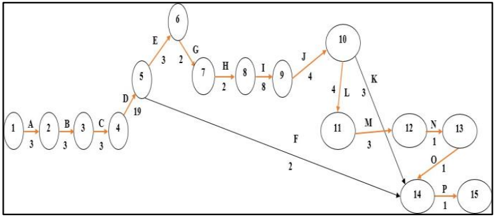
- The network for one housing unit has 3 paths; the paper also says the work network has 16 lines.
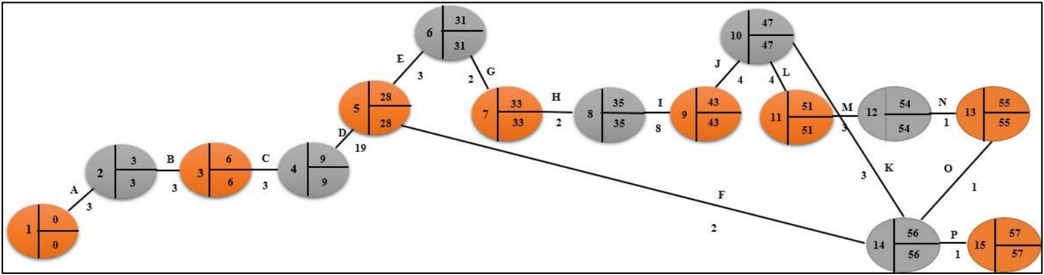
- Using CPM, the critical path duration is reported as 57 days for one housing unit.
- Using PERT, the critical path duration is reported as 65.83 days and also summarized as 66 days of maximum work per housing unit.
- The paper identifies the critical-path activities as A, B, C, D, E, G, H, I, J, L, M, N, O, P; it states that F and K are not on the critical path because they have slack.
## Methods
- Design: Quantitative study applying CPM and PERT to project scheduling for the Nava House Bekasi cluster housing development project.
- Data/sample: A housing project in Tambun, Bekasi; the project is described as a cluster type housing development with 33 housing units on about 1 hectare of land, and the analysis focuses on one type 36 housing unit.
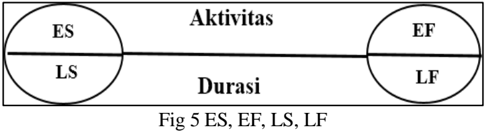
- Analysis: The paper lists work activities, estimates activity times, builds AON/AOA network diagrams, computes ES, EF, LS, LF, slack, and uses POM QM for Windows alongside manual calculations.
## Limitations
- The paper itself notes a practical constraint: construction experienced delays due to weather (rainy season) and running out of building materials; this is presented as the project problem, not as a study-design limitation.
- It is evident from the text that the study is limited to one project/site and largely to one housing unit’s schedule; this limits generalizability (evident from the text).
- The paper gives some inconsistent or messy tables and values, including differing activity counts and time figures across sections; this makes the presentation internally inconsistent (evident from the text).
Model-written summary. Check it against the paper before relying on it.
Integrity signals
Registry
Cites
Statistics
Figures



Verification
Claims the paper makes
2 Valid · 2 Not valid · 2 Not checked · 21 Own results and interpretations
A result the paper reports from its own data — it cites no other source for it, so there is none to check. The quote shows it is in the paper.
In the paper
“The critical path contained in the PERT method produces 65.83 days”
plain- Asserted: passes — The authors put it forward as true.
- Checkable: passes — It can be checked against evidence.
- Load-bearing: passes — The paper’s conclusions depend on it.
- Based: passes — The paper gives a reason why it holds.
A result the paper reports from its own data — it cites no other source for it, so there is none to check. The quote shows it is in the paper.
In the paper
“Meanwhile, houses that are still early in construction or houses that are about to begin construction are analyzed using the PERT method, obtaining critical path results of 66 days.”
plainstates a cause- Asserted: passes — The authors put it forward as true.
- Checkable: passes — It can be checked against evidence.
- Load-bearing: passes — The paper’s conclusions depend on it.
- Based: passes — The paper gives a reason why it holds.
A result the paper reports from its own data — it cites no other source for it, so there is none to check. The quote shows it is in the paper.
In the paper
“Housing units that have been completed and analyzed using the CPM method resulted in 57 days of work.”
plainstates a cause- Asserted: passes — The authors put it forward as true.
- Checkable: passes — It can be checked against evidence.
- Load-bearing: passes — The paper’s conclusions depend on it.
- Based: passes — The paper gives a reason why it holds.
A result the paper reports from its own data — it cites no other source for it, so there is none to check. The quote shows it is in the paper.
In the paper
“F | 3 | 30 | 33 | 63.83 | 60.83 | 30.83”
plain- Asserted: passes — The authors put it forward as true.
- Checkable: passes — It can be checked against evidence.
- Load-bearing: unclear — It is unclear whether the paper’s conclusions depend on it.
- Based: passes — The paper gives a reason why it holds.
A result the paper reports from its own data — it cites no other source for it, so there is none to check. The quote shows it is in the paper.
In the paper
“K | 4 | 52.83 | 56.83 | 63.83 | 59.83 | 7”
plain- Asserted: passes — The authors put it forward as true.
- Checkable: passes — It can be checked against evidence.
- Load-bearing: unclear — It is unclear whether the paper’s conclusions depend on it.
- Based: passes — The paper gives a reason why it holds.
11 more claims
Create a free account to see all 27 claims and to verify the 2 references still open.
- Probably not a substantial claim. 8
- It may state two separate claims as one. 8
- The quote only partly states this claim. 1
Citations
Cites
Fault Detection Method based on Artificial Neural Network for 330kV Nigerian Transmission Line
Musa Oruma, A., Mahmud, I., Alhaji Adamu, U., Yakubu Wakawa, S., Idris, G., & Mustapha, M. (2024) · International Journal of Innovative Science and Research Technology (IJISRT) · doi:10.38124/ijisrt/ijisrt24apr651 · Cited by 1,767
A Study to Evaluate Psychological Distress and Self-Esteem Among Patients with Hemodialysis
C, Y. K. (2024) · International Journal of Innovative Science and Research Technology (IJISRT) · doi:10.38124/ijisrt/ijisrt24mar1998 · Cited by 1,745
Enhancements in Immediate Speech Emotion Detection: Harnessing Prosodic and Spectral Characteristics
Shah, Z., Zhiyong, S., & ., A. (2024) · International Journal of Innovative Science and Research Technology (IJISRT) · doi:10.38124/ijisrt/ijisrt24apr872 · Cited by 1,663
Beyond Mobile Payments: Exploring the Evolution and Future of Fintech (BY IJISRT)
Ahmad Shah, M., Harish, K., ., S., Hansda, K., Chowdhury, D., & Yadav, S. (2024) · International Journal of Innovative Science and Research Technology (IJISRT) · doi:10.38124/ijisrt/ijisrt24apr259 · Cited by 1,633
Otete François, D., Kihuya Eddy, N., Mwinensenge James, M., Kitambala Marsi, M., Kabeya Justin, K., Ebalantshim Daniel, M., Ilunga Eddy, M., Mutombo Emery, K., Jean-Baptiste, L. S., Chiribagula Valentin, B., et al. (2024) · International Journal of Innovative Science and Research Technology (IJISRT) · doi:10.38124/ijisrt/ijisrt24may2042 · Cited by 1,552
E-Commerce Promotional Products Selection Using SWARA and TOPSIS
Raissa Maharani, N. F., Rhezza Pratama, N., & Dachyar, M. (2024) · International Journal of Innovative Science and Research Technology (IJISRT) · doi:10.38124/ijisrt/ijisrt24apr2676 · Cited by 1,547
Guedji DIOUF, M., Makhtar Mbacké LEYE, M., Coly BOP, M., Tacko DIOP, C., Aziz NDIAYE, A., & KA, O. (2024) · International Journal of Innovative Science and Research Technology (IJISRT) · doi:10.38124/ijisrt/ijisrt24mar222 · Cited by 1,546
Parvathi, A. U., & TK, S. (2024) · International Journal of Innovative Science and Research Technology (IJISRT) · doi:10.38124/ijisrt/ijisrt24jun949 · Cited by 1,546
A. Bolatito, O., O. Hannah, A., & Ipede, O. (2024) · International Journal of Innovative Science and Research Technology (IJISRT) · doi:10.38124/ijisrt/ijisrt24apr2181 · Cited by 1,545
Analysis of Work Measurement Using a Stopwatch in a Motorcycle Workshop
Rizki, M., Perdinan Sihaloho, Y., Garninda, F., Fatwa, T., & Prastyo, Y. (2024) · International Journal of Innovative Science and Research Technology (IJISRT) · doi:10.38124/ijisrt/ijisrt24may2437 · Cited by 1,545
Self-citationAlexander, Y., Eko Putra, F., & Anggun Sari, P. (2024) · International Journal of Innovative Science and Research Technology (IJISRT) · doi:10.38124/ijisrt/ijisrt24jun909 · Cited by 1,545
Rizki, M., Wiyatno, T. N., & Astuti, R. F. (2024) · International Journal of Innovative Science and Research Technology (IJISRT) · doi:10.38124/ijisrt/ijisrt24jun1035 · Cited by 1,360
Self-citationRevolutionizing Supply Chain Management: Real-time Data Processing and Concurrency
Shukla, S., & Singh, P. (2024) · International Journal of Innovative Science and Research Technology (IJISRT) · doi:10.38124/ijisrt/ijisrt24may207 · Cited by 1,322
Shintabella, R., Edi Widodo, C., & Wibowo, A. (2024) · International Journal of Innovative Science and Research Technology (IJISRT) · doi:10.38124/ijisrt/ijisrt24mar1125 · Cited by 1,320
Implications of Adnexal Invasions in Primary Extramammary Paget’s Disease: A Systematic Review
Aryal, S., & Ye Qiang, L. (2024) · International Journal of Innovative Science and Research Technology (IJISRT) · doi:10.38124/ijisrt/ijisrt24apr2251 · Cited by 929
Volume 4 - 2019, Issue 12 - December
(2019) · International Journal of Innovative Science and Research Technology · doi:10.38124/volume4issue12 · Cited by 594
B. SADUESTE, A., & MASALINTO, M. L. (2023) · International Journal of Innovative Science and Research Technology (IJISRT) · doi:10.38124/ijisrt/ijisrt23may934 · Cited by 503
Akinola, O., Akinola, A., Victor Ifeanyi, I., Oyerinde, O., Joseph Adewole, O., Sulaimon, B., & Sulaimon, B. (2024) · International Journal of Innovative Science and Research Technology (IJISRT) · doi:10.38124/ijisrt/ijisrt24mar1231 · Cited by 283
Akinola, O., Akinola, A., Oyekan, B., Oyerinde, O., Folashade Adebiyi, H., & Sulaimon, B. (2024) · International Journal of Innovative Science and Research Technology (IJISRT) · doi:10.38124/ijisrt/ijisrt24apr225 · Cited by 283
Quantification of Protein Concentration Using UV Absorbance and Coomassie Dyes
Noble, J. E. (2014) · Methods in enzymology on CD-ROM/Methods in enzymology · doi:10.1016/b978-0-12-420070-8.00002-7 · Cited by 108
Diesel Fuel Injector Nozzle Reclamation
Lingras, S. (2024) · International Journal of Innovative Science and Research Technology (IJISRT) · doi:10.38124/ijisrt/ijisrt24may1429 · Cited by 96
Mosa, K. A., Ismail, A., & Helmy, M. (2017) · SpringerBriefs in Systems Biology · doi:10.1007/978-3-319-59379-1 · Cited by 66
Implementasi Metode PERT dan CPM pada Sistem Informasi Manajemen Proyek Pembangunan Kapal
Abdurrasyid, A., Luqman, L., Haris, A., & Indrianto, I. (2019) · Khazanah Informatika Jurnal Ilmu Komputer dan Informatika · doi:10.23917/khif.v5i1.7066 · Cited by 60
Arianie, G. P., & Puspitasari, N. B. (2017) · J@ti Undip : Jurnal Teknik Industri · doi:10.14710/jati.12.3.189-196 · Cited by 45
ANALISIS PENJADWALAN PROYEK NEW PRODUCT DEVELOPMENT MENGGUNAKAN METODE PERT DAN CPM
Angelin, A., & Ariyanti, S. (2019) · Jurnal Ilmiah Teknik Industri · doi:10.24912/jitiuntar.v6i1.3025 · Cited by 39
Penerapan Metode CPM Dan PERT Pada Gedung Parkir 3 Lantai Grand Panglima Polim Kediri
Iluk, T., Ridwan, A., & Winarto, S. (2020) · Jurnal Manajemen Teknologi & Teknik Sipil · doi:10.30737/jurmateks.v3i2.1054 · Cited by 17
Penggunaan critical path method (CPM) untuk evaluasi waktu dan biaya pelaksanaan proyek
Siregar, A. C., & Iffiginia, I. (2019) · Teknika Jurnal Sains dan Teknologi · doi:10.36055/tjst.v15i2.6816 · Cited by 15
Sistem Informasi Manajemen Proyek (SIMAPRO) Berbasis Web (Studi Kasus: PT. Arya Bakti Saluyu)
Alawiyah, T., Mulyani, Y. S., Gunawan, M. A., Setiaji, R., & Nurdin, H. (2022) · Jurnal Khatulistiwa Informatika · doi:10.31294/jki.v10i2.14061 · Cited by 9
Maulidi, A., Arifin, S., & Suyoso, H. (2021) · Jurnal Ilmiah MITSU · doi:10.24929/ft.v9i1.992 · Cited by 6
Prasetya, H. (2021) · Ideguru: Jurnal Karya Ilmiah Guru · doi:10.51169/ideguru.v6i3.278 · Cited by 5
Adyatma, M. R., & Hadi, T. S. (2022) · Jurnal Kajian Ruang · doi:10.30659/jkr.v1i2.20025 · Cited by 5
Husna, R. A., Ilmiyah, N. F., & Resti, N. C. (2022) · Journal Focus Action of Research Mathematic (Factor M) · doi:10.30762/f_m.v5i1.633 · Cited by 4
Witania, A., Nugraha, A. D., Ermawati, E., Fajar Sari, L., Megawati, N. L., & Fadillah, N. N. (2022) · Journal of Management Small and Medium Enterprises (SMEs) · doi:10.35508/jom.v15i2.7527 · Cited by 2
Evaluating Gliclazide Safety and Effectiveness in the Management of Type 2 Diabetes Mellitus
Patel's, M. (2024) · International Journal of Innovative Science and Research Technology (IJISRT) · doi:10.38124/ijisrt/ijisrt24jun1710 · Cited by 1
Research works printed but not linked: 8
- [1]. A. Aziz et al. , PROJECT MANAGEMENT (Theoretical and Practical Overview) , vol. 1. 2022. [Online]. Available: www.penerbitwidina.com -
- [2]. A. Yuliana, "Analysis of the Implementation of Reconstruction Project Management on Jalan Kwandang Molingkapoto Prov. Gorontalo,' Radial J. Perad. Science, Engineering and Technology. , vol. 4, no. 1, pp. 72-78, 2016. -
- [3]. H. Prabowo and M. Anhar, "Optimizing Project Management at PT.Cipta Ekatama Nusantara Using the CPM/PERT Method in the Cendana Sawangan Regency Housing Development," Sekol. College of Economics. Indonesia. , vol. 1, no. 1, pp. 1-17, 2021, [Online]. Available: http://repository.stei.ac.id/id/ eprint/2891 -
- [5]. I. Sudipta, "Project Management Study of Resources in Construction Project Implementation (Case Study: Construction of Villa Bali Air)," J. Ilm. Tech. Civil , vol. 17, no. 1, pp. 73-83, 2013. -
- [6]. AC Siregar and I. Iffiginia, "Use of the critical path method (CPM) to evaluate project implementation time and costs," Tech. J. Science and Technology. , vol. 15, no. 2, p. 102, 2019, doi: 10.36055/tjst.v15i2. 6816. - · doi:10.36055/tjst.v15i2
- [17]. AK Tama, L. Anggraini, and B. Tutuko, "Construction Management Performance Analysis on the Semarang State University Digitized Building Project," J. Tek. Civil , pp. 1-15, 2020. -
- [18]. Christian, Cefiro, and Sentosa, "Case Study of the Application of the PERT Method in the Warehouse X Project," J. Univ. Kristen Petra , pp. 1-8, 2013, [Online]. Available: https://media.neliti.com/media/ publications/81512-ID-studi-case-penerapan-methodpert-pada-p.pdf -
- [20]. A. Ozaga and AA Arzi, "Project Management: Designing a Learning Management System (LMS) for Learning Information Systems Using the Critical Chain Method," August , vol. 02, no. 1, p. 1, 2022.
Cited by
The Development of a Smart Farming System: An Internet of Things Approach
Oyelowo, O. R., Obansola, O. Y., Olaniran, R. A., et al. (2024) · International Journal of Innovative Science and Research Technology (IJISRT) · doi:10.38124/ijisrt/ijisrt24jun1715 · Cited by 2
Metadata
- Authors
- Garninda, F., Fitra, A., Kustiwan, S., & Wiyatno, T. N.
- Affiliations
- Universitas Pelita Bangsa (ID)
- ORCID
- Wiyatno, Tri Ngudi
- Venue
- International Journal of Innovative Science and Research Technology (IJISRT)
- Published
- 2024-07-18
- Pages
- 197-208
- ISSN
- 2456-2165 (ISSN-L)
- OpenAlex
- W4400790173
- Semantic Scholar
- 78caec6026300d0efbd4ef5b749f49a7ec8e8cd0
- Cited by
- 1
- References
- 35
- Citations by year
- 2024: 1
- FWCI
- 0.30
- Type
- journal article
- Language
- en
- Open access
- diamond
- doi.org
- Licence
- cc-by-nc
- Locations
- International Journal of Innovative Science and Research Technology (IJISRT) (publishedVersion, cc-by-nc)
- Topics
- Social Sciences › Decision Sciences › Management Science and Operations Research › Resource-Constrained Project Scheduling
- Social Sciences › Decision Sciences › Management Science and Operations Research › Construction Project Management and Performance
- Social Sciences › Business, Management and Accounting › Strategy and Management › Management and Optimization Techniques
- Keywords
- critical path method, project evaluation and review technique, housing development projects, cluster housing, construction scheduling, critical path, project completion time
About these checks
Registry, retraction, Cites and statistics results are computed, not judged, with one exception: a printed reference that no index lists is read once by a model before it counts as a citation error. Claims are extracted by a model and kept only when their quote appears verbatim in the text; each cited source is then checked, with a model’s help, for whether it says what the claim relies on. Those verdicts can be wrong — read the claim’s quote and the cited source before relying on one.
The claim verdicts this report counts are experimental: their accuracy is not yet measured.
A language model drew the claims from the paper on 2026-10-10, under version 3 of the claim definition (model deepseek-v4.1-flash, prompt extract-v3).
A second model labelled each claim on 2026-10-10 (model jev-1.13-20260917, definition revision gold-guideline-v0.2).
Statistics and arithmetic are recomputed, not judged.
Confidence bands are shown only for fields calibrated on our annotated test set. None is calibrated yet, so no band is shown.
What counts as a claim ›How we measure confidence ›How we check this ›
Are you an author, or do you see a problem with this page? Request a review
Data sources
Bibliographic data: Semantic Scholar, OpenAlex, Crossref.
Contains information from the Semantic Scholar Academic Graph Datasets, made available under the ODC Attribution License (ODC-BY 1.0).
Semantic Scholar’s data is described in: Kinney, R., et al. (2023). The Semantic Scholar Open Data Platform. arXiv:2301.10140.
