

EVIDENCE FOR A DISTANT GIANT PLANET IN THE SOLAR SYSTEM
Open accessThe DOI matches its Crossref record; 54 of the 57 references it cites were found in a registry or an index; 4 of the 25 sources its claims cite were checked for support.
Abstract
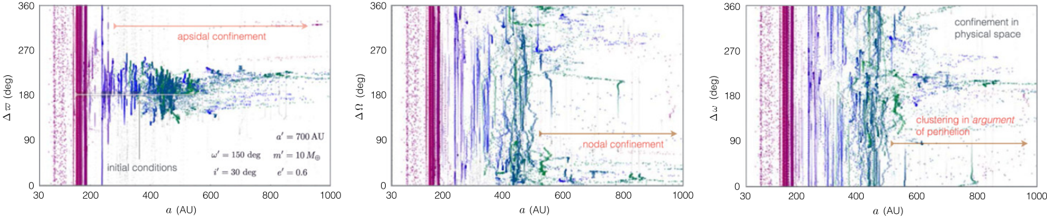
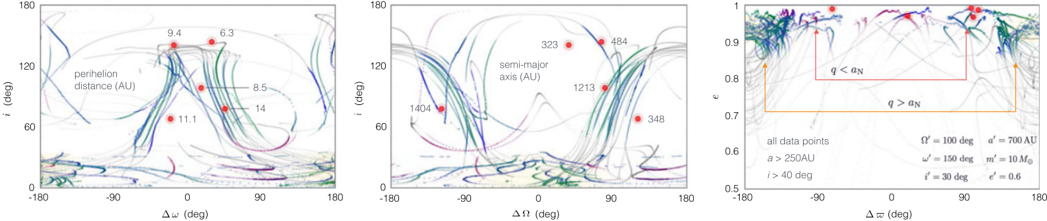
Recent analyses have shown that distant orbits within the scattered disk population of the Kuiper Belt exhibit an unexpected clustering in their respective arguments of perihelion. While several hypotheses have been put forward to explain this alignment, to date, a theoretical model that can successfully account for the observations remains elusive. In this work we show that the orbits of distant Kuiper Belt objects (KBOs) cluster not only in argument of perihelion, but also in physical space. We demonstrate that the perihelion positions and orbital planes of the objects are tightly confined and that such a clustering has only a probability of 0.007% to be due to chance, thus requiring a dynamical origin. We find that the observed orbital alignment can be maintained by a distant eccentric planet with mass ≳10 m ⊕ whose orbit lies in approximately the same plane as those of the distant KBOs, but whose perihelion is 180° away from the perihelia of the minor bodies. In addition to accounting for the observed orbital alignment, the existence of such a planet naturally explains the presence of high-perihelion Sedna-like objects, as well as the known collection of high semimajor axis objects with inclinations between 60° and 150° whose origin was previously unclear. Continued analysis of both distant and highly inclined outer solar system objects provides the opportunity for testing our hypothesis as well as further constraining the orbital elements and mass of the distant planet.
Overview
CoChat Summary
## TL;DR
The paper argues that the distant Kuiper belt’s orbital clustering is real and unlikely to be due to chance, based on a joint probability of 0.007% and a significance of about 3.8σ. It proposes that a distant eccentric planet—roughly 10 Earth masses on a wide, eccentric, likely low-inclination orbit—can explain the clustering, the detached Sedna-like objects, and some highly inclined Kuiper belt objects.
## Key findings
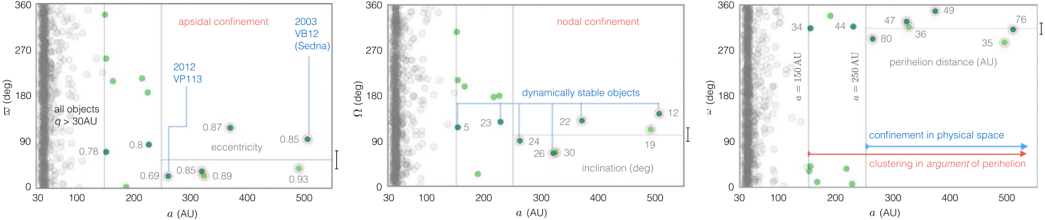
- Among 13 Kuiper belt objects with \(q > 30\) AU and \(a > 150\) AU in the initially clustered sample, 6 were deemed largely unaffected by Neptune after 4 Gyr integrations of 6 clones each; these stable objects cluster at \(\omega = 318 \pm 8^\circ\), \(\Omega = 113 \pm 13^\circ\), and \(\varpi = 71 \pm 16^\circ\).
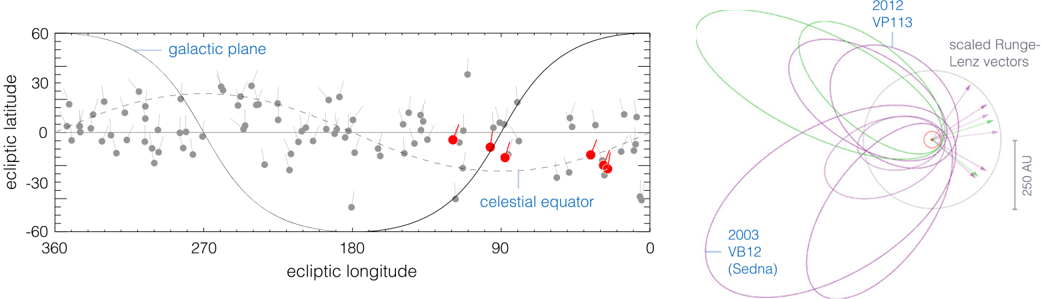
- The observed clustering in perihelion position occurs only 0.7% of the time in random draws from the comparison sample, clustering in orbital pole position occurs only 1% of the time, and the joint probability is 0.007% (about 3.8σ).
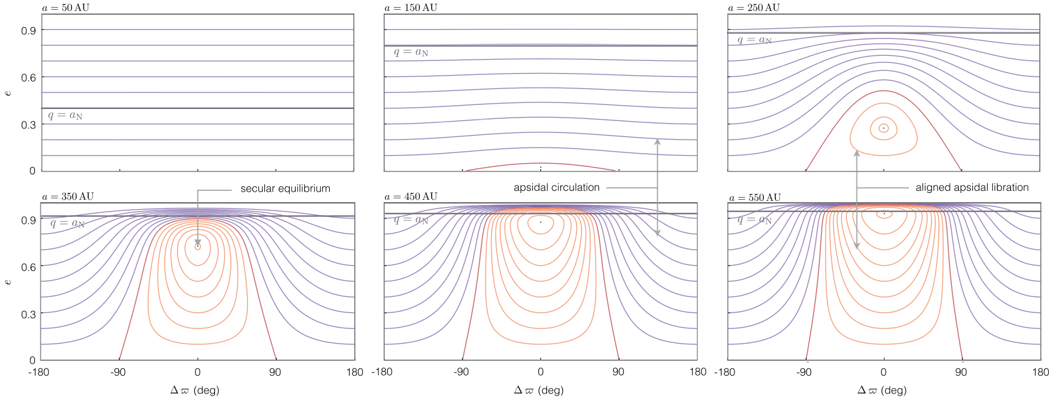
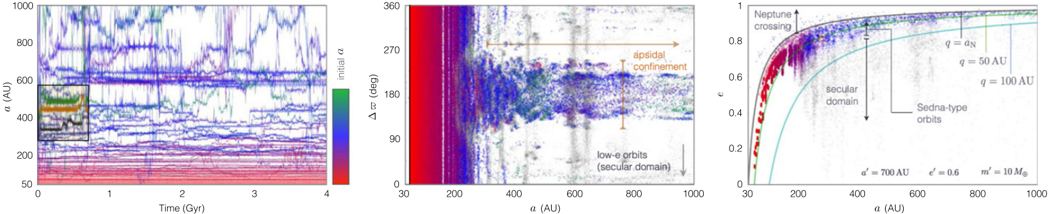
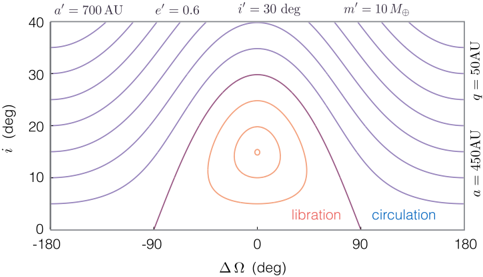
- In analytic phase-space portraits, a planet with \(m' = 10\,m_\oplus\), \(a' = 700\) AU, and \(e' = 0.6\) produces libration of \(\Delta\varpi\) for test particles with \(a \gtrsim 200\) AU and high eccentricity.
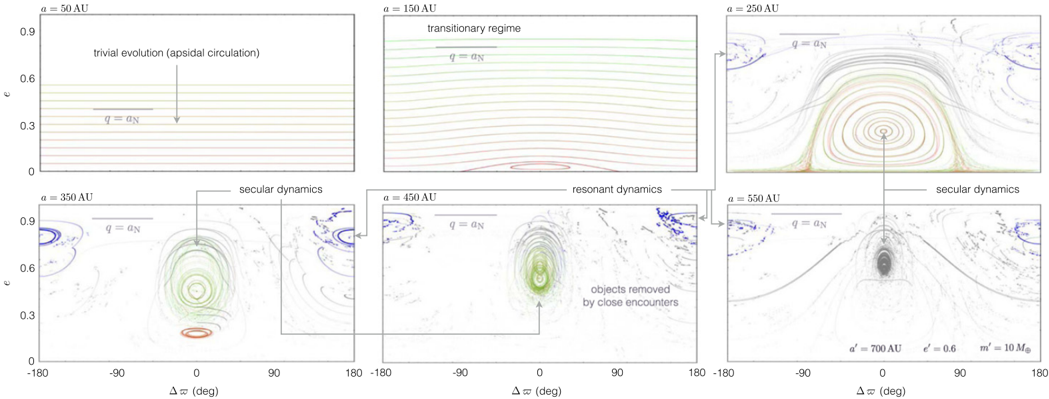
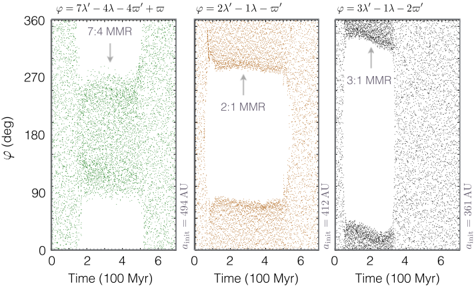
- Direct N-body simulations found that long-lived apsidally anti-aligned orbits can exist for perturber semi-major axes \(a' \sim 400\)–1500 AU and eccentricities \(e' \sim 0.5\)–0.8; the text says a perturber near \(a' \sim 700\) AU, \(e' \sim 0.6\) would likely need to be “a factor of a few” more massive than \(10\,m_\oplus\) to reproduce the effects.
## Methods
- The authors reanalyzed the distant Kuiper belt sample by examining orbital elements \(\omega\), \(\Omega\), and \(\varpi\), and by projecting perihelion locations and orbit poles into inertial space.
- They tested Neptune-affected objects by numerically evolving 6 clones of each candidate for 4 Gyr; objects with more than one clone showing large-scale semi-major axis variation were labeled dynamically unstable.
- They combined secular analytical theory with direct N-body simulations, using a hybrid symplectic-Bulirsch-Stoer implementation in mercury6, with integrations typically run for 4 Gyr.
- Synthetic scattered disks were generated with test particles spanning \(a \in (50,550)\) AU or \(a \in (150,550)\) AU, with specified distributions in perihelion distance, inclination, and angular elements, to see whether a distant perturber could sculpt the observed clustering.
## Limitations
- Stated in the paper: the authors say their analytical model makes “numerous assumptions,” including that many test-particle orbits cross the perturber or Neptune, violating secular-theory assumptions, and that the expansion may not always be small enough to justify truncation at the chosen order.
- Stated in the paper: the perturber parameters are “highly degenerate,” and the precise range of mass, semi-major axis, eccentricity, inclination, and argument of perihelion required to match the data is “at present difficult to diagnose.”
- Evident from the text: the observational sample is small, with only 6 clustered objects driving the strongest physical-space alignment result, so the inference rests on limited statistics.
Model-written summary. Check it against the paper before relying on it.
Integrity signals
Registry
Cites
Statistics
Figures
Verification
Claims the paper makes
3 Valid · 5 Not valid · 16 Not checked · 102 Own results and interpretations
At least one cited source doesn’t support this claim or points to a different paper, and none confirmed it — see the verdicts below.
In the paper
“the long-term modulation of scattered KBO eccentricities provides a natural explanation for the existence of the so-called distant detached objects such as Sedna and 2012 VP113 (Brown et al. 2004; Trujillo & Sheppard 2014).”
What the sources say
- Disputedcites Brown et al. 2004 matched to “Discovery of a Candidate Inner Oort Cloud Planetoid” (2004) sourceExperimental — accuracy not yet measured
Section 4.1 says scattering by the major planets cannot place Sedna on its 76 AU perihelion orbit; it considers an unseen planet but deems that possibility unlikely. Section 4.2 likewise says ordinary long-term external perturbations are too weak for an orbit like Sedna’s. The paper therefore does not present long-term modulation of scattered KBO eccentricities as a natural explanation for Sedna, and it does not discuss 2012 VP113. (LLM, conf=0.86)
Checked by a reasoning model — may be wrong.
- Not checked — no full text of the sourcecites Trujillo & Sheppard 2014 matched to “A Sedna-like body with a perihelion of 80 astronomical units” (2014) source
plainstates a cause- Asserted: passes — The authors put it forward as true.
- Checkable: passes — It can be checked against evidence.
- Load-bearing: passes — The paper’s conclusions depend on it.
- Based: passes — The paper gives a reason why it holds.
- Disputed
The cited sources support only part of this claim — read each source’s verdict below.
In the paper
“Such an estimate is at odds with the negligibly small mass of the present Sedna population (Schwamb et al. 2010).”
What the sources say
- Partly supportedcites Schwamb et al. 2010 matched to “PROPERTIES OF THE DISTANT KUIPER BELT: RESULTS FROM THE PALOMAR DISTANT SOLAR SYSTEM SURVEY” (2010) sourceExperimental — accuracy not yet measured
Our copy of Schwamb et al. (2010) does constrain the present Sedna population (§5.4 Population Estimate: best-fit 393 +1286/-264 and 74 +279/-47 objects brighter than or equal to Sedna for the hot and cold brightness distributions, i.e. 'hundreds to thousands of planetoids brighter than Sedna present beyond the Kuiper Belt'), so it is a legitimate source for the size of the Sedna population today. However, no passage calls that population's mass 'negligibly small' or quantifies it in absolute (planetary) mass terms; on the contrary, §5.4 states 'there may be an order of magnitude or two more mass residing in the Sedna region than exists in the present Kuiper Belt,' and the authors stress their estimates are lower bounds with large uncertainties (§5.4, §5.5 Comparison to Occultation Surveys). The 'negligibly small mass' characterisation, and its comparison against the mass required for the inclination instability, is the citing authors' own inference rather than a statement of this paper. (LLM, conf=0.70)
plain- Asserted: passes — The authors put it forward as true.
- Checkable: passes — It can be checked against evidence.
- Load-bearing: passes — The paper’s conclusions depend on it.
- Based: passes — The paper gives a reason why it holds.
- Partly supported
Every source the paper cites for this claim was checked and supports it.
In the paper
“The clustering in ω therefore appears to be real.”
What the sources say
- Supportedcites de la Fuente Marcos & de la Fuente Marcos 2014 matched to “Extreme trans-Neptunian objects and the Kozai mechanism: signalling the presence of trans-Plutonian planets” (2014) source
Section 3 (THE IMPACT OF THE DECLINATION BIAS) states outright that 'we further confirm that the clustering in ω pointed out by Trujillo & Sheppard (2014) is real, not the result of observational bias,' and the Conclusions (S7) repeat that the finding 'is not a statistical coincidence and it cannot be explained as a result of observational bias.' The hedged citing sentence ('appears to be real') is thus supported by a source making the point at least as strongly; the paper's caveat that the sample of 13 ETNOs makes conclusions 'statistically fragile' concerns other trends (e.g. the eccentricity clustering), not the ω clustering. Population in the source is extreme trans-Neptunian objects (a > 150 au, q > 30 au). (LLM, conf=0.92)
hedged- Asserted: passes — The authors put it forward as true.
- Checkable: passes — It can be checked against evidence.
- Load-bearing: passes — The paper’s conclusions depend on it.
- Based: passes — The paper gives a reason why it holds.
- Supported
The cited sources support only part of this claim — read each source’s verdict below.
In the paper
“Additionally, in order to operate on the appropriate timescale, the inclination instability requires 1 -10 Earth masses of material to exist between ∼ 100 AU and ∼ 10 , 000 AU (Madigan & McCourt 2015).”
What the sources say
- Partly supportedcites Madigan & McCourt 2015 matched to “A new inclination instability reshapes Keplerian disks into cones: application to the outer Solar System” (2015) sourceExperimental — accuracy not yet measured
The discussion (p. 5) says the proposed inclination-instability scenario implies an initial disk mass of approximately 1–10 Earth masses, but places it between approximately 50 and 10,000 AU, not 100 and 10,000 AU. The paper links the instability’s timescale to disk mass, but describes this mass as an implication of its Solar System scenario rather than a general requirement for the instability to operate. (LLM, conf=0.90)
plainstates a cause- Asserted: passes — The authors put it forward as true.
- Checkable: passes — It can be checked against evidence.
- Load-bearing: passes — The paper’s conclusions depend on it.
- Based: passes — The paper gives a reason why it holds.
- Partly supported
A result the paper reports from its own data — it cites no other source for it, so there is none to check. The quote shows it is in the paper.
In the paper
“Clearly, the results suggest that the clustering seen in the observational data can be reproduced (at least on a qualitative level) by a mildly inclined, highly eccentric distant perturber.”
boostedstates a possible cause- Asserted: passes — The authors put it forward as true.
- Checkable: passes — It can be checked against evidence.
- Load-bearing: passes — The paper’s conclusions depend on it.
- Based: passes — The paper gives a reason why it holds.
79 more claims
Create a free account to see all 126 claims and to verify the 10 references still open.
- Probably not a substantial claim. 17
- It may state two separate claims as one. 29
Claims other papers make about this one
Each is checked against this paper’s own text: does it say what the citing paper says it does?
The source backs part of the claim, not all of it — or backs it for a different population, condition or comparison.
In the citing paper
“The original analysis of Batygin & Brown (2016) was a simple proof of concept that an inclined eccentric massive planet could cause outer solar system clustering, so the choice of m 9 = 10 M earth , e 9 = 0.7, and i 9 = 30° was merely notional.”
From The Orbit of Planet Nine (2021) · cites this paper as Batygin & Brown (2016)
Experimental — accuracy not yet measuredThe source backs part of the claim, not all of it — or backs it for a different population, condition or comparison.
In the citing paper
“As shown in Batygin & Brown (2016), such a numerical setup successfully captures the relevant dynamical phenomena, at a substantially reduced computational cost.”
From Observational constraints on the orbit and location of Planet Nine in the outer solar system (2016) · cites this paper as Batygin & Brown (2016)
Experimental — accuracy not yet measuredThe source backs part of the claim, not all of it — or backs it for a different population, condition or comparison.
In the citing paper
“Moreover, these objects also share very nearly the same orbital plane, which is tilted an average of 22° to the ecliptic.”
From Observational constraints on the orbit and location of Planet Nine in the outer solar system (2016) · cites this paper as Batygin & Brown (2016)
Experimental — accuracy not yet measuredThe source backs part of the claim, not all of it — or backs it for a different population, condition or comparison.
In the citing paper
“Most importantly, Batygin & Brown (2016) point out that all well-determined orbits of KBOs beyond Neptune with semimajor axis, a, larger than 227 au approach perihelion within 94° of longitude of each other.”
From Observational constraints on the orbit and location of Planet Nine in the outer solar system (2016) · cites this paper as Batygin & Brown (2016)
Experimental — accuracy not yet measuredThe source backs part of the claim, not all of it — or backs it for a different population, condition or comparison.
In the citing paper
“The combined probability of these two occurrences happening simply due to chance is less than 0.01%.”
From Observational constraints on the orbit and location of Planet Nine in the outer solar system (2016) · cites this paper as Batygin & Brown (2016)
Experimental — accuracy not yet measured
12 more claims about this paper
Create a free account to see every claim other papers make about this one.
Citations
Cites
Goldstein, H. (1951) · UCLA - Biblioteca de Ciencias y Tecnologia Felix Morales Bueno · Cited by 10,004
Murray, C. D., & Dermott, S. F. (2000) · Cambridge University Press eBooks · doi:10.1017/cbo9781139174817 · Cited by 2,856
A hybrid symplectic integrator that permits close encounters between massive bodies
Chambers, J. E. (1999) · Monthly Notices of the Royal Astronomical Society · doi:10.1046/j.1365-8711.1999.02379.x · Cited by 1,820 · cited 1×
“9 For the entirety of the N-body simulation suite, we utilized the mercury6 gravitational dynamics software package (Chambers 1999).”
MethodDirect Imaging of Multiple Planets Orbiting the Star HR 8799
Marois, C., Macintosh, B., Barman, T., Zuckerman, B., Song, I., Patience, J., Lafrenière, D., & Doyon, R. (2008) · Science · doi:10.1126/science.1166585 · Cited by 1,773 · cited 1×
“While observational inference of extrasolar planetary systems such as HR 8799 (Marois et al. 2008) suggests that planets can indeed occupy exceptionally wide orbits, the solar nebula would have had to be exceptionally expansive to be compatible with in-situ formation of a planet on such a distant…”
BackgroundOrigin of the orbital architecture of the giant planets of the Solar System
Tsiganis, K., Gomes, R., Morbidelli, A., & Levison, H. F. (2005) · Nature · doi:10.1038/nature03539 · Cited by 1,476 · cited 2×
“…planet orbits for definitiveness, the actual process of Kuiper belt formation was likely associated with initially eccentric and inclined giant planet orbits, that subsequently regularized due to dynamical friction (Tsiganis et al. 2005; Levison et al. 2008; Batygin et al. 2011; Nesvorný 2015).”
BackgroundLEVISON, H., MORBIDELLI, A., VANLAERHOVEN, C., GOMES, R., & TSIGANIS, K. (2008) · Icarus · doi:10.1016/j.icarus.2007.11.035 · Cited by 473 · cited 2×
“…it is worth noting that although the primordial planetesimal disk of the solar system likely comprised tens of Earth masses (Tsiganis et al. 2005; Levison et al. 2008, 2011; Batygin et al. 2011), the vast majority of this material was ejected from the system by close encounters with the giant…”
BackgroundTidal dissipation by solid friction and the resulting orbital evolution
Kaula, W. M. (1964) · Reviews of Geophysics · doi:10.1029/rg002i004p00661 · Cited by 436 · cited 2×
“The long-term dynamical behavior of such an object can be described within the framework of secular perturbation theory (Kaula 1964).”
BackgroundChaotic behavior and the origin of the 31 Kirkwood gap
Wisdom, J. (1983) · Icarus · doi:10.1016/0019-1035(83)90127-6 · Cited by 426 · cited 1×
“…systems with two degrees of freedom, dynamical evolution of the individual degrees of freedom can proceed in a quasi-decoupled manner (as long as homoclinic curves are not encountered) as a consequence of separation of timescales (Wisdom 1983; Henrard & Caranicolas 1990; Batygin & Morbidelli 2013).”
BackgroundThe Dynamics of Planetary Rings
Goldreich, P., & Tremaine, S. (1982) · Annual Review of Astronomy and Astrophysics · doi:10.1146/annurev.aa.20.090182.001341 · Cited by 392 · cited 1×
“Generally speaking, coherent dynamical structures in particle disks can either be sustained by self-gravity (Tremaine 1998; Touma et al. 2009) or by gravitational shepherding facilitated by an extrinsic perturber (Goldreich & Tremaine 1982; Chiang et al. 2009).”
Background(2002) · Taylor & Francis eBooks · Cited by 342
Research works printed but not linked: 1
- Neishtadt, A. I. 1984, Prikladnaia Matematika i Mekhanika, 48, 197
Cited by
Items 301–400 of 433
Can an Earth‐mass planet exist between Jupiter and Saturn? A numerical experiment
Dvořák, R., & Cuntz, M. (2023) · Astronomische Nachrichten · doi:10.1002/asna.20220077 · Cited by 3
Steeper Scattered Disks Buckle Faster
Zderic, A., & Madigan, A.-M. (2023) · The Astrophysical Journal Letters · doi:10.3847/2041-8213/accde2 · Cited by 2
“…objects, extreme inclination orbits, and possible clustering in arguments of periapsis and longitude of periapsis (Trujillo & Sheppard 2014; Batygin & Brown 2016; Lawler et al. 2017; Shankman et al. 2017; Becker et al. 2018; Brown & Batygin 2019; Bernardinelli et al. 2020; Kavelaars et al.…”
BackgroundPrimordial Planets with an Admixture of Dark Matter Particles and Baryonic Matter
Kiren, O. V., Arun, K., Sivaram, C., & Paul, K. T. (2023) · Universe · doi:10.3390/universe9090401 · Cited by 1
Are There Terrestrial Planets Lurking in the Outer Solar System?
Siraj, A. (2023) · The Astrophysical Journal Letters · doi:10.3847/2041-8213/ad13eb · Cited by 2
“Planet Nine, a proposed ∼ 6 M ⊕ planet with a semimajor axis of ∼ 400 au, is a possibility motivated by the observed clustering of extreme trans-Neptunian objects in the outer solar system ( Batygin & Brown 2016; Brown & Batygin 2016; Batygin et al. 2019; Brown & Batygin 2021 ) .”
BackgroundPermanent capture into the solar system
Belbruno, E. A., & Green, J. (2024) · Celestial Mechanics and Dynamical Astronomy · doi:10.1007/s10569-024-10223-1 · Cited by 3
“Currently,anobservationcampaign isunderwaytofindthefifthgiantplanet,whichisreferredtoasPlanet9(BatyginandBrown 2016),assumingtheejectedplanetisstillboundtoourSun.”
Emel’yanenko, V. V. (2025) · Celestial Mechanics and Dynamical Astronomy · doi:10.1007/s10569-025-10238-2 · Cited by 2
“The most discussed is an assumption about the existence of a distant planet producing the observed orbital distribution of distant trans-Neptunian objects (e.g., Trujillo and Sheppard 2014; Batygin and Brown 2016; Batygin and Morbidelli 2017; Brown and Batygin 2021).”
A far-infrared search for planet nine using AKARI all-sky survey
Chen, A. Y.-A., Goto, T., Yamamura, I., Nakagawa, T., Wu, C. K.-W., Phan, T., Hashimoto, T., Uno, Y., Ho, S. C.-C., & Kim, S. J. (2025) · Publications of the Astronomical Society of Australia · doi:10.1017/pasa.2025.10037 · Cited by 6
A Pan-STARRS Search for Distant Planets: Part 1
Holman, M. J., Napier, K. J., Payne, M. J., & Kurlander, J. A. (2025) · The Planetary Science Journal · doi:10.3847/psj/addd03 · Cited by 7
“A distant gas giant could generate the apparent apsidal alignment of extreme TNOs, those with large semi-major axes and perihelion distances (Trujillo & Sheppard 2014; Brown & Batygin 2016; Batygin & Brown 2016; Sheppard & Trujillo 2016).”
Orbital features of distant trans-Neptunian objects induced by giant gaseous clumps
Emel’yanenko, V. V. (2020) · Astronomy and Astrophysics · doi:10.1051/0004-6361/202038999 · Cited by 2
“Later, Batygin & Brown (2016) noted that, to a greater extent, there is a grouping of longitudes of ascending nodes Ω and longitudes of perihelion π = ω + Ω, and this effect is associated with the combined action of orbital and secular resonances (Batygin & Morbidelli 2017).”
BackgroundResultInfluentialOrbital features of distant trans-Neptunian objects induced by giant gaseous clumps
Emel’yanenko, V. V. (2020) · Springer Link (Chiba Institute of Technology) · doi:10.1051/0004-6361/202038999/pdf · Cited by 2
Wang, X.-M. (2023) · Astrophysical Journal · doi:10.3847/1538-4357/aca52e · Cited by 1
“Recently, it has been suggested that there may be a planet with a mass of∼5–10M⊕ outside Neptune, Planet Nine, which is at an orbital distance of ∼400–800 au (Batygin & Brown 2016; Brown & Batygin 2016; Batygin et al. 2019).”
BackgroundNew insights to the plantary formation process
Ip, W. (2016) · Chinese Science Bulletin (Chinese Version) · doi:10.1360/n972016-00118 · Cited by 2
Metallicity of Sun-like G-stars that have Exoplanets
Gurumath, S. R., Hiremath, K. M., & Ramasubramanian, V. (2017) · Journal of Astrophysics and Astronomy · doi:10.1007/s12036-017-9443-z · Cited by 2
Is the Recently Proposed Mars-Sized Perturber at 65–80 AU Ruled Out by the Cassini Ranging Data?
Iorio, L. (2017) · Frontiers in Astronomy and Space Sciences · doi:10.3389/fspas.2017.00028 · Cited by 3
“4 m⊕ and aX ≃ 65 − 80 AU, from the different one recently proposed by Batygin and Brown (2016) and Brown and Batygin (2016) for the so-called Planet Nine, or Telisto (Iorio, 2017), which is a hypothetical more massive and remote new planet with mX ≃ 10 m⊕, aX ≃ 700 AU, eX ≃ 0.”
BackgroundMethodInfluentialFlip mechanism of Jupiter-crossing orbits in the non-hierarchical triple system
Li, M., Lei, H., Huang, Y., & Gong, S. (2021) · Monthly Notices of the Royal Astronomical Society · doi:10.1093/mnras/stab363 · Cited by 3
Pons, J., & Gallardo, T. (2022) · Monthly Notices of the Royal Astronomical Society · doi:10.1093/mnras/stac018 · Cited by 2
СУЩЕСТВУЕТ ЛИ ДЕВЯТАЯ ПЛАНЕТА?, "Земля и Вселенная"
Эйсмонт, Н. А. (2022) · Zemlia i Vselennaia · doi:10.7868/s0044394822020025 · Cited by 2
A Fruit of a Different Kind: 2015 BP519 as an Outlier Among the Extreme Trans-neptunian Objects
Marcos, C. D. L. F., & Marcos, R. D. L. F. (2018) · Research Notes of the AAS · doi:10.3847/2515-5172/aadfec · Cited by 2
No Evidence for Orbital Clustering in the Extreme Trans-Neptunian Objects
Napier, K. J., Gerdes, D. W., Lin 林, H. W. 省., Hamilton, S. J., Bernstein, G. M., Bernardinelli, P. H., Abbott, T. M. C., Aguena, M., Annis, J., Avila, S., et al. (2021) · The Planetary Science Journal · doi:10.3847/psj/abe53e · Cited by 1
Transneptunian Space and the Post-Pluto Paradigm
Parker, A. H. (2020) · University of Arizona Press eBooks · doi:10.2458/azu_uapress_9780816540945-ch023 · Cited by 4
“…Sedna-like population, which may hint at a large unseen perturber lurking at several hundred AU from the Sun (e.g., Trujillo & Sheppard 2014, Batygin & Brown 2016, Sheppard et al. 2019), though independent datasets to not all show evidence for the orbital distribution features upon which…”
BackgroundIdentification of a White Dwarf Companion in the V* HP Dra System
Jałowiczor, P. A., Casewell, S. L., Schneider, A. C., et al. (2021) · Research Notes of the AAS · doi:10.3847/2515-5172/ac151f · Cited by 1
Features of the Dynamical Evolution of a Massive Disk of Trans-Neptunian Objects
Emel’yanenko, V. V. (2021) · Solar System Research · doi:10.1134/s0038094621040055 · Cited by 1
“In the case of the existence of the ninth planet in the orbit obtained in (Batygin and Brown, 2016; Batygin et al., 2019), there are dynamical features that are difficult to match with the orbital distribution both TNOs (Shankman et al.”
BackgroundMethodInfluentialEmel’yanenko, V. V. (2024) · Solar System Research · doi:10.1134/s0038094624700278 · Cited by 1
“That is, it provided new and rather unexpected information about the structure of the outer part of the Solar System, which became the basis for putting forward a hypothesis about the existence of a distant ninth planet (Trujillo and Sheppard, 2014; Batygin and Brown, 2016).”
May, T. F., Decker, C. M., Profeta, J. J., Biju, R., & Bayandor, J. (2025) · AIAA SciTech Forum · doi:10.2514/6.2025-1402 · Cited by 1
Evaluating an embryo origin for detached TNOs within full Kuiper belt formation models
Kaib, N. A., Trujillo, C. A., & Sheppard, S. S. (2025) · Icarus · doi:10.1016/j.icarus.2025.116733 · Cited by 2
Discovery of a Dwarf Planet Candidate in an Extremely Wide Orbit: 2017 OF201
Cheng, S., Li, J., & Yang, E. (2026) · The Astrophysical Journal Letters · doi:10.3847/2041-8213/ae3a75 · Cited by 14
“Only the outer two giant planets (Uranus, Neptune) are included explicitly, while the combined influence of the inner giants (Jupiter, Saturn) is modeled as a static solar oblateness ( J 2 ), following Batygin & Brown (2016) and Gerdes et al. (2017) 13 .”
Hu, Q., Huang, Y., Gladman, B., & Zhu, W. (2025) · The Astrophysical Journal · doi:10.3847/1538-4357/ae0a30 · Cited by 3
“Numerous simulations have investigated the dynamical evolution of TNOs under the perturbation of an existing distant planet and found that eTNOs, including sednoids, can be efficiently generated (Lykawka & Mukai 2008; Batygin & Brown 2016; Lykawka & Ito 2023).”
InfluentialSpectroscopic Characterization of WD J000801.25-350450 and Its Two Comoving Companions
Jałowiczor, P. A., Bickle, T. P., Kirkpatrick, J. D., et al. (2026) · The Astronomical Journal · doi:10.3847/1538-3881/ae38d3 · Cited by 1
Cometary Dynamics—Formation and Evolution of the Oort Cloud
Rickman, H. (2026) · Astronomy · doi:10.3390/astronomy5020008 · Cited by 1
Relativistic time transfer for a Mars lander: from proper time to Areocentric Coordinate Time
Xu, D.-W., Yu, Q., & Xie, Y. (2016) · Research in Astronomy and Astrophysics · doi:10.1088/1674-4527/16/10/155 · Cited by 3
“In this table, we also include the contribution of a putative trans-Plutonian super-Earth body, also called “Planet Nine,” whose existence is currently a lively debate (Batygin & Brown 2016; Brown & Batygin 2016; Mustill et al. 2016; Iorio 2012, 2014).”
BackgroundOn the relationship between long-period comets and large trans-Neptunian planetary bodies
Guliyev, R., & Guliyev, A. S. (2016) · Proceedings of the International Astronomical Union · doi:10.1017/s1743921316012692 · Cited by 1
Effect of the darkforce on the extra-anomalous apsidal precession of solar planets
Nyambuya, G. G. (2018) · Astrophysics and Space Science · doi:10.1007/s10509-018-3437-4 · Cited by 1
Brown, M. E. (2019) · Physics Today · doi:10.1063/pt.3.4172 · Cited by 1
Self-citationFormer 9th and possible future 9th planet in the Solar system
Vidmachenko, A. P. (2016) · Astronomical School’s Report · doi:10.18372/2411-6602.12.2086 · Cited by 1
de Kleer, K., & de Pater, I. (2017) · Springer eBooks · doi:10.1007/978-3-319-30648-3_42-1 · Cited by 1
Wang, Y., Sun, W., Zhou, J., et al. (2023) · The Astronomical Journal · doi:10.3847/1538-3881/ace039 · Cited by 1
“However, Batygin & Brown (2016) show that a possible distant giant planet with more than 10 Earth masses in the solar system can explain the clustering phenomenon of distant Kuiper Belt objects in the argument of perihelion and physical space.”
BackgroundHoller, B. J., Runyon, K. D., Ahrens, C., Annex, A. M., Bannister, M. T., Beddingfield, C. B., Benecchi, S., Brandt, P. C., Britt, D. T., Cahill, J. T. S., et al. (2023) · doi:10.3847/25c2cfeb.20f2e216 · Cited by 1
Porter, M. W., Gerdes, D. W., Napier, K. J., Lin, H. W., & Adams, F. C. (2024) · The Planetary Science Journal · doi:10.3847/psj/ad2201 · Cited by 3
“In recent years, anomalous orbital clustering observed in distant TNO populations, first noted by Trujillo & Sheppard (2014), has been claimed as evidence of an undiscovered 5-10 M ⊕ planet orbiting the Sun at hundreds of AU (Batygin & Brown 2016; Batygin et al. 2019).”
BackgroundMeisner, A., Caselden, D., Humphreys, A., et al. (2024) · Citizen Science Theory and Practice · doi:10.5334/cstp.737 · Cited by 1
Physical basis of space environment and extraterrestrial life
Farooq, H. M. U., Xuechao, L., Zhao, X., Chen, Z. P., & Qian, A. (2025) · Elsevier eBooks · doi:10.1016/b978-0-443-36338-2.00008-0 · Cited by 1
The Non-Uniform and Dynamic Orbits of Trans-Neptunian Objects
Brown, R. B., & Dahlke, S. R. (2018) · International Journal of Astrophysics and Space Science · doi:10.11648/j.ijass.20180601.14 · Cited by 1
“Brown studied the six most stable TNO orbits in this range and showed they all have longitudes of ascending node between 100° and 126° [8].”
BackgroundInfluentialMigration of Giant Gaseous Clumps and Structure of the Outer Solar System
Emel’yanenko, V. V. (2020) · Solar System Research · doi:10.1134/s0038094620010013 · Cited by 2
“As already noted in (Batygin and Brown, 2016; Batygin et al., 2019), there are two groups of objects.”
BackgroundResultInfluentialAn attempt to constrain Planet Nine’s orbit and position via resonant confinement of distant TNOs
Downey, B. G., & Morbidelli, A. (2020) · Monthly Notices of the Royal Astronomical Society · doi:10.1093/mnras/staa790 · Cited by 2
“On the other hand, a value of ep9 < 0.18 is difficult to explain in the framework of the main scenarios proposed to explain the existence of Planet Nine: either the capture from another planetary system during a stellar flyby (Jı́lková et al. 2015, 2016; Mustill, Raymond & Davies MNRAS 494, 2045–2052 (2020) D ow nloa…”
BackgroundInfluentialSpecifics of the Distribution of Orbits of Long-Period Comets in the Inner Part of the Oort Cloud
Kalinicheva, O. V., & Chernetenko, Y. A. (2020) · Astrophysical Bulletin · doi:10.1134/s1990341320040082 · Cited by 1
“The results are close to the estimates obtained by Batygin and Brown (2016) and Batygin et al. (2019), but with a somewhat greater eccentricity.”
BackgroundResultInfluentialLi, M., Huang, Y., & Gong, S. (2021) · Research in Astronomy and Astrophysics · doi:10.1088/1674-4527/21/2/25 · Cited by 1
“…existence of this hypothetical distant massive planet may explain some interesting observations around the outer Solar System, such as the existence of the most distant Kuiper belt objects (KBOs) and their orbital alignment phenomena (Batygin & Morbidelli 2017; Batygin & Brown 2016a; Beust 2016).”
BackgroundTatischeff, B. (2019) · Physics & Astronomy International Journal · doi:10.15406/paij.2019.03.00193 · Cited by 1
“The existence of two new solar planets was proposed in order to explain the strange behaviour of some bodies belonging to the Kuiper’s belt [6].”
BackgroundFuture Exoplanet Research: Science Questions and How to Address Them
Schneider, J. L. (2017) · Springer eBooks · doi:10.1007/978-3-319-30648-3_163-1 · Cited by 2
The Possibility of Mirror Planet as Planet Nine in the Solar System
Wang, P., Tang, Y., Zu, L., Chen, Y., & Feng, L. (2022) · Universe · doi:10.3390/universe8100523 · Cited by 1
“While a new ninth planet in our Solar System could account for this dynamical phenomenon [3,4].”
Stellar Occultation Simulator: application to Planet 9
Ferrante, W. G., & Braga-Ribas, F. (2023) · The European Physical Journal Special Topics · doi:10.1140/epjs/s11734-023-01031-z · Cited by 2
“1 Clustering of TNO orbits used to predict Planet 9 [1] be possible to prepare the best observation possible.”
Evolution of Primordial Dark Matter Planets in the Early UniversePreprint
Arun, K., Kiren, O. V., & Sivaram, C. (2020) · Preprints.org · doi:10.20944/preprints202008.0188.v1 · Cited by 1
Wang, S., Zhao, Z., & Zhu, Q.-H. (2023) · arXiv (Cornell University) · doi:10.48550/arxiv.2307.03095 · Cited by 1
Has Kronos Devoured Planet Nine and Its Epigones?
Iorio, L. (2026) · Universe · doi:10.3390/universe12020042
“The simplest candidate for such a dark energy is a positive cosmological constant Λ, but such an identification raises some difficult questions, such as why Λ is so small (in particle physics) [15–17].”
Muñoz-Gutiérrez, M. A., Peimbert, A., Lehner, M. J., & Wang, S. (2021) · The Astronomical Journal · doi:10.3847/1538-3881/ac1102 · Cited by 6
On the hunt for a mystery planet
Witze, A. (2016) · Nature · doi:10.1038/531290a
Comments on the Discovery of a Ninth Planet
Wickramasinghe, N. C. (2015) · Journal of Astrobiology & Outreach · doi:10.4172/2332-2519.1000e114
Hinkel, A. (2016) · UKnowledge (University of Kentucky)
Clinical Biomarkers and the Discovery of Unexpected Prognostic Information ∗
Horne, B. D. (2017) · Journal of the American College of Cardiology · doi:10.1016/j.jacc.2016.11.077
X Makes Nine: A Distant Ice Giant in the Solar System
van den Berg, H. A. (2016) · Science Progress · doi:10.3184/003685016x14593318781056
Hegel, Bode’s Law and the Missing Planet
Cunningham, C. J. (2017) · Springer eBooks · doi:10.1007/978-3-319-32875-1_1
Solar System survey casts doubt on mysterious 'Planet Nine'
Popkin, G. (2017) · Nature · doi:10.1038/nature.2017.22177
Yang, W.-Z., Xu, D.-W., Yu, Q., Liu, J., & Xie, Y. (2017) · Research in Astronomy and Astrophysics · doi:10.1088/1674-4527/17/8/88 · Cited by 1
“Like the work of Xu et al. (2016), we also estimate the contribution of the hypothetical Planet Nine or Telisto (Batygin & Brown 2016; Brown & Batygin 2016; Mustill et al. 2016; Iorio 2012, 2014, 2017) on P1 to be about 10 ns, which can be neglected.”
BackgroundWeak-lensing magnification as a probe for the dark Universe
Garcia-Fernandez, M., & High Energy Physics (HEP) USDOE Office of Science (SC) (2017) · OSTI OAI (U.S. Department of Energy Office of Scientific and Technical Information) · doi:10.2172/1374700
de Kleer, K., & de Pater, I. (2018) · Springer eBooks · doi:10.1007/978-3-319-55333-7_42
Auf der Suche nach Signaturen des Lebens
Janjic, A. (2017) · Springer eBooks · doi:10.1007/978-3-662-54787-8_1
Guliyev, A. S., & Guliyev, R. (2018) · arXiv (Cornell University) · doi:10.48550/arxiv.1801.04451
Diversity of the Extrasolar Worlds
Masuda, K. (2018) · Springer theses · doi:10.1007/978-981-10-8453-9_1
Ursulov, A. V., & Chuvasheva, T. V. (2017) · Astronomicheskii Zhurnal · doi:10.7868/s0004629917050097
Evolução do Sistema Solar Primordial em Etermos de Grande História e Evolução Universal
Grinin, L. E. (2018) · Journal of Big History · doi:10.22339/jbh.v2i2.2305
Finding the location of Planet Nine
Downey, B. G. (2016) · DSpace@MIT (Massachusetts Institute of Technology)
How people detect incomplete explanations
Korman, J., & Khemlani, S. (2017) · eScholarship (California Digital Library) · Cited by 1
Vision of Perfect Observation Capabilities
Vereš, P. (2018) · Space and society · doi:10.1007/978-3-030-01000-3_6
Super-Earth at a distance of less than 1,000 AU in Solar system is absent
Vidmachenko, A. P. (2017) · Astronomical School’s Report · doi:10.18372/2411-6602.13.10
"It's full of asteroids!": Solar system science with a large field of view
Holler, B. J., Milam, S. N., Bauer, J. M., Kruk, J. W., Alcock, C. R., Bannister, M. T., Bjoraker, G. L., Bodewits, D., Bosh, A. S., Buie, M. W., et al. (2019) · Research Portal (Queen's University Belfast) · Cited by 1
Janjic, A. (2019) · Springer eBooks · doi:10.1007/978-3-662-59492-6_1
THE ROLE OF PRIORS IN A PROBABILISTIC ACCOUNT OF “BEST EXPLANATION”
Donchev, A. (2017) · Organon F. medzinárodný časopis pre analytickú filozofiu
Moltenbrey, M. (2019) · Springer eBooks · doi:10.1007/978-3-662-59360-8_11
The Planet "X " Theoretical Calculation of The mean Orbital Velocity & Orbital Period
Sayed, M. (2020) · International Journal of Advanced Engineering and Business Science · doi:10.21608/ijaebs.2020.86661
The Outer Solar System Perihelion Gap
Oldroyd, W. J., & Trujillo, C. A. (2019) · epsc
Hacia una nueva revolución copernicana
Alonso, J. (2020) · Desacatos · doi:10.29340/63.2263
No sign of Planet Nine? Trail runs cold for hypothetical world
O’Callaghan, J. (2021) · Nature · doi:10.1038/d41586-021-00456-7
Neptune Visited and the Outer Solar System Revolutionised, 1989–2019
Sheehan, W. P. (2021) · Historical & cultural astronomy · doi:10.1007/978-3-030-54218-4_10
Solar System Planets and Exoplanets
Bevelacqua, J. J. (2021) · IntechOpen eBooks · doi:10.5772/intechopen.98431
Adams, J. C., & Engel, J. (2021) · Springer eBooks · doi:10.1007/978-3-030-59075-8_10
Baransky, A., Lukina, O., Borysenko, S. A., et al. (2020) · Advances in Astronomy and Space Physics · doi:10.17721/2227-1481.10.48-54
Guliyev, A. S., Nabiyev, S., & Guliyev, R. (2021) · Earth Moon and Planets · doi:10.1007/s11038-021-09541-3
The Arcanum Mission: Scientific Objectives and Instruments for Neptune, Triton and KBOsPreprint
McKevitt, J., Bornberg, C., Dixon, T., et al. (2021) · arXiv (Cornell University) · doi:10.48550/arxiv.2110.10808
“Previous work has constrained the location of Planet Nine, ad-mittedly within a wide envelope, to the following [20,21] Researchers have identified an exoplanet HD 106906b, roughly 11 times the mass of Jupiter, situated some 336 light-years from Earth, in a 15,000 year-long highly eccentric orbit…”
General Presentation of the Solar System
Encrenaz, T. A., Roques, F., & Lamy, L. (2021) · Wiley eBooks · doi:10.1002/9781119881667.ch1
Water and Volatiles in the Outer Solar System
Grasset, O., Castillo-Rogez, J. C., Guillot, T., Fletcher, L. N., & Tosi, F. (2017) · Space sciences series of ISSI · doi:10.1007/978-94-024-1628-2_6 · Cited by 1
Marcos, C. D. L. F., Marcos, R. D. L. F., Văduvescu, O., & Stǎnescu, M. (2022) · Monthly Notices of the Royal Astronomical Society Letters · doi:10.1093/mnrasl/slac036 · Cited by 2
The Diverse Population of Small Bodies of the Solar System
de León, J., Licandro, J., & Pinilla-Alonso, N. (2017) · Springer eBooks · doi:10.1007/978-3-319-30648-3_55-1
Vita‐Finzi, C. (2016) · Springer eBooks · doi:10.1007/978-3-319-33850-7_6
Schwadron, N. A., Cooper, J. F., Desai, M. I., Downs, C., Gorby, M., Jordan, A. P., Joyce, C. J., Kozarev, K. A., Linker, J. A., Mikić, Z., et al. (2017) · Space sciences series of ISSI · doi:10.1007/978-94-024-1588-9_8
Vita‐Finzi, C. (2016) · Springer eBooks · doi:10.1007/978-3-319-33850-7_1
The Chemistry of Extrasolar Planets
Harman, C. E. (2020) · Elsevier eBooks · doi:10.1016/b978-0-08-102908-4.00151-x
Future Exoplanet Research: Science Questions and How to Address Them
Schneider, J. L. (2018) · Springer eBooks · doi:10.1007/978-3-319-30648-3_163-2 · Cited by 1
How to Remedy Direct Observation
Ebach, M. C. (2022) · Springer eBooks · doi:10.1007/978-981-19-6741-2_5
Popoviciu, D. R. (2023) · BENTHAM SCIENCE PUBLISHERS eBooks · doi:10.2174/9789815080711123010009
(2023) · Vandenhoeck & Ruprecht eBooks · doi:10.13109/9783666568732.299
A New Dark Matter and Dark Energy Theory Based on the Assumption of Mass VectorizationPreprint
Zhou, F. (2024) · SSRN Electronic Journal · doi:10.2139/ssrn.4692093
Metadata
- Authors
- Batygin, K., & Brown, M. E.
- Affiliations
- California Institute of Technology (US)
- Venue
- The Astronomical Journal
- Publisher
- American Astronomical Society
- Published
- 2016-01-20
- Volume
- 151
- Issue
- 2
- Pages
- 22
- ISSN
- 0004-6256 (ISSN-L)
- 1538-3881
- OpenAlex
- W2287698241
- Cited by
- 432
- References
- 57
- Citations by year
- 2026: 11 · 2025: 33 · 2024: 26 · 2023: 35 · 2022: 24 · 2021: 39 · 2020: 53 · 2019: 37 · 2018: 44 · 2017: 67 · 2016: 62
- FWCI
- 33.43
- Type
- journal article
- Language
- en
- Open access
- bronze
- doi.org
- Licence
- iopscience.iop.org/page/copyright (vor)
- iopscience.iop.org/info/page/text-and-data-mining (tdm)
- Locations
- The Astronomical Journal (publishedVersion)
- arXiv (Cornell University) (submittedVersion)
- CaltechAUTHORS (California Institute of Technology) (submittedVersion)
- arXiv (Cornell University)
- Topics
- Physical Sciences › Earth and Planetary Sciences › Space and Planetary Science › Astro and Planetary Science
- Physical Sciences › Physics and Astronomy › Astronomy and Astrophysics › Stellar, planetary, and galactic studies
- Physical Sciences › Engineering › Aerospace Engineering › Space Satellite Systems and Control
- Keywords
- scattered disk, Kuiper belt objects, orbital clustering, argument of perihelion, planetary perturbations, orbital dynamics
About these checks
Registry, retraction, Cites and statistics results are computed, not judged, with one exception: a printed reference that no index lists is read once by a model before it counts as a citation error. Claims are extracted by a model and kept only when their quote appears verbatim in the text; each cited source is then checked, with a model’s help, for whether it says what the claim relies on. Those verdicts can be wrong — read the claim’s quote and the cited source before relying on one.
The claim verdicts this report counts are experimental: their accuracy is not yet measured.
A language model drew the claims from the paper on 2026-10-10, under version 3 of the claim definition (model deepseek-v4.1-flash, prompt extract-v3).
A second model labelled each claim on 2026-10-10 (model jev-1.13-20260917, definition revision gold-guideline-v0.2).
Cited sources are checked with a language model’s help (gpt-6-sol and qwen3.8-omni-flash).
Statistics and arithmetic are recomputed, not judged.
Confidence bands are shown only for fields calibrated on our annotated test set. None is calibrated yet, so no band is shown.
What counts as a claim ›How we measure confidence ›How we check this ›
Are you an author, or do you see a problem with this page? Request a review
Data sources
Bibliographic data: Semantic Scholar, OpenAlex, Crossref.
Contains information from the Semantic Scholar Academic Graph Datasets, made available under the ODC Attribution License (ODC-BY 1.0).
Semantic Scholar’s data is described in: Kinney, R., et al. (2023). The Semantic Scholar Open Data Platform. arXiv:2301.10140.
