

EVIDENCE FOR A DISTANT GIANT PLANET IN THE SOLAR SYSTEM
Open accessThe DOI matches its Crossref record; 54 of the 57 references it cites were found in a registry or an index; 4 of the 25 sources its claims cite were checked for support.
Abstract
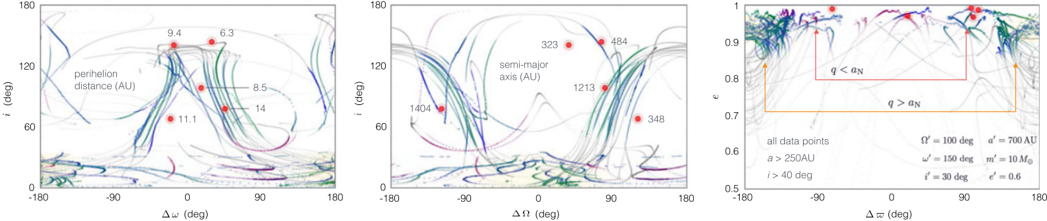
Recent analyses have shown that distant orbits within the scattered disk population of the Kuiper Belt exhibit an unexpected clustering in their respective arguments of perihelion. While several hypotheses have been put forward to explain this alignment, to date, a theoretical model that can successfully account for the observations remains elusive. In this work we show that the orbits of distant Kuiper Belt objects (KBOs) cluster not only in argument of perihelion, but also in physical space. We demonstrate that the perihelion positions and orbital planes of the objects are tightly confined and that such a clustering has only a probability of 0.007% to be due to chance, thus requiring a dynamical origin. We find that the observed orbital alignment can be maintained by a distant eccentric planet with mass ≳10 m ⊕ whose orbit lies in approximately the same plane as those of the distant KBOs, but whose perihelion is 180° away from the perihelia of the minor bodies. In addition to accounting for the observed orbital alignment, the existence of such a planet naturally explains the presence of high-perihelion Sedna-like objects, as well as the known collection of high semimajor axis objects with inclinations between 60° and 150° whose origin was previously unclear. Continued analysis of both distant and highly inclined outer solar system objects provides the opportunity for testing our hypothesis as well as further constraining the orbital elements and mass of the distant planet.
Overview
CoChat Summary
## TL;DR
The paper argues that the distant Kuiper belt’s orbital clustering is real and unlikely to be due to chance, based on a joint probability of 0.007% and a significance of about 3.8σ. It proposes that a distant eccentric planet—roughly 10 Earth masses on a wide, eccentric, likely low-inclination orbit—can explain the clustering, the detached Sedna-like objects, and some highly inclined Kuiper belt objects.
## Key findings
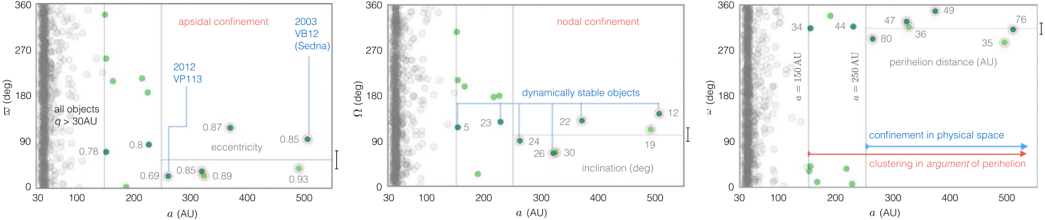
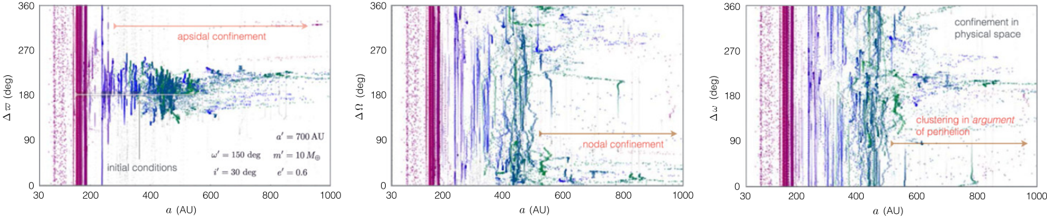
- Among 13 Kuiper belt objects with \(q > 30\) AU and \(a > 150\) AU in the initially clustered sample, 6 were deemed largely unaffected by Neptune after 4 Gyr integrations of 6 clones each; these stable objects cluster at \(\omega = 318 \pm 8^\circ\), \(\Omega = 113 \pm 13^\circ\), and \(\varpi = 71 \pm 16^\circ\).
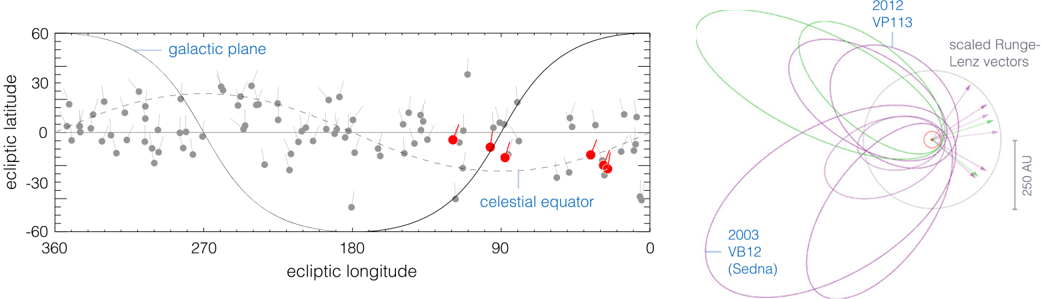
- The observed clustering in perihelion position occurs only 0.7% of the time in random draws from the comparison sample, clustering in orbital pole position occurs only 1% of the time, and the joint probability is 0.007% (about 3.8σ).
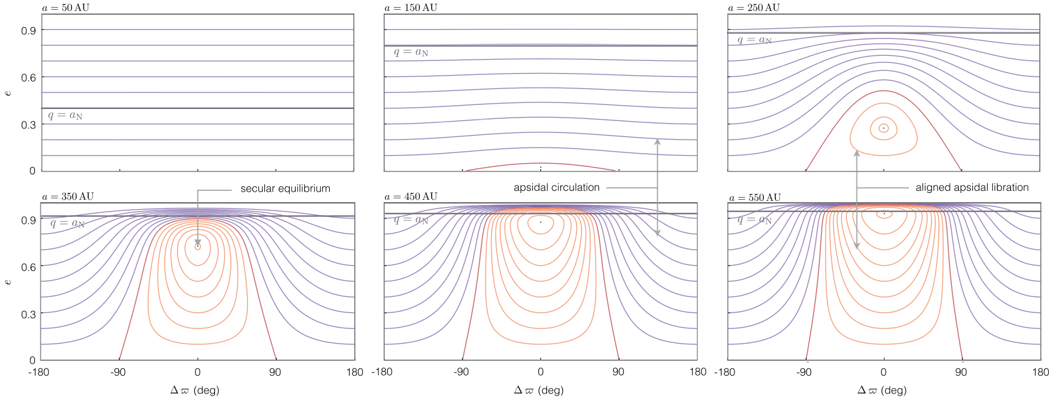
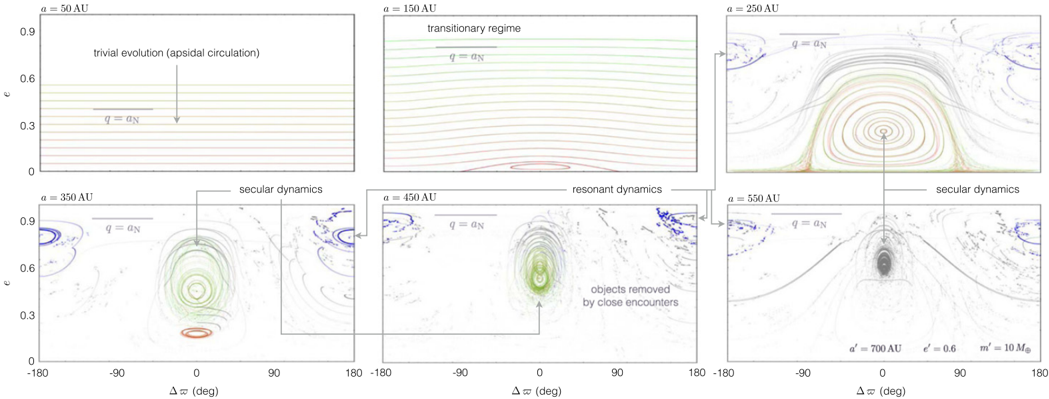
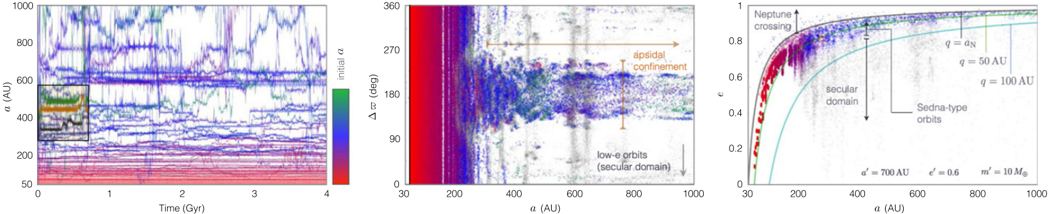
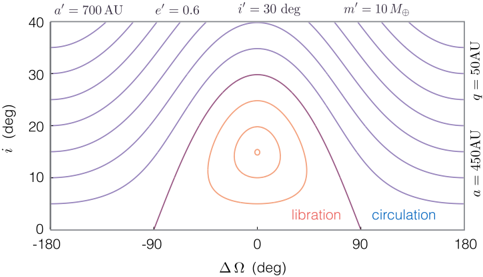
- In analytic phase-space portraits, a planet with \(m' = 10\,m_\oplus\), \(a' = 700\) AU, and \(e' = 0.6\) produces libration of \(\Delta\varpi\) for test particles with \(a \gtrsim 200\) AU and high eccentricity.
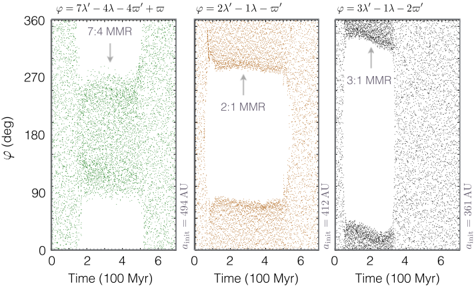
- Direct N-body simulations found that long-lived apsidally anti-aligned orbits can exist for perturber semi-major axes \(a' \sim 400\)–1500 AU and eccentricities \(e' \sim 0.5\)–0.8; the text says a perturber near \(a' \sim 700\) AU, \(e' \sim 0.6\) would likely need to be “a factor of a few” more massive than \(10\,m_\oplus\) to reproduce the effects.
## Methods
- The authors reanalyzed the distant Kuiper belt sample by examining orbital elements \(\omega\), \(\Omega\), and \(\varpi\), and by projecting perihelion locations and orbit poles into inertial space.
- They tested Neptune-affected objects by numerically evolving 6 clones of each candidate for 4 Gyr; objects with more than one clone showing large-scale semi-major axis variation were labeled dynamically unstable.
- They combined secular analytical theory with direct N-body simulations, using a hybrid symplectic-Bulirsch-Stoer implementation in mercury6, with integrations typically run for 4 Gyr.
- Synthetic scattered disks were generated with test particles spanning \(a \in (50,550)\) AU or \(a \in (150,550)\) AU, with specified distributions in perihelion distance, inclination, and angular elements, to see whether a distant perturber could sculpt the observed clustering.
## Limitations
- Stated in the paper: the authors say their analytical model makes “numerous assumptions,” including that many test-particle orbits cross the perturber or Neptune, violating secular-theory assumptions, and that the expansion may not always be small enough to justify truncation at the chosen order.
- Stated in the paper: the perturber parameters are “highly degenerate,” and the precise range of mass, semi-major axis, eccentricity, inclination, and argument of perihelion required to match the data is “at present difficult to diagnose.”
- Evident from the text: the observational sample is small, with only 6 clustered objects driving the strongest physical-space alignment result, so the inference rests on limited statistics.
Model-written summary. Check it against the paper before relying on it.
Integrity signals
Registry
Cites
Statistics
Figures
Verification
Claims the paper makes
3 Valid · 5 Not valid · 16 Not checked · 102 Own results and interpretations
At least one cited source doesn’t support this claim or points to a different paper, and none confirmed it — see the verdicts below.
In the paper
“the long-term modulation of scattered KBO eccentricities provides a natural explanation for the existence of the so-called distant detached objects such as Sedna and 2012 VP113 (Brown et al. 2004; Trujillo & Sheppard 2014).”
What the sources say
- Disputedcites Brown et al. 2004 matched to “Discovery of a Candidate Inner Oort Cloud Planetoid” (2004) sourceExperimental — accuracy not yet measured
Section 4.1 says scattering by the major planets cannot place Sedna on its 76 AU perihelion orbit; it considers an unseen planet but deems that possibility unlikely. Section 4.2 likewise says ordinary long-term external perturbations are too weak for an orbit like Sedna’s. The paper therefore does not present long-term modulation of scattered KBO eccentricities as a natural explanation for Sedna, and it does not discuss 2012 VP113. (LLM, conf=0.86)
Checked by a reasoning model — may be wrong.
- Not checked — no full text of the sourcecites Trujillo & Sheppard 2014 matched to “A Sedna-like body with a perihelion of 80 astronomical units” (2014) source
plainstates a cause- Asserted: passes — The authors put it forward as true.
- Checkable: passes — It can be checked against evidence.
- Load-bearing: passes — The paper’s conclusions depend on it.
- Based: passes — The paper gives a reason why it holds.
- Disputed
The cited sources support only part of this claim — read each source’s verdict below.
In the paper
“Such an estimate is at odds with the negligibly small mass of the present Sedna population (Schwamb et al. 2010).”
What the sources say
- Partly supportedcites Schwamb et al. 2010 matched to “PROPERTIES OF THE DISTANT KUIPER BELT: RESULTS FROM THE PALOMAR DISTANT SOLAR SYSTEM SURVEY” (2010) sourceExperimental — accuracy not yet measured
Our copy of Schwamb et al. (2010) does constrain the present Sedna population (§5.4 Population Estimate: best-fit 393 +1286/-264 and 74 +279/-47 objects brighter than or equal to Sedna for the hot and cold brightness distributions, i.e. 'hundreds to thousands of planetoids brighter than Sedna present beyond the Kuiper Belt'), so it is a legitimate source for the size of the Sedna population today. However, no passage calls that population's mass 'negligibly small' or quantifies it in absolute (planetary) mass terms; on the contrary, §5.4 states 'there may be an order of magnitude or two more mass residing in the Sedna region than exists in the present Kuiper Belt,' and the authors stress their estimates are lower bounds with large uncertainties (§5.4, §5.5 Comparison to Occultation Surveys). The 'negligibly small mass' characterisation, and its comparison against the mass required for the inclination instability, is the citing authors' own inference rather than a statement of this paper. (LLM, conf=0.70)
plain- Asserted: passes — The authors put it forward as true.
- Checkable: passes — It can be checked against evidence.
- Load-bearing: passes — The paper’s conclusions depend on it.
- Based: passes — The paper gives a reason why it holds.
- Partly supported
Every source the paper cites for this claim was checked and supports it.
In the paper
“The clustering in ω therefore appears to be real.”
What the sources say
- Supportedcites de la Fuente Marcos & de la Fuente Marcos 2014 matched to “Extreme trans-Neptunian objects and the Kozai mechanism: signalling the presence of trans-Plutonian planets” (2014) source
Section 3 (THE IMPACT OF THE DECLINATION BIAS) states outright that 'we further confirm that the clustering in ω pointed out by Trujillo & Sheppard (2014) is real, not the result of observational bias,' and the Conclusions (S7) repeat that the finding 'is not a statistical coincidence and it cannot be explained as a result of observational bias.' The hedged citing sentence ('appears to be real') is thus supported by a source making the point at least as strongly; the paper's caveat that the sample of 13 ETNOs makes conclusions 'statistically fragile' concerns other trends (e.g. the eccentricity clustering), not the ω clustering. Population in the source is extreme trans-Neptunian objects (a > 150 au, q > 30 au). (LLM, conf=0.92)
hedged- Asserted: passes — The authors put it forward as true.
- Checkable: passes — It can be checked against evidence.
- Load-bearing: passes — The paper’s conclusions depend on it.
- Based: passes — The paper gives a reason why it holds.
- Supported
The cited sources support only part of this claim — read each source’s verdict below.
In the paper
“Additionally, in order to operate on the appropriate timescale, the inclination instability requires 1 -10 Earth masses of material to exist between ∼ 100 AU and ∼ 10 , 000 AU (Madigan & McCourt 2015).”
What the sources say
- Partly supportedcites Madigan & McCourt 2015 matched to “A new inclination instability reshapes Keplerian disks into cones: application to the outer Solar System” (2015) sourceExperimental — accuracy not yet measured
The discussion (p. 5) says the proposed inclination-instability scenario implies an initial disk mass of approximately 1–10 Earth masses, but places it between approximately 50 and 10,000 AU, not 100 and 10,000 AU. The paper links the instability’s timescale to disk mass, but describes this mass as an implication of its Solar System scenario rather than a general requirement for the instability to operate. (LLM, conf=0.90)
plainstates a cause- Asserted: passes — The authors put it forward as true.
- Checkable: passes — It can be checked against evidence.
- Load-bearing: passes — The paper’s conclusions depend on it.
- Based: passes — The paper gives a reason why it holds.
- Partly supported
A result the paper reports from its own data — it cites no other source for it, so there is none to check. The quote shows it is in the paper.
In the paper
“Clearly, the results suggest that the clustering seen in the observational data can be reproduced (at least on a qualitative level) by a mildly inclined, highly eccentric distant perturber.”
boostedstates a possible cause- Asserted: passes — The authors put it forward as true.
- Checkable: passes — It can be checked against evidence.
- Load-bearing: passes — The paper’s conclusions depend on it.
- Based: passes — The paper gives a reason why it holds.
79 more claims
Create a free account to see all 126 claims and to verify the 10 references still open.
- Probably not a substantial claim. 17
- It may state two separate claims as one. 29
Claims other papers make about this one
Each is checked against this paper’s own text: does it say what the citing paper says it does?
The source backs part of the claim, not all of it — or backs it for a different population, condition or comparison.
In the citing paper
“The original analysis of Batygin & Brown (2016) was a simple proof of concept that an inclined eccentric massive planet could cause outer solar system clustering, so the choice of m 9 = 10 M earth , e 9 = 0.7, and i 9 = 30° was merely notional.”
From The Orbit of Planet Nine (2021) · cites this paper as Batygin & Brown (2016)
Experimental — accuracy not yet measuredThe source backs part of the claim, not all of it — or backs it for a different population, condition or comparison.
In the citing paper
“As shown in Batygin & Brown (2016), such a numerical setup successfully captures the relevant dynamical phenomena, at a substantially reduced computational cost.”
From Observational constraints on the orbit and location of Planet Nine in the outer solar system (2016) · cites this paper as Batygin & Brown (2016)
Experimental — accuracy not yet measuredThe source backs part of the claim, not all of it — or backs it for a different population, condition or comparison.
In the citing paper
“Moreover, these objects also share very nearly the same orbital plane, which is tilted an average of 22° to the ecliptic.”
From Observational constraints on the orbit and location of Planet Nine in the outer solar system (2016) · cites this paper as Batygin & Brown (2016)
Experimental — accuracy not yet measuredThe source backs part of the claim, not all of it — or backs it for a different population, condition or comparison.
In the citing paper
“Most importantly, Batygin & Brown (2016) point out that all well-determined orbits of KBOs beyond Neptune with semimajor axis, a, larger than 227 au approach perihelion within 94° of longitude of each other.”
From Observational constraints on the orbit and location of Planet Nine in the outer solar system (2016) · cites this paper as Batygin & Brown (2016)
Experimental — accuracy not yet measuredThe source backs part of the claim, not all of it — or backs it for a different population, condition or comparison.
In the citing paper
“The combined probability of these two occurrences happening simply due to chance is less than 0.01%.”
From Observational constraints on the orbit and location of Planet Nine in the outer solar system (2016) · cites this paper as Batygin & Brown (2016)
Experimental — accuracy not yet measured
12 more claims about this paper
Create a free account to see every claim other papers make about this one.
Citations
Cites
Goldstein, H. (1951) · UCLA - Biblioteca de Ciencias y Tecnologia Felix Morales Bueno · Cited by 10,004
Murray, C. D., & Dermott, S. F. (2000) · Cambridge University Press eBooks · doi:10.1017/cbo9781139174817 · Cited by 2,856
A hybrid symplectic integrator that permits close encounters between massive bodies
Chambers, J. E. (1999) · Monthly Notices of the Royal Astronomical Society · doi:10.1046/j.1365-8711.1999.02379.x · Cited by 1,820 · cited 1×
“9 For the entirety of the N-body simulation suite, we utilized the mercury6 gravitational dynamics software package (Chambers 1999).”
MethodDirect Imaging of Multiple Planets Orbiting the Star HR 8799
Marois, C., Macintosh, B., Barman, T., Zuckerman, B., Song, I., Patience, J., Lafrenière, D., & Doyon, R. (2008) · Science · doi:10.1126/science.1166585 · Cited by 1,773 · cited 1×
“While observational inference of extrasolar planetary systems such as HR 8799 (Marois et al. 2008) suggests that planets can indeed occupy exceptionally wide orbits, the solar nebula would have had to be exceptionally expansive to be compatible with in-situ formation of a planet on such a distant…”
BackgroundOrigin of the orbital architecture of the giant planets of the Solar System
Tsiganis, K., Gomes, R., Morbidelli, A., & Levison, H. F. (2005) · Nature · doi:10.1038/nature03539 · Cited by 1,476 · cited 2×
“…planet orbits for definitiveness, the actual process of Kuiper belt formation was likely associated with initially eccentric and inclined giant planet orbits, that subsequently regularized due to dynamical friction (Tsiganis et al. 2005; Levison et al. 2008; Batygin et al. 2011; Nesvorný 2015).”
BackgroundLEVISON, H., MORBIDELLI, A., VANLAERHOVEN, C., GOMES, R., & TSIGANIS, K. (2008) · Icarus · doi:10.1016/j.icarus.2007.11.035 · Cited by 473 · cited 2×
“…it is worth noting that although the primordial planetesimal disk of the solar system likely comprised tens of Earth masses (Tsiganis et al. 2005; Levison et al. 2008, 2011; Batygin et al. 2011), the vast majority of this material was ejected from the system by close encounters with the giant…”
BackgroundTidal dissipation by solid friction and the resulting orbital evolution
Kaula, W. M. (1964) · Reviews of Geophysics · doi:10.1029/rg002i004p00661 · Cited by 436 · cited 2×
“The long-term dynamical behavior of such an object can be described within the framework of secular perturbation theory (Kaula 1964).”
BackgroundChaotic behavior and the origin of the 31 Kirkwood gap
Wisdom, J. (1983) · Icarus · doi:10.1016/0019-1035(83)90127-6 · Cited by 426 · cited 1×
“…systems with two degrees of freedom, dynamical evolution of the individual degrees of freedom can proceed in a quasi-decoupled manner (as long as homoclinic curves are not encountered) as a consequence of separation of timescales (Wisdom 1983; Henrard & Caranicolas 1990; Batygin & Morbidelli 2013).”
BackgroundThe Dynamics of Planetary Rings
Goldreich, P., & Tremaine, S. (1982) · Annual Review of Astronomy and Astrophysics · doi:10.1146/annurev.aa.20.090182.001341 · Cited by 392 · cited 1×
“Generally speaking, coherent dynamical structures in particle disks can either be sustained by self-gravity (Tremaine 1998; Touma et al. 2009) or by gravitational shepherding facilitated by an extrinsic perturber (Goldreich & Tremaine 1982; Chiang et al. 2009).”
Background(2002) · Taylor & Francis eBooks · Cited by 342
Research works printed but not linked: 1
- Neishtadt, A. I. 1984, Prikladnaia Matematika i Mekhanika, 48, 197
Cited by
Items 101–200 of 433
Observational Constraints on Planet Nine: Astrometry of Pluto and Other Trans-Neptunian Objects
Holman, M. J., & Payne, M. J. (2016) · The Astronomical Journal · doi:10.3847/0004-6256/152/4/80 · Cited by 32
New constraints on the location of P9 obtained with the INPOP19a planetary ephemeris
Fienga, A., Di Ruscio, A., Bernus, L., Deram, P., Durante, D., Laskar, J., & Iess, L. (2020) · Astronomy & Astrophysics · doi:10.1051/0004-6361/202037919 · Cited by 32
First Data Release of the All-sky NOAO Source Catalog
Nidever, D. L., Dey, A., Olsen, K., Ridgway, S. T., Nikutta, R., Juneau, S., Fitzpatrick, M., Scott, A., & Valdes, F. (2018) · The Astronomical Journal · doi:10.3847/1538-3881/aad68f · Cited by 39
Shepherding in a Self-gravitating Disk of Trans-Neptunian Objects
Sefilian, A. A., & Touma, J. (2019) · The Astronomical Journal · doi:10.3847/1538-3881/aaf0fc · Cited by 37
“93, 0.81p p= =w W and r 0.80p =v , indicating confinement in both pw and pW as noted by Batygin & Brown (2016).”
BackgroundInfluentialMAKING PLANET NINE: A SCATTERED GIANT IN THE OUTER SOLAR SYSTEM
Bromley, B. C., & Kenyon, S. J. (2016) · The Astrophysical Journal · doi:10.3847/0004-637x/826/1/64 · Cited by 31
The rate of stellar encounters along a migrating orbit of the Sun
Martínez-Barbosa, C. A., Jílková, L., Zwart, S. P., & Brown, A. G. A. (2016) · Monthly Notices of the Royal Astronomical Society · doi:10.1093/mnras/stw2507 · Cited by 34
“The most recent prediction in this context was made by Batygin & Brown (2016) who showed that the presence of a distant planet – so-called P9 – can explain the observed orbital alignment of some KBOs and inner Oort cloud objects.”
BackgroundGregorcic, B., Planinšič, G., & Etkina, E. (2017) · Physical Review Physics Education Research · doi:10.1103/physrevphyseducres.13.020104 · Cited by 42
“Even more recently, Batygin and Brown [44] analyzed data about the orbital motion of small distant objects in our own Solar System and proposed a hypothesis that there may be another, to this date unobserved, planet 10 times more massive than Earth, orbiting beyond Pluto, a very intriguing proposal, indeed.”
BackgroundMarcos, C. D. L. F., Marcos, R. D. L. F., & Aarseth, S. J. (2018) · Monthly Notices of the Royal Astronomical Society Letters · doi:10.1093/mnrasl/sly019 · Cited by 32
“…origin or be the result of other, notyet-documented, stellar fly-bys or perhaps interactions with one or more unseen perturbers orbiting the Sun well beyond Nep- MNRAS 000, 1–5 (2018) tune (see e.g. de la Fuente Marcos & de la Fuente Marcos 2014; Trujillo & Sheppard 2014; Batygin & Brown 2016).”
BackgroundNguyen, M. M., Rosa, R. J. D., & Kalas, P. (2020) · The Astronomical Journal · doi:10.3847/1538-3881/abc012 · Cited by 37
“…if it has an eccentric orbit inclined to the disk midplane (Jílková & Zwart 2015; Nesvold et al. 2017; Rodet et al. 2017), inviting comparison to how Planet Nine may be aligning the eccentric orbits of detached Kuiper Belt objects (KBOs) like Sedna (Trujillo & Sheppard 2014; Batygin & Brown 2016).”
BackgroundGrazier, K. R., Castillo-Rogez, J. C., & Horner, J. (2018) · The Astronomical Journal · doi:10.3847/1538-3881/aae095 · Cited by 28
“It has been speculated that these objects might be the result of perturbations from an additional, as yet unseen planet (e.g., Gomes et al. 2006; Batygin & Brown 2016; Sheppard & Trujillo 2016) or produced directly from objects in the scattered disk through a process of resonance sticking and…”
BackgroundWas Planet 9 captured in the Sun’s natal star-forming region?
Parker, R. J., Lichtenberg, T., & Quanz, S. P. (2017) · Monthly Notices of the Royal Astronomical Society Letters · doi:10.1093/mnrasl/slx141 · Cited by 38
“A recent body of research (e.g. Trujillo & Sheppard 2014; Batygin & Brown 2016a,b; Brown & Batygin 2016; Holman & Payne 2016a,b) has suggested that the unusual orbital characteristics of several Edgeworth–Kuiper Belt Objects could be explained by the presence of an unseen/undiscovered ∼20M⊕ planet…”
BackgroundInfluentialOSSOS. XIV. The Plane of the Kuiper Belt
Laerhoven, C. V., Gladman, B., Volk, K., Kavelaars, J. J., Petit, J.-M., Bannister, M. T., Alexandersen, M., Chen, Y.-T., & Gwyn, S. (2019) · The Astronomical Journal · doi:10.3847/1538-3881/ab24e1 · Cited by 37
The Simons Observatory: Galactic Science Goals and Forecasts
Hensley, B. S., Clark, S. E., Fanfani, V., Krachmalnicoff, N., Fabbian, G., Poletti, D., Puglisi, G., Coppi, G., Nibauer, J., Gerasimov, R., et al. (2022) · The Astrophysical Journal · doi:10.3847/1538-4357/ac5e36 · Cited by 48
“Based on the clustering of Kuiper Belt objects, it has been proposed that a 5–10M⊕ Planet 9 may be orbiting the Sun at 400–800 au (Batygin & Brown 2016; Batygin et al. 2019).”
BackgroundWater and Volatiles in the Outer Solar System
Grasset, O., Castillo-Rogez, J. C., Guillot, T., Fletcher, L. N., & Tosi, F. (2017) · Space Science Reviews · doi:10.1007/s11214-017-0407-z · Cited by 36
“Larger objects are suspected beyond the detection capability of the current telescopes via their influence on the dynamical behavior of the Kuiper Belt and scattered disk (e.g., Batygin and Brown 2016).”
A Near-coplanar Stellar Flyby of the Planet Host Star HD 106906
Rosa, R. J. D., & Kalas, P. (2019) · The Astronomical Journal · doi:10.3847/1538-3881/ab0109 · Cited by 33
Solar obliquity induced by planet nine: Simple Calculation
Lai, D. (2016) · The Astronomical Journal · doi:10.3847/0004-6256/152/6/215 · Cited by 30
“Batygin & Brown (2016) showed that a hypothetical planet (“Planet Nine”) in the outer solar system can explain several otherwise intriguing orbital properties of distant KBOs.”
BackgroundInfluentialComparison of pulsar positions from timing and very long baseline astrometry
Wang, J., Coles, W. A., Hobbs, G. B., et al. (2017) · Monthly Notices of the Royal Astronomical Society · doi:10.1093/mnras/stx837 · Cited by 29
“The use of VLBI measurements in pulsar timing arrays would improve the sensitivity of the data sets both for gravitational wave searches and for searches for unknown solar-system bodies (such as the postulated planet X; see e.g., Batygin & Brown 2016).”
MethodDid Jupiter's core form in the innermost parts of the Sun's protoplanetary disc?
Raymond, S. N., Izidoro, A., Bitsch, B., & Jacobson, S. A. (2016) · Monthly Notices of the Royal Astronomical Society · doi:10.1093/mnras/stw431 · Cited by 30
“Scattering of leftover cores during this stage is also a natural way to explain the wide orbit of the putative “Planet 9” (Batygin & Brown 2016).”
BackgroundOn the Capture of Interstellar Objects by Our Solar System
Napier, K. J., Adams, F. C., & Batygin, K. (2021) · The Planetary Science Journal · doi:10.3847/psj/abe76e/53 · Cited by 34
“…of dwarf planets (starting with Brown et al. 2004, or perhaps Tombaugh 1946), high-inclination objects (Becker et al. 2018), and aligned extreme trans-Neptunian objects (Sheppard & Trujillo 2016) that led to the hypothesis of a possible ninth planet (Batygin & Brown 2016; Batygin et al. 2019).”
BackgroundSelf-citationNon-resonant secular dynamics of trans-Neptunian objects perturbed by a distant super-Earth
Saillenfest, M., Fouchard, M., Tommei, G., & Valsecchi, G. B. (2017) · Celestial Mechanics and Dynamical Astronomy · doi:10.1007/s10569-017-9775-7 · Cited by 29
“Very inclined and retrograde objects are actually observed in the distant Solar system9, and their formation was studied in particular by Gomes et al. (2015) and Batygin and Brown (2016b).”
BackgroundMethodInfluentialCosmologists in search of planet nine: The case for CMB experiments
Cowan, N. B., Holder, G., & Kaib, N. A. (2016) · The Astrophysical Journal Letters · doi:10.3847/2041-8205/822/1/l2 · Cited by 28
“Batygin & Brown (2016) suggest that Planet Nine is Neptune-mass and at a distance of approximately 700 AU.”
BackgroundInfluentialEvolution and magnitudes of candidate planet nine
Linder, E. F., & Mordasini, C. (2016) · Astronomy & Astrophysics · doi:10.1051/0004-6361/201628350 · Cited by 27
“2), however, and additionally, it is assumed to have an inclination of i = 30◦ (Batygin & Brown 2016).”
BackgroundMethodInfluentialOSSOS. XV. Probing the Distant Solar System with Observed Scattering TNOs
Kaib, N. A., Pike, R., Lawler, S., Kovalik, M., Brown, C., Alexandersen, M., Bannister, M. T., Gladman, B. J., & Petit, J.-M. (2019) · The Astronomical Journal · doi:10.3847/1538-3881/ab2383 · Cited by 27
“Although attempts have been made to constrain the planet’s other orbital elements (e.g. Brown & Batygin 2016), these are not definitively known, and we randomly draw our planet’s initial longitude of ascending node, argument of perihelion, and mean anomaly from uniform distributions.”
BackgroundLenz, C. T., Klahr, H. H., Birnstiel, T., Kretke, K. A., & Stammler, S. M. (2020) · Astronomy and Astrophysics · doi:10.1051/0004-6361/202037878 · Cited by 36
Mildly Hierarchical Triple Dynamics and Applications to the Outer Solar System
Bhaskar, H., Li, G., Hadden, S., Payne, M. J., & Holman, M. J. (2020) · The Astronomical Journal · doi:10.3847/1538-3881/abcbfc · Cited by 29
The Great Planetary Heist: theft and capture in star-forming regions
Daffern-Powell, E. C., Parker, R. J., & Quanz, S. P. (2022) · Monthly Notices of the Royal Astronomical Society · doi:10.1093/mnras/stac1392 · Cited by 34
Nesvorný, D., Bernardinelli, P., Vokrouhlický, D., & Batygin, K. (2023) · Icarus · doi:10.1016/j.icarus.2023.115738 · Cited by 26
Self-citationSchwadron, N. A., Cooper, J. F., Desai, M. I., Downs, C., Gorby, M., Jordan, A. P., Joyce, C. J., Kozarev, K. A., Linker, J. A., Mikić, Z., et al. (2017) · Space Science Reviews · doi:10.1007/s11214-017-0381-5 · Cited by 33
Evaluating the dynamical stability of outer solar system objects in the presence of planet nine
Becker, J. C., Adams, F. C., Khain, T., Hamilton, S. J., & Gerdes, D. (2017) · The Astronomical Journal · doi:10.3847/1538-3881/aa7aa2 · Cited by 25
“Batygin & Brown (2016b) uses the nominal Planet Nine orbit from Batygin & Brown (2016a) to explain the existence of a population of highly inclined KBOs with a ≤100: these objects can be explained as a migratory end-state of objects that started as members of the extreme TNO populations.”
BackgroundMethodInfluentialStudy and application of the resonant secular dynamics beyond Neptune
Saillenfest, M., Fouchard, M., Tommei, G., & Valsecchi, G. B. (2016) · Celestial Mechanics and Dynamical Astronomy · doi:10.1007/s10569-016-9735-7 · Cited by 30
“diate region between the Kuiper Belt and the Oort Cloud, numerous hard-to-test hypotheses are presented in the literature to investigate its distribution. That interest was renewed after the study by Batygin and Brown (2016) about the possible existence of a ninth planet beyond the Kuiper Belt. In that context, it wou…”
BackgroundMethodInfluentialRosenfield, P. A., Fay, J., Gilchrist, R. K., Cui, C., Weigel, A. D., Robitaille, T., Otor, O. J., & Goodman, A. (2018) · The Astrophysical Journal Supplement Series · doi:10.3847/1538-4365/aab776 · Cited by 38
“WWT has also been used in video abstracts, which have converted WWT tours into videos distilling a scholarly publication (see the Publisher’s website of Berri-man & Good 2017; Batygin & Brown 2016; Yusef-Zadeh et al. 2015; Currie et al. 2015).”
Iorio, L. (2019) · The Astronomical Journal · doi:10.3847/1538-3881/ab19bf · Cited by 25
“Last but not least, the location of the recently hypothesized new, remote planet of the solar system (Batygin & Brown 2016; Brown & Batygin 2016), provisionally known as Planet Nine or Telisto, can be effectively constrained by means of the orbital precessions of the other known major bodies of the…”
BackgroundDi Ruscio, A., Fienga, A., Durante, D., Iess, L., Laskar, J., & Gastineau, M. (2020) · Astronomy & Astrophysics · doi:10.1051/0004-6361/202037920 · Cited by 24
“In 2016, Batygin & Brown (2016) proposed the presence of a ninth planet (P9), beyond the orbit of Neptune, that is able to explain the observed anomalies (see Batygin et al. (2019) for a thorough overview of the P9 hypothesis).”
BackgroundThe Secular Dynamics of TNOs and Planet Nine Interactions
Li, G., Hadden, S., Payne, M. J., & Holman, M. J. (2018) · The Astronomical Journal · doi:10.3847/1538-3881/aae83b · Cited by 30
“It illustrates that there is a clear alignment of the test particles around the geometrical longitude of pericenter, Δθe∼180°, for smallpericenter objects (30 au rp 80 au), consistent with Brown & Batygin (2016) and the observational results of Trujillo & Sheppard (2014).”
BackgroundMethodResultInfluentialRelevance of tidal heating on large TNOs
Saxena, P., Renaud, J. P., Henning, W. G., Jutzi, M., & Hurford, T. A. (2017) · Icarus · doi:10.1016/j.icarus.2017.11.023 · Cited by 26
“rted back to cold, primordial surfaces over time. Additionally, many of the largest TNOs have only been discovered in the last 20 years, and it is likely that other similar bodies will be discovered (Batygin and Brown, 2016). Given the importance of collisions in shaping the outer solar system (Levison et al., 2008),…”
BackgroundImpact Rates in the Outer Solar System
Nesvorný, D., Dones, L., Prá, M. D., Womack, M. P., & Zahnle, K. J. (2023) · The Planetary Science Journal · doi:10.3847/psj/ace8ff · Cited by 35
“The galactic tide and stellar encounters were included in the simulation, while the putative Planet Nine (Trujillo & Sheppard 2014; Batygin & Brown 2016, N17) was not.”
MethodOort cloud perturbations as a source of hyperbolic Earth impactors
Peña‐Asensio, E., Visuri, J., Trigo-Rodríguez, J. M., Socas‐Navarro, H., Gritsevich, M. I., Siljama, M., & Rimola, A. (2023) · Icarus · doi:10.1016/j.icarus.2023.115844 · Cited by 27
“For example, the Scholz motion region passes through the zone of high probability for the putative planet 9 and multiple hyperbolic CNEOS fireballs fall around it (Batygin and Brown, 2016; Brown and Batygin, 2021; Socas-Navarro, 2023).”
BackgroundSEARCHING FOR PLANET NINE WITH COADDED WISE AND NEOWISE-REACTIVATION IMAGES
Meisner, A., Bromley, B. C., Nugent, P., Schlegel, D. J., Kenyon, S. J., Schlafly, E. F., & Dawson, K. (2017) · The Astronomical Journal · doi:10.3847/1538-3881/153/2/65 · Cited by 22
“Batygin & Brown (2016) elaborated on this scenario by showing that a ‘Planet Nine’ could simultaneously account for sednoids and the clustering of distant TNOs, using extensive simulations to significantly constrain the hypothetical planet’s feasible mass range (5−20M⊕) and orbital parameters (380 …”
BackgroundSaillenfest, M., Fouchard, M., Ito, T., & Higuchi, A. (2019) · Astronomy and Astrophysics · doi:10.1051/0004-6361/201936298 · Cited by 26
“…neglected in simulations of trans-Neptunian objects, even when they feature very distant orbits (Gallardo et al. 2012, Saillenfest et al. 2017b,a, Batygin & Brown 2016, Becker et al. 2017), whereas the internal perturbations are usually neglected in simulations of the Oort cloud, at least beyond…”
BackgroundThe Atacama Cosmology Telescope: A Search for Planet 9
Næss, S., Aiola, S., Battaglia, N., Bond, J. R., Calabrese, E., Choi, S. K., Cothard, N. F., Halpern, M., Hill, J. C., Koopman, B. J., et al. (2021) · The Astrophysical Journal · doi:10.3847/1538-4357/ac2307 · Cited by 27
“SPIE, Vol. 9914, Millimeter, Submillimeter, and Far-Infrared Detectors and Instrumentation for Astronomy VIII, 991418, https://act.princeton.edu/sites/act/files/highly_ uniform_150mm.pdf Holman, M. J., Payne, M. J., Blankley, P., Janssen, R., & Kuindersma, S. 2018, arXiv:1805.02638, arXiv e-prints, arXiv:1805.02638, F…”
BackgroundInfluentialIorio, L. (2017) · Astrophysics and Space Science · doi:10.1007/s10509-016-2993-8 · Cited by 21
“…which turned out to exhibit a peculiar grouping pattern either in the values of their arguments of periheliaω (Trujillo & Sheppard 2014) and in the physical 1Here and in the following, “X” is used with the meaning of “unknown”, not as the Roman numeral for ten. space itself (Batygin & Brown 2016a).”
BackgroundMethodResultInfluentialThe Large Array Survey Telescope—Science Goals
Ben-Ami, S., Ofek, E. O., Polishook, D., Franckowiak, A., Hallakoun, N., Segre, E., Shvartzvald, Y., Strotjohann, N. L., Yaron, O., Aharonson, O., et al. (2023) · Publications of the Astronomical Society of the Pacific · doi:10.1088/1538-3873/aceb30 · Cited by 33
“Another intriguing explanation, supported by the analysis of orbits of known Kuiper-belt objects, hints on the existence of a yet unknown massive planet (>∼ 10M⊕; Batygin & Brown 2016).”
ResultDynamics of the β Pictoris planetary system and its falling evaporating bodies
Beust, H., Milli, J., Morbidelli, A., Lacour, S., Lagrange, A. ‐., Chauvin, G., Bonnefoy, M., & Wang, J. (2024) · Astronomy and Astrophysics · doi:10.1051/0004-6361/202348203 · Cited by 27
Sefilian, A. A., Rafikov, R. R., & Wyatt, M. C. (2023) · The Astrophysical Journal · doi:10.3847/1538-4357/ace68e · Cited by 28
Solar Evolution Models with a Central Black Hole
Bellinger, E. P., Caplan, M. E., Ryu, T., Bollimpalli, D. A., Ball, W. H., Kühnel, F., Farmer, R., de Mink, S. E., & Christensen-Dalsgaard, J. (2023) · The Astrophysical Journal · doi:10.3847/1538-4357/ad04de · Cited by 27
“Scholtz & Unwin ( 2020 ) have argued that the hypothesized Planet 9 ( Batygin & Brown 2016 ) could be a PBH, which could be con fi rmed by annihilation signals.”
BackgroundStochastic tidal heating by random interactions with extended substructures
Peñarrubia, J. (2019) · Monthly Notices of the Royal Astronomical Society · doi:10.1093/mnras/stz338 · Cited by 30
“Interestingly, recent studies of the dynamics of Trans-Neptunian Objects with semi-major axes a & 250AU find evidence for a nonequilibrium configuration, which may be caused by perturbations from a super-Earth (M & 10M⊕) object known as “Planet Nine” (Batygin & Brown 2016; Becker et al. 2018).”
BackgroundInjection of Inner Oort Cloud Objects into the Distant Kuiper Belt by Planet Nine
Batygin, K., & Brown, M. E. (2021) · The Astrophysical Journal Letters · doi:10.3847/2041-8213/abee1f · Cited by 23
“First, the injected particles clearly follow typical P9driven dynamical evolution (see Batygin & Brown 2016; Batygin & Morbidelli 2017; Khain et al. 2018, 2020; Li et al. 2018; Hadden et al. 2018) with relative lon- 5 Although the distant Kuiper belt sourced from the t = 1 Myr model of the IOC…”
BackgroundSelf-citationFinding Planet Nine: a Monte Carlo approach
de la Fuente Marcos, C., & de la Fuente Marcos, R. (2016) · Monthly Notices of the Royal Astronomical Society: Letters · doi:10.1093/mnrasl/slw049 · Cited by 19
“Batygin & Brown (2016) have predicted the existence of a massive planet well beyond Pluto in order to explain the observed clustering in physical space of the perihelia of the extreme trans-Neptunian objects or ETNOs (90377) Sedna, 2004 VN112, 2007 TG422, 2010 GB174, 2012 VP113, and 2013 RF98.”
BackgroundMethodResultInfluentialDynamical impact of the Planet Nine scenario: N-body experiments
de la Fuente Marcos, C., de la Fuente Marcos, R., & Aarseth, S. J. (2016) · Monthly Notices of the Royal Astronomical Society: Letters · doi:10.1093/mnrasl/slw078 · Cited by 19
“…about 0◦—actually,−26◦— (de la Fuente Marcos & de la Fuente Marcos 2014; Trujillo & Sheppard 2014), their longitude of the ascending node,Ω about 134◦(Batygin & Brown 2016; Brown & Firth 2016), their eccentricities,e, about 0.8, and their inclinations,i about 20◦(de la Fuente Marcos & de la…”
BackgroundMethodInfluentialRice, M., & Laughlin, G. (2020) · The Planetary Science Journal · doi:10.3847/psj/abc42c · Cited by 34
Griveaud, P., Crida, A., Petit, A. C., Lega, E., & Morbidelli, A. (2024) · Astronomy and Astrophysics · doi:10.1051/0004-6361/202450340 · Cited by 26
Galiazzo, M., Marcos, C. D. L. F., Marcos, R. D. L. F., B, G. C. A., MARIS, M., & Montalto, M. (2016) · Astrophysics and Space Science · doi:10.1007/s10509-016-2801-5 · Cited by 21
“However, the possible existence of trans-Plutonian planets (see e.g. Trujillo & Sheppard 2014; de la Fuente Marcos & de la Fuente 2 Marcos 2014; de la Fuente Marcos et al. 2015; Baty- gin & Brown 2016) may affect the dynamical pathways leading to this dynamical class.”
BackgroundHusserl on Perception: A Nonrepresentationalism That Nearly Was
Bower, M. E. M. (2017) · European Journal of Philosophy · doi:10.1111/ejop.12261 · Cited by 18
Eccentricity dynamics of wide binaries – I. The effect of Galactic tides
Modak, S., & Hamilton, C. (2023) · Monthly Notices of the Royal Astronomical Society · doi:10.1093/mnras/stad2073 · Cited by 24
Is There an Earth-like Planet in the Distant Kuiper Belt?
Lykawka, P. S., & Itô, T. (2023) · The Astronomical Journal · doi:10.3847/1538-3881/aceaf0 · Cited by 22
Khain, T., Batygin, K., & Brown, M. E. (2018) · The Astronomical Journal · doi:10.3847/1538-3881/aac212 · Cited by 18
“To explain this persistent orbital grouping, Batygin & Brown (2016a) proposed the existence of a Neptune-like perturber—“Planet Nine”—that is apsidally anti-aligned with the aforementioned KBOs and generates their orbital confinement through a complex interplay of resonant and secular effects…”
BackgroundMethodInfluentialSelf-citationFinding Planet Nine: apsidal anti-alignment Monte Carlo results
de la Fuente Marcos, C., & de la Fuente Marcos, R. (2016) · Monthly Notices of the Royal Astronomical Society · doi:10.1093/mnras/stw1778 · Cited by 17
“As Table2, bottom section, but only for the six objects singled out in Batygin & Brown (2016): (90377) Sedna, 2004 VN112, 2007 TG422, 2010 GB174, 2012 VP113 and 2013 RF98.”
BackgroundMethodResultInfluentialLow-cost precursor of an interstellar mission
Heller, R., Anglada-Escudé, G., Hippke, M., & Kervella, P. (2020) · Astronomy and Astrophysics · doi:10.1051/0004-6361/202038687 · Cited by 17
“Its expected orbital semimajor axis is between about 380 AU and 980 AU (Batygin & Brown 2016; Brown & Batygin 2016).”
BackgroundCertification of quantum states with hidden structure of their bitstrings
Sotnikov, O. M., Iakovlev, I. A., Iliasov, A. A., Katsnelson, M. I., Bagrov, A. A., & Mazurenko, V. V. (2022) · npj Quantum Information · doi:10.1038/s41534-022-00559-7 · Cited by 26
“…of optical instruments and the ability to look into more and more distant corners of the Universe, in many cases one can conclude on the existence of a planet only in an indirect way by analyzing its tiny in fl uence on the orbits of neighboring visible planets 1 and stellar brightness 2 .”
BackgroundKozai-Lidov mechanism inside retrograde mean motion resonances
Huang, Y., Li, M., Li, J., & Gong, S. (2018) · Monthly Notices of the Royal Astronomical Society · doi:10.1093/mnras/sty2562 · Cited by 20
“Batygin & Brown (2016a) put forward this idea that a distant giant planet with 10m⊕ , which is called Planet Nine these days,may lead to the clusterings of∆ω,∆Ω, and∆$ of distant KBOs.”
BackgroundSefilian, A. A., Kratter, K. M., Wyatt, M. C., Petrovich, C., Thébault, P., Malhotra, R., & Faramaz, V. (2025) · Monthly Notices of the Royal Astronomical Society · doi:10.1093/mnras/staf1555 · Cited by 22
On the Dynamics of the Inclination Instability
Madigan, A.-M., Zderic, A., McCourt, M., & Fleisig, J. (2018) · The Astronomical Journal · doi:10.3847/1538-3881/aad95c · Cited by 19
“…A., & Touma, J. R. 2018, ArXiv e-prints, arXiv:1804.06859 Shankman, C., Kavelaars, J. J., Bannister, M. T., et al. 2017, AJ, 154, 50 Trujillo, C. A., & Sheppard, S. S. 2014, Nature, 507, 471 5 Of course this statement does not hold if a massive planet 9 (Batygin & Brown 2016) exists in this region.”
InfluentialThe “memory” of the Oort cloud
Fouchard, M., Higuchi, A., Itô, T., & Maquet, L. (2018) · Astronomy and Astrophysics · doi:10.1051/0004-6361/201833435 · Cited by 22
Perspectives on the distribution of orbits of distant Trans-Neptunian objects
Kavelaars, J. J., Lawler, S. M., Bannister, M. T., & Shankman, C. (2019) · Elsevier eBooks · doi:10.1016/b978-0-12-816490-7.00003-5 · Cited by 38
de León, J., Marcos, C. D. L. F., & Marcos, R. D. L. F. (2017) · Monthly Notices of the Royal Astronomical Society Letters · doi:10.1093/mnrasl/slx003 · Cited by 20
Clement, M. S., & Kaib, N. A. (2020) · The Astronomical Journal · doi:10.3847/1538-3881/ab9227 · Cited by 22
“Batygin & Brown (2016a) performed a detailed analysis of the applicable parameter space (along ar X iv :2 00 5.”
BackgroundMethodInfluentialChaotic dynamics of trans-Neptunian objects perturbed by planet nine
Hadden, S., Li, G., Payne, M. J., & Holman, M. J. (2018) · The Astronomical Journal · doi:10.3847/1538-3881/aab88c · Cited by 16
“Subsequently, Batygin & Brown (2016a) (BB16a) noted that the six dynamically stable, distant ESDOs that were known at the time were all apsidally and nodally aligned, having their long axes roughly aligned and sharing the same orbital plane.”
BackgroundBlackbody radiation from isolated Neptunes
Ginzburg, S., Sari, R., & Loeb, A. (2016) · The Astrophysical Journal Letters · doi:10.3847/2041-8205/822/1/l11 · Cited by 15
“The presence of an outer undetected planet in the solar system has been recently suggested, due to possible evidence of its gravitational influence on the orbits of Kuiper belt objects (de la Fuente Marcos & de la Fuente Marcos 2014; Trujillo & Sheppard 2014; Batygin & Brown 2016).”
BackgroundDynamical Analysis of Three Distant Trans-Neptunian Objects with Similar Orbits
Khain, T., Becker, J., Adams, F. C., Gerdes, D. W., Hamilton, S. J., Franson, K., Zullo, L., Sako, M., Napier, K. J., Lin, H. W., et al. (2018) · The Astronomical Journal · doi:10.3847/1538-3881/aaeb2a · Cited by 15
Modified Newtonian Dynamics as an Alternative to the Planet Nine Hypothesis
Brown, K., & Mathur, H. (2023) · The Astronomical Journal · doi:10.3847/1538-3881/acef1e · Cited by 27
Changes in orientation and shape of protoplanetary discs moving through an ambient medium
Wijnen, T. P. G., Pelupessy, F. I., Pols, O. R., & Zwart, S. P. (2017) · Astronomy and Astrophysics · doi:10.1051/0004-6361/201730793 · Cited by 18
“…& McCourt 2016), which can explain the observed strange orbits of planetesimals in the outer solar system without needing to invoke “Planet 9” (Batygin & Brown 2016; although see Jílková et al. 2015, for an alternative scenario in which these objects could have been captured during a…”
BackgroundDirectly testing gravity with Proxima Centauri
Banik, I., & Kroupa, P. (2019) · Monthly Notices of the Royal Astronomical Society · doi:10.1093/mnras/stz1379 · Cited by 21
“However, even the proposed Planet Nine would have a mass of only ≈ 10M⊕ at a heliocentric distance > 200 AU (Batygin & Brown 2016).”
BackgroundSolar System limits on gravitational dipoles
Banik, I., & Kroupa, P. (2020) · Monthly Notices of the Royal Astronomical Society · doi:10.1093/mnras/staa1447 · Cited by 17
“(25) Moreover, the M9 estimate in Batygin & Brown (2016) should already include its dipole halo since it is based on how P9 perturbs the orbits of distant Kuiper Belt Objects.”
BackgroundInfluentialA dynamical approach in exploring the unknown mass in the Solar system using pulsar timing arrays
Guo, Y. J., Lee, K., & Caballero, R. N. (2017) · Monthly Notices of the Royal Astronomical Society · doi:10.1093/mnras/stx3326 · Cited by 15
“…with PTA blind searches may be difficult, the use of more evolved dynamical models may allow in the future PTAs to contribute in imposing meaningful constraints on the parameter space of independently proposed unknown planets (e.g. Batygin & Brown 2016; Brown & Batygin 2016), as shown in Figure 10.”
Evolution and magnitudes of candidate Planet Nine
Linder, E., & Mordasini, C. (2016) · Springer Link (Chiba Institute of Technology) · doi:10.1051/0004-6361/201628350/pdf · Cited by 14
A 3π Search for Planet Nine at 3.4 μm with WISE and NEOWISE
Meisner, A. M., Bromley, B. C., Kenyon, S. J., & Anderson, T. E. (2018) · The Astronomical Journal · doi:10.3847/1538-3881/aaae70 · Cited by 16
“However, the Planet Nine narrative disfavors very high inclinations (Batygin & Brown 2016a; Batygin & Morbidelli 2017), and i > 55◦ would be required to observe Planet Nine in the high |β| sky area we have excluded.”
BackgroundInfluentialSolar system science with the Wide-Field Infrared Survey Telescope
Holler, B. J., Milam, S. N., Bauer, J. M., Alcock, C. R., Bannister, M. T., Bjoraker, G. L., Bodewits, D., Bosh, A. S., Buie, M. W., Farnham, T. L., et al. (2018) · Journal of Astronomical Telescopes Instruments and Systems · doi:10.1117/1.jatis.4.3.034003 · Cited by 25
“Inner Oort Cloud objects The most distant solar system minor bodies are time capsules that preserve information from the formation of the solar system, and their orbits possibly provide clues to the presence of an as-yet-undetected giant planet [93].”
BackgroundSedna and the cloud of comets surrounding the solar system in Milgromian dynamics
Paučo, R., & Klačka, J. (2016) · Astronomy and Astrophysics · doi:10.1051/0004-6361/201527713 · Cited by 19
Stellar Flybys Interrupting Planet–Planet Scattering Generates Oort Planets
Bailey, N., & Fabrycky, D. C. (2019) · The Astronomical Journal · doi:10.3847/1538-3881/ab2d2a · Cited by 20
Resonant dynamical friction around a supermassive black hole: analytical description
Ginat, Y. B., Panamarev, T., Kocsis, B., & Perets, H. B. (2023) · Monthly Notices of the Royal Astronomical Society · doi:10.1093/mnras/stad2400 · Cited by 15
Fan, S., & Batygin, K. (2017) · The Astrophysical Journal Letters · doi:10.3847/2041-8213/aa9f0b · Cited by 13
“…of arguments of perihelion that accompanies the aforementioned eccentricity-inclination cycles of particle orbits has been invoked to explain the observed clustering of arguments among a>150 au KBOs (Trujillo & Sheppard 2014), as an alternative to the Planet Nine hypothesis1 (Batygin & Brown 2016).”
Self-citationInclination Excitation of Solar System Debris Disk Due to Stellar Flybys
Moore, N. W. H., Li, G., & Adams, F. C. (2020) · The Astrophysical Journal · doi:10.3847/1538-4357/abb08f · Cited by 18
“Such a model is able to explain other features of the outer Solar System, such as the alignment of the pericenters of TNOs (e.g., Trujillo & Sheppard 2014; Batygin & Brown 2016; Li et al. 2018; Batygin et al. 2019).”
BackgroundA Search for Planet Nine using the Zwicky Transient Facility Public Archive
Brown, M. E., & Batygin, K. (2022) · The Astronomical Journal · doi:10.3847/1538-3881/ac32dd · Cited by 17
“The unexpected alignment of both the longitudes of perihelion and the orbital poles of distant detatched Kuiper Belt objects (KBOs) with semimajor axes beyond 150 au suggests the existence of a giant planet well beyond the Kuiper Belt (Batygin & Brown 2016).”
BackgroundSelf-citationDistribution of long-period comets: comparison between simulations and observations
Fouchard, M., Rickman, H., Froeschlé, C., & Valsecchi, G. B. (2017) · Astronomy and Astrophysics · doi:10.1051/0004-6361/201630343 · Cited by 17
“(iii) Batygin & Brown (2016) have proposed the existence of a massive planet between the extended scattered disk and the Oort cloud.”
Sedna and the cloud of comets surrounding the solar system in Milgromian dynamics
Paučo, R., & Klačka, J. (2016) · Springer Link (Chiba Institute of Technology) · doi:10.1051/0004-6361/201527713/pdf · Cited by 14
Evolution of the Early Solar System in Terms of Big History and Universal Evolution
Grinin, L. E. (2018) · Journal of Big History · doi:10.22339/jbh.v2i1.2252 · Cited by 28
Circularizing Planet Nine through dynamical friction with an extended, cold planetesimal belt
Eriksson, L. E. J., Mustill, A. J., & Johansen, A. (2018) · Monthly Notices of the Royal Astronomical Society · doi:10.1093/mnras/sty111 · Cited by 15
“The observations that led to the Planet Nine hypothesis are the proposed clustering of ETNO’s, which many authors have demonstrated can be created and maintained by a distant eccentric planet (e.g. Trujillo & Sheppard 2014; Batygin & Brown 2016).”
BackgroundMethodInfluentialShannon, A., & Dawson, R. I. (2018) · Monthly Notices of the Royal Astronomical Society · doi:10.1093/mnras/sty1930 · Cited by 15
“Reversing this thinking, some authors have used the observed features of the TransNeptunian population to infer the existence of now-lost planets (Gladman & Chan 2006; Lykawka & Mukai 2008; Silsbee & Tremaine 2017), or ever as-yet-undiscovered planets (Batygin & Brown 2016).”
BackgroundStellar Winds As a Mechanism to Tilt the Spin Axes of Sun-like Stars
Spalding, C. (2019) · The Astrophysical Journal · doi:10.3847/1538-4357/ab23f5 · Cited by 16
“S R ] 2 2 M ay 2 01 9 2 pothesis has become more promising in light of growing evidence in support of the existence of such a planet (Batygin & Brown 2016; Brown & Batygin 2016; Millholland & Laughin 2017; Becker et al. 2017), however, the most recent estimates of the planet’s orbit are…”
BackgroundStability of Neptune’s Distant Resonances in the Presence of Planet Nine
Clement, M. S., & Sheppard, S. S. (2021) · The Astronomical Journal · doi:10.3847/1538-3881/abfe07 · Cited by 16
Planet Nine, dark matter and MOND
Sivaram, C., Arun, K., & Kiren, O. V. (2016) · Astrophysics and Space Science · doi:10.1007/s10509-016-2815-z · Cited by 12
A Pluto–Charon Sonata: Dynamical Limits on the Masses of the Small Satellites
Kenyon, S. J., & Bromley, B. C. (2019) · The Astronomical Journal · doi:10.3847/1538-3881/ab2890 · Cited by 14
“…other transneptunian objects may point to a ninth planet orbiting the Sun at distances more than ten times beyond the orbit of Neptune (Trujillo & Sheppard 2014; Batygin & Brown 2016; Brown & Batygin 2016; Sheppard & Trujillo 2016; Becker et al. 2018; Sheppard et al. 2018; Brown & Batygin 2019).”
BackgroundGeneration of Low-inclination, Neptune-crossing Trans-Neptunian Objects by Planet Nine
Batygin, K., Morbidelli, A., Brown, M. E., & Nesvorný, D. (2024) · The Astrophysical Journal Letters · doi:10.3847/2041-8213/ad3cd2 · Cited by 11
“…studies carried out over the last decade have explored how the dynamical influence of P9 could shape the solar system’s observed characteristics (Batygin & Brown 2016a,b; Brown & Batygin 2016; Beust 2016; Batygin & Morbidelli 2017; Millholland & Laughlin 2017; Becker et al. 2017; Sail-lenfest…”
BackgroundSelf-citationBai, Y., Lu, S. Q., & Orlofsky, N. (2023) · Physical review. D/Physical review. D. · doi:10.1103/physrevd.108.103026 · Cited by 16
“While it has been argued (including in the context of Planet Nine [92, 93], which could itself very speculatively be a DEP) that capture of free-floating planets is rare [94–100], it is no less likely for a free-floating DEP to be captured than a free-floating OEP of a similar mass [101].”
BackgroundInfluentialOort Cloud and sednoid formation in an embedded cluster, I: Populations and size distributions
Wajer, P., Rickman, H., Kowalski, B., & Wiśniowski, T. (2024) · Icarus · doi:10.1016/j.icarus.2024.116065 · Cited by 11
Marcos, C. D. L. F., & Marcos, R. D. L. F. (2017) · Monthly Notices of the Royal Astronomical Society Letters · doi:10.1093/mnrasl/slx106 · Cited by 13
“…objects or ETNOs (Trujillo & Sheppard 2014)— exhibit a number of unexpected orbital patterns that may be incompatible with the traditional eight-planets-only Solar system paradigm (see e.g. de la Fuente Marcos & de la Fuente Marcos 2014; Trujillo & Sheppard 2014; Batygin & Brown 2016a).”
BackgroundResultInfluentialBinary stripping as a plausible origin of correlated pairs of extreme trans-Neptunian objects
Marcos, C. D. L. F., Marcos, R. D. L. F., & Aarseth, S. J. (2017) · Astrophysics and Space Science · doi:10.1007/s10509-017-3181-1 · Cited by 11
“In Batygin and Brown (2016), when studying the issue of clustered perihelia and orbital pole positions, it is assumed that the two measurements are statistically uncorrelated and the joint probability of observing both clustering in perihelion position and in pole orientation 5 concurrently is…”
BackgroundInfluentialThe Angular Momentum of the Solar System
仓, 荣. (2016) · Astronomy and Astrophysics · doi:10.12677/aas.2016.42004 · Cited by 11
Scenarios for the dynamics of comet 67P/Churyumov–Gerasimenko over the past 500 kyr
Guzzo, M., & Lega, E. (2017) · Monthly Notices of the Royal Astronomical Society · doi:10.1093/mnras/stx1669 · Cited by 12
Gillman, M., Erenler, H. E., & Sutton, P. J. (2018) · International Journal of Astrobiology · doi:10.1017/s1473550418000125 · Cited by 16
Metadata
- Authors
- Batygin, K., & Brown, M. E.
- Affiliations
- California Institute of Technology (US)
- Venue
- The Astronomical Journal
- Publisher
- American Astronomical Society
- Published
- 2016-01-20
- Volume
- 151
- Issue
- 2
- Pages
- 22
- ISSN
- 0004-6256 (ISSN-L)
- 1538-3881
- OpenAlex
- W2287698241
- Cited by
- 432
- References
- 57
- Citations by year
- 2026: 11 · 2025: 33 · 2024: 26 · 2023: 35 · 2022: 24 · 2021: 39 · 2020: 53 · 2019: 37 · 2018: 44 · 2017: 67 · 2016: 62
- FWCI
- 33.43
- Type
- journal article
- Language
- en
- Open access
- bronze
- doi.org
- Licence
- iopscience.iop.org/page/copyright (vor)
- iopscience.iop.org/info/page/text-and-data-mining (tdm)
- Locations
- The Astronomical Journal (publishedVersion)
- arXiv (Cornell University) (submittedVersion)
- CaltechAUTHORS (California Institute of Technology) (submittedVersion)
- arXiv (Cornell University)
- Topics
- Physical Sciences › Earth and Planetary Sciences › Space and Planetary Science › Astro and Planetary Science
- Physical Sciences › Physics and Astronomy › Astronomy and Astrophysics › Stellar, planetary, and galactic studies
- Physical Sciences › Engineering › Aerospace Engineering › Space Satellite Systems and Control
- Keywords
- scattered disk, Kuiper belt objects, orbital clustering, argument of perihelion, planetary perturbations, orbital dynamics
About these checks
Registry, retraction, Cites and statistics results are computed, not judged, with one exception: a printed reference that no index lists is read once by a model before it counts as a citation error. Claims are extracted by a model and kept only when their quote appears verbatim in the text; each cited source is then checked, with a model’s help, for whether it says what the claim relies on. Those verdicts can be wrong — read the claim’s quote and the cited source before relying on one.
The claim verdicts this report counts are experimental: their accuracy is not yet measured.
A language model drew the claims from the paper on 2026-10-10, under version 3 of the claim definition (model deepseek-v4.1-flash, prompt extract-v3).
A second model labelled each claim on 2026-10-10 (model jev-1.13-20260917, definition revision gold-guideline-v0.2).
Cited sources are checked with a language model’s help (gpt-6-sol and qwen3.8-omni-flash).
Statistics and arithmetic are recomputed, not judged.
Confidence bands are shown only for fields calibrated on our annotated test set. None is calibrated yet, so no band is shown.
What counts as a claim ›How we measure confidence ›How we check this ›
Are you an author, or do you see a problem with this page? Request a review
Data sources
Bibliographic data: Semantic Scholar, OpenAlex, Crossref.
Contains information from the Semantic Scholar Academic Graph Datasets, made available under the ODC Attribution License (ODC-BY 1.0).
Semantic Scholar’s data is described in: Kinney, R., et al. (2023). The Semantic Scholar Open Data Platform. arXiv:2301.10140.
