

EVIDENCE FOR A DISTANT GIANT PLANET IN THE SOLAR SYSTEM
Open accessThe DOI matches its Crossref record; 54 of the 57 references it cites were found in a registry or an index; 4 of the 25 sources its claims cite were checked for support.
Abstract
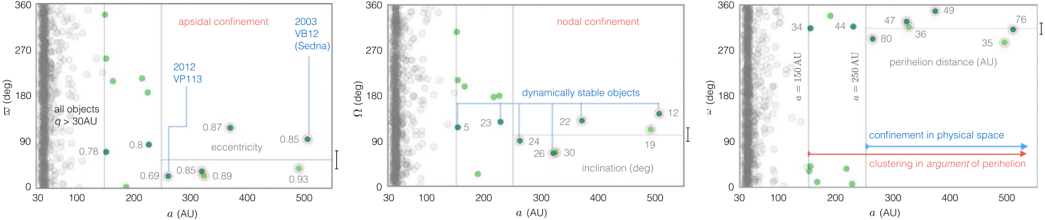
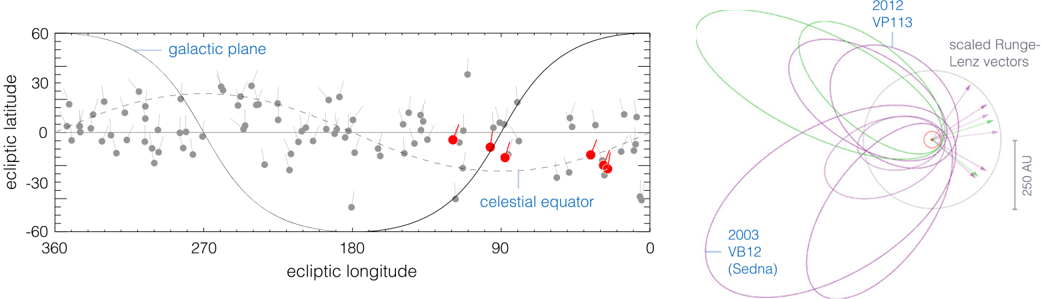
Recent analyses have shown that distant orbits within the scattered disk population of the Kuiper Belt exhibit an unexpected clustering in their respective arguments of perihelion. While several hypotheses have been put forward to explain this alignment, to date, a theoretical model that can successfully account for the observations remains elusive. In this work we show that the orbits of distant Kuiper Belt objects (KBOs) cluster not only in argument of perihelion, but also in physical space. We demonstrate that the perihelion positions and orbital planes of the objects are tightly confined and that such a clustering has only a probability of 0.007% to be due to chance, thus requiring a dynamical origin. We find that the observed orbital alignment can be maintained by a distant eccentric planet with mass ≳10 m ⊕ whose orbit lies in approximately the same plane as those of the distant KBOs, but whose perihelion is 180° away from the perihelia of the minor bodies. In addition to accounting for the observed orbital alignment, the existence of such a planet naturally explains the presence of high-perihelion Sedna-like objects, as well as the known collection of high semimajor axis objects with inclinations between 60° and 150° whose origin was previously unclear. Continued analysis of both distant and highly inclined outer solar system objects provides the opportunity for testing our hypothesis as well as further constraining the orbital elements and mass of the distant planet.
Overview
CoChat Summary
## TL;DR
The paper argues that the distant Kuiper belt’s orbital clustering is real and unlikely to be due to chance, based on a joint probability of 0.007% and a significance of about 3.8σ. It proposes that a distant eccentric planet—roughly 10 Earth masses on a wide, eccentric, likely low-inclination orbit—can explain the clustering, the detached Sedna-like objects, and some highly inclined Kuiper belt objects.
## Key findings
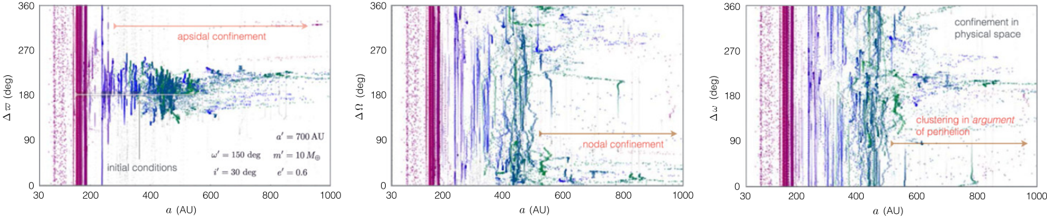
- Among 13 Kuiper belt objects with \(q > 30\) AU and \(a > 150\) AU in the initially clustered sample, 6 were deemed largely unaffected by Neptune after 4 Gyr integrations of 6 clones each; these stable objects cluster at \(\omega = 318 \pm 8^\circ\), \(\Omega = 113 \pm 13^\circ\), and \(\varpi = 71 \pm 16^\circ\).
- The observed clustering in perihelion position occurs only 0.7% of the time in random draws from the comparison sample, clustering in orbital pole position occurs only 1% of the time, and the joint probability is 0.007% (about 3.8σ).
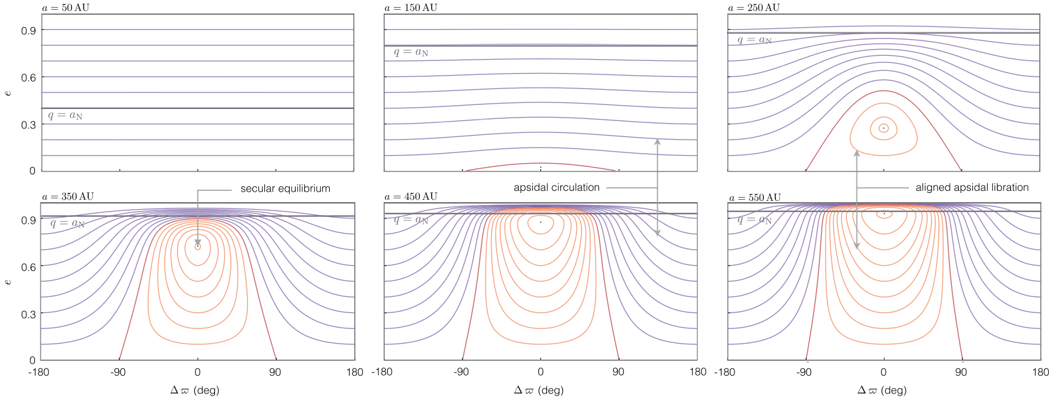
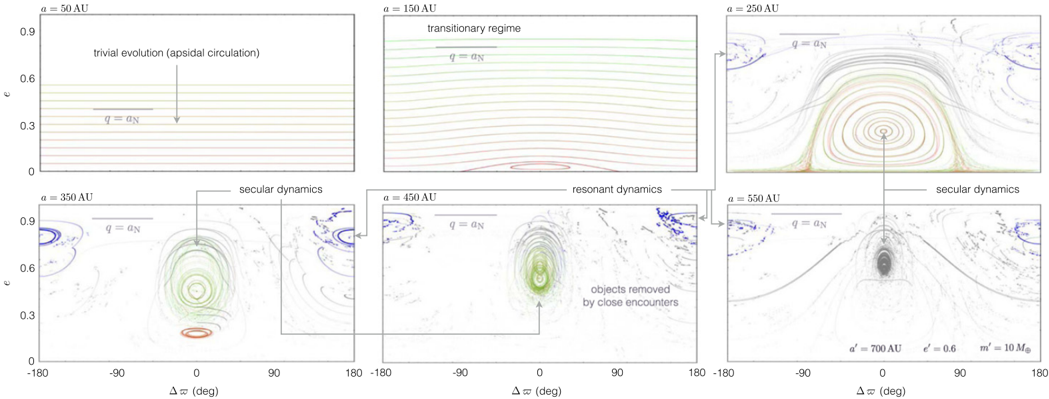
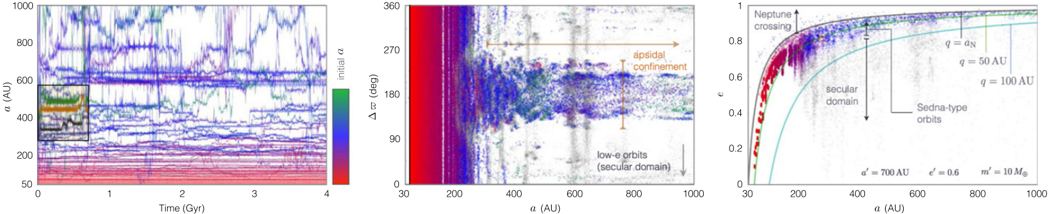
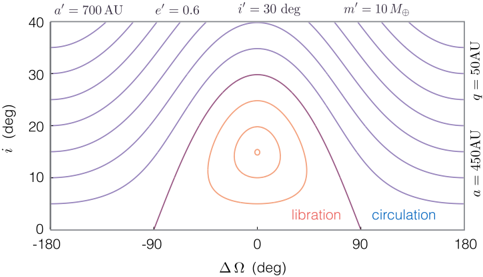
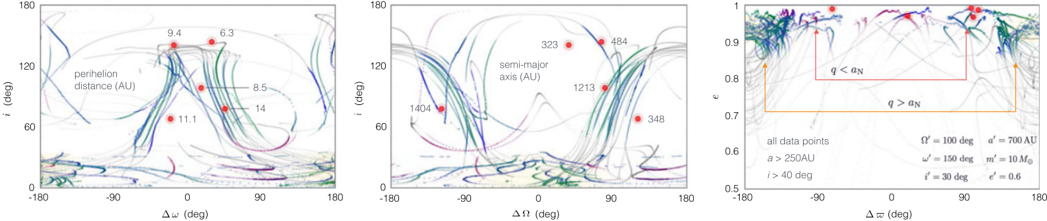
- In analytic phase-space portraits, a planet with \(m' = 10\,m_\oplus\), \(a' = 700\) AU, and \(e' = 0.6\) produces libration of \(\Delta\varpi\) for test particles with \(a \gtrsim 200\) AU and high eccentricity.
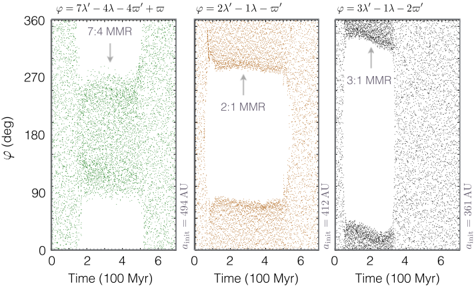
- Direct N-body simulations found that long-lived apsidally anti-aligned orbits can exist for perturber semi-major axes \(a' \sim 400\)–1500 AU and eccentricities \(e' \sim 0.5\)–0.8; the text says a perturber near \(a' \sim 700\) AU, \(e' \sim 0.6\) would likely need to be “a factor of a few” more massive than \(10\,m_\oplus\) to reproduce the effects.
## Methods
- The authors reanalyzed the distant Kuiper belt sample by examining orbital elements \(\omega\), \(\Omega\), and \(\varpi\), and by projecting perihelion locations and orbit poles into inertial space.
- They tested Neptune-affected objects by numerically evolving 6 clones of each candidate for 4 Gyr; objects with more than one clone showing large-scale semi-major axis variation were labeled dynamically unstable.
- They combined secular analytical theory with direct N-body simulations, using a hybrid symplectic-Bulirsch-Stoer implementation in mercury6, with integrations typically run for 4 Gyr.
- Synthetic scattered disks were generated with test particles spanning \(a \in (50,550)\) AU or \(a \in (150,550)\) AU, with specified distributions in perihelion distance, inclination, and angular elements, to see whether a distant perturber could sculpt the observed clustering.
## Limitations
- Stated in the paper: the authors say their analytical model makes “numerous assumptions,” including that many test-particle orbits cross the perturber or Neptune, violating secular-theory assumptions, and that the expansion may not always be small enough to justify truncation at the chosen order.
- Stated in the paper: the perturber parameters are “highly degenerate,” and the precise range of mass, semi-major axis, eccentricity, inclination, and argument of perihelion required to match the data is “at present difficult to diagnose.”
- Evident from the text: the observational sample is small, with only 6 clustered objects driving the strongest physical-space alignment result, so the inference rests on limited statistics.
Model-written summary. Check it against the paper before relying on it.
Integrity signals
Registry
Cites
Statistics
Figures
Verification
Claims the paper makes
3 Valid · 5 Not valid · 16 Not checked · 102 Own results and interpretations
At least one cited source doesn’t support this claim or points to a different paper, and none confirmed it — see the verdicts below.
In the paper
“the long-term modulation of scattered KBO eccentricities provides a natural explanation for the existence of the so-called distant detached objects such as Sedna and 2012 VP113 (Brown et al. 2004; Trujillo & Sheppard 2014).”
What the sources say
- Disputedcites Brown et al. 2004 matched to “Discovery of a Candidate Inner Oort Cloud Planetoid” (2004) sourceExperimental — accuracy not yet measured
Section 4.1 says scattering by the major planets cannot place Sedna on its 76 AU perihelion orbit; it considers an unseen planet but deems that possibility unlikely. Section 4.2 likewise says ordinary long-term external perturbations are too weak for an orbit like Sedna’s. The paper therefore does not present long-term modulation of scattered KBO eccentricities as a natural explanation for Sedna, and it does not discuss 2012 VP113. (LLM, conf=0.86)
Checked by a reasoning model — may be wrong.
- Not checked — no full text of the sourcecites Trujillo & Sheppard 2014 matched to “A Sedna-like body with a perihelion of 80 astronomical units” (2014) source
plainstates a cause- Asserted: passes — The authors put it forward as true.
- Checkable: passes — It can be checked against evidence.
- Load-bearing: passes — The paper’s conclusions depend on it.
- Based: passes — The paper gives a reason why it holds.
- Disputed
The cited sources support only part of this claim — read each source’s verdict below.
In the paper
“Such an estimate is at odds with the negligibly small mass of the present Sedna population (Schwamb et al. 2010).”
What the sources say
- Partly supportedcites Schwamb et al. 2010 matched to “PROPERTIES OF THE DISTANT KUIPER BELT: RESULTS FROM THE PALOMAR DISTANT SOLAR SYSTEM SURVEY” (2010) sourceExperimental — accuracy not yet measured
Our copy of Schwamb et al. (2010) does constrain the present Sedna population (§5.4 Population Estimate: best-fit 393 +1286/-264 and 74 +279/-47 objects brighter than or equal to Sedna for the hot and cold brightness distributions, i.e. 'hundreds to thousands of planetoids brighter than Sedna present beyond the Kuiper Belt'), so it is a legitimate source for the size of the Sedna population today. However, no passage calls that population's mass 'negligibly small' or quantifies it in absolute (planetary) mass terms; on the contrary, §5.4 states 'there may be an order of magnitude or two more mass residing in the Sedna region than exists in the present Kuiper Belt,' and the authors stress their estimates are lower bounds with large uncertainties (§5.4, §5.5 Comparison to Occultation Surveys). The 'negligibly small mass' characterisation, and its comparison against the mass required for the inclination instability, is the citing authors' own inference rather than a statement of this paper. (LLM, conf=0.70)
plain- Asserted: passes — The authors put it forward as true.
- Checkable: passes — It can be checked against evidence.
- Load-bearing: passes — The paper’s conclusions depend on it.
- Based: passes — The paper gives a reason why it holds.
- Partly supported
Every source the paper cites for this claim was checked and supports it.
In the paper
“The clustering in ω therefore appears to be real.”
What the sources say
- Supportedcites de la Fuente Marcos & de la Fuente Marcos 2014 matched to “Extreme trans-Neptunian objects and the Kozai mechanism: signalling the presence of trans-Plutonian planets” (2014) source
Section 3 (THE IMPACT OF THE DECLINATION BIAS) states outright that 'we further confirm that the clustering in ω pointed out by Trujillo & Sheppard (2014) is real, not the result of observational bias,' and the Conclusions (S7) repeat that the finding 'is not a statistical coincidence and it cannot be explained as a result of observational bias.' The hedged citing sentence ('appears to be real') is thus supported by a source making the point at least as strongly; the paper's caveat that the sample of 13 ETNOs makes conclusions 'statistically fragile' concerns other trends (e.g. the eccentricity clustering), not the ω clustering. Population in the source is extreme trans-Neptunian objects (a > 150 au, q > 30 au). (LLM, conf=0.92)
hedged- Asserted: passes — The authors put it forward as true.
- Checkable: passes — It can be checked against evidence.
- Load-bearing: passes — The paper’s conclusions depend on it.
- Based: passes — The paper gives a reason why it holds.
- Supported
The cited sources support only part of this claim — read each source’s verdict below.
In the paper
“Additionally, in order to operate on the appropriate timescale, the inclination instability requires 1 -10 Earth masses of material to exist between ∼ 100 AU and ∼ 10 , 000 AU (Madigan & McCourt 2015).”
What the sources say
- Partly supportedcites Madigan & McCourt 2015 matched to “A new inclination instability reshapes Keplerian disks into cones: application to the outer Solar System” (2015) sourceExperimental — accuracy not yet measured
The discussion (p. 5) says the proposed inclination-instability scenario implies an initial disk mass of approximately 1–10 Earth masses, but places it between approximately 50 and 10,000 AU, not 100 and 10,000 AU. The paper links the instability’s timescale to disk mass, but describes this mass as an implication of its Solar System scenario rather than a general requirement for the instability to operate. (LLM, conf=0.90)
plainstates a cause- Asserted: passes — The authors put it forward as true.
- Checkable: passes — It can be checked against evidence.
- Load-bearing: passes — The paper’s conclusions depend on it.
- Based: passes — The paper gives a reason why it holds.
- Partly supported
A result the paper reports from its own data — it cites no other source for it, so there is none to check. The quote shows it is in the paper.
In the paper
“Clearly, the results suggest that the clustering seen in the observational data can be reproduced (at least on a qualitative level) by a mildly inclined, highly eccentric distant perturber.”
boostedstates a possible cause- Asserted: passes — The authors put it forward as true.
- Checkable: passes — It can be checked against evidence.
- Load-bearing: passes — The paper’s conclusions depend on it.
- Based: passes — The paper gives a reason why it holds.
79 more claims
Create a free account to see all 126 claims and to verify the 10 references still open.
- Probably not a substantial claim. 17
- It may state two separate claims as one. 29
Claims other papers make about this one
Each is checked against this paper’s own text: does it say what the citing paper says it does?
The source backs part of the claim, not all of it — or backs it for a different population, condition or comparison.
In the citing paper
“The original analysis of Batygin & Brown (2016) was a simple proof of concept that an inclined eccentric massive planet could cause outer solar system clustering, so the choice of m 9 = 10 M earth , e 9 = 0.7, and i 9 = 30° was merely notional.”
From The Orbit of Planet Nine (2021) · cites this paper as Batygin & Brown (2016)
Experimental — accuracy not yet measuredThe source backs part of the claim, not all of it — or backs it for a different population, condition or comparison.
In the citing paper
“As shown in Batygin & Brown (2016), such a numerical setup successfully captures the relevant dynamical phenomena, at a substantially reduced computational cost.”
From Observational constraints on the orbit and location of Planet Nine in the outer solar system (2016) · cites this paper as Batygin & Brown (2016)
Experimental — accuracy not yet measuredThe source backs part of the claim, not all of it — or backs it for a different population, condition or comparison.
In the citing paper
“Moreover, these objects also share very nearly the same orbital plane, which is tilted an average of 22° to the ecliptic.”
From Observational constraints on the orbit and location of Planet Nine in the outer solar system (2016) · cites this paper as Batygin & Brown (2016)
Experimental — accuracy not yet measuredThe source backs part of the claim, not all of it — or backs it for a different population, condition or comparison.
In the citing paper
“Most importantly, Batygin & Brown (2016) point out that all well-determined orbits of KBOs beyond Neptune with semimajor axis, a, larger than 227 au approach perihelion within 94° of longitude of each other.”
From Observational constraints on the orbit and location of Planet Nine in the outer solar system (2016) · cites this paper as Batygin & Brown (2016)
Experimental — accuracy not yet measuredThe source backs part of the claim, not all of it — or backs it for a different population, condition or comparison.
In the citing paper
“The combined probability of these two occurrences happening simply due to chance is less than 0.01%.”
From Observational constraints on the orbit and location of Planet Nine in the outer solar system (2016) · cites this paper as Batygin & Brown (2016)
Experimental — accuracy not yet measured
12 more claims about this paper
Create a free account to see every claim other papers make about this one.
Citations
Cites
Goldstein, H. (1951) · UCLA - Biblioteca de Ciencias y Tecnologia Felix Morales Bueno · Cited by 10,004
Murray, C. D., & Dermott, S. F. (2000) · Cambridge University Press eBooks · doi:10.1017/cbo9781139174817 · Cited by 2,856
A hybrid symplectic integrator that permits close encounters between massive bodies
Chambers, J. E. (1999) · Monthly Notices of the Royal Astronomical Society · doi:10.1046/j.1365-8711.1999.02379.x · Cited by 1,820 · cited 1×
“9 For the entirety of the N-body simulation suite, we utilized the mercury6 gravitational dynamics software package (Chambers 1999).”
MethodDirect Imaging of Multiple Planets Orbiting the Star HR 8799
Marois, C., Macintosh, B., Barman, T., Zuckerman, B., Song, I., Patience, J., Lafrenière, D., & Doyon, R. (2008) · Science · doi:10.1126/science.1166585 · Cited by 1,773 · cited 1×
“While observational inference of extrasolar planetary systems such as HR 8799 (Marois et al. 2008) suggests that planets can indeed occupy exceptionally wide orbits, the solar nebula would have had to be exceptionally expansive to be compatible with in-situ formation of a planet on such a distant…”
BackgroundOrigin of the orbital architecture of the giant planets of the Solar System
Tsiganis, K., Gomes, R., Morbidelli, A., & Levison, H. F. (2005) · Nature · doi:10.1038/nature03539 · Cited by 1,476 · cited 2×
“…planet orbits for definitiveness, the actual process of Kuiper belt formation was likely associated with initially eccentric and inclined giant planet orbits, that subsequently regularized due to dynamical friction (Tsiganis et al. 2005; Levison et al. 2008; Batygin et al. 2011; Nesvorný 2015).”
BackgroundLEVISON, H., MORBIDELLI, A., VANLAERHOVEN, C., GOMES, R., & TSIGANIS, K. (2008) · Icarus · doi:10.1016/j.icarus.2007.11.035 · Cited by 473 · cited 2×
“…it is worth noting that although the primordial planetesimal disk of the solar system likely comprised tens of Earth masses (Tsiganis et al. 2005; Levison et al. 2008, 2011; Batygin et al. 2011), the vast majority of this material was ejected from the system by close encounters with the giant…”
BackgroundTidal dissipation by solid friction and the resulting orbital evolution
Kaula, W. M. (1964) · Reviews of Geophysics · doi:10.1029/rg002i004p00661 · Cited by 436 · cited 2×
“The long-term dynamical behavior of such an object can be described within the framework of secular perturbation theory (Kaula 1964).”
BackgroundChaotic behavior and the origin of the 31 Kirkwood gap
Wisdom, J. (1983) · Icarus · doi:10.1016/0019-1035(83)90127-6 · Cited by 426 · cited 1×
“…systems with two degrees of freedom, dynamical evolution of the individual degrees of freedom can proceed in a quasi-decoupled manner (as long as homoclinic curves are not encountered) as a consequence of separation of timescales (Wisdom 1983; Henrard & Caranicolas 1990; Batygin & Morbidelli 2013).”
BackgroundThe Dynamics of Planetary Rings
Goldreich, P., & Tremaine, S. (1982) · Annual Review of Astronomy and Astrophysics · doi:10.1146/annurev.aa.20.090182.001341 · Cited by 392 · cited 1×
“Generally speaking, coherent dynamical structures in particle disks can either be sustained by self-gravity (Tremaine 1998; Touma et al. 2009) or by gravitational shepherding facilitated by an extrinsic perturber (Goldreich & Tremaine 1982; Chiang et al. 2009).”
Background(2002) · Taylor & Francis eBooks · Cited by 342
Research works printed but not linked: 1
- Neishtadt, A. I. 1984, Prikladnaia Matematika i Mekhanika, 48, 197
Cited by
LSST: from Science Drivers to Reference Design and Anticipated Data Products
Ivezić, Ž., Kahn, S. M., Tyson, J. A., Abel, B., Acosta, E., Allsman, R., Alonso, D., AlSayyad, Y., Anderson, S. F., Andrew, J., et al. (2008) · arXiv · doi:10.48550/arxiv.0805.2366 · Cited by 4,357
Self-citationLSST: From Science Drivers to Reference Design and Anticipated Data Products
Ivezić, Ž., Kahn, S. M., Tyson, J. A., Abel, B., Acosta, E., Allsman, R., Alonso, D., AlSayyad, Y., Anderson, S. F., Andrew, J., et al. (2019) · The Astrophysical Journal · doi:10.3847/1538-4357/ab042c · Cited by 4,357
Self-citationThe Dark Energy Survey: more than dark energy – an overview
(2016) · Monthly Notices of the Royal Astronomical Society · doi:10.1093/mnras/stw641 · Cited by 1,019
A brief visit from a red and extremely elongated interstellar asteroid
Meech, K. J., Weryk, R., Micheli, M., Kleyna, J. T., Hainaut, O. R., Jedicke, R., Wainscoat, R. J., Chambers, K. C., Keane, J. V., Petric, A., et al. (2017) · Nature · doi:10.1038/nature25020 · Cited by 424
CMB-S4 Science Case, Reference Design, and Project Plan
Abazajian, K., Addison, G. E., Adshead, P. J., Ahmed, Z., Allen, S. W., Alonso, D., Alvarez, M. A., Anderson, A. J., Arnold, K., Baccigalupi, C., et al. (2019) · arXiv (Cornell University) · doi:10.48550/arxiv.1907.04473 · Cited by 397
“The recent excitement about a possible Planet Nine [486] (nominally 5–15 M⊕ at several hundred AU) has made it clear that there is substantial discovery space for new planets in the outer Solar System.”
BackgroundSelf-citationDynamical Evolution of the Early Solar System
Nesvorný, D. (2018) · Annual Review of Astronomy and Astrophysics · doi:10.1146/annurev-astro-081817-052028 · Cited by 299
The astrophysics of nanohertz gravitational waves
Burke-Spolaor, S., Taylor, S. R., Charisi, M., Dolch, T., Hazboun, J. S., Holgado, A. M., Kelley, L. Z., Lazio, T. J. W., Madison, D. R., McMann, N., et al. (2019) · The Astronomy and Astrophysics Review · doi:10.1007/s00159-019-0115-7 · Cited by 300
“Though some of the early efforts may have been affected by severe selection effects (Henrichs and Staller 1978), the existence of distant members of the solar system is a question that has recently attracted considerably more attention, given the suggestion of a previously unknown “Planet Nine” (Batygin and Brown 2016…”
BackgroundThe Astrophysics Of Nanohertz Gravitational Waves
Burke-Spolaor, S., Taylor, S. R., Charisi, M., Dolch, T., Hazboun, J. S., Holgado, A. M., Kelley, L. Z., Lazio, T. J. W., Madison, D. R., McMann, N., et al. (2019) · Repository of the Academy's Library (Library of the Hungarian Academy of Sciences) · Cited by 230
Dark matter, dark energy, and alternate models: A review
Arun, K., Gudennavar, S. B., & Sivaram, C. (2017) · Advances in Space Research · doi:10.1016/j.asr.2017.03.043 · Cited by 206
Batygin, K., Adams, F. C., Brown, M. E., & Becker, J. C. (2019) · Physics Reports · doi:10.1016/j.physrep.2019.01.009 · Cited by 181
“…radically excited distribution of Centaur inclinations is a natural outcome of Planet Nine induced evolution, and constitutes a tantalizing line of evidence that points to Planet Nine’s existence (Batygin and Brown 2016b; Batygin and Morbidelli 2017; Becker et al. 2018; see also Gomes et al. 2015).”
BackgroundMethodResultInfluentialSelf-citationOSSOS. VII. 800+ Trans-Neptunian Objects—The Complete Data Release
Bannister, M. T., Gladman, B. J., Kavelaars, J. J., Petit, J.-M., Volk, K., Chen 陳英, Y.-T. 同., Alexandersen, M., Gwyn, S. D. J., Schwamb, M. E., Ashton, E., et al. (2018) · The Astrophysical Journal Supplement Series · doi:10.3847/1538-4365/aab77a · Cited by 161
“There has been recent interest in the apparent angular clustering of the MPC-listed TNOs with a> 150 au orbits, which some have hypothesized as evidence for a massive distant planet (Trujillo & Sheppard 2014; Batygin & Brown 2016).”
BackgroundOrigin and Evolution of Short-period Comets
Nesvorný, D., Vokrouhlický, D., Dones, L., Levison, H. F., Kaib, N., & Morbidelli, A. (2017) · The Astrophysical Journal · doi:10.3847/1538-4357/aa7cf6 · Cited by 163
“P9 is hypothesized, via its gravitational shepherding effects, to produce the non-uniform distribution of orbital angles of known extreme KBOs (a > 150 au, q > 35 au; Trujillo & Sheppard 2014, Batygin & Brown 2016a).”
BackgroundMethodBanik, I., & Zhao, H. (2022) · Symmetry · doi:10.3390/sym14071331 · Cited by 191
Johnson, S. A., Penny, M. T., Gaudi, B. S., Kerins, E. J., Rattenbury, N. J., Robin, A. C., Novati, S. C., & Henderson, C. B. (2020) · The Astronomical Journal · doi:10.3847/1538-3881/aba75b · Cited by 176
“…some intuition as to whether there was an equivalent of a solar system’s mass function worth of unbound bodies per star in the MW, but we note that such a mass function is likely to be incomplete at low masses, and possibly also at higher masses (Trujillo & Sheppard 2014; Batygin & Brown 2016).”
BackgroundScience with the 2.5-meter Wide Field Survey Telescope (WFST)
Wang, T., Liu, G., Cai, Z.-Y., Geng, J.-J., Fang, M., He, H., Jiang, J.-A., Jiang, N., Kong, X., Li, B., et al. (2023) · Science China Physics Mechanics and Astronomy · doi:10.1007/s11433-023-2197-5 · Cited by 156
Observational constraints on the orbit and location of Planet Nine in the outer solar system
Brown, M. E., & Batygin, K. (2016) · The Astrophysical Journal Letters · doi:10.3847/2041-8205/824/2/l23 · Cited by 112
“The distant eccentric perturber studied in Batygin & Brown (2016) – which we refer to as Planet Nine – modulates the perihelia of objects in the anti-aligned cluster and naturally creates objects like Sedna, in addition to the other high perihelion KBOs.”
BackgroundMethodInfluentialSelf-citationAsteroid (469219) 2016 HO3, the smallest and closest Earth quasi-satellite
Marcos, C. D. L. F., & Marcos, R. D. L. F. (2016) · Monthly Notices of the Royal Astronomical Society · doi:10.1093/mnras/stw1972 · Cited by 118
“Quasi-satellite configurations may have played a role in the origin of the Earth– Moon system (Kortenkamp & Hartmann 2016); they have also been found numerically (de la Fuente Marcos, de la Fuente Marcos & Aarseth 2016) within the context of the Planet Nine hypothesis (Batygin & Brown 2016).”
BackgroundKuiper belt: Formation and evolution
Morbidelli, A., & Nesvorný, D. (2019) · Elsevier eBooks · doi:10.1016/b978-0-12-816490-7.00002-3 · Cited by 144
“More recently, the planet IX hypothesis (Trujillo and Sheppard, 2014; Batygin and Brown, 2016) has opened the possibility that Sednoids have been trapped onto their current orbits by the perturbations exerted by this planet.”
BackgroundWhat if Planet 9 is a Primordial Black Hole?
Scholtz, J., & Unwin, J. (2020) · Physical Review Letters · doi:10.1103/physrevlett.125.051103 · Cited by 95
“We take these objects to be primordial black holes (PBHs) and point out the orbits of TNOs would be altered if one of these PBHs was captured by the Solar System, inline with the Planet 9 hypothesis.”
BackgroundInfluentialNew Extreme Trans-Neptunian Objects: Toward a Super-Earth in the Outer Solar System
Sheppard, S. S., & Trujillo, C. (2016) · The Astronomical Journal · doi:10.3847/1538-3881/152/6/221 · Cited by 92
“This was looked at in detail by Batygin & Brown (2016) to try and constrain what any distant planet’s orbit may look like.”
BackgroundOSSOS. VI. Striking Biases in the Detection of Large Semimajor Axis Trans-Neptunian Objects
Shankman, C., Kavelaars, J. J., Bannister, M. T., Gladman, B. J., Lawler, S. M., Chen 陳英, Y.-T. 同., Jakubik, M., Kaib, N., Alexandersen, M., Gwyn, S. D. J., et al. (2017) · The Astronomical Journal · doi:10.3847/1538-3881/aa7aed · Cited by 87
“Such a planet would cause pericenter cycling and give dynamical kicks to these large-a TNOs, creating a population analogous to the centaurs, which is seen in multiple simulations with a variety of additional planet candidates (Batygin & Brown 2016b; Lawler et al. 2016; Shankman et al. 2017).”
BackgroundMethodInfluentialOrigin and Evolution of Long-period Comets
Vokrouhlický, D., Nesvorný, D., & Dones, L. (2019) · The Astronomical Journal · doi:10.3847/1538-3881/ab13aa · Cited by 100
A PRIMER ON UNIFYING DEBRIS DISK MORPHOLOGIES
Lee, E. J., & Chiang, E. (2016) · The Astrophysical Journal · doi:10.3847/0004-637x/827/2/125 · Cited by 91
“Observational evidence for the relevance of individual MMRs is so far scant except for among Kuiper belt objects (e.g., Batygin & Brown 2016; Volk et al. 2016) and in the inner Solar System’s zodiacal dust disk (e.g., Dermott et al. 1994; Reach 2010; Jones et al. 2013).”
BackgroundThe First Brown Dwarf Discovered by the Backyard Worlds: Planet 9 Citizen Science Project
Kuchner, M. J., Faherty, J. K., Schneider, A. C., Meisner, A., Filippazzo, J., Gagné, J., Trouille, L. E., Silverberg, S. M., Castro, R., Fletcher, B., et al. (2017) · The Astrophysical Journal Letters · doi:10.3847/2041-8213/aa7200 · Cited by 92
“Besides seeking new brown dwarfs and nearby stars, the project is a sensitive all-sky search for planets orbiting the Sun beyond Pluto, like the proposed ∼ 10 M⊕ object in a ∼ 600 au orbit called Planet Nine (Batygin & Brown 2016; Fortney et al. 2016).”
BackgroundTilburg, K. V., Taki, A.-M., & Weiner, N. (2018) · Journal of Cosmology and Astroparticle Physics · doi:10.1088/1475-7516/2018/07/041 · Cited by 99
Tuning the Legacy Survey of Space and Time (LSST) Observing Strategy for Solar System Science
Schwamb, M. E., Jones, L., Yoachim, P., Volk, K., Dorsey, R. C., Opitom, C., Greenstreet, S., Lister, T. A., Snodgrass, C., Bolin, B., et al. (2023) · The Astrophysical Journal Supplement Series · doi:10.3847/1538-4365/acc173 · Cited by 101
“…(“Planet Nine”) is gravitationally shepherding the distant planetesimals onto similar orbits with aligned orbital poles and longitudes of perihelion (Trujillo & Sheppard 2014; Batygin & Brown 2016; Sheppard & Trujillo 2016; Batygin et al. 2019; Brown & Batygin 2019, 2021; Oldroyd & Trujillo 2021).”
BackgroundDark matter and the XENON1T electron recoil excess
Kannike, K., Raidal, M., Veermäe, H., et al. (2020) · Physical review. D/Physical review. D. · doi:10.1103/physrevd.102.095002 · Cited by 77
Constraints on the location of a possible 9th planet derived from the Cassini data
Fienga, A., Laskar, J., Manche, H., & Gastineau, M. (2016) · Astronomy & Astrophysics · doi:10.1051/0004-6361/201628227 · Cited by 76
“In Batygin & Brown (2016), only the long term evolution is considered as a constraint for the distribution of the KBO, so the true anomaly is left as an unknown.”
BackgroundMethodInfluentialTRACKING NEPTUNE’S MIGRATION HISTORY THROUGH HIGH-PERIHELION RESONANT TRANS-NEPTUNIAN OBJECTS
Kaib, N. A., & Sheppard, S. S. (2016) · The Astronomical Journal · doi:10.3847/0004-6256/152/5/133 · Cited by 74
“Ignoring the potential effects of distant perturbers on extreme Kuiper belt objects (e.g. Fernández 1997; Trujillo & Sheppard 2014; Batygin & Brown 2016), an object with a & 50 AU must typically have a perihelion near Neptune for it to have been scattered to a large orbit.”
BackgroundGENERATION OF HIGHLY INCLINED TRANS-NEPTUNIAN OBJECTS BY PLANET NINE
Batygin, K., & Brown, M. E. (2016) · The Astrophysical Journal Letters · doi:10.3847/2041-8205/833/1/l3 · Cited by 72
“Following the numerical calculations reported in Batygin & Brown (2016) and Brown & Batygin (2016a), the starting configuration of the Kuiper belt was represented by a disk of 3,200 test particles, uniformly distributed across the semi-major axes range a ∈ (150, 550) AU and perihelion distance q ∈…”
BackgroundMethodInfluentialSelf-citationA New High Perihelion Inner Oort Cloud Object: 2015 TG387
Sheppard, S., Trujillo, C., Tholen, D., & Kaib, N. (2018) · arXiv · doi:10.48550/arxiv.1810.00013 · Cited by 70
Wyatt, M. C., Bonsor, A., Jackson, A. P., Marino, S., & Shannon, A. (2016) · Monthly Notices of the Royal Astronomical Society · doi:10.1093/mnras/stw2633 · Cited by 83
“Such a scenario is often invoked to explain the origin of detached Kuiper belt objects like Sedna on wide orbits at 100-1000 au (e.g., Kaib & Quinn 2008), and indeed the putative planet nine (Batygin & Brown 2016).”
BackgroundA Search of the Full Six Years of the Dark Energy Survey for Outer Solar System Objects
Bernardinelli, P. H., Bernstein, G. M., Sako, M., Yanny, B., Aguena, M., Allam, S., Andrade-Oliveira, F., Bertin, E., Brooks, D., Buckley-Geer, E., et al. (2022) · The Astrophysical Journal Supplement Series · doi:10.3847/1538-4365/ac3914 · Cited by 64
“…et al. (2020b), which asked whether the population of TNOs with a> 150 au and q> 30 au shows deviation from an underlying uniform distribution in ω, Ω, and ϖ≡Ω+ ω. Deviations from such isotropy serve as the primary motivation for the Planet 9 hypothesis (Batygin & Brown 2016; Batygin et al. 2019).”
BackgroundEffects of unseen additional planetary perturbers on compact extrasolar planetary systems
Becker, J., & Adams, F. C. (2017) · Monthly Notices of the Royal Astronomical Society · doi:10.1093/mnras/stx461 · Cited by 70
“However, for a diametrically different companion type – say, a super-Earth at a = 700 au, analogous to the proposed Planet 9 in our own Solar system (Batygin & Brown 2016) – none of the systems in our sample would be disrupted from their current transiting configurations.”
BackgroundDebiasing the NEOWISE Cryogenic Mission Comet Populations
Bauer, J. M., Grav, T., Fernández, Y. R., Mainzer, A., Kramer, E., Masiero, J. R., Spahr, T. B., Nugent, C., Stevenson, R., Meech, K. J., et al. (2017) · The Astronomical Journal · doi:10.3847/1538-3881/aa72df · Cited by 79
“However, recent work by Batygin & Brown (2016) indicates that planetary perturbers may fall within a smaller mass range.”
BackgroundSolar obliquity induced by planet nine
Bailey, E., Batygin, K., & Brown, M. E. (2016) · The Astronomical Journal · doi:10.3847/0004-6256/152/5/126 · Cited by 62
“In particular, the illustrative m9 = 10m⊕, a9 = 700 AU, e9 = 0.6 perturber considered by Batygin & Brown (2016), as well as virtually all of the “highprobability” orbits computed by Brown & Batygin (2016) fall short of exciting 6 degrees of obliquity from a strictly coplanar initial configuration.”
BackgroundInfluentialSelf-citationA New High Perihelion Trans-Plutonian Inner Oort Cloud Object: 2015 TG387
Sheppard, S. S., Trujillo, C. A., Tholen, D. J., & Kaib, N. (2019) · The Astronomical Journal · doi:10.3847/1538-3881/ab0895 · Cited by 62
Lawler, S. M., Kavelaars, J. J., Alexandersen, M., Bannister, M. T., Gladman, B., Petit, J.-M., & Shankman, C. (2018) · Frontiers in Astronomy and Space Sciences · doi:10.3389/fspas.2018.00014 · Cited by 61
“, 2016), dropouts frommean-motion resonances during Neptune’s orbital circularization phase (Pike and Lawler, 2017), interactions with a distant giant planet (Gomes et al., 2015; Batygin and Brown, 2016; Lawler et al., 2017), a stellar flyby (Morbidelli and Levison, 2004), capture from a passing star (Jílková et al.”
BackgroundInfluentialCORRALLING A DISTANT PLANET WITH EXTREME RESONANT KUIPER BELT OBJECTS
Malhotra, R., Volk, K., & Wang, X. (2016) · The Astrophysical Journal Letters · doi:10.3847/2041-8205/824/2/l22 · Cited by 60
“Fienga et al. (2016) provide an analysis of Cassini tracking data, arguing that for the favored planet parameters of Batygin & Brown (2016), the residuals in the orbital motion of Saturn are reduced with the existence of such a planet at current true longitude near 120°; however, their analysis…”
BackgroundMethodINTERACTION CROSS SECTIONS AND SURVIVAL RATES FOR PROPOSED SOLAR SYSTEM MEMBER PLANET NINE
Li, G., & Adams, F. C. (2016) · The Astrophysical Journal Letters · doi:10.3847/2041-8205/823/1/l3 · Cited by 60
“The final system parameters that represent successful production require orbital eccentricity 0.4 ef 0.9, semimajor axis af = 400 − 1500 AU, and inclination angle if 60◦ (Batygin & Brown 2016).”
BackgroundInfluentialChen (陳英同), Y.-T., Lin (林省文), H. W., Holman, M. J., Payne, M. J., Fraser, W. C., Lacerda, P., Ip (葉永烜), W.-H., Chen (陳文屏), W.-P., Kudritzki, R.-P., Jedicke, R., et al. (2016) · The Astrophysical Journal Letters · doi:10.3847/2041-8205/827/2/l24 · Cited by 60
“We note that the simulations in Batygin & Brown (2016), provide a source of high-i and large-a TNOs with a clustered distribution of Ω.”
BackgroundMethodInfluentialThe Curiously Warped Mean Plane of the Kuiper Belt
Volk, K., & Malhotra, R. (2017) · The Astronomical Journal · doi:10.3847/1538-3881/aa79ff · Cited by 60
“…recent intriguing but not conclusive evidence of a large unseen planet on an inclined orbit in the distant solar system (Trujillo & Sheppard 2014; Batygin & Brown 2016; Brown & Batygin 2016; Holman & Payne 2016a, 2016b; Malhotra et al. 2016; Sheppard & Trujillo 2016), as well as previous…”
BackgroundWhy do warm Neptunes present nonzero eccentricity?
Correia, A. C. M., Bourrier, V., & Delisle, J.-B. (2020) · Astronomy and Astrophysics · doi:10.1051/0004-6361/201936967 · Cited by 74
“For instance, a ninth planet was proposed to explain the observed clustering in the perihelia of the distant Kuiper Belt objects (Trujillo & Sheppard 2014; Batygin & Brown 2016).”
BackgroundSolar System Physics for Exoplanet Research
Horner, J., Kane, S. R., Marshall, J. P., Dalba, P. A., Holt, T. R., Wood, J., Maynard-Casely, H. E., Wittenmyer, R., Lykawka, P. S., Hill, M., et al. (2020) · Publications of the Astronomical Society of the Pacific · doi:10.1088/1538-3873/ab8eb9 · Cited by 79
“…has recently driven wide discussion of, and a number of searches for, the proposed 'Planet Nine' (e.g. Batygin & Brown, 2016a; Beust, 2016; Brown & Batygin, 2016, 2019; Batygin & Morbidelli, 2017; Batygin, Adams, Brown & Becker, 2019) An even more speculative idea is that Jupiter undertook a…”
BackgroundThe Canada–France Ecliptic Plane Survey (CFEPS)—High-latitude Component
Petit, J.-M., Kavelaars, J. J., Gladman, B., Jones, L., Parker, J. W., Bieryla, A., Laerhoven, C. V., Pike, R. E., Nicholson, P., Ashby, M. L. N., et al. (2017) · The Astronomical Journal · doi:10.3847/1538-3881/aa6aa5 · Cited by 72
“Recent models suggest stellar encounters (e.g., Levison et al. 2010; Brasser et al. 2012) or the existence of a ninth planet (Batygin & Brown 2016) may play an important role in shaping the outer solar system.”
BackgroundMeisner, A., Faherty, J. K., Kirkpatrick, J. D., Schneider, A. C., Caselden, D., Gagné, J., Kuchner, M. J., Burgasser, A. J., Casewell, S. L., Debes, J. H., et al. (2020) · The Astrophysical Journal · doi:10.3847/1538-4357/aba633 · Cited by 69
The EXPRES Stellar Signals Project II. State of the Field in Disentangling Photospheric Velocities
Zhao, L., Fischer, D. A., Ford, E. B., Wise, A. W., Cretignier, M., Aigrain, S., Barragán, O., Bedell, M., Buchhave, L. A., Camacho, J. D., et al. (2022) · The Astronomical Journal · doi:10.3847/1538-3881/ac5176 · Cited by 77
“…9 would be below the white noise level; most constraints on Planet 9ʼs orbit correspond to an RV semiamplitude of ∼4 cm s−1 with a period of ∼7500 yr (Batygin & Brown 2016; Millholland & Laughlin 2017; Batygin et al. 2019; Brown & Batygin 2021). whether the echelle orders are merged, the…”
BackgroundDynamical evolution induced by planet nine
Batygin, K., & Morbidelli, A. (2017) · The Astronomical Journal · doi:10.3847/1538-3881/aa937c · Cited by 58
“…the existence of highly inclined, large semi-major axis Centaurs (Gomes et al. 2015; Batygin & Brown 2016a), (iv) the six-degree obliquity of the sun (Bailey et al. 2016; Lai 2016; Gomes et al. 2017), as well as (v) the origins of proximate (a < 100 AU) retrograde KBOs (Batygin & Brown 2016b).”
BackgroundMethodResultInfluentialSelf-citationTemporary deleterious mass mutations relate to originations of cockroach families
Vršanský, P., OruŘinský, R., Aristov, D., Wei, D., Vidlička, Ľ., & Ren, D. (2017) · Biologia · doi:10.1515/biolog-2017-0096 · Cited by 57
“Nevertheless, the preliminary calculations indicate influence of objects of this size would be too low, which also includes other Sedna-like objects known up to date and the possible planet X (different sense) detected indirectly (Batygin & Brown 2016).”
BackgroundBrown, M. E., & Batygin, K. (2021) · The Astronomical Journal · doi:10.3847/1538-3881/ac2056 · Cited by 57
“Brown & Batygin (2016) showed that a wide range of masses and semimajor axes were acceptable with the constraints available at the time, while Batygin et al. (2019) showed hints of a preference for lower mass and semimajor axis.”
BackgroundResultSelf-citationFu, C., Wu, P., & Yu, H. (2020) · Physical review. D/Physical review. D. · doi:10.1103/physrevd.102.043527 · Cited by 66
Zeebe, R. E. (2017) · The Astronomical Journal · doi:10.3847/1538-3881/aa8cce · Cited by 60
“Note that P9’s existence and hence its orbit is entirely speculative at this point (Trujillo & Sheppard 2014; Brown & Batygin 2016; Batygin & Brown 2016; Fienga et al. 2016; Malhotra et al. 2016; Holman & Payne 2016; Shankman et al. 2017; Millholland & Laughlin 2017).”
BackgroundCol-OSSOS: The Colors of the Outer Solar System Origins Survey
Schwamb, M. E., Fraser, W. C., Bannister, M. T., Marsset, M., Pike, R. E., Kavelaars, J. J., Benecchi, S., Lehner, M. J., 王祥, S.-Y. 宇. W., Thirouin, A., et al. (2019) · The Astrophysical Journal Supplement Series · doi:10.3847/1538-4365/ab2194 · Cited by 77
Excitation of a Primordial Cold Asteroid Belt as an Outcome of Planetary Instability
Deienno, R., Izidoro, A., Morbidelli, A., Gomes, R. S., Nesvorný, D., & Raymond, S. N. (2018) · The Astrophysical Journal · doi:10.3847/1538-4357/aad55d · Cited by 65
THE ORBITAL DISTRIBUTION OF TRANS-NEPTUNIAN OBJECTS BEYOND 50 au
Nesvorný, D., Vokrouhlický, D., & Roig, F. (2016) · The Astrophysical Journal Letters · doi:10.3847/2041-8205/827/2/l35 · Cited by 53
“The gravitational effects of the fifth giant planet (NM12) and planet 9 (Trujillo & Sheppard 2014, Batygin & Brown 2016) on the disk planetesimals are ignored.”
BackgroundPitjeva, E. V., & Pitjev, N. P. (2018) · Celestial Mechanics and Dynamical Astronomy · doi:10.1007/s10569-018-9853-5 · Cited by 53
“…found that the total mass of the Kuiper belt is two orders of magnitude larger than the mass of the Main asteroid belt (Pitjeva and Pitjev 2014; Pitjeva et al. 2017), and at the same time is almost three orders of magnitude smaller than the mass of the proposed 9th planet (Batygin and Brown 2016).”
BackgroundIs there an exoplanet in the solar system?
Mustill, A. J., Raymond, S. N., & Davies, M. B. (2016) · Monthly Notices of the Royal Astronomical Society: Letters · doi:10.1093/mnrasl/slw075 · Cited by 52
“Batygin & Brown (2016) show that families of aligned and anti-aligned particles can exist under the influence of Planet 9, and in our integration a strong concentration of particles in orbits aligned with the planet is evident, together with a small number in an anti-aligned con-figuration.”
Becker, J. C., Khain, T., Hamilton, S. J., Adams, F. C., Gerdes, D. W., Zullo, L., Franson, K., Millholland, S., Bernstein, G. M., Sako, M., et al. (2018) · The Astronomical Journal · doi:10.3847/1538-3881/aad042 · Cited by 52
“This timesaving integration strategy has been used extensively in the Planet Nine literature (Batygin & Brown 2016a; Brown & Batygin 2016; Hadden et al. 2018; Millholland & Laughlin 2017).”
MethodOuter Solar System Possibly Shaped by a Stellar Fly-by
Pfalzner, S., Bhandare, A., Vincke, K., & Lacerda, P. (2018) · The Astrophysical Journal · doi:10.3847/1538-4357/aad23c · Cited by 62
Near-term interstellar probe: First step
McNutt, R. L., Wimmer-Schweingruber, R. F., Gruntman, M., Krimigis, S. M., Roelof, E. C., Brandt, P. C., Vernon, S. R., Paul, M., Lathrop, B. W., Mehoke, D. S., et al. (2019) · Acta Astronautica · doi:10.1016/j.actaastro.2019.06.013 · Cited by 56
Gomes, R., Deienno, R., & Morbidelli, A. (2017) · The Astronomical Journal · doi:10.3847/1538-3881/153/1/27 · Cited by 49
“For example, the standard pl9 in Batygin & Brown (2016) with = Åm M109 and = I 309 has =a 700 au9 and e9=0.6.”
BackgroundMethodResultInfluentialA Measurement of the Galactic Plane Mass Density from Binary Pulsar Accelerations
Chakrabarti, S., Chang, P., Lam, M. T., Vigeland, S. J., & Quillen, A. C. (2021) · The Astrophysical Journal Letters · doi:10.3847/2041-8213/abd635 · Cited by 72
Observational Bias and the Clustering of Distant Eccentric Kuiper Belt Objects
Brown, M. E. (2017) · The Astronomical Journal · doi:10.3847/1538-3881/aa79f4 · Cited by 48
Self-citationPre-discovery Observations and Orbit of Comet C/2017 K2 (PANSTARRS)
Hui, M.-T., Jewitt, D. C., & Clark, D. (2017) · The Astronomical Journal · doi:10.3847/1538-3881/aa9be1 · Cited by 50
“The possible distant giant planet claimed by Trujillo & Sheppard (2014) and Batygin & Brown (2016) was not considered, as the evidence for this body remains equivocal (Shankman et al. 2017).”
BackgroundOSSOS. V. Diffusion in the Orbit of a High-perihelion Distant Solar System Object
Bannister, M. T., Shankman, C., Volk, K., Chen 陳, Y.-T. 英., Kaib, N., Gladman, B. J., Jakubik, M., Kavelaars, J. J., Fraser, W. C., Schwamb, M. E., et al. (2017) · The Astronomical Journal · doi:10.3847/1538-3881/aa6db5 · Cited by 47
“We test the long-term dynamical behavior of 2013 SY99 as in Section 3.2, with the addition of the inclined i=30° a=700 au 10 M⊕ planet of Batygin & Brown (2016) (Figure 2, lower).”
BackgroundMethodResultInfluentialHands, T. O., Dehnen, W., Gration, A., Stadel, J., & Moore, B. (2019) · Monthly Notices of the Royal Astronomical Society · doi:10.1093/mnras/stz1069 · Cited by 56
“Batygin & Brown (2016b) explain these inclined objects in the framework of a 9th planet, invoking Kozai (1962) -Lidov (1962) cycles from planet 9 to generate large inclinations in initially long-period KBOs, before inward scattering by Neptune places them on their current orbits.”
BackgroundConstraints on planet nine’s orbit and sky position within a framework of mean motion resonances
Millholland, S., & Laughlin, G. (2017) · The Astronomical Journal · doi:10.3847/1538-3881/153/3/91 · Cited by 45
“For example, de la Fuente Marcos et al. (2016) show that when the baseline Planet Nine model of Batygin & Brown (2016a) is adopted, the orbits of 2004 VN112, 2007 TG422, and 2013 RF98 are destabilized within a few tens of Myr.”
BackgroundInfluentialObservational Constraints on Planet Nine: Cassini Range Observations
Holman, M. J., & Payne, M. J. (2016) · The Astronomical Journal · doi:10.3847/0004-6256/152/4/94 · Cited by 44
“ustering of the ESDOs: they all have arguments of perihelion, !, near zero. This does not result from known observational biases (de la Fuente Marcos and de la Fuente Marcos 2014; Gomes et al. 2015). Batygin and Brown (2016) (BB16a) extended this by noting that the most distant of the ESDOs are both apsidally and noda…”
BackgroundMethodResultInfluentialObservational Constraints on Planet Nine: Cassini Range Observations
Holman, M. J., & Payne, M. J. (2016) · arXiv · doi:10.48550/arxiv.1604.03180 · Cited by 44
Wang, S., Zhao, Z., & Zhu, Q.-H. (2024) · Physical Review Research · doi:10.1103/physrevresearch.6.013207 · Cited by 87
Solar System Physics for Exoplanet Research
Horner, J., Kane, S. R., Marshall, J. P., Dalba, P. A., Holt, T. R., Wood, J., Maynard-Casely, H. E., Wittenmyer, R. A., Lykawka, P. S., Hill, M. L., et al. (2020) · Cited by 42
The Canada-France Ecliptic Plane Survey (CFEPS) -High Latitude ComponentPreprint
Petit, J.-M., Kavelaars, J. J., Gladman, B., Jones, L., Parker, J. W., Laerhoven, C. V., Pike, R. E., Nicholson, P. D., Bieryla, A., Ashby, M. L. N., et al. (2016) · HAL · Cited by 57
Consequences of a Distant Massive Planet on the Large Semimajor Axis Trans-Neptunian Objects
Shankman, C., Kavelaars, J. J., Lawler, S. M., Gladman, B. J., & Bannister, M. T. (2017) · The Astronomical Journal · doi:10.3847/1538-3881/153/2/63 · Cited by 42
“…of ω beyond this a > 150 au threshold (Figure 1 panel A) and so we continue this approach and select all of the TNOs satisfying 4 a > 150 au and q > 30 au as the sample for this study2 for consistency and reproducibility with prior studies (Trujillo & Sheppard 2014; Batygin & Brown 2016).”
BackgroundMethodResultInfluentialEvidence and Knowledge from Computer Simulation
Parker, W. S. (2020) · Erkenntnis · doi:10.1007/s10670-020-00260-1 · Cited by 42
Orbital clustering of distant Kuiper belt objects by hypothetical Planet 9. Secular or resonant?
Beust, H. (2016) · Astronomy & Astrophysics · doi:10.1051/0004-6361/201628638 · Cited by 41
“This issue was recently investigated into more details by Batygin & Brown (2016) (hereafter B16).”
BackgroundLong-term dynamics beyond Neptune: secular models to study the regular motions
Saillenfest, M., Fouchard, M., Tommei, G., & Valsecchi, G. B. (2016) · Celestial Mechanics and Dynamical Astronomy · doi:10.1007/s10569-016-9700-5 · Cited by 46
Fly-by encounters between two planetary systems I: Solar system analogues
Li, D., Mustill, A. J., & Davies, M. B. (2019) · Monthly Notices of the Royal Astronomical Society · doi:10.1093/mnras/stz1794 · Cited by 47
“Recently, a so-called Planet-Nine hundreds of au away from the Sun was proposed to explain the orbital clustering of distant Trans-Neptunian objects (Batygin & Brown 2016).”
BackgroundTrans-Neptunian Objects Found in the First Four Years of the Dark Energy Survey
Bernardinelli, P. H., Bernstein, G. M., Sako, M., Liu, T., Saunders, W. R., Khain, T., Lin, H. W., Gerdes, D. W., Brout, D., Adams, F. C., et al. (2020) · The Astrophysical Journal Supplement Series · doi:10.3847/1538-4365/ab6bd8 · Cited by 41
Kunitomo, M., Guillot, T., Ida, S., & Takeuchi, T. (2018) · Astronomy and Astrophysics · doi:10.1051/0004-6361/201833127 · Cited by 47
Producing distant planets by mutual scattering of planetary embryos
Silsbee, K., & Tremaine, S. (2018) · The Astronomical Journal · doi:10.3847/1538-3881/aaa19b · Cited by 40
“The extra bodies that we discuss in this paper are much smaller and closer than the Planet IX proposed by Batygin & Brown (2016): ~ Å– M0.”
BackgroundInfluentialTesting the Isotropy of the Dark Energy Survey’s Extreme Trans-Neptunian Objects
Bernardinelli, P. H., Bernstein, G. M., Sako, M., Hamilton, S., Gerdes, D. W., Adams, F. C., Saunders, W. R., Aguena, M., Allam, S., Avila, S., et al. (2020) · The Planetary Science Journal · doi:10.3847/psj/ab9d80 · Cited by 39
“…four cases: 1. a>150 au and q>30 au (the full seven object set), as in Trujillo & Sheppard (2014); 2. a>250 au and q>30 au (four DES objects), where Batygin & Brown (2016a) find there is a clustering in Ω and ϖ; 3. a>150 au and q>37 au (four DES objects), eliminating objects with the stronger…”
BackgroundResultInfluentialOBSERVATIONAL SIGNATURES OF A MASSIVE DISTANT PLANET ON THE SCATTERING DISK
Lawler, S. M., Shankman, C., Kaib, N., Bannister, M. T., Gladman, B., & Kavelaars, J. J. (2017) · The Astronomical Journal · doi:10.3847/1538-3881/153/1/33 · Cited by 39
“…to that used by Shankman et al. (2016), while the other two simulations have an additional superearth with similar parameters to what was suggested by Batygin and Brown (2016) (eccentric P9: M = 10 M⊕, a = 500 AU, e = 0.5, i = 5◦), and in the interest of completeness, what was suggested by…”
BackgroundMethodInfluentialKurlander, J. A., Bernardinelli, P. H., Schwamb, M. E., Jurić, M., Murtagh, J., Chandler, C. O., Merritt, S. R., Nesvorný, D., Vokrouhlický, D., Jones, L., et al. (2025) · The Astronomical Journal · doi:10.3847/1538-3881/add685 · Cited by 63
The fates of Solar system analogues with one additional distant planet
Veras, D. (2016) · Monthly Notices of the Royal Astronomical Society · doi:10.1093/mnras/stw2170 · Cited by 38
“⋆ E-mail: d.veras@warwick.ac.uk The recent finding that several distant Kuiper Belt Objects exhibit this same clustering in orbital space, as well a clustering in physical space (Batygin & Brown 2016), has prompted a febrile response amongst the public and scientific community.”
BackgroundEvidence for a sub-Jovian planet in the young TWA 7 disk
Lagrange, A. ‐., Wilkinson, C., Mâlin, M., Boccaletti, A., Perrot, C., Matrà, L., Combes, F., Beust, H., Rouan, D., Chomez, A., et al. (2025) · Nature · doi:10.1038/s41586-025-09150-4 · Cited by 40
“It was checked whether such a scenario could be compatible with the hypothetical Planet Nine [25].”
Polluting white dwarfs with perturbed exo-comets
Caiazzo, I., & Heyl, J. (2017) · Monthly Notices of the Royal Astronomical Society · doi:10.1093/mnras/stx1036 · Cited by 43
“4 THE ROLE OF THE PLANET In our simulations, we hypothesize the presence of a planet, between Mars and Neptune in size, with a semi-major axis ap close to the Oort Cloud (e.g. Planet 9, Batygin & Brown 2016; Malhotra et al. 2016).”
BackgroundMethodShapes, structures, and evolution of small bodies
Zhang, Y., & Michel, P. (2021) · Astrodynamics · doi:10.1007/s42064-021-0128-7 · Cited by 41
Orbital Clustering in the Distant Solar System
Brown, M. E., & Batygin, K. (2019) · The Astronomical Journal · doi:10.3847/1538-3881/aaf051 · Cited by 39
“While the existence of Planet Nine remains the only current hypothesis for the explanation of this clustering (Batygin & Brown 2016), we have shown that the joint clustering in longitude of perihelion and pole position of the distant KBOs is nearly indisputable, regardless of the existence of…”
BackgroundMethodInfluentialSelf-citationTHE HUNT FOR PLANET NINE: ATMOSPHERE, SPECTRA, EVOLUTION, AND DETECTABILITY
Fortney, J. J., Marley, M. S., Laughlin, G., Nettelmann, N., Morley, C. V., Lupu, R. E., Visscher, C., Jeremic, P., Khadder, W. G., & Hargrave, M. (2016) · The Astrophysical Journal Letters · doi:10.3847/2041-8205/824/2/l25 · Cited by 36
“INTRODUCTION Recently, Batygin & Brown (2016) have found that the orbits of long period Kuiper Belt Objects cluster in their arguments of perihelion and also in physical space in the solar system.”
BackgroundMethodSheppard, S. S., Trujillo, C., & Tholen, D. J. (2016) · The Astrophysical Journal Letters · doi:10.3847/2041-8205/825/1/l13 · Cited by 36
“Recently Batygin and Brown (2016) obtained a possible rudimentary orbit for this planet predicted by Trujillo and Sheppard (2014).”
BackgroundDiscovery and Physical Characterization of a Large Scattered Disk Object at 92 au
Gerdes, D. W., Sako, M., Hamilton, S. J., Zhang, K., Khain, T., Becker, J., Annis, J. T., Wester, W. C., Bernstein, G. M., Scheibner, C., et al. (2017) · The Astrophysical Journal Letters · doi:10.3847/2041-8213/aa64d8 · Cited by 36
“This finding has motivated the hypothesis of a distant super-earth (Trujillo & Sheppard 2014; Batygin & Brown 2016), sometimes called Planet 9.”
BackgroundMethodLow Radio Frequency Observations from the Moon Enabled by NASA Landed Payload Missions
Burns, J. O., MacDowall, R. J., Bale, S. D., et al. (2021) · The Planetary Science Journal · doi:10.3847/psj/abdfc3 · Cited by 36
“This includes, but is not limited to, the putative Planet 9 (e.g., Batygin & Brown 2016).”
BackgroundLong-term orbital dynamics of trans-Neptunian objects
Saillenfest, M. (2020) · Celestial Mechanics and Dynamical Astronomy · doi:10.1007/s10569-020-9954-9 · Cited by 42
Oort cloud Ecology: II. the chronology of the formation of the Oort cloud
Zwart, S. P., Torres, S., Cai, M. X., & Brown, A. G. A. (2021) · Astronomy and Astrophysics · doi:10.1051/0004-6361/202040096 · Cited by 50
Mróz, P., Udalski, A., Szymański, M. K., Soszyński, I., Pietrukowicz, P., Kozłowski, S., Poleski, R., Skowron, J., Ulaczyk, K., Gromadzki, M., et al. (2024) · The Astrophysical Journal Letters · doi:10.3847/2041-8213/ad8e68 · Cited by 71
“The idea put forward by Niikura et al. (2019a) also led to claims that the proposed Planet 9 (Batygin & Brown 2016; Batygin et al. 2019) may actually be a PBH (Scholtz & Unwin 2020).”
Mallama, A. D., Krobusek, B. A., & Pavlov, H. (2016) · Icarus · doi:10.1016/j.icarus.2016.09.023 · Cited by 45
“Batygin and Brown (2016) then derived the orbital parameters of a proposed body called Planet Nine (P9) that could explain that clustering.”
BackgroundResultMean Motion Resonances at High Eccentricities: The 2:1 and the 3:2 Interior Resonances
Wang, X., & Malhotra, R. (2017) · The Astronomical Journal · doi:10.3847/1538-3881/aa762b · Cited by 34
“Recently it has been suggested that some of the most distant Kuiper Belt objects may be strongly affected by MMRs with an unseen distant planet (Batygin & Brown 2016; Malhotra et al. 2016); these distant Kuiper Belt objects have eccentricities exceeding 0.70.”
BackgroundInfluentialOrbital clustering of distant Kuiper belt objects by hypothetical Planet 9. Secular or resonant?
Beust, H. (2016) · Springer Link (Chiba Institute of Technology) · doi:10.1051/0004-6361/201628638/pdf · Cited by 32
Making planet nine: Pebble accretion at 250–750 AU in a gravitationally unstable ring
Kenyon, S. J., & Bromley, B. C. (2016) · The Astrophysical Journal · doi:10.3847/0004-637x/825/1/33 · Cited by 33
Shepherding in a Self-Gravitating Disk of Trans-Neptunian Objects
Sefilian, A. A., & Touma, J. R. (2018) · arXiv · doi:10.48550/arxiv.1804.06859 · Cited by 33
Metadata
- Authors
- Batygin, K., & Brown, M. E.
- Affiliations
- California Institute of Technology (US)
- Venue
- The Astronomical Journal
- Publisher
- American Astronomical Society
- Published
- 2016-01-20
- Volume
- 151
- Issue
- 2
- Pages
- 22
- ISSN
- 0004-6256 (ISSN-L)
- 1538-3881
- OpenAlex
- W2287698241
- Cited by
- 432
- References
- 57
- Citations by year
- 2026: 11 · 2025: 33 · 2024: 26 · 2023: 35 · 2022: 24 · 2021: 39 · 2020: 53 · 2019: 37 · 2018: 44 · 2017: 67 · 2016: 62
- FWCI
- 33.43
- Type
- journal article
- Language
- en
- Open access
- bronze
- doi.org
- Licence
- iopscience.iop.org/page/copyright (vor)
- iopscience.iop.org/info/page/text-and-data-mining (tdm)
- Locations
- The Astronomical Journal (publishedVersion)
- arXiv (Cornell University) (submittedVersion)
- CaltechAUTHORS (California Institute of Technology) (submittedVersion)
- arXiv (Cornell University)
- Topics
- Physical Sciences › Earth and Planetary Sciences › Space and Planetary Science › Astro and Planetary Science
- Physical Sciences › Physics and Astronomy › Astronomy and Astrophysics › Stellar, planetary, and galactic studies
- Physical Sciences › Engineering › Aerospace Engineering › Space Satellite Systems and Control
- Keywords
- scattered disk, Kuiper belt objects, orbital clustering, argument of perihelion, planetary perturbations, orbital dynamics
About these checks
Registry, retraction, Cites and statistics results are computed, not judged, with one exception: a printed reference that no index lists is read once by a model before it counts as a citation error. Claims are extracted by a model and kept only when their quote appears verbatim in the text; each cited source is then checked, with a model’s help, for whether it says what the claim relies on. Those verdicts can be wrong — read the claim’s quote and the cited source before relying on one.
The claim verdicts this report counts are experimental: their accuracy is not yet measured.
A language model drew the claims from the paper on 2026-10-10, under version 3 of the claim definition (model deepseek-v4.1-flash, prompt extract-v3).
A second model labelled each claim on 2026-10-10 (model jev-1.13-20260917, definition revision gold-guideline-v0.2).
Cited sources are checked with a language model’s help (gpt-6-sol and qwen3.8-omni-flash).
Statistics and arithmetic are recomputed, not judged.
Confidence bands are shown only for fields calibrated on our annotated test set. None is calibrated yet, so no band is shown.
What counts as a claim ›How we measure confidence ›How we check this ›
Are you an author, or do you see a problem with this page? Request a review
Data sources
Bibliographic data: Semantic Scholar, OpenAlex, Crossref.
Contains information from the Semantic Scholar Academic Graph Datasets, made available under the ODC Attribution License (ODC-BY 1.0).
Semantic Scholar’s data is described in: Kinney, R., et al. (2023). The Semantic Scholar Open Data Platform. arXiv:2301.10140.
