

Shared Leadership and Team Creativity: A Social Network Analysis in Engineering Design Teams
Open accessThe DOI matches its Crossref record; 48 of the 49 references it cites were found in a registry or an index.
Abstract
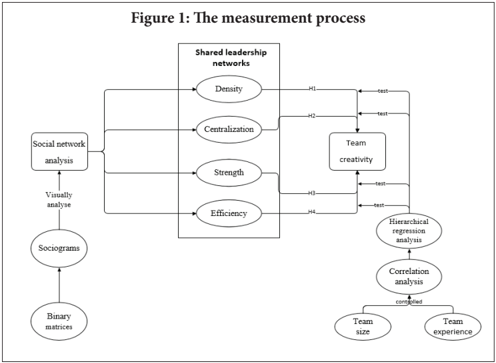
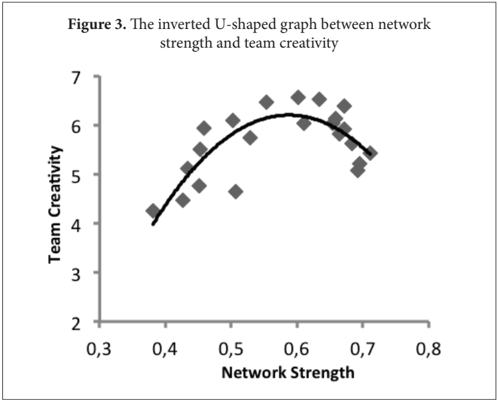
This research explores the relationship between shared leadership and creativity in engineering design teams.To do this, a social network perspective was adopted using four measures to assess key elements of shared leadership networks.These are (a) network density, (b) centralization, (c) efficiency and (d) strength.Data was collected from a sample of 22 engineering design teams who adopt a shared leadership approach.Our results support previous findings that the density of a shared leadership network is positively related to team creativity.In contrast, we learned that centralization exerts a negative influence on it.Moreover, while we found that there is no evidence to support a positive correlation between efficiency and team creativity, we demonstrate an inverted U-shaped relationship between strength and team creativity in a shared leadership network.These findings are important because they add to the academic debate in the shared leadership area and provide valuable insights for managers.
Overview
The claims and statistics of this paper haven’t been checked yet.
Free: it reads the open-access text and checks the first 5 claims that cite a source we can check. Create a free account to check every claim.
Integrity signals
Registry
Cites
Statistics
Figures

Verification
Claims the paper makes
The claims and statistics of this paper haven’t been checked yet.
Free: it reads the open-access text and checks the first 5 claims that cite a source we can check. Create a free account to check every claim.
Claims other papers make about this one
Each is checked against this paper’s own text: does it say what the citing paper says it does?
The source backs part of the claim, not all of it — or backs it for a different population, condition or comparison.
In the citing paper
“Free and open collaboration has been shown to increase creativity in felds as diverse as software development [59], musical improvisation [49], and engineering design [59].”
From When is a Tool a Tool? User Perceptions of System Agency in Human–AI Co-Creative Drawing (2023) · cites this paper as [59]
Experimental — accuracy not yet measured
Self-check
Percentages, sums and reported differences re-computed from the paper’s own numbers.
The self-check needs the paper’s full text.
Citations
Cites
Tabachnick, B. G., & Fidell, L. S. (1983) · Cited by 80,054
Granovetter, M. S. (1973) · American Journal of Sociology · doi:10.1086/225469 · Cited by 40,491
Multiple regression: testing and interpreting interactions
(1992) · Choice Reviews Online · doi:10.5860/choice.29-3352 · Cited by 36,654
Social Network Analysis: Methods and Applications
Wasserman, S. S., & Faust, K. (1994) · Cited by 17,991
Centrality in social networks conceptual clarification
Freeman, L. C. (1978) · Social Networks · doi:10.1016/0378-8733(78)90021-7 · Cited by 17,062
Efficient behavior of small-world networks
Latora, V., & Marchiori, M. (2001) · Physical Review Letters · doi:10.1103/physrevlett.87.198701 · Cited by 5,119
Structural Holes: The Social Structure of CompetitionPreprint
Burt, R. S. (1992) · SSRN Electronic Journal · Cited by 3,048
Personal Factors Associated with Leadership: A Survey of the Literature
Stogdill, R. M. (1948) · The Journal of Psychology · doi:10.1080/00223980.1948.9917362 · Cited by 2,535
SOCIAL NETWORKS AND THE PERFORMANCE OF INDIVIDUALS AND GROUPS.
Sparrowe, R. T., Liden, R. C., Wayne, S. J., & Kraimer, M. L. (2001) · Academy of Management Journal · doi:10.2307/3069458 · Cited by 1,910
The Social Side of Creativity: A Static and Dynamic Social Network Perspective
Perry-Smith, J. E., & Shalley, C. E. (2003) · The Academy of Management Review · doi:10.2307/30040691 · Cited by 1,750
Shared Leadership: Reframing the Hows and Whys of Leadership
Pearce, C., & Conger, J. (2003) · Sage eBooks · doi:10.4135/9781452229539 · Cited by 1,732
Trust as an Organizing Principle
McEvily, B., Perrone, V., & Zaheer, A. (2003) · Organization Science · doi:10.1287/orsc.14.1.91.12814 · Cited by 1,673
SHARED LEADERSHIP IN TEAMS: AN INVESTIGATION OF ANTECEDENT CONDITIONS AND PERFORMANCE.
CARSON, J. B., TESLUK, P. E., & MARRONE, J. A. (2007) · Academy of Management Journal · doi:10.2307/20159921 · Cited by 1,432
Work Groups and Teams in Organizations
Kozlowski, S. W. J., & Bell, B. S. (2003) · Handbook of Psychology · doi:10.1002/0471264385.wei1214 · Cited by 1,383
Pearce, C. L., & Jr. Sims Henry, P. (2002) · Group Dynamics Theory Research and Practice · doi:10.1037//1089-2699.6.2.172 · Cited by 1,303
Applied Linear Regression Models.
Thoni, H., Neter, J., Wasserman, W., & Kutner, M. H. (1990) · Biometrics · doi:10.2307/2531657 · Cited by 916
Zaccaro, S. J., Rittman, A. L., & Marks, M. A. (2001) · The Leadership Quarterly · doi:10.1016/s1048-9843(01)00093-5 · Cited by 850
Ensley, M. D., Hmieleski, K. M., & Pearce, C. L. (2006) · The Leadership Quarterly · doi:10.1016/j.leaqua.2006.02.002 · Cited by 820
The future of leadership: Combining vertical and shared leadership to transform knowledge work
Pearce, C. L. (2004) · Academy of Management Perspectives · doi:10.5465/ame.2004.12690298 · Cited by 793
Day, D. V., Gronn, P., & Salas, E. (2004) · The Leadership Quarterly · doi:10.1016/j.leaqua.2004.09.001 · Cited by 763
Dynamic Delegation: Shared, Hierarchical, and Deindividualized Leadership in Extreme Action Teams
Klein, K. J., Ziegert, J. C., Knight, A. P., & Xiao, Y. (2006) · Administrative Science Quarterly · doi:10.2189/asqu.51.4.590 · Cited by 755
A Little Creativity Goes a Long Way: An Examination of Teams’ Engagement in Creative Processes
Gilson, L. L., & Shalley, C. E. (2004) · Journal of Management · doi:10.1016/j.jm.2003.07.001 · Cited by 729
The Development of Social Network Analysis
(2013) · Social Network Analysis · doi:10.4135/9781529682557.n2 · Cited by 652
Distributed leadership in teams: The network of leadership perceptions and team performance
Mehra, A., Smith, B. R., Dixon, A. L., & Robertson, B. (2006) · The Leadership Quarterly · doi:10.1016/j.leaqua.2006.02.003 · Cited by 604
The ties that lead: A social network approach to leadership
Balkundi, P., & Kilduff, M. (2005) · The Leadership Quarterly · doi:10.1016/j.leaqua.2005.09.004 · Cited by 595
Virtuality, communication, and new product team creativity: a social network perspective
Leenders, R. T. A. J., van Engelen, J. M. L., & Kratzer, J. (2003) · Journal of Engineering and Technology Management · doi:10.1016/s0923-4748(03)00005-5 · Cited by 565
Leadership from a Communication Perspective
Tourish, D. (2016) · Oxford Research Encyclopedia of Communication · doi:10.1093/acrefore/9780190228613.013.13 · Cited by 395
The strength-of-weak-ties perspective on creativity: A comprehensive examination and extension.
Baer, M. (2010) · Journal of Applied Psychology · doi:10.1037/a0018761 · Cited by 394
Dependence and Risk: Transforming the Structure of Social Exchange
Molm, L. D. (1994) · Social Psychology Quarterly · doi:10.2307/2786874 · Cited by 386
Social network analysis and the evaluation of leadership networks
Hoppe, B., & Reinelt, C. (2010) · The Leadership Quarterly · doi:10.1016/j.leaqua.2010.06.004 · Cited by 327
The Shared Leadership Process in Decision-Making Teams
Bergman, J. Z., Rentsch, J. R., Small, E. E., Davenport, S. W., & Bergman, S. M. (2012) · The Journal of Social Psychology · doi:10.1080/00224545.2010.538763 · Cited by 255
Goal specific social capital and job satisfaction
Flap, H., & Völker, B. (2001) · Social Networks · doi:10.1016/s0378-8733(01)00044-2 · Cited by 244
Cox, J. F., Pearce, C. L., & Perry, M. L. (2003) · Shared Leadership: Reframing the Hows and Whys of Leadership · doi:10.4135/9781452229539.n3 · Cited by 196
Shared Leadership in Teams: A Matter of Distribution
Engel Small, E., & Rentsch, J. R. (2010) · Journal of Personnel Psychology · doi:10.1027/1866-5888/a000017 · Cited by 189
Yu, Y., Fulk, J. L., Monge, P. R., & Contractor, N. (2009) · Communication Research · doi:10.1177/0093650209351469 · Cited by 166
Fransen, K., Puyenbroeck, S. V., Loughead, T. M., Vanbeselaere, N., Cuyper, B. D., Broek, G. V., & Boen, F. (2015) · Social Networks · doi:10.1016/j.socnet.2015.04.003 · Cited by 164
An analysis of shared leadership, diversity, and team creativity in an e-learning environment
Lee, D. S., Lee, K. C., Seo, Y. W., & Choi, D. Y. (2014) · Computers in Human Behavior · doi:10.1016/j.chb.2013.10.064 · Cited by 150
Kratzer, J., Leenders, R., & van Engelen, J. M. L. (2009) · International Journal of Project Management · doi:10.1016/j.ijproman.2009.09.007 · Cited by 107
The social structure of leadership and creativity in engineering design teams: An empirical analysis
Kratzer, J., Leenders, R., & van Engelen, J. M. L. (2008) · Journal of Engineering and Technology Management · doi:10.1016/j.jengtecman.2008.10.004 · Cited by 92
Exploring the impact of shared leadership on management team member job outcomes
Shane Wood, M., & Fields, D. (2007) · Baltic Journal of Management · doi:10.1108/17465260710817474 · Cited by 82
Shared leadership effectiveness in independent professional teams
Muethel, M., & Hoegl, M. (2012) · European Management Journal · doi:10.1016/j.emj.2012.11.008 · Cited by 73
Assessing Group-Level Constructs Under Missing Data Conditions: A Monte Carlo Simulation
Maloney, M. M., Johnson, S. G., & Zellmer-Bruhn, M. E. (2010) · Small Group Research · doi:10.1177/1046496410363829 · Cited by 62
Organizational Factors for Exploration and Exploitation
Pandey, S., & sharma, R. (2009) · Journal of technology management & innovation · doi:10.4067/s0718-27242009000100005 · Cited by 59
Individual Creativity and the Influence of Mindful Leaders on Enterprise Innovation
Gehani, R. R. (2011) · Journal of technology management & innovation · doi:10.4067/s0718-27242011000300006 · Cited by 43
Project Management for Engineering Design
Lessard, C. S., & Lessard, J. (2007) · Synthesis lectures on engineering · doi:10.1007/978-3-031-79303-5 · Cited by 17
Flap, H., & Völker, B. (2001) · University of Groningen research database (University of Groningen / Centre for Information Technology) · Cited by 11
Fransen, K., Puyenbroeck, S. V., Loughead, T. M., Vanbeselaere, N., Cuyper, B. D., Broek, G. V., & Boen, F. (2017) · SportRxiv (OSF Preprints) · doi:10.31236/osf.io/7srax · Cited by 6
Bubenzer, P. (2016) · Cited by 2
Research works printed but not linked: 2
- Hackman, M. Z., & Johnson, C. E. (2013). Leadership: A communica- tion perspective: Waveland Press.
- Kutner, M. H., Nachtsheim, C., & Neter, J. (2004). Applied linear re- gression models: McGraw-Hill/Irwin.
Cited by
A Meta-Analysis of Shared Leadership: Antecedents, Consequences, and Moderators
Wu, Q., Cormican, K., & Chen, G. (2020) · Journal of Leadership & Organizational Studies · doi:10.1177/1548051818820862 · Cited by 170
Self-citationWu, C.-M., & Chen, T.-J. (2018) · International Journal of Hospitality Management · doi:10.1016/j.ijhm.2018.02.003 · Cited by 164
Shared leadership in project teams: An integrative multi-level conceptual model and research agenda
Scott‐Young, C. M., Georgy, M., & Grisinger, A. (2019) · International Journal of Project Management · doi:10.1016/j.ijproman.2019.02.002 · Cited by 178
Bagheri, A., Akbari, M., & Artang, A. (2020) · European Journal of Innovation Management · doi:10.1108/ejim-07-2020-0281 · Cited by 161
Song, Z., Gu, Q., & Cooke, F. L. (2019) · Human Resource Management · doi:10.1002/hrm.21988 · Cited by 131
Metadata
- Authors
- Wu, Q., & Cormican, K.
- Affiliations
- Ollscoil na Gaillimhe – University of Galway (IE)
- Corresponding author
- Wu, Qiong
- Venue
- Journal of technology management & innovation
- Published
- 2016-06
- Volume
- 11
- Issue
- 2
- Pages
- 2-12
- ISSN
- 0718-2724 (ISSN-L)
- OpenAlex
- W2466274021
- Cited by
- 49
- References
- 49
- Citations by year
- 2025: 2 · 2024: 6 · 2023: 7 · 2022: 5 · 2021: 7 · 2020: 8 · 2019: 7 · 2018: 3 · 2017: 3 · 2016: 1
- FWCI
- 7.35
- Type
- journal article
- Language
- en
- Open access
- diamond
- doi.org
- Licence
- cc-by-nc
- Locations
- Journal of technology management & innovation (publishedVersion, cc-by-nc)
- LA Referencia (Red Federada de Repositorios Institucionales de Publicaciones Científicas) (publishedVersion, other-oa)
- Redalyc (Universidad Autónoma del Estado de México) (submittedVersion)
- Americanae (AECID Library) (submittedVersion, other-oa)
- DOAJ (DOAJ: Directory of Open Access Journals) (submittedVersion)
- Topics
- Social Sciences › Psychology › Social Psychology › Team Dynamics and Performance
- Physical Sciences › Engineering › Mechanical Engineering › Design Education and Practice
- Social Sciences › Decision Sciences › Information Systems and Management › Knowledge Management and Sharing
- Keywords
- shared leadership, team creativity, engineering design teams, leadership networks, network density, network centralization, network efficiency, network strength, inverted U-shaped relationship
About these checks
Registry, retraction, Cites and statistics results are computed, not judged, with one exception: a printed reference that no index lists is read once by a model before it counts as a citation error. Claims are extracted by a model and kept only when their quote appears verbatim in the text; each cited source is then checked, with a model’s help, for whether it says what the claim relies on. Those verdicts can be wrong — read the claim’s quote and the cited source before relying on one.
Statistics and arithmetic are recomputed, not judged.
Confidence bands are shown only for fields calibrated on our annotated test set. None is calibrated yet, so no band is shown.
What counts as a claim ›How we measure confidence ›How we check this ›
Are you an author, or do you see a problem with this page? Request a review
Data sources
Bibliographic data: Semantic Scholar, OpenAlex, Crossref.
Contains information from the Semantic Scholar Academic Graph Datasets, made available under the ODC Attribution License (ODC-BY 1.0).
Semantic Scholar’s data is described in: Kinney, R., et al. (2023). The Semantic Scholar Open Data Platform. arXiv:2301.10140.
