

The DOI matches its Crossref record; 52 of the 52 references it cites were found in a registry or an index.
The Role of Advanced Glycation End Products in Diabetic Vascular Complications
Open accessAbstract
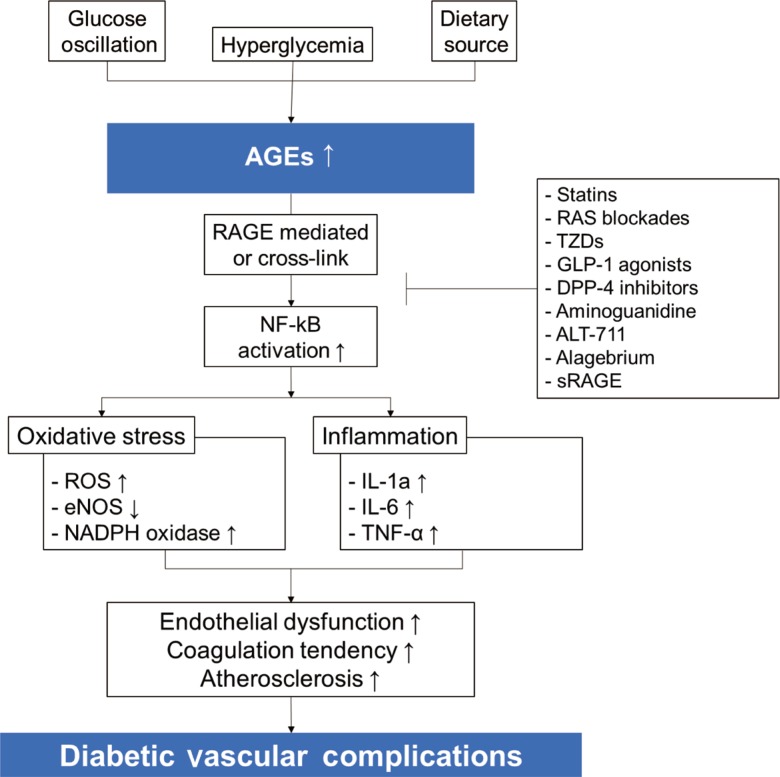
In cases of chronic hyperglycemia, advanced glycation end-products (AGEs) are actively produced and accumulated in the circulating blood and various tissues. AGEs also accelerate the expression of receptors for AGEs, and they play an important role in the development of diabetic vascular complications through various mechanisms. Active interventions for glucose and related risk factors may help improve the clinical course of patients by reducing AGEs. This review summarizes recent updates on AGEs that have a significant impact on diabetic vascular complications.
Overview
The claims and statistics of this paper haven’t been checked yet.
Run the check — free, no account needed. It reads the open-access text and checks the sources it cites.
Integrity signals
Registry
Cites
Statistics
Figures
Verification
Claims the paper makes
The claims and statistics of this paper haven’t been checked yet.
Run the check — free, no account needed. It reads the open-access text and checks the sources it cites.
Claims other papers make about this one
Each is checked against this paper’s own text: does it say what the citing paper says it does?
In the citing paper
“Endogenous AGEs represent adducts that are produced and slowly accumulated within the body during the normal aging process and under the oxidative stress, inflammatory, and hyperglycemic (high blood sugar) conditions often observed in diabetes and other metabolic syndromes1,4,12,13.”
From Advanced glycation end products (AGEs) and other adducts in aging-related diseases and alcohol-mediated tissue injury (2021) · cites this paper as [12]
Self-check
Percentages, sums and reported differences re-computed from the paper’s own numbers.
The self-check needs the paper’s full text.
Citations
Cites
10-year follow-up of intensive glucose control in type 2 diabetes
Holman, R. R., Paul, S. K., Bethel, M. A., Matthews, D. R., & Neil, H. A. W. (2008) · New England Journal of Medicine · doi:10.1056/nejmoa0806470 · Cited by 7,751
Advanced glycation end-products: A review
Singh, R., Barden, A., Mori, T., & Beilin, L. (2001) · Diabetologia · doi:10.1007/s001250051591 · Cited by 2,597
Advanced Glycation End Products and Diabetic Complications
Singh, V. P., Bali, A., Singh, N., & Jaggi, A. S. (2014) · The Korean Journal of Physiology & Pharmacology · doi:10.4196/kjpp.2014.18.1.1 · Cited by 1,518
Advanced glycation end products in foods and a practical guide to their reduction in the diet
Uribarri, J., Woodruff, S., Goodman, S., Cai, W., Chen, X., Pyzik, R., Yong, A., Striker, G. E., & Vlassara, H. (2010) · Journal of the American Dietetic Association · doi:10.1016/j.jada.2010.03.018 · Cited by 1,289
Bucala, R., Tracey, K. J., & Cerami, A. (1991) · Journal of Clinical Investigation · doi:10.1172/jci115014 · Cited by 1,162
Writing Team for the Diabetes Control and Complications Trial/Epidemiology of Diabetes Interventions and Complications Research Group (2003) · JAMA · doi:10.1001/jama.290.16.2159 · Cited by 1,009
Diabetes and advanced glycation endproducts
Vlassara, H., & Palace, M. R. (2002) · Journal of Internal Medicine · doi:10.1046/j.1365-2796.2002.00932.x · Cited by 723
YONEKURA, H., YAMAMOTO, Y., SAKURAI, S., PETROVA, R. G., ABEDIN, M. J., LI, H., YASUI, K., TAKEUCHI, M., MAKITA, Z., TAKASAWA, S., et al. (2003) · Biochemical Journal · doi:10.1042/bj20021371 · Cited by 716
Lo, T. W. C., Westwood, M. E., McLellan, A. C., Selwood, T., & Thornalley, P. J. (1994) · Journal of Biological Chemistry · doi:10.1016/s0021-9258(18)31635-1 · Cited by 695
Bierhaus, A. (1998) · Cardiovascular Research · doi:10.1016/s0008-6363(97)00233-2 · Cited by 554
Yamagishi, S., & Imaizumi, T. (2005) · Current Pharmaceutical Design · doi:10.2174/1381612054367300 · Cited by 455
Soulis, T., Cooper, M. E., Papazoglou, D., Clarke, B., & Jerums, G. (1991) · Diabetes · doi:10.2337/diabetes.40.10.1328 · Cited by 446
Uribarri, J., Cai, W., Sandu, O. A., Peppa, Μ., Goldberg, T., & Vlassara, H. (2005) · Annals of the New York Academy of Sciences · doi:10.1196/annals.1333.052 · Cited by 428
Dietary Advanced Glycation End Products and Aging
Luevano-Contreras, C., & Chapman-Novakofski, K. (2010) · Nutrients · doi:10.3390/nu2121247 · Cited by 396
Cipollone, F., Iezzi, A., Fazia, M. L., Zucchelli, M., Pini, B., Cuccurullo, C., Cesare, D. D., Blasis, G. D., Muraro, R., Bei, R., et al. (2003) · Circulation · doi:10.1161/01.cir.0000086014.80477.0d · Cited by 377
Inhibition of advanced glycation endproduct formation by foodstuffs
Wu, C., Huang, S.-M., Lin, J., & Yen, G. (2011) · Food & Function · doi:10.1039/c1fo10026b · Cited by 328
Advanced Glycation End Product Interventions Reduce Diabetes-Accelerated Atherosclerosis
Forbes, J. M., Yee, L. T. L., Thallas, V., Lassila, M., Candido, R., Jandeleit-Dahm, K. A. M., Thomas, M. C., Burns, W. C., Deemer, E. K., Thorpe, S. R., et al. (2004) · Diabetes · doi:10.2337/diabetes.53.7.1813 · Cited by 314
Yamagishi, S. (2010) · Experimental Gerontology · doi:10.1016/j.exger.2010.11.007 · Cited by 312
Diabetes and atherosclerosis: is there a role for hyperglycemia?
Chait, A., & Bornfeldt, K. (2008) · Journal of Lipid Research · doi:10.1194/jlr.r800059-jlr200 · Cited by 298
Methylglyoxal-Derived Hydroimidazolone Advanced Glycation End-Products of Human Lens Proteins
Ahmed, N., Thornalley, P. J., Dawczynski, J., Franke, S., Strobel, J., Stein, G., & HAIK, G. M. (2003) · Investigative Ophthalmology & Visual Science · doi:10.1167/iovs.03-0573 · Cited by 282
Hanford, L. E., Enghild, J. J., Valnickova, Z., Petersen, S. V., Schaefer, L. M., Schaefer, T. M., Reinhart, T. A., & Oury, T. D. (2004) · Journal of Biological Chemistry · doi:10.1074/jbc.m409782200 · Cited by 215
Thornalley, P. J., Yurek‐George, A., & Argirov, O. (2000) · Biochemical Pharmacology · doi:10.1016/s0006-2952(00)00287-2 · Cited by 214
Berg, T. J., Nørgaard, K., Faber, J. O., Torjesen, P. A., Hildebrandt, P. R., Mehlsen, J., & Hanssen, K. F. (1999) · Diabetes Care · doi:10.2337/diacare.22.7.1186 · Cited by 212
Regulation of Vascular Endothelial Growth Factor Expression by Advanced Glycation End Products
Treins, C., Giorgetti-Peraldi, S., Murdaca, J., & Van Obberghen, E. (2001) · Journal of Biological Chemistry · doi:10.1074/jbc.m106534200 · Cited by 191
Advanced Glycation End Products: A Molecular Target for Vascular Complications in Diabetes
Yamagishi, S., Nakamura, N., Suematsu, M., Kaseda, K., & Matsui, T. (2015) · Molecular Medicine · doi:10.2119/molmed.2015.00067 · Cited by 179
Atherosclerosis and diabetes: The rage connection
Schmidt, A. M., & Stern, D. M. (2000) · Current Atherosclerosis Reports · doi:10.1007/s11883-000-0082-4 · Cited by 167
Ojima, A., Ishibashi, Y., Matsui, T., Maeda, S., Nishino, Y., Takeuchi, M., Fukami, K., & Yamagishi, S.-I. (2013) · The American Journal of Pathology · doi:10.1016/j.ajpath.2012.09.016 · Cited by 156
Nakamura, K., Yamagishi, S., Adachi, H., Kurita‐Nakamura, Y., Matsui, T., Yoshida, T., Sato, A., & Imaizumi, T. (2006) · Diabetes/Metabolism Research and Reviews · doi:10.1002/dmrr.690 · Cited by 143
Advanced glycation end products accelerate rat vascular calcification through RAGE/oxidative stress
Qin, W. D., Ren, X., Jiang, Y., Jin, H. L., Liu, N., & Li, J. (2013) · BMC Cardiovascular Disorders · doi:10.1186/1471-2261-13-13 · Cited by 142
Naka, Y., Bucciarelli, L. G., Wendt, T., Lee, L. K., Rong, L., Ramasamy, R., Yan, S. F., & Schmidt, A. M. (2004) · Arteriosclerosis Thrombosis and Vascular Biology · doi:10.1161/01.atv.0000133191.71196.90 · Cited by 138
Nakamura, K., Yamagishi, S., Adachi, H., Kurita‐Nakamura, Y., Matsui, T., Yoshida, T., & Imaizumi, T. (2007) · Molecular Medicine · doi:10.2119/2006-00090.nakamura · Cited by 134
Koska, J., Saremi, A., Howell, S., Bahn, G., De Courten, B., Ginsberg, H., Beisswenger, P. J., Reaven, P. D., & for the VADT Investigators (2018) · Diabetes Care · doi:10.2337/dc17-1740 · Cited by 134
Coughlan, M. T., Thallas-Bonke, V., Pete, J., Long, D. M., Gasser, A., Tong, D. C. K., Arnstein, M., Thorpe, S. R., Cooper, M. E., & Forbes, J. M. (2007) · Endocrinology · doi:10.1210/en.2006-1300 · Cited by 124
Yamagishi, S., Ueda, S., & Okuda, S. (2007) · Current Pharmaceutical Design · doi:10.2174/138161207781757051 · Cited by 119
Yamagishi, S., Nakamura, K., Matsui, T., Noda, Y., & Imaizumi, T. (2008) · Current Pharmaceutical Design · doi:10.2174/138161208783597416 · Cited by 104
Mechanisms by which diabetes increases cardiovascular disease
Gleissner, C. A., Galkina, E., Nadler, J. L., & Ley, K. F. (2007) · Drug Discovery Today Disease Mechanisms · doi:10.1016/j.ddmec.2007.12.005 · Cited by 99
Luévano‐Contreras, C., Garay‐Sevilla, M. E., Wróbel, K., Malacara, J. M., & Wróbel, K. (2012) · Journal of Clinical Biochemistry and Nutrition · doi:10.3164/jcbn.12-40 · Cited by 92
Nakashima, S., Matsui, T., Takeuchi, M., & Yamagishi, S.-I. (2014) · Hormone and Metabolic Research · doi:10.1055/s-0034-1371892 · Cited by 90
Yamagishi, S., Nakamura, K., & Matsui, T. (2009) · Pharmacological Research · doi:10.1016/j.phrs.2009.01.006 · Cited by 81
Ishibashi, Y., Yamagishi, S., Matsui, T., Ohta, K., Tanoue, R., Takeuchi, M., Ueda, S., Nakamura, K., & Okuda, S. (2012) · Metabolism · doi:10.1016/j.metabol.2012.01.006 · Cited by 80
Role of Advanced Glycation End Products (AGEs) in Thrombogenic Abnormalities in Diabetes
Takenaka, K., Yamagishi, S., Matsui, T., Nakamura, K., & Imaizumi, T. (2006) · Current Neurovascular Research · doi:10.2174/156720206775541804 · Cited by 77
Ihm, S., Chang, K., Kim, H.-Y., Baek, S. H., Youn, H., Seung, K., & Kim, J. (2009) · Basic Research in Cardiology · doi:10.1007/s00395-009-0071-x · Cited by 75
Xu, B., Ji, Y. H., Kang, Y., Cao, Y., & Ferro, A. (2005) · Clinical Science · doi:10.1042/cs20050183 · Cited by 66
Yamagishi, S., Nakamura, K., & Matsui, T. (2007) · Current Molecular Medicine · doi:10.2174/156652407781387073 · Cited by 62
Chung, N. A. Y., Lydakis, C., Belgore, F., Li-Saw-Hee, F. L., Blann, A. D., & Lip, G. Y. H. (2003) · Heart · doi:10.1136/heart.89.12.1411 · Cited by 57
Matsui, T., Nakashima, S., Nishino, Y., Ojima, A., Nakamura, N., Arima, K., Fukami, K., Okuda, S., & Yamagishi, S. (2015) · Laboratory Investigation · doi:10.1038/labinvest.2015.35 · Cited by 51
Yamagishi, S., Adachi, H., Takeuchi, M., Enomoto, M., Furuki, K., Matsui, T., Nakamura, K., & Imaizumi, T. (2007) · Hormone and Metabolic Research · doi:10.1055/s-2007-991176 · Cited by 36
Cheng, C. L., Tang, Y., Zheng, Z., Liu, X., Ye, Z. C., Wang, C., & Lou, T. (2012) · Clinical and investigative medicine · doi:10.25011/cim.v35i5.18701 · Cited by 33
Cooking Methods for Red Meats and Risk of Type 2 Diabetes: A Prospective Study of U.S. Women
Liu, G., Zong, G., Hu, F. B., Willett, W. C., Eisenberg, D. M., & Sun, Q. (2017) · Diabetes Care · doi:10.2337/dc17-0204 · Cited by 31
Kwok, J. M. F., Ma, C. C.-H., & Ma, S. (2012) · Vascular Pharmacology · doi:10.1016/j.vph.2012.10.003 · Cited by 24
Geronikaki, A. A., Gavalas, A., Dislian, V., & Giannoglou, G. D. (2007) · Cardiovascular & Hematological Agents in Medicinal Chemistry · doi:10.2174/187152507782109926 · Cited by 12
Yamagishi, S. (2008) · European Heart Journal · doi:10.1093/eurheartj/ehn244 · Cited by 6
Research works printed but not linked: 1
- Soulis-Liparota, 1991, Diabetes, 40, 1328, 10.2337/diab.40.10.1328 · DOI
Cited by
Sorted by citations
Pisoschi, A. M., Pop, A., Iordache, F., Stanca, L., Predoi, G., & Șerban, A. I. (2020) · European Journal of Medicinal Chemistry · doi:10.1016/j.ejmech.2020.112891 · Cited by 883
Papachristoforou, E., Lambadiari, V., Maratou, E., & Makrilakis, K. (2020) · Journal of Diabetes Research · doi:10.1155/2020/7489795 · Cited by 519
Rungratanawanich, W., Qu, Y., Wang, X., Essa, M. M., & Song, B.-J. (2021) · Experimental & Molecular Medicine · doi:10.1038/s12276-021-00561-7 · Cited by 411
Health benefits of resveratrol administration
Galiniak, S., Aebisher, D., & Bartusik‐Aebisher, D. (2019) · Acta Biochimica Polonica · doi:10.18388/abp.2018_2749 · Cited by 349
Novel advances in inhibiting advanced glycation end product formation using natural compounds
Song, Q., Liu, J., Dong, L., Wang, X., & Zhang, X. (2021) · Biomedicine & Pharmacotherapy · doi:10.1016/j.biopha.2021.111750 · Cited by 259
Metadata
- Authors
- Rhee, S. Y., & Kim, Y. S.
- Affiliations
- Kyung Hee University (KR)
- Corresponding author
- Kim, Young Seol
- Venue
- Diabetes & Metabolism Journal
- Publisher
- Korean Diabetes Association
- Published
- 2018
- Volume
- 42
- Issue
- 3
- Pages
- 188
- ISSN
- 2233-6079 (ISSN-L)
- 2233-6087
- PMC
- PMC6015964
- OpenAlex
- W2806671364
- Cited by
- 274
- References
- 52
- Citations by year
- 2026: 20 · 2025: 33 · 2024: 20 · 2023: 25 · 2022: 44 · 2021: 58 · 2020: 46 · 2019: 24 · 2018: 3
- FWCI
- 4.26
- Type
- journal article
- Language
- en
- Open access
- gold
- doi.org
- Licence
- Locations
- Diabetes & Metabolism Journal (publishedVersion, cc-by-nc)
- Europe PMC (PubMed Central) (publishedVersion, cc-by-nc)
- PubMed Central (publishedVersion, cc-by-nc)
- PubMed (publishedVersion)
- DOAJ (DOAJ: Directory of Open Access Journals) (submittedVersion, cc-by-sa)
- Funders
- Ministry of Health and Welfare (HI10C2020)
- Topics
- Life Sciences › Biochemistry, Genetics and Molecular Biology › Clinical Biochemistry › Advanced Glycation End Products research
- Health Sciences › Medicine › Nephrology › Chronic Kidney Disease and Diabetes
- Health Sciences › Medicine › Dermatology › Skin Diseases and Diabetes
- Keywords
- advanced glycation end products, diabetic vascular complications, chronic hyperglycemia, AGE receptor, AGE formation, glycemic control, diabetes complications
About these checks
Registry, retraction, Cites and statistics results are computed, not judged, with one exception: a printed reference that no index lists is read once by a model before it counts as a citation error. Claims are extracted by a model and kept only when their quote appears verbatim in the text; each cited source is then checked, with a model’s help, for whether it says what the claim relies on. Those verdicts can be wrong — read the claim’s quote and the cited source before relying on one.
Statistics and arithmetic are recomputed, not judged.
Confidence bands are shown only for fields calibrated on our annotated test set. None is calibrated yet, so no band is shown.
What counts as a claim ›How we measure confidence ›How we check this ›
Are you an author, or do you see a problem with this page? Request a review
