

The DOI matches its Crossref record; 22 of the 24 references it cites were found in a registry or an index.
The limbic system
Open accessAbstract
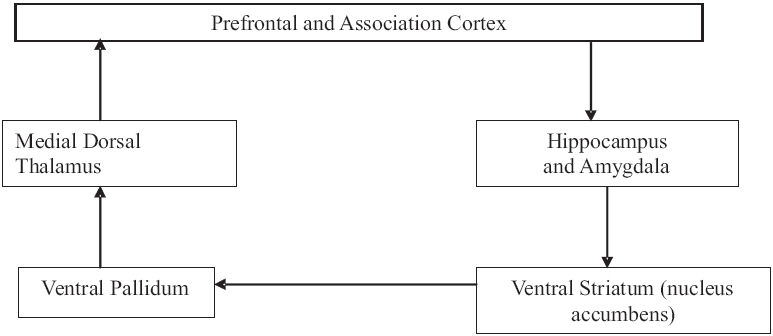
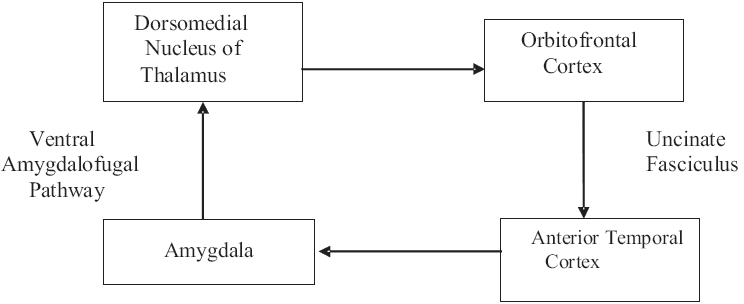
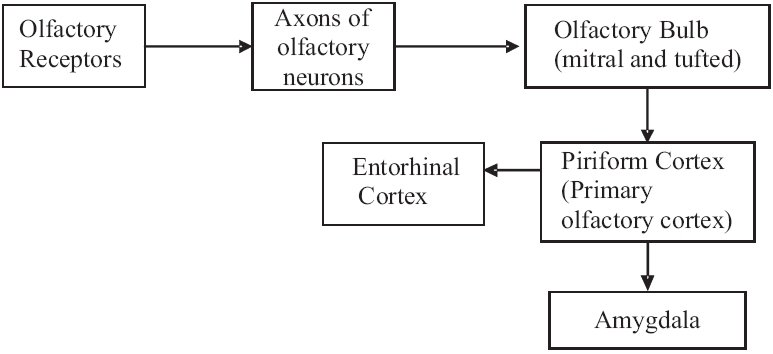
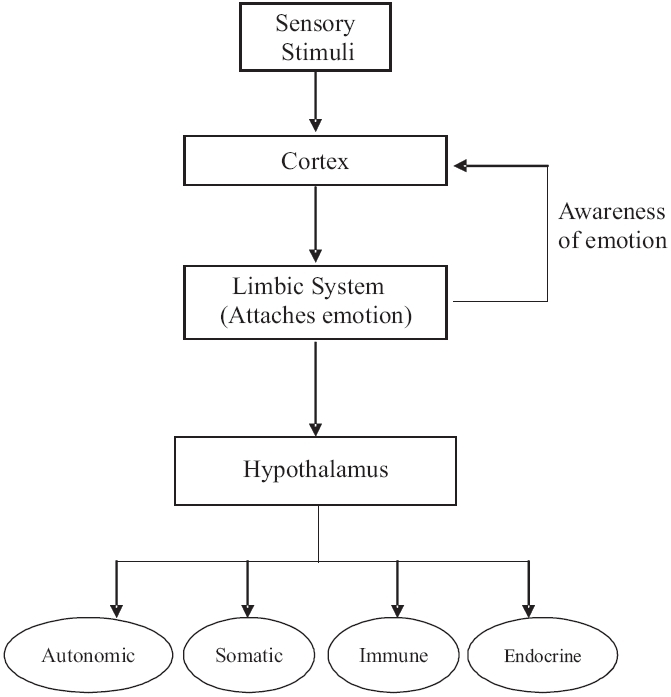
“The hypothalamus, the anterior thalamic nucleus, the cingulate gyrus, the hippocampus and their interconnections, constitute a harmonious mechanism which may elaborate the functions of central emotion as well as participate in the emotional expression.” James Papez, 1937 The limbic system consists of the phylogenetically old limbic lobe and other subcortical structures and their connections. Although not empirically proven, the limbic system is a functional concept which may be employed to explain various brain functions.[1] HISTORY Paul Pierre Broca in 1878 spoke of ‘le grand lobe limbique’ or the great limbic lobe and applied the term “limbic” (from the Latin limbus for border) to the curved rim of the cortex which incudes the cingulate and the parahippocampal gyri. However, its putative role in emotion was elaborated by the American physician, James Papez in 1937 in the seminal paper titled ‘A proposed mechanism of emotion’. This anatomical model is referred to as the Papez circuit.[2] Yakovlev in 1948 proposed Yakovlev's circuit in the control of emotion involving the orbitofrontal, insular and anterior temporal lobe cortex, the amygdala and the dorsomedial nucleus of thalamus.[3] In 1952, Paul D. MacLean coined the term “limbic system” to describe Broca's limbic lobe and related subcortical nuclei as the collective neural substrate for emotion.[1] MacLean was also instrumental in proposing and defining the Triune concept of the brain. MacLean's evolutionary “Triune brain theory” proposed that the human brain was in reality three brains in one: the R-complex (reptilian complex), the limbic system and the neocortex.[4] The concept of the limbic system has since been further expanded and developed by Nauta, Heimer and others. COMPONENTS OF THE LIMBIC SYSTEM There is no universal agreement on the total list of structures, which comprise the limbic system. The brain regions that constitute the limbic system are: Limbic cortex Cingulate gyrus Parahippocampal gyrus Hippocampal formation The dentate gyrus Hippocampus Subicular Complex Amygdala Septal area Hypothalamus These structures form a complex network for controlling emotion.[5] Limbic lobe The limbic lobe situated at the inferomedial aspect of the cerebral hemispheres, consists of two concentric gyri surrounding the corpus callosum. Broca proposed that the larger outer gyrus be named “limbic gyrus” and the smaller inner one “the intralimbic gyrus”. The limbic gyrus (limbic lobe) consists of the isthmus of the cingulate gyrus, the parahippocampal gyrus (both of which are continuous via a bundle of white matter called “cingulum”) and the subcallosal area.[6] The cingulate gyrus (Latin = Belt ridge) dorsal to the corpus callosum is heavily interconnected with the association areas of the cerebral cortex. The parahippocampal gyrus in the medial temporal lobe contains several distinct regions, the most important being the entorhinal cortex (ERC). The ERC funnels highly processed cortical information to the hippocampal formation and serves as its major output pathway.[5] The hippocampal formation Hippocampal formation in the temporal lobe has three distinct zones: The dentate gyrus The hippocampus proper The subiculum Embryologically, the hippocampal formation is an extension of the medial edge of the temporal lobe. The entire hippocampal formation has a length of about 5 cm from its anterior end at the amygdala to its tapering posterior end near the splenium of the corpus callosum.[5] Dentate gyrus The dentate gyrus is composed of three layers: an outer acellular molecular layer, a granular middle layer and an inner polymorphic layer. Hippocampus The word hippocampus means “Sea Horse” in Greek. Hippocampus is a trilaminate structure with an outer molecular layer, a middle pyramidal layer and an inner polymorphic layer. On the basis of differences in cytoarchitecture and connectivity, the hippocampus has four fields (named by Lorente de No in 1934): CA1, CA2, CA3 and CA4 (CA: Cornu Ammonis). To embryologic enthusiasts, CA4 is not part of the Cornu Ammonis but is a separate structure—the dentate hilus. The thin layer of fibers adjacent to the polymorphic layer of the hippocampus is known as the alveus. These fibres coalesce to form the fimbria and subsequently, the crura of the fornix (main efferent pathway of the hippocampal formation). The crura of the fornix converge to form the body of the fornix, which later forms the columns of the fornix and pass through the hypothalamus into the mammillary bodies.[57] Subicular complex The subicular complex has three components: the presubiculum, the parasubiculum and subiculum. Subiculum is the transitional zone between the six-layered, entorhinal cortex and the three-layered hippocampus.[5] Amygdala Identified by Burdach in the early 19th century, amygdala, an almond-shaped structure deep within the temporal lobe, is a collection of nuclei lying beneath the uncus. Lying at the anterior end of the hippocampal formati
Overview
The claims and statistics of this paper haven’t been checked yet.
Run the check — free, no account needed. It reads the open-access text and checks the sources it cites.
Integrity signals
Registry
Cites
Statistics
Figures
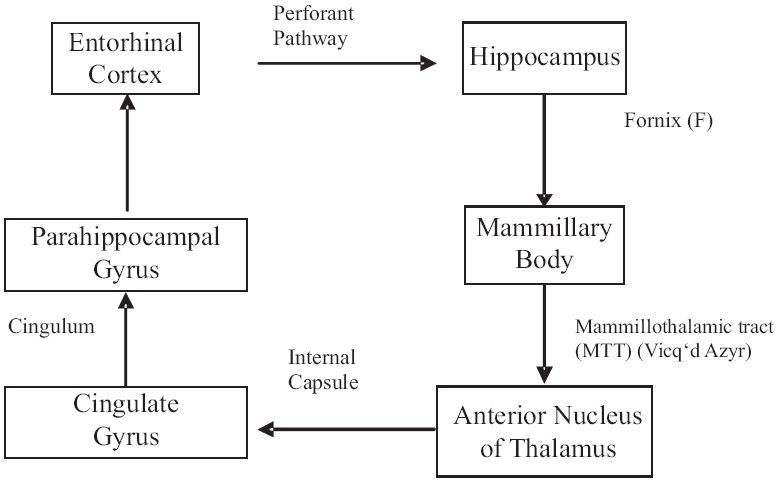
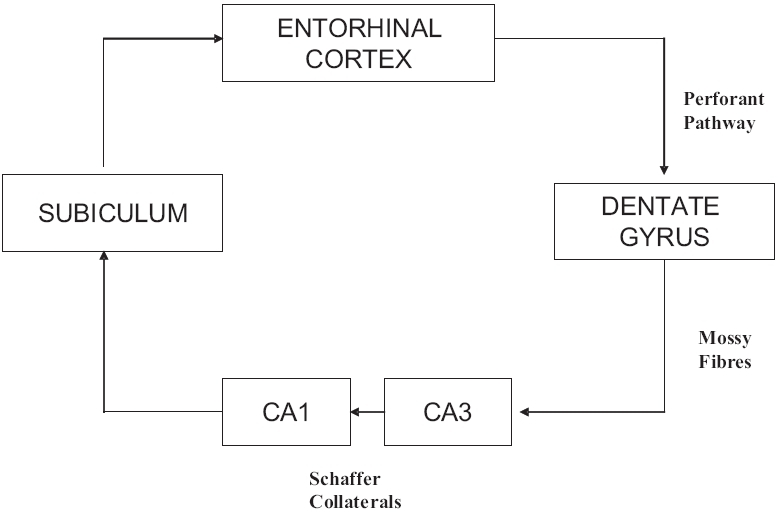
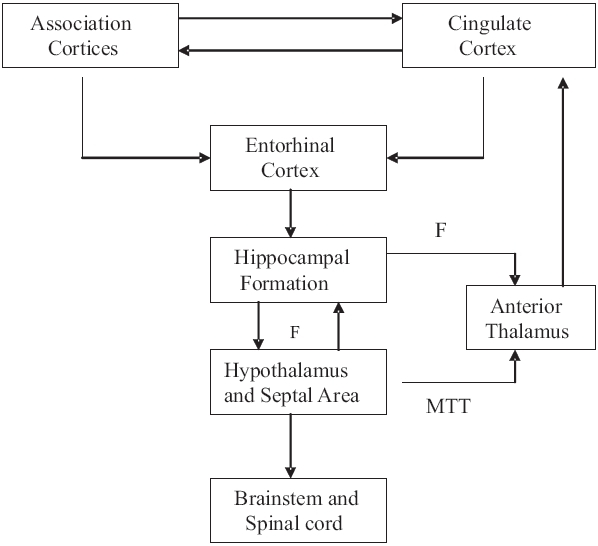
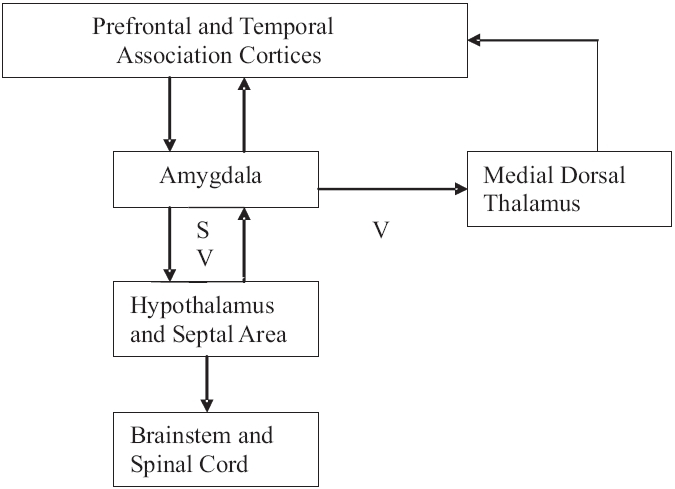
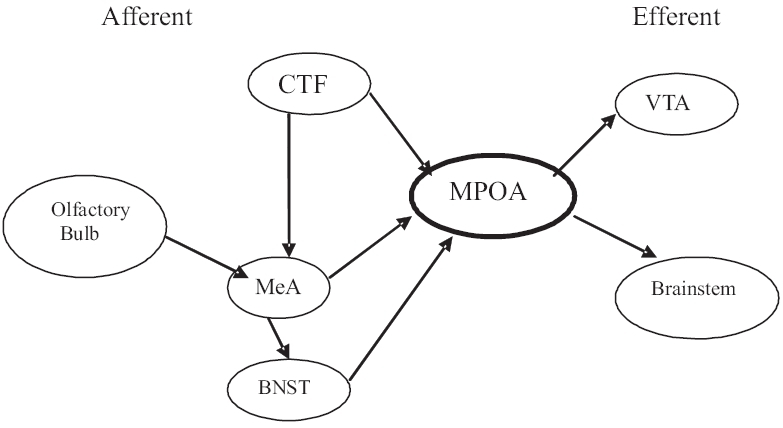
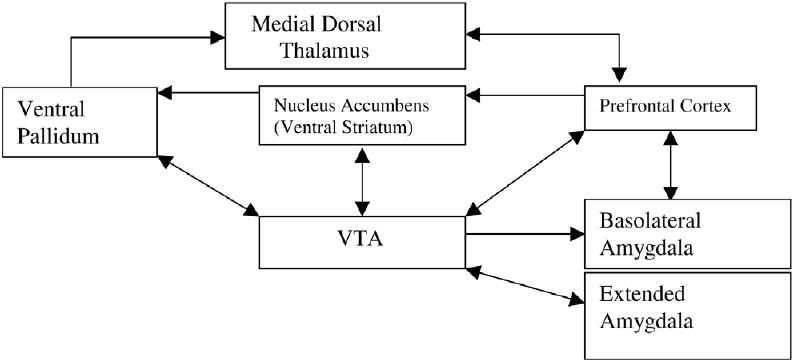
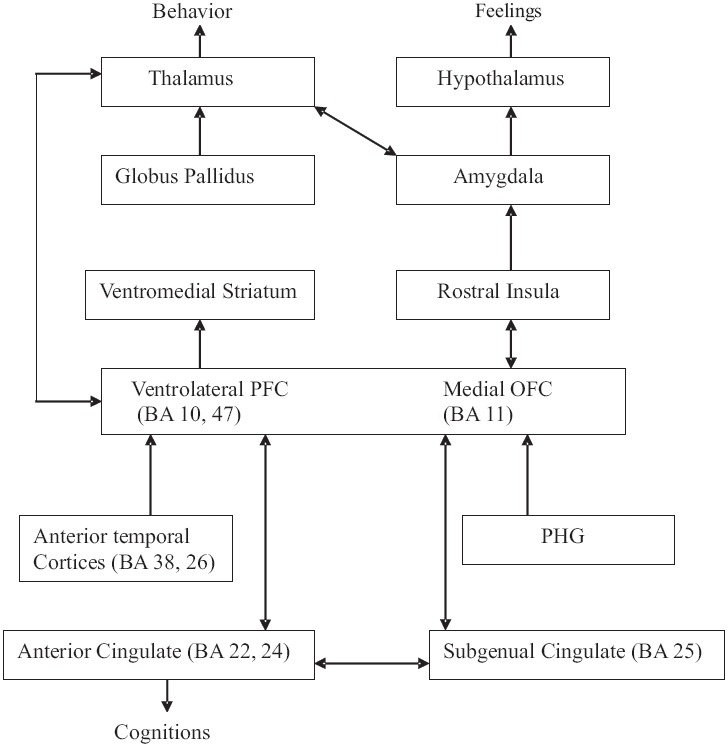
Verification
Claims the paper makes
The claims and statistics of this paper haven’t been checked yet.
Run the check — free, no account needed. It reads the open-access text and checks the sources it cites.
Claims other papers make about this one
Each is checked against this paper’s own text: does it say what the citing paper says it does?
The source backs part of the claim, not all of it — or backs it for a different population, condition or comparison.
In the citing paper
“so when the connection between the two is impaired, emotional lability can occur.”
From Approach to the patient with acquired hypothalamic syndrome (2026) · cites this paper as [86]
Experimental — accuracy not yet measuredThe cited source says what the claim attributes to it.
In the citing paper
“The limbic system affects emotional regulation and is integrally connected to the hypothalamus (86), so when the connection between the two is impaired, emotional lability can occur.”
From Approach to the patient with acquired hypothalamic syndrome (2026) · cites this paper as [86]
Self-check
Percentages, sums and reported differences re-computed from the paper’s own numbers.
The self-check needs the paper’s full text.
Citations
Cites
A PROPOSED MECHANISM OF EMOTION
PAPEZ, J. W. (1937) · Archives of Neurology And Psychiatry · doi:10.1001/archneurpsyc.1937.02260220069003 · Cited by 3,563
The Neural Basis of Addiction: A Pathology of Motivation and Choice
Kalivas, P. W., & Volkow, N. D. (2005) · American Journal of Psychiatry · doi:10.1176/appi.ajp.162.8.1403 · Cited by 2,757
The role of the hypothalamic-pituitary-adrenal axis in neuroendocrine responses to stress
Smith, S. M., & Vale, W. W. (2006) · Dialogues in Clinical Neuroscience · doi:10.31887/dcns.2006.8.4/ssmith · Cited by 1,948
Cognitive neuroscience of emotional memory
LaBar, K. S., & Cabeza, R. (2006) · Nature Reviews Neuroscience · doi:10.1038/nrn1825 · Cited by 1,834
The Amygdaloid Complex: Anatomy and Physiology
SAH, P., FABER, E. S. L., LOPEZ DE ARMENTIA, M., & POWER, J. (2003) · Physiological Reviews · doi:10.1152/physrev.00002.2003 · Cited by 1,745
The sleep switch: hypothalamic control of sleep and wakefulness
Saper, C. B., Chou, T. C., & Scammell, T. E. (2001) · Trends in Neurosciences · doi:10.1016/s0166-2236(00)02002-6 · Cited by 1,656
Adolphs, R., Tranel, D., Damasio, H., & Damasio, A. (1995) · The Journal of Neuroscience · doi:10.1523/jneurosci.15-09-05879.1995 · Cited by 1,138
The functional neuroanatomy of bipolar disorder: a review of neuroimaging findings
Strakowski, S. M., DelBello, M. P., & Adler, C. M. (2005) · Molecular Psychiatry · doi:10.1038/sj.mp.4001585 · Cited by 818
Frontal Cortical and Left Temporal Glutamatergic Dysfunction in Schizophrenia
Deakin, J. F. W., Slater, P., Simpson, M. D. C., Gilchrist, A., Skan, W., Royston, M. C., Reynolds, G. P., & Cross, A. J. (1989) · Journal of Neurochemistry · doi:10.1111/j.1471-4159.1989.tb07257.x · Cited by 386
Extended Amygdala and Basal Forebrain
Alheid, G. F. (2003) · Annals of the New York Academy of Sciences · doi:10.1111/j.1749-6632.2003.tb07082.x · Cited by 334
Research works printed but not linked: 7
- Maclean PD. The triune brain in evolution: Role in paleocerebral functions. Plenum Press: New York; 1990.
- Pierri JN, Lewis DA. Functional neuroanatomy. In : Kaplan and Sadock′s Comprehensive textbook of psychiatry, 8 th ed. Sadock BJ, Sadock VA, editor. Lippincott William and Wilkins: Phildelphia; p. 3-33.
- Ganong WF. Smell and taste. In : review of medical physiology. 21 st ed. McGraw Hill Companies Inc: 2003. p. 188-91.
- Ganong WF. Neural basis of instinctual behavior and emotions. In Review of Medical Physiology. 21 st ed. McGraw Hill Companies Inc: 2003. p. 260-9.
- Benca RM, Cirelli C, Rattenborg MC, Tononi G. Basic science of sleep. In : Kaplan and Sadock′s Comprehensive textbook of psychiatry, 8 th ed. Sadock BJ, Sadock VA, editors. Lippincott William and Wilkins: Phildelphia; p. 280-95.
- Paller KA, Squire LR. Biology of memory. In : Kaplan and Sadock′s Comprehensive textbook of psychiatry, 8 th ed. Sadock BJ, Sadock VA, editor. Lippincott William and Wilkins: Phildelphia; p. 553-66.
- Hechtman L. Attention-deficit/hyperactivity disorder. In : Kaplan and Sadock′s Comprehensive textbook of psychiatry, 8 th ed. Sadock BJ, Sadock VA, editor. Lippincott William and Wilkins: Phildelphia; p. 3183-97.
Cited by
Sorted by citations
The impact of sugar consumption on stress driven, emotional and addictive behaviors
Jacques, A., Chaaya, N., Beecher, K., Ali, S. A., Belmer, A., & Bartlett, S. (2019) · Neuroscience & Biobehavioral Reviews · doi:10.1016/j.neubiorev.2019.05.021 · Cited by 271
Current advances in orthodontic pain
Long, H., Wang, Y., Jian, F., Liao, L., Yang, X., & Lai, W. (2016) · International Journal of Oral Science · doi:10.1038/ijos.2016.24 · Cited by 169
Douet, V., & Chang, L. (2015) · Frontiers in Aging Neuroscience · doi:10.3389/fnagi.2014.00343 · Cited by 122
Kamali, A., Milosavljevic, S., Gandhi, A., Lano, K. R., Shobeiri, P., Sherbaf, F. G., Sair, H. I., Riascos, R., & Hasan, K. M. (2023) · Brain Topography · doi:10.1007/s10548-023-00955-y · Cited by 118
Regional susceptibility to dose-dependent white matter damage after brain radiotherapy
Connor, M., Karunamuni, R. A., McDonald, C. R., Seibert, T. M., White, N. S., Moiseenko, V., Bartsch, H., Farid, N., Kuperman, J. M., Krishnan, A. P., et al. (2017) · Radiotherapy and Oncology · doi:10.1016/j.radonc.2017.04.006 · Cited by 117
Metadata
- Authors
- RajMohan, V, & Mohandas, E.
- Venue
- Indian Journal of Psychiatry
- Published
- 2007
- Volume
- 49
- Issue
- 2
- Pages
- 132
- ISSN
- 0019-5545 (ISSN-L)
- PMC
- PMC2917081
- OpenAlex
- W1968677514
- Cited by
- 342
- References
- 24
- Citations by year
- 2026: 18 · 2025: 38 · 2024: 45 · 2023: 55 · 2022: 41 · 2021: 31 · 2020: 31 · 2019: 33 · 2018: 14 · 2017: 12 · 2016: 9 · 2015: 5 · 2014: 3 · 2012: 3
- FWCI
- 0.50
- Type
- journal article
- Language
- en
- Open access
- diamond
- doi.org
- Licence
- cc-by-nc-sa
- Locations
- Indian Journal of Psychiatry (publishedVersion, cc-by-nc-sa)
- PubMed Central (publishedVersion, cc-by)
- PubMed (publishedVersion)
- Topics
- Life Sciences › Neuroscience › Cognitive Neuroscience › Memory and Neural Mechanisms
- Life Sciences › Neuroscience › Cognitive Neuroscience › Neural and Behavioral Psychology Studies
- Life Sciences › Neuroscience › Cellular and Molecular Neuroscience › Neuroscience and Neuropharmacology Research
- Keywords
- limbic system, Papez circuit, emotions, limbic lobe, cingulate gyrus, parahippocampal gyrus, hippocampus, amygdala, hypothalamus, septal area, triune brain theory, limbic cortex
About these checks
Registry, retraction, Cites and statistics results are computed, not judged, with one exception: a printed reference that no index lists is read once by a model before it counts as a citation error. Claims are extracted by a model and kept only when their quote appears verbatim in the text; each cited source is then checked, with a model’s help, for whether it says what the claim relies on. Those verdicts can be wrong — read the claim’s quote and the cited source before relying on one.
Statistics and arithmetic are recomputed, not judged.
Confidence bands are shown only for fields calibrated on our annotated test set. None is calibrated yet, so no band is shown.
What counts as a claim ›How we measure confidence ›How we check this ›
Are you an author, or do you see a problem with this page? Request a review
