

The DOI matches its Crossref record; 46 of the 46 references it cites were found in a registry or an index; none of the 10 sources its claims cite is checked for support yet.
Evaluation of pituitary function in cases with the diagnosis of pediatric mild traumatic brain injury: Cross-sectional study
Open accessAbstract
Background: This study was to determine whether pituitary dysfunction occurs after head trauma in children or not and which axis is affected more; to define the association of pituitary dysfunction with the severity of head trauma and duration time after the diagnosis of head trauma. Materials and Methods: In this study, 24 children who were diagnosed with head trauma were evaluated regarding pituitary dysfunction. In all cases, after 12 h fasting, serum cortisol, fT3, fT4, thyroid-stimulating hormone, prolactin, insulin-like growth factor-1, serum sodium, urine density, follicle-stimulating hormone, luteinizing hormone, in female cases E2, in male cases, TT levels were determined. Results: Mean age of children was 9.5 ± 3.1 years, 14 children (58.3%) had mild, 9 children (37.5%) had moderate, and 1 children (4.2%) had severe head trauma according to the Glasgow coma scale. Mean duration time after head trauma was 29.4 ± 9.8 months. In all cases, no pathologic condition was determined in the pituitary hormonal axis. In one children (4.2%), low basal cortisol level was found. There were no children with hormonal deficiency in this study. Conclusion: Although pituitary dysfunction after head trauma may develop in the early period, some may present in the late period; therefore, all cases should be followed up at outpatient clinics for a longer period.
Overview
CoChat Summary
TL;DR
In this cross-sectional study of 24 children evaluated 12–44 months after predominantly mild/moderate traumatic brain injury (TBI), no pituitary hormone deficiency was identified, although 9 (37.5%) had IGF-1 Z-scores below −2 SD and 2 had low basal cortisol. The authors conclude that long-term follow-up is still warranted because pituitary dysfunction after TBI may present early or late.
Key findings
- Among 24 children (mean age 9.5 ± 3.1 years; 14 mild, 9 moderate, 1 severe TBI by Glasgow coma scale [GCS]; mean 29.4 ± 9.8 months after trauma), no pituitary hormone deficiency was found; fT3, fT4, TSH, prolactin, serum sodium, urine density, and gonadotropin values were normal/appropriate, and no delayed or early puberty was identified.
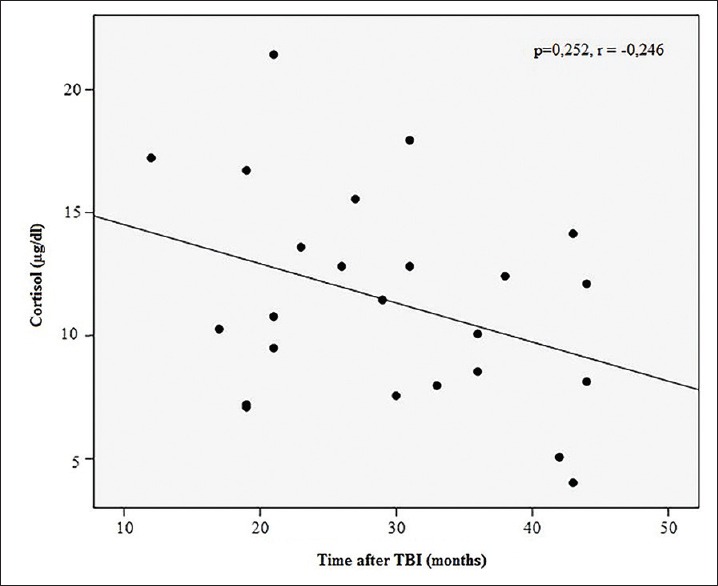
- Low basal cortisol was reported in 2 cases in the Results/Discussion (the abstract says 1, 4.2%); one had a low-dose ACTH stimulation test with normal post-stimulation cortisol (18.44 µg/dl), and the other refused testing. Basal cortisol did not correlate with GCS (P = 0.097) and was lower in moderate versus mild TBI without statistical significance (P = 0.1).
- IGF-1 values were within normal limits, but 9/24 (37.5%) had IGF-1 Z-scores below −2 SD (8 pubertal, 1 prepubertal); none had short stature. No significant differences were found between mild and moderate TBI groups for IGF-1, IGF-1 Z-score, height SDS, thyroid hormones, prolactin, sodium, or urine density.
Methods
- Cross-sectional study of 24 pediatric patients aged 5–17 years diagnosed with TBI at Trakya University Pediatric Emergency Department between April 2006 and December 2008; inclusion required GCS ≤13 or GCS 13–15 with pathology on computed brain tomography; exclusions included long-term medication use, syndromes/chromosomal anomalies/CNS developmental defects, previous infection or metabolic disease, or previous head trauma diagnosis.
- After 12 h fasting, morning blood samples measured basal cortisol, fT3, fT4, TSH, prolactin, IGF-1, FSH, LH, estradiol in females, total testosterone in males, and serum sodium; morning urine density was also measured. IGF-1 Z-scores were calculated using a formula for Turkish children.
- Cases were divided into mild versus moderate TBI (the single severe case was included in the moderate group) and compared; Spearman correlation and Mann–Whitney U-test were used, with P < 0.05 considered significant.
Limitations
- Stated: the number of cases was low; the cross-sectional design did not assess the acute period, so the authors cannot comment on whether early hyperprolactinemia or central diabetes insipidus occurred; one severe TBI case was included in the moderate group for comparisons; one case with low basal cortisol refused ACTH stimulation.
- Evident: there was no control group, and no dynamic GH stimulation tests were performed (only planned/monitoring), so GH deficiency could not be definitively excluded; the single-center design may limit generalizability.
- Evident: the abstract reports one low basal cortisol while the Results/Discussion report two, an internal inconsistency in the paper.
Model-written summary. Check it against the paper before relying on it.
Integrity signals
Registry
Cites
Statistics
Figures
Verification
Claims the paper makes
0 Valid · 0 Not valid · 8 Not checked · 31 Own results and interpretations
In the paper
“When the IGF-1 Z-scores are assessed according to the Tanner puberty stages, 8 pubertal and 1 prepubertal cases, a total of 9 (37.5%) cases were identified as below −2 SD.”
- Also stated in: § Discussion · plain
“when the IGF-1 Z-scores of cases are evaluated according to the study by Bereket et al., 9 cases were seen to be below −2 SD.[17]”
§ Evaluation of pituitary function in cases with the diagnosis of pediatric mild traumatic brain injury: Cross-sectional study > Results
What the sources say
- Not checked yetcites [17] Bereket, 2006, Horm Res source
plainn = 9- Asserted: passes — The authors put it forward as true.
- Checkable: passes — It can be checked against evidence.
- Load-bearing: unclear — It is unclear whether the paper’s conclusions depend on it.
- Based: passes — The paper gives a reason why it holds.
- Also stated in: § Discussion · plain
A result the paper reports from its own data — it cites no other source for it, so there is none to check. The quote shows it is in the paper.
In the paper
“The fT3, fT4, and TSH values of all cases were within normal limits.”
§ Evaluation of pituitary function in cases with the diagnosis of pediatric mild traumatic brain injury: Cross-sectional study > Results
plain- Asserted: passes — The authors put it forward as true.
- Checkable: passes — It can be checked against evidence.
- Load-bearing: unclear — It is unclear whether the paper’s conclusions depend on it.
- Based: passes — The paper gives a reason why it holds.
A result the paper reports from its own data — it cites no other source for it, so there is none to check. The quote shows it is in the paper.
In the paper
“There was no significant difference found in a comparison of thyroid hormone levels between the mild and moderate TBI groups [Table 3].”
§ Evaluation of pituitary function in cases with the diagnosis of pediatric mild traumatic brain injury: Cross-sectional study > Results
plain- Asserted: passes — The authors put it forward as true.
- Checkable: passes — It can be checked against evidence.
- Load-bearing: unclear — It is unclear whether the paper’s conclusions depend on it.
- Based: passes — The paper gives a reason why it holds.
A result the paper reports from its own data — it cites no other source for it, so there is none to check. The quote shows it is in the paper.
In the paper
“The gonadotropin values were FSH 3.68 ± 2.15 mIU/ml, and LH 2.89 ± 2.5 mIU/ml in the cases who had entered puberty according to the physical examination (n: 10).”
§ Evaluation of pituitary function in cases with the diagnosis of pediatric mild traumatic brain injury: Cross-sectional study > Results
plainn = 10- Asserted: passes — The authors put it forward as true.
- Checkable: passes — It can be checked against evidence.
- Load-bearing: unclear — It is unclear whether the paper’s conclusions depend on it.
- Based: passes — The paper gives a reason why it holds.
A result the paper reports from its own data — it cites no other source for it, so there is none to check. The quote shows it is in the paper.
In the paper
“In all cases, no pathologic condition was determined in the pituitary hormonal axis.”
- Also stated in: § Results: · plain
“There were no children with hormonal deficiency in this study.”
- Also stated in: § Conclusion · plain
“no pituitary hormone deficiencies supported by clinical and laboratory work were identified”
§ Evaluation of pituitary function in cases with the diagnosis of pediatric mild traumatic brain injury: Cross-sectional study > Abstract > Results:
plainn = 24- Asserted: passes — The authors put it forward as true.
- Checkable: passes — It can be checked against evidence.
- Load-bearing: passes — The paper’s conclusions depend on it.
- Based: passes — The paper gives a reason why it holds.
- Rests on an assumption not shown here.
- Also stated in: § Results: · plain
12 more claims
Create a free account to see all 39 claims and to verify the 4 references still open.
- It may state two separate claims as one. 18
- Probably not a substantial claim. 7
- The quote only partly states this claim. 1
Self-check
Percentages, sums and reported differences re-computed from the paper’s own numbers.
Each contradiction between two passages listed here was confirmed by an independent check.
Rated minor: it would not touch a result — a value no result rests on, a p-value that stays on the same side of the significance level, or a conflict that is clerical, resolved elsewhere in the paper, or outside its own findings.
In the paper
§ Evaluation of pituitary function in cases with the diagnosis of pediatric mild traumatic brain injury: Cross-sectional study
“Evaluation of pituitary function in cases with the diagnosis of pediatric mild traumatic brain injury: Cross-sectional study”
§ Evaluation of pituitary function in cases with the diagnosis of pediatric mild traumatic brain injury: Cross-sectional study > Results
“According to the GCS, 14 cases (58.3%) were classified with mild, 9 cases (37.5%) were moderate, and 1 case (4.2%) had severe head trauma.”
Rated minor: it would not touch a result — a value no result rests on, a p-value that stays on the same side of the significance level, or a conflict that is clerical, resolved elsewhere in the paper, or outside its own findings.
In the paper
§ Evaluation of pituitary function in cases with the diagnosis of pediatric mild traumatic brain injury: Cross-sectional study > Abstract > Results:
“In one children (4.2%), low basal cortisol level was found.”
§ Evaluation of pituitary function in cases with the diagnosis of pediatric mild traumatic brain injury: Cross-sectional study > Results
“When the basal cortisol taken from patients in the morning was investigated, two cases had low basal cortisol values identified.”
Citations
Cites
ASSESSMENT OF COMA AND IMPAIRED CONSCIOUSNESS
Teasdale, G., & Jennett, B. (1974) · The Lancet · doi:10.1016/s0140-6736(74)91639-0 · Cited by 13,215
Variations in pattern of pubertal changes in girls
Marshall, W. A., & Tanner, J. M. (1969) · Archives of Disease in Childhood · doi:10.1136/adc.44.235.291 · Cited by 5,963
Variations in the pattern of pubertal changes in boys
Marshall, W. A., & Tanner, J. M. (1970) · Archives of Disease in Childhood · doi:10.1136/adc.45.239.13 · Cited by 5,147
Family history of subarachnoid haemorrhage: supplemental value of scrutinizing all relatives.
Greebe, P., Bromberg, J. E., Rinkel, G. J., Algra, A., & van Gijn, J. (1997) · Journal of Neurology, Neurosurgery & Psychiatry · doi:10.1136/jnnp.62.3.273 · Cited by 4,139
The Diagnosis of Polycystic Ovary Syndrome during Adolescence
Witchel, S. F., Oberfield, S., Rosenfield, R. L., Codner, E., Bonny, A., Ibáñez, L., Pena, A., Horikawa, R., Gomez-Lobo, V., Joel, D., et al. (2015) · Hormone Research in Paediatrics · doi:10.1159/000375530 · Cited by 3,113
Kelly, D. F., Gaw Gonzalo, I. T., Cohan, P., Berman, N., Swerdloff, R., & Wang, C. (2000) · Journal of Neurosurgery · doi:10.3171/jns.2000.93.5.0743 · Cited by 455
Hypopituitarism Secondary to Head Trauma
Benvenga, S. (2000) · Journal of Clinical Endocrinology & Metabolism · doi:10.1210/jc.85.4.1353 · Cited by 423
Schneier, A. J., Shields, B. J., Hostetler, S. G., Xiang, H., & Smith, G. A. (2006) · Pediatrics · doi:10.1542/peds.2005-2588 · Cited by 423
Anterior Pituitary Dysfunction in Survivors of Traumatic Brain Injury
Agha, A., Rogers, B., Sherlock, M., O’Kelly, P., Tormey, W., Phillips, J., & Thompson, C. J. (2004) · The Journal of Clinical Endocrinology & Metabolism · doi:10.1210/jc.2004-0511 · Cited by 390
Residual pituitary function after brain injury-induced hypopituitarism: a prospective 12-month study
Aimaretti, G., Ambrosio, M. R., Di Somma, C., Gasperi, M., Cannavò, S., Scaroni, C., Fusco, A., Del Monte, P., De Menis, E., Faustini-Fustini, M., et al. (2005) · The Journal of Clinical Endocrinology & Metabolism · doi:10.1210/jc.2005-0504 · Cited by 370
Research works printed but not linked: 3
- Masson, 1996, Characteristics of head trauma in children: Epidemiology and a 5-year follow-up, Arch Pediatr, 651
- Sockalosky, 1987, Sexuel precocity after taumatic brain injury, J Pediatr, 373
- Mariani, 1996, Post-traumatic hypopituitarism after skull injury: Apropos of 3 cases, Arch Pediatr, 796
Cited by
Blood biomarkers in paediatric mild traumatic brain injury: a systematic review
Lugones, M., Parkin, G. M., Bjelosevic, S., Takagi, M., Clarke, C., Anderson, V. A., & Ignjatović, V. (2018) · Neuroscience & Biobehavioral Reviews · doi:10.1016/j.neubiorev.2018.02.006 · Cited by 40
Fluid Biomarkers of Pediatric Mild Traumatic Brain Injury: A Systematic Review
Mannix, R., Levy, R. A., Zemek, R. L., Yeates, K. O., Arbogast, K. B., Meehan, W. P., III, Leddy, J. J., Master, C. L., Mayer, A. R., Howell, D. R., et al. (2020) · Journal of Neurotrauma · doi:10.1089/neu.2019.6956 · Cited by 37
Pituitary Response to Traumatic Brain Injury
Lal, R., & Hoffman, A. R. (2019) · Contemporary Endocrinology · doi:10.1007/978-3-030-11339-1_18 · Cited by 3
Anterior Pituitary Hormonal Disturbances in Patients Suffering with Traumatic Brain Injury
Satyarthee, G. D., & Garg, K. (2017) · Journal of Neurosciences in Rural Practice · doi:10.4103/jnrp.jnrp_438_16
Metadata
- Authors
- Aylanç, H., Tütüncüler, F., & Süt, N.
- Affiliations
- Trakya University (TR)
- Corresponding author
- Aylanç, Hakan
- Venue
- Journal of Neurosciences in Rural Practice
- Publisher
- Scientific Scholar
- Published
- 2016-04
- Volume
- 7
- Issue
- 04
- Pages
- 537-543
- ISSN
- 0976-3155 (ISSN-L)
- 0976-3147
- PMC
- PMC5006465
- OpenAlex
- W2468095698
- Semantic Scholar
- ce17c3031b014251b96974741f37df767e03e729
- Cited by
- 4
- References
- 46
- Citations by year
- 2020: 1 · 2019: 1 · 2018: 1 · 2017: 1
- FWCI
- 0.69
- Type
- journal article
- Language
- en
- Open access
- gold
- doi.org
- Licence
- Locations
- Journal of Neurosciences in Rural Practice (publishedVersion, cc-by-nc-nd)
- PubMed (publishedVersion)
- PubMed Central (publishedVersion, cc-by-nc-sa)
- Çanakkale Onsekiz Mart University AVESIS (submittedVersion)
- Trakya University's Institutional Open Access System (Trakya University) (submittedVersion, other-oa)
- Topics
- Health Sciences › Medicine › Endocrinology, Diabetes and Metabolism › Pituitary Gland Disorders and Treatments
- Health Sciences › Medicine › Clinical Neurology › Traumatic Brain Injury and Neurovascular Disturbances
- Health Sciences › Medicine › Clinical Neurology › Traumatic Brain Injury Research
- Keywords
- pituitary dysfunction, mild traumatic brain injury, pediatric head injury, cortisol, thyroid function, prolactin, insulin-like growth factor I, gonadotropins, injury severity, follow-up
About these checks
Registry, retraction, Cites and statistics results are computed, not judged, with one exception: a printed reference that no index lists is read once by a model before it counts as a citation error. Claims are extracted by a model and kept only when their quote appears verbatim in the text; each cited source is then checked, with a model’s help, for whether it says what the claim relies on. Those verdicts can be wrong — read the claim’s quote and the cited source before relying on one.
A language model drew the claims from the paper on 2026-11-14, under version 3 of the claim definition (model deepseek-v4.1-flash, prompt extract-v3).
A second model labelled each claim on 2026-11-14 (model jev-1.13-20260917, definition revision gold-guideline-v0.2).
Statistics and arithmetic are recomputed, not judged.
Confidence bands are shown only for fields calibrated on our annotated test set. None is calibrated yet, so no band is shown.
What counts as a claim ›How we measure confidence ›How we check this ›
Are you an author, or do you see a problem with this page? Request a review
How to cite
Cite CoChat for the checks on this page, and the paper for its own findings.
- This page
- CoChat. (2026). Citation check: Evaluation of pituitary function in cases with the diagnosis of pediatric mild traumatic brain injury: Cross-sectional study. https://app.cochat.ai/papers/10.4103/0976-3147.185509
- The paper
- Aylanç, H., Tütüncüler, F., & Süt, N. (2016). Evaluation of pituitary function in cases with the diagnosis of pediatric mild traumatic brain injury: Cross-sectional study. Journal of Neurosciences in Rural Practice. https://doi.org/10.4103/0976-3147.185509
Data sources
Bibliographic data: Semantic Scholar, OpenAlex, Crossref.
Contains information from the Semantic Scholar Academic Graph Datasets, made available under the ODC Attribution License (ODC-BY 1.0).
Semantic Scholar’s data is described in: Kinney, R., et al. (2023). The Semantic Scholar Open Data Platform. arXiv:2301.10140.
