

Mindfulness influences the psycho-social dimension of chronic pain: A randomized controlled clinical trial in Indian context
Open accessThe DOI matches its Crossref record; 36 of the 38 references it cites were found in a registry or an index; 13 of the 24 sources its claims cite were checked for support.
Abstract
Background and Aims: In India, the awareness about the psycho-social dimension of chronic pain is minimal among physicians and patients. The research with community-based group therapies (like mindfulness) to address the psycho-social aspects in chronic pain patients remains limited. The aim of this randomized controlled trial was to see the effects of mindfulness on pain intensity, pain catastrophizing, chronic pain acceptance, perceived stress, well-being, and mindfulness characteristics. Materials and Methods: In this two-site, parallel group, clinical trial, 170 patients attending pain outdoors of two government hospitals in West Bengal, India, were randomized to attend five weekly in-person mindfulness sessions (cases) or usual care sessions (controls) within the hospital premises. Pre-program and post-program data were collected and analyzed using statistical methods like repeated measures analysis of variance. Results: In participants of the mindfulness group, significant changes post session were noted in pain intensity [F(1,326) = 15.0122; P = 0.0001291], pain acceptance [F(1,326) = 4.5311; P = 0.03403], and perceived stress score [F(1,326) = 13.2788; P = 0.0003122] compared to pre-session. The changes in pain catastrophizing, World Health Organization well-being and Freiburg mindfulness inventory scores were non-specific. Conclusion: Mindfulness had a positive influence on pain intensity, pain acceptance, and perceived stress of Indian chronic pain patients. The effects on pain catastrophizing, mindfulness characteristics, and well-being (non-specific) were also encouraging. Further studies will be required to substantiate these results. © 2023 Wolters Kluwer Medknow Publications. All rights reserved.
Overview
CoChat Summary
TL;DR
This two-site randomized controlled trial in West Bengal found that a brief five-session mindfulness program improved pain intensity, pain acceptance, and perceived stress in chronic pain patients compared with usual care. Effects on pain catastrophizing, well-being, and mindfulness characteristics were described as non-specific or not significant.
Key findings
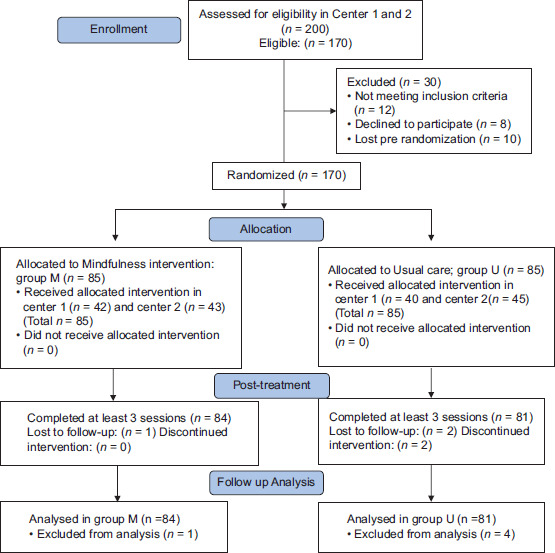
- 170 chronic pain patients were randomized; 165 completed the study (84 mindfulness, 81 usual care).
- In the mindfulness group, pre- to post-session changes were significant for pain intensity, with RM-ANOVA F(1,326) = 15.0122; P = 0.0001291 and effect size ηp2 = 0.04402.
- Significant improvements were also reported for pain acceptance F(1,326) = 4.5311; P = 0.03403; ηp2 = 0.01371 and perceived stress F(1,326) = 13.2788; P = 0.0003122; ηp2 = 0.03914.
- The paper reports non-significant pre- to post-session results for pain catastrophizing F(1,326) = 1.7762; P = 0.1835, WHO well-being F(1,326) = 1.3821; P = 0.2406, and FMI mindfulness characteristics F(1,326) = 1.0625; P = 0.3034.
Methods
- Two-site, parallel-group, randomized controlled trial conducted in outpatient settings of two government hospitals in West Bengal, India, from June 2022 to December 2022.
- 170 patients with chronic non-cancer pain (>3 months), age 18–65 years, pain intensity >4 on NRS, stable treatment, and at least VIth standard education were randomized to five weekly in-person mindfulness sessions or usual care sessions; 165 completed the study.
- Outcomes were measured pre- and post-program using NRS, PCS, CPAQ-8, PSS-4, WHO-5, and FMI, and analyzed with repeated measures ANOVA (Bonferroni model); baseline comparisons used t-tests and chi-square tests.
Limitations
- The paper states that all outcomes were subjective self-reports, intent-to-treat analysis was not possible, cost analysis was not performed, follow-up data were not collected, and other psycho-social variables were beyond scope.
- The authors note possible expectancy bias and difficulty with physical attendance; home practice was only verbally confirmed.
- Evident from the text: the trial’s main findings are based on short-term pre/post data with no long-term follow-up, so durability of effects is unknown.
Model-written summary. Check it against the paper before relying on it.
Integrity signals
Registry
Cites
Statistics
Figures
Verification
Claims the paper makes
13 Valid · 0 Not valid · 11 Not checked · 38 Own results and interpretations
The cited sources support only part of this claim — read each source’s verdict below.
In the paper
“For the past few decades, mindfulness has shown to effect the psychological health and quality of life of chronic pain patients in the West.[9]”
§ Mindfulness influences the psycho-social dimension of chronic pain: A randomized controlled clinical trial in Indian context > INTRODUCTION
What the sources say
- Partly supportedcites [9] Hilton L Hempel S Ewing BA Apaydin E Xenakis L Newberry S, Mindfulness meditation for chronic pain: Systematic review and meta-analysis Ann Behav Med 2017 51 199 213 27658913 PMC5368208 sourceExperimental — accuracy not yet measured
The Discussion reports significant improvements in depression and health-related quality of life among chronic pain patients. The Description of Included Studies lists trials in the USA and Europe, but also in Asia and the Middle East; the paper does not report a separate result for Western patients. The geographic qualifier is therefore not fully supported. (LLM, conf=0.82)
plainstates a cause- Asserted: passes — The authors put it forward as true.
- Checkable: passes — It can be checked against evidence.
- Load-bearing: passes — The paper’s conclusions depend on it.
- Based: passes — The paper gives a reason why it holds.
- Partly supported
The cited sources support only part of this claim — read each source’s verdict below.
In the paper
“Pain beliefs like pain catastrophizing (an exaggerated, negative interpretation of pain), fear of avoidance of work (a belief that all activities should be avoided to reduce pain), and low expectations for recovery put patients at a poor prognosis.[5]”
§ Mindfulness influences the psycho-social dimension of chronic pain: A randomized controlled clinical trial in Indian context > INTRODUCTION
What the sources say
- Partly supportedcites [5] Linton SJ Shaw WS Impact of psychological factors in the experience of pain Phys Ther 2011 91 700 11 21451097 sourceExperimental — accuracy not yet measured
The Conclusions and Implications section identifies catastrophizing and fear avoidance as beliefs associated with poor prognosis, and says expectations about recovery are associated with pain outcomes. The available passage does not establish that *low* recovery expectations specifically predict poor prognosis, or that fear avoidance is specifically avoidance of work rather than activity generally. (LLM, conf=0.82)
plainstates a cause- Asserted: passes — The authors put it forward as true.
- Checkable: passes — It can be checked against evidence.
- Load-bearing: passes — The paper’s conclusions depend on it.
- Based: passes — The paper gives a reason why it holds.
- Partly supported
A result the paper reports from its own data — it cites no other source for it, so there is none to check. The quote shows it is in the paper.
In the paper
“No significant difference between pre-session and post-session was observed for PCS [F(1,326) = 1.7762; P = 0.1835], WHO-well-being scale [F(1,326) = 1.3821; P = 0.2406], and FMI [F(1,326) = 1.0625; P = 0.3034].”
§ Mindfulness influences the psycho-social dimension of chronic pain: A randomized controlled clinical trial in Indian context > RESULTS
plain- Asserted: passes — The authors put it forward as true.
- Checkable: passes — It can be checked against evidence.
- Load-bearing: unclear — It is unclear whether the paper’s conclusions depend on it.
- Based: passes — The paper gives a reason why it holds.
A result the paper reports from its own data — it cites no other source for it, so there is none to check. The quote shows it is in the paper.
In the paper
“The treatment effect size was ηp2 = 0.01371 and ηp2 = 0.03914, respectively.”
§ Mindfulness influences the psycho-social dimension of chronic pain: A randomized controlled clinical trial in Indian context > RESULTS
plain- Asserted: passes — The authors put it forward as true.
- Checkable: passes — It can be checked against evidence.
- Load-bearing: unclear — It is unclear whether the paper’s conclusions depend on it.
- Based: passes — The paper gives a reason why it holds.
A result the paper reports from its own data — it cites no other source for it, so there is none to check. The quote shows it is in the paper.
In the paper
“In our study, there was an impact on pain catastrophizing in the mindfulness group [F(1,326) = 8.0009; P = 0.004965] compared to control group.”
§ Mindfulness influences the psycho-social dimension of chronic pain: A randomized controlled clinical trial in Indian context > DISCUSSION > Pain catastrophizing
plainstates a cause- Asserted: passes — The authors put it forward as true.
- Checkable: passes — It can be checked against evidence.
- Load-bearing: passes — The paper’s conclusions depend on it.
- Based: passes — The paper gives a reason why it holds.
23 more claims
Create a free account to see all 62 claims and to verify the 3 references still open.
- Probably not a substantial claim. 31
- It may state two separate claims as one. 13
Statistics recomputed
Every reported test result, recomputed from its test statistic and degrees of freedom. A result shows as not adding up only once an independent check has confirmed it.
- ConsistentF(1, 326) = 15.0122reported p = .0001291 · recomputed p < .001
“F(1,326) = 15.0122, p = .0001291”
- ConsistentF(1, 326) = 4.5311reported p = .03403 · recomputed p = .034
“F(1,326) = 4.5311, p = .03403”
- ConsistentF(1, 326) = 13.2788reported p = .0003122 · recomputed p < .001
“F(1,326) = 13.2788, p = .0003122”
- ConsistentF(1, 326) = 13.2788reported p = .0003122 · recomputed p < .001
“F(1,326) =13.2788, p = .0003122”
- ConsistentF(1, 326) = 8.8186reported p = .003203 · recomputed p = .003
“F(1,326) = 8.8186, p = .003203”
8 more recomputed tests
Create a free account to see every test the Stats check recomputed.
Self-check
Percentages, sums and reported differences re-computed from the paper’s own numbers.
Self-check results appear here once an independent check has confirmed them.
Citations
Cites
Mindfulness-based interventions in context: Past, present, and future
Kabat-Zinn, J. (2003) · Clinical Psychology: Science and Practice · doi:10.1093/clipsy.bpg016 · Cited by 8,615 · cited 1×
“[6] In western countries, mindfulness started as mindfulness-based stress reduction (MBSR) programs and later gave way to abbreviated versions of mindfulness-based intervention (MBI) which were found to be equally effective.”
The Pain Catastrophizing Scale: Development and validation.
Sullivan, M. J. L., Bishop, S. R., & Pivik, J. (1995) · Psychological Assessment · doi:10.1037//1040-3590.7.4.524 · Cited by 8,227
The WHO-5 well-being index: A systematic review of the literature
Topp, C. W., Østergaard, S. D., Søndergaard, S., & Bech, P. (2015) · Psychotherapy and Psychosomatics · doi:10.1159/000376585 · Cited by 4,708 · cited 1×
“[15] Mindfulness FMI is a valid and reliable questionnaire with 14 items covering all the different aspects of mindfulness.”
Qaseem, A., Wilt, T. J., McLean, R. M., Forciea, M. A., & for the Clinical Guidelines Committee of the American College of Physicians* (2017) · Annals of Internal Medicine · doi:10.7326/m16-2367 · Cited by 3,234 · cited 1×
“[32] A study by Zeidan et al. outlined the detailed mechanisms behind mindfulness-based pain relief.”
Garnefski, N., Kraaij, V., Schroevers, M. J., & Somsen, G. A. (2008) · Journal of Clinical Psychology in Medical Settings · doi:10.1007/s10880-008-9136-5 · Cited by 2,479
Measuring mindfulness—The Freiburg Mindfulness Inventory (FMI)
Walach, H., Buchheld, N., Buttenmüller, V., Kleinknecht, N., & Schmidt, S. (2006) · Personality and Individual Differences · doi:10.1016/j.paid.2005.11.025 · Cited by 1,475 · cited 1×
“[16]”
Pain catastrophizing: a critical review.
Quartana, P. J., Campbell, C. M., & Edwards, R. R. (2009) · Expert Review of Neurotherapeutics · doi:10.1586/ern.09.34 · Cited by 1,405 · cited 1×
“[19] There is a dearth of prevalence data on pain catastrophizing in Indian context.”
Acceptance of chronic pain: component analysis and a revised assessment method
McCracken, L. M., Vowles, K. E., & Eccleston, C. (2004) · Pain · doi:10.1016/j.pain.2003.10.012 · Cited by 1,101
Mindfulness Meditation for Chronic Pain: Systematic Review and Meta-analysis
Hilton, L., Hempel, S., Ewing, B. A., Apaydin, E., Xenakis, L., Newberry, S., Colaiaco, B., Maher, A. R., Shanman, R. M., Sorbero, M. E., et al. (2017) · Annals of Behavioral Medicine · doi:10.1007/s12160-016-9844-2 · Cited by 977 · cited 2×
“[9] The American college of physicians included mindfulness in their clinical practice guidelines for chronic low back pain.”
Impact of psychological factors in the experience of pain
Linton, S. J., & Shaw, W. S. (2011) · Physical Therapy · doi:10.2522/ptj.20100330 · Cited by 819
Alghadir, A., Anwer, S., Iqbal, A., & Iqbal, Z. (2018) · Journal of Pain Research · doi:10.2147/jpr.s158847 · Cited by 783 · cited 1×
“[11] Pain catastrophizing PCS is an instrument for measuring catastrophic thinking related to pain and was used extensively in clinical practice and research.”
Evaluating psychosocial contributions to chronic pain outcomes
Meints, S. M., & Edwards, R. R. (2018) · Progress in Neuro-Psychopharmacology and Biological Psychiatry · doi:10.1016/j.pnpbp.2018.01.017 · Cited by 719 · cited 1×
“[2] Neither the psycho-social factors are routinely assessed in hospitals/ clinics nor are they taken into account to improve treatment outcomes.”
New, normative, English-sample data for the Short Form Perceived Stress Scale (PSS-4)
Warttig, S. L., Forshaw, M. J., South, J., & White, A. K. (2013) · Journal of Health Psychology · doi:10.1177/1359105313508346 · Cited by 611 · cited 1×
“[14] Well‑being The World Health Organization 5 item well-being index (WHO-5) is a global rating scale measuring subjective psychological well-being.”
Turk, D. C., Swanson, K. S., & Tunks, E. R. (2008) · The Canadian Journal of Psychiatry · doi:10.1177/070674370805300402 · Cited by 298 · cited 1×
“[4] Pain beliefs like pain catastrophizing (an exaggerated, negative interpretation of pain), fear of avoidance of work (a belief that all activities should be avoided to reduce pain), and low expectations for recovery put patients at a poor prognosis.”
Zeidan, F., Grant, J. A., Brown, C. A., McHaffie, J. G., & Coghill, R. C. (2012) · Neuroscience Letters · doi:10.1016/j.neulet.2012.03.082 · Cited by 284 · cited 2×
“[8] Specific mindfulness-based pain management programs have been developed and researched upon.”
Do mindfulness-based interventions reduce pain intensity? A critical review of the literature
Reiner, K., Tibi, L., & Lipsitz, J. D. (2013) · Pain Medicine · doi:10.1111/pme.12006 · Cited by 208 · cited 1×
“[17] A review of literature found 10 out of 16 studies on mindfulness, reporting a decrease in pain intensity for chronic pain patients, [18] while in our subjects, a significant decrease in pain intensity with NRS [F(1,326) =15.0122; P = 0.0001291] between pre-session and post-session was noted,…”
InfluentialChronic pain, psychopathology, and DSM-5 Somatic Symptom Disorder
Katz, J., Rosenbloom, B. N., & Fashler, S. (2015) · The Canadian Journal of Psychiatry · doi:10.1177/070674371506000402 · Cited by 195 · cited 1×
“[3] Physical and psychological adaptation to chronic pain does not constitute a psycho-pathology; rather, it reflects normal processes of the human condition.”
Mindfulness-based interventions for chronic pain: evidence and applications
Majeed, M. H., Ali, A. A., & Sudak, D. M. (2018) · Asian Journal of Psychiatry · doi:10.1016/j.ajp.2017.11.025 · Cited by 173 · cited 1×
“[31] A systemic review and meta-analysis found mindfulness to improve pain.”
Effects of Mindfulness Meditation on Chronic Pain: A Randomized Controlled Trial
la Cour, P., & Petersen, M. (2015) · Pain Medicine · doi:10.1111/pme.12605 · Cited by 163
Demarzo, M., Montero-Marin, J., Puebla-Guedea, M., Navarro-Gil, M., Herrera-Mercadal, P., Moreno-González, S., Calvo-Carrión, S., Bafaluy-Franch, L., & Garcia-Campayo, J. (2017) · Frontiers in Psychology · doi:10.3389/fpsyg.2017.01343 · Cited by 121 · cited 1×
“[7] Mindfulness-related pain relief and other effects were known to be associated with unique appraisal cognitive processes and share a common final pathway with other cognitive techniques.”
Cusens, B., Duggan, G. B., Thorne, K., & Burch, V. (2010) · Clinical Psychology & Psychotherapy · doi:10.1002/cpp.653 · Cited by 102 · cited 1×
“[33] In Indian context, the research with mindfulness in chronic pain patients remains minimal.”
McCracken, L. M. (1999) · Journal of Back and Musculoskeletal Rehabilitation · doi:10.3233/bmr-1999-132-306 · Cited by 87 · cited 1×
“[22] Pain acceptance leads to enhanced emotional/physical functioning in chronic pain patients beyond the influence of depression, pain intensity, and coping.”
The prevalence of chronic pain among adults in India
Jain, P., Saxena, A., & Bhatnagar, S. (2018) · Indian Journal of Palliative Care · doi:10.4103/ijpc.ijpc_141_18 · Cited by 86 · cited 1×
“[1] As chronic pain is emerging as a massive public health problem in India, the investigators search for a group intervention (in the form of mindfulness), which is evidence-based and socially acceptable and can be practically implemented at the ground level for the masses.”
Henriksson, J., Wasara, E., & Rönnlund, M. (2016) · Psychological Reports · doi:10.1177/0033294116675086 · Cited by 73 · cited 1×
“[23] A previous Western study on 107 participants found mindfulness to heighten pain acceptance (d = 0.66), [24] while another with 109 patients showed similar results.”
InfluentialValidation of the chronic pain acceptance questionnaire-8 in an Australian pain clinic sample
Baranoff, J., Hanrahan, S. J., Kapur, D., & Connor, J. P. (2014) · International Journal of Behavioral Medicine · doi:10.1007/s12529-012-9278-6 · Cited by 46 · cited 1×
“[13] Perceived stress PSS-4 is a 4-item stress assessment scale with five responses, and items 2 and 3 are reversed.”
Larsson, B., Dragioti, E., Gerdle, B., & Björk, J. (2019) · Annals of General Psychiatry · doi:10.1186/s12991-019-0231-9 · Cited by 42 · cited 1×
“[28] A study found mindfulness to improve mental well-being and quality of life in healthy Indian adults.”
Bansal, D., Gudala, K., Lavudiya, S., Ghai, B., & Arora, P. (2016) · Pain Medicine · doi:10.1093/pm/pnv103 · Cited by 38 · cited 1×
“[20] A previous study found MBIs for chronic pain to be effective via reductions in pain catastrophizing.”
Dorado, K., Schreiber, K. L., Koulouris, A., Edwards, R. R., Napadow, V., & Lazaridou, A. (2018) · Health Psychology Open · doi:10.1177/2055102918807406 · Cited by 37 · cited 1×
“[21] In our study, there was an impact on pain catastrophizing in the mindfulness group [F(1,326) = 8.0009; P = 0.004965] compared to control group.”
InfluentialThe Association Between Perceived Stress and Low Back Pain Among Eldercare Workers in Japan
Tsuboi, Y., Ueda, Y., Naruse, F., & Ono, R. (2017) · Journal of Occupational and Environmental Medicine · doi:10.1097/jom.0000000000001062 · Cited by 33 · cited 1×
“[25] Pain theories emphasize the importance of psychological and stress-related factors in the perception and persistence of pain.”
Zargar, F., & Omidi, A. (2015) · Journal of Research in Medical Sciences · doi:10.4103/1735-1995.172816 · Cited by 31 · cited 1×
“[26] A study by present researchers found mindfulness to decrease perceived stress in the general Indian population (non-pain patients).”
Effectiveness of mindfulness meditation (Vipassana) in the management of chronic low back pain.
(2009) · PubMed Central · Cited by 15
Pal, A., Mukhopadhyay, P., & Dawar Pal, N. (2022) · International Journal of Community Medicine and Public Health · doi:10.18203/2394-6040.ijcmph20221238 · Cited by 6 · cited 1×
“[29] In our study, the effects on WHO well-being [F(1,326) = 1.3821; P = 0.2406] and mindfulness characteristics measured by FMI [F(1,326) = 1.0625; P = 0.3034] were non-specific.”
InfluentialSelf-citationPal, A., Mukhopadhyay, P., Datta, S., & Pal, N. D. (2022) · Indian Journal of Psychiatry · doi:10.4103/indianjpsychiatry.indianjpsychiatry_4_21 · Cited by 6 · cited 1×
“[27] In this study, mindfulness made a significant decrease in perceived stress [F(1,326) = 13.2788; P = 0.0003122] of the chronic pain patients post session comparable to studies done in the past.”
InfluentialSelf-citationA Review of Chronic Pain with Depression and/or Anxiety Comorbidities in the Indian Population
Lokapur, M., Kumar, N., Shah, H., & Shah, D. (2023) · Indian Journal of Pain · doi:10.4103/ijpn.ijpn_26_21 · Cited by 5 · cited 1×
“[30] The present study does not look specifically into these comorbidities (patients with psychiatric illness were excluded); rather, it focuses on coexisting psycho-social associations of chronic pain.”
Pal, A., Mukhopadhyay, P., DAWARPAL, N., et al. (2021) · JOURNAL OF CLINICAL AND DIAGNOSTIC RESEARCH · doi:10.7860/jcdr/2021/50612.15689 · Cited by 2 · cited 3×
“[10] The chances of high dropouts and practical ease to conduct a brief format in hospital premises prompted us to adopt this MBI.”
InfluentialSelf-citationGopichandran, V., Pradeep, N., & Kannan, S. (2020) · Current Medical Issues · doi:10.4103/cmi.cmi_14_20 · Cited by 1 · cited 1×
“[35] A small study by present investigators saw potential in mindfulness affecting different variables in Indian chronic pain sufferers.”
Cited by
Temporomandibular disorders and mental health: shared etiologies and treatment approaches
Wan, J., Lin, J., Zha, T., Ciruela, F., Jiang, S., Wu, Z., Fang, X., Chen, Q., & Chen, X. (2025) · The Journal of Headache and Pain · doi:10.1186/s10194-025-01985-6 · Cited by 109
Evaluation of perceived stress and its impact on study habits in preclinical medical students
Paudel, K. R., Orent, J., & Curtis, R. (2026) · Journal of Neurosciences in Rural Practice · doi:10.25259/jnrp_255_2025
Cramer, H., Krstić, S., Schröter, M., Schleinzer, A., Küçükosmanoğlu, H. S., Tavakoly, R., Meibert, P., Meibert, J., Anheyer, D., & Haller, H. (2026) · Frontiers in Medicine · doi:10.3389/fmed.2026.1911807
Metadata
- Authors
- Pal, A., Mukhopadhyay, P., Biswas, R., & Bhattacharya, D.
- Affiliations
- KPC Medical College and Hospital (IN)
- Department of Public Health, Kalyani ESI Hospital, Kalyani, West Bengal, India
- Department of Anaesthesia, Raigunj Medical College, Raiganj, West Bengal, India
- R. G. Kar Medical College and Hospital (IN)
- Corresponding author
- Pal, Anirban
- Venue
- Indian Journal of Psychiatry
- Published
- 2023-10
- Volume
- 65
- Issue
- 10
- Pages
- 1061-1068
- ISSN
- 0019-5545 (ISSN-L)
- 1998-3794
- PMC
- PMC10725204
- OpenAlex
- W4387610339
- Semantic Scholar
- 0793bebdde70eb851ba0e50864708fd6b5392e38
- Cited by
- 3
- References
- 38
- Citations by year
- 2026: 2 · 2025: 1
- FWCI
- 0.87
- Type
- journal article
- Language
- en
- Open access
- diamond
- doi.org
- Licence
- cc-by-nc-sa
- Locations
- Indian Journal of Psychiatry (publishedVersion, cc-by-nc-sa)
- PubMed Central (publishedVersion, cc-by-nc-sa)
- PubMed (publishedVersion)
- DOAJ (DOAJ: Directory of Open Access Journals) (submittedVersion, cc-by-sa)
- Funders
- Indian Council of Medical Research
- Topics
- Social Sciences › Psychology › Clinical Psychology › Mindfulness and Compassion Interventions
- Health Sciences › Health Professions › Physical Therapy, Sports Therapy and Rehabilitation › Musculoskeletal pain and rehabilitation
- Life Sciences › Neuroscience › Cognitive Neuroscience › Pain Management and Placebo Effect
- Keywords
- mindfulness, chronic pain, pain intensity, pain catastrophizing, pain acceptance, perceived stress, well-being, group therapy, Indian patients
About these checks
Registry, retraction, Cites and statistics results are computed, not judged, with one exception: a printed reference that no index lists is read once by a model before it counts as a citation error. Claims are extracted by a model and kept only when their quote appears verbatim in the text; each cited source is then checked, with a model’s help, for whether it says what the claim relies on. Those verdicts can be wrong — read the claim’s quote and the cited source before relying on one.
The claim verdicts this report counts are experimental: their accuracy is not yet measured.
A language model drew the claims from the paper on 2026-10-11, under version 3 of the claim definition (model deepseek-v4.1-flash, prompt extract-v3).
A second model labelled each claim on 2026-10-11 (model jev-1.13-20260917, definition revision gold-guideline-v0.2).
Cited sources are checked with a language model’s help (gpt-6-sol).
Statistics and arithmetic are recomputed, not judged.
Confidence bands are shown only for fields calibrated on our annotated test set. None is calibrated yet, so no band is shown.
What counts as a claim ›How we measure confidence ›How we check this ›
Are you an author, or do you see a problem with this page? Request a review
Data sources
Bibliographic data: Semantic Scholar, OpenAlex, Crossref.
Contains information from the Semantic Scholar Academic Graph Datasets, made available under the ODC Attribution License (ODC-BY 1.0).
Semantic Scholar’s data is described in: Kinney, R., et al. (2023). The Semantic Scholar Open Data Platform. arXiv:2301.10140.
