

Persian version of the support and control in birth questionnaire among Iranian women
Open accessThe DOI matches its Crossref record; 34 of the 34 references it cites were found in a registry or an index.
Abstract
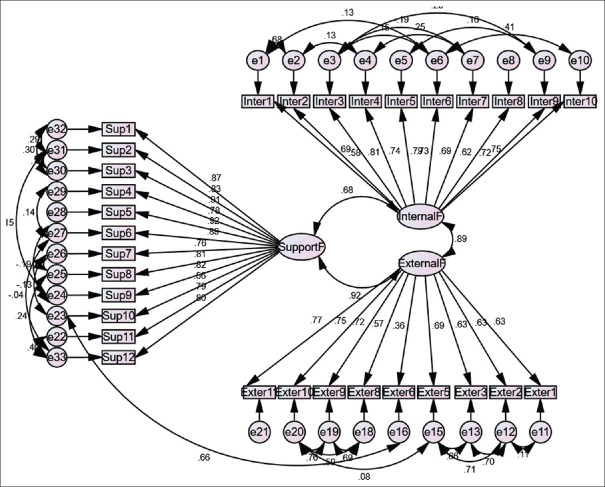
BACKGROUND: Lack of perceived support and control during labor and childbirth is known as an important predictor of post-traumatic stress disorder following childbirth. However, there is no standard scale to measure perceived support and control for Iranian women. This study determined the validity and reliability of the support and control in birth questionnaire for Iranian women. MATERIALS AND METHODS: Support and control in the birth questionnaire were translated into Persian by the forward and backward translation method in 2019. Among a total of 102 healthcare centers in Tabriz, 50 urban and 10 rural centers were selected randomly. Then, 660 women with vaginal childbirth during the postpartum period were extracted by each center and selected randomly. The validity of the Persian version was evaluated in terms of face, content, and construct validity. Internal consistency and reliability were assessed by Cronbach's alpha coefficient and intraclass correlation coefficient, respectively. Exploratory and confirmatory factor analyses were used for evaluating the construct validity of the tool. RESULTS: Cronbach's alpha coefficient (0.95) and intraclass correlation coefficient (0.99) were acceptable. In an exploratory analysis, three factors were extracted and these three factors explained 63.1% of the total variance. Items 14 and 17 were removed from the Persian version due to low factor loading and impact factor values. Confirmatory factor analysis supported the three factors extracted in the exploratory analysis. Confirmatory factor analysis showed suitable indexes of fitness for 31 items. CONCLUSION: Persian version of the support and control in the birth questionnaire is a valid and reliable tool for the Iranian women population.
Overview
The claims and statistics of this paper haven’t been checked yet.
Free: it reads the open-access text and checks the first 5 claims that cite a source we can check. Create a free account to check every claim.
Integrity signals
Registry
Cites
Statistics
Figures
Verification
Claims the paper makes
The claims and statistics of this paper haven’t been checked yet.
Free: it reads the open-access text and checks the first 5 claims that cite a source we can check. Create a free account to check every claim.
Claims other papers make about this one
Each is checked against this paper’s own text: does it say what the citing paper says it does?
The cited source says what the claim attributes to it.
In the citing paper
“This scale has been validated for the Iranian population, with Cronbach’s alpha of 0.95 and an ICC of 0.99 [39]. In our study, the Cronbach’s alpha coefficient was 0.98, with subscale values ranging from 0.93 to 0.96.”
From Effect of midwifery students’ continuity of care program on women’s experiences of maternity care: A randomised controlled trial (2026) · cites this paper as [39]
Self-check
Percentages, sums and reported differences re-computed from the paper’s own numbers.
The self-check needs the paper’s full text.
Citations
Cites
A QUANTITATIVE APPROACH TO CONTENT VALIDITY1
LAWSHE, C. H. (1975) · Personnel Psychology · doi:10.1111/j.1744-6570.1975.tb01393.x · Cited by 7,313 · cited 1×
“62 were considered acceptable.[31] The expert opinions on the translation of technical terminology and use of culturally appropriate terms were collected and suitable changes were made.”
BackgroundPain and women's satisfaction with the experience of childbirth: A systematic review
Hodnett, E. D. (2002) · American Journal of Obstetrics and Gynecology · doi:10.1016/s0002-9378(02)70189-0 · Cited by 967 · cited 1×
“[13] The childbirth experience is a mental concept and can be influenced by fulfillment of expectations, engagement in decision‐making, and perceived support and control during labor and childbirth.[14,15] The lack of maternal control can result in stress, anxiety, depression, and traumatic childbirth experience by in…”
BackgroundDevelopment and validation of the Mini Asthma Quality of Life Questionnaire
Juniper, E. F., Guyatt, G. H., Cox, F. M., Ferrie, P. J., & King, D. R. (1999) · European Respiratory Journal · doi:10.1034/j.1399-3003.1999.14a08.x · Cited by 786
Malecki, C. K., & Demaray, M. K. (2003) · School Psychology Quarterly · doi:10.1521/scpq.18.3.231.22576 · Cited by 746 · cited 1×
“However, receiving recommendations, advice, and information is perceived as a type of support.[36] Due to undesirable CVR, CVI, impact factor, and loading values, items 14 and 17 (two items of external control) were removed from the Persian version.”
MethodPrevalence and Predictors of Women's Experience of Psychological Trauma During Childbirth
Soet, J. E., Brack, G. A., & DiIorio, C. (2003) · Birth · doi:10.1046/j.1523-536x.2003.00215.x · Cited by 733 · cited 1×
“[4] The important predictors of PTSD are primiparity,[5] low perceived social support,[6] fear of childbirth,[7] instrumental delivery, emergency C‐section,[8] negative childbirth experience,[9] and religious attitude.”
BackgroundPrevalence and risk factors of postpartum posttraumatic stress disorder: A meta-analysis
Grekin, R., & O'Hara, M. W. (2014) · Clinical Psychology Review · doi:10.1016/j.cpr.2014.05.003 · Cited by 647 · cited 1×
“Although it is proven that the lack of maternal control and poor support may result in traumatic childbirth and adverse consequences,[20] these important factors are sometimes evaluated with one or few questions.”
BackgroundPrevalence and predictors of post‐traumatic stress symptoms following childbirth
Czarnocka, J., & Slade, P. (2000) · British Journal of Clinical Psychology · doi:10.1348/014466500163095 · Cited by 384 · cited 2×
“Responses are scored based on the 4‐point Likert scale (“completely appropriate” [4], “appropriate but need to modify” [3], “need to revise” [2], and “inappropriate” [1]).”
BackgroundFeeling in Control During Labor: Concepts, Correlates, and Consequences
Green, J. M., & Baston, H. A. (2003) · Birth · doi:10.1046/j.1523-536x.2003.00253.x · Cited by 360 · cited 1×
“Regarding that labor and childbirth are generally uncontrollable, the sense of control may be correlated with interpersonal variables, such as respectful, careful, and supportive behavior of staff toward the patients, and vice versa.[34] A qualitative study showed that receiving support from healthcare personnel impro…”
BackgroundDoes a traumatic birth experience have an impact on future reproduction?
Gottvall, K., & Waldenström, U. (2002) · BJOG: An International Journal of Obstetrics & Gynaecology · doi:10.1111/j.1471-0528.2002.01200.x · Cited by 357
Women's experiences of labour and birth: an evolutionary concept analysis
Larkin, P., Begley, C. M., & Devane, D. (2009) · Midwifery · doi:10.1016/j.midw.2007.07.010 · Cited by 323
Pain and women's satisfaction with the experience of childbirth: A systematic review*1
HODNETT, E. D. (2002) · American Journal of Obstetrics and Gynecology · doi:10.1067/mob.2002.121141 · Cited by 310
The impact of subjective birth experiences on post-traumatic stress symptoms: a longitudinal study
Garthus-Niegel, S., von Soest, T., Vollrath, M. E., & Eberhard-Gran, M. (2013) · Archives of Women's Mental Health · doi:10.1007/s00737-012-0301-3 · Cited by 297 · cited 1×
“[10] Among them, negative childbirth experience is reported as the most important factor.[11]”
BackgroundRisk factors and predictive signs of postpartum depression
Righetti-Veltema, M., Conne-Perréard, E., Bousquet, A., & Manzano, J. (1998) · Journal of Affective Disorders · doi:10.1016/s0165-0327(97)00110-9 · Cited by 280 · cited 1×
“Responses are scored based on the 4‐point Likert scale (“completely appropriate” [4], “appropriate but need to modify” [3], “need to revise” [2], and “inappropriate” [1]).”
Factors related to a negative birth experience – A mixed methods study
Henriksen, L., Grimsrud, E., Schei, B., & Lukasse, M. (2017) · Midwifery · doi:10.1016/j.midw.2017.05.004 · Cited by 237 · cited 2×
“For reprints contact: WKHLRPMedknow_reprints@wolterskluwer.com 2 Journal of Education and Health Promotion | Volume 12 | June 2023 experiences varies from 9.3% in Canada[12] to 21% in Norway.”
BackgroundInfluentialNilvér, H., Begley, C., & Berg, M. (2017) · BMC Pregnancy and Childbirth · doi:10.1186/s12884-017-1356-y · Cited by 196
The pain of childbirth: perceptions of culturally diverse women
Callister, L. C., Khalaf, I. A., Semenic, S. E., Kartchner, R., & Vehviläinen-Julkunen, K. M. (2003) · Pain Management Nursing · doi:10.1016/s1524-9042(03)00028-6 · Cited by 187 · cited 1×
“However, Finnish mothers felt it was necessary to trust themselves and they described the birth as a health indicator.[26] Turkish mothers also considered pain during labor as a normal event in their life.”
BackgroundTraumatic Stress after Childbirth: The Role of Obstetric Variables
Soderquist, J., Wijma, K., & Wijma, B. (2002) · Journal of Psychosomatic Obstetrics & Gynecology · doi:10.3109/01674820209093413 · Cited by 183 · cited 2×
“[4] The important predictors of PTSD are primiparity,[5] low perceived social support,[6] fear of childbirth,[7] instrumental delivery, emergency C‑section,[8] negative childbirth experience,[9] and religious attitude.”
BackgroundDepressive symptoms and symptoms of post-traumatic stress disorder in women after childbirth
Zaers, S., Waschke, M., & Ehlert, U. (2008) · Journal of Psychosomatic Obstetrics & Gynecology · doi:10.1080/01674820701804324 · Cited by 179 · cited 2×
“Responses are scored based on the 4‐point Likert scale (“completely appropriate” [4], “appropriate but need to modify” [3], “need to revise” [2], and “inappropriate” [1]).”
BackgroundPredictors of a negative labour and birth experience based on a national survey of Canadian women
Smarandache, A., Kim, T. H. M., Bohr, Y., & Tamim, H. (2016) · BMC Pregnancy and Childbirth · doi:10.1186/s12884-016-0903-2 · Cited by 166
Measurement of Maternal Perceptions of Support and Control in Birth (SCIB)
Ford, E. M., Ayers, S., & Wright, D. B. (2009) · Journal of Women s Health · doi:10.1089/jwh.2008.0882 · Cited by 162 · cited 3×
“External control means maternal control over the labor and childbirth setting, engagement in decision‐making, and accessibility of information.[15] A woman with high perceived control over her body and environment during labor and childbirth will have lower pain, and higher positive emotions and childbirth satisfactio…”
BackgroundMethodThe longitudinal course of post-traumatic stress after childbirth
Söderquist, J., Wijma, B., & Wijma, K. (2006) · Journal of Psychosomatic Obstetrics & Gynecology · doi:10.1080/01674820600712172 · Cited by 147 · cited 1×
“[4] The important predictors of PTSD are primiparity,[5] low perceived social support,[6] fear of childbirth,[7] instrumental delivery, emergency C‐section,[8] negative childbirth experience,[9] and religious attitude.”
BackgroundPosttraumatic stress disorder after childbirth: Analysis of symptom presentation and sampling
Susan, A., Harris, R., Sawyer, A., Parfitt, Y., & Ford, E. (2009) · Journal of Affective Disorders · doi:10.1016/j.jad.2009.02.029 · Cited by 144 · cited 1×
“[4] The important predictors of PTSD are primiparity,[5] low perceived social support,[6] fear of childbirth,[7] instrumental delivery, emergency C‐section,[8] negative childbirth experience,[9] and religious attitude.”
BackgroundStressful events and support during birth: The effect on anxiety, mood and perceived control
Ford, E., & Ayers, S. (2009) · Journal of Anxiety Disorders · doi:10.1016/j.janxdis.2008.07.009 · Cited by 115 · cited 7×
“95).[19] The time of questionnaire completion may have played a role in the way the items were responded.”
BackgroundMethodInfluentialWomen′s needs and expectations during normal labor and delivery
Zarean, E., Iravani, M., Janghorbani, M., & Bahrami, M. (2015) · Journal of Education and Health Promotion · doi:10.4103/2277-9531.151885 · Cited by 98 · cited 1×
“Considering that women’s response to childbirth physiological and psychological changes can be affected by healthcare policies and mechanisms of childbirth management in different countries with different cultural situations,[28] there is a need for adopting a standard scale to measure support and control during labor…”
BackgroundLemola, S., Stadlmayr, W., & Grob, A. (2007) · Journal of Reproductive and Infant Psychology · doi:10.1080/02646830701467231 · Cited by 94 · cited 1×
“[4] The important predictors of PTSD are primiparity,[5] low perceived social support,[6] fear of childbirth,[7] instrumental delivery, emergency C‐section,[8] negative childbirth experience,[9] and religious attitude.”
BackgroundCultural conceptions of Women's labor pain and labor pain management: A mixed-method analysis
Mathur, V. A., Morris, T., & McNamara, K. (2020) · Social Science & Medicine · doi:10.1016/j.socscimed.2020.113240 · Cited by 88 · cited 1×
“[24] Cultural beliefs toward the management of labor pain and expectations from a woman during labor and birth have an important role in women’s perception.[25] For instance, Chinese mothers are usually embarrassed by screaming during labor.”
BackgroundPerceived control and maternal satisfaction with childbirth: a measure development study
Stevens, N. R., Wallston, K. A., & Hamilton, N. A. (2012) · Journal of Psychosomatic Obstetrics & Gynecology · doi:10.3109/0167482x.2011.652996 · Cited by 65 · cited 3×
“[15] A woman with high perceived control over her body and environment during labor and childbirth will have lower pain, and higher positive emotions and childbirth satisfaction.[17,18]”
BackgroundWhat Constitutes a Good Childbirth? A Qualitative Study of Pregnant Finnish Women
Melender, H. (2006) · Journal of Midwifery & Women's Health · doi:10.1016/j.jmwh.2006.02.009 · Cited by 65 · cited 1×
“[34] A qualitative study showed that receiving support from healthcare personnel improved perceived control.[35] In contrast, the perception of Iranian women of external control and support may be different from that of British women.”
BackgroundDirect and indirect relationship between locus of control and depression
Yu, X., & Fan, G. (2016) · Journal of Health Psychology · doi:10.1177/1359105314551624 · Cited by 45 · cited 1×
“[14,15] The lack of maternal control can result in stress, anxiety, depression, and traumatic childbirth experience by influencing the physical and emotional responses of the mother.[16] Perceived control is defined as participation, engagement in decision‐making, accessibility of information, and freedom in adopting…”
BackgroundChildbirth Experiences in Australia of Women Born in Turkey, Vietnam, and Australia
McLachlan, H., & Waldenström, U. (2005) · Birth · doi:10.1111/j.0730-7659.2005.00370.x · Cited by 42 · cited 1×
“[26] Turkish mothers also considered pain during labor as a normal event in their life.[27]”
BackgroundPain and emotions reported after childbirth and recalled 6 months later: the role of controllability
Tinti, C., Schmidt, S., & Businaro, N. (2011) · Journal of Psychosomatic Obstetrics & Gynecology · doi:10.3109/0167482x.2011.557756 · Cited by 33 · cited 1×
“[15] A woman with high perceived control over her body and environment during labor and childbirth will have lower pain, and higher positive emotions and childbirth satisfaction.[17,18]”
BackgroundThe Turkish version of perceived support and control in birth scale
İnci, F., İşbir, G. G., & Tanhan, F. (2015) · Journal of Psychosomatic Obstetrics & Gynecology · doi:10.3109/0167482x.2015.1073708 · Cited by 17
Psychometric testing of the support and control in birth scale
Liu, S.-Y., Lu, Y., Gau, M., & Liu, C. (2020) · BMC Pregnancy and Childbirth · doi:10.1186/s12884-020-02888-x · Cited by 12
Alipanahpour, S., Zarshenas, M., & Akbarzadeh, M. (2021) · Journal of Education and Health Promotion · doi:10.4103/jehp.jehp_924_20 · Cited by 4 · cited 1×
“[4] The important predictors of PTSD are primiparity,[5] low perceived social support,[6] fear of childbirth,[7] instrumental delivery, emergency C‐section,[8] negative childbirth experience,[9] and religious attitude.[10] Among them, negative childbirth experience is reported as the most important factor.”
Background
Research works printed but not linked: 2
- Munro BH Statistical Methods for Health Care Research 2006 Philadelphia Lippincott, Williams and Wilkins
- Tinsley HEA Brown SD Handbook of Applied Multivariate Statistics and Mathematical Modeling 2000 First ed San Diego, California Academic Press 95 118
Cited by
Jafari, E., Mirghafourvand, M., Abbasalizadeh, S., Meedya, S., Doshmangir, L., & Mohammad-Alizadeh-Charandabi, S. (2026) · PLOS One · doi:10.1371/journal.pone.0353118 · Cited by 1
“This scale has been validated for the Iranian population, with Cronbach’s alpha of 0.95 and an ICC of 0.99 [39].”
InfluentialSelf-citationMolgora, S., Bonazza, F., Carones, M. B., Ferrazzi, E. M., & Ford, E. M. (2025) · European Journal of Obstetrics & Gynecology and Reproductive Biology X · doi:10.1016/j.eurox.2025.100424 · Cited by 2
“The SCIB scale was also tested and validated among Chinese, Turkish and Persian women [9;18;19].”
Aksoy, S. D., Suar, G., Gokce, C., & Özdemir, S. (2026) · International Journal of Nursing Practice · doi:10.1111/ijn.70108
Metadata
- Authors
- Ghanbari-Homaie, S., Mohammad-Alizadeh-Charandabi, S., Asghari-Jafarabadi, M., Meedya, S., Mohammadi, E., & Mirghafourvand, M.
- Affiliations
- Tabriz University of Medical Sciences (IR)
- Department of Midwifery, Nursing and Midwifery Faculty, Tabriz University of Medical Sciences, Tabriz, Iran
- University of Wollongong (AU)
- Tarbiat Modares University (IR)
- Social Determinants of Health Research Center, Nursing and Midwifery Faculty, Tabriz University of Medical Sciences, Tabriz, Iran
- Venue
- Journal of Education and Health Promotion
- Published
- 2023-06
- Volume
- 12
- Issue
- 1
- Pages
- 191-191
- ISSN
- 2277-9531 (ISSN-L)
- 2319-6440
- PMC
- PMC10402777
- OpenAlex
- W4383212360
- Cited by
- 3
- References
- 34
- Citations by year
- 2026: 2 · 2025: 1
- FWCI
- 0.94
- Type
- journal article
- Language
- en
- Open access
- gold
- doi.org
- Licence
- cc-by-nc-sa
- Locations
- Journal of Education and Health Promotion (publishedVersion, cc-by-nc-sa)
- PubMed Central (publishedVersion, cc-by-nc-sa)
- PubMed (publishedVersion)
- Research Online (University of Wollongong) (submittedVersion)
- DOAJ (DOAJ: Directory of Open Access Journals) (submittedVersion, cc-by-sa)
- Funders
- Tabriz University of Medical Sciences (IR.TBZMED.REC.1396.786)
- University of Tabriz
- Topics
- Health Sciences › Medicine › Obstetrics and Gynecology › Maternal and Perinatal Health Interventions
- Health Sciences › Medicine › Public Health, Environmental and Occupational Health › Maternal Mental Health During Pregnancy and Postpartum
- Health Sciences › Nursing › Research and Theory › Health Education and Validation
- Keywords
- labor and childbirth, postpartum women, Persian translation, psychometric validation, construct validity, reliability statistics, Iranian women
About these checks
Registry, retraction, Cites and statistics results are computed, not judged, with one exception: a printed reference that no index lists is read once by a model before it counts as a citation error. Claims are extracted by a model and kept only when their quote appears verbatim in the text; each cited source is then checked, with a model’s help, for whether it says what the claim relies on. Those verdicts can be wrong — read the claim’s quote and the cited source before relying on one.
Statistics and arithmetic are recomputed, not judged.
Confidence bands are shown only for fields calibrated on our annotated test set. None is calibrated yet, so no band is shown.
What counts as a claim ›How we measure confidence ›How we check this ›
Are you an author, or do you see a problem with this page? Request a review
Data sources
Bibliographic data: Semantic Scholar, OpenAlex, Crossref.
Contains information from the Semantic Scholar Academic Graph Datasets, made available under the ODC Attribution License (ODC-BY 1.0).
Semantic Scholar’s data is described in: Kinney, R., et al. (2023). The Semantic Scholar Open Data Platform. arXiv:2301.10140.
