

The DOI matches its Crossref record; 34 of the 36 references it cites were found in a registry or an index.
Impact of a School-Based Hygiene Promotion and Sanitation Intervention on Pupil Hand Contamination in Western Kenya: A Cluster Randomized Trial
Open accessAbstract
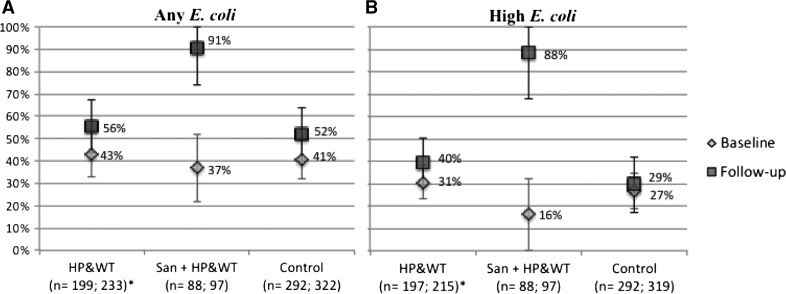
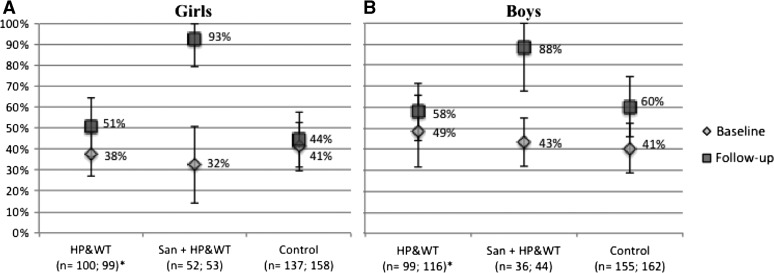
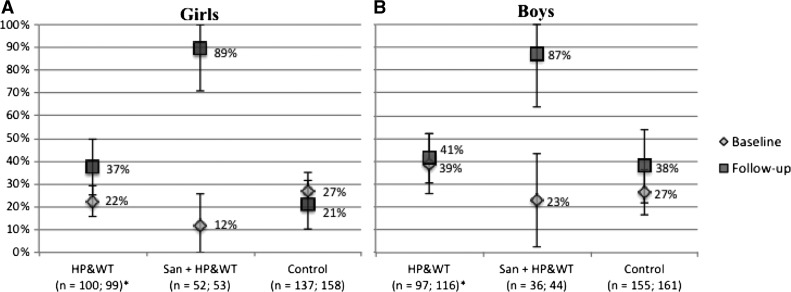
Handwashing with soap effectively reduces exposure to diarrhea-causing pathogens. Interventions to improve hygiene and sanitation conditions in schools within low-income countries have gained increased attention; however, their impact on schoolchildren's exposure to fecal pathogens has not been established. Our trial examined whether a school-based water, sanitation, and hygiene intervention reduced Escherichia coli contamination on pupils' hands in western Kenya. A hygiene promotion and water treatment intervention did not reduce risk of E. coli presence (relative risk [RR] = 0.92, 95% confidence interval [CI] = 0.54–1.56); the addition of new latrines to intervention schools significantly increased risk among girls (RR = 2.63, 95% CI = 1.29–5.34), with a non-significant increase among boys (RR = 1.36, 95% CI = 0.74–2.49). Efforts to increase usage of school latrines by constructing new facilities may pose a risk to children in the absence of sufficient hygiene behavior change, daily provision of soap and water, and anal cleansing materials.
Overview
The claims and statistics of this paper haven’t been checked yet.
Run the check — free, no account needed. It reads the open-access text and checks the sources it cites.
Integrity signals
Registry
Cites
Statistics
Figures
Verification
Claims the paper makes
The claims and statistics of this paper haven’t been checked yet.
Run the check — free, no account needed. It reads the open-access text and checks the sources it cites.
Claims other papers make about this one
Each is checked against this paper’s own text: does it say what the citing paper says it does?
The cited source says what the claim attributes to it.
In the citing paper
“Four of the 18 publications reported no evidence of reduced risk for the primary disease-related outcome measures, including soil-transmitted helminths and E. coli on pupils’ hands [17,20,25,26].”
From Water, Sanitation and Hygiene (WASH) in Schools in Low-Income Countries: A Review of Evidence of Impact (2019) · cites this paper as [25]
Self-check
Percentages, sums and reported differences re-computed from the paper’s own numbers.
The self-check needs the paper’s full text.
Citations
Cites
Global, regional, and national causes of child mortality in 2008: a systematic analysis
Black, R. E., Cousens, S. N., Johnson, H. L., Lawn, J. E., Rudan, I., Bassani, D. G., Jha, P., Campbell, H. J., Walker, C. L. F., Cibulskis, R. E., et al. (2010) · The Lancet · doi:10.1016/s0140-6736(10)60549-1 · Cited by 3,062
Water, sanitation and hygiene for the prevention of diarrhoea
Cairncross, S., Hunt, C., Boisson, S., Bostoen, K., Curtis, V., Fung, I. C., & Schmidt, W.-P. (2010) · International Journal of Epidemiology · doi:10.1093/ije/dyq035 · Cited by 667
The Effect of Handwashing with Water or Soap on Bacterial Contamination of Hands
Burton, M., Cobb, E., Donachie, P., Judah, G., Curtis, V., & Schmidt, W.-P. (2011) · International Journal of Environmental Research and Public Health · doi:10.3390/ijerph8010097 · Cited by 318
Talaat, M., Afifi, S., Dueger, E., El-Ashry, N., Marfin, A., Kandeel, A., Mohareb, E., & El-Sayed, N. (2011) · Emerging Infectious Diseases · doi:10.3201/eid1704.101353 · Cited by 238
Hygiene: new hopes, new horizons
Curtis, V., Schmidt, W., Luby, S., Florez, R., Touré, O., & Biran, A. (2011) · The Lancet Infectious Diseases · doi:10.1016/s1473-3099(10)70224-3 · Cited by 228 · cited 2×
“report what is socially desirable and evidence that they correlate poorly with measured fecal indicator bacteria on hands.(6,16,25,26) Alternative measurement of microbiological”
BackgroundFreeman, M. C., Greene, L. E., Dreibelbis, R., Saboori, S., Muga, R., Brumback, B., & Rheingans, R. (2012) · Tropical Medicine & International Health · doi:10.1111/j.1365-3156.2011.02927.x · Cited by 228
Self-citationBOWEN, A., MA, H., OU, J., BILLHIMER, W., LONG, T., MINTZ, E., HOEKSTRA, R. M., & LUBY, S. (2007) · The American Journal of Tropical Medicine and Hygiene · doi:10.4269/ajtmh.2007.76.1166 · Cited by 208
The potential of schoolchildren as health change agents in rural western Kenya
Onyango‐Ouma, W., Aagaard‐Hansen, J., & Jensen, B. B. (2005) · Social Science & Medicine · doi:10.1016/j.socscimed.2005.03.041 · Cited by 167
Pickering, A. J., Davis, J., Walters, S. P., Horak, H. M., Keymer, D. P., Mushi, D., Strickfaden, R., Chynoweth, J. S., Liu, J., Blum, A., et al. (2010) · Environmental Science & Technology · doi:10.1021/es903524m · Cited by 164
O'REILLY, C. E., FREEMAN, M. C., RAVANI, M., MIGELE, J., MWAKI, A., AYALO, M., OMBEKI, S., HOEKSTRA, R. M., & QUICK, R. (2008) · Epidemiology and Infection · doi:10.1017/s0950268807008060 · Cited by 159
Self-citation
Cited by
Sorted by citations
Strunz, E. C., Addiss, D. G., Stocks, M. E., Ogden, S., Utzinger, J., & Freeman, M. C. (2014) · PLoS Medicine · doi:10.1371/journal.pmed.1001620 · Cited by 826
Self-citationInterventions to improve water quality for preventing diarrhoea
Clasen, T., Alexander, K., Sinclair, D., Boisson, S., Peletz, R., Chang, H. H., Majorin, F., & Cairncross, S. (2015) · Cochrane Database of Systematic Reviews · doi:10.1002/14651858.cd004794.pub3 · Cited by 514
Freeman, M. C., Garn, J. V., Sclar, G. D., Boisson, S., Medlicott, K., Alexander, K. T., Penakalapati, G., Anderson, D., Mahtani, A. G., Grimes, J. E. T., et al. (2017) · International Journal of Hygiene and Environmental Health · doi:10.1016/j.ijheh.2017.05.007 · Cited by 358
Self-citationHand washing promotion for preventing diarrhoea
Ejemot-Nwadiaro, R. I., Ehiri, J. E., Arikpo, D., Meremikwu, M. M., & Critchley, J. (2015) · Cochrane Database of Systematic Reviews · doi:10.1002/14651858.cd004265.pub3 · Cited by 367
McMichael, C. (2019) · International Journal of Environmental Research and Public Health · doi:10.3390/ijerph16030359 · Cited by 220
“[25] conducted in schools in western Kenya found that hygiene promotion and water treatment did not reduce risk of Escherichia coli presence on pupils’ hands; further, the addition of new latrines to intervention schools significantly increased E.”
BackgroundInfluential
Metadata
- Authors
- Greene, L. E., Freeman, M. C., Akoko, D., Saboori, S., Moe, C., & Rheingans, R.
- Affiliations
- Emory University (US)
- Corresponding author
- Greene, Leslie E.
- Venue
- The American Society of Tropical Medicine and Hygiene
- Published
- 2012-09-05
- Volume
- 87
- Issue
- 3
- Pages
- 385-393
- ISSN
- 0002-9637 (ISSN-L)
- 1476-1645
- PMC
- PMC3435337
- OpenAlex
- W2150544519
- Cited by
- 123
- References
- 36
- Citations by year
- 2026: 2 · 2024: 5 · 2023: 7 · 2022: 9 · 2021: 14 · 2020: 8 · 2019: 14 · 2018: 3 · 2017: 14 · 2016: 12 · 2015: 13 · 2014: 14 · 2013: 7 · 2012: 1
- FWCI
- 10.46
- Type
- journal article
- Language
- en
- Open access
- hybrid
- doi.org
- Locations
- American Journal of Tropical Medicine and Hygiene (publishedVersion, cc-by)
- Europe PMC (PubMed Central) (publishedVersion, cc-by)
- PubMed Central (publishedVersion, cc-by)
- PubMed (publishedVersion)
- Funders
- Bill and Melinda Gates Foundation
- Emory University
- Topics
- Health Sciences › Nursing › Nutrition and Dietetics › Child Nutrition and Water Access
- Health Sciences › Medicine › Public Health, Environmental and Occupational Health › School Health and Nursing Education
- Life Sciences › Agricultural and Biological Sciences › Food Science › Food Safety and Hygiene
- Keywords
- hand hygiene, hand contamination, Escherichia coli, school sanitation, school latrines, hygiene promotion, fecal pathogens, elementary school students, diarrhea, sex differences, Western Kenya
- MeSH terms
- Adolescent, Child, Diarrhea, Escherichia coli, Female, Follow-Up Studies, Hand Disinfection, Humans, Hygiene, Kenya, Male, Poverty, Risk Factors, Sanitation, Schools, Soaps, Toilet Facilities, Cluster Analysis
About these checks
Registry, retraction, Cites and statistics results are computed, not judged, with one exception: a printed reference that no index lists is read once by a model before it counts as a citation error. Claims are extracted by a model and kept only when their quote appears verbatim in the text; each cited source is then checked, with a model’s help, for whether it says what the claim relies on. Those verdicts can be wrong — read the claim’s quote and the cited source before relying on one.
Statistics and arithmetic are recomputed, not judged.
Confidence bands are shown only for fields calibrated on our annotated test set. None is calibrated yet, so no band is shown.
What counts as a claim ›How we measure confidence ›How we check this ›
Are you an author, or do you see a problem with this page? Request a review
