

The DOI matches its DataCite record; 85 of the 91 references it cites were found in a registry or an index.
Explaining Neural Scaling Laws
Open accessAbstract
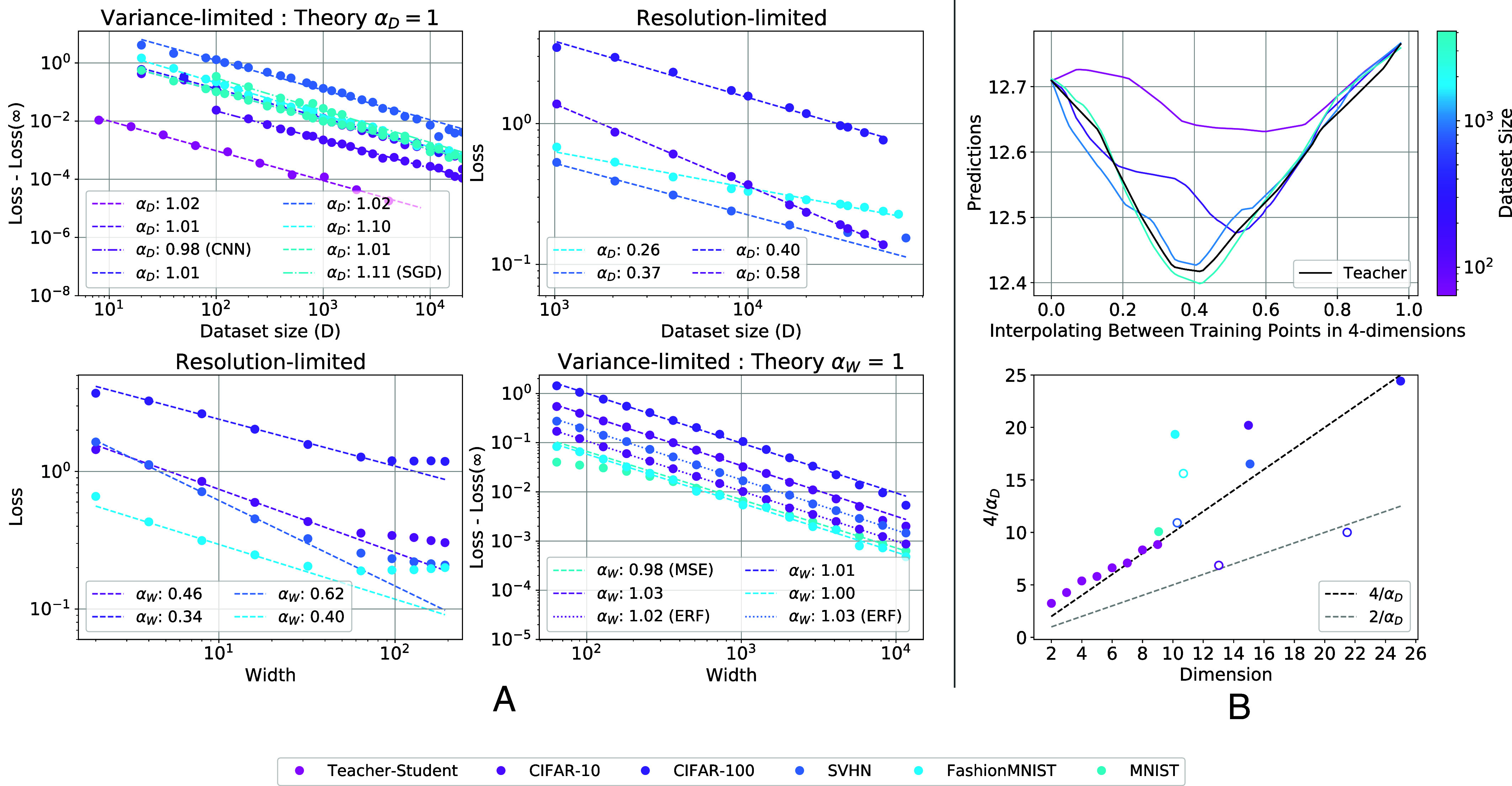
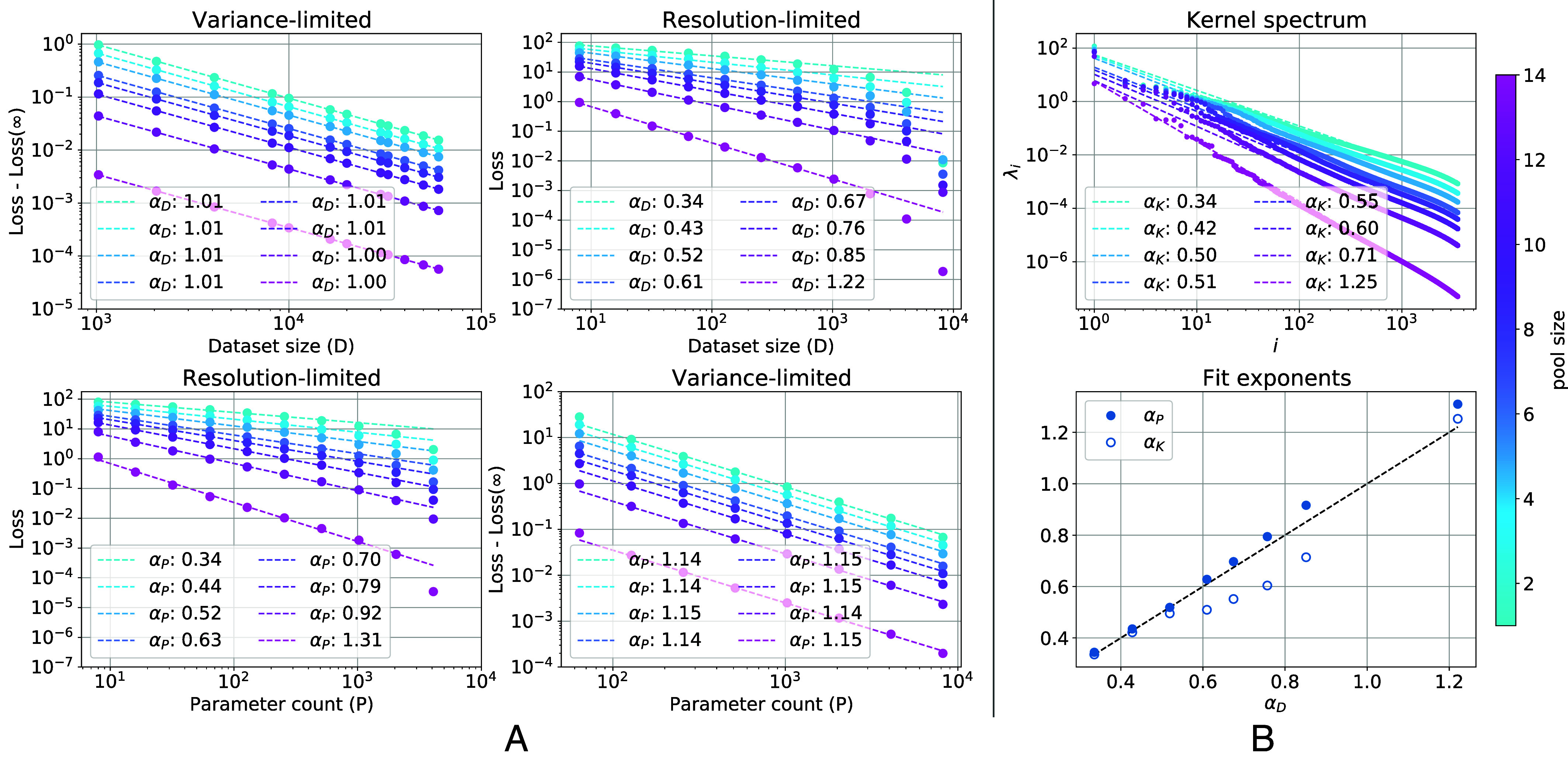
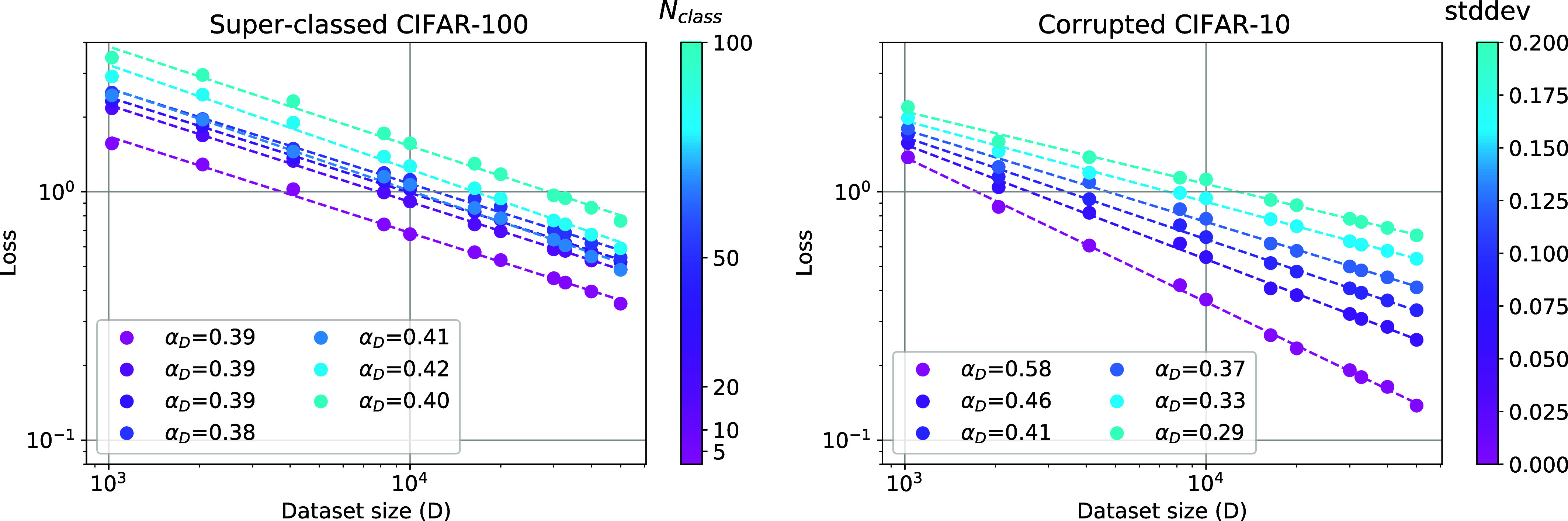
The population loss of trained deep neural networks often follows precise power-law scaling relations with either the size of the training dataset or the number of parameters in the network. We propose a theory that explains the origins of and connects these scaling laws. We identify variance-limited and resolution-limited scaling behavior for both dataset and model size, for a total of four scaling regimes. The variance-limited scaling follows simply from the existence of a well-behaved infinite data or infinite width limit, while the resolution-limited regime can be explained by positing that models are effectively resolving a smooth data manifold. In the large width limit, this can be equivalently obtained from the spectrum of certain kernels, and we present evidence that large width and large dataset resolution-limited scaling exponents are related by a duality. We exhibit all four scaling regimes in the controlled setting of large random feature and pretrained models and test the predictions empirically on a range of standard architectures and datasets. We also observe several empirical relationships between datasets and scaling exponents under modifications of task and architecture aspect ratio. Our work provides a taxonomy for classifying different scaling regimes, underscores that there can be different mechanisms driving improvements in loss, and lends insight into the microscopic origins of and relationships between scaling exponents.
Overview
The claims and statistics of this paper haven’t been checked yet.
Run the check — free, no account needed. It reads the open-access text and checks the sources it cites.
Integrity signals
Registry
Cites
Statistics
Figures
Verification
Claims the paper makes
The claims and statistics of this paper haven’t been checked yet.
Run the check — free, no account needed. It reads the open-access text and checks the sources it cites.
Claims other papers make about this one
Each is checked against this paper’s own text: does it say what the citing paper says it does?
The cited source says what the claim attributes to it.
In the citing paper
“Return follows a powerlaw: loss scales as a power-law with the amount of compute used for training (Henighan et al., 2020;Kaplan et al., 2020;Bahri et al., 2021;Ghorbani et al., 2021;Bansal et al., 2022;Hernandez et al., 2021).”
From Scaling Data-Constrained Language Models (2023) · cites this paper as Bahri et al., 2021
Self-check
Percentages, sums and reported differences re-computed from the paper’s own numbers.
The self-check needs the paper’s full text.
Citations
Cites
PyTorch: An Imperative Style, High-Performance Deep Learning Library
Paszke, A., Gross, S., Massa, F., Lerer, A., Bradbury, J., Chanan, G., Killeen, T., Lin, Z., Gimelshein, N., Antiga, L., et al. (2019) · arXiv · doi:10.48550/arxiv.1912.01703 · Cited by 31,473
The Elements of Statistical Learning
Hastie, T., Tibshirani, R., & Friedman, J. (2009) · Springer Series in Statistics · doi:10.1007/978-0-387-84858-7 · Cited by 25,970
Language Models are Few-Shot Learners
Brown, T. B., Mann, B., Ryder, N., Subbiah, M., Kaplan, J., Dhariwal, P., Neelakantan, A., Shyam, P., Sastry, G., Askell, A., et al. (2020) · arXiv · doi:10.48550/arxiv.2005.14165 · Cited by 23,372
EfficientNet: Rethinking Model Scaling for Convolutional Neural Networks
Tan, M., & Le, Q. V. (2019) · arXiv · doi:10.48550/arxiv.1905.11946 · Cited by 17,072
McCullagh, P., & Nelder, J. A. (1989) · doi:10.1007/978-1-4899-3242-6 · Cited by 16,836
Scaling Laws for Neural Language Models
Kaplan, J., McCandlish, S., Henighan, T., Brown, T. B., Chess, B., Child, R., Gray, S., Radford, A., Wu, J., & Amodei, D. (2020) · arXiv · doi:10.48550/arxiv.2001.08361 · Cited by 9,550
Zagoruyko, S., & Komodakis, N. (2016) · Procedings of the British Machine Vision Conference 2016 · doi:10.5244/c.30.87 · Cited by 7,244
SGDR: Stochastic Gradient Descent with Warm Restarts
Loshchilov, I., & Hutter, F. (2016) · arXiv · doi:10.48550/arxiv.1608.03983 · Cited by 5,309
Bayesian Learning for Neural Networks
Neal, R. M. (1996) · Lecture Notes in Statistics · doi:10.1007/978-1-4612-0745-0 · Cited by 4,276
Stein, M. L. (1999) · Springer series in statistics · doi:10.1007/978-1-4612-1494-6 · Cited by 2,358
Research works printed but not linked: 4
- [9]J. Hoffmann, An empirical analysis of compute-optimal large language model training. Adv. Neural Inf. Process. Syst. 35, 30016– 30030 (2022).
- [14]A. Matthews, J. Hron, M. Rowland, R. E. Turner, Z. Ghahramani, “Gaussian process behaviour in wide deep neural networks” in International Conference on Learning Representations (2018).
- [30]M. S. Advani, A. M. Saxe, High-dimensional dynamics of generalization error in neural networks. arXiv [Preprint] (2017). 10.48550/arXiv.1710.03667 (Accessed 1 January 2021). PMC7685244 33022471 · DOI
- [44]D. de Laat, “Approximating manifolds by meshes: Asymptotic bounds in higher codimension” Thesis, University of Groningen, Groningen, The Netherlands (2011).
Cited by
Sorted by citations
Items 101–187 of 187
Uncertainty quantification from ensemble variance scaling laws in deep neural networks
Elsharkawy, I., Hooberman, B. H., & Kahn, Y. F. (2025) · Machine Learning Science and Technology · doi:10.1088/2632-2153/adf7fe · Cited by 2
Sakemi, Y., Okamoto, Y., Morie, T., Nobukawa, S., Hosomi, T., & Aihara, K. (2025) · Advanced Intelligent Systems · doi:10.1002/aisy.202500351 · Cited by 2
Quantity versus diversity: Influence of data on detecting EEG pathology with advanced ML models
Poziomska, M., Dovgialo, M., Olbratowski, P., Niedbalski, P., Ogniewski, P., Zych, J., Rogala, J., & Żygierewicz, J. (2025) · Neural Networks · doi:10.1016/j.neunet.2025.108073 · Cited by 6
Data Scaling Laws for End-to-End Autonomous Driving
Naumann, A., Gu, X., Dimlioglu, T., Bojarski, M., Değirmenci, A., Popov, A., Bisla, D., Pavone, M., Müller, U., & Ivanovic, B. (2025) · IEEE/CVF Conference on Computer Vision and Pattern Recognition Workshops (CVPRW) · doi:10.1109/cvprw67362.2025.00242 · Cited by 2
Seibel, M. S., Haueisen, J., & Jochmann, T. (2026) · Journal of Neural Engineering · doi:10.1088/1741-2552/ae453d · Cited by 2
Advancing Ligand Binding Affinity Prediction with Cartesian Tensor-Based Deep LearningPreprint
Yu, J., Sheng, X., Fan, Z., Wang, Z., Cao, D., Hao, Y., Zhang, Y., Shao, P., Ma, H., Cao, T., et al. (2025) · bioRxiv (Cold Spring Harbor Laboratory) · doi:10.1101/2025.06.04.657800 · Cited by 2
Developments in Artificial Intelligence and Linguistics
Ciesla, R. (2024) · Springer eBooks · doi:10.1007/978-3-031-51004-5_2 · Cited by 1
Learning Fixed Points of Recurrent Neural Networks by Reparameterizing the Network Model
Zhu, V., & Rosenbaum, R. (2024) · Neural Computation · doi:10.1162/neco_a_01681 · Cited by 2
Computational complexity of deep learning: fundamental limitations and empirical phenomena
Barak, B., Carrell, A., Favero, A., Li, W., Stephan, L., & Zlokapa, A. (2024) · Journal of Statistical Mechanics Theory and Experiment · doi:10.1088/1742-5468/ad3a5b · Cited by 1
Collective variables of neural networks: empirical time evolution and scaling laws
Tovey, S., Krippendorf, S., Spannowsky, M., Nikolaou, K., & Holm, C. (2025) · Machine Learning Science and Technology · doi:10.1088/2632-2153/adee76 · Cited by 2
Neural scaling laws for deep regression on domain image data of twisted magnets
Čadež, T., & Kim, K.-M. (2025) · Machine Learning: Science and Technology · doi:10.1088/2632-2153/ae484c · Cited by 2
Simon, J. E., Kraiński, Ł., Karlinski, M. A., & Niewada, M. (2025) · Journal of Clinical Medicine · doi:10.3390/jcm14207327 · Cited by 1
Family-Vicsek universality of the binary intrinsic dimension of nonequilibrium data
Verdel, R., Bhakuni, D. S., & Acevedo, S. (2025) · Physical review. E · doi:10.1103/n1sc-v1y3 · Cited by 1
Urban region representation learning via dual spatial contrasts
Qin, Q., Tinghua Ai, A., Huang, W., Xu, S., Du, M., & Li, S. (2025) · International Journal of Geographical Information Systems · doi:10.1080/13658816.2025.2585320 · Cited by 1
Leveraging network motifs to improve artificial neural networks
Zhang, H., Yang, C.-H. H., Zenil, H., Chen, P., Shen, Y., Kiani, N. A., & Tegner, J. N. (2025) · Nature Communications · doi:10.1038/s41467-025-66533-x · Cited by 1
Improving Data-Driven Coffee Machine Learning Through IoT Integration
Minato, A., Borsatti, F., Moliner, A. D., Convento, E., Oboe, R., & Susto, G. A. (2025) · IFAC-PapersOnLine · doi:10.1016/j.ifacol.2025.12.069 · Cited by 1
Tang, S., Wang, S., Jiang, J., & Zheng, Y. (2026) · Journal of Hydrology · doi:10.1016/j.jhydrol.2026.134945 · Cited by 3
Alavizadeh, H., Chen, L., & Zhang, J. (2026) · Journal of Information Security and Applications · doi:10.1016/j.jisa.2026.104443 · Cited by 1
Energy-Aware Routing to Large Reasoning Models
Ellis-Mohr, A. R., Hartman, M., & Varshney, L. R. (2026) · IEEE Journal on Selected Areas in Information Theory · doi:10.1109/jsait.2026.3688592 · Cited by 1
Scaling transferable coarse-graining with mean force matching
Park, A., Chennakesavalu, S., & Rotskoff, G. M. (2026) · The Journal of Chemical Physics · doi:10.1063/5.0329526 · Cited by 1
A roadmap for medical large language models: a review of foundations, applications, and challenges
Sha, Y.-Y., Yu, L., Lin, Z.-H., Kaur, A., Lou, Y., Gornale, S. S., Zhang, T., Wong, L. S., Wang, Z., Yan, Y., et al. (2026) · Military Medical Research · doi:10.1016/j.mmr.2026.100050 · Cited by 3
Fischer, M., Hinz, R. T., Wölke, C., Cekić-Lasković, I., Winter, M., & Heuer, A. (2026) · Digital Discovery · doi:10.1039/d6dd00149a · Cited by 1
Ramirez, F. M., Clerkin, E. M., Crandall, D., & Smith, L. B. (2026) · Proceedings of the National Academy of Sciences · doi:10.1073/pnas.2536143123 · Cited by 1
Scaling Pre-Training to One Hundred Billion Data for Vision Language Models
Wang, X., Alabdulmohsin, I., Salz, D., Li, Z., Rong, K., & Zhai, X. (2026) · 2026 IEEE/CVF Conference on Computer Vision and Pattern Recognition- FINDINGS Track (CVPRF) · doi:10.1109/cvprf71909.2026.00594 · Cited by 1
Shin, K., Kwak, H., Kim, W., Jeong, J.-S., Jung, S., Kim, K., Ha, J.-W., & Lee, S.-W. (2023) · Proceedings of the conference - Association for Computational Linguistics. Meeting · doi:10.18653/v1/2023.acl-long.64 · Cited by 5
Leveraging Synthetic Targets for Machine Translation
Mittal, S., Hrinchuk, O., & Kuchaiev, O. (2023) · Findings of the Association for Computational Linguistics: ACL (Findings of ACL) · doi:10.18653/v1/2023.findings-acl.597 · Cited by 2
A Survey of Metrics to Enhance Training Dependability in Large Language Models
Fang, W., Zhang, H., Gong, Z., Zeng, L., Lu, X., Liu, B., Wu, X., Zheng, Y., Hu, Z., & Zhang, X. (2023) · IEEE International Symposium on Software Reliability Engineering Workshops (ISSREW) · doi:10.1109/issrew60843.2023.00071 · Cited by 1
Enhancing ASR Performance through Relative Word Frequency in OCR and Normal Word Frequency Analysis
Jung, K., Bae, S., Kim, N.-J., Lim, J., Ryu, H. G., & Lee, H. (2024) · IEEE International Conference on Artificial Intelligence Circuits and Systems (AICAS) · doi:10.1109/aicas59952.2024.10595962 · Cited by 1
Key Factors Determining the Required Number of Training Images in Person Re-Identification
Sasaki, T., Walmsley, A. S., Adachi, K., Enomoto, S., & Yamaguchi, S. (2024) · IEEE Access · doi:10.1109/access.2024.3461739 · Cited by 1
Universal Laws of Learning Emerging in Wide Neural Networks and Their Current State
Karakida, R. (2024) · The Brain & Neural Networks · doi:10.3902/jnns.31.167 · Cited by 1
A step toward interpretability: smearing the likelihood
Larkoski, A. (2025) · Journal of High Energy Physics · doi:10.1007/jhep03(2025)198 · Cited by 5
PLayer: a plug-and-play embedded neural system to boost neural organoid 3D reconstruction
Ma, Y., Khutsishvili, D., Zang, Z., Yue, W., Guo, Z., Feng, T., Wang, Z., Lin, L., Ma, S., & Guan, X. (2025) · Advanced Photonics Nexus · doi:10.1117/1.apn.4.3.036007 · Cited by 1
ILoRa: Interleaving-driven neural network for rate adaptation in LoRa communications
Qi, X., Li, H., Zhang, D., & Wang, L. (2025) · Computer Communications · doi:10.1016/j.comcom.2025.108287 · Cited by 1
Are You Thirsty? So is Your AI.
Qiao, H., Bhardwaj, E., Landau, V. G. D., Bonfils, N., Iqbal, M., Jaworsky, O., Munson, R. O. A., Rubisova, L., Smith, N. M., Thapa, A., et al. (2025) · ACM SIGCAS/SIGCHI Conference on Computing and Sustainable Societies (COMPASS) · doi:10.1145/3715335.3736308 · Cited by 3
Learning curves for Gaussian process regression with power-law priors and targetsPreprint
Jin, H., Banerjee, P. K., & Montúfar, G. (2021) · arXiv (Cornell University) · doi:10.48550/arxiv.2110.12231 · Cited by 1
Reaching the Ceiling? Empirical Scaling Behaviour for Deep Eeg Pathology DecodingPreprint
Kiessner, A.-K., Schirrmeister, R. T., Boedecker, J., & Tonio Ball, A. (2023) · SSRN Electronic Journal · doi:10.2139/ssrn.4611029 · Cited by 1
Predicting Neural Activity from Connectome Embedding SpacesPreprint
Zhang, Z., Zhang, H., & Mihalaş, Ş. (2025) · Research Square · doi:10.1101/2025.05.09.653224 · Cited by 2
The Efficiency Paradox in Agentic AI Workflows: When Optimization Increases the Electricity BillPreprint
Gijsbrechts, J., & van Jaarsveld, W. L. (2026) · SSRN Electronic Journal · doi:10.2139/ssrn.6168735 · Cited by 1
Representation mitosis in wide neural networks.Preprint
Doimo, D., Glielmo, A., Goldt, S., & Laio, A. (2021) · arXiv (Cornell University)
Turing-Universal Learners with Optimal Scaling LawsPreprint
Nakkiran, P. (2021) · arXiv (Cornell University) · doi:10.48550/arxiv.2111.05321 · Cited by 4
Can AI Read the Minds of Corporate Executives?Preprint
Chapados, N., Fan, Z., Goyenko, R. Y., Laradji, I., Liu, F., & Zhang, C. (2023) · SSRN Electronic Journal · doi:10.2139/ssrn.4493166
Redundant representations help generalization in wide neural networks * , †
Doimo, D., Glielmo, A., Goldt, S., & Laio, A. (2023) · Journal of Statistical Mechanics Theory and Experiment · doi:10.1088/1742-5468/aceb4f · Cited by 6
A Probabilistic Method to Predict Classifier Accuracy on Larger Datasets given Small Pilot Data
Harvey, E., Chen, W., Kent, D. M., & Hughes, M. C. (2023) · PubMed · doi:10.48550/arxiv.2311.18025
Network dynamics-based framework for understanding deep neural networks
Lin, Y., Feng, S., Zhang, Y., & Zhao, H. P. (2026) · Science China Physics Mechanics and Astronomy · doi:10.1007/s11433-025-2929-5 · Cited by 1
Recent developments at the intersection of AI and theoretical physics
Ruehle, F. (2024) · Contemporary Physics · doi:10.1080/00107514.2025.2498817
Identifying Highly Relevant Entries in Datasets: A Relevance-Based Classification
Delbianco, F., & Tohmé, F. (2025) · Journal of Classification · doi:10.1007/s00357-025-09513-6
On the Effectiveness of Sparse Linear Polarization Pixels for Face Anti-Spoofing
Kim, J., Pelz, A., Scherer, M., & David Mendlovic, B. (2025) · IEEE Sensors Journal · doi:10.1109/jsen.2025.3597155
On the Optimal Ensemble of Distributed DNN Models
Kim, H., & Lee, H.-W. (2025) · IEEE Internet of Things Journal · doi:10.1109/jiot.2026.3719354
Zeng, W., Zou, H., Li, X., Dou, Y., Wang, X., & Peng, S. (2025) · bioRxiv (Cold Spring Harbor Laboratory) · doi:10.1101/2025.09.02.673615 · Cited by 1
Wu, L., Shi, Y., Song, C., Xiong, X., He, Z., Hu, J., & Xia, D. (2025) · SSRN Electronic Journal · doi:10.2139/ssrn.5467287
Correcting for Interloper Contamination in the Power Spectrum with Neural Networks
Cagliari, M. S., Dizgah, A. M., & Villaescusa-Navarro, F. (2025) · The Astrophysical Journal · doi:10.3847/1538-4357/adf72a
Irfan, I. (2025) · SSRN Electronic Journal · doi:10.2139/ssrn.5512098
StreamDQ: HBM-Integrated On-the-Fly DeQuantization via Memory Load for Large Language Models
Jeong, M., Yoon, D., Ahn, S., Lee, S., Kim, J.-Y., Jeon, J., Sim, J., Joo, Y., & Kim, H. (2025) · IEEE Computer Architecture Letters · doi:10.1109/lca.2025.3626929
Evaluation of Time-Series Training Dataset through Lens of Spectrum of Deep State Space Models
Kanai, S., Ida, Y., Adachi, K., Uchida, M., Yoshida, T., & Yamaguchi, S. (2025) · International Joint Conference on Neural Networks (IJCNN) · doi:10.1109/ijcnn64981.2025.11228807 · Cited by 1
Report on the 1st Workshop on Information Retrieval for Climate Impact (MANILA24) at SIGIR 2024
de Rijke, M., van den Hurk, B., Salim, F., Khourdajie, A. A., Bai, N., Calzone, R., Curran, D., Demil, G., Frew, L., Gießing, N., et al. (2025) · ACM SIGIR Forum · doi:10.1145/3769733.3769737
Automated versus human scoring of the Rey-Osterrieth Complex Figure Test: a rapid review
Andersen, S. L., Lundervold, A. J., & Ronold, E. H. (2026) · Frontiers in Psychiatry · doi:10.3389/fpsyt.2025.1746720 · Cited by 1
What Is the Law? A System for Statutory Research (STARA) with Large Language Models
Surani, F., Gailmard, L., Casasola, A., Magesh, V., Robitschek, E. J., & Ho, D. E. (2025) · International Conference on Artificial Intelligence and Law · doi:10.1145/3769126.3769219
Harnessing intuitive local evolution rules for physical learning
Ezraty, R., Stern, M., & Rubinstein, S. M. (2026) · Physical review. E · doi:10.1103/51dl-czj3 · Cited by 2
Beyond scaling curves: internal dynamics of neural networks through the NTK lens
Nikolaou, K., Krippendorf, S., Tovey, S., & Holm, C. (2026) · Machine Learning Science and Technology · doi:10.1088/2632-2153/ae4442 · Cited by 2
Probabilistic Dynamic Quantization for Memory Constrained Devices
Santini, G., Paissan, F., & Farella, E. (2025) · IEEE International Conference on Computer Vision Workshops · doi:10.1109/iccvw69036.2025.00419
Toward Sustainable Education: Generative AI-Powered Argument Mining in Student Writing
Ren, Y., Zhang, N., Li, X., Zhang, Y., Chen, Y., & Lan, M. (2026) · Sustainability · doi:10.3390/su18073338
Methodology and tooling for energy-efficient neural networks computation and optimization
Waltsburger, H. (2024) · theses.fr (ABES) · doi:10.70675/6aadb508z47bfz4dc6z95b6zbd5a77514a0a
Grasnick, A. (2026) · Springer eBooks · doi:10.1007/978-3-658-47898-8_14-1
Scaling Laws in the Tiny Regime: How Small Models Change Their Mistakes
Alnemari, M. H., Qureshi, R., & Bagherzadeh, N. (2026) · Machine Learning and Knowledge Extraction · doi:10.3390/make8050112
Scaling vision models does not consistently improve localisation-based explanation quality
Cedro, M., & Chlebus, M. (2026) · Scientific Reports · doi:10.1038/s41598-026-68191-5
Kell, D. B., & Roberts, I. (2026) · Chemical Society Reviews · doi:10.1039/d5cs01387a
Machine learning based efficiency maximization of bio-Fenton SBR for enhanced antibiotic removal
Lin, C., Shen, T., Yoneyama, Y., Inagaki, Y., & Sakakibara, Y. (2026) · Journal of environmental chemical engineering · doi:10.1016/j.jece.2026.123210
Deep-learning of satellite aerodynamics in very low Earth orbit with partial-physics pretraining
Wong, B. Y. J., Ramesh, S. S., & Khoo, B. C. (2026) · Aerospace Science and Technology · doi:10.1016/j.ast.2026.112719
Daum, F. E., Dai, L., Huang, J., & Noushin, A. (2026) · Signal processing, sensor fusion, and target recognition. Conference · doi:10.1117/12.3093595
Modeling the impact of dataset size and class imbalance on YOLOv10-based PPE detection systems
Barlybayev, A., Amangeldy, N., Veettil, B. K., Gazizova, N., Kurmetbek, B., & Nazyrova, A. (2026) · PeerJ Computer Science · doi:10.7717/peerj-cs.3891
Yuanhan, Z., Cheng, Q., Rao, Y., Liu, F., Zhou, Y. Q., Chao, Y., Liu, Z., Pu, G., Zhu, J., Du, A., et al. (2026) · Journal of Water Process Engineering · doi:10.1016/j.jwpe.2026.110454
Fairbairn, C. E., & Bosch, N. (2026) · Clinical Psychological Science · doi:10.1177/21677026251379441 · Cited by 1
Zhang, D., Zhang, E., Zhang, Y., Zhang, S., Wang, B., & Chen, F. (2026) · IEEE International Parallel and Distributed Processing Symposium (IPDPS) · doi:10.1109/ipdps65963.2026.00031
Query-adaptive local regression for p>n high dimensional spectral analysis
Li, S., Lin, H., & Peng, W. (2026) · Chemometrics and Intelligent Laboratory Systems · doi:10.1016/j.chemolab.2026.105800
Broken Neural Scaling Laws in Learning the Optical Properties of Solids
Anonymous, Grunert, M., & Runge, E. (2026) · PRX Intelligence · doi:10.1103/wv8r-7zr1 · Cited by 1
Bartl, J. D., Itzhak, A., & Barad, H. (2026) · Progress in Materials Science · doi:10.1016/j.pmatsci.2026.101802
The Scaling Paradox in Human-AI CollaborationPreprint
Qi, A., & Wang, M. (2026) · SSRN Electronic Journal · doi:10.2139/ssrn.7207559
Scaling Laws of Deep-Learning Neural Networks: Taxonomy and Survey
Wang, C., & Lin, Y. (2026) · Springer eBooks · doi:10.1007/978-981-95-8110-8_4
Scaling Laws of Deep Learning Neural Networks: Information Loss
Wang, C., & Lin, Y. (2026) · Springer eBooks · doi:10.1007/978-981-95-8110-8_6
Risk and cross validation in ridge regression with correlated samples *
Atanasov, A., Zavatone-Veth, J. A., & Pehlevan, C. (2026) · Journal of Statistical Mechanics Theory and Experiment · doi:10.1088/1742-5468/ae9378
Nguyen, D. H., Koehl, L., Tartare, G., & Tran, K. P. (2026) · Knowledge-Based Systems · doi:10.1016/j.knosys.2026.117085
On the smallness of the large language model scaling exponents
Succi, S., Coveney, P. V., & Hansen, A. (2026) · Frontiers in Physics · doi:10.3389/fphy.2026.1917378
Morales, D., Gutierrez, A., Navarro, L., & Rios, P. (2026) · Journal of Computational and Data-Driven Materials Engineering · doi:10.68159/i241089787
LIPOTHERM: A Calibration Framework for GDGT Paleothermometry Based on Machine Learning
Kumar, V., Tiwari, M., & Roy, B. (2026) · Geochemistry Geophysics Geosystems · doi:10.1029/2026gc013071
Visual Sensitivities in Toddlers’ Hands Provide a Foundation for Shape Perception
Pereira, A. F., Endejan, T., & Smith, L. B. (2026) · Developmental Science · doi:10.1111/desc.70291
Generative AI and the “Contextification” of Human Language
Pascal, U. (2026) · Critical AI · doi:10.1215/2834703x-12689882
Metadata
- Authors
- Bahri, Y., Dyer, E., Kaplan, J., Lee, J., & Sharma, U.
- Affiliations
- Google (United States) (US)
- Johns Hopkins University (US)
- Corresponding author
- Bahri, Yasaman
- Dyer, Ethan
- Lee, Jaehoon
- Sharma, Utkarsh
- Venue
- arXiv
- Publisher
- arXiv
- Published
- 2021
- Volume
- 121
- Issue
- 27
- Pages
- e2311878121-e2311878121
- ISSN
- 0027-8424 (ISSN-L)
- arXiv
- 2102.06701
- PMC
- PMC11228526
- OpenAlex
- W3133450183
- Cited by
- 182
- References
- 91
- Citations by year
- 2026: 56 · 2025: 74 · 2024: 17 · 2023: 15 · 2022: 7 · 2021: 13
- FWCI
- 21.65
- Type
- journal article
- Language
- en
- Open access
- hybrid
- doi.org
- Licence
- cc-by-nc-nd
- arxiv.org/licenses/nonexclusive-distrib/1.0/
- Locations
- Proceedings of the National Academy of Sciences (publishedVersion, cc-by-nc-nd)
- PubMed Central (publishedVersion, cc-by-nc-nd)
- PubMed (publishedVersion)
- arXiv (Cornell University) (submittedVersion)
- arXiv (Cornell University)
- Funders
- Open Philanthropy Project
- Topics
- Physical Sciences › Computer Science › Artificial Intelligence › Stochastic Gradient Optimization Techniques
- Physical Sciences › Computer Science › Artificial Intelligence › Neural Networks and Applications
- Physical Sciences › Computer Science › Artificial Intelligence › Domain Adaptation and Few-Shot Learning
- Keywords
- neural scaling laws, power-law scaling, population decline, infinite-width limit, data manifold, random features, pre-trained models, scaling exponents, duality, model size, training data size
About these checks
Registry, retraction, Cites and statistics results are computed, not judged, with one exception: a printed reference that no index lists is read once by a model before it counts as a citation error. Claims are extracted by a model and kept only when their quote appears verbatim in the text; each cited source is then checked, with a model’s help, for whether it says what the claim relies on. Those verdicts can be wrong — read the claim’s quote and the cited source before relying on one.
Statistics and arithmetic are recomputed, not judged.
Confidence bands are shown only for fields calibrated on our annotated test set. None is calibrated yet, so no band is shown.
What counts as a claim ›How we measure confidence ›How we check this ›
Are you an author, or do you see a problem with this page? Request a review
