

The DOI matches its DataCite record; 75 of the 75 references it cites were found in a registry or an index; 65 of the 82 sources its claims cite were checked for support.
Diffusion Models Beat GANs on Image Synthesis
Open accessAbstract
We show that diffusion models can achieve image sample quality superior to the current state-of-the-art generative models. We achieve this on unconditional image synthesis by finding a better architecture through a series of ablations. For conditional image synthesis, we further improve sample quality with classifier guidance: a simple, compute-efficient method for trading off diversity for fidelity using gradients from a classifier. We achieve an FID of 2.97 on ImageNet 128$\times$128, 4.59 on ImageNet 256$\times$256, and 7.72 on ImageNet 512$\times$512, and we match BigGAN-deep even with as few as 25 forward passes per sample, all while maintaining better coverage of the distribution. Finally, we find that classifier guidance combines well with upsampling diffusion models, further improving FID to 3.94 on ImageNet 256$\times$256 and 3.85 on ImageNet 512$\times$512. We release our code at https://github.com/openai/guided-diffusion
Overview
AI snapshot
Written from the paper’s full text.
TL;DR
Diffusion models with improved UNet architectures and classifier guidance surpass state-of-the-art GANs on class-conditional ImageNet synthesis, achieving FID 2.97 at 128×128, 4.59 at 256×256, and 7.72 at 512×512. Combining guidance with upsampling further improves FID to 3.94 at 256×256 and 3.85 at 512×512.
Key findings
- Improved architecture alone gives state-of-the-art unconditional results: LSUN bedrooms FID 1.90, horses 2.57, cats 5.57; ImageNet 64×64 ADM (dropout) FID 2.07.
- Classifier guidance improves conditional ImageNet: ADM-G FID 2.97 at 128×128, 4.59 at 256×256, and 7.72 at 512×512; with 25 DDIM steps, FID is 5.98, 5.44, and 8.41 respectively, comparable to BigGAN-deep.
- Guidance trades diversity for fidelity: increasing gradient scale improves precision/IS but lowers recall. For example, a conditional ImageNet 256×256 model with guidance scale 1.0 has FID 4.59, precision 0.82, recall 0.52; scale 10.0 has FID 9.11, precision 0.88, recall 0.32.
- Combining guidance with upsampling gives the best FIDs: ADM-G + ADM-U reaches FID 3.94 on ImageNet 256×256 and 3.85 on ImageNet 512×512.
Methods
- Architecture ablations were run on ImageNet 128×128 with batch size 256 and 250 sampling steps, testing depth vs. width, attention heads/resolutions, BigGAN up/downsampling, residual rescaling, and AdaGN. The final default uses variable width, 2 residual blocks per resolution, 64 channels per head, attention at 32/16/8, BigGAN residual blocks, and AdaGN.
- Classifier guidance trains a classifier \(p_\phi(y|x_t,t)\) on noisy images and uses gradients \(\nabla_{x_t}\log p_\phi(y|x_t,t)\) to guide diffusion sampling, with a gradient scale \(s\) for stochastic and DDIM samplers. Models are trained on ImageNet 128×128, 256×256, and 512×512, and on LSUN bedroom, horse, and cat.
- Evaluation uses FID, sFID, Inception Score, and Improved Precision/Recall; comparisons re-compute metrics using public samples or models where possible and use the entire training set as the reference batch.
Limitations
- Stated: diffusion models are still slower than GANs at sampling time because they use multiple denoising steps/forward passes.
- Stated: classifier guidance is limited to labeled datasets, and the paper provides no effective strategy for trading off diversity for fidelity on unlabeled datasets.
- Evident from the text: compute requirements are high, e.g., ImageNet 256×256 ADM-G (1980K) uses 916 generator V100-days plus 46 classifier V100-days (962 total), and ImageNet 512×512 best uses 1878 + 36 = 1914 V100-days; guidance also trades recall for precision, so best FID occurs at an intermediate scale.
Model-written summary. Check it against the paper before relying on it.
Integrity signals
Registry
Cites
Statistics
Figures
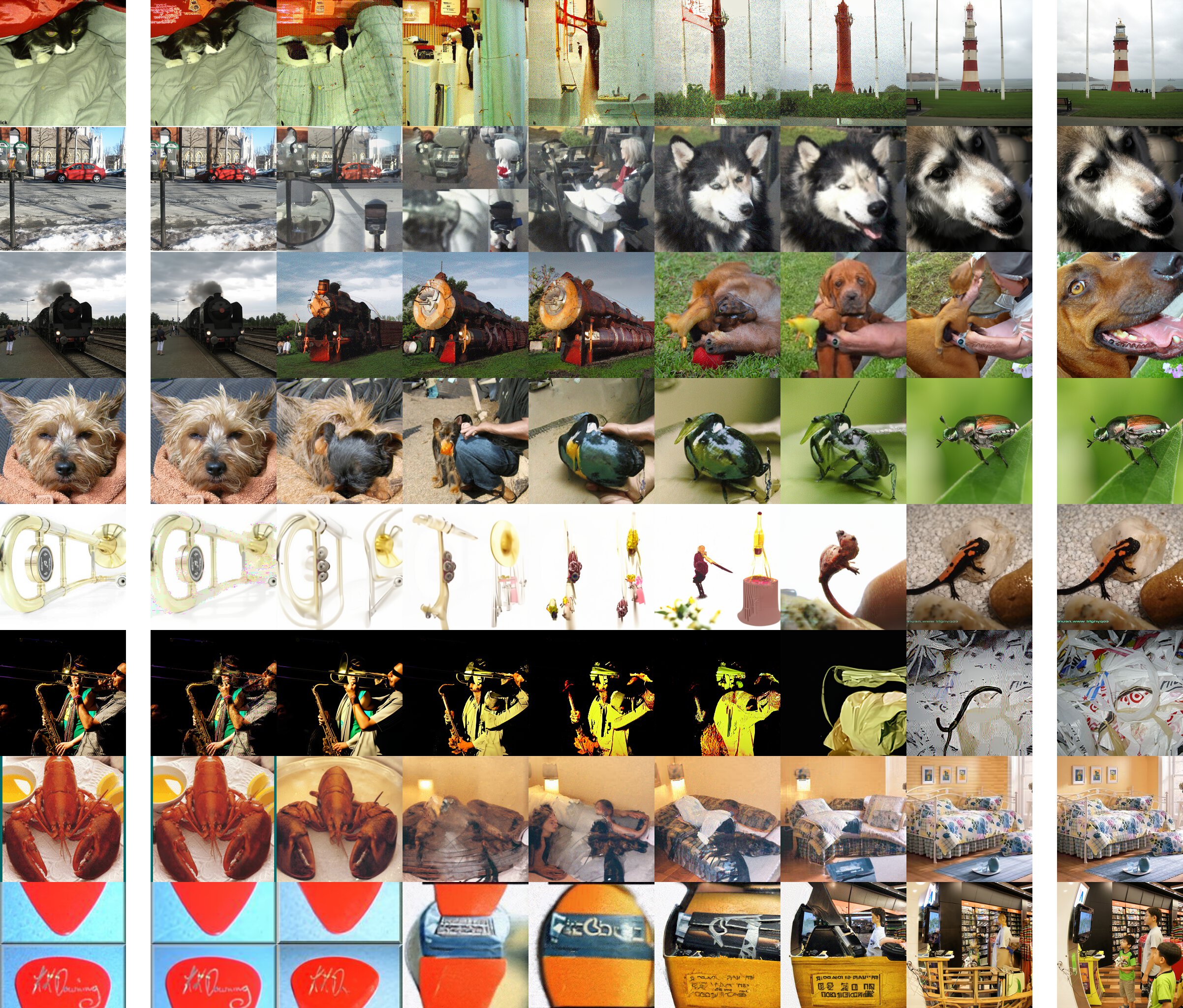
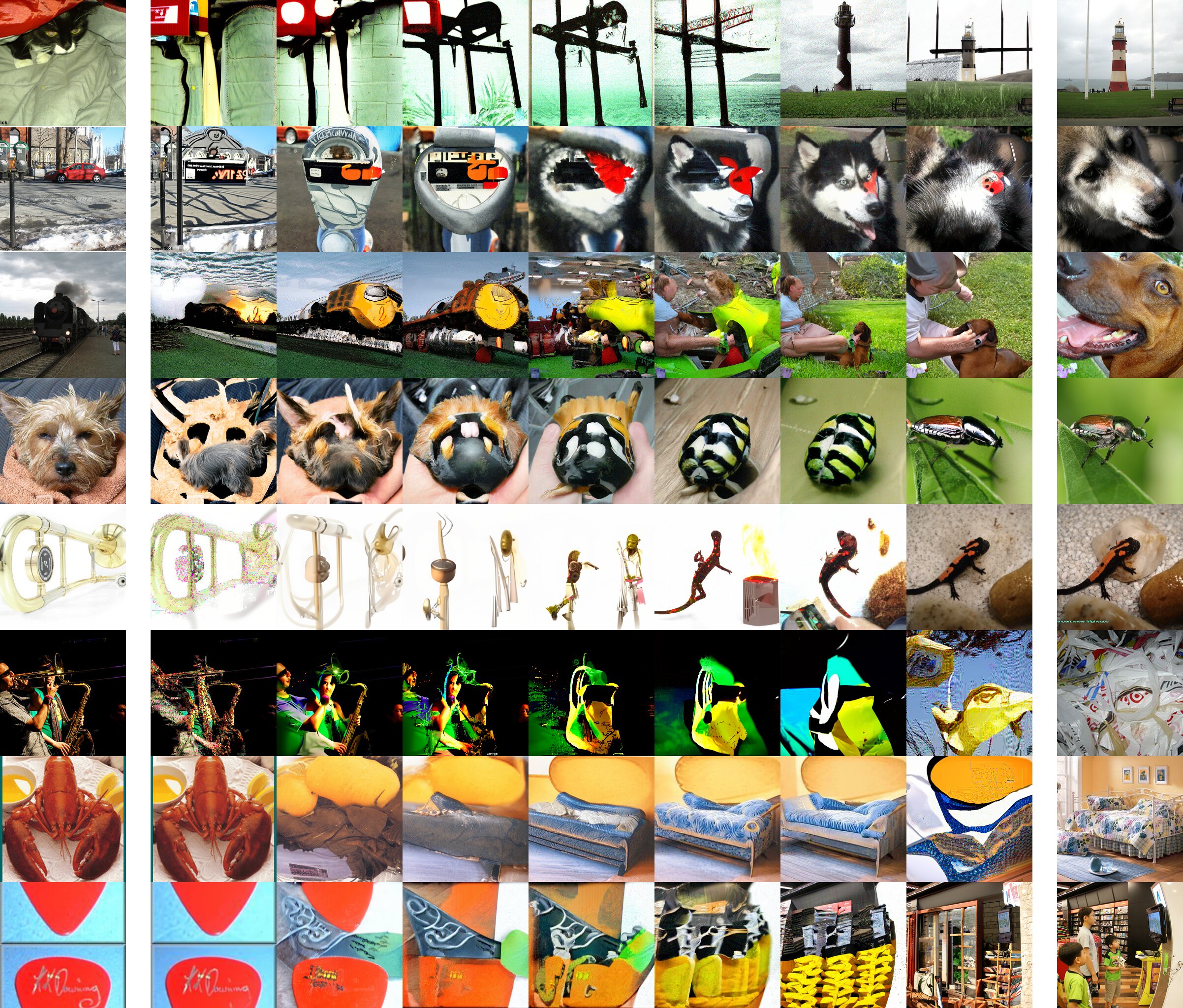
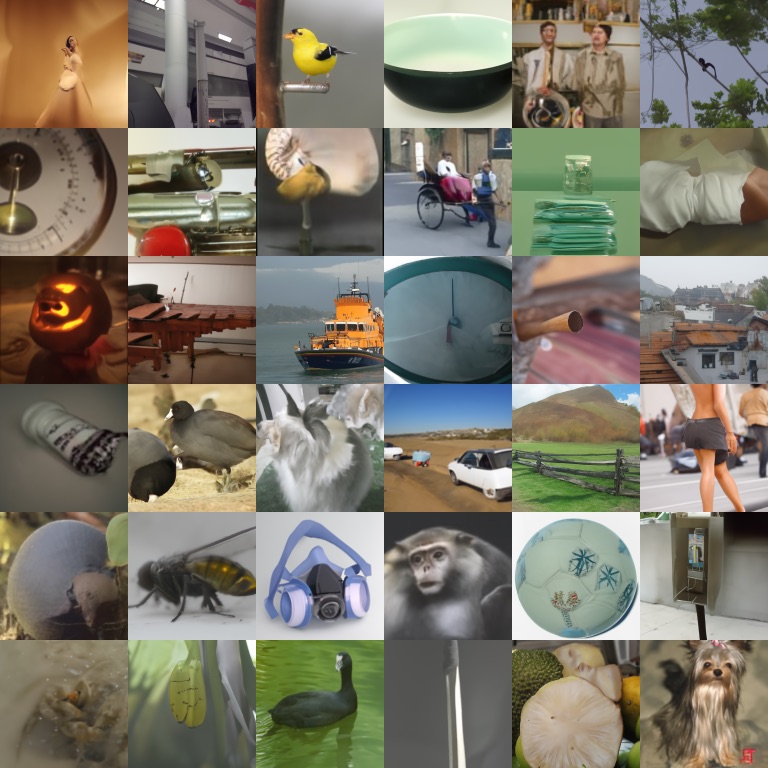
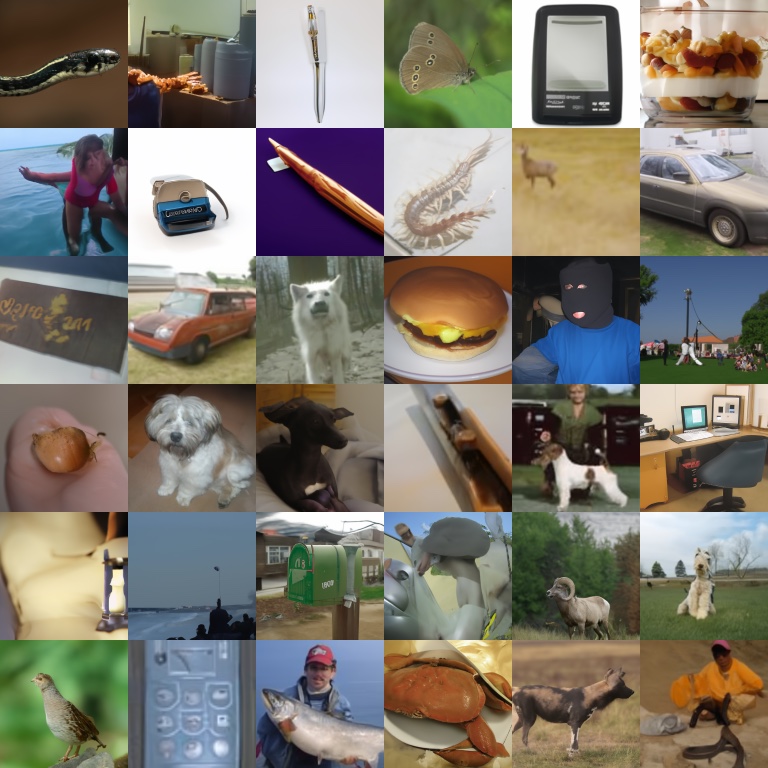
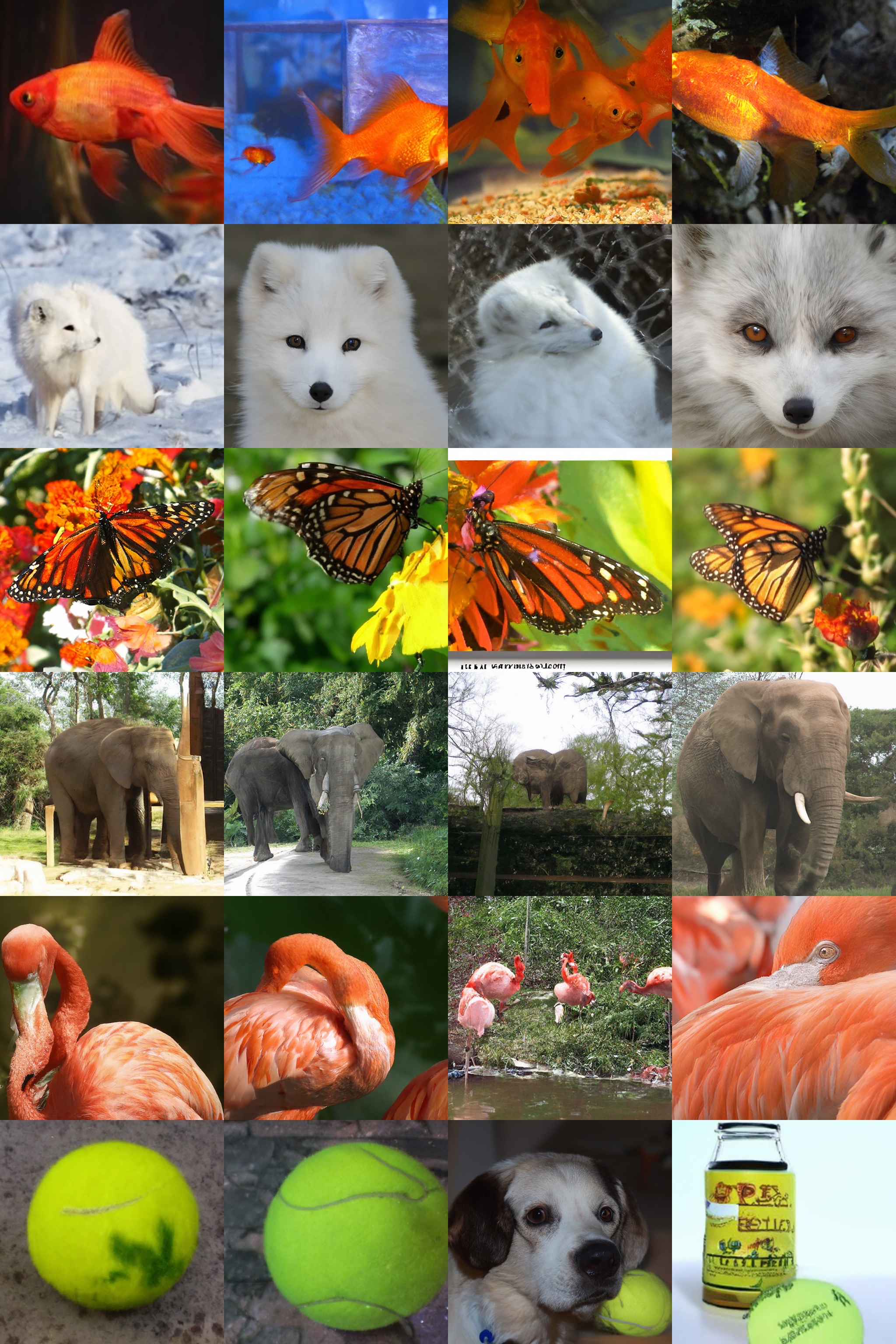
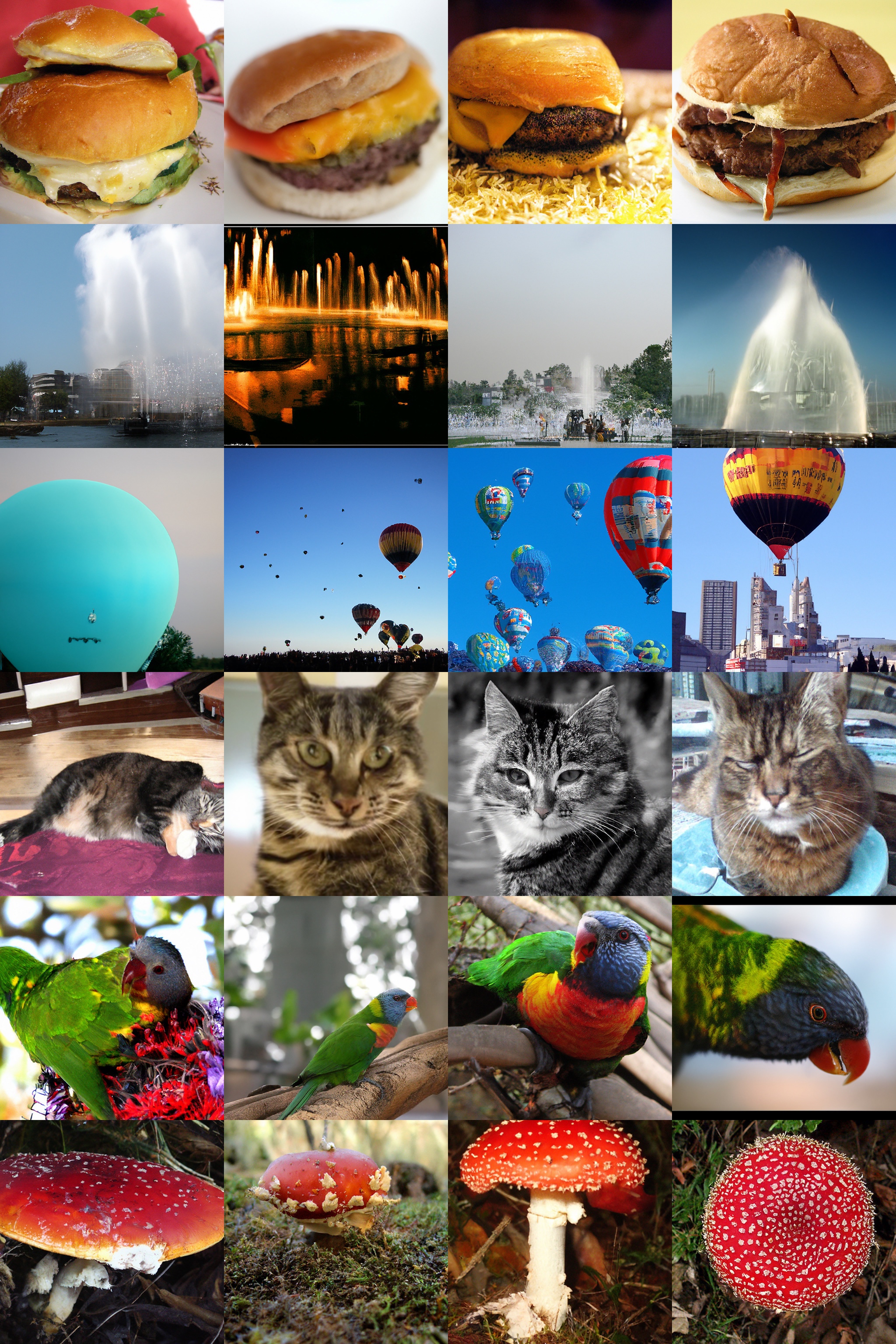
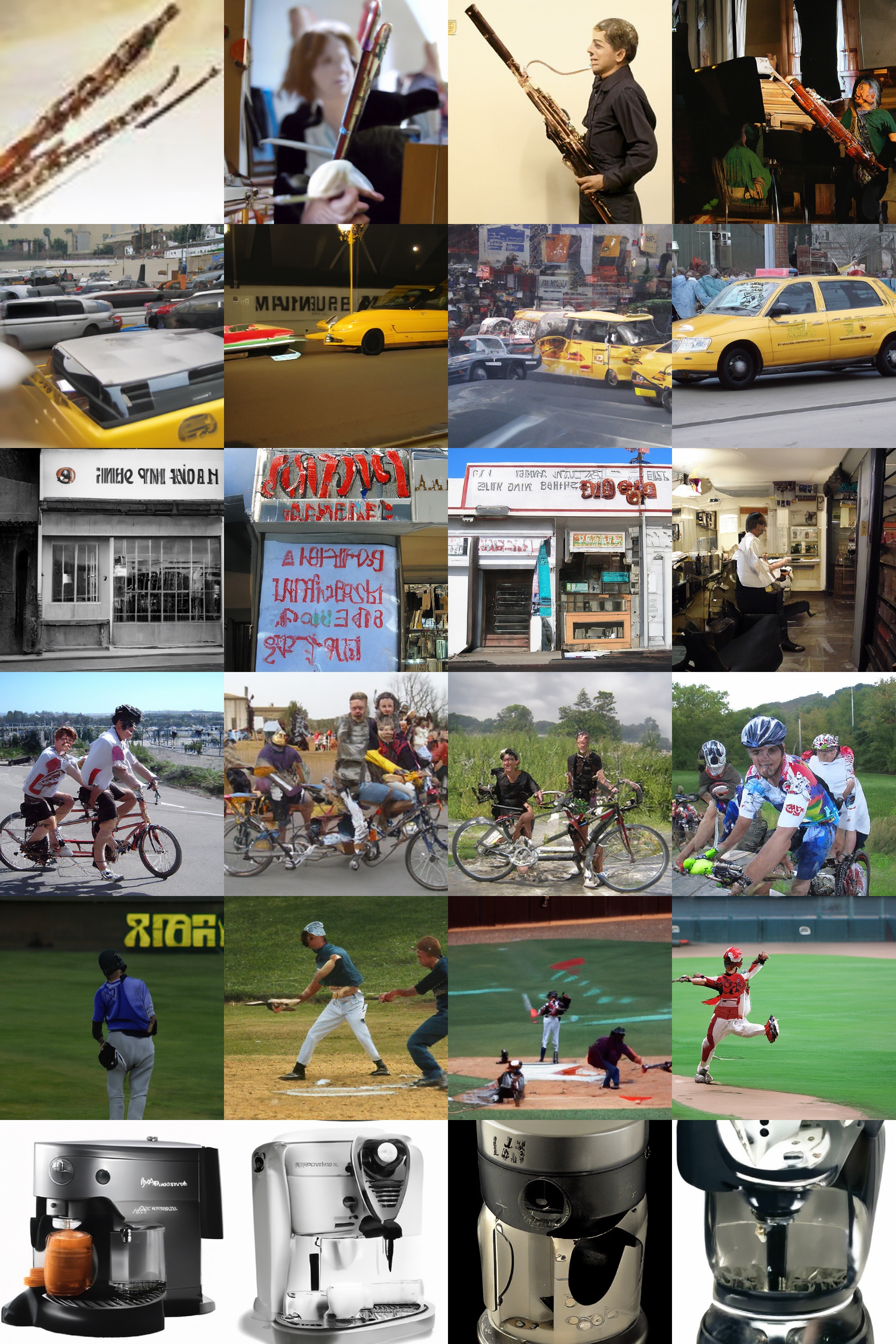
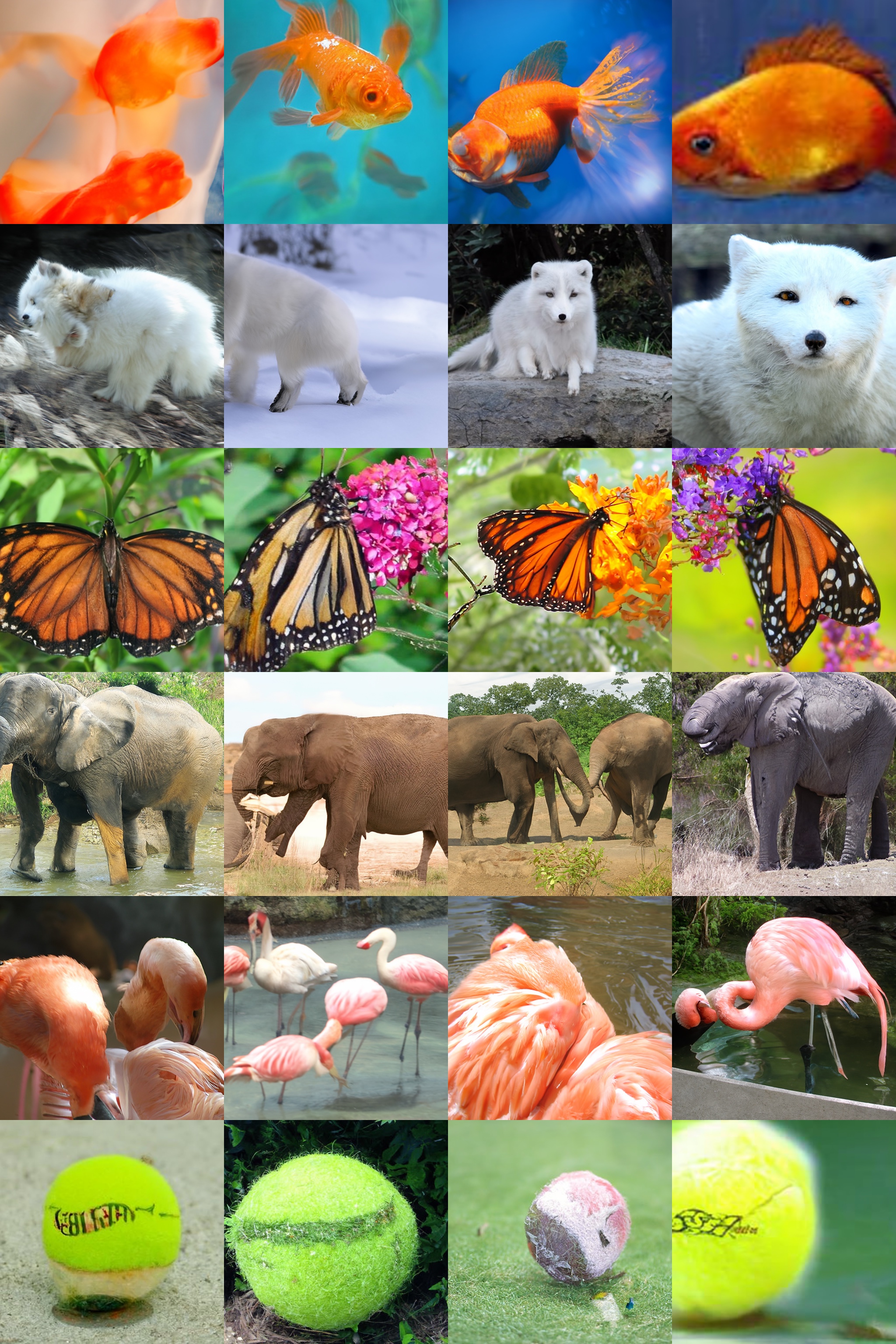
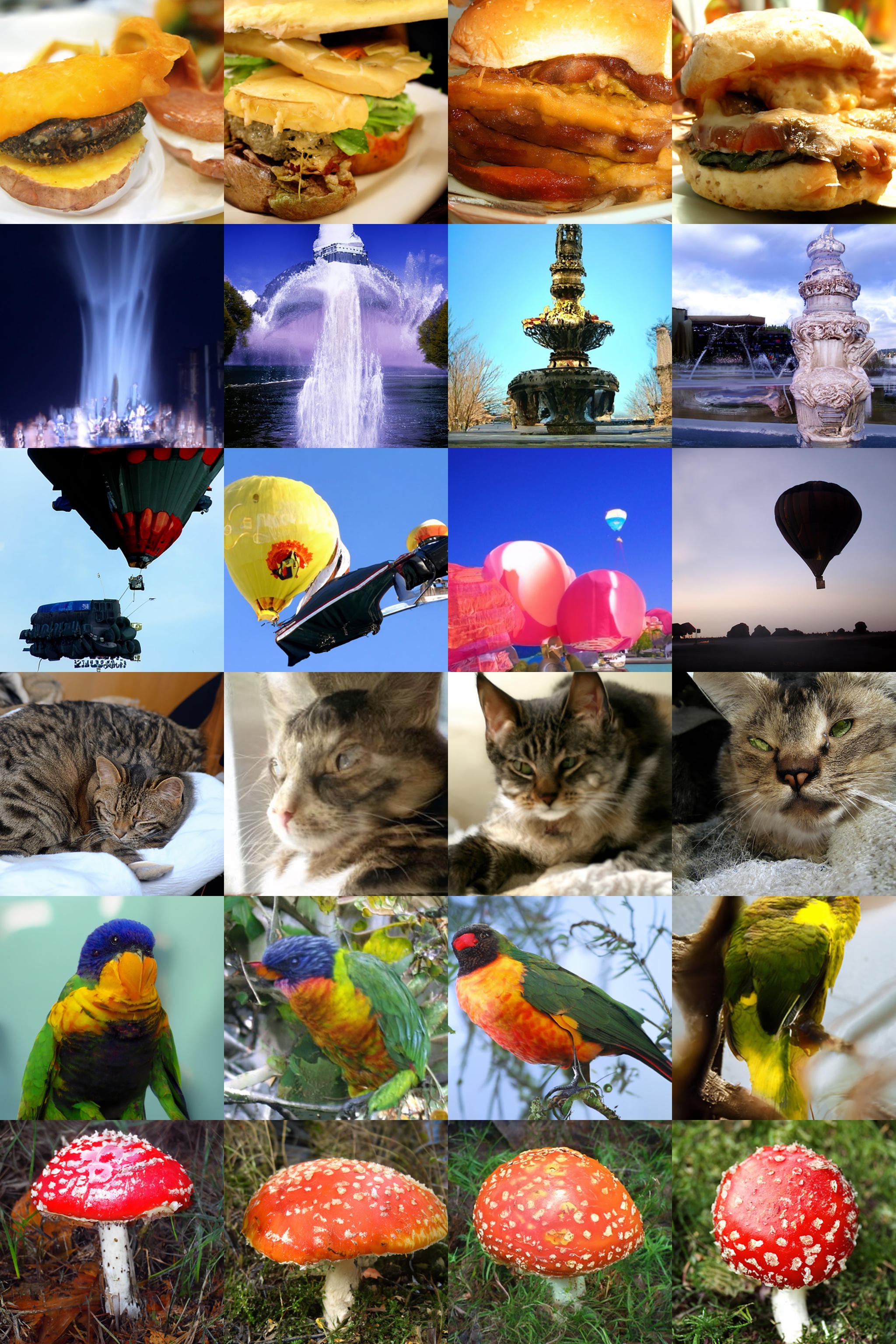
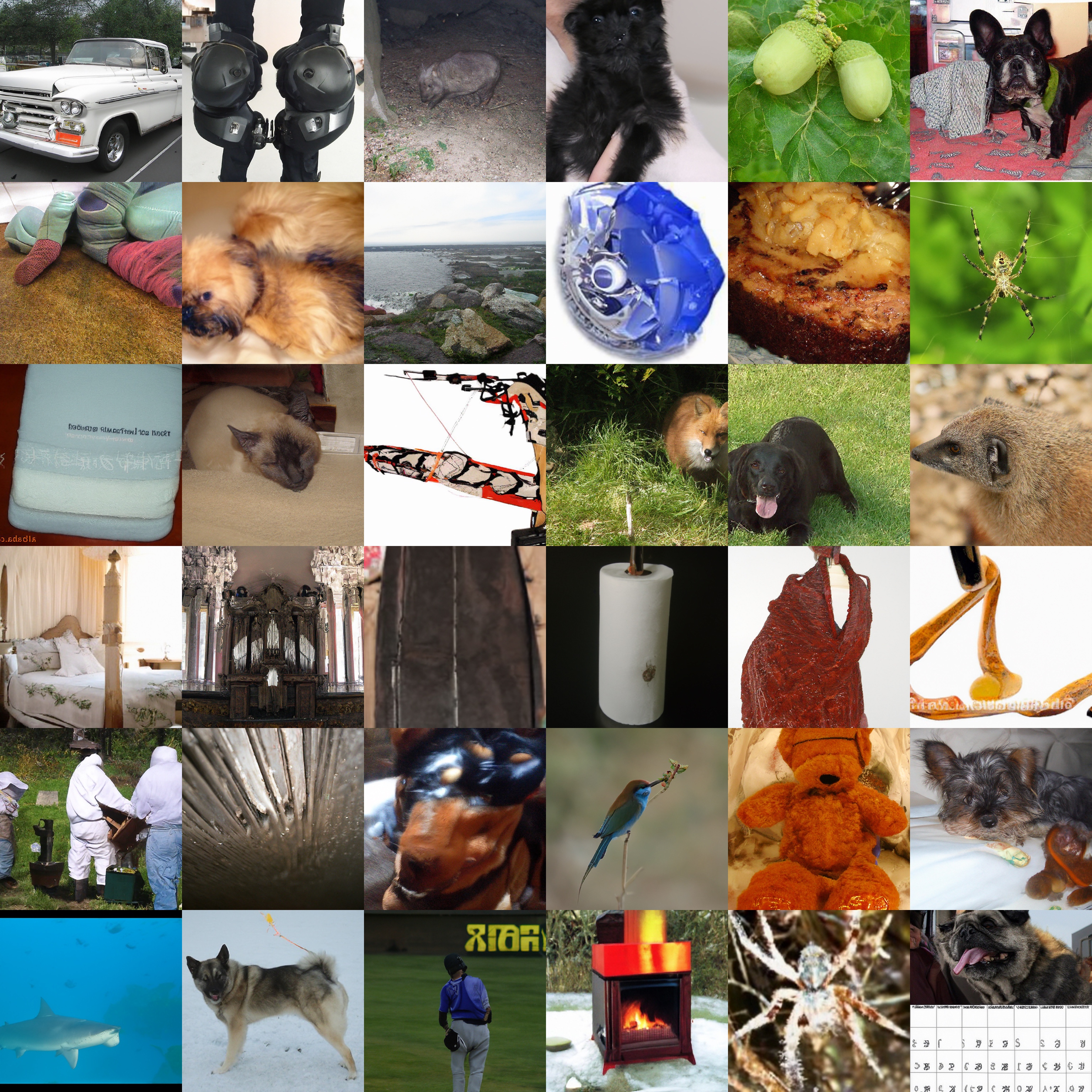
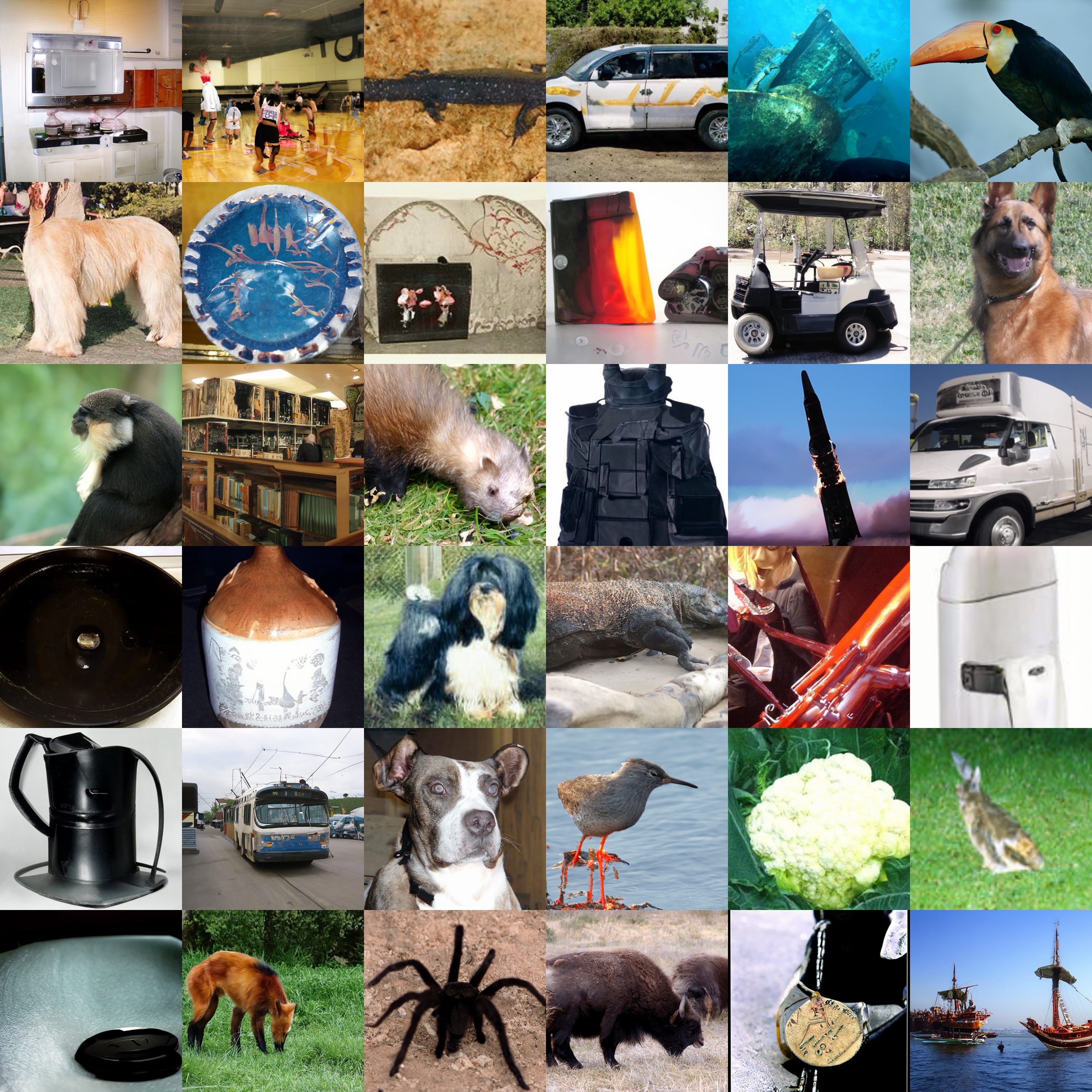
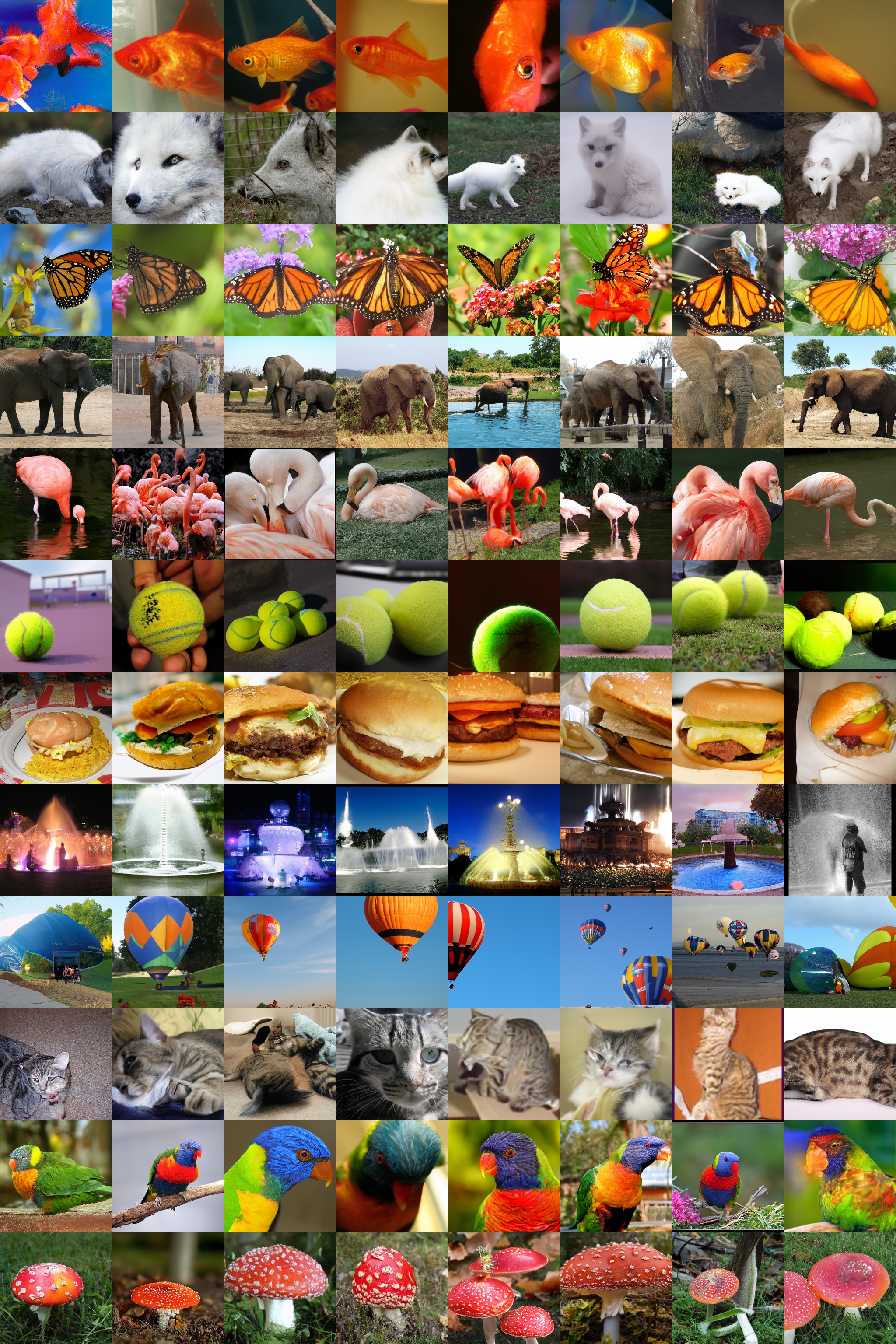
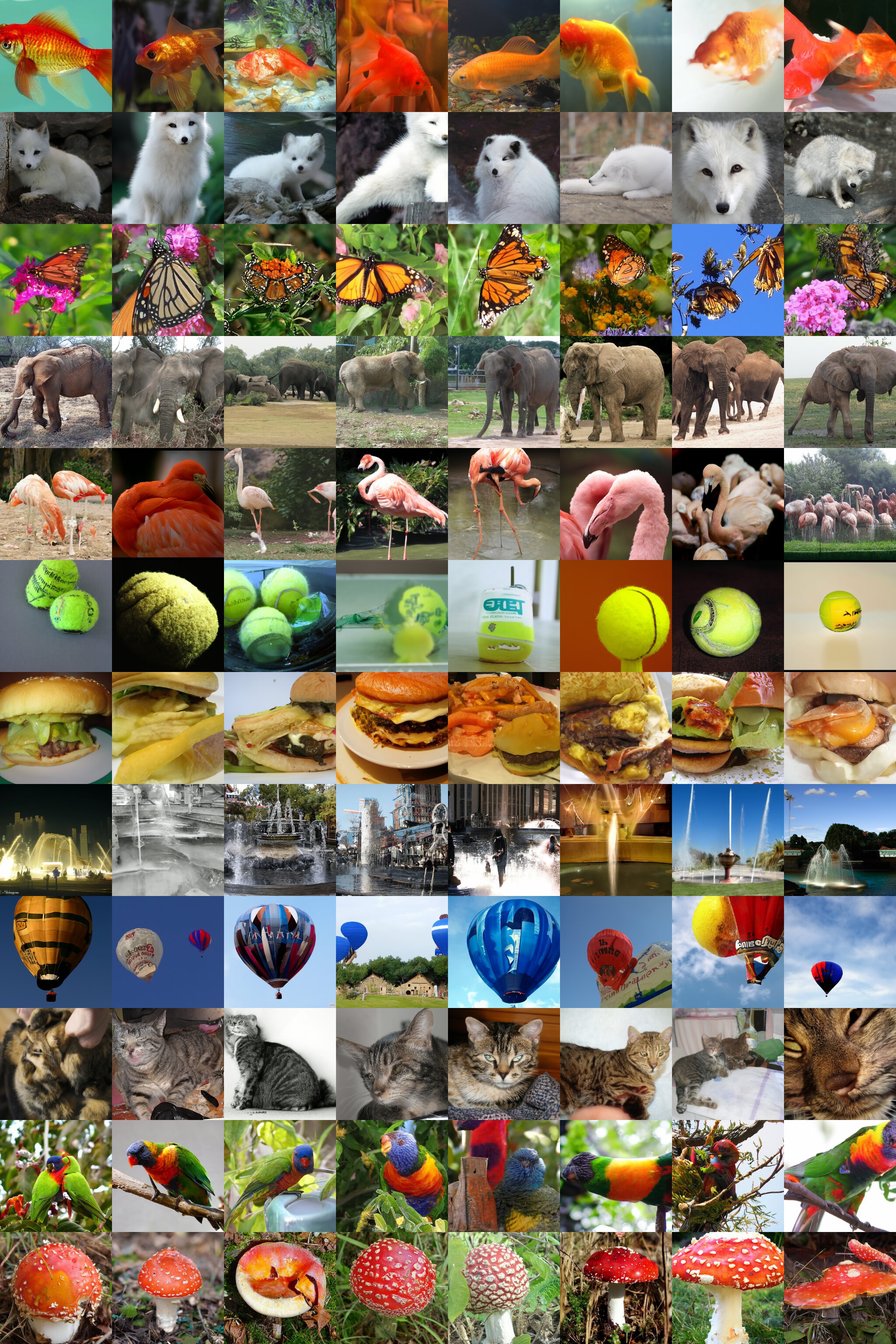
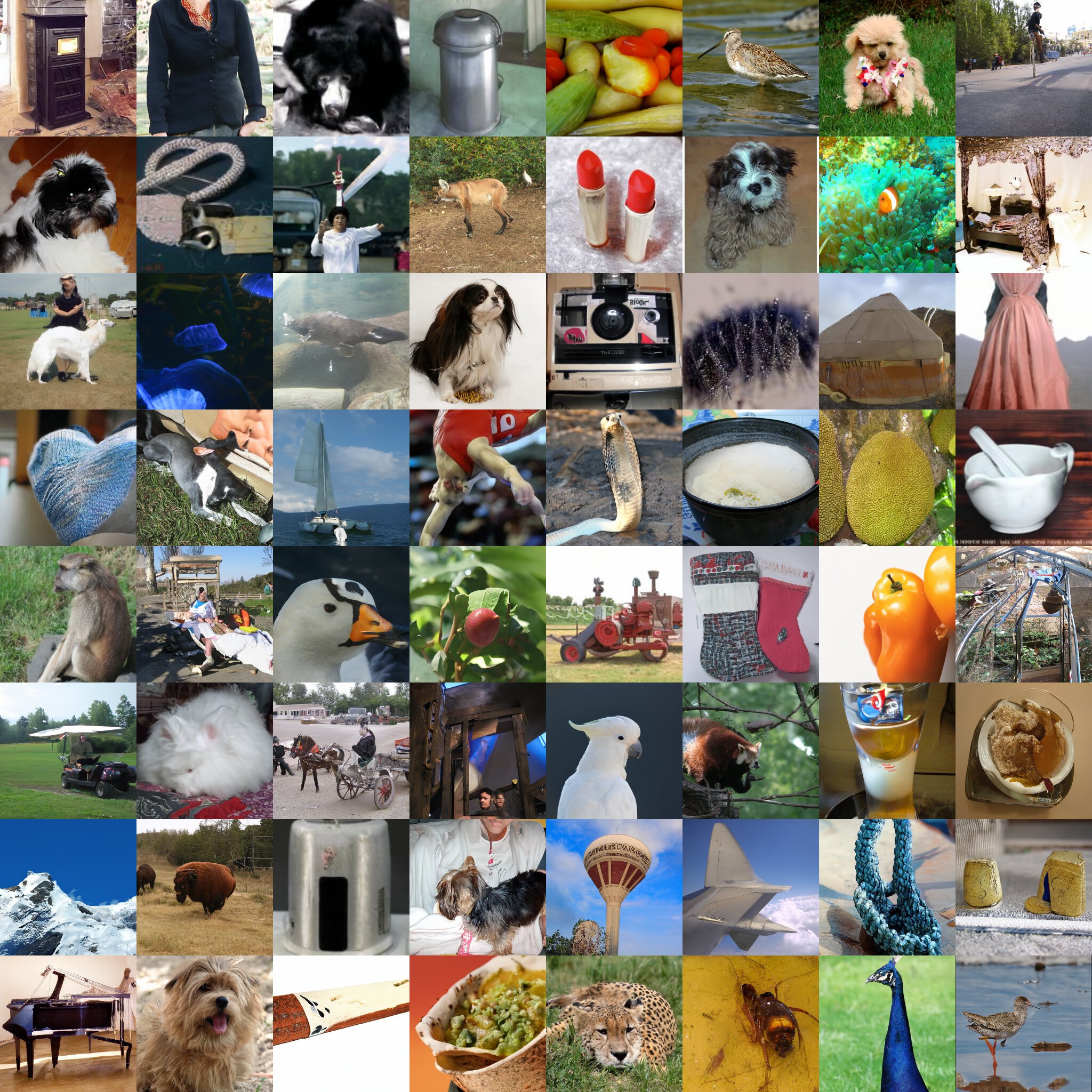
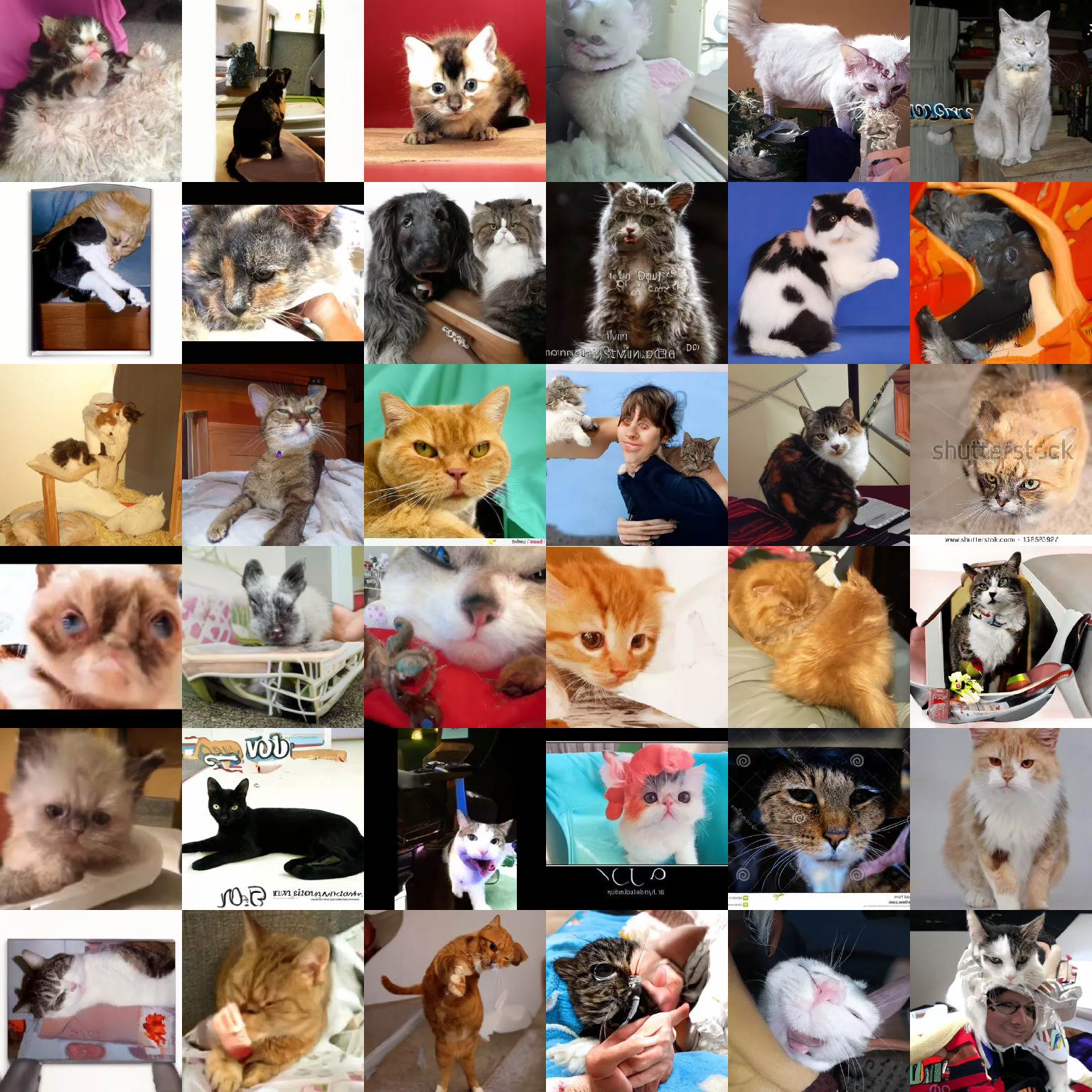
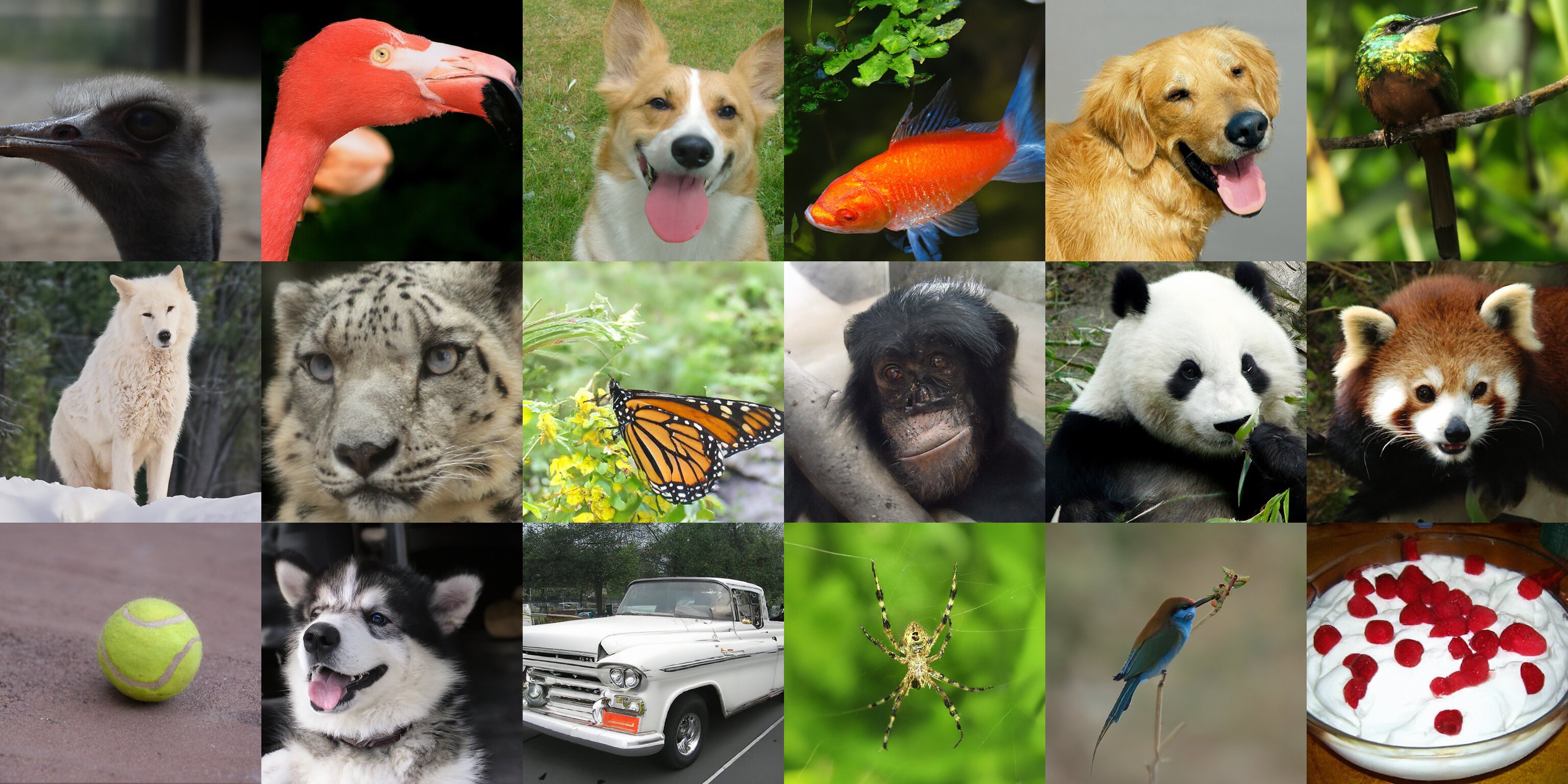
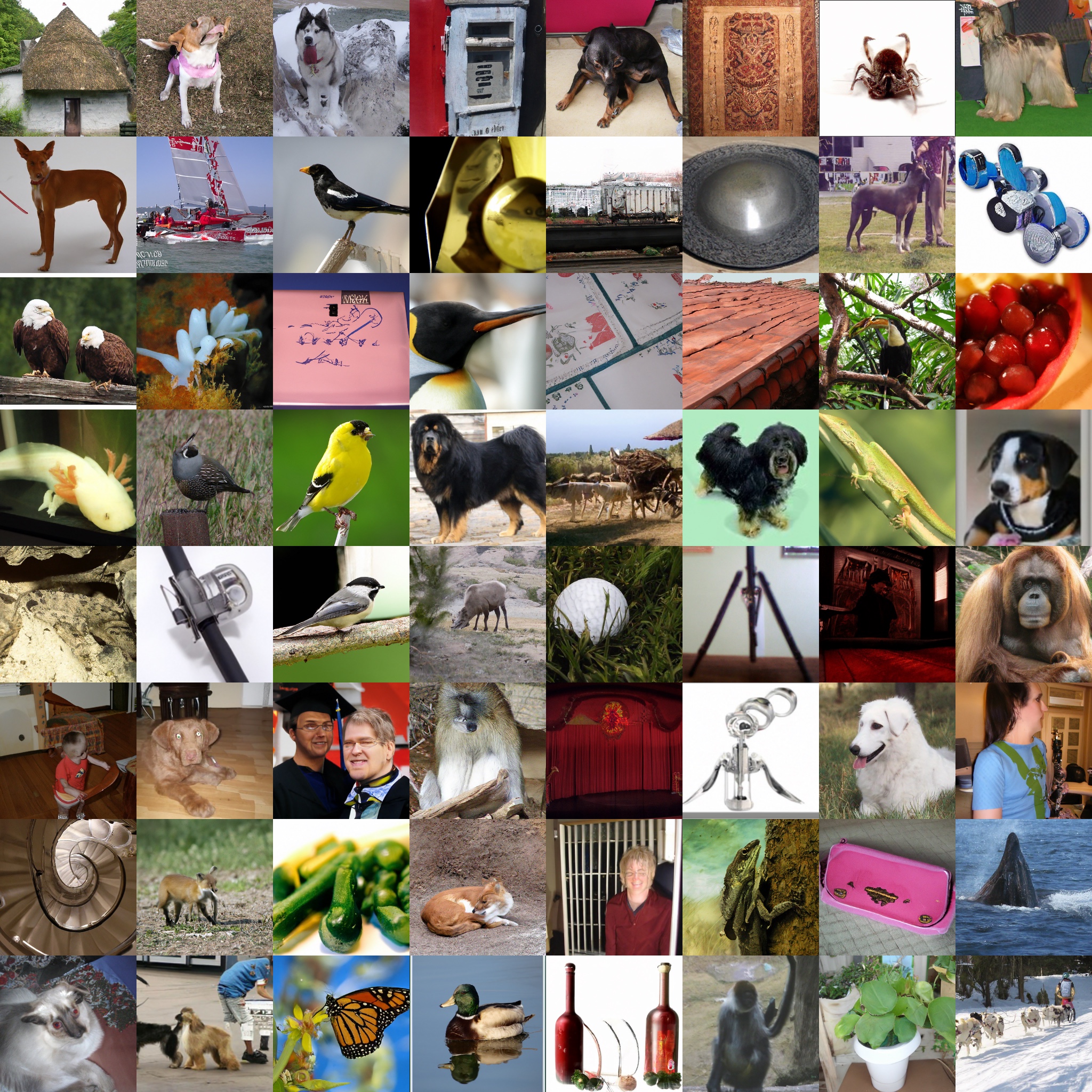
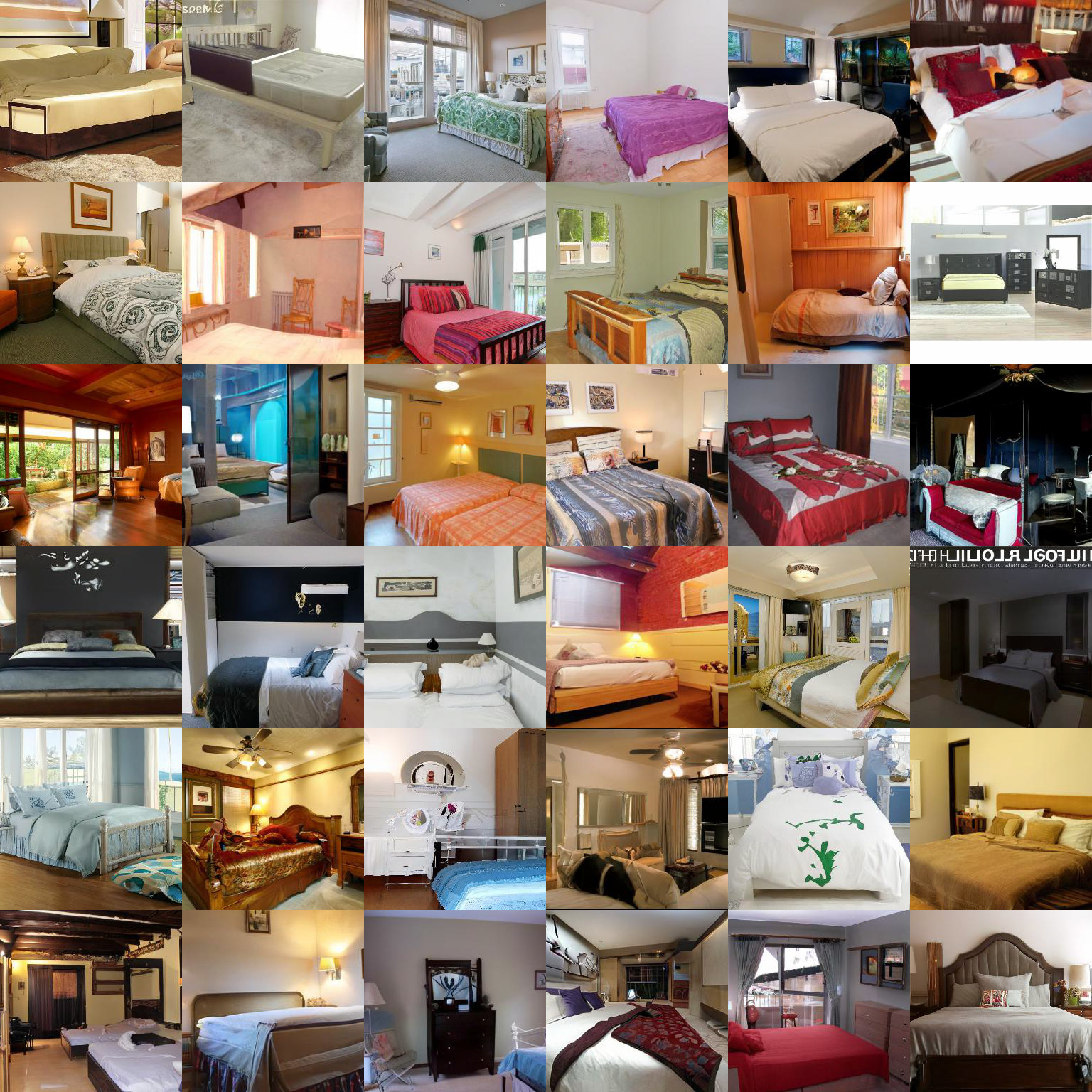
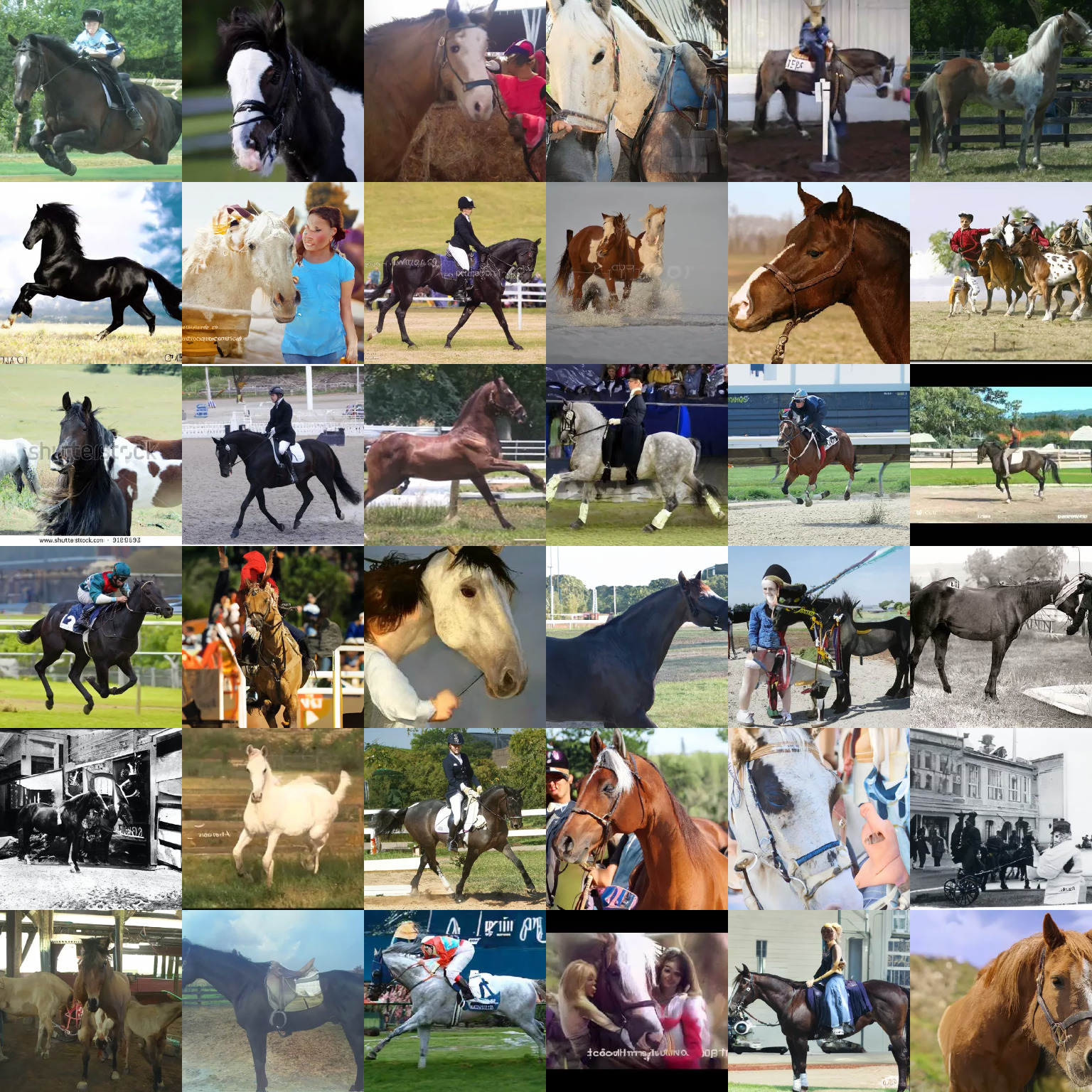
Verification
Claims the paper makes
66 Own result · 23 Supported · 19 Own interpretation · 18 Partly supported · 8 Not checked yet · 8 No basis given · 2 Supported so far · 2 Mixed support · 2 Own method · 1 Couldn’t confirm · 1 Sources not found · 1 No full text of the sources · accuracy not yet measured
Some cited sources support this claim and some don’t — read each source’s verdict below.
In the paper
“While these models capture more diversity and are typically easier to scale and train than GANs, they still fall short in terms of visual sample quality.”
What the sources say
- Disputedcites [51] [51] Ali Razavi, Aaron van den Oord, and Oriol Vinyals. Generating diverse high-fidelity images with VQ-VAE-2. arXiv:1906.00446, 2019. sourceExperimental — accuracy not yet measured
Section 3.3 (p. 5) says that fitting the full data distribution with likelihood-based models is considerably more difficult than adversarial modeling, contrary to the claimed ease of training. The paper discusses training larger models in Section 3.2 (p. 5), but does not say likelihood-based models are easier to scale than GANs. (LLM, conf=0.82)
Checked by a reasoning model — may be wrong.
- Partly supportedcites [43] [43] Alex Nichol and Prafulla Dhariwal. Improved denoising diffusion probabilistic models. arXiv:2102.09672, 2021. sourceExperimental — accuracy not yet measured
The Conclusion (p. 8) says DDPMs have a stationary training objective that scales easily with training compute. It does not say they are typically easier to scale or train than GANs, or extend that claim to likelihood-based models generally. The GAN comparison (p. 7) addresses sample quality and mode coverage, not ease of training. (LLM, conf=0.83)
- Partly supportedcites [42] [42] Charlie Nash, Jacob Menick, Sander Dieleman, and Peter W. Battaglia. Generating images with sparse representations. arXiv:2103.03841, 2021. sourceExperimental — accuracy not yet measured
The Introduction says likelihood-based training tends to be more stable than adversarial training, supporting the training comparison. It does not establish that likelihood-based image models are easier to scale; the Discussion instead says good results on complex, high-resolution datasets require substantial computational resources, while GANs achieve high quality with less. (LLM, conf=0.88)
plaincorrelational- Asserted: passes — The authors put it forward as true.
- Checkable: passes — It can be checked against evidence.
- Load-bearing: unclear — It is unclear whether the paper’s conclusions depend on it.
- Based: passes — The paper gives a reason why it holds.
- Disputed
Some cited sources support this claim and some don’t — read each source’s verdict below.
In the paper
“While these models capture more diversity and are typically easier to scale and train than GANs, they still fall short in terms of visual sample quality.”
What the sources say
- Disputedcites [51] [51] Ali Razavi, Aaron van den Oord, and Oriol Vinyals. Generating diverse high-fidelity images with VQ-VAE-2. arXiv:1906.00446, 2019. sourceExperimental — accuracy not yet measured
The Experiments section (p. 6) says the paper’s likelihood-based VQ-VAE produces samples of comparable fidelity to BigGAN-deep, with higher diversity. The Conclusion (p. 11) likewise calls its best samples competitive with state-of-the-art GANs, contrary to the unqualified claim that likelihood-based models still fall short in visual quality. (LLM, conf=0.86)
Checked by a reasoning model — may be wrong.
- Disputedcites [43] [43] Alex Nichol and Prafulla Dhariwal. Improved denoising diffusion probabilistic models. arXiv:2102.09672, 2021. sourceExperimental — accuracy not yet measured
The Conclusion (p. 8) says DDPMs can match the sample quality of GANs, contrary to the unqualified claim that they still fall short. The comparison is mixed: Table 4 (p. 6) gives the larger diffusion model a better FID than BigGAN-deep at ImageNet 64 × 64, while Table 5 (p. 12) shows a remaining gap at 256 × 256. (LLM, conf=0.83)
Checked by a reasoning model — may be wrong.
- Partly supportedcites [42] [42] Charlie Nash, Jacob Menick, Sander Dieleman, and Peter W. Battaglia. Generating images with sparse representations. arXiv:2103.03841, 2021. sourceExperimental — accuracy not yet measured
The Image generation benchmarks section reports that GANs had the strongest precision and FID scores, and that DCTransformer samples were less reliably coherent than GAN samples. But it calls the overall comparison mixed: DCTransformer led on spatial FID in three of five datasets, and the Introduction describes its sample quality as competitive with state-of-the-art GANs. The source therefore supports a qualified quality gap, not a blanket claim that likelihood-based models fall short. (LLM, conf=0.84)
plain- Asserted: passes — The authors put it forward as true.
- Checkable: passes — It can be checked against evidence.
- Load-bearing: passes — The paper’s conclusions depend on it.
- Based: passes — The paper gives a reason why it holds.
- Disputed
Every source the paper cites for this claim was checked and supports it.
In the paper
“This class of models already holds the state-of-the-art [60] on CIFAR-10 [31]”
What the sources say
- Supportedcites [60] [60] Yang Song, Jascha Sohl-Dickstein, Diederik P. Kingma, Abhishek Kumar, Stefano Ermon, and Ben Poole. Score-based generative modeling through stochastic differential equations. arXiv:2011.13456, 2020. source
The Introduction reports new state-of-the-art Inception and FID scores on CIFAR-10. Section 4.4 likewise says the authors’ model sets records for unconditional CIFAR-10 generation, supporting the cited claim. (LLM, conf=0.93)
plain- Asserted: passes — The authors put it forward as true.
- Checkable: passes — It can be checked against evidence.
- Load-bearing: passes — The paper’s conclusions depend on it.
- Based: passes — The paper gives a reason why it holds.
- Supported
The cited sources support only part of this claim — read each source’s verdict below.
In the paper
“Furthermore, GANs are often difficult to train, collapsing without carefully selected hyperparameters and regularizers [5, 41, 4].”
What the sources say
- Supportedcites [5] [5] Andrew Brock, Jeff Donahue, and Karen Simonyan. Large scale gan training for high fidelity natural image synthesis. arXiv:1809.11096, 2018. source
The Background (p. 2) describes extensive work on modifications intended to stabilize GAN training. The paper reports collapse even in its improved models (3.2 Summary, p. 5), and shows that changes to learning rates can trigger immediate collapse (Appendix G.1, p. 32), supporting the claim that training is sensitive to hyperparameters and regularization. (LLM, conf=0.90)
- Partly supportedcites [41] [41] Takeru Miyato, Toshiki Kataoka, Masanori Koyama, and Yuichi Yoshida. Spectral normalization for generative adversarial networks. arXiv:1802.05957, 2018. sourceExperimental — accuracy not yet measured
The Introduction (p. 1) describes unstable GAN training, and the ImageNet results (p. 11) report that GANs without normalization collapsed. But the paper does not establish that avoiding collapse generally requires carefully selected hyperparameters and regularizers: the Introduction (pp. 1–2) says spectral normalization works without intensive hyperparameter tuning or complementary regularization techniques. (LLM, conf=0.84)
- Not checked yetcites [4] [4] Andrew Brock, Theodore Lim, J. M. Ritchie, and Nick Weston. Neural photo editing with introspective adversarial networks. arXiv:1609.07093, 2016. source
plaindirect- Asserted: passes — The authors put it forward as true.
- Checkable: passes — It can be checked against evidence.
- Load-bearing: passes — The paper’s conclusions depend on it.
- Based: passes — The paper gives a reason why it holds.
- Supported
The cited sources support only part of this claim — read each source’s verdict below.
In the paper
“it has been shown that GANs capture less diversity than state-of-the-art likelihood-based models [51, 43, 42].”
What the sources say
- Supportedcites [51] [51] Ali Razavi, Aaron van den Oord, and Oriol Vinyals. Generating diverse high-fidelity images with VQ-VAE-2. arXiv:1906.00446, 2019. source
The Introduction (p. 2) says likelihood-based models in principle cover all modes of the data, unlike GANs, which can lack diversity. The Experiments section (p. 6) also reports higher sample diversity for VQ-VAE than for BigGAN-deep, which it identifies as a state-of-the-art GAN. (LLM, conf=0.90)
- Partly supportedcites [43] [43] Alex Nichol and Prafulla Dhariwal. Improved denoising diffusion probabilistic models. arXiv:2102.09672, 2021. sourceExperimental — accuracy not yet measured
The Introduction (p. 1) reports that diffusion models achieved much higher recall than GANs at similar FID, and the Conclusion (p. 8) describes better mode coverage for DDPMs. This supports the diversity comparison for the models studied, but not the broader claim about GANs versus state-of-the-art likelihood-based models generally. (LLM, conf=0.83)
- Supportedcites [42] [42] Charlie Nash, Jacob Menick, Sander Dieleman, and Peter W. Battaglia. Generating images with sparse representations. arXiv:2103.03841, 2021. source
The Introduction describes mode-dropping as a common downside of GANs and says likelihood-based training incentivizes coverage of the full data distribution. In §4.1, the paper reports that its likelihood-based DCTransformer typically achieves better recall than the GANs compared, which it interprets as better data coverage. (LLM, conf=0.89)
plain- Asserted: passes — The authors put it forward as true.
- Checkable: passes — It can be checked against evidence.
- Load-bearing: passes — The paper’s conclusions depend on it.
- Based: passes — The paper gives a reason why it holds.
- Supported
Every source the paper cites for this claim was checked and supports it.
In the paper
“However, the FID of this model is still not competitive with BigGAN-deep [5], the current state-of-the-art on this dataset.”
What the sources say
- Supportedcites [5] [5] Andrew Brock, Jeff Donahue, and Karen Simonyan. Large scale gan training for high fidelity natural image synthesis. arXiv:1809.11096, 2018. source
Table 2 (p. 7) identifies BigGAN-deep as an ImageNet 256 × 256 model and reports its FID. Section 5.1 (p. 7) says the models outperform previous state-of-the-art FID scores. The comparison with the citing authors’ own model is their assessment, not a result attributed to this source. (LLM, conf=0.90)
plain- Asserted: passes — The authors put it forward as true.
- Checkable: passes — It can be checked against evidence.
- Load-bearing: passes — The paper’s conclusions depend on it.
- Based: passes — The paper gives a reason why it holds.
- Supported
Every source the paper cites for this claim was checked and supports it.
In the paper
“Nichol and Dhariwal [43] found that these models improve reliably with increased compute”
What the sources say
- Supportedcites [43] [43] Alex Nichol and Prafulla Dhariwal. Improved denoising diffusion probabilistic models. arXiv:2102.09672, 2021. source
Section 6 (p. 7) reports that the authors’ preliminary results suggest DDPM performance improves predictably as training compute increases. The Abstract (p. 1) likewise says sample quality and likelihood scale smoothly with training compute. (LLM, conf=0.91)
plaindirect- Asserted: passes — The authors put it forward as true.
- Checkable: passes — It can be checked against evidence.
- Load-bearing: unclear — It is unclear whether the paper’s conclusions depend on it.
- Based: passes — The paper gives a reason why it holds.
- Supported
The cited sources that could be checked couldn’t confirm or dispute this claim.
In the paper
“and we can increase this gradient scale factor by an order of magnitude without obtaining adversarial examples [61].”
What the sources say
- Could not verifycites [61] [61] Christian Szegedy, Wojciech Zaremba, Ilya Sutskever, Joan Bruna, Dumitru Erhan, Ian Good- fellow, and Rob Fergus. Intriguing properties of neural networks. arXiv:1312.6199, 2013. sourceExperimental — accuracy not yet measured
The Experimental results (pp. 5–8) discuss generating adversarial examples and magnifying image distortions, but do not test whether a tenfold increase in a gradient scale factor fails to produce them. I searched for the claimed scale factor, gradients, and an order-of-magnitude increase; the 10× figure on p. 6 refers only to magnifying an image difference for display. (LLM, conf=0.73)
plaindirect- Asserted: passes — The authors put it forward as true.
- Checkable: passes — It can be checked against evidence.
- Load-bearing: unclear — It is unclear whether the paper’s conclusions depend on it.
- Based: passes — The paper gives a reason why it holds.
- Could not verify
The cited sources support only part of this claim — read each source’s verdict below.
In the paper
“GANs [19] currently hold the state-of-the-art on most image generation tasks [5, 68, 28] as measured by sample quality metrics such as FID [23], Inception Score [54] and Precision [32].”
What the sources say
- Partly supportedcites [5] [5] Andrew Brock, Jeff Donahue, and Karen Simonyan. Large scale gan training for high fidelity natural image synthesis. arXiv:1809.11096, 2018. sourceExperimental — accuracy not yet measured
Section 5.1 (p. 7) reports that BigGAN surpassed previous state-of-the-art Inception Score and FID results on ImageNet. Section 2 (p. 3) describes those metrics as measures of sample quality. The paper does not establish that GANs lead on most image-generation tasks, and it does not report Precision as a performance metric. (LLM, conf=0.87)
- Not checked yetcites [68] [68] Yan Wu, Jeff Donahue, David Balduzzi, Karen Simonyan, and Timothy Lillicrap. Logan: Latent optimisation for generative adversarial networks. arXiv:1912.00953, 2019. source
A check is scheduled.
- Partly supportedcites [28] [28] Tero Karras, Samuli Laine, Miika Aittala, Janne Hellsten, Jaakko Lehtinen, and Timo Aila. Analyzing and improving the image quality of stylegan. arXiv:1912.04958, 2019. sourceExperimental — accuracy not yet measured
The Introduction describes StyleGAN as state of the art for high-resolution image synthesis, and the Conclusions say StyleGAN2 advanced the state of the art on several datasets. Neither passage establishes that GANs lead on most image-generation tasks. FID, Inception Score, and Precision have separate citations in the citing sentence, so they are not the part attributed to this paper. (LLM, conf=0.85)
plain- Asserted: passes — The authors put it forward as true.
- Checkable: passes — It can be checked against evidence.
- Load-bearing: passes — The paper’s conclusions depend on it.
- Based: passes — The paper gives a reason why it holds.
- Partly supported
Every source the paper cites for this claim was checked and supports it.
In the paper
“However, some of these metrics do not fully capture diversity”
What the sources say
- Supportedcites [51] [51] Ali Razavi, Aaron van den Oord, and Oriol Vinyals. Generating diverse high-fidelity images with VQ-VAE-2. arXiv:1906.00446, 2019. source
The Conclusion (p. 11) says concrete measures of sample quality and diversity are still in their infancy and visual inspection remains necessary. Section 5.3.1 (p. 11) also notes drawbacks of common metrics, supporting the claim that some metrics do not fully capture diversity. (LLM, conf=0.88)
- Supportedcites [43] [43] Alex Nichol and Prafulla Dhariwal. Improved denoising diffusion probabilistic models. arXiv:2102.09672, 2021. source
The Introduction (p. 1) reports much higher recall for diffusion models at similar FID, indicating that FID alone does not fully reflect distribution coverage. Section 5 (p. 7) likewise reports better FID for BigGAN-deep but worse recall than a diffusion model. (LLM, conf=0.90)
- Supportedcites [42] [42] Charlie Nash, Jacob Menick, Sander Dieleman, and Peter W. Battaglia. Generating images with sparse representations. arXiv:2103.03841, 2021. source
Section 4 (Experiments; page unavailable) says standard FID features compress spatial information, making the metric less sensitive to spatial variability. Section 4.1 reports that GANs had the strongest FID scores while DCTransformer typically had the best recall scores, which the authors associate with data coverage and diverse samples. Together, these passages support the qualified claim that some metrics do not fully capture diversity. (LLM, conf=0.88)
plain- Asserted: passes — The authors put it forward as true.
- Checkable: passes — It can be checked against evidence.
- Load-bearing: passes — The paper’s conclusions depend on it.
- Based: passes — The paper gives a reason why it holds.
- Supported
- Probably not a substantial claim. 42
- It may state two separate claims as one. 34
- The quote only partly states this claim. 1
Every source the paper cites for this claim was checked and supports it.
In the paper
“Nichol and Dhariwal [43] find that fixing the variance Σθ(xt, t) to a constant as done in Ho et al. [25] is sub-optimal for sampling with fewer diffusion steps”
§ 2 Background > 2.1 Improvements
What the sources say
- Supportedcites [43] [43] Alex Nichol and Prafulla Dhariwal. Improved denoising diffusion probabilistic models. arXiv:2102.09672, 2021. source
Section 4 (p. 6) reports that models with fixed variances suffered much greater losses in sample quality when the number of sampling steps was reduced, while the model with learned variances maintained high quality. Section 3.1 (p. 3) identifies the fixed-variance approach used by Ho et al.; the variances were fixed rather than learned, not necessarily the same value at every step. (LLM, conf=0.94)
plaindirect- Asserted: passes — The authors put it forward as true.
- Checkable: passes — It can be checked against evidence.
- Load-bearing: fails — The paper’s conclusions may not depend on it.
- Based: passes — The paper gives a reason why it holds.
Probably not a substantial claim. The paper’s conclusions may not depend on it.
- Supported
The cited sources support only part of this claim — read each source’s verdict below.
In the paper
“They also note that training with this objective and using their corresponding sampling procedure is equivalent to the denoising score matching model from Song and Ermon [58]”
What the sources say
- Not checked yetcites [25] [25] Jonathan Ho, Ajay Jain, and Pieter Abbeel. Denoising diffusion probabilistic models. arXiv:2006.11239, 2020.
- Partly supportedcites [58] [58] Yang Song and Stefano Ermon. Improved techniques for training score-based generative models. arXiv:2006.09011, 2020. sourceExperimental — accuracy not yet measured
The Introduction (p. 1) says score-based generative models learn their score functions through denoising score matching, and Section 2.2 (pp. 2–3) describes training and sampling with a noise-conditional score network. Our copy does not state that training with Lsimple and its corresponding sampling procedure are equivalent to that model; a search for the equivalence found no such passage. (LLM, conf=0.84)
plain- Asserted: passes — The authors put it forward as true.
- Checkable: passes — It can be checked against evidence.
- Load-bearing: fails — The paper’s conclusions may not depend on it.
- Based: passes — The paper gives a reason why it holds.
Probably not a substantial claim. The paper’s conclusions may not depend on it.
The sources with a verdict support this claim; the rest weren’t checked yet, have no full text we could read, or their verdicts aren’t rated yet.
In the paper
“As a result, much work has been done to achieve GAN-like sample quality with likelihood-based models [51, 25, 42, 9].”
What the sources say
- Supportedcites [51] [51] Ali Razavi, Aaron van den Oord, and Oriol Vinyals. Generating diverse high-fidelity images with VQ-VAE-2. arXiv:1906.00446, 2019. source
The Introduction (p. 1) identifies VAEs and autoregressive models as likelihood-based models. The Conclusion (p. 11) describes this paper’s VQ-VAE with an autoregressive prior and says its best samples have fidelity competitive with state-of-the-art GANs. The paper therefore serves as an example of the work described in the citing sentence. (LLM, conf=0.93)
- Not checked yetcites [25] [25] Jonathan Ho, Ajay Jain, and Pieter Abbeel. Denoising diffusion probabilistic models. arXiv:2006.11239, 2020.
- Supportedcites [42] [42] Charlie Nash, Jacob Menick, Sander Dieleman, and Peter W. Battaglia. Generating images with sparse representations. arXiv:2103.03841, 2021. source
The Introduction describes likelihood-based approaches to image generation and says this paper’s autoregressive DCTransformer achieves sample quality competitive with state-of-the-art GANs. This paper is therefore an example of the work the citing sentence describes. (LLM, conf=0.90)
- Not checked yetcites [9] [9] Rewon Child. Very deep vaes generalize autoregressive models and can outperform them on images. arXiv:2011.10650, 2021.
plain- Asserted: passes — The authors put it forward as true.
- Checkable: passes — It can be checked against evidence.
- Load-bearing: fails — The paper’s conclusions may not depend on it.
- Based: passes — The paper gives a reason why it holds.
Probably not a substantial claim. The paper’s conclusions may not depend on it.
- Supported
Every source the paper cites for this claim was checked and supports it.
In the paper
“By setting this noise to 0, they provide a way to turn any model εθ(xt, t) into a deterministic mapping from latents to images”
§ 2 Background > 2.1 Improvements
What the sources say
- Supportedcites [57] [57] Jiaming Song, Chenlin Meng, and Stefano Ermon. Denoising diffusion implicit models. arXiv:2010.02502, 2020. source
Section 4.1 (p. 5) states that setting σₜ = 0 for all steps removes the random-noise term from the generative process, yielding samples from latent variables xₜ through a fixed procedure to x₀. Section 5 (p. 6) also describes DDIM as deterministic and says the same trained model can be used by changing the sampling parameters. (LLM, conf=0.94)
plaindirect- Asserted: passes — The authors put it forward as true.
- Checkable: passes — It can be checked against evidence.
- Load-bearing: fails — The paper’s conclusions may not depend on it.
- Based: passes — The paper gives a reason why it holds.
Probably not a substantial claim. The paper’s conclusions may not depend on it.
- Supported
The sources with a verdict support this claim; the rest weren’t checked yet, have no full text we could read, or their verdicts aren’t rated yet.
In the paper
“The variance Σθ(xt, t) of this Gaussian distribution can be fixed to a known constant [25] or learned with a separate neural network head [43], and both approaches yield high-quality samples when the total number of diffusion steps T is large enough.”
What the sources say
- Not checked yetcites [25] [25] Jonathan Ho, Ajay Jain, and Pieter Abbeel. Denoising diffusion probabilistic models. arXiv:2006.11239, 2020.
- Supportedcites [43] [43] Alex Nichol and Prafulla Dhariwal. Improved denoising diffusion probabilistic models. arXiv:2102.09672, 2021. source
Section 3.1 (pp. 3–4) describes learning the variance from a model output distinct from its mean output. It also explains that, as the number of diffusion steps increases, the choice of variance matters less for sample quality; Section 2.2 (p. 2) reports high-quality results with fixed variance. The cited paper therefore supports the learned-variance approach and the sample-quality comparison, though it does not use the phrase “separate neural network head.” (LLM, conf=0.86)
plaindirect- Asserted: passes — The authors put it forward as true.
- Checkable: passes — It can be checked against evidence.
- Load-bearing: fails — The paper’s conclusions may not depend on it.
- Based: passes — The paper gives a reason why it holds.
Probably not a substantial claim. The paper’s conclusions may not depend on it. It may state two separate claims as one.
Every source the paper cites for this claim was checked and supports it.
In the paper
“and can produce high-quality samples even on the difficult ImageNet 256×256 dataset using an upsampling stack.”
What the sources say
- Supportedcites [43] [43] Alex Nichol and Prafulla Dhariwal. Improved denoising diffusion probabilistic models. arXiv:2102.09672, 2021. source
Section C (p. 12) describes a two-stage diffusion model that chains a 64×64 model with an upsampling diffusion model to generate class-conditional ImageNet 256×256 images. Table 5 reports an FID of 12.3 for this model, supporting the claim about sample quality. (LLM, conf=0.92)
plaindirect- Asserted: passes — The authors put it forward as true.
- Checkable: passes — It can be checked against evidence.
- Load-bearing: passes — The paper’s conclusions depend on it.
- Based: passes — The paper gives a reason why it holds.
Probably not a substantial claim.
- Supported
Every source the paper cites for this claim was checked and supports it.
In the paper
“and find that this provides an alternative way to sample with fewer steps.”
§ 2 Background > 2.1 Improvements
What the sources say
- Supportedcites [57] [57] Jiaming Song, Chenlin Meng, and Stefano Ermon. Denoising diffusion implicit models. arXiv:2010.02502, 2020. source
Section 5.1 (p. 7) explicitly says DDIM can generate samples in fewer steps, with quality comparable to 1000-step models in 20–100 steps. Section 5 (p. 6) describes changing how samples are produced without changing the trained model, supporting its characterization as an alternative sampling method. (LLM, conf=0.94)
plaindirect- Asserted: passes — The authors put it forward as true.
- Checkable: passes — It can be checked against evidence.
- Load-bearing: fails — The paper’s conclusions may not depend on it.
- Based: passes — The paper gives a reason why it holds.
Probably not a substantial claim. The paper’s conclusions may not depend on it.
- Supported
Every source the paper cites for this claim was checked and supports it.
In the paper
“and propose to parameterize Σθ(xt, t) as a neural network whose output v is interpolated as:”
§ 2 Background > 2.1 Improvements
What the sources say
- Supportedcites [43] [43] Alex Nichol and Prafulla Dhariwal. Improved denoising diffusion probabilistic models. arXiv:2102.09672, 2021. source
Section 3.1 (p. 3) says the model outputs a vector v that is converted into variances by interpolation between βt and β̃t in the log domain. This supports the attribution: the network parameterizes Σθ indirectly through v, rather than predicting Σθ directly. (LLM, conf=0.92)
plain- Asserted: passes — The authors put it forward as true.
- Checkable: passes — It can be checked against evidence.
- Load-bearing: passes — The paper’s conclusions depend on it.
- Based: passes — The paper gives a reason why it holds.
Probably not a substantial claim.
- Supported
Every source the paper cites for this claim was checked and supports it.
In the paper
“Song et al. [57] propose DDIM, which formulates an alternative non-Markovian noising process that has the same forward marginals as DDPM”
§ 2 Background > 2.1 Improvements
What the sources say
- Supportedcites [57] [57] Jiaming Song, Chenlin Meng, and Stefano Ermon. Denoising diffusion implicit models. arXiv:2010.02502, 2020. source
Section 3 (p. 3) says the authors explore non-Markovian inference processes whose joint distributions differ while retaining the DDPM marginals q(x_t | x_0). The Introduction (p. 2) identifies this generalization as part of their DDIM proposal. (LLM, conf=0.94)
plaindirect- Asserted: passes — The authors put it forward as true.
- Checkable: passes — It can be checked against evidence.
- Load-bearing: fails — The paper’s conclusions may not depend on it.
- Based: passes — The paper gives a reason why it holds.
Probably not a substantial claim. The paper’s conclusions may not depend on it.
- Supported
The cited sources support only part of this claim — read each source’s verdict below.
In the paper
“Diffusion models are a class of likelihood-based models which have recently been shown to produce high-quality images [56, 59, 25]”
What the sources say
- Supportedcites [56] [56] Jascha Sohl-Dickstein, Eric A. Weiss, Niru Maheswaranathan, and Surya Ganguli. Deep unsupervised learning using nonequilibrium thermodynamics. arXiv:1503.03585, 2015. source
Section 1.1 (pp. 1–2) describes diffusion models whose log likelihood can be evaluated and reports high-log-likelihood models trained on image datasets. Figure 4’s caption (p. 6) describes a generated dead-leaves image with consistent occlusion and multiscale structure; Section 3.2.1 (p. 9) also reports generated CIFAR-10 samples and state-of-the-art performance on dead-leaves images. Together, these support the broad claim, though the paper does not use the phrase “high-quality images.” (LLM, conf=0.85)
- Partly supportedcites [59] [59] Yang Song and Stefano Ermon. Generative modeling by estimating gradients of the data distribution. arXiv:arXiv:1907.05600, 2020. sourceExperimental — accuracy not yet measured
The Experiments section (p. 7) reports high-quality images generated by the paper’s models on MNIST, CelebA, and CIFAR-10. But Related Work (p. 9) explicitly says its objective is based on score matching instead of likelihood, so this source does not support describing its model as likelihood-based. (LLM, conf=0.90)
- Not checked yetcites [25] [25] Jonathan Ho, Ajay Jain, and Pieter Abbeel. Denoising diffusion probabilistic models. arXiv:2006.11239, 2020.
plain- Asserted: passes — The authors put it forward as true.
- Checkable: passes — It can be checked against evidence.
- Load-bearing: passes — The paper’s conclusions depend on it.
- Based: passes — The paper gives a reason why it holds.
It may state two separate claims as one.
- Supported
Every source the paper cites for this claim was checked and supports it.
In the paper
“Learning the reverse process variances with their hybrid objective allows sampling with fewer steps without much drop in sample quality.”
§ 2 Background > 2.1 Improvements
What the sources say
- Supportedcites [43] [43] Alex Nichol and Prafulla Dhariwal. Improved denoising diffusion probabilistic models. arXiv:2102.09672, 2021. source
Section 3.1 (p. 4) says the hybrid objective lets the model learn reverse-process variances. Section 4 (p. 6) reports that the hybrid model with learned variances maintains high sample quality with fewer sampling steps, unlike models with fixed variances. (LLM, conf=0.95)
plaindirect- Asserted: passes — The authors put it forward as true.
- Checkable: passes — It can be checked against evidence.
- Load-bearing: fails — The paper’s conclusions may not depend on it.
- Based: passes — The paper gives a reason why it holds.
Probably not a substantial claim. The paper’s conclusions may not depend on it.
- Supported
Every source the paper cites for this claim was checked and supports it.
In the paper
“To this end, Sohl-Dickstein et al. [56] note that q(xt−1|xt) approaches a diagonal Gaussian distribution as T →∞ and correspondingly βt → 0, so it is sufficient to train a neural network to predict a mean µθ and a diagonal covariance matrix Σθ:”
What the sources say
- Supportedcites [56] [56] Jascha Sohl-Dickstein, Eric A. Weiss, Niru Maheswaranathan, and Surya Ganguli. Deep unsupervised learning using nonequilibrium thermodynamics. arXiv:1503.03585, 2015. source
Section 2.2 (p. 5) says that, for Gaussian diffusion, the reverse conditional is Gaussian when βₜ is small and that a longer trajectory permits a smaller diffusion rate. It also says the model estimates the reverse kernel’s mean and covariance; Appendix D.2.1 (p. 17) specifies a diagonal covariance matrix. (LLM, conf=0.90)
plaincorrelational- Asserted: passes — The authors put it forward as true.
- Checkable: passes — It can be checked against evidence.
- Load-bearing: fails — The paper’s conclusions may not depend on it.
- Based: passes — The paper gives a reason why it holds.
Probably not a substantial claim. The paper’s conclusions may not depend on it. It may state two separate claims as one.
- Supported
The cited sources support only part of this claim — read each source’s verdict below.
In the paper
“The above derivation for conditional sampling is only valid for the stochastic diffusion sampling process, and cannot be applied to deterministic sampling methods like DDIM [57].”
§ 4 Classifier Guidance > 4.2 Conditional Sampling for DDIM
What the sources say
- Partly supportedcites [57] [57] Jiaming Song, Chenlin Meng, and Stefano Ermon. Denoising diffusion implicit models. arXiv:2010.02502, 2020. sourceExperimental — accuracy not yet measured
Section 4.1 (p. 5) describes DDIM sampling as deterministic when the noise coefficient is zero, supporting the description of DDIM. The paper does not address the citing authors’ conditional-sampling derivation or say that it cannot be applied to DDIM; searches for conditional sampling and conditioning did not establish that limitation. (LLM, conf=0.87)
plain- Asserted: passes — The authors put it forward as true.
- Checkable: passes — It can be checked against evidence.
- Load-bearing: passes — The paper’s conclusions depend on it.
- Based: passes — The paper gives a reason why it holds.
It may state two separate claims as one.
- Partly supported
Every source the paper cites for this claim was checked and supports it.
In the paper
“Recently, sFID was proposed by Nash et al. [42] as a version of FID that uses spatial features rather than the standard pooled features.”
What the sources say
- Supportedcites [42] [42] Charlie Nash, Jacob Menick, Sander Dieleman, and Peter W. Battaglia. Generating images with sparse representations. arXiv:2103.03841, 2021. source
The Table 1 caption in Section 4 (Experiments) explicitly says sFID uses intermediate spatial Inception features rather than the spatially pooled features used in standard FID. The section also identifies standard FID's features as pool 3 features. (LLM, conf=0.94)
plain- Asserted: passes — The authors put it forward as true.
- Checkable: passes — It can be checked against evidence.
- Load-bearing: fails — The paper’s conclusions may not depend on it.
- Based: passes — The paper gives a reason why it holds.
Probably not a substantial claim. The paper’s conclusions may not depend on it.
- Supported
Every source the paper cites for this claim was checked and supports it.
In the paper
“Finally, Kynkäänniemi et al. [32] proposed Improved Precision and Recall metrics to separately measure sample fidelity as the fraction of model samples which fall into the data manifold (precision), and diversity as the fraction of data samples which fall into the sample manifold (recall).”
What the sources say
- Supportedcites [32] [32] Tuomas Kynkäänniemi, Tero Karras, Samuli Laine, Jaakko Lehtinen, and Timo Aila. Improved precision and recall metric for assessing generative models. arXiv:1904.06991, 2019. source
Section 2 describes the authors’ improved metric as estimating the manifolds of real and generated data. The Figure 1 caption defines precision as the probability that a generated image falls within the real-data support, and recall as the probability that a real image falls within the generated-data support; Section 1.1 connects these to sample quality and coverage. (LLM, conf=0.94)
plaindirect- Asserted: passes — The authors put it forward as true.
- Checkable: passes — It can be checked against evidence.
- Load-bearing: fails — The paper’s conclusions may not depend on it.
- Based: passes — The paper gives a reason why it holds.
Probably not a substantial claim. The paper’s conclusions may not depend on it. It may state two separate claims as one.
- Supported
The cited sources support only part of this claim — read each source’s verdict below.
In the paper
“Inception Score (IS) was proposed by Salimans et al. [54], and it measures how well a model captures the full ImageNet class distribution while still producing individual samples that are convincing examples of a single class.”
§ 2 Background > 2.2 Sample Quality Metrics
What the sources say
- Partly supportedcites [54] [54] Tim Salimans, Ian Goodfellow, Wojciech Zaremba, Vicki Cheung, Alec Radford, and Xi Chen. Improved techniques for training gans. arXiv:1606.03498, 2016. sourceExperimental — accuracy not yet measured
Section 4 (p. 4) proposes the Inception Score and says it rewards low-entropy class predictions for individual images and high-entropy marginal predictions across generated images, using an ImageNet-pretrained classifier. It does not say the score measures whether a model captures the full ImageNet class distribution or whether individual samples are convincing examples of a class; those are stronger claims than the stated criteria. (LLM, conf=0.86)
plain- Asserted: passes — The authors put it forward as true.
- Checkable: passes — It can be checked against evidence.
- Load-bearing: fails — The paper’s conclusions may not depend on it.
- Based: passes — The paper gives a reason why it holds.
Probably not a substantial claim. The paper’s conclusions may not depend on it.
- Partly supported
Every source the paper cites for this claim was checked and supports it.
In the paper
“They found that increasing truncation naturally led to a decrease in diversity but an increase in fidelity.”
What the sources say
- Supportedcites [5] [5] Andrew Brock, Jeff Donahue, and Karen Simonyan. Large scale gan training for high fidelity natural image synthesis. arXiv:1809.11096, 2018. source
Section 3.1 (p. 4) states that stronger truncation improves individual sample quality at the cost of overall variety. The paper qualifies this trade-off: some models are not amenable to truncation and produce artifacts. (LLM, conf=0.93)
plaindirect- Asserted: passes — The authors put it forward as true.
- Checkable: passes — It can be checked against evidence.
- Load-bearing: fails — The paper’s conclusions may not depend on it.
- Based: passes — The paper gives a reason why it holds.
Probably not a substantial claim. The paper’s conclusions may not depend on it. It may state two separate claims as one.
- Supported
The cited sources support only part of this claim — read each source’s verdict below.
In the paper
“For BigGAN-deep, Brock et al. [5] do not explicitly describe the compute requirements for training their models, but rather provide rough estimates in terms of days on a Google TPUv3 pod [20].”
What the sources say
- Partly supportedcites [5] [5] Andrew Brock, Jeff Donahue, and Karen Simonyan. Large scale gan training for high fidelity natural image synthesis. arXiv:1809.11096, 2018. sourceExperimental — accuracy not yet measured
Appendix C (p. 23) reports training on a Google TPU v3 Pod and says most models take 24–48 hours, supporting a rough duration estimate. It also specifies 128, 256, or 512 cores by image resolution, so the claim that the paper does not explicitly describe compute requirements overlooks hardware requirements it does give. The duration is for most models, not specifically BigGAN-deep. (LLM, conf=0.84)
- Not checked yetcites [20] [20] Google. Cloud tpus. https://cloud.google.com/tpu/, 2018.
plain- Asserted: passes — The authors put it forward as true.
- Checkable: passes — It can be checked against evidence.
- Load-bearing: fails — The paper’s conclusions may not depend on it.
- Based: passes — The paper gives a reason why it holds.
Probably not a substantial claim. The paper’s conclusions may not depend on it. It may state two separate claims as one.
- Partly supported
The cited sources support only part of this claim — read each source’s verdict below.
In the paper
“To ensure consistent comparisons, we use the entire training set as the reference batch [23, 5], and evaluate metrics for all models using the same codebase.”
What the sources say
- Supportedcites [23] [23] Martin Heusel, Hubert Ramsauer, Thomas Unterthiner, Bernhard Nessler, and Sepp Hochreiter. Gans trained by a two time-scale update rule converge to a local nash equilibrium. Advances in Neural Information Processing Systems 30 (NIPS 2017), 2017. source
The Experiments section (p. 6) says the paper used all images from the training dataset to compute the reference statistics for FID. The citation is attached to that reference-set choice; the statement about using the same codebase describes the citing authors’ own evaluation practice. (LLM, conf=0.92)
- Could not verifycites [5] [5] Andrew Brock, Jeff Donahue, and Karen Simonyan. Large scale gan training for high fidelity natural image synthesis. arXiv:1809.11096, 2018. sourceExperimental — accuracy not yet measured
Section 5.1 (p. 7) reports IS and FID comparisons, but does not say that the entire training set was used as a reference batch. Searches for FID reference statistics and a shared metrics codebase found no passage establishing either practice. Appendix C.1 (p. 23) discusses a different kind of batch statistics, used when sampling images. (LLM, conf=0.70)
plaindirect- Asserted: passes — The authors put it forward as true.
- Checkable: passes — It can be checked against evidence.
- Load-bearing: passes — The paper’s conclusions depend on it.
- Based: passes — The paper gives a reason why it holds.
Probably not a substantial claim. It may state two separate claims as one.
- Supported
Every source the paper cites for this claim was checked and supports it.
In the paper
“and models which memorize a small subset of the full dataset will still have high IS [3].”
§ 2 Background > 2.2 Sample Quality Metrics
What the sources say
- Supportedcites [3] [3] Shane Barratt and Rishi Sharma. A note on the inception score. arXiv:1801.01973, 2018. source
Section 4.2.3, “Not Reporting Overfitting” (page not provided), says a generative algorithm that memorizes an appropriate subset of the training data would perform extremely well on the Inception Score. This supports the claim that memorizing a subset can yield a high score, though the paper specifies that the subset must be appropriate. (LLM, conf=0.92)
plaindirect- Asserted: passes — The authors put it forward as true.
- Checkable: passes — It can be checked against evidence.
- Load-bearing: fails — The paper’s conclusions may not depend on it.
- Based: passes — The paper gives a reason why it holds.
Probably not a substantial claim. The paper’s conclusions may not depend on it.
- Supported
Every source the paper cites for this claim was checked and supports it.
In the paper
“One drawback of this metric is that it does not reward covering the whole distribution or capturing diversity within a class”
§ 2 Background > 2.2 Sample Quality Metrics
What the sources say
- Supportedcites [3] [3] Shane Barratt and Rishi Sharma. A note on the inception score. arXiv:1801.01973, 2018. source
Section 4 shows that an analog of the Inception Score gives its highest score to a generator producing only two extreme outputs, while the true distribution scores lower. Section 3.3 explains that the score depends on predicted class entropy and classification confidence, not on diversity within each class. Together, these support both drawbacks in the claim. (LLM, conf=0.90)
plain- Asserted: passes — The authors put it forward as true.
- Checkable: passes — It can be checked against evidence.
- Load-bearing: fails — The paper’s conclusions may not depend on it.
- Based: passes — The paper gives a reason why it holds.
Probably not a substantial claim. The paper’s conclusions may not depend on it. It may state two separate claims as one.
- Supported
Every source the paper cites for this claim was checked and supports it.
In the paper
“The DDIM [57] sampling process is deterministic given the initial noise xT , thus giving rise to an implicit latent space.”
What the sources say
- Supportedcites [57] [57] Jiaming Song, Chenlin Meng, and Stefano Ermon. Denoising diffusion implicit models. arXiv:2010.02502, 2020. source
Section 4.1 (p. 5) says that when the noise coefficient is zero, DDIM generates samples from the latent variable xT through a fixed procedure. Related Work (p. 9) states that samples are uniquely determined by the latent variables, and Experiments (p. 6) explicitly identifies xT as the initial latent variable. (LLM, conf=0.94)
plaindirect- Asserted: passes — The authors put it forward as true.
- Checkable: passes — It can be checked against evidence.
- Load-bearing: unclear — It is unclear whether the paper’s conclusions depend on it.
- Based: passes — The paper gives a reason why it holds.
It may state two separate claims as one.
- Supported
The cited sources support only part of this claim — read each source’s verdict below.
In the paper
“They find that this metric better captures spatial relationships, rewarding image distributions with coherent high-level structure.”
What the sources say
- Partly supportedcites [42] [42] Charlie Nash, Jacob Menick, Sander Dieleman, and Peter W. Battaglia. Generating images with sparse representations. arXiv:2103.03841, 2021. sourceExperimental — accuracy not yet measured
In §4, the authors say sFID uses intermediate spatial features because standard FID features compress spatial information, supporting the spatial-relationships part. But §4.1 says DCTransformer performs better on sFID despite producing samples that are less reliably coherent than GAN samples. The paper therefore does not support the claim that sFID rewards coherent high-level structure. (LLM, conf=0.86)
plaindirect- Asserted: passes — The authors put it forward as true.
- Checkable: passes — It can be checked against evidence.
- Load-bearing: fails — The paper’s conclusions may not depend on it.
- Based: passes — The paper gives a reason why it holds.
Probably not a substantial claim. The paper’s conclusions may not depend on it.
- Partly supported
The cited sources support only part of this claim — read each source’s verdict below.
In the paper
“BigGAN-deep [5] 64-128 6.02 7.18 0.86 0.35 ADM-G (4360K) 521 9 530 3.09 5.59 0.82 0.54 ADM-G (450K) 54 9 63 5.67 6.19 0.82 0.49”
What the sources say
- Partly supportedcites [5] [5] Andrew Brock, Jeff Donahue, and Karen Simonyan. Large scale gan training for high fidelity natural image synthesis. arXiv:1809.11096, 2018. sourceExperimental — accuracy not yet measured
The citation identifies BigGAN-deep, and the source’s Table 2 (p. 7, reproduced in the 4.3 Summary) reports its ImageNet 128×128 FID as 5.7 ± 0.3. It does not give the cited comparison’s exact 6.02 FID or 64–128 V100-days. The ADM-G figures are in the citing paper’s row, not findings attributed to this source. (LLM, conf=0.87)
plain- Asserted: passes — The authors put it forward as true.
- Checkable: passes — It can be checked against evidence.
- Load-bearing: passes — The paper’s conclusions depend on it.
- Based: passes — The paper gives a reason why it holds.
It may state two separate claims as one.
- Partly supported
The cited sources support only part of this claim — read each source’s verdict below.
In the paper
“This greatly improves FID on ImageNet 256×256, but does not reach the same performance as state-of-the-art models like BigGAN-deep [43, 53], as seen in Table 5.”
§ 5 Results > 5.2 Comparison to Upsampling
What the sources say
- Supportedcites [43] [43] Alex Nichol and Prafulla Dhariwal. Improved denoising diffusion probabilistic models. arXiv:2102.09672, 2021. source
Table 5 in “Sample Quality on ImageNet 256 × 256” (p. 12) reports that the two-stage diffusion model improves FID from 31.5 for the single-stage model to 12.3, but remains behind BigGAN-deep at 7.0. The comparison is for class-conditional ImageNet 256 × 256. (LLM, conf=0.94)
- Partly supportedcites [53] [53] Chitwan Saharia, Jonathan Ho, William Chan, Tim Salimans, David J. Fleet, and Mohammad Norouzi. Image super-resolution via iterative refinement. arXiv:arXiv:2104.07636, 2021. 15 https://arxiv.org/abs/1711.05101 https://arxiv.org/abs/1903.02271 https://arxiv.org/abs/2101.02388 https://arxiv.org/abs/1710.03740 https://arxiv.org/abs/1411.1784 https://arxiv.org/abs/1802.05637 https://arxiv.org/abs/1802.05957 https://arxiv.org/abs/2103.03841 https://arxiv.org/abs/2102.09672 https://github.com/NVlabs/stylegan2 https://arxiv.org/abs/2104.11222 https://arxiv.org/abs/1912.01703 https://arxiv.org/a sourceExperimental — accuracy not yet measured
Section 4.7, Table 5 reports an FID of 11.3 for two-stage SR3, versus 38.1 for VQ-VAE-2 and 7.4 for BigGAN at truncation 1.0. But SR3 slightly outperforms BigGAN at truncation 1.5 (11.8), so the unqualified statement that it does not reach BigGAN's performance overstates the comparison. (LLM, conf=0.88)
plaindirect- Asserted: passes — The authors put it forward as true.
- Checkable: passes — It can be checked against evidence.
- Load-bearing: unclear — It is unclear whether the paper’s conclusions depend on it.
- Based: passes — The paper gives a reason why it holds.
It may state two separate claims as one.
- Supported
A result the paper reports from its own data — it cites no other source for it, so there is none to check. The quote shows it is in the paper.
In the paper
“We show the same result on ImageNet 128×128, finding that architecture can indeed give a substantial boost to sample quality on much larger and more diverse datasets at a higher resolution.”
plaindirect- Asserted: passes — The authors put it forward as true.
- Checkable: passes — It can be checked against evidence.
- Load-bearing: passes — The paper’s conclusions depend on it.
- Based: passes — The paper gives a reason why it holds.
The quote only partly states this claim.
A result the paper reports from its own data — it cites no other source for it, so there is none to check. The quote shows it is in the paper.
In the paper
“We show that diffusion models can achieve image sample quality superior to the current state-of-the-art generative models.”
- Also stated in: § 1 Introduction · plain
“With these improvements, we achieve a new state-of-the-art, surpassing GANs on several different metrics and datasets.”
plaindirect- Asserted: passes — The authors put it forward as true.
- Checkable: passes — It can be checked against evidence.
- Load-bearing: passes — The paper’s conclusions depend on it.
- Based: passes — The paper gives a reason why it holds.
It may state two separate claims as one.
- Also stated in: § 1 Introduction · plain
A result the paper reports from its own data — it cites no other source for it, so there is none to check. The quote shows it is in the paper.
In the paper
“Our diffusion models can obtain the best FID on each task, and the best sFID on all but one task.”
§ 5 Results > 5.1 State-of-the-art Image Synthesis
hedged- Asserted: passes — The authors put it forward as true.
- Checkable: passes — It can be checked against evidence.
- Load-bearing: passes — The paper’s conclusions depend on it.
- Based: passes — The paper gives a reason why it holds.
It may state two separate claims as one.
A result the paper reports from its own data — it cites no other source for it, so there is none to check. The quote shows it is in the paper.
In the paper
“Aside from rescaling residual connections, all of the other modifications improve performance and have a positive compounding effect.”
plaindirect- Asserted: passes — The authors put it forward as true.
- Checkable: passes — It can be checked against evidence.
- Load-bearing: unclear — It is unclear whether the paper’s conclusions depend on it.
- Based: passes — The paper gives a reason why it holds.
It may state two separate claims as one.
A result the paper reports from its own data — it cites no other source for it, so there is none to check. The quote shows it is in the paper.
In the paper
“Table 2 shows our results, indicating that more heads or fewer channels per head improves FID.”
hedgeddirect- Asserted: passes — The authors put it forward as true.
- Checkable: passes — It can be checked against evidence.
- Load-bearing: unclear — It is unclear whether the paper’s conclusions depend on it.
- Based: passes — The paper gives a reason why it holds.
It may state two separate claims as one.
A result the paper reports from its own data — it cites no other source for it, so there is none to check. The quote shows it is in the paper.
In the paper
“Figure 7 shows our results, revealing that the samples are indeed unique and not stored in the training set.”
plain- Asserted: passes — The authors put it forward as true.
- Checkable: passes — It can be checked against evidence.
- Load-bearing: unclear — It is unclear whether the paper’s conclusions depend on it.
- Based: passes — The paper gives a reason why it holds.
It may state two separate claims as one.
A result the paper reports from its own data — it cites no other source for it, so there is none to check. The quote shows it is in the paper.
In the paper
“However, we noticed some noise artifacts when reversing all 250 steps, and find that reversing the first 249 steps gives much better reconstructions.”
plaindirect- Asserted: passes — The authors put it forward as true.
- Checkable: passes — It can be checked against evidence.
- Load-bearing: fails — The paper’s conclusions may not depend on it.
- Based: passes — The paper gives a reason why it holds.
Probably not a substantial claim. The paper’s conclusions may not depend on it.
The paper states this without a source or data behind it here, so there is nothing to check it against. The quote shows it is in the paper.
In the paper
“We note that our classifier training is relatively lightweight compared to training the generative model.”
plain- Asserted: passes — The authors put it forward as true.
- Checkable: passes — It can be checked against evidence.
- Load-bearing: fails — The paper’s conclusions may not depend on it.
- Based: fails — The paper may give no reason why it holds.
Probably not a substantial claim. The paper’s conclusions may not depend on it. The paper may give no reason why it holds.
A result the paper reports from its own data — it cites no other source for it, so there is none to check. The quote shows it is in the paper.
In the paper
“We find that the sweep schedule produces better results than the uniform 250 step schedule on all three datasets, and mostly bridges the gap to the 1000 step schedule.”
plaindirect- Asserted: passes — The authors put it forward as true.
- Checkable: passes — It can be checked against evidence.
- Load-bearing: unclear — It is unclear whether the paper’s conclusions depend on it.
- Based: passes — The paper gives a reason why it holds.
It may state two separate claims as one.
A result the paper reports from its own data — it cites no other source for it, so there is none to check. The quote shows it is in the paper.
In the paper
“Table 4 also shows that classifier guidance improves precision at the cost of recall, thus introducing a trade-off in sample fidelity versus diversity.”
§ 4 Classifier Guidance > 4.3 Scaling Classifier Gradients
plaindirect- Asserted: passes — The authors put it forward as true.
- Checkable: passes — It can be checked against evidence.
- Load-bearing: unclear — It is unclear whether the paper’s conclusions depend on it.
- Based: passes — The paper gives a reason why it holds.
It may state two separate claims as one.
A result the paper reports from its own data — it cites no other source for it, so there is none to check. The quote shows it is in the paper.
In the paper
“We find that two techniques behave similarly, and neither technique provides any substantial improvement in our evaluation metrics.”
plain- Asserted: passes — The authors put it forward as true.
- Checkable: passes — It can be checked against evidence.
- Load-bearing: unclear — It is unclear whether the paper’s conclusions depend on it.
- Based: passes — The paper gives a reason why it holds.
It may state two separate claims as one.
A result the paper reports from its own data — it cites no other source for it, so there is none to check. The quote shows it is in the paper.
In the paper
“These models obtain perceptual quality similar to GANs, while maintaining a higher coverage of the distribution as measured by recall, and can even do so using only 25 diffusion steps.”
§ 5 Results > 5.1 State-of-the-art Image Synthesis
plain- Asserted: passes — The authors put it forward as true.
- Checkable: passes — It can be checked against evidence.
- Load-bearing: passes — The paper’s conclusions depend on it.
- Based: passes — The paper gives a reason why it holds.
It may state two separate claims as one.
A result the paper reports from its own data — it cites no other source for it, so there is none to check. The quote shows it is in the paper.
In the paper
“We find that a naive implementation of our models in PyTorch 1.7 is very inefficient, utilizing only 20-30% of the hardware.”
plain- Asserted: passes — The authors put it forward as true.
- Checkable: passes — It can be checked against evidence.
- Load-bearing: fails — The paper’s conclusions may not depend on it.
- Based: passes — The paper gives a reason why it holds.
Probably not a substantial claim. The paper’s conclusions may not depend on it.
A result the paper reports from its own data — it cites no other source for it, so there is none to check. The quote shows it is in the paper.
In the paper
“Scaling up the classifier gradients remedied this problem, and the class probabilities from the classifier increased to nearly 100%.”
§ 4 Classifier Guidance > 4.3 Scaling Classifier Gradients
plaindirect- Asserted: passes — The authors put it forward as true.
- Checkable: passes — It can be checked against evidence.
- Load-bearing: unclear — It is unclear whether the paper’s conclusions depend on it.
- Based: passes — The paper gives a reason why it holds.
It may state two separate claims as one.
A result the paper reports from its own data — it cites no other source for it, so there is none to check. The quote shows it is in the paper.
In the paper
“We also find that low temperatures have both low precision and low recall, indicating that the model is not focusing on modes of the real data distribution.”
hedgeddirect- Asserted: passes — The authors put it forward as true.
- Checkable: passes — It can be checked against evidence.
- Load-bearing: unclear — It is unclear whether the paper’s conclusions depend on it.
- Based: passes — The paper gives a reason why it holds.
It may state two separate claims as one.
A result the paper reports from its own data — it cites no other source for it, so there is none to check. The quote shows it is in the paper.
In the paper
“Our improved architecture is sufficient to achieve this on unconditional image generation tasks, and our classifier guidance technique allows us to do so on class-conditional tasks.”
plaindirect- Asserted: passes — The authors put it forward as true.
- Checkable: passes — It can be checked against evidence.
- Load-bearing: passes — The paper’s conclusions depend on it.
- Based: passes — The paper gives a reason why it holds.
It may state two separate claims as one.
In the paper
“LSUN Horse 256×256 StyleGAN2 [28] 130 3.84 6.46 0.63 0.48 ADM (250K) 116 - 116 2.95 5.94 0.69 0.55”
What the sources say
- Not matchedcites [28] [28] Tero Karras, Samuli Laine, Miika Aittala, Janne Hellsten, Jaakko Lehtinen, and Timo Aila. Analyzing and improving the image quality of stylegan. arXiv:1912.04958, 2019.
Couldn’t be matched to a paper in Crossref, so it can’t be checked.
plain- Asserted: passes — The authors put it forward as true.
- Checkable: passes — It can be checked against evidence.
- Load-bearing: passes — The paper’s conclusions depend on it.
- Based: passes — The paper gives a reason why it holds.
It may state two separate claims as one.
- Not matched
A result the paper reports from its own data — it cites no other source for it, so there is none to check. The quote shows it is in the paper.
In the paper
“We had already seen AdaGN improve our earliest diffusion models”
§ 1 head > 3.1 Adaptive Group Normalization
plaindirect- Asserted: passes — The authors put it forward as true.
- Checkable: passes — It can be checked against evidence.
- Load-bearing: fails — The paper’s conclusions may not depend on it.
- Based: passes — The paper gives a reason why it holds.
Probably not a substantial claim. The paper’s conclusions may not depend on it.
A result the paper reports from its own data — it cites no other source for it, so there is none to check. The quote shows it is in the paper.
In the paper
“For our ImageNet 128×128 model in particular, we find that we can increase the per-GPU batch size from 4 to 32 while still fitting in GPU memory, and this makes a large utilization difference.”
plaindirectSingle case- Asserted: passes — The authors put it forward as true.
- Checkable: passes — It can be checked against evidence.
- Load-bearing: fails — The paper’s conclusions may not depend on it.
- Based: passes — The paper gives a reason why it holds.
Probably not a substantial claim. The paper’s conclusions may not depend on it.
A result the paper reports from its own data — it cites no other source for it, so there is none to check. The quote shows it is in the paper.
In the paper
“When using a scale of 1, we observed that the classifier assigned reasonable probabilities (around 50%) to the desired classes for the final samples, but these samples did not match the intended classes upon visual inspection.”
§ 4 Classifier Guidance > 4.3 Scaling Classifier Gradients
plain- Asserted: passes — The authors put it forward as true.
- Checkable: passes — It can be checked against evidence.
- Load-bearing: unclear — It is unclear whether the paper’s conclusions depend on it.
- Based: passes — The paper gives a reason why it holds.
It may state two separate claims as one.
A result the paper reports from its own data — it cites no other source for it, so there is none to check. The quote shows it is in the paper.
In the paper
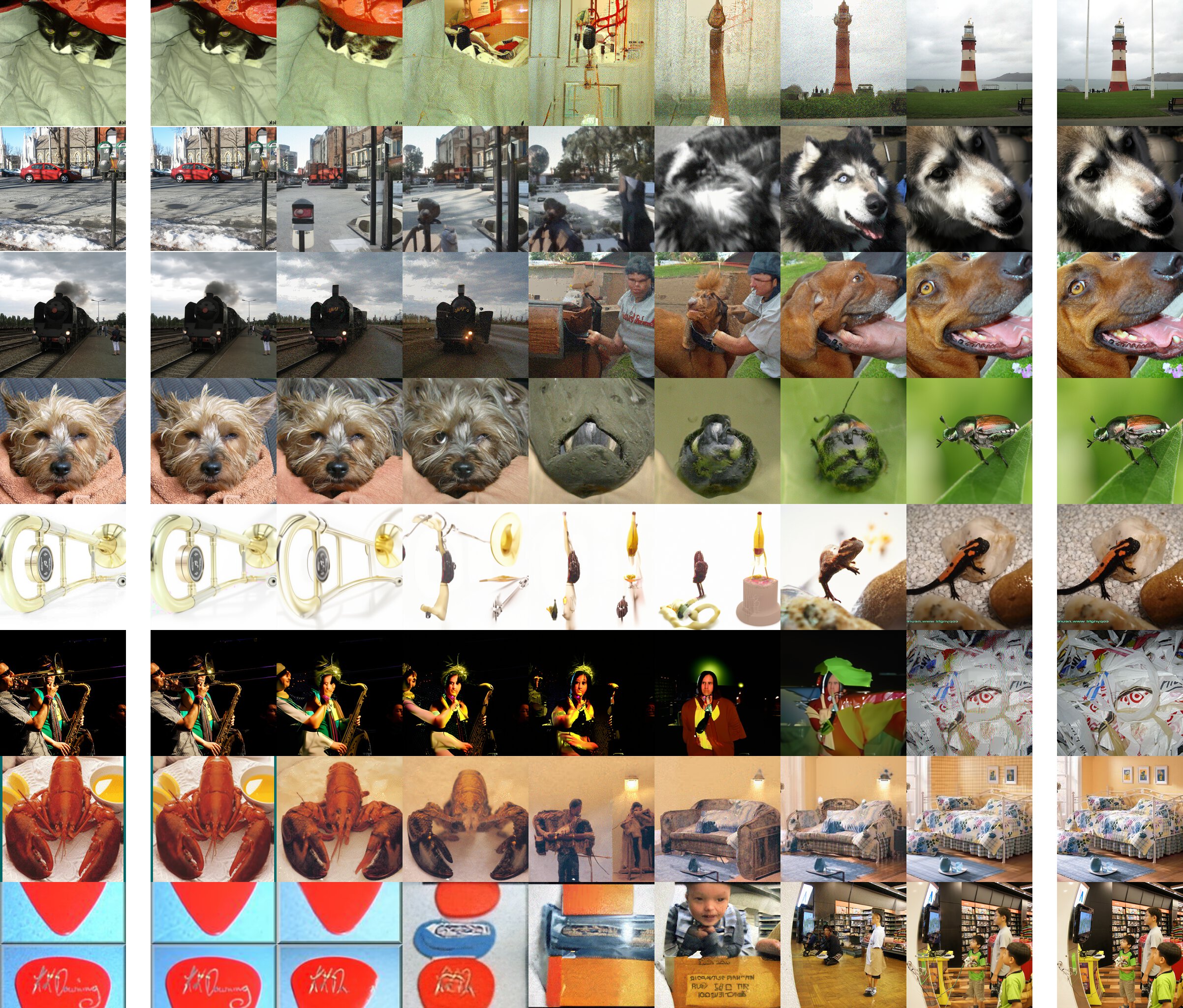
“We see that the model with no guidance has almost perfect reconstructions due to its high recall, whereas raising the guidance scale to 2.5 only finds approximately similar reconstructions.”
plaindirect- Asserted: passes — The authors put it forward as true.
- Checkable: passes — It can be checked against evidence.
- Load-bearing: unclear — It is unclear whether the paper’s conclusions depend on it.
- Based: passes — The paper gives a reason why it holds.
It may state two separate claims as one.
A result the paper reports from its own data — it cites no other source for it, so there is none to check. The quote shows it is in the paper.
In the paper
“it increases training time and takes longer to reach the same performance as a wider model”
plaindirect- Asserted: passes — The authors put it forward as true.
- Checkable: passes — It can be checked against evidence.
- Load-bearing: passes — The paper’s conclusions depend on it.
- Based: passes — The paper gives a reason why it holds.
It may state two separate claims as one.
A result the paper reports from its own data — it cites no other source for it, so there is none to check. The quote shows it is in the paper.
In the paper
“In Table 6, we show that guidance and upsampling improve sample quality along different axes.”
§ 5 Results > 5.2 Comparison to Upsampling
plaindirect- Asserted: passes — The authors put it forward as true.
- Checkable: passes — It can be checked against evidence.
- Load-bearing: unclear — It is unclear whether the paper’s conclusions depend on it.
- Based: passes — The paper gives a reason why it holds.
It may state two separate claims as one.
A result the paper reports from its own data — it cites no other source for it, so there is none to check. The quote shows it is in the paper.
In the paper
“We observe that the classifier drastically changes some images, while leaving others relatively unaffected.”
plaindirect- Asserted: passes — The authors put it forward as true.
- Checkable: passes — It can be checked against evidence.
- Load-bearing: fails — The paper’s conclusions may not depend on it.
- Based: passes — The paper gives a reason why it holds.
Probably not a substantial claim. The paper’s conclusions may not depend on it.
A result the paper reports from its own data — it cites no other source for it, so there is none to check. The quote shows it is in the paper.
In the paper
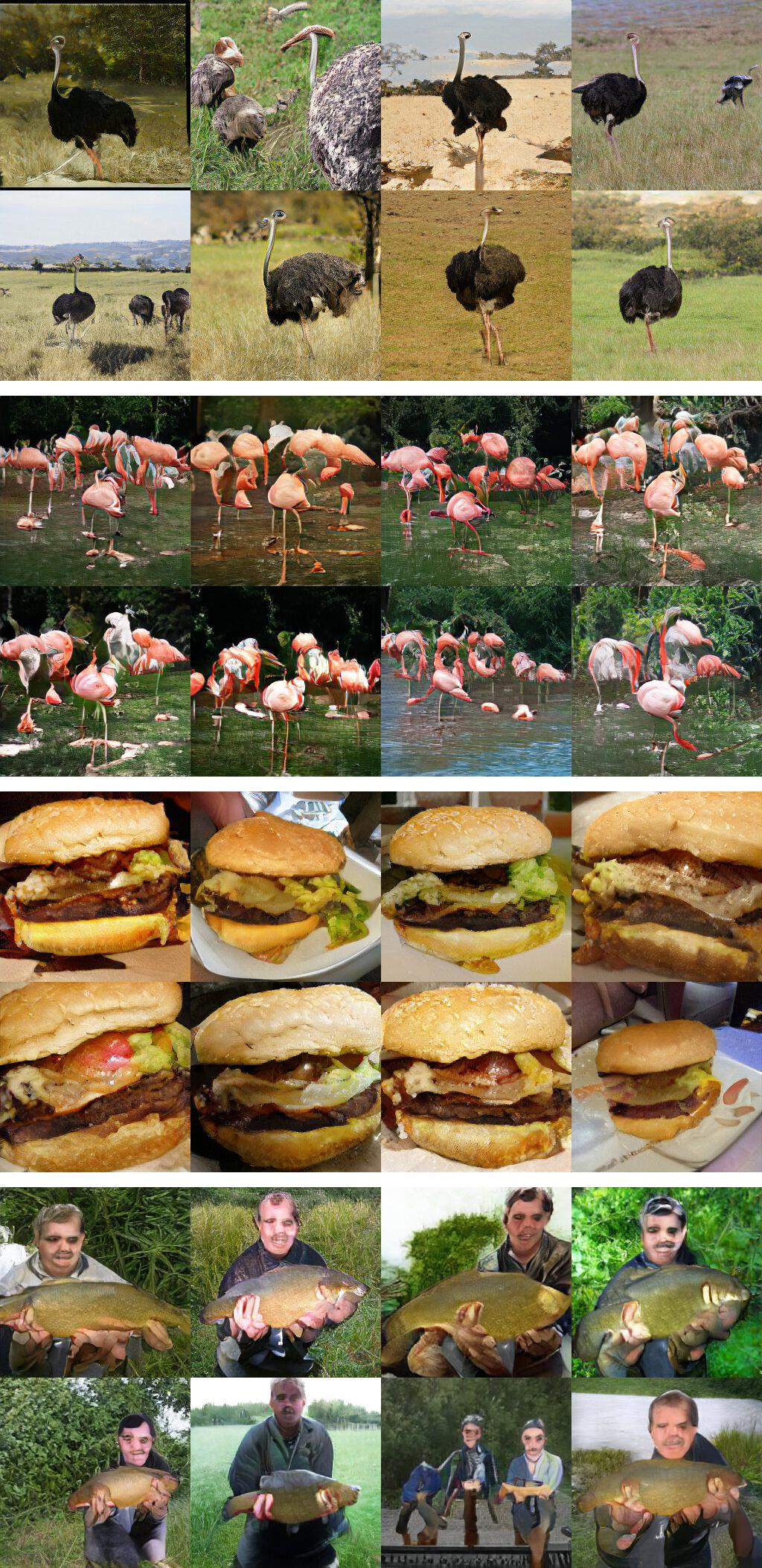
“While the samples are of similar perceptual quality, the diffusion model contains more modes than the GAN, such as zoomed ostrich heads, single flamingos, different orientations of cheeseburgers, and a tinca fish with no human holding it.”
§ 5 Results > 5.1 State-of-the-art Image Synthesis
plain- Asserted: passes — The authors put it forward as true.
- Checkable: passes — It can be checked against evidence.
- Load-bearing: passes — The paper’s conclusions depend on it.
- Based: passes — The paper gives a reason why it holds.
It may state two separate claims as one.
A result the paper reports from its own data — it cites no other source for it, so there is none to check. The quote shows it is in the paper.
In the paper
“We observe in Figure 2 that while increased depth helps performance”
plaindirect- Asserted: passes — The authors put it forward as true.
- Checkable: passes — It can be checked against evidence.
- Load-bearing: fails — The paper’s conclusions may not depend on it.
- Based: passes — The paper gives a reason why it holds.
Probably not a substantial claim. The paper’s conclusions may not depend on it.
In the paper
“Ho et al. [25] show that, under reasonable assumptions, we can model the distribution pθ(xt−1|xt) of xt−1 given xt as a diagonal Gaussian”
What the sources say
- Not checked yetcites [25] [25] Jonathan Ho, Ajay Jain, and Pieter Abbeel. Denoising diffusion probabilistic models. arXiv:2006.11239, 2020.
plain- Asserted: passes — The authors put it forward as true.
- Checkable: passes — It can be checked against evidence.
- Load-bearing: fails — The paper’s conclusions may not depend on it.
- Based: passes — The paper gives a reason why it holds.
Probably not a substantial claim. The paper’s conclusions may not depend on it.
The paper states this without a source or data behind it here, so there is nothing to check it against. The quote shows it is in the paper.
In the paper
“while offering desirable properties such as distribution coverage, a stationary training objective, and easy scalability.”
plaincorrelational- Asserted: passes — The authors put it forward as true.
- Checkable: passes — It can be checked against evidence.
- Load-bearing: passes — The paper’s conclusions depend on it.
- Based: passes — The paper gives a reason why it holds.
It may state two separate claims as one.
In the paper
“Ho et al. [25] observe that the simple mean-sqaured error objective, Lsimple, works better in practice than the actual variational lower bound Lvlb”
What the sources say
- Not checked yetcites [25] [25] Jonathan Ho, Ajay Jain, and Pieter Abbeel. Denoising diffusion probabilistic models. arXiv:2006.11239, 2020.
plaindirect- Asserted: passes — The authors put it forward as true.
- Checkable: passes — It can be checked against evidence.
- Load-bearing: fails — The paper’s conclusions may not depend on it.
- Based: passes — The paper gives a reason why it holds.
Probably not a substantial claim. The paper’s conclusions may not depend on it.
The paper states this without a source or data behind it here, so there is nothing to check it against. The quote shows it is in the paper.
In the paper
“Furthermore, except for VAEs, sampling from these models is slower than GANs in terms of wall-clock time.”
plain- Asserted: passes — The authors put it forward as true.
- Checkable: passes — It can be checked against evidence.
- Load-bearing: fails — The paper’s conclusions may not depend on it.
- Based: fails — The paper may give no reason why it holds.
Probably not a substantial claim. The paper’s conclusions may not depend on it. The paper may give no reason why it holds.
A conclusion the paper draws from its own results — it cites no other source for it, so there is none to check. The quote shows it is in the paper.
In the paper
“As a result, we did not conduct an exhaustive sweep, and superior schedules are likely to exist.”
hedged- Asserted: passes — The authors put it forward as true.
- Checkable: fails — It may be too vague to check against evidence.
- Load-bearing: fails — The paper’s conclusions may not depend on it.
- Based: passes — The paper gives a reason why it holds.
Probably not a substantial claim. It may be too vague to check against evidence. The paper’s conclusions may not depend on it.
In the paper
“While the above objective is well-justified, Ho et al. [25] found that a different objective produces better samples in practice.”
What the sources say
- Not checked yetcites [25] [25] Jonathan Ho, Ajay Jain, and Pieter Abbeel. Denoising diffusion probabilistic models. arXiv:2006.11239, 2020.
plaindirect- Asserted: passes — The authors put it forward as true.
- Checkable: passes — It can be checked against evidence.
- Load-bearing: passes — The paper’s conclusions depend on it.
- Based: passes — The paper gives a reason why it holds.
Probably not a substantial claim.
A conclusion the paper draws from its own results — it cites no other source for it, so there is none to check. The quote shows it is in the paper.
In the paper
“It is typically intractable to sample from this distribution exactly”
§ 4 Classifier Guidance > 4.1 Conditional Reverse Noising Process
plain- Asserted: passes — The authors put it forward as true.
- Checkable: passes — It can be checked against evidence.
- Load-bearing: passes — The paper’s conclusions depend on it.
- Based: passes — The paper gives a reason why it holds.
Probably not a substantial claim.
A conclusion the paper draws from its own results — it cites no other source for it, so there is none to check. The quote shows it is in the paper.
In the paper
“These guided diffusion models can reduce the sampling time gap between GANs and diffusion models, although diffusion models still require multiple forward passes during sampling.”
plaindirect- Asserted: passes — The authors put it forward as true.
- Checkable: passes — It can be checked against evidence.
- Load-bearing: passes — The paper’s conclusions depend on it.
- Based: passes — The paper gives a reason why it holds.
It may state two separate claims as one.
In the paper
“Ho et al. [25] introduced the UNet architecture for diffusion models”
What the sources say
- Not checked yetcites [25] [25] Jonathan Ho, Ajay Jain, and Pieter Abbeel. Denoising diffusion probabilistic models. arXiv:2006.11239, 2020.
plaindirect- Asserted: passes — The authors put it forward as true.
- Checkable: passes — It can be checked against evidence.
- Load-bearing: fails — The paper’s conclusions may not depend on it.
- Based: passes — The paper gives a reason why it holds.
Probably not a substantial claim. The paper’s conclusions may not depend on it.
In the paper
“For many classes of generative models, there is a much simpler way to reduce diversity: reducing the temperature [1].”
What the sources say
- Not checked — no full text of the sourcecites [1] [1] David Ackley, Geoffrey Hinton, and Terrence Sejnowski. A learning algorithm for boltzmann machines. Cognitive science, 9(1):147-169, 1985. source
plaindirect- Asserted: passes — The authors put it forward as true.
- Checkable: passes — It can be checked against evidence.
- Load-bearing: fails — The paper’s conclusions may not depend on it.
- Based: passes — The paper gives a reason why it holds.
Probably not a substantial claim. The paper’s conclusions may not depend on it.
A conclusion the paper draws from its own results — it cites no other source for it, so there is none to check. The quote shows it is in the paper.
In the paper
“We thus want to sample from the distribution Zq(xt|xt+1)q̂(y|xt) where Z is a normalizing constant.”
plain- Asserted: passes — The authors put it forward as true.
- Checkable: passes — It can be checked against evidence.
- Load-bearing: passes — The paper’s conclusions depend on it.
- Based: passes — The paper gives a reason why it holds.
Probably not a substantial claim.
- The authors state this as an assumption: The label distribution q̂(y|x0) is known and readily available for each sample.
In the paper
“Ho et al. [25] note that we need not apply q repeatedly to sample from xt ∼ q(xt|x0).”
What the sources say
- Not checked yetcites [25] [25] Jonathan Ho, Ajay Jain, and Pieter Abbeel. Denoising diffusion probabilistic models. arXiv:2006.11239, 2020.
plain- Asserted: passes — The authors put it forward as true.
- Checkable: passes — It can be checked against evidence.
- Load-bearing: fails — The paper’s conclusions may not depend on it.
- Based: passes — The paper gives a reason why it holds.
Probably not a substantial claim. The paper’s conclusions may not depend on it.
A conclusion the paper draws from its own results — it cites no other source for it, so there is none to check. The quote shows it is in the paper.
In the paper
“Our proposed classifier guidance technique is currently limited to labeled datasets, and we have provided no effective strategy for trading off diversity for fidelity on unlabeled datasets.”
plain- Asserted: passes — The authors put it forward as true.
- Checkable: passes — It can be checked against evidence.
- Load-bearing: fails — The paper’s conclusions may not depend on it.
- Based: passes — The paper gives a reason why it holds.
Probably not a substantial claim. The paper’s conclusions may not depend on it. It may state two separate claims as one.
A conclusion the paper draws from its own results — it cites no other source for it, so there is none to check. The quote shows it is in the paper.
In the paper
“Finally, we can define a new epsilon prediction ε̂(xt) which corresponds to the score of the joint distribution:”
§ 4 Classifier Guidance > 4.2 Conditional Sampling for DDIM
plaincorrelational- Asserted: passes — The authors put it forward as true.
- Checkable: passes — It can be checked against evidence.
- Load-bearing: passes — The paper’s conclusions depend on it.
- Based: passes — The paper gives a reason why it holds.
Probably not a substantial claim.
A conclusion the paper draws from its own results — it cites no other source for it, so there is none to check. The quote shows it is in the paper.
In the paper
“they are still slower than GANs at sampling time due to the use of multiple denoising steps (and therefore forward passes).”
plaindirect- Asserted: passes — The authors put it forward as true.
- Checkable: passes — It can be checked against evidence.
- Load-bearing: unclear — It is unclear whether the paper’s conclusions depend on it.
- Based: passes — The paper gives a reason why it holds.
It may state two separate claims as one.
What the paper did — it cites no source for this, so there is none to check. The quote shows it is in the paper.
In the paper
“As a result, we did not conduct an exhaustive sweep, and superior schedules are likely to exist.”
plain- Asserted: passes — The authors put it forward as true.
- Checkable: passes — It can be checked against evidence.
- Load-bearing: fails — The paper’s conclusions may not depend on it.
- Based: passes — The paper gives a reason why it holds.
Probably not a substantial claim. The paper’s conclusions may not depend on it.
What the paper did — it cites no source for this, so there is none to check. The quote shows it is in the paper.
In the paper
“When comparing against other methods, we re-compute these metrics using public samples or models whenever possible.”
plain- Asserted: passes — The authors put it forward as true.
- Checkable: passes — It can be checked against evidence.
- Load-bearing: passes — The paper’s conclusions depend on it.
- Based: passes — The paper gives a reason why it holds.
Probably not a substantial claim.
In the paper
“Ho et al. [25] find that instead of learning Σθ(xt, t), they can fix it to a constant, choosing either βtI or β̃tI.”
What the sources say
- Not checked yetcites [25] [25] Jonathan Ho, Ajay Jain, and Pieter Abbeel. Denoising diffusion probabilistic models. arXiv:2006.11239, 2020.
plain- Asserted: passes — The authors put it forward as true.
- Checkable: passes — It can be checked against evidence.
- Load-bearing: fails — The paper’s conclusions may not depend on it.
- Based: passes — The paper gives a reason why it holds.
Probably not a substantial claim. The paper’s conclusions may not depend on it.
The authors state this as an assumption.
The noise ε is drawn from a diagonal Gaussian distribution.
“For the remainder of this paper, we assume that the noise ε is drawn from a diagonal Gaussian distribution”
The authors state this as an assumption.
logφ p(y|xt) has low curvature compared to Σ−1.
“We can assume that logφ p(y|xt) has low curvature compared to Σ−1.”
The authors state this as an assumption.
The underlying diffusion model is unconditional in the above derivations.
“In the above derivations, we assumed that the underlying diffusion model was unconditional, modeling p(x).”
The paper relies on this without support.
More compute typically yields better results.
“Compute is essential to modern machine learning applications, and more compute typically yields better results.”
The authors state this as an assumption.
The label distribution q̂(y|x0) is known and readily available for each sample.
“we start by defining a conditional Markovian noising process q̂ similar to q, and assume that q̂(y|x0) is a known and readily available label distribution for each sample.”
The paper relies on this without support.
Under reasonable settings for βt and T, the distribution q(xT) is nearly an isotropic Gaussian distribution.
“Under reasonable settings for βt and T , the distribution q(xT ) is nearly an isotropic Gaussian distribution, so sampling xT is trivial.”
Claims other papers make about this one
Each is checked against this paper’s own text: does it say what the citing paper says it does?
The source backs part of the claim, not all of it — or backs it for a different population, condition or comparison.
In the citing paper
“Diffusion models can produce more realistic images compared to GANs and VAEs (Aghasanli etal. 2023; Dhariwal and Nichol 2021).”
From Deepfake video detection: challenges and opportunities (2024) · cites this paper as Dhariwal and Nichol 2021
Experimental — accuracy not yet measuredThe source backs part of the claim, not all of it — or backs it for a different population, condition or comparison.
In the citing paper
“PSNR and SSIM can be pushed by using a post-hoc guiding mechanism [15] and we implement this image-based guider via a perceptual loss, see Sec. D.6.”
From High-Resolution Image Synthesis with Latent Diffusion Models (2022) · cites this paper as [15]
Experimental — accuracy not yet measuredThe cited source says what the claim attributes to it.
In the citing paper
“Recently, Diffusion Probabilistic Models (DM) have outperformed GANs in image synthesis, demonstrating superior results in terms of both quality and diversity [42,67,85,86,140,164].”
From Past, Present, and Future of Sensor-based Human Activity Recognition Using Wearables: A Surveying Tutorial on a Still Challenging Task (2025) · cites this paper as [42]
The cited source says what the claim attributes to it.
In the citing paper
“The final FID scores are 4.1 (Lion) vs. 4.7 (AdamW), and for reference, the FID of ADM (Dhariwal and Nichol, 2021) is 10.94.”
From Symbolic Discovery of Optimization Algorithms (2023) · cites this paper as Dhariwal and Nichol, 2021
The cited source says what the claim attributes to it.
In the citing paper
“and define the state-of-the-art in class-conditional image synthesis [15,31] and super-resolution [72].”
From High-Resolution Image Synthesis with Latent Diffusion Models (2022) · cites this paper as [15]
The cited source says what the claim attributes to it.
In the citing paper
“training the most powerful DMs often takes hundreds of GPU days (e.g. 150 - 1000 V100 days in [15]) and repeated evaluations on a noisy version of the input space render also inference expensive”
From High-Resolution Image Synthesis with Latent Diffusion Models (2022) · cites this paper as [15]
The cited source says what the claim attributes to it.
In the citing paper
“Recently, Diffusion Probabilistic Models (DM) [82], have achieved state-of-the-art results in density estimation [45] as well as in sample quality [15].”
From High-Resolution Image Synthesis with Latent Diffusion Models (2022) · cites this paper as [15]
The cited source says what the claim attributes to it.
In the citing paper
“In particular, [15] presented an algorithm to guide both unconditional and conditional models trained on the ImageNet dataset with a classifier log pΦ(y|xt), trained on each xt of the diffusion process.”
From High-Resolution Image Synthesis with Latent Diffusion Models (2022) · cites this paper as [15]
The cited source says what the claim attributes to it.
In the citing paper
“This can be interpreted as an update correcting the”
From High-Resolution Image Synthesis with Latent Diffusion Models (2022) · cites this paper as [15]
The cited source says what the claim attributes to it.
In the citing paper
“An intriguing feature of diffusion models is that unconditional models can be conditioned at test-time [15, 82, 85].”
From High-Resolution Image Synthesis with Latent Diffusion Models (2022) · cites this paper as [15]
The cited source says what the claim attributes to it.
In the citing paper
“We closely reach the performance of state of the art methods as StyleGAN2 [42] and ADM [15] while significantly reducing the required compute resources.”
From High-Resolution Image Synthesis with Latent Diffusion Models (2022) · cites this paper as [15]
The check wasn’t confident either way, so it gives no verdict — never disputed.
In the citing paper
“so that producing 50k samples takes approximately 5 days [15] on a single A100 GPU.”
From High-Resolution Image Synthesis with Latent Diffusion Models (2022) · cites this paper as [15]
Experimental — accuracy not yet measured
Self-check
Percentages, sums and reported differences re-computed from the paper’s own numbers.
Each contradiction between two passages listed here was confirmed by an independent check.
Rated minor: it would not touch a result — a value no result rests on, a p-value that stays on the same side of the significance level, or a conflict that is clerical, resolved elsewhere in the paper, or outside its own findings.
In the paper
§ References
“ADM-G (540K), ADM-U (500K) 329 30 359 3.85 5.86 0.84 0.53”
§ 5 Results > 5.2 Comparison to Upsampling
“ADM-G, ADM-U 250 250 3.94 6.14 215.84 0.83 0.53”
Rated minor: it would not touch a result — a value no result rests on, a p-value that stays on the same side of the significance level, or a conflict that is clerical, resolved elsewhere in the paper, or outside its own findings.
In the paper
“ADM-G (200K), ADM-U (150K) 110 10‡ 126 4.93 5.82 0.82 0.52”
Reported 126 · recomputed 120
Rated minor: it would not touch a result — a value no result rests on, a p-value that stays on the same side of the significance level, or a conflict that is clerical, resolved elsewhere in the paper, or outside its own findings.
In the paper
§ 4 Classifier Guidance > 4.1 Conditional Reverse Noising Process
“Algorithm 2 Classifier guided DDIM sampling, given a diffusion model εθ(xt), classifier pφ(y|xt), and gradient scale s.”
§ 4 Classifier Guidance > 4.1 Conditional Reverse Noising Process
“ε̂← εθ(xt)− √ 1− ᾱt∇xt log pφ(y|xt)”
Citations
Cites
Part of this paper’s reference list could not be split into single entries.
Vaswani, A., Shazeer, N., Parmar, N., Uszkoreit, J., Jones, L., Gomez, A. N., Kaiser, L., & Polosukhin, I. (2017) · arXiv · doi:10.48550/arxiv.1706.03762 · Cited by 120,404
Adam: A Method for Stochastic Optimization
Kingma, D. P., & Ba, J. (2014) · arXiv · doi:10.48550/arxiv.1412.6980 · Cited by 98,946
PyTorch: An Imperative Style, High-Performance Deep Learning Library
Paszke, A., Gross, S., Massa, F., Lerer, A., Bradbury, J., Chanan, G., Killeen, T., Lin, Z., Gimelshein, N., Antiga, L., et al. (2019) · arXiv · doi:10.48550/arxiv.1912.01703 · Cited by 31,473
Language Models are Few-Shot Learners
Brown, T. B., Mann, B., Ryder, N., Subbiah, M., Kaplan, J., Dhariwal, P., Neelakantan, A., Shyam, P., Sastry, G., Askell, A., et al. (2020) · arXiv · doi:10.48550/arxiv.2005.14165 · Cited by 23,372
Self-citationLearning Transferable Visual Models From Natural Language Supervision
Radford, A., Kim, J. W., Hallacy, C., Ramesh, A., Goh, G., Agarwal, S., Sastry, G., Askell, A., Mishkin, P., Clark, J., et al. (2021) · arXiv · doi:10.48550/arxiv.2103.00020 · Cited by 15,293
Decoupled Weight Decay Regularization
Loshchilov, I., & Hutter, F. (2017) · arXiv · doi:10.48550/arxiv.1711.05101 · Cited by 12,522
A Style-Based Generator Architecture for Generative Adversarial Networks
Karras, T., Laine, S., & Aila, T. (2019) · 2019 IEEE/CVF Conference on Computer Vision and Pattern Recognition (CVPR) · doi:10.1109/cvpr.2019.00453 · Cited by 11,714
Conditional Generative Adversarial Nets
Mirza, M., & Osindero, S. (2014) · arXiv · doi:10.48550/arxiv.1411.1784 · Cited by 8,863
Denoising Diffusion Probabilistic Models
Ho, J., Jain, A., & Abbeel, P. (2020) · arXiv · doi:10.48550/arxiv.2006.11239 · Cited by 8,712
GANs Trained by a Two Time-Scale Update Rule Converge to a Local Nash Equilibrium
Heusel, M., Ramsauer, H., Unterthiner, T., Nessler, B., & Hochreiter, S. (2017) · arXiv · doi:10.48550/arxiv.1706.08500 · Cited by 8,365
Research works printed but not linked: 1
- [12][12] DeepMind. Biggan-deep 128x128 on tensorflow hub. https://tfhub.dev/deepmind/ biggan-deep-128/1, 2018. 13 https://twitter.com/advadnoun/status/1351038053033406468 https://twitter.com/advadnoun/status/1351038053033406468 https://arxiv.org/abs/1801.01973 https://arxiv.org/abs/1609.07093 https://arxiv.org/abs/1809.11096 https://arxiv.org/abs/2005.14165 https://arxiv.org/abs/2009.00713 https://arxiv.org/abs/2011.10650 https://arxiv.org/abs/1707.00683 https://tfhub.dev/deepmind/biggan-deep-128/1 https://tfhub.dev/deepmind/biggan-deep-128/1 · arXiv
Cited by
Sorted by citations
Items 2,901–3,000 of 3,985
SPG: Style‐Prompting Guidance for Style‐Specific Content Creation
Liang, Q., Chen, Z., Zhou, Y., & Huang, H. F. (2025) · Computer Graphics Forum · doi:10.1111/cgf.70251 · Cited by 2
ControlMambaIR: conditional controls with state-space model for image restoration
Yang, C., Liang, L., & Su, Z. (2026) · Applied Intelligence · doi:10.1007/s10489-026-07301-2 · Cited by 2
Conditioning in generative quantum denoising diffusion models
Quinn, D., Buffoni, L., Gherardini, S., & Chiara, G. D. (2026) · Quantum Science and Technology · doi:10.1088/2058-9565/ae8881 · Cited by 3
The deficit of new information in diffusion models: a focus on diverse samples
Polamreddy, L. R., Li, J., & Zhang, Y. (2025) · Information Fusion · doi:10.1016/j.inffus.2025.103857 · Cited by 2
Li, H., Mu, X., & Li, D. (2025) · Applied Intelligence · doi:10.1007/s10489-025-06955-8 · Cited by 2
Chen, L., Gao, X., Lu, H., Li, B., Xu, M., Feng, Y., Xue, B., & Wang, T. (2025) · Pattern Analysis and Applications · doi:10.1007/s10044-025-01580-0 · Cited by 2
Controllable molecular generation with fine-tuned flow-matching model
Wang, K., Janet, J. P., & Tibo, A. (2026) · Communications Chemistry · doi:10.1038/s42004-026-02188-z · Cited by 2
Solving Diffusion Inverse Problems with Restart Posterior Sampling
Ahmed, B., & Makin, J. G. (2026) · Lecture notes in computer science · doi:10.1007/978-3-032-37013-6_5 · Cited by 2
Szczuka, J. M., Richards, K., & Parker, M. (2026) · Crime and justice briefing papers. · doi:10.5204/eprints.263560 · Cited by 2
Authorship disclosure and consumer perception of AI-generated graphic design
Ekart, B., & Ahtik, J. (2026) · Journal of Graphic Engineering and Design · doi:10.24867/jged-2026-2-023 · Cited by 2
Language Driven Image Editing via Transformers
Santos, R., Branco, A., & Silva, J. (2022) · IEEE International Conference on Tools with Artificial Intelligence (ICTAI) · doi:10.1109/ictai56018.2022.00139 · Cited by 2
Discriminative Candidate Selection for Image Inpainting Applications to the Fine Arts
Cipolina-Kun, L., Papadakis, S. M., & Caenazzo, S. (2022) · LatinX in AI at International Conference on Machine Learning (LXAI) · doi:10.52591/lxai202207176 · Cited by 2
Possibilities of Applying Artificial Intelligence Text and Image Generation Models
Šiaulių valstybinė kolegija / Šiauliai State Higher Education Institution, L., Tautvydienė, G., Morkevičienė, I., & Šiaulių valstybinė kolegija / Šiauliai State Higher Education Institution, L. (2023) · doi:10.56131/tmt.2023.2.1.156 · Cited by 2
A Study on Webtoon Generation Using CLIP and Diffusion Models
Yu, K., Kim, H., Kim, J., Chun, C., & Kim, P. (2023) · Electronics · doi:10.3390/electronics12183983 · Cited by 2
Crop Planting Layout Generative Adversarial Network Model
Chen, W., Liu, M., Zhen, Y., Guo, L., & Zeng, Y. (2023) · IEEE International Conference on Sensing, Communication, and Networking (SECON) · doi:10.1109/secon58729.2023.10287463 · Cited by 2
Semantics‐guided generative diffusion model with a 3DMM model condition for face swapping
Liu, X., Liu, Y., Zheng, Y., Yang, T., Zhang, J., Wang, V., & Fang, H. (2023) · Computer Graphics Forum · doi:10.1111/cgf.14949 · Cited by 2
Chen, A., Wu, Z., Li, D., Wang, D., & Zhang, W. (2023) · IEEE Transactions on Instrumentation and Measurement · doi:10.1109/tim.2023.3329193 · Cited by 2
Improving the Conditional Fine-Grained Image Generation With Part Perception
Han, X. Y., You, M., & Lu, P. (2023) · IEEE Transactions on Multimedia · doi:10.1109/tmm.2023.3326649 · Cited by 2
Enhanced Atrial Fibrillation (AF) Detection via Data Augmentation with Diffusion Model
Vashagh, A., Akhoondkazemi, A., Zahabi, S. J., & Shafie, D. (2023) · International Conference on Computer and Knowledge Engineering · doi:10.1109/iccke60553.2023.10326310 · Cited by 2
DiffuVST: Narrating Fictional Scenes with Global-History-Guided Denoising Models
Wu, S., Yuan, M., & Su, Q. (2023) · Findings of the Association for Computational Linguistics: EMNLP (Findings of EMNLP) · doi:10.18653/v1/2023.findings-emnlp.126 · Cited by 2
Robust and Refined Salient Object Detection Based on Diffusion Model
Ye, H., Zhang, Y., & Zhao, X. (2023) · Electronics · doi:10.3390/electronics12244962 · Cited by 2
Cervical OCT Image Synthesis via Noise Adaptation Diffusion Models
Xiong, Y., Luo, Y., Tang, Q., Zhang, Y., & Du, B. (2023) · IEEE International Conference on Bioinformatics and Biomedicine (BIBM) · doi:10.1109/bibm58861.2023.10385491 · Cited by 2
Improving Generation and Evaluation of Long Image Sequences for Embryo Development Prediction
Celard, P., Vieira, A. S., Sorribes-Fdez, J. M., Iglesias, E. L., & Borrajo, L. (2024) · Electronics · doi:10.3390/electronics13030476 · Cited by 2
TendiffPure: a convolutional tensor-train denoising diffusion model for purification
Bai, M., Zhou, D., & Zhao, Q. (2024) · Frontiers of Information Technology & Electronic Engineering · doi:10.1631/fitee.2300392 · Cited by 2
Image-domain material decomposition for dual-energy CT using a conditional diffusion model
Peng, J., Chang, C., Fan, M., Xie, H., Roper, J. R., Qiu, R. L. J., Wang, T., Tang, X., & Yang, X. (2024) · SPIE Medical Imaging: Clinical and Biomedical Imaging · doi:10.1117/12.3006941 · Cited by 2
GPC: A Generated Dataset for the Detection of Road Potholes and Cracks
Wu, T., Zhang, L., Song, X., Wang, S., & Shi, L. (2023) · IEEE International Conference on Frontiers Technology of Information and Computer (ICFTIC) · doi:10.1109/icftic59930.2023.10456157 · Cited by 2
Model-Based Label-to-Image Diffusion for Semi-Supervised Choroidal Vessel Segmentation
Huang, K., Ma, X., Su, N., Yuan, S., & Chen, Q. (2024) · IEEE International Conference on Acoustics Speech and Signal Processing · doi:10.1109/icassp48485.2024.10448431 · Cited by 2
Progressive Image Synthesis from Semantics to Details with Denoising Diffusion GAN
Yang, G., Lu, H., Li, C., Zhou, G. H., Wu, H., & Lu, Z. (2024) · IEEE International Conference on Acoustics Speech and Signal Processing · doi:10.1109/icassp48485.2024.10445885 · Cited by 2
Target Class Transformation for Segmentation Task Using U-GAN
Isaienkov, Y. O., & Mokin, O. B. (2024) · Visnyk of Vinnytsia Politechnical Institute · doi:10.31649/1997-9266-2024-172-1-81-87 · Cited by 2
Baek, H., Yu, S., Son, S., Seo, J., & Chung, Y. (2024) · Sensors · doi:10.3390/s24072371 · Cited by 2
Unsupervised Co-generation of Foreground-Background Segmentation from Text-to-Image Synthesis
Ahmed, Y. A., & Mittal, A. (2024) · IEEE Winter Conference on Applications of Computer Vision · doi:10.1109/wacv57701.2024.00498 · Cited by 2
Katsumata, K., Vo, D. M., & Nakayama, H. (2024) · IEEE Winter Conference on Applications of Computer Vision · doi:10.1109/wacv57701.2024.00487 · Cited by 2
Generation of Synthetic Echocardiograms Using Video Diffusion Models
Pellicer, A. O., Yadav, A. K. S., Bhagtani, K., Xiang, Z., Pizlo, Z., Gradus‐Pizlo, I., & Delp, E. J. (2024) · IEEE Southwest Symposium on Image Analysis and Interpretation (SSIAI) · doi:10.1109/ssiai59505.2024.10508643 · Cited by 2
Generating Privacy-preserving Educational Data Records with Diffusion Model
Guan, Q., Yu, Y., Huang, X., Fang, L., He, C., Wu, L., Luo, W., & Chen, G. (2024) · International World Wide Web Conference (WWW) · doi:10.1145/3589335.3651511 · Cited by 2
scDM: A deep generative method for cell surface protein prediction with diffusion model
Yu, H., Zheng, Y., & Yang, X. (2024) · Journal of Molecular Biology · doi:10.1016/j.jmb.2024.168610 · Cited by 2
Qowy, A. B., Ihsan, A. N., & Hartati, S. (2024) · JURNAL TEKNIK INFORMATIKA · doi:10.15408/jti.v17i1.37942 · Cited by 2
DifBFSR: Blind Face Super-Resolution via Conditional Diffusion Contraction
Yu, W., Li, Z., Liu, Q., Chen, Y., Zhang, S., & Lin, J. (2024) · Computing and Informatics · doi:10.31577/cai_2024_2_369 · Cited by 2
RealSinger: Ultra-realistic singing voice generation via stochastic differential equations
Shi, Z., & Wu, S. (2024) · Neurocomputing · doi:10.1016/j.neucom.2024.127933 · Cited by 2
Chen, A., Wu, Z., Li, D., Wang, D., & Zhang, W. (2024) · Applied Acoustics · doi:10.1016/j.apacoust.2024.110101 · Cited by 2
Generative models for ultrasound image reconstruction from single plane-wave simulated data
Merino, S., Salazar-Reque, I., & Lavarello, R. (2024) · IEEE UFFC Latin America Ultrasonics Symposium (LAUS) · doi:10.1109/laus60931.2024.10553012 · Cited by 2
PtbNet: Based on Local Few-Shot Classes and Small Objects to Accurately Detect PTB
yang, W., Gao, S., Zhang, H., Yu, H., Xu, M., Chong, P., Zhang, W., Wang, H., Zhang, W., & Qian, A. (2024) · IEEE Transactions on Medical Imaging · doi:10.1109/tmi.2024.3419134 · Cited by 2
Generation and Editing of Faces using Stable Diffusion with Criminal Suspect Matching
Warrier, A., Mathew, A., Patra, A., Hiremath, K. S., & Jijo, J. (2024) · IEEE International Conference on Advanced Systems and Emergent Technologies (IC_ASET) · doi:10.1109/ic_aset61847.2024.10596159 · Cited by 2
Improving Object Detecting by Structuring and Training YOLO Model
Zhou, Z., Gu, D., Shi, Y., Zhou, H., Chen, K., Qu, H., & Ren, H. (2024) · International Conference on Computer Information and Big Data Applications (CIBDA) · doi:10.1145/3671151.3671268 · Cited by 2
HCGAN: hierarchical contrast generative adversarial network for unpaired sketch face synthesis
Du, K., Wang, Z., Cao, L., Guo, Y., Shu, T., & Zhang, F. (2024) · PeerJ Computer Science · doi:10.7717/peerj-cs.2184 · Cited by 2
Hakim, S. A., Ubaidillah, M., Ramadhan, A., Hawari, R. Z. A., Rizky, A. B., Lutfi, R., Hermanto, P. T. M., & Yudistira, N. (2024) · Jurnal Teknologi Informasi dan Ilmu Komputer · doi:10.25126/jtiik.1138118 · Cited by 2
Board 262: Enhancing Deep Knowledge Tracing via Diffusion Models for Personalized Adaptive Learning
Dong, X., Fu, Y., Kuo, M.-M., Sarker, S., Qian, L., & Li, X. (2024) · ASEE Annual Conference & Exposition · doi:10.18260/1-2--46835 · Cited by 3
Unsupervised Domain Adaptation for Medical Image Segmentation with Conditional Diffusion Model
Zhao, Y., Lu, K., Wang, S., Lu, J. G., & Xue, J. (2024) · IEEE International Symposium on Biomedical Imaging (ISBI) · doi:10.1109/isbi56570.2024.10635862 · Cited by 2
4-D Cone-Beam CT Reconstruction via Diffusion Model and Motion Compensation
Wang, X., Ou, Z. Y., Jin, P., Xie, J., Teng, Z., Xu, L., Du, J., Ding, M., Chen, Y., & Niu, T. (2024) · IEEE Transactions on Radiation and Plasma Medical Sciences · doi:10.1109/trpms.2024.3449155 · Cited by 2
Temporally Coherent Video Cartoonization for Animation Scenery Generation
Rayo, G., & Tous, R. (2024) · Electronics · doi:10.3390/electronics13173462 · Cited by 2
A SAR Interference Suppression Method Based on Diffusion Model
Wang, W., Wang, X., Yang, B., Tan, L., Li, Z., Wu, J., & Yang, J. (2024) · IEEE International Geoscience and Remote Sensing Symposium (IGARSS) · doi:10.1109/igarss53475.2024.10642796 · Cited by 2
House Layout Generation via Diffusion Model with Relative Room Area Ranking
Xiang, J., Hou, B., Chen, X., Qi, H., Feng, L., Liu, J., & Li, X. (2024) · International Joint Conference on Neural Networks (IJCNN) · doi:10.1109/ijcnn60899.2024.10650991 · Cited by 2
Pose-Guided Self-Training with Two-Stage Clustering for Unsupervised Landmark Discovery
Tourani, S., Alwheibi, A., Mahmood, A., & Khan, M. H. (2024) · IEEE Computer Society Conference on Computer Vision and Pattern Recognition/Proceedings - IEEE Computer Society Conference on Computer Vision and Pattern Recognition/Proceedings · doi:10.1109/cvpr52733.2024.02174 · Cited by 2
AnyDesign: Versatile area fashion editing via mask-free diffusion
Niu, Y., Dong, Y., Wu, L., Peng, J., & Wang, J. (2026) · Neural Networks · doi:10.1016/j.neunet.2026.109129 · Cited by 4
BOTH2Hands: Inferring 3D Hands from Both Text Prompts and Body Dynamics
Zhang, W., Huang, M., Zhou, Y., Zhang, J., Jingyi Yu, A., Wang, J., & Xu, L. (2024) · IEEE Computer Society Conference on Computer Vision and Pattern Recognition/Proceedings - IEEE Computer Society Conference on Computer Vision and Pattern Recognition/Proceedings · doi:10.1109/cvpr52733.2024.00232 · Cited by 2
Ink Dot-Oriented Differentiable Optimization for Neural Image Halftoning
Jiang, H., Zhou, B., & Mu, Y. (2024) · IEEE Computer Society Conference on Computer Vision and Pattern Recognition/Proceedings - IEEE Computer Society Conference on Computer Vision and Pattern Recognition/Proceedings · doi:10.1109/cvpr52733.2024.02599 · Cited by 2
Sketch-2-4D: Sketch driven dynamic 3D scene generation
Yang, G., Chen, D.-Y., & Mu, T. (2024) · Graphical Models · doi:10.1016/j.gmod.2024.101231 · Cited by 2
Distilling ODE Solvers of Diffusion Models into Smaller Steps
Kim, S., Tang, H., & Yu, F. (2024) · IEEE Computer Society Conference on Computer Vision and Pattern Recognition/Proceedings - IEEE Computer Society Conference on Computer Vision and Pattern Recognition/Proceedings · doi:10.1109/cvpr52733.2024.00899 · Cited by 2
Self-Prior Guided Diffusion Model for Marine Snow Removal
Zhao, H., Gu, Z., Zheng, B., & Zheng, H. (2024) · MTS/IEEE OCEANS Conference (OCEANS) · doi:10.1109/oceans51537.2024.10682203 · Cited by 2
EL2NM: Extremely Low-light Noise Modeling Through Diffusion Iteration
Qin, J., Qin, P., Chai, R., Jia, Q., & Jin, Z. (2024) · IEEE/CVF Conference on Computer Vision and Pattern Recognition Workshops (CVPRW) · doi:10.1109/cvprw63382.2024.00115 · Cited by 2
Content-Aware Supervision For Diffusion-Based Restoration of Extremely Compressed Background For VCM
Dao, L. T. H., Vien, A. G., Lee, J., Jeong, S., Yang, N., & Lee, C. (2024) · Proceedings - International Conference on Image Processing · doi:10.1109/icip51287.2024.10648159 · Cited by 2
GeoGen: Geometry-Aware Generative Modeling via Signed Distance Functions
Esposito, S., Xu, Q., Kania, K., Hewitt, C., Mariotti, O., Petikam, L., Valentin, J., Onken, A., & Aodha, O. M. (2024) · IEEE/CVF Conference on Computer Vision and Pattern Recognition Workshops (CVPRW) · doi:10.1109/cvprw63382.2024.00743 · Cited by 2
AdvDenoise: Fast Generation Framework of Universal and Robust Adversarial Patches Using Denoise
Li, J., Wang, Z., & Li, J. (2024) · IEEE/CVF Conference on Computer Vision and Pattern Recognition Workshops (CVPRW) · doi:10.1109/cvprw63382.2024.00352 · Cited by 3
Segmentation-Free Guidance for Text-to-Image Diffusion Models
Azarian, K., Das, D., Hou, Q., & Porikli, F. (2024) · IEEE/CVF Conference on Computer Vision and Pattern Recognition Workshops (CVPRW) · doi:10.1109/cvprw63382.2024.00747 · Cited by 2
Noise Adaptive Fine-grained Speech Intelligibility Enhancement With Soft-label Guided Diffusion
Zhu, C., Li, D., Chen, A., Gao, Y. M., Li, W., & Wang, X. (2024) · IEEE International Conference on Multimedia and Expo (ICME) · doi:10.1109/icme57554.2024.10687538 · Cited by 2
SynthBrainGrow: Synthetic Diffusion Brain Aging for Longitudinal MRI Data Generation in Young People
Zapaishchykova, A., Kann, B. H., Tak, D., Ye, Z., Haas-Kogan, D. A., & Aerts, H. J. W. L. (2024) · Lecture notes in computer science · doi:10.1007/978-3-031-72744-3_8 · Cited by 2
Sai, K. N., Wable, U., Singh, A., S, K. N. V. S., Gonuguntla, H., & Jain, C. (2024) · International Conference on Electrical, Computer and Energy Technologies (ICECET) · doi:10.1109/icecet61485.2024.10698398 · Cited by 2
Fu, Z., Pan, X., & Zhang, G. (2024) · IEEE Access · doi:10.1109/access.2024.3476469 · Cited by 2
Jeong, D., Kang, D., Park, J., & Paik, J. (2024) · IEEE Access · doi:10.1109/access.2024.3477734 · Cited by 2
Diffusion-model-based inverse problem processing for optically-measured sound field
Hao, D., Oikawa, Y., & Ishikawa, K. (2024) · Optics Express · doi:10.1364/oe.537802 · Cited by 2
Advancing Retinal Image Segmentation: A Denoising Diffusion Probabilistic Model Perspective
Alimanov, A., & Islam, M. B. (2024) · IEEE International Conference on Multimedia Information Processing and Retrieval (MIPR) · doi:10.1109/mipr62202.2024.00098 · Cited by 2
Perceptual Image Compression via Stable Diffusion at Low Bitrate
Jin, L., & Watanabe, H. (2024) · IEEE International Conference on Multimedia Information Processing and Retrieval (MIPR) · doi:10.1109/mipr62202.2024.00107 · Cited by 2
Memorizing Swin-Transformer Denoising Network for Diffusion Model
Chen, J., & Shen, Y. (2024) · Electronics · doi:10.3390/electronics13204050 · Cited by 2
Unsupervised Learning Paradigm
Wang, W. (2024) · Springer eBooks · doi:10.1007/978-981-97-5333-8_9 · Cited by 2
TreeReward: Improve Diffusion Model via Tree-Structured Feedback Learning
Zhang, J., Wu, J., Kuang, H., Zhang, H., Ren, Y., Chen, W., Zhang, M., Xiao, X., & Li, G. (2024) · ACM International Conference on Multimedia (ACM MM) · doi:10.1145/3664647.3680610 · Cited by 2
Fast prediction of irradiation-induced cascade defects using denoising diffusion probabilistic model
Liao, R., Xu, K., Liu, Y., Gao, Z., Jin, S., Liang, L., & Lu, G. (2024) · Nuclear Materials and Energy · doi:10.1016/j.nme.2024.101805 · Cited by 3
DiffPop: Plausibility‐Guided Object Placement Diffusion for Image Composition
Liu, J., Zhou, H., Wei, S., & Ma, R. (2024) · Computer Graphics Forum · doi:10.1111/cgf.15246 · Cited by 2
Exploring the Impact of AI Painting Tools on Graphic Design Education for Hearing-Impaired Students
Mao, Y., Ying, F., & Liu, K. (2024) · Lecture notes in computer science · doi:10.1007/978-3-031-74353-5_34 · Cited by 2
Singh, S., Keserwani, P., Roy, P. P., & Saini, R. (2024) · IEEE Access · doi:10.1109/access.2024.3510136 · Cited by 2
A Primary Comparison of Diffusion Models and Generative Adversarial Networks for Image Synthesis
Shen, Z., Mao, M., & Fan, P. (2024) · International Conference on Machine Learning and Machine Intelligence (MLMI) · doi:10.1145/3696271.3696307 · Cited by 2
Generative Self-supervised Learning for Medical Image Classification
Park, I., Kim, S., & Ryu, J. (2024) · Lecture notes in computer science · doi:10.1007/978-981-96-0901-7_2 · Cited by 3
PDPP: Projected Diffusion for Procedure Planning in Instructional Videos
Wang, H., Wu, Y., Guo, S., & Wang, L. (2024) · IEEE Transactions on Pattern Analysis and Machine Intelligence · doi:10.1109/tpami.2024.3518762 · Cited by 2
Damudi, M. Z., & Kini, A. S. (2024) · International Journal of Biomedical Imaging · doi:10.1155/ijbi/2352602 · Cited by 2
Wang, H., Sun, X., Sun, Y., & Li, P. (2024) · Computers & Graphics · doi:10.1016/j.cag.2024.104153 · Cited by 2
StyleGAN-: Extending StyleGAN to Arbitrary-Ratio Translation With StyleBook
Dai, Y., Xiang, T., Deng, B., Du, Y., Cai, H., Qin, J., & He, S. (2024) · IEEE Transactions on Visualization and Computer Graphics · doi:10.1109/tvcg.2024.3522565 · Cited by 2
Bezerra, E. S., Leher, Q. O., Alves, U. D. D. S., Paixão, T., & Alvarez, A. B. (2024) · Interfases · doi:10.26439/interfases2024.n020.7389 · Cited by 2
DiffLGE: Diffusion-Based Image Generation for Synthesizing Late Gadolinium Enhancement Scans
Deng, Y., Jiang, Y., & Hong, Y. (2024) · IEEE International Conference on Bioinformatics and Biomedicine (BIBM) · doi:10.1109/bibm62325.2024.10821814 · Cited by 2
CH-DDPMs: A Conjugate and Hybrid Diffusion Model for Low-Dose Fat CT Image Segmentation
Chen, Z., Du, T., Sun, Y., Jiang, T., Xu, N., Grzegorzek, M., Sun, H., & Li, C. (2024) · IEEE International Conference on Bioinformatics and Biomedicine (BIBM) · doi:10.1109/bibm62325.2024.10821733 · Cited by 2
Temporal Adaptive Attention Map Guidance for Text-to-Image Diffusion Models
Jung, S.-H., & Heo, Y. S. (2025) · Electronics · doi:10.3390/electronics14030412 · Cited by 2
SketchAnimator: Animate Sketch via Motion Customization of Text-to-Video Diffusion Models
Yang, R., Li, D., Zhang, H., & Song, Y.-Z. (2024) · IEEE International Conference on Visual Communications and Image Processing (VCIP) · doi:10.1109/vcip63160.2024.10849934 · Cited by 2
PAPRec: 3D Point Cloud Reconstruction Based on Prior-Guided Adaptive Probabilistic Network
Liu, C., Zhu, M., Chen, Y., Wei, X., & Li, H. (2025) · Sensors · doi:10.3390/s25051354 · Cited by 2
SlimSpeech: Lightweight and Efficient Text-to-Speech with Slim Rectified Flow
Wang, K., Guan, W., Lu, S., Yao, J., Li, L., & Hong, Q. (2025) · IEEE International Conference on Acoustics Speech and Signal Processing · doi:10.1109/icassp49660.2025.10889258 · Cited by 2
TextureDiffusion: Target Prompt Disentangled Editing for Various Texture Transfer
Su, Z., Zhuang, J., & Yuan, C. Y. (2025) · IEEE International Conference on Acoustics Speech and Signal Processing · doi:10.1109/icassp49660.2025.10888836 · Cited by 2
Lin, Y., Cheng, H.-C., Huang, C.-I., Wang, C.-Y., & Wang, J. (2025) · IEEE International Conference on Acoustics Speech and Signal Processing · doi:10.1109/icassp49660.2025.10890644 · Cited by 2
GoLoColor: Towards Global-Local Semantic Aware Image Colorization
Yue, T., Du, X., Liu, J., & Fang, Z. (2025) · IEEE International Conference on Acoustics Speech and Signal Processing · doi:10.1109/icassp49660.2025.10888355 · Cited by 2
Efficient Defocus Deblurring Networks based on Diffusion Models
Chen, K., & Liu, Y. (2025) · IEEE International Conference on Acoustics Speech and Signal Processing · doi:10.1109/icassp49660.2025.10889855 · Cited by 2
Retinex-Based Self-Conditioned Diffusion Model for Low-Light Image Enhancement
Zhang, J., Li, Z., Zhang, J., & Wang, Y. (2025) · IEEE International Conference on Acoustics Speech and Signal Processing · doi:10.1109/icassp49660.2025.10890851 · Cited by 3
FreeSegDiff: Annotation-free Saliency Segmentation with Diffusion Models
Ma, C., Yang, Y., Ju, C., Shi, Y., Zhang, Y., & Wang, Y. (2025) · IEEE International Conference on Acoustics Speech and Signal Processing · doi:10.1109/icassp49660.2025.10890464 · Cited by 2
Fine-portraitist: Visualizing the Speaker’s Face Portrait during Speech Listening
Wang, J., Liu, L., & Wang, J. (2025) · IEEE International Conference on Acoustics Speech and Signal Processing · doi:10.1109/icassp49660.2025.10889904 · Cited by 2
ODE-based generative modeling: Learning from a single natural image
Yue, J., Gan, Y., Zhou, L., Zhao, Y. Q., Li, S., & Ye, M. (2025) · Expert Systems with Applications · doi:10.1016/j.eswa.2025.127185 · Cited by 2
Navigating h-Space for Multi-Attribute Editing in Diffusion Models
Park, J. M., Shaheryar, M., Lee, S., & Jung, S. K. (2025) · International Conference on Artificial Intelligence in Information and Communication (ICAIIC) · doi:10.1109/icaiic64266.2025.10920714 · Cited by 2
Metadata
- Authors
- Dhariwal, P., & Nichol, A.
- Affiliations
- OpenAI (United States) (US)
- Venue
- arXiv
- Publisher
- arXiv
- Published
- 2021
- ISSN
- 2331-8422 (ISSN-L)
- arXiv
- 2105.05233
- OpenAlex
- W3162926177
- Semantic Scholar
- 64ea8f180d0682e6c18d1eb688afdb2027c02794
- Cited by
- 3,362
- References
- 60
- Citations by year
- 2026: 43 · 2025: 923 · 2024: 1508 · 2023: 770 · 2022: 79 · 2021: 39
- Type
- posted content
- Language
- en
- Open access
- green
- arxiv.org
- Locations
- arXiv (Cornell University) (submittedVersion)
- arXiv (Cornell University)
- Topics
- Physical Sciences › Computer Science › Computer Vision and Pattern Recognition › Generative Adversarial Networks and Image Synthesis
- Physical Sciences › Computer Science › Artificial Intelligence › Adversarial Robustness in Machine Learning
- Physical Sciences › Computer Science › Computer Vision and Pattern Recognition › Image and Signal Denoising Methods
- Keywords
- diffusion models, image generation, unconditional image generation, conditional image generation, classifier guidance, sample quality, ImageNet
About these checks
Registry, retraction, Cites and statistics results are computed, not judged, with one exception: a printed reference that no index lists is read once by a model before it counts as a citation error. Claims are extracted by a model and kept only when their quote appears verbatim in the text; each cited source is then checked, with a model’s help, for whether it says what the claim relies on. Those verdicts can be wrong — read the claim’s quote and the cited source before relying on one.
A language model drew the claims from the paper on 2026-11-08, under version 3 of the claim definition (model deepseek-v4.1-flash, prompt extract-v3).
A second model labelled each claim on 2026-11-08 (model jev-1.13-20260917, definition revision gold-guideline-v0.2).
Cited sources are checked with a language model’s help (gpt-6-sol).
Statistics and arithmetic are recomputed, not judged.
Confidence bands are shown only for fields calibrated on our annotated test set. None is calibrated yet, so no band is shown.
What counts as a claim ›How we measure confidence ›How we check this ›
Are you an author, or do you see a problem with this page? Request a review
