

The DOI matches its DataCite record; 57 of the 59 references it cites were found in a registry or an index, and 2 are not checked yet.
Large Language Models Can Self-Improve
Open accessAbstract
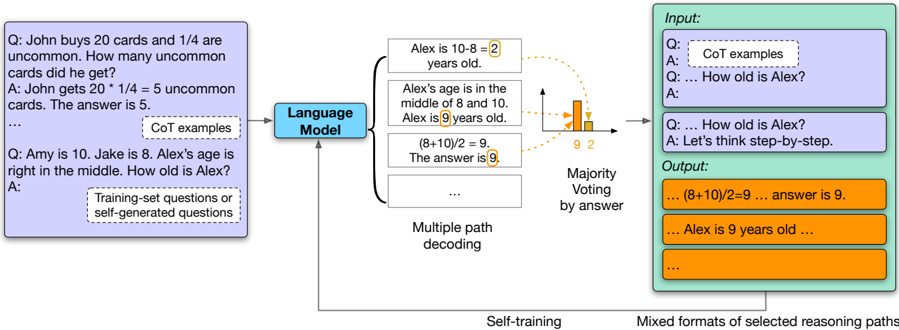
Large Language Models (LLMs) have achieved excellent performances in various tasks. However, fine-tuning an LLM requires extensive supervision. Human, on the other hand, may improve their reasoning abilities by self-thinking without external inputs. In this work, we demonstrate that an LLM is also capable of self-improving with only unlabeled datasets. We use a pre-trained LLM to generate "high-confidence" rationale-augmented answers for unlabeled questions using Chain-of-Thought prompting and self-consistency, and fine-tune the LLM using those self-generated solutions as target outputs. We show that our approach improves the general reasoning ability of a 540B-parameter LLM (74.4%->82.1% on GSM8K, 78.2%->83.0% on DROP, 90.0%->94.4% on OpenBookQA, and 63.4%->67.9% on ANLI-A3) and achieves state-of-the-art-level performance, without any ground truth label. We conduct ablation studies and show that fine-tuning on reasoning is critical for self-improvement.
Overview
The claims and statistics of this paper haven’t been checked yet.
Run the check — free, no account needed. It reads the open-access text and checks the sources it cites.
Integrity signals
Registry
Cites
Statistics
Figures
Verification
Claims the paper makes
The claims and statistics of this paper haven’t been checked yet.
Run the check — free, no account needed. It reads the open-access text and checks the sources it cites.
Claims other papers make about this one
Each is checked against this paper’s own text: does it say what the citing paper says it does?
The source backs part of the claim, not all of it — or backs it for a different population, condition or comparison.
In the citing paper
“Researchers are starting to apply discrete optimization and RL to find effective prompts, generally for a single logical LM call (Guo et al., 2023; Pryzant et al., 2023; Huang et al., 2022; Yang et al., 2023).”
From DSPy: Compiling Declarative Language Model Calls into Self-Improving Pipelines (2023) · cites this paper as Huang et al., 2022
Experimental — accuracy not yet measured
Self-check
Percentages, sums and reported differences re-computed from the paper’s own numbers.
The self-check needs the paper’s full text.
Citations
Cites
Language Models are Few-Shot Learners
Brown, T. B., Mann, B., Ryder, N., Subbiah, M., Kaplan, J., Dhariwal, P., Neelakantan, A., Shyam, P., Sastry, G., Askell, A., et al. (2020) · arXiv · doi:10.48550/arxiv.2005.14165 · Cited by 23,372
Distilling the Knowledge in a Neural Network
Hinton, G., Vinyals, O., & Dean, J. (2015) · arXiv · doi:10.48550/arxiv.1503.02531 · Cited by 14,204
SQuAD: 100,000+ Questions for Machine Comprehension of Text
Rajpurkar, P., Zhang, J., Lopyrev, K., & Liang, P. (2016) · Proceedings of the 2016 Conference on Empirical Methods in Natural Language Processing · doi:10.18653/v1/d16-1264 · Cited by 6,208
Chain-of-Thought Prompting Elicits Reasoning in Large Language Models
Wei, J., Wang, X., Schuurmans, D., Bosma, M., Ichter, B., Xia, F., Chi, E., Le, Q., & Zhou, D. (2022) · arXiv · doi:10.48550/arxiv.2201.11903 · Cited by 4,263
Self-citationGLUE: A Multi-Task Benchmark and Analysis Platform for Natural Language Understanding
Wang, A., Singh, A., Michael, J., Hill, F., Levy, O., & Bowman, S. (2018) · Proceedings of the 2018 EMNLP Workshop BlackboxNLP: Analyzing and Interpreting Neural Networks for NLP · doi:10.18653/v1/w18-5446 · Cited by 4,222
Training language models to follow instructions with human feedback
Ouyang, L., Wu, J., Jiang, X., Almeida, D., Wainwright, C. L., Mishkin, P., Zhang, C., Agarwal, S., Slama, K., Ray, A., et al. (2022) · arXiv · doi:10.48550/arxiv.2203.02155 · Cited by 4,208
A Broad-Coverage Challenge Corpus for Sentence Understanding through Inference
Williams, A., Nangia, N., & Bowman, S. (2018) · Proceedings of the 2018 Conference of the North American Chapter of the Association for Computational Linguistics: Human Language Technologies, Volume 1 (Long Papers) · doi:10.18653/v1/n18-1101 · Cited by 3,342
PaLM: Scaling Language Modeling with Pathways
Chowdhery, A., Narang, S., Devlin, J., Bosma, M., Mishra, G., Roberts, A., Barham, P., Chung, H. W., Sutton, C., Gehrmann, S., et al. (2022) · arXiv · doi:10.48550/arxiv.2204.02311 · Cited by 2,590
Self-citationSelf-Training With Noisy Student Improves ImageNet Classification
Xie, Q., Luong, M.-T., Hovy, E., & Le, Q. V. (2020) · 2020 IEEE/CVF Conference on Computer Vision and Pattern Recognition (CVPR) · doi:10.1109/cvpr42600.2020.01070 · Cited by 2,393
Large language models are zero-shot reasoners
Kojima, T., Gu, S. (., Reid, M., Matsuo, Y., & Iwasawa, Y. (2022) · Advances in Neural Information Processing Systems 35 · doi:10.52202/068431-1613 · Cited by 2,013
Self-citationThe PASCAL Recognising Textual Entailment Challenge
Dagan, I., Glickman, O., & Magnini, B. (2006) · Lecture notes in computer science · doi:10.1007/11736790_9 · Cited by 1,674
Can a Suit of Armor Conduct Electricity? A New Dataset for Open Book Question Answering
Mihaylov, T., Clark, P. E., Khot, T., & Sabharwal, A. (2018) · Conference on Empirical Methods in Natural Language Processing (EMNLP) · doi:10.18653/v1/d18-1260 · Cited by 1,602
Do Deep Nets Really Need to be Deep?Preprint
Ba, J. L., & Caruana, R. (2013) · arXiv (Cornell University) · doi:10.48550/arxiv.1312.6184 · Cited by 1,592
Scaling Instruction-Finetuned Language Models
Chung, H. W., Hou, L., Longpre, S., Zoph, B., Tay, Y., Fedus, W., Li, Y., Wang, X., Dehghani, M., Brahma, S., et al. (2022) · arXiv · doi:10.48550/arxiv.2210.11416 · Cited by 1,441
Self-citationEmergent Abilities of Large Language Models
Wei, J., Tay, Y., Bommasani, R., Raffel, C., Zoph, B., Borgeaud, S., Yogatama, D., Bosma, M., Zhou, D., Metzler, D., et al. (2022) · arXiv · doi:10.48550/arxiv.2206.07682 · Cited by 1,264
Finetuned Language Models Are Zero-Shot Learners
Wei, J., Bosma, M., Zhao, V. Y., Guu, K., Yu, A. W., Lester, B., Du, N., Dai, A. M., & Le, Q. V. (2021) · arXiv · doi:10.48550/arxiv.2109.01652 · Cited by 1,101
SuperGLUE: A Stickier Benchmark for General-Purpose Language Understanding Systems
Wang, A., Pruksachatkun, Y., Nangia, N., Singh, A., Michael, J., Hill, F., Levy, O., & Bowman, S. R. (2019) · arXiv · doi:10.48550/arxiv.1905.00537 · Cited by 1,051
Self-Consistency Improves Chain of Thought Reasoning in Language Models
Wang, X., Wei, J., Schuurmans, D., Le, Q., Chi, E., Narang, S., Chowdhery, A., & Zhou, D. (2022) · arXiv · doi:10.48550/arxiv.2203.11171 · Cited by 829
Self-citationIt’s Not Just Size That Matters: Small Language Models Are Also Few-Shot Learners
Schick, T., & Schütze, H. (2021) · Proceedings of the 2021 Conference of the North American Chapter of the Association for Computational Linguistics: Human Language Technologies · doi:10.18653/v1/2021.naacl-main.185 · Cited by 747
Adversarial NLI: A New Benchmark for Natural Language Understanding
Nie, Y., Williams, A., Dinan, E., Bansal, M., Weston, J., & Kiela, D. (2020) · Proceedings of the 58th Annual Meeting of the Association for Computational Linguistics · doi:10.18653/v1/2020.acl-main.441 · Cited by 656
Multitask Prompted Training Enables Zero-Shot Task Generalization
Sanh, V., Webson, A., Raffel, C., Bach, S. H., Sutawika, L., Alyafeai, Z., Chaffin, A., Stiegler, A., Scao, T. L., Raja, A., et al. (2021) · arXiv · doi:10.48550/arxiv.2110.08207 · Cited by 612
Training Verifiers to Solve Math Word Problems
Cobbe, K., Kosaraju, V., Bavarian, M., Chen, M., Jun, H., Kaiser, L., Plappert, M., Tworek, J., Hilton, J., Nakano, R., et al. (2021) · arXiv · doi:10.48550/arxiv.2110.14168 · Cited by 575
Beyond the Imitation Game: Quantifying and extrapolating the capabilities of language models
Srivastava, A., Rastogi, A., Rao, A., Shoeb, A. A. M., Abid, A., Fisch, A., Brown, A. R., Santoro, A., Gupta, A., Garriga-Alonso, A., et al. (2022) · arXiv · doi:10.48550/arxiv.2206.04615 · Cited by 569
Think you have Solved Question Answering? Try ARC, the AI2 Reasoning Challenge
Clark, P., Cowhey, I., Etzioni, O., Khot, T., Sabharwal, A., Schoenick, C., & Tafjord, O. (2018) · arXiv · doi:10.48550/arxiv.1803.05457 · Cited by 462
Large Language Models Are Reasoning Teachers
Ho, N., Schmid, L., & Yun, S.-Y. (2023) · Proceedings of the conference - Association for Computational Linguistics. Meeting · doi:10.18653/v1/2023.acl-long.830 · Cited by 403
Least-to-Most Prompting Enables Complex Reasoning in Large Language Models
Zhou, D., Schärli, N., Hou, L., Wei, J., Scales, N., Wang, X., Schuurmans, D., Cui, C., Bousquet, O., Le, Q., et al. (2022) · arXiv · doi:10.48550/arxiv.2205.10625 · Cited by 380
Self-citatione-SNLI: Natural language inference with natural language explanations
Camburu, O.-M., Rocktäschel, T., Lukasiewicz, T., & Blunsom, P. (2018) · arXiv · doi:10.48550/arxiv.1812.01193 · Cited by 367
UL2: Unifying Language Learning ParadigmsPreprint
Tay, Y., Dehghani, M., Tran, V. Q., Garcia, X., Wei, J., Wang, X., Chung, H. W., Shakeri, S., Bahri, D., Schuster, T., et al. (2022) · arXiv (Cornell University) · doi:10.48550/arxiv.2205.05131 · Cited by 364
Self-citation(2022) · doi:10.52202/068431-0278 · Cited by 358
Self-citationProgram Induction by Rationale Generation: Learning to Solve and Explain Algebraic Word Problems
Ling, W., Yogatama, D., Dyer, C., & Blunsom, P. (2017) · Proceedings of the 55th Annual Meeting of the Association for Computational Linguistics (Volume 1: Long Papers) · doi:10.18653/v1/p17-1015 · Cited by 325
Are NLP Models really able to Solve Simple Math Word Problems?
Patel, A., Bhattamishra, S., & Goyal, N. (2021) · Proceedings of the 2021 Conference of the North American Chapter of the Association for Computational Linguistics: Human Language Technologies · doi:10.18653/v1/2021.naacl-main.168 · Cited by 307
Bayesian dark knowledgePreprint
Balan, A. K., Rathod, V., Murphy, K. P., & Welling, M. (2015) · Neural Information Processing Systems · doi:10.48550/arxiv.1506.04416 · Cited by 276
Automatic Chain of Thought Prompting in Large Language Models
Zhang, Z., Zhang, A., Li, M., & Smola, A. (2022) · arXiv · doi:10.48550/arxiv.2210.03493 · Cited by 274
Using “annotator rationales” to improve machine learning for text categorization
Zaidan, O. F., Eisner, J. M., & Piatko, C. (2007) · Cited by 252
Amini, M.-R., Feofanov, V., Pauletto, L., Hadjadj, L., Devijver, É., & Maximov, Y. (2024) · Neurocomputing · doi:10.1016/j.neucom.2024.128904 · Cited by 244
DROP: A Reading Comprehension Benchmark Requiring Discrete Reasoning Over Paragraphs
Dua, D., Wang, Y., Dasigi, P., Stanovsky, G., Singh, S., & Gardner, M. (2019) · arXiv · doi:10.48550/arxiv.1903.00161 · Cited by 238
WT5?! Training Text-to-Text Models to Explain their PredictionsPreprint
Narang, S., Raffel, C., Lee, K., Roberts, A., Fiedel, N., & Malkan, K. (2020) · arXiv (Cornell University) · doi:10.48550/arxiv.2004.14546 · Cited by 221
Progressive-Hint Prompting Improves Reasoning in Large Language ModelsPreprint
Zheng, C., Liu, Z., Xie, E., Li, Z., & Li, Y. (2023) · arXiv (Cornell University) · doi:10.48550/arxiv.2304.09797 · Cited by 219
Language Models (Mostly) Know What They Know
Kadavath, S., Conerly, T., Askell, A., Henighan, T., Drain, D., Perez, E., Schiefer, N., Hatfield-Dodds, Z., DasSarma, N., Tran-Johnson, E., et al. (2022) · arXiv · doi:10.48550/arxiv.2207.05221 · Cited by 187
(2022) · doi:10.52202/068431-1126 · Cited by 182
Self-citationSTaR: Bootstrapping Reasoning With Reasoning
Zelikman, E., Wu, Y., Mu, J., & Goodman, N. D. (2022) · arXiv · doi:10.48550/arxiv.2203.14465 · Cited by 182
Self-citationAutomatic Adaptation of Object Detectors to New Domains Using Self-Training
RoyChowdhury, A., Chakrabarty, P., Singh, A., Jin, S., Jiang, H., Cao, L., & Miller, E. G. (2019) · IEEE Computer Society Conference on Computer Vision and Pattern Recognition/Proceedings - IEEE Computer Society Conference on Computer Vision and Pattern Recognition/Proceedings · doi:10.1109/cvpr.2019.00087 · Cited by 177
Maieutic Prompting: Logically Consistent Reasoning with Recursive Explanations
Jung, J., Qin, L., Welleck, S., Brahman, F., Bhagavatula, C., Bras, R. J. L., & Choi, Y. (2022) · Conference on Empirical Methods in Natural Language Processing (EMNLP) · doi:10.18653/v1/2022.emnlp-main.82 · Cited by 176
On the Advance of Making Language Models Better ReasonersPreprint
Li, Y., Lin, Z., Zhang, S., Fu, Q., Chen, B., Lou, J.-G., & Chen, W.-Z. (2022) · arXiv.org · doi:10.48550/arxiv.2206.02336 · Cited by 165
Can language models learn from explanations in context?
Lampinen, A. K., Dasgupta, I., Chan, S. C. Y., Matthewson, K., Tessler, M. H., Creswell, A., McClelland, J. L., Wang, J. X., & Hill, F. (2022) · arXiv · doi:10.48550/arxiv.2204.02329 · Cited by 163
GPT3Mix: Leveraging Large-scale Language Models for Text Augmentation
Yoo, K. M., Park, D., Kang, J., Lee, S.-W., & Park, W. (2021) · Findings of the Association for Computational Linguistics: EMNLP 2021 · doi:10.18653/v1/2021.findings-emnlp.192 · Cited by 151
Revisiting Self-Training for Neural Sequence GenerationPreprint
He, J., Gu, J., Shen, J., & Ranzato, M. (2019) · arXiv (Cornell University) · doi:10.48550/arxiv.1909.13788 · Cited by 150
Rationale-Augmented Ensembles in Language ModelsPreprint
Wang, X., Wei, J., Schuurmans, D., Le, Q. V., Ed, H., & Zhou, D. (2022) · arXiv (Cornell University) · doi:10.48550/arxiv.2207.00747 · Cited by 131
Self-citationTeaching Small Language Models to Reason
Magister, L. C., Mallinson, J., Adamek, J., Malmi, E., & Severyn, A. (2023) · Proceedings of the 61st Annual Meeting of the Association for Computational Linguistics (Volume 2: Short Papers) · doi:10.18653/v1/2023.acl-short.151 · Cited by 127
Towards Understanding Chain-of-Thought Prompting: An Empirical Study of What Matters
Wang, B., Min, S., Deng, X., Shen, J., Wu, Y., Zettlemoyer, L., & Sun, H. (2023) · Proceedings of the 61st Annual Meeting of the Association for Computational Linguistics (Volume 1: Long Papers) · doi:10.18653/v1/2023.acl-long.153 · Cited by 120
Self-citationMaieutic Prompting: Logically Consistent Reasoning with Recursive Explanations
Jung, J., Qin, L., Welleck, S., Brahman, F., Bhagavatula, C., Bras, R. L., & Choi, Y. (2022) · arXiv · doi:10.48550/arxiv.2205.11822 · Cited by 98
Generating Training Data with Language Models: Towards Zero-Shot Language UnderstandingPreprint
Yu, M., Huang, J., Zhang, Y., & Han, J. (2022) · arXiv (Cornell University) · doi:10.48550/arxiv.2202.04538 · Cited by 91
Self-citationDistilling Reasoning Capabilities into Smaller Language Models
Shridhar, K., Stolfo, A., & Sachan, M. (2023) · Findings of the Association for Computational Linguistics: ACL 2023 · doi:10.18653/v1/2023.findings-acl.441 · Cited by 79 · cited 1×
“Recent works (Magister et al., 2022; dhar et al., 2023; Ho et al., 2023) demonstrated that distillation on explanations generated from large models can increase the reasoning abilities of smaller models with ground truth filtering.”
Did Aristotle Use a Laptop? A Question Answering Benchmark with Implicit Reasoning StrategiesPreprint
Geva, M., Khashabi, D., Segal, E., Khot, T., Roth, D., & Berant, J. (2021) · arXiv (Cornell University) · doi:10.48550/arxiv.2101.02235 · Cited by 70
Lightman, H., Kosaraju, V., Burda, Y., Edwards, H., Baker, B., Lee, T., Leike, J., Schulman, J., Sutskever, I., & Cobbe, K. (2023) · arXiv · doi:10.48550/arxiv.2305.20050 · Cited by 65
Evaluating Explanations: How Much Do Explanations from the Teacher Aid Students?
Pruthi, D., Bansal, R., Dhingra, B., Soares, L. B., Collins, M., Lipton, Z. C., Neubig, G., & Cohen, W. W. (2022) · Transactions of the Association for Computational Linguistics · doi:10.1162/tacl_a_00465 · Cited by 60
Self-Polish: Enhance Reasoning in Large Language Models via Problem Refinement
Xi, Z., Jin, S., Zhou, Y., Zheng, R., Gao, S., Liu, J., Gui, T., Zhang, Q., & Huang, X. (2023) · Findings of the Association for Computational Linguistics: EMNLP (Findings of EMNLP) · doi:10.18653/v1/2023.findings-emnlp.762 · Cited by 40
Eisenstein, J., Andor, D., Bohnet, B., Collins, M., & Mimno, D. (2022) · arXiv (Cornell University) · doi:10.48550/arxiv.2210.02498 · Cited by 10
Learning by Distilling Context
Snell, C., Klein, D., & Zhong, R. (2022) · arXiv · doi:10.48550/arxiv.2209.15189 · Cited by 8
Research works printed but not linked: 7
- Xiaokang Chen, Yuhui Yuan, Gang Zeng, and Jingdong Wang. 2021. Semi-supervised semantic segmenta- tion with cross pseudo supervision. In IEEE Confer- ence on Computer Vision and Pattern Recognition (CVPR).
- Anoop Korattikara Balan, Vivek Rathod, Kevin P Mur- phy, and Max Welling. 2015. Bayesian dark knowl- edge. Advances in neural information processing systems, 28.
- Aitor Lewkowycz, Anders Andreassen, David Dohan, Ethan Dyer, Henryk Michalewski, Vinay Venkatesh Ramasesh, Ambrose Slone, Cem Anil, Imanol Schlag, Theo Gutman-Solo, Yuhuai Wu, Behnam Neyshabur, Guy Gur-Ari, and Vedant Misra. 2022. Solving quantitative reasoning problems with lan- guage models. ArXiv, abs/2206.14858. · arXiv
- Yifei Li, Zeqi Lin, Shizhuo Zhang, Qiang Fu, Bei Chen, Jian-Guang Lou, and Weizhu Chen. 2022b. On the advance of making language models better reasoners. ArXiv, abs/2206.02336. · arXiv
- Wang Ling, Dani Yogatama, Chris Dyer, and Phil Blun- som. 2017b. Program induction by rationale gener- ation: Learning to solve and explain algebraic word problems. In ACL.
- Timo Schick and Hinrich Schütze. 2020a. Exploiting cloze-questions for few-shot text classification and natural language inference. In Conference of the Eu- ropean Chapter of the Association for Computational Linguistics.
- Jason Wei, Yi Tay, Rishi Bommasani, Colin Raffel, Barret Zoph, Sebastian Borgeaud, Dani Yogatama, Maarten Bosma, Denny Zhou, Donald Metzler, et al. 2022b. Emergent abilities of large language models. arXiv preprint arXiv:2206.07682. · arXiv
Cited by
Sorted by citations
Large language models in medicine
Thirunavukarasu, A. J., Ting, D. S. J., Elangovan, K., Gutierrez, L., Tan, T. F., & Ting, D. S. W. (2023) · Nature Medicine · doi:10.1038/s41591-023-02448-8 · Cited by 3,944
Self-Instruct: Aligning Language Models with Self-Generated Instructions
Wang, Y., Kordi, Y., Mishra, S., Liu, A., Smith, N. A., Khashabi, D., & Hajishirzi, H. (2023) · Proceedings of the 61st Annual Meeting of the Association for Computational Linguistics (Volume 1: Long Papers) · doi:10.18653/v1/2023.acl-long.754 · Cited by 1,243
Unleashing the potential of prompt engineering for large language models
CHEN, B. ‐., Zhang, Z., Langrené, N., & Zhu, S. (2025) · Patterns · doi:10.1016/j.patter.2025.101260 · Cited by 1,097
Towards Reasoning in Large Language Models: A Survey
Huang, J., & Chang, K. C.-C. (2023) · Findings of the Association for Computational Linguistics: ACL 2023 · doi:10.18653/v1/2023.findings-acl.67 · Cited by 428
Self-citationBai, Y., Kadavath, S., Kundu, S., Askell, A., Kernion, J., Jones, A., Chen, A., Goldie, A., Mirhoseini, A., & Kaplan, J. (2022) · arXiv (Cornell University) · doi:10.48550/arxiv.2212.08073 · Cited by 326
“Some other recent works on self-supervision include [Shi et al., 2022, Huang et al., 2022].”
Background
Metadata
- Authors
- Huang, J., Gu, S. S., Hou, L., Wu, Y., Wang, X., Yu, H., & Han, J.
- Affiliations
- University of Illinois Urbana-Champaign (US)
- Google (United States) (US)
- Venue
- arXiv
- Publisher
- arXiv
- Published
- 2022
- Pages
- 1051-1068
- arXiv
- 2210.11610
- OpenAlex
- W4389523706
- Cited by
- 230
- References
- 59
- Citations by year
- 2026: 36 · 2025: 77 · 2024: 63 · 2023: 53 · 2022: 1
- FWCI
- 40.57
- Type
- conference paper
- Language
- en
- Open access
- hybrid
- doi.org
- Licence
- Locations
- Conference on Empirical Methods in Natural Language Processing (EMNLP) (publishedVersion, cc-by)
- arXiv (Cornell University) (submittedVersion)
- arXiv (Cornell University)
- Topics
- Physical Sciences › Computer Science › Artificial Intelligence › Topic Modeling
- Physical Sciences › Computer Science › Artificial Intelligence › Natural Language Processing Techniques
- Physical Sciences › Computer Science › Artificial Intelligence › Domain Adaptation and Few-Shot Learning
- Keywords
- large language models, human development, self-supervised fine-tuning, unlabeled data, chain-of-thought prompting, self-consistency, reasoning skills, low-resource languages, Arecaceae, GSM8K, OpenBookQA
About these checks
Registry, retraction, Cites and statistics results are computed, not judged, with one exception: a printed reference that no index lists is read once by a model before it counts as a citation error. Claims are extracted by a model and kept only when their quote appears verbatim in the text; each cited source is then checked, with a model’s help, for whether it says what the claim relies on. Those verdicts can be wrong — read the claim’s quote and the cited source before relying on one.
Statistics and arithmetic are recomputed, not judged.
Confidence bands are shown only for fields calibrated on our annotated test set. None is calibrated yet, so no band is shown.
What counts as a claim ›How we measure confidence ›How we check this ›
Are you an author, or do you see a problem with this page? Request a review
