

The DOI matches its DataCite record; 57 of the 59 references it cites were found in a registry or an index, and 2 are not checked yet.
Large Language Models Can Self-Improve
Open accessAbstract
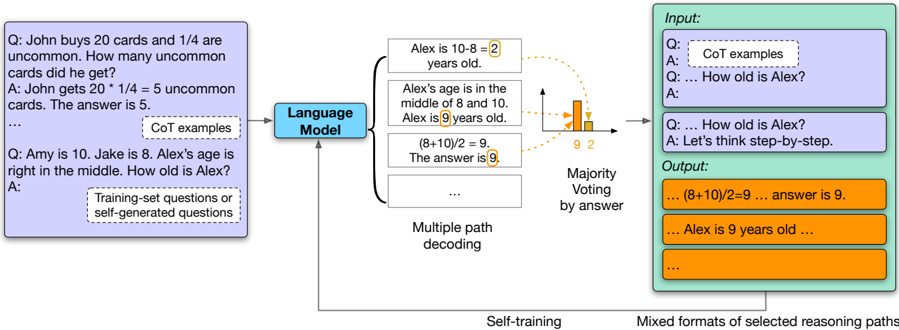
Large Language Models (LLMs) have achieved excellent performances in various tasks. However, fine-tuning an LLM requires extensive supervision. Human, on the other hand, may improve their reasoning abilities by self-thinking without external inputs. In this work, we demonstrate that an LLM is also capable of self-improving with only unlabeled datasets. We use a pre-trained LLM to generate "high-confidence" rationale-augmented answers for unlabeled questions using Chain-of-Thought prompting and self-consistency, and fine-tune the LLM using those self-generated solutions as target outputs. We show that our approach improves the general reasoning ability of a 540B-parameter LLM (74.4%->82.1% on GSM8K, 78.2%->83.0% on DROP, 90.0%->94.4% on OpenBookQA, and 63.4%->67.9% on ANLI-A3) and achieves state-of-the-art-level performance, without any ground truth label. We conduct ablation studies and show that fine-tuning on reasoning is critical for self-improvement.
Overview
The claims and statistics of this paper haven’t been checked yet.
Run the check — free, no account needed. It reads the open-access text and checks the sources it cites.
Integrity signals
Registry
Cites
Statistics
Figures
Verification
Claims the paper makes
The claims and statistics of this paper haven’t been checked yet.
Run the check — free, no account needed. It reads the open-access text and checks the sources it cites.
Claims other papers make about this one
Each is checked against this paper’s own text: does it say what the citing paper says it does?
The source backs part of the claim, not all of it — or backs it for a different population, condition or comparison.
In the citing paper
“Researchers are starting to apply discrete optimization and RL to find effective prompts, generally for a single logical LM call (Guo et al., 2023; Pryzant et al., 2023; Huang et al., 2022; Yang et al., 2023).”
From DSPy: Compiling Declarative Language Model Calls into Self-Improving Pipelines (2023) · cites this paper as Huang et al., 2022
Experimental — accuracy not yet measured
Self-check
Percentages, sums and reported differences re-computed from the paper’s own numbers.
The self-check needs the paper’s full text.
Citations
Cites
Language Models are Few-Shot Learners
Brown, T. B., Mann, B., Ryder, N., Subbiah, M., Kaplan, J., Dhariwal, P., Neelakantan, A., Shyam, P., Sastry, G., Askell, A., et al. (2020) · arXiv · doi:10.48550/arxiv.2005.14165 · Cited by 23,372
Distilling the Knowledge in a Neural Network
Hinton, G., Vinyals, O., & Dean, J. (2015) · arXiv · doi:10.48550/arxiv.1503.02531 · Cited by 14,204
SQuAD: 100,000+ Questions for Machine Comprehension of Text
Rajpurkar, P., Zhang, J., Lopyrev, K., & Liang, P. (2016) · Proceedings of the 2016 Conference on Empirical Methods in Natural Language Processing · doi:10.18653/v1/d16-1264 · Cited by 6,208
Chain-of-Thought Prompting Elicits Reasoning in Large Language Models
Wei, J., Wang, X., Schuurmans, D., Bosma, M., Ichter, B., Xia, F., Chi, E., Le, Q., & Zhou, D. (2022) · arXiv · doi:10.48550/arxiv.2201.11903 · Cited by 4,263
Self-citationGLUE: A Multi-Task Benchmark and Analysis Platform for Natural Language Understanding
Wang, A., Singh, A., Michael, J., Hill, F., Levy, O., & Bowman, S. (2018) · Proceedings of the 2018 EMNLP Workshop BlackboxNLP: Analyzing and Interpreting Neural Networks for NLP · doi:10.18653/v1/w18-5446 · Cited by 4,222
Training language models to follow instructions with human feedback
Ouyang, L., Wu, J., Jiang, X., Almeida, D., Wainwright, C. L., Mishkin, P., Zhang, C., Agarwal, S., Slama, K., Ray, A., et al. (2022) · arXiv · doi:10.48550/arxiv.2203.02155 · Cited by 4,208
A Broad-Coverage Challenge Corpus for Sentence Understanding through Inference
Williams, A., Nangia, N., & Bowman, S. (2018) · Proceedings of the 2018 Conference of the North American Chapter of the Association for Computational Linguistics: Human Language Technologies, Volume 1 (Long Papers) · doi:10.18653/v1/n18-1101 · Cited by 3,342
PaLM: Scaling Language Modeling with Pathways
Chowdhery, A., Narang, S., Devlin, J., Bosma, M., Mishra, G., Roberts, A., Barham, P., Chung, H. W., Sutton, C., Gehrmann, S., et al. (2022) · arXiv · doi:10.48550/arxiv.2204.02311 · Cited by 2,590
Self-citationSelf-Training With Noisy Student Improves ImageNet Classification
Xie, Q., Luong, M.-T., Hovy, E., & Le, Q. V. (2020) · 2020 IEEE/CVF Conference on Computer Vision and Pattern Recognition (CVPR) · doi:10.1109/cvpr42600.2020.01070 · Cited by 2,393
Large language models are zero-shot reasoners
Kojima, T., Gu, S. (., Reid, M., Matsuo, Y., & Iwasawa, Y. (2022) · Advances in Neural Information Processing Systems 35 · doi:10.52202/068431-1613 · Cited by 2,013
Self-citation
Research works printed but not linked: 7
- Xiaokang Chen, Yuhui Yuan, Gang Zeng, and Jingdong Wang. 2021. Semi-supervised semantic segmenta- tion with cross pseudo supervision. In IEEE Confer- ence on Computer Vision and Pattern Recognition (CVPR).
- Anoop Korattikara Balan, Vivek Rathod, Kevin P Mur- phy, and Max Welling. 2015. Bayesian dark knowl- edge. Advances in neural information processing systems, 28.
- Aitor Lewkowycz, Anders Andreassen, David Dohan, Ethan Dyer, Henryk Michalewski, Vinay Venkatesh Ramasesh, Ambrose Slone, Cem Anil, Imanol Schlag, Theo Gutman-Solo, Yuhuai Wu, Behnam Neyshabur, Guy Gur-Ari, and Vedant Misra. 2022. Solving quantitative reasoning problems with lan- guage models. ArXiv, abs/2206.14858. · arXiv
- Yifei Li, Zeqi Lin, Shizhuo Zhang, Qiang Fu, Bei Chen, Jian-Guang Lou, and Weizhu Chen. 2022b. On the advance of making language models better reasoners. ArXiv, abs/2206.02336. · arXiv
- Wang Ling, Dani Yogatama, Chris Dyer, and Phil Blun- som. 2017b. Program induction by rationale gener- ation: Learning to solve and explain algebraic word problems. In ACL.
- Timo Schick and Hinrich Schütze. 2020a. Exploiting cloze-questions for few-shot text classification and natural language inference. In Conference of the Eu- ropean Chapter of the Association for Computational Linguistics.
- Jason Wei, Yi Tay, Rishi Bommasani, Colin Raffel, Barret Zoph, Sebastian Borgeaud, Dani Yogatama, Maarten Bosma, Denny Zhou, Donald Metzler, et al. 2022b. Emergent abilities of large language models. arXiv preprint arXiv:2206.07682. · arXiv
Cited by
Sorted by citations
Large language models in medicine
Thirunavukarasu, A. J., Ting, D. S. J., Elangovan, K., Gutierrez, L., Tan, T. F., & Ting, D. S. W. (2023) · Nature Medicine · doi:10.1038/s41591-023-02448-8 · Cited by 3,944
Self-Instruct: Aligning Language Models with Self-Generated Instructions
Wang, Y., Kordi, Y., Mishra, S., Liu, A., Smith, N. A., Khashabi, D., & Hajishirzi, H. (2023) · Proceedings of the 61st Annual Meeting of the Association for Computational Linguistics (Volume 1: Long Papers) · doi:10.18653/v1/2023.acl-long.754 · Cited by 1,243
Unleashing the potential of prompt engineering for large language models
CHEN, B. ‐., Zhang, Z., Langrené, N., & Zhu, S. (2025) · Patterns · doi:10.1016/j.patter.2025.101260 · Cited by 1,097
Towards Reasoning in Large Language Models: A Survey
Huang, J., & Chang, K. C.-C. (2023) · Findings of the Association for Computational Linguistics: ACL 2023 · doi:10.18653/v1/2023.findings-acl.67 · Cited by 428
Self-citationBai, Y., Kadavath, S., Kundu, S., Askell, A., Kernion, J., Jones, A., Chen, A., Goldie, A., Mirhoseini, A., & Kaplan, J. (2022) · arXiv (Cornell University) · doi:10.48550/arxiv.2212.08073 · Cited by 326
“Some other recent works on self-supervision include [Shi et al., 2022, Huang et al., 2022].”
BackgroundHsieh, C.-Y., Li, C.-L., Yeh, C.-K., Nakhost, H., Fujii, Y., Ratner, A., Krishna, R., Lee, C.-Y., & Pfister, T. (2023) · Findings of the Association for Computational Linguistics: ACL 2023 · doi:10.18653/v1/2023.findings-acl.507 · Cited by 316
Recent advancements and challenges of NLP-based sentiment analysis: A state-of-the-art review
Jim, J. R., Talukder, M. A. R., Malakar, P., Kabir, M. M., Nur, K. M., & Mridha, M. F. (2024) · Natural Language Processing Journal · doi:10.1016/j.nlp.2024.100059 · Cited by 420
Mental-LLM: Leveraging Large Language Models for Mental Health Prediction via Online Text Data
Xu, X., Yao, B., Dong, Y., Gabriel, S., Yu, H., Hendler, J., Ghassemi, M., Dey, A. K., & Wang, D. (2024) · Proceedings of the ACM on Interactive, Mobile, Wearable and Ubiquitous Technologies · doi:10.1145/3643540 · Cited by 278
Self-citationMumuni, A., & Mumuni, F. (2024) · Journal of Information and Intelligence · doi:10.1016/j.jiixd.2024.01.002 · Cited by 221
Explainable Generative AI (GenXAI): a survey, conceptualization, and research agenda
Schneider, J. (2024) · Artificial Intelligence Review · doi:10.1007/s10462-024-10916-x · Cited by 214
Self-Planning Code Generation with Large Language Models
Jiang, X., Dong, Y., Wang, L., Fang, Z., Shang, Q., Li, G., Jin, Z., & Jiao, W. (2024) · ACM Transactions on Software Engineering and Methodology · doi:10.1145/3672456 · Cited by 158
Fields, J., Chovanec, K., & Madiraju, P. (2024) · IEEE Access · doi:10.1109/access.2024.3349952 · Cited by 188
Learning theories for artificial intelligence promoting learning processes
Gibson, D., Kovanovic, V., Ifenthaler, D., Dexter, S., & Feng, S. (2023) · British Journal of Educational Technology · doi:10.1111/bjet.13341 · Cited by 155
Large Language Models Are Reasoning Teachers
Ho, N., Schmid, L., & Yun, S.-Y. (2023) · Proceedings of the conference - Association for Computational Linguistics. Meeting · doi:10.18653/v1/2023.acl-long.830 · Cited by 403
Domain Specialization as the Key to Make Large Language Models Disruptive: A Comprehensive Survey
Ling, C., Zhao, X., Lu, J., Deng, C., Zheng, C., Wang, J., Chowdhury, T., Li, Y., Cui, H., Zhang, X., et al. (2025) · ACM Computing Surveys · doi:10.1145/3764579 · Cited by 385
Reasoning with Language Model Prompting: A Survey
Qiao, S., Ou, Y., Zhang, N., Chen, X., Yao, Y., Deng, S., Tan, C., Huang, F., & Chen, H. (2023) · Proceedings of the conference - Association for Computational Linguistics. Meeting · doi:10.18653/v1/2023.acl-long.294 · Cited by 346
Teaching Small Language Models to Reason
Magister, L. C., Mallinson, J., Adamek, J., Malmi, E., & Severyn, A. (2023) · Proceedings of the 61st Annual Meeting of the Association for Computational Linguistics (Volume 2: Short Papers) · doi:10.18653/v1/2023.acl-short.151 · Cited by 127
Espejel, J. L., Ettifouri, E. H., Alassan, M. S. Y., Chouham, E. M., & Dahhane, W. (2023) · Natural Language Processing Journal · doi:10.1016/j.nlp.2023.100032 · Cited by 148
UniMatch V2: Pushing the Limit of Semi-Supervised Semantic Segmentation
Yang, L., Zhao, Z. W., & Zhao, H. (2025) · IEEE Transactions on Pattern Analysis and Machine Intelligence · doi:10.1109/tpami.2025.3528453 · Cited by 132
Materials science in the era of large language models: a perspective
Lei, G., Docherty, R., & Cooper, S. J. (2024) · Digital Discovery · doi:10.1039/d4dd00074a · Cited by 130
Pan, L., Saxon, M., Xu, W., Nathani, D., Wang, X., & Wang, W. Y. (2024) · Transactions of the Association for Computational Linguistics · doi:10.1162/tacl_a_00660 · Cited by 86
Self-citationWill we run out of data? Limits of LLM scaling based on human-generated data
Villalobos, P., Ho, A., Sevilla, J., Besiroglu, T., Heim, L., & Hobbhahn, M. (2022) · arXiv · doi:10.48550/arxiv.2211.04325 · Cited by 80
“26 Verification processes can be used as training signals which guide the data generation and improve performance (Zhang & Parkes, 2023; Huang et al., 2022).”
MethodSelf-consuming generative models go MAD
Casco-Rodriguez, J., Alemohammad, S., Luzi, L., Imtiaz, A., Babaei, H., LeJeune, D., Siahkoohi, A., & Baraniuk, R. (2023) · LatinX in AI at Neural Information Processing Systems Conference 2023 · doi:10.52591/lxai202312101 · Cited by 83
When Can LLMs Actually Correct Their Own Mistakes? A Critical Survey of Self-Correction of LLMs
Kamoi, R., Zhang, Y., Zhang, N., Han, J., & Zhang, R. (2024) · Transactions of the Association for Computational Linguistics · doi:10.1162/tacl_a_00713 · Cited by 200
Self-citationDistilling Reasoning Capabilities into Smaller Language Models
Shridhar, K., Stolfo, A., & Sachan, M. (2023) · Findings of the Association for Computational Linguistics: ACL 2023 · doi:10.18653/v1/2023.findings-acl.441 · Cited by 79
“Huang et al. (2022) used the most voted outputs to further fine-tune the model for better performance.”
MethodISR-LLM: Iterative Self-Refined Large Language Model for Long-Horizon Sequential Task Planning
Zhou, Z., Song, J., Yao, K., Shu, Z., & Ma, L. (2024) · Proceedings - IEEE International Conference on Robotics and Automation/Proceedings · doi:10.1109/icra57147.2024.10610065 · Cited by 102
Potential applications and implications of large language models in primary care
Andrew, A. (2024) · Family Medicine and Community Health · doi:10.1136/fmch-2023-002602 · Cited by 70
Cognitive Architectures for Language Agents
Sumers, T. R., Yao, S., Narasimhan, K., & Griffiths, T. L. (2023) · arXiv · doi:10.48550/arxiv.2309.02427 · Cited by 72
“LLMs pre-trained on large-scale internet data learn a remarkably effective prior over string completions, allowing them to solve a wide range of tasks out of the box (Huang et al., 2022b).”
BackgroundMethodYang, J., Liu, C., Deng, W., Wu, D., Weng, C., Zhou, Y., & Wang, K. (2023) · Patterns · doi:10.1016/j.patter.2023.100887 · Cited by 87
Self-Adaptive Large Language Model (LLM)-Based Multiagent Systems
do Nascimento, N. M., Alencar, P., & Cowan, D. D. (2023) · IEEE International Conference on Autonomic Computing and Self-Organizing Systems Companion (ACSOS-C) · doi:10.1109/acsos-c58168.2023.00048 · Cited by 82
The alignment problem from a deep learning perspective
Ngo, R., Chan, L., & Mindermann, S. (2022) · arXiv · doi:10.48550/arxiv.2209.00626 · Cited by 68
“…addition to standard drivers of progress, AI developers are increasingly using ML systems for accelerating programming [OpenAI, 2023a], and developing new architectures [Elsken et al., 2019], algorithms [Fawzi et al., 2022], training data [Huang et al., 2022a], and chips [Mirhoseini et al., 2021].”
MethodAutomatic Prompt Augmentation and Selection with Chain-of-Thought from Labeled Data
Shum, K., Diao, S., & Zhang, T. (2023) · Findings of the Association for Computational Linguistics: EMNLP (Findings of EMNLP) · doi:10.18653/v1/2023.findings-emnlp.811 · Cited by 79
Ren, Y., Zhang, H., Yu, F. R., Li, W., Zhao, P., & He, Y. (2024) · IEEE Transactions on Mobile Computing · doi:10.1109/tmc.2024.3522130 · Cited by 71
Natural Language Reasoning, A Survey
Yu, F., Zhang, H., Tiwari, P., & Wang, B. (2024) · ACM Computing Surveys · doi:10.1145/3664194 · Cited by 131
DSPy: Compiling Declarative Language Model Calls into Self-Improving Pipelines
Khattab, O., Singhvi, A., Maheshwari, P., Zhang, Z., Santhanam, K., Vardhamanan, S., Haq, S., Sharma, A., Joshi, T. T., Moazam, H., et al. (2023) · arXiv · doi:10.48550/arxiv.2310.03714 · Cited by 911
“Researchers are starting to apply discrete optimization and RL to find effective prompts, generally for a single logical LM call (Guo et al., 2023; Pryzant et al., 2023; Huang et al., 2022; Yang et al., 2023).”
BackgroundCRITIC: Large Language Models Can Self-Correct with Tool-Interactive Critiquing
Gou, Z., Shao, Z., Gong, Y., Shen, Y., Yang, Y., Duan, N., & Chen, W. (2023) · arXiv · doi:10.48550/arxiv.2305.11738 · Cited by 561
“, 2023) and reasoning correctness (Ye & Durrett, 2022; Huang et al., 2022).”
LlaVA-CoT: Let Vision Language Models Reason Step-By-Step
Xu, G., Jin, P., Wu, Z., Li, H., Song, Y., Sun, L., & Yuan, L. (2025) · IEEE/CVF International Conference on Computer Vision (ICCV) · doi:10.1109/iccv51701.2025.00202 · Cited by 118
Liu, Y., Lo, S. K., Lu, Q., Zhu, L., Zhao, D., Xu, X., Harrer, S., & Whittle, J. (2025) · Journal of Systems and Software · doi:10.1016/j.jss.2024.112278 · Cited by 51
Ouyang, Z., Jiang, Y., & Liu, H. (2024) · The International Review of Research in Open and Distributed Learning · doi:10.19173/irrodl.v25i3.7677 · Cited by 61
Can ChatGPT Assess Human Personalities? A General Evaluation Framework
Rao, H., Leung, C., & Miao, C. (2023) · Findings of the Association for Computational Linguistics: EMNLP (Findings of EMNLP) · doi:10.18653/v1/2023.findings-emnlp.84 · Cited by 94
Generative AI vs. humans in online hotel review management: A Task-Technology Fit perspective
Zhang, H., Xiang, Z., & Zach, F. (2025) · Tourism Management · doi:10.1016/j.tourman.2025.105187 · Cited by 61
Symbolic Chain-of-Thought Distillation: Small Models Can Also “Think” Step-by-Step
Li, L. H., Hessel, J., Yu, Y., Ren, X., Chang, K.-W., & Choi, Y. (2023) · Proceedings of the conference - Association for Computational Linguistics. Meeting · doi:10.18653/v1/2023.acl-long.150 · Cited by 148
The AI-mediated intimacy economy: a paradigm shift in digital interactions
Bozdağ, A. A. (2025) · AI & SOCIETY · doi:10.1007/s00146-024-02132-6 · Cited by 42
Li, H., Fu, J., & Python, A. (2025) · Journal of Medical Internet Research · doi:10.2196/71916 · Cited by 49
SAGE: Self-evolving Agents with Reflective and Memory-augmented Abilities
Liang, X., Tao, M., Xia, Y., Wang, J., Li, K., Wang, Y., He, Y., Yang, J., Shi, T., Wang, Y., et al. (2025) · Neurocomputing · doi:10.1016/j.neucom.2025.130470 · Cited by 39
Self-citationOpportunities for retrieval and tool augmented large language models in scientific facilities
Prince, M. H., Chan, H., Vriza, A., Zhou, T., Sastry, V. K., Luo, Y., Dearing, M. T., Harder, R., Vasudevan, R. K., & Cherukara, M. J. (2024) · npj Computational Materials · doi:10.1038/s41524-024-01423-2 · Cited by 56
A social path to human-like artificial intelligence
Duéñez‐Guzmán, E. A., Sadedin, S., Wang, J. X., McKee, K. R., & Leibo, J. Z. (2023) · Nature Machine Intelligence · doi:10.1038/s42256-023-00754-x · Cited by 50
Bozdağ, A. A. (2023) · Online Journal of Communication and Media Technologies · doi:10.30935/ojcmt/13414 · Cited by 42
REFINER: Reasoning Feedback on Intermediate RepresentationsPreprint
Paul, D., Ismayilzada, M., Peyrard, M., Borges, B., Bosselut, A., West, R., & Faltings, B. V. (2023) · arXiv (Cornell University) · doi:10.48550/arxiv.2304.01904 · Cited by 35
Bland, T. (2024) · JMIR Medical Education · doi:10.2196/63865 · Cited by 39
Generalization potential of large language models
Budnikov, M., Bykova, A., & Yamshchikov, I. P. (2024) · Neural Computing and Applications · doi:10.1007/s00521-024-10827-6 · Cited by 42
Promptbreeder: Self-Referential Self-Improvement via Prompt Evolution
Fernando, C., Banarse, D., Michalewski, H., Osindero, S., & Rocktäschel, T. (2023) · arXiv · doi:10.48550/arxiv.2309.16797 · Cited by 31
RewriteLM: An Instruction-Tuned Large Language Model for Text Rewriting
Shu, L., Luo, L., Hoskere, J., Zhu, Y., Liu, Y., Tong, S., Chen, J., & Meng, L. (2024) · Proceedings of the AAAI Conference on Artificial Intelligence · doi:10.1609/aaai.v38i17.29863 · Cited by 59
Advancing Legal Citation Text Classification A Conv1D-Based Approach for Multi-Class Classification
Xie, Y., Li, Z., Yin, Y., Wei, Z., Xu, G., & Luo, Y. (2024) · Journal of Theory and Practice of Engineering Science · doi:10.53469/jtpes.2024.04(02).03 · Cited by 39
Better Zero-Shot Reasoning with Self-Adaptive Prompting
Wan, X., Sun, R., Dai, H., Arık, S. Ö., & Pfister, T. (2023) · Findings of the Association for Computational Linguistics: ACL (Findings of ACL) · doi:10.18653/v1/2023.findings-acl.216 · Cited by 56
Codepori: Large-Scale System for Autonomous Software Development Using Multi-Agent Technology
Rasheed, Z., Malik, S., Kemell, K.-K., Muhammad, W., Saari, M., Systä, K., & Abrahamsson, P. (2024) · doi:10.2139/ssrn.4979510 · Cited by 27
A Survey of Reasoning with Foundation Models: Concepts, Methodologies, and Outlook
Sun, J., Zheng, C., Xie, E., Liu, Z., Chu, R., Qiu, J., Xu, J., Ding, M., Li, H., Geng, M., et al. (2025) · ACM Computing Surveys · doi:10.1145/3729218 · Cited by 45
Self-citationWada, A., Akashi, T., Shih, G., Hagiwara, A., Nishizawa, M., Hayakawa, Y., Kikuta, J., Shimoji, K., Sano, K., Kamagata, K., et al. (2024) · Diagnostics · doi:10.3390/diagnostics14141541 · Cited by 25
Sharma, N. V., & Jindal, N. (2023) · Multimedia Tools and Applications · doi:10.1007/s11042-023-17890-6 · Cited by 34
Qiu, X., Hao, T., Shi, S., Tan, X., & Xiong, Y.-J. (2024) · IEEE Signal Processing Letters · doi:10.1109/lsp.2024.3377590 · Cited by 28
MoT: Memory-of-Thought Enables ChatGPT to Self-Improve
Li, X., & Qiu, X. (2023) · Conference on Empirical Methods in Natural Language Processing (EMNLP) · doi:10.18653/v1/2023.emnlp-main.392 · Cited by 53
LUNA: A Model-Based Universal Analysis Framework for Large Language Models
Song, D., Xie, X., Song, J., Zhu, D., Huang, Y., Juefei-Xu, F., & Ma, L. (2024) · IEEE Transactions on Software Engineering · doi:10.1109/tse.2024.3411928 · Cited by 33
Singh, D., Nuthakki, S., Naik, A., Mullankandy, S., Singh, P. K., & Nuthakki, Y. (2022) · Cognizance Journal of Multidisciplinary Studies · doi:10.47760/cognizance.2022.v02i03.002 · Cited by 22
Information extraction from historical well records using a large language model
Ma, Z., Santos, J. E., Lackey, G., Viswanathan, H., & O’Malley, D. (2024) · Scientific Reports · doi:10.1038/s41598-024-81846-5 · Cited by 29
Tian, Y., Han, Y., Chen, X., Wang, W. W., & Chawla, N. V. (2025) · ACM International Conference on Web Search and Data Mining (WSDM) · doi:10.1145/3701551.3703577 · Cited by 63
Federated Prompting and Chain-of-Thought Reasoning for Improving LLMs Answering
Liu, X., Pang, T., & Fan, C. (2023) · Lecture notes in computer science · doi:10.1007/978-3-031-40292-0_1 · Cited by 26
A Survey of Reasoning with Foundation ModelsPreprint
Sun, J., Zheng, C., Xie, E., Liu, Z., Chu, R., Liu, J., Xu, J., Ding, M., Li, H., Geng, M., et al. (2023) · OSF Preprints (OSF Preprints) · doi:10.31219/osf.io/ac4sp · Cited by 143
Self-citationEvaluation on ChatGPT for Chinese Language Understanding
Li, L., Zhang, H., Li, C., You, H., & Cui, W. (2023) · Data Intelligence · doi:10.1162/dint_a_00232 · Cited by 22
AI in radiography education: Evaluating multiple-choice questions difficulty and discrimination
Emekli, E., & Karahan, B. N. (2025) · Journal of medical imaging and radiation sciences · doi:10.1016/j.jmir.2025.101896 · Cited by 20
RVISA: Reasoning and Verification for Implicit Sentiment Analysis
Lai, W., Xie, H., Xu, G., & Li, Q. (2025) · IEEE Transactions on Affective Computing · doi:10.1109/taffc.2025.3537799 · Cited by 25
Can Large Language Models Safely Address Patient Questions Following Cataract Surgery?
Chowdhury, M., Lim, E., Higham, A., McKinnon, R., Ventoura, N., He, Y., & De Pennington, N. (2023) · Proceedings of the 5th Clinical Natural Language Processing Workshop · doi:10.18653/v1/2023.clinicalnlp-1.17 · Cited by 17
Robust semi-supervised learning in open environments
Guo, L.-Z., Jia, L.-H., Shao, J.-J., & Li, Y. (2025) · Frontiers of Computer Science · doi:10.1007/s11704-024-40646-w · Cited by 15
Tan, X., Shi, S., Qiu, X., Qu, C., Qi, Z., Xu, Y., & Qi, Y. (2023) · Conference on Empirical Methods in Natural Language Processing (EMNLP) · doi:10.18653/v1/2023.emnlp-industry.62 · Cited by 22
A Survey of Task Planning with Large Language Models
Zhai, W., Liao, J., Chen, Z., Su, B., & Zhao, X. (2025) · Intelligent Computing · doi:10.34133/icomputing.0124 · Cited by 21
Synthetic data distillation enables the extraction of clinical information at scale
Woo, E. G., Burkhart, M. C., Alsentzer, E., & Beaulieu‐Jones, B. K. (2025) · npj Digital Medicine · doi:10.1038/s41746-025-01681-4 · Cited by 18
Voultsiou, E., & Moussiades, L. (2026) · Electronics · doi:10.3390/electronics15030524 · Cited by 18
How Many Demonstrations Do You Need for In-context Learning?
Chen, J., Chen, L., Zhu, C., & Zhou, T. (2023) · Findings of the Association for Computational Linguistics: EMNLP 2023 · doi:10.18653/v1/2023.findings-emnlp.745 · Cited by 12
Assessing the risk of takeover catastrophe from large language models
Baum, S. D. (2024) · Risk Analysis · doi:10.1111/risa.14353 · Cited by 11
Worthley, B., Guo, M., Sheneman, L., & Bland, T. (2025) · AI · doi:10.3390/ai6030060 · Cited by 14
Automatically Generating Rules of Malicious Software Packages via Large Language Model
Zhang, X., Du, X., Chen, H., He, Y., Niu, W., & Li, Y. (2025) · International Conference on Dependable Systems & Networks/Proceedings · doi:10.1109/dsn64029.2025.00072 · Cited by 12
Tell me what you don’t know: large language models and the pathologies of intelligence analysis
Logan, S. (2024) · Australian Journal Of International Affairs · doi:10.1080/10357718.2024.2331733 · Cited by 12
LLMs Can't Plan, But Can Help Planning in LLM-Modulo Frameworks
Kambhampati, S., Valmeekam, K., Guan, L., Verma, M., Stechly, K., Bhambri, S., Saldyt, L., & Murthy, A. (2024) · arXiv · doi:10.48550/arxiv.2402.01817 · Cited by 237
“…plans is that they can’t also self-improve by generating synthetic data by generating plans themselves, critiquing the plans by themselves to improve them, and then use those to fine-tune themselves, as has been claimed in the literature Wang et al. (2022) 3 Huang et al. (2023b); see Section 3.3.”
BackgroundInfluentialLLMs with User-defined Prompts as Generic Data Operators for Reliable Data Processing
Ma, L., Thakurdesai, N., Chen, J., Xu, J., Körpeoğlu, E., Kumar, S., & Achan, K. (2023) · IEEE International Conference on Big Data (BigData) · doi:10.1109/bigdata59044.2023.10386472 · Cited by 16
Do Large Language Models Show Human-like Biases? Exploring Confidence—Competence Gap in AI
Singh, A. K., Lamichhane, B., Devkota, S., Dhakal, U., & Dhakal, C. (2024) · Information · doi:10.3390/info15020092 · Cited by 29
Li, Y., Yuan, P., Feng, S., Pan, B., Sun, B., Wang, X. X., Wang, H., & Li, K. (2024) · Proceedings of the AAAI Conference on Artificial Intelligence · doi:10.1609/aaai.v38i17.29821 · Cited by 20
Self-citationXu, A. Y., Singh, M., Balmaceno-Criss, M., Oh, A., Leigh, D., Daher, M., Alsoof, D., McDonald, C. L., Diebo, B. G., & Daniels, A. H. (2025) · Journal of orthopaedic surgery · doi:10.1177/10225536241268789 · Cited by 12
OntoTune: Ontology-Driven Self-training for Aligning Large Language Models
Liu, Z., Gan, C. G., Wang, J., Zhang, Y., Bo, Z., Sun, M., Chen, H., & Zhang, W. (2025) · International World Wide Web Conference (WWW) · doi:10.1145/3696410.3714816 · Cited by 14
Kumar, A., Salim, M. M., Camacho, D., & Park, J. H. (2025) · Computer Networks · doi:10.1016/j.comnet.2025.111379 · Cited by 14
Fine-Tuning Large Language Models for Task Specific Data
Ramesh, R., Akarsh Thejasvi Raju, M., Reddy, H. V., & Sandeep Varma, N. (2024) · International Conference on Networking, Embedded and Wireless Systems (ICNEWS) · doi:10.1109/icnews60873.2024.10730913 · Cited by 10
Learning Interpretable Style Embeddings via Prompting LLMs
Patel, A., Rao, D., Kothary, A., McKeown, K. R., & Callison-Burch, C. (2023) · Findings of the Association for Computational Linguistics: EMNLP (Findings of EMNLP) · doi:10.18653/v1/2023.findings-emnlp.1020 · Cited by 29
Reasoning Models Don't Always Say What They Think
Chen, Y., Benton, J., Radhakrishnan, A., Uesato, J., Denison, C., Schulman, J., Somani, A., Hase, P., Wagner, M., Roger, F., et al. (2025) · arXiv · doi:10.48550/arxiv.2505.05410 · Cited by 18
Exploring formal defeasible reasoning of large language models: A Chain-of-Thought approach
Li, Z., Chen, C., Li, M., & Liao, B. (2025) · Knowledge-Based Systems · doi:10.1016/j.knosys.2025.113564 · Cited by 9
Democratizing LLMs: An Exploration of Cost-Performance Trade-offs in Self-Refined Open-Source Models
Shashidhar, S., Chinta, A., Sahai, V., Wang, Z., & Ji, H. (2023) · Findings of the Association for Computational Linguistics: EMNLP 2023 · doi:10.18653/v1/2023.findings-emnlp.608 · Cited by 9
Large Language Models in Ophthalmology: Potential and Pitfalls
Yaghy, A., Yaghy, M., Shields, J. A., & Shields, C. L. (2024) · Seminars in Ophthalmology · doi:10.1080/08820538.2023.2300808 · Cited by 9
Faltings, F., Galley, M., Brantley, K., Peng, B., Cai, W., Zhang, Y., Gao, J., & Dolan, B. (2023) · Conference on Empirical Methods in Natural Language Processing (EMNLP) · doi:10.18653/v1/2023.emnlp-main.270 · Cited by 11
Democratizing Reasoning Ability: Tailored Learning from Large Language Model
Wang, Z., Huang, S., Liu, Y., Wang, J., Song, M., Zhang, Z., Huang, H., Wei, F., Deng, W., Sun, F., et al. (2023) · Conference on Empirical Methods in Natural Language Processing (EMNLP) · doi:10.18653/v1/2023.emnlp-main.120 · Cited by 22
Minimum levels of interpretability for artificial moral agents
Vijayaraghavan, A., & Badea, C. (2024) · AI and Ethics · doi:10.1007/s43681-024-00536-0 · Cited by 12
Clustering Algorithms and RAG Enhancing Semi-Supervised Text Classification with Large LLMs
Zhong, S., Zeng, J., Yu, Y., & Lin, B. (2025) · International Journal of Data Science and Analytics · doi:10.1007/s41060-025-00774-3 · Cited by 10
Babatunde, I. D., Nnanna, O. M., & Klein, M. (2025) · ACM Symposium on Applied Computing · doi:10.1145/3672608.3707925 · Cited by 11
Kuan, C.-Y., Yang, C.-K., Huang, W., Lu, K.-H., & Lee, H.-Y. (2024) · IEEE Spoken Language Technology Workshop (SLT) · doi:10.1109/slt61566.2024.10832184 · Cited by 13
Metadata
- Authors
- Huang, J., Gu, S. S., Hou, L., Wu, Y., Wang, X., Yu, H., & Han, J.
- Affiliations
- University of Illinois Urbana-Champaign (US)
- Google (United States) (US)
- Venue
- arXiv
- Publisher
- arXiv
- Published
- 2022
- Pages
- 1051-1068
- arXiv
- 2210.11610
- OpenAlex
- W4389523706
- Cited by
- 230
- References
- 59
- Citations by year
- 2026: 36 · 2025: 77 · 2024: 63 · 2023: 53 · 2022: 1
- FWCI
- 40.57
- Type
- conference paper
- Language
- en
- Open access
- hybrid
- doi.org
- Licence
- Locations
- Conference on Empirical Methods in Natural Language Processing (EMNLP) (publishedVersion, cc-by)
- arXiv (Cornell University) (submittedVersion)
- arXiv (Cornell University)
- Topics
- Physical Sciences › Computer Science › Artificial Intelligence › Topic Modeling
- Physical Sciences › Computer Science › Artificial Intelligence › Natural Language Processing Techniques
- Physical Sciences › Computer Science › Artificial Intelligence › Domain Adaptation and Few-Shot Learning
- Keywords
- large language models, human development, self-supervised fine-tuning, unlabeled data, chain-of-thought prompting, self-consistency, reasoning skills, low-resource languages, Arecaceae, GSM8K, OpenBookQA
About these checks
Registry, retraction, Cites and statistics results are computed, not judged, with one exception: a printed reference that no index lists is read once by a model before it counts as a citation error. Claims are extracted by a model and kept only when their quote appears verbatim in the text; each cited source is then checked, with a model’s help, for whether it says what the claim relies on. Those verdicts can be wrong — read the claim’s quote and the cited source before relying on one.
Statistics and arithmetic are recomputed, not judged.
Confidence bands are shown only for fields calibrated on our annotated test set. None is calibrated yet, so no band is shown.
What counts as a claim ›How we measure confidence ›How we check this ›
Are you an author, or do you see a problem with this page? Request a review
