

InternVL3: Exploring Advanced Training and Test-Time Recipes for Open-Source Multimodal Models
Open accessThe DOI matches its DataCite record; 145 of the 145 references it cites were found in a registry or an index; none of the 38 sources its claims cite is checked for support yet.
Abstract
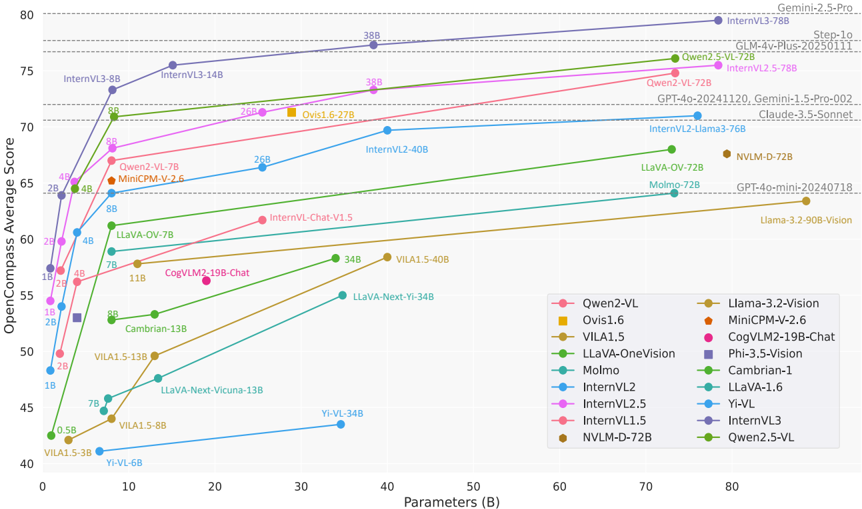
We introduce InternVL3, a significant advancement in the InternVL series featuring a native multimodal pre-training paradigm. Rather than adapting a text-only large language model (LLM) into a multimodal large language model (MLLM) that supports visual inputs, InternVL3 jointly acquires multimodal and linguistic capabilities from both diverse multimodal data and pure-text corpora during a single pre-training stage. This unified training paradigm effectively addresses the complexities and alignment challenges commonly encountered in conventional post-hoc training pipelines for MLLMs. To further improve performance and scalability, InternVL3 incorporates variable visual position encoding (V2PE) to support extended multimodal contexts, employs advanced post-training techniques such as supervised fine-tuning (SFT) and mixed preference optimization (MPO), and adopts test-time scaling strategies alongside an optimized training infrastructure. Extensive empirical evaluations demonstrate that InternVL3 delivers superior performance across a wide range of multi-modal tasks. In particular, InternVL3-78B achieves a score of 72.2 on the MMMU benchmark, setting a new state-of-the-art among open-source MLLMs. Its capabilities remain highly competitive with leading proprietary models, including ChatGPT-4o, Claude 3.5 Sonnet, and Gemini 2.5 Pro, while also maintaining strong pure-language proficiency. In pursuit of open-science principles, we will publicly release both the training data and model weights to foster further research and development in next-generation MLLMs.
Overview
CoChat Summary
TL;DR
InternVL3 introduces a native multimodal pre-training paradigm that jointly learns language and multimodal capabilities in one stage, plus V2PE, SFT/MPO post-training, test-time scaling, and infrastructure optimizations. InternVL3-78B reaches 72.2 on MMMU, setting a new state of the art among open-source MLLMs while remaining competitive with proprietary models.
Key findings
- InternVL3-78B achieves 72.2 on MMMU, 906 on OCRBench, 96.0/98.6 on VCR-EN-Easy (EM/Jaccard), and 89.0/88.7 on MMBench English/Chinese; the paper reports it as a new open-source MLLM state of the art and competitive with ChatGPT-4o, Claude 3.5 Sonnet, and Gemini 2.5 Pro.
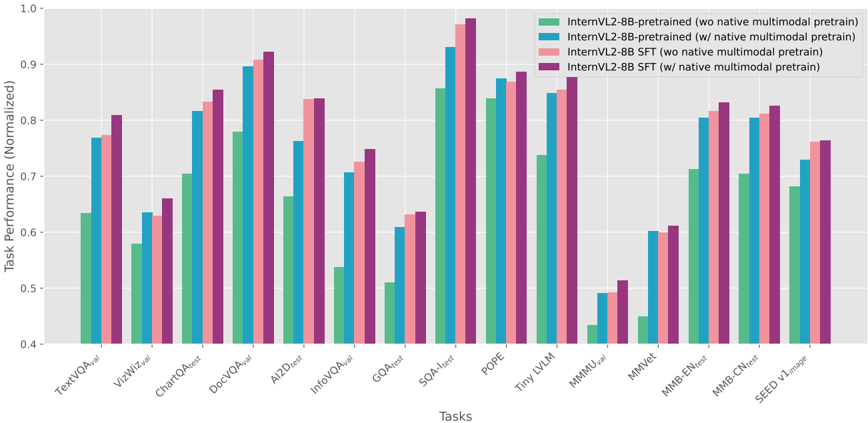
- Native multimodal pre-training is effective: replacing InternVL2-8B’s MLP warmup with native multimodal pre-training yields performance on most benchmarks comparable to the fully multi-stage-trained InternVL2-8B baseline, with further gains after instruction tuning on higher-quality data.
- MPO improves multimodal reasoning across seven benchmarks: InternVL3-78B and InternVL3-38B outperform their non-MPO counterparts by 4.1 and 4.5 points overall, respectively, even though MPO training data is a subset of SFT data.
- Test-time scaling with Best-of-8 and VisualPRM improves reasoning: on the Vision-Only split of MathVerse, best-of-8 gives increases of approximately 6.0 and 3.2 percentage points for InternVL3-38B and InternVL3-78B, respectively.
Methods
- Architecture follows “ViT-MLP-LLM”: vision encoder options are InternViT-300M and InternViT-6B; language models are pre-trained Qwen2.5 series and InternLM3-8B base models; the MLP is a two-layer randomly initialized network; pixel unshuffle reduces each 448×448 image tile to 256 visual tokens.
- Native multimodal pre-training jointly optimizes all parameters on multimodal and pure-language corpora, computes loss only on text tokens, and uses square averaging for token weights. Data combines InternVL2.5 pre-training corpus with GUI, tool usage, 3D scene, and video data, plus InternLM2.5 and open-source text data; the chosen language:multimodal ratio is 1:3, totaling about 200B tokens (50B language, 150B multimodal).
- Post-training uses SFT followed by MPO. SFT grows from 16.3M samples in InternVL2.5 to 21.7M in InternVL3; MPO uses about 300K preference samples and combines DPO preference loss, BCO quality loss, and LM generation loss. Test-time scaling uses Best-of-N with VisualPRM-8B as critic; infrastructure extends InternEVO, yielding a 50% to 200% training speedup for comparable-size models under the same compute budget.
Limitations
- The paper states a noticeable performance gap remains between InternVL3 and models like Qwen2.5-VL on certain benchmarks, such as MuirBench, implying future work may need better training data curation and model refinements.
- The paper reports minor declines on some benchmarks, such as MMHal, and states that optimizing data and training strategies for more consistent improvements remains an important future direction.
- The paper states visual grounding gains plateau at larger scales: InternVL2.5-78B reaches an average score of 92.3 while InternVL3-78B shows 91.4; it speculates this is because InternVL3’s training data expansion did not include additional grounding-specific data and the relative reduction in grounding-targeted data may have restricted localization capabilities.
Model-written summary. Check it against the paper before relying on it.
Integrity signals
Registry
Cites
Statistics
Figures
Verification
Claims the paper makes
0 Valid · 1 Not valid · 14 Not checked · 83 Own results and interpretations
A result the paper reports from its own data — it cites no other source for it, so there is none to check. The quote shows it is in the paper.
In the paper
“When compared with other competitive models, such as Qwen2-VL-72B and Qwen2.5-VL-72B, the InternVL3 series-especially the 78B variant-offers a consistent performance advantage on the multimodal understanding benchmarks.”
§ InternVL3: Exploring Advanced Training and Test-Time Recipes for Open-Source Multimodal Models > 3.6 Comprehensive Multimodal Evaluation
plainstates an association- Asserted: passes — The authors put it forward as true.
- Checkable: passes — It can be checked against evidence.
- Load-bearing: passes — The paper’s conclusions depend on it.
- Based: unclear — It is unclear why the paper says it holds.
A result the paper states — it cites no source for it, so there is none to check. The quote shows it is in the paper.
In the paper
“As a result, the number of training samples grows from 16.3M in InternVL2.5 to 21.7M in InternVL3.”
§ InternVL3: Exploring Advanced Training and Test-Time Recipes for Open-Source Multimodal Models > Data.
plainstates a cause- Asserted: passes — The authors put it forward as true.
- Checkable: passes — It can be checked against evidence.
- Load-bearing: unclear — It is unclear whether the paper’s conclusions depend on it.
- Based: passes — The paper gives a reason why it holds.
A result the paper states — it cites no source for it, so there is none to check. The quote shows it is in the paper.
In the paper
“while also maintaining strong pure-language proficiency.”
§ InternVL3: Exploring Advanced Training and Test-Time Recipes for Open-Source Multimodal Models > Abstract
boosted- Asserted: passes — The authors put it forward as true.
- Checkable: passes — It can be checked against evidence.
- Load-bearing: unclear — It is unclear whether the paper’s conclusions depend on it.
- Based: passes — The paper gives a reason why it holds.
A result the paper reports from its own data — it cites no other source for it, so there is none to check. The quote shows it is in the paper.
In the paper
“Compared with previous models, InternVL3 demonstrates substantial improvements across a wide range of task categories.”
§ InternVL3: Exploring Advanced Training and Test-Time Recipes for Open-Source Multimodal Models > 3.1 Overall Comparison to Other Advanced MLLMs
boosted- Asserted: passes — The authors put it forward as true.
- Checkable: passes — It can be checked against evidence.
- Load-bearing: passes — The paper’s conclusions depend on it.
- Based: passes — The paper gives a reason why it holds.
A result the paper reports from its own data — it cites no other source for it, so there is none to check. The quote shows it is in the paper.
In the paper
“Its capabilities remain highly competitive with leading proprietary models, including ChatGPT-4o, Claude 3.5 Sonnet, and Gemini 2.5 Pro, while also maintaining strong pure-language proficiency.”
§ InternVL3: Exploring Advanced Training and Test-Time Recipes for Open-Source Multimodal Models > Abstract
plain- Asserted: passes — The authors put it forward as true.
- Checkable: passes — It can be checked against evidence.
- Load-bearing: passes — The paper’s conclusions depend on it.
- Based: passes — The paper gives a reason why it holds.
45 more claims
Create a free account to see all 98 claims and every source verdict.
- It may state two separate claims as one. 42
- Probably not a substantial claim. 6
- The quote only partly states this claim. 1
Self-check
Percentages, sums and reported differences re-computed from the paper’s own numbers.
Each contradiction between two passages listed here was confirmed by an independent check.
Rated minor: it would not touch a result — a value no result rests on, a p-value that stays on the same side of the significance level, or a conflict that is clerical, resolved elsewhere in the paper, or outside its own findings.
In the paper
§ InternVL3: Exploring Advanced Training and Test-Time Recipes for Open-Source Multimodal Models > 3.8 Visual Grounding
“InternVL3-8B, InternVL3-9B, and InternVL3-14B yield average scores around 88.2-89.6,reflecting a consistent trend of performance gains as the model size increases.”
§ InternVL3: Exploring Advanced Training and Test-Time Recipes for Open-Source Multimodal Models > 3.6 Comprehensive Multimodal Evaluation
“InternVL3-8B 92.5 94.6 88.0 88.2 92.5 81.8 89.6 90.0 89.6 InternVL3-9B 91.8 93.2 86.6 86.4 91.0 79.9 88.0 88.5 88.2”
Rated minor: it would not touch a result — a value no result rests on, a p-value that stays on the same side of the significance level, or a conflict that is clerical, resolved elsewhere in the paper, or outside its own findings.
In the paper
§ InternVL3: Exploring Advanced Training and Test-Time Recipes for Open-Source Multimodal Models > GPT-4o Gemini 2.0 Claude Aguvis-72B Qwen2.5-VL-72B UI-TARS-72B InternVL3-8B -38B -72B
“The 8B variant (81.4%) already surpasses UI-TARS-72B”
§ InternVL3: Exploring Advanced Training and Test-Time Recipes for Open-Source Multimodal Models > GPT-4o Gemini 2.0 Claude Aguvis-72B Qwen2.5-VL-72B UI-TARS-72B InternVL3-8B -38B -72B
“InternVL3-72B achieves 90.9%, outperforming UI-TARS-72B (90.3%).”
Citations
Cites
Fei-Fei, L., Fergus, R., & Perona, P. (2005) · 2004 Conference on Computer Vision and Pattern Recognition Workshop · doi:10.1109/cvpr.2004.383 · Cited by 2,502
Liu, H., Li, C., Wu, Q., & Lee, Y. J. (2023) · Advances in Neural Information Processing Systems 36 · doi:10.52202/075280-1516 · Cited by 2,428
Making the V in VQA Matter: Elevating the Role of Image Understanding in Visual Question Answering
Goyal, Y., Khot, T., Summers-Stay, D., Batra, D., & Parikh, D. (2017) · 2017 IEEE Conference on Computer Vision and Pattern Recognition (CVPR) · doi:10.1109/cvpr.2017.670 · Cited by 2,287
Chen, Z., Wang, W., Cao, Y., Liu, Y., Gao, Z., Cui, E., Zhu, J., Ye, S., Tian, H., Liu, Z., et al. (2024) · arXiv · doi:10.48550/arxiv.2412.05271 · Cited by 2,204
Self-citationGrounding DINO: Marrying DINO with Grounded Pre-training for Open-Set Object Detection
Liu, S., Zeng, Z., Ren, T., Li, F., Zhang, H., Yang, J., Jiang, Q., Li, C., Yang, J., Su, H., et al. (2025) · Lecture Notes in Computer Science · doi:10.1007/978-3-031-72970-6_3 · Cited by 2,074
Self-citationNatural Questions: A benchmark for question answering research
Kwiatkowski, T., Palomaki, J., Redfield, O., Collins, M., Parikh, A., Alberti, C., Epstein, D., Polosukhin, I., Devlin, J., Lee, K., et al. (2019) · Transactions of the Association for Computational Linguistics · doi:10.1162/tacl_a_00276 · Cited by 2,069
MiniCPM-V: A GPT-4V Level MLLM on Your PhonePreprint
Yao, Y., Yu, T., Zhang, A., Wang, C., Cui, J., Zhu, H., Cai, T., Li, H., Zhao, W., He, Z., et al. (2024) · arXiv · doi:10.48550/arxiv.2408.01800 · Cited by 1,695
Self-citationTriviaQA: A Large Scale Distantly Supervised Challenge Dataset for Reading Comprehension
Joshi, M., Choi, E., Weld, D., & Zettlemoyer, L. (2017) · Proceedings of the 55th Annual Meeting of the Association for Computational Linguistics (Volume 1: Long Papers) · doi:10.18653/v1/p17-1147 · Cited by 1,690
Math-Shepherd: Verify and Reinforce LLMs Step-by-step without Human Annotations
Wang, P., Li, L., Shao, Z., Xu, R., Dai, D., Li, Y., Chen, D., Wu, Y., & Sui, Z. (2024) · Proceedings of the conference - Association for Computational Linguistics. Meeting · doi:10.18653/v1/2024.acl-long.510 · Cited by 1,665
TriviaQA: A Large Scale Distantly Supervised Challenge Dataset for Reading Comprehension
Joshi, M., Choi, E., Weld, D. S., & Zettlemoyer, L. (2017) · arXiv · doi:10.48550/arxiv.1705.03551 · Cited by 1,650
Research works printed but not linked: 6
- Anonymous. CG-bench: Clue-grounded question answering benchmark for long video understanding. In Submitted to The Thirteenth International Conference on Learning Representations, 2024. under review. 14, 15
- Shuai Bai, Keqin Chen, Xuejing Liu, Jialin Wang, Wenbin Ge, Sibo Song, Kai Dang, Peng Wang, Shijie Wang, Jun Tang, et al. Qwen2.5-vl technical report. arXiv preprint arXiv:2502.13923, 2025. 1, 2, 9, 10, 15 · arXiv
- Jie Cao and Jing Xiao. An augmented benchmark dataset for geometric question answering through dual parallel text encoding. In Proceedings of the 29th International Conference on Computational Linguistics, pages 1511-1520, 2022. 6
- Zhe Chen, Weiyun Wang, Hao Tian, Shenglong Ye, Zhangwei Gao, Erfei Cui, Wenwen Tong, Kongzhi Hu, Jiapeng Luo, Zheng Ma, et al. How far are we to gpt-4v? closing the gap to commercial multimodal models with open-source suites. arXiv preprint arXiv:2404.16821, 2024. 2, 3 · arXiv
- Hunter Lightman, Vineet Kosaraju, Yuri Burda, Harrison Edwards, Bowen Baker, Teddy Lee, Jan Leike, John Schulman, Ilya Sutskever, and Karl Cobbe. Let's verify step by step. In The Twelfth International Conference on Learning Representations, 2023. 7
- Minesh Mathew, Viraj Bagal, Rubèn Tito, Dimosthenis Karatzas, Ernest Valveny, and CV Jawahar. Infographicvqa. In Proceedings of the IEEE/CVF Winter Conference on Applications of Computer Vision, pages 1697-1706, 2022. 6, 7, 8, 10
Cited by
Items 1,301–1,400 of 2,641
Euphonium: Steering Video Flow Matching via Process Reward Gradient Guided Stochastic DynamicsPreprint
Zhong, R., Lian, J., Mi, X., Zhou, Z., Zhou, Y., Lu, Q., & Yan, J. (2026) · arXiv · doi:10.48550/arxiv.2602.04928 · Cited by 3
Association for Computational Linguistics 2026, Fraser, K., Howard, P., & Su, X. (2026) · arXiv · doi:10.48550/arxiv.2603.02370 · Cited by 3
PRISM: Robust VLM Alignment with Principled Reasoning for Integrated Safety in MultimodalityPreprint
Li, N., Zhao, Z., Suh, G. E., Pavone, M., & Xiao, C. (2025) · arXiv · doi:10.48550/arxiv.2508.18649 · Cited by 3
AesRM: Improving Video Aesthetics with Expert-Level FeedbackPreprint
Han, Y., Wei, Y., He, Y., Liu, X., Li, T., Yu, Z., Han, A., Zhang, S., Weng, T., & Zou, D. (2026) · arXiv · doi:10.48550/arxiv.2604.28078 · Cited by 3
Self-citationYao, K., Wang, X., Pan, M., Xiyue, H., Li, J., Wang, W., Dahlmeier, D., Shen, Y., Shen, Y., Zhang, W., et al. (2026) · arXiv · doi:10.48550/arxiv.2609.23038 · Cited by 3
“Spatial-Interactor also performs strongly among the systems reported in Table 1 (OpenAI, 2026, 2024; Gemini Team, 2025; Chen et al., 2026a; Bai et al., 2025b,a; Zhu et al., 2025; Ouyang et al., 2025; Feng et al., 2025; Wu et al., 2025b,a; Li et al., 2026a).”
Self-citationCai, W., Zhang, H., Huang, Y., Xie, Y., Gao, S., Deng, J., Xu, S., Song, J., & Zhang, Z. (2026) · Conference on Empirical Methods in Natural Language Processing (EMNLP) · doi:10.18653/2026.emnlp-main.422 · Cited by 3
Self-citationStepping VLMs onto the Court: Benchmarking Spatial Intelligence in SportsPreprint
Yang, Y., Shao, Y., Huang, D., Dong, L., Liu, Y., Tang, S., Zhou, X., Gao, Y., Wang, W., Zhou, Y., et al. (2026) · arXiv · doi:10.48550/arxiv.2603.09896 · Cited by 3
“In addition, we benchmark models fine-tuned on prior spatial intelligence datasets, including SpaceR [29], VST [30], SpatialLadder [27], SenseNova-SI [6], and Cambrain-S [31], together with their corresponding base models [57, 58].”
Self-citationVIBE: Annotation-Free Video-to-Text Information Bottleneck Evaluation for TL;DR
Chen, S., Li, P.-H., Chinchali, S., & Topcu, U. (2025) · neural information processing systems · doi:10.52202/085713-3634 · Cited by 3
DocTrace: Towards Traceable Long Document VQA via Hierarchical Evidence Graph ReasoningPreprint
Xiang, L., Guan, Z., Chen, H., Lin, X., Lei, Z., Hu, T., He, B., & Zeng, L. (2026) · arXiv · doi:10.48550/arxiv.2608.03292 · Cited by 3
“We compare against representative end-to-end document understanding models, including mPLUG-DocOwl2, Do-copilot, InternVL3, and DocSeeker. mPLUG-DocOwl2 mPLUG-DocOwl2 is an OCR-free document understanding model that directly aligns document images with a large language model through a dedicated visual abstraction modu…”
InfluentialEdge-case Synthesis for Fisheye Object Detection: A Data-centric PerspectivePreprint
Kim, S., & Go, K. (2025) · arXiv · doi:10.48550/arxiv.2507.16254 · Cited by 3
“We fine-tuned the model with the FishEye8K dataset, with captions obtained from InternVL3-38B [49].”
Guiding the Inner Eye: A Framework for Hierarchical and Flexible Visual Grounded ReasoningPreprint
Wei, Z., Ding, W., Hao, Y., & Chen, X. (2025) · arXiv · doi:10.48550/arxiv.2511.22172 · Cited by 3
“5-VL-7B-Instruct Team (2024) Our GRiP achieves comparable performance with InternVL3-78B Zhu et al. (2025).”
GeoThought: A Dataset for Enhancing Mathematical Geometry Reasoning in Vision-Language ModelsPreprint
Shi, N., Qin, C., Song, S., & Luo, M. (2025) · arXiv · doi:10.48550/arxiv.2510.21881 · Cited by 3
“5-VL [3] and In-tern3VL [36] series.”
TAG: Thinking with Action Unit Grounding for Facial Expression RecognitionPreprint
Lin, H., Bai, T., Zhang, J., Chang, X., Lu, S., Gu, F., Hu, Z., & Zhang, W. (2026) · arXiv · doi:10.48550/arxiv.2602.18763 · Cited by 3
Ju, S., Song, B., Chen, T., Zhang, J., Wu, Q., Chang, C., Wang, H., Zhou, Y., & Ji, R. (2026) · doi:10.1109/cvprf71909.2026.00799 · Cited by 3
“5 [49, 69].”
Self-citationFormat Matters: The Robustness of Multimodal LLMs in Reviewing Evidence from Tables and ChartsPreprint
Ho, X., Wu, Y.-A., Kumar, S., Boudin, F., Takasu, A., & Aizawa, A. (2025) · AAAI Publications (The Association for the Advancement of Artificial Intelligence (AAAI)) · doi:10.48550/arxiv.2511.10075 · Cited by 3
C-CoT: Counterfactual Chain-of-Thought with Vision-Language Models for Safe Autonomous DrivingPreprint
Tian, K., Lian, Y., Yang, K., Chen, X., & Li, S. (2026) · arXiv · doi:10.48550/arxiv.2605.10744 · Cited by 3
“5 (8B) [33], DeepSeek-VL (7B) [34], and Qwen2.”
Self-citationFlowGen: Synthesizing Diverse Flowcharts to Enhance and Benchmark MLLM Reasoning
Shi, K., Liu, S., Lin, Z., Guo, H., & Cheng, G. (2026) · International Conference on Learning Representations · Cited by 3
Hu, L., Xue, Y., Li, D., Liu, G., & Lin, Z. (2026) · arXiv · doi:10.48550/arxiv.2602.05729 · Cited by 3
“However, CLIP-based models are limited to the simple form of single image-single caption pairs and fail to fully leverage the increasingly powerful capabilities of pretrained multimodal large language models (MLLMs) (Liu et al., 2023; Li et al., 2024; An et al., 2025; Zhu et al., 2025).”
When Vision Speaks for SoundPreprint
Wen, X., Mo, W. J., Fu, X., Cai, R., Zhu, T., Li, W., Xie, Y., Chen, M., & Qi, P. (2026) · arXiv · doi:10.48550/arxiv.2605.16403 · Cited by 3
“Powered by foundation models such as GPT [41], Gemini [22], and Qwen-VL [57], recent Video-LLMs [14, 30, 54, 71] can interpret dynamic scenes [18, 47], answer complex questions [31, 44], and follow instructions [27, 63].”
Ou, S., Liu, H., Wang, P., Liao, Y., Xuan, C., Wang, Y., & Wang, Y. (2025) · Findings of the Association for Computational Linguistics: EMNLP (Findings of EMNLP) · doi:10.18653/v1/2025.findings-emnlp.349 · Cited by 3
Self-citationSER: Learning to Ground Video Reasoning with Semantic Evidence RewardsPreprint
Xia, S., Lai, Z., Jiang, T., Tian, K., Zhou, S., Li, B., & Wang, Y. (2026) · arXiv · doi:10.48550/arxiv.2606.24726 · Cited by 3
“Multimodal Large Language Models (MLLMs) have recently achieved strong performance on open-ended question answering and holistic event understanding (OpenAI, 2024; Bai et al., 2025; Zhu et al., 2025; Zhang et al., 2025a).”
Self-citationWhen and Where to Look: Adaptive Visual Evidence Scheduling for Efficient Long Video UnderstandingPreprint
Li, K., Chen, J., Li, M., Zheng, Z., Zou, H., Zhang, H., Liu, X., & Chen, X. (2026) · arXiv · doi:10.48550/arxiv.2608.03918 · Cited by 3
“5-VL-7B, and InternVL-3-8B (Li et al. 2024; Bai et al. 2025; Zhu et al. 2025).”
Self-citationTextlessRAG: End-to-End Visual Document RAG by Speech without Text
Xie, P., Qian, S., Liu, B., Wang, D., Sun, L., & Zhang, X. (2026) · IEEE International Conference on Acoustics Speech and Signal Processing · doi:10.1109/icassp55912.2026.11462642 · Cited by 3
Self-citationhong, Y., Gu, J., Lou, Y., Fan, L., Yang, Q., Wang, Y., Ding, K., Wu, Y., Xiang, S., & Ye, J. (2026) · arXiv · doi:10.48550/arxiv.2602.23952 · Cited by 3
“Vision Language Models (VLMs) [1, 3, 43] demonstrate exceptional performance in Visual Question Answering (VQA) [2, 9] by leveraging extensive parametric knowledge learned during pre-training.”
Self-citationDUEL: Adversarial Self-Play for Multimodal ReasoningPreprint
Qiu, L., Zeng, H., Liu, Y., Sun, B., Liao, G., & Liu, J. (2026) · arXiv · doi:10.48550/arxiv.2605.24794 · Cited by 3
Self-citationXue, K., Wei, T., Zhang, G., Ou, Z., Lu, K., Feng, Y., Zhu, Y., & Luo, H. (2026) · International Conference on Machine Learning · doi:10.48550/arxiv.2605.31251 · Cited by 3
PROSE: Training-Free Egocentric Scene Registration with Vision-Language ModelsPreprint
Chen, Z., Lee, N., Sun, B., Kwon, T., Pollefeys, M., Bauer, Z., & Hong, S. (2026) · arXiv · doi:10.48550/arxiv.2606.16569 · Cited by 3
“The weakest backbones, InternVL3-8B [54] and GPT-4o [56], fall off sharply on every metric, including Valid Ratio (VR), so a weaker VLM yields not only less accurate transforms but fewer usable ones.”
Self-citationUncovering and Shaping the Latent Representation of 3D Scene Topology in Vision-Language ModelsPreprint
Wang, H., & Gao, W. (2026) · arXiv · doi:10.48550/arxiv.2605.07148 · Cited by 3
“5-VL-7B [35], InternVL3-8B [36].”
Self-citationVideo‐Based Automated Seizure Classification Using Multimodal Large Language Models
Zhang, L., Jiang, R., Monsoor, T., Pasqua, J. N., McCrimmon, C. M., Sinha, P., Sharma, K., Alzuabi, M. A., Morales, V., Miranda, H., et al. (2026) · Annals of Clinical and Translational Neurology · doi:10.1002/acn3.70574 · Cited by 3
“Vision-language models (VLMs) such as GPT-4 Vision [7] and InternVL [8], along with audio-language models (ALMs) [9], are capable of high-level reasoning over complex sensory inputs [10].”
InfluentialTOMCAT: Test-time Comprehensive Knowledge Accumulation for Compositional Zero-Shot Learning
Yan, X., & Feng, S. (2025) · neural information processing systems · doi:10.52202/085713-3165 · Cited by 3
Bridging Time and Space: Decoupled Spatio-Temporal Alignment for Video Grounding
Tu, X., Wu, J., Kang, F., Nong, Q., Zhang, K., Niu, C., & Wu, F. (2026) · ACM International Conference on Multimedia (ACM MM) · doi:10.1145/3767308.3835022 · Cited by 3
“Tell me the start and end time for the following event: The man in dark blue shirt is eating salad. thus struggle to learn discriminative target information from multimodal features in complex scenarios such as distractors or occlusion.”
Self-citationJia, M., Zhang, Q., Luo, A., Li, L., Ye, S., Lu, H., Hou, W., & Zhao, D. (2026) · Proceedings of the conference - Association for Computational Linguistics. Meeting · doi:10.18653/v1/2026.acl-long.256 · Cited by 3
Self-citationVirtueBench: Evaluating Trustworthiness under Uncertainty in Long Video UnderstandingPreprint
Yu, X., Li, B., Li, Y., & Yang, Z. (2026) · arXiv · doi:10.48550/arxiv.2603.07071 · Cited by 3
“Benefiting from the development of large-scale pretraining techniques, Vision-Language Models (VLMs) [1, 4, 11, 14, 18, 28, 34, 35, 37, 40, 41, 44] have demonstrated enhanced multimodal capabilities.”
Universal Skeleton Understanding via Differentiable Rendering and MLLMs
Wang, Z., Li, P., Wang, X., Tang, Y., Ma, K., & Liu, M. (2026) · International Conference on Machine Learning · doi:10.48550/arxiv.2603.18003 · Cited by 3
“5-VL-7B and InternVL3-8B were obtained by rendering skeletons with the non-learnable 3D+Velocity renderer (same as in dered with the non-learnable 3D+Velocity renderer (same as in Table 7; 12 frames, 448 × 448 , identical front-view camera), finetuned on MQA recognition for 6 epochs.”
InfluentialSelf-citationViTexQA: A Multi-frame Temporal Perception Dataset for Video Text Question Answering
Guo, Z., Duan, C., Guan, T., Wang, Z., Zhou, K., & Yan, P. (2026) · Lecture notes in computer science · doi:10.1007/978-3-032-37450-9_38 · Cited by 3
Learning to see before seeing: demystifying LLM visual priors from language pre-training
Han, J., Tong, S., Fan, D., Ren, Y., Sinha, K., Torr, P., & Kokkinos, F. (2026) · Oxford University Research Archive (ORA) (University of Oxford) · Cited by 3
TennisExpert: Towards Expert-Level Analytical Sports Video UnderstandingPreprint
Liu, Z., Weng, X., Hu, L., Hóu, Z., Jiang, K., Dong, J. S., & Liu, Y. (2026) · arXiv · doi:10.48550/arxiv.2603.13397 · Cited by 3
“The field has since progressed rapidly, with increasingly powerful architectures emerging [4,24,36,48].”
Self-citationSceneGraphVLM: Dynamic Scene Graph Generation from Video with Vision-Language ModelsPreprint
Makarov, V., Gizetdinov, M., & Yudin, D. A. (2026) · arXiv · doi:10.48550/arxiv.2605.13667 · Cited by 3
From Diagnosis to Improvement: Probing Spatio-Physical Reasoning in Vision Language ModelsPreprint
Tiancheng, 韩. H., Gao, Y., Li, Y., Yu, W., Zhang, Q., & Shao, W. (2025) · arXiv · doi:10.48550/arxiv.2508.10770 · Cited by 3
Self-citationProCap: Projection-Aware Captioning for Spatial Augmented Reality
Cao, Z., Deng, Y., Ling, H., & Huang, B. (2026) · IEEE Conference on Virtual Reality and 3D User Interfaces (VR) · doi:10.1109/vr67842.2026.00026 · Cited by 2
“With the advent of deep learning, photometric [25] and geometric [26,27,65,66] compensation are formulated as an end-to-end learning problem.”
Tang, Z., Krishnan, R. M., Yu, Z., & Sun, C. (2026) · IEEE Winter Conference on Applications of Computer Vision · doi:10.1109/wacv61042.2026.00435 · Cited by 2
Khan, U., Nawaz, U., Teja, L. S., Saeed, N., Bilal, M., Xie, Y., Yaqub, M. K., & Khan, M. H. (2026) · Lecture notes in computer science · doi:10.1007/978-3-032-38059-3_33 · Cited by 2
PyFi: Toward Pyramid-like Financial Image Understanding for VLMs via Adversarial AgentsPreprint
Zhang, Y., Zhao, Y., & Chen, S. (2025) · arXiv · doi:10.48550/arxiv.2512.14735 · Cited by 2
World-In-Loop: Online Correction via Event-Triggered World Models for Robust VLA Policies
Xu, S., Li, F., Luo, Y., Chen, Q., Yang, Y. F., Duan, Z., Chen, L., & Yang, Z.-X. (2026) · Lecture notes in computer science · doi:10.1007/978-3-032-37083-9_37 · Cited by 2
Vision-Language Models for Sick Leave Certificates: Beyond OCR in Real-World Form Understanding
Galfré, M., Curcio, V., Dardouillet, P., & Van, O. L. (2025) · International Conference on Foundation and Large Language Models (FLLM) · doi:10.1109/fllm67465.2025.11390982 · Cited by 2
“General-purpose VLM architectures, such as InternVL3 [26] and Qwen2-VL [27], demonstrate strong document parsing capabilities, including handwritten and machine-printed content, across multiple languages thanks to pretraining with OCR-rich datasets.”
TimeJudge: empowering video-LLMs as zero-shot judges for temporal consistency in video captions
Hu, Y., Song, Z., Yu, J., Chen, Y. P., & Yang, W. H. (2025) · Frontiers of Information Technology & Electronic Engineering · doi:10.1631/fitee.2500412 · Cited by 2
Han, X., Wu, Z. W., Wang, Z., Dong, S., Zhang, R., Liu, J., & Zhang, L. (2026) · Pattern Recognition · doi:10.1016/j.patcog.2026.114411 · Cited by 2
From Small to Large: In-Context Learning as a New Paradigm for Domain Generalization
Zhou, G., Han, Z. Y., Xie, S., Chen, S., Huang, B., Zhu, L., Gao, X., Yao, L., & Khan, S. (2025) · International Journal of Computer Vision · doi:10.1007/s11263-025-02618-w · Cited by 2
“We also extended our experiments to include two prominent open-source LMMs: InternVL3 (Zhu et al., 2025) and Qwen2.”
Ghiasvand, S., Amirizaniani, M., Oskouie, H. E., Alizadeh, M., & Pedarsani, R. (2026) · arXiv · doi:10.48550/arxiv.2606.29689 · Cited by 2
“6 family [20], LLaVA-OneVision [16], InternVL3 [43], and Llama-3.”
Zhao, C., Tan, Z., Li, D., Chen, T., Yu, Z., Gong, N. Z., & Liu, H. (2026) · arXiv · doi:10.48550/arxiv.2605.14291 · Cited by 2
“By aligning visual content with natural-language instructions and responses, LVLMs support a wide range of multimodal tasks, including visual question answering [3], image captioning [4], document understanding [5], and multimodal instruction following [6].”
Yamabe, S., Waseda, F., Shiono, D., & Takahashi, T. (2025) · arXiv · doi:10.48550/arxiv.2512.03463 · Cited by 2
Wu, D., Yang, D., Yao, J., Zhang, H., W, C., Zhou, Y., & Zhao, S. (2026) · arXiv · doi:10.48550/arxiv.2607.21061 · Cited by 2
Self-citationSeeing Clearly, Reasoning Confidently: Plug-and-Play Remedies for Vision Language Model BlindnessPreprint
Hu, X., Ni, H., Zhang, Y., Hamm, J., Li, Z., & Ding, Z. (2026) · arXiv · doi:10.48550/arxiv.2602.19615 · Cited by 2
Private PoEtry: Private In-Context Learning via Product of ExpertsPreprint
Romijnders, R., Derakhshani, M. M., Petit, J., Welling, M., Louizos, C., & Asano, Y. M. (2026) · arXiv · doi:10.48550/arxiv.2602.05012 · Cited by 2
“5-2B model (Zhu et al., 2025).”
VideoScaffold: Elastic-Scale Visual Hierarchies for Streaming Video Understanding in MLLMsPreprint
Zheng, N., Huang, J., Guo, Q., & Zhao, F. (2025) · arXiv · doi:10.48550/arxiv.2512.22226 · Cited by 2
Bhat, Z. P., Cha, S., Gulati, R., Jhuria, M., Praveen, V., Kornuta, T., Lu, Y., & Murali, V. N. (2025) · IEEE International Conference on Computer Vision Workshops · doi:10.1109/iccvw69036.2025.00560 · Cited by 2
“InternVL-3 provides competitive open source performance through unified image and video training [34].”
Lawrence, L., Saha, O., Wei, M., Sun, C., Maji, S., & Horn, G. V. (2026) · IEEE Winter Conference on Applications of Computer Vision · doi:10.1109/wacv61042.2026.00145 · Cited by 2
“2 [12], and InternVL3 [49] architectures.”
StaR-KVQA: Structured Reasoning Traces for Implicit-Knowledge Visual Question AnsweringPreprint
Wen, Z., Wei, W., Fang, Y., Yu, X., Zhang, H., Zhu, W., & Zhang, X. (2025) · arXiv · doi:10.48550/arxiv.2510.06638 · Cited by 2
“2-11B-Vision [15], Gemma-3-12B/27B [22], InternVL3-78B [64]; proprietary Gemini 2.5 Flash/Pro [12], GPT-4o [20]; SFT [36], CoT [48], LLaVA-CoT [53], M2-Reasoning (7B) [2], SDFT [58].”
InfluentialSelf-citationDing, Y., Luo, L., Wang, S., Yuan, X., Ma, Y., Bin, Y., Fan, W., & Li, Q. (2026) · arXiv · doi:10.48550/arxiv.2608.22688 · Cited by 2
“For open-source VLMs , we consider Qwen 2.5VL [48], Qwen3-VL [50], InternVL3 [53],InternVL3.”
Ye, G., Jingbin, N., Li, Y., Liang, M., Xue, Z., Shao, Y., & Li, Y. (2026) · arXiv · doi:10.48550/arxiv.2607.10240 · Cited by 2
“Weevaluatefouropen-weight VLMs: InternVL3-8B [57], Qwen2.”
Kim, Y., Kim, T., Kim, Y., & Park, S. (2026) · arXiv · doi:10.48550/arxiv.2607.05859 · Cited by 2
“Modern VLM architectures, such as the Qwen [3, 37, 43], InternVL [13, 38, 51], and LLaVA [23, 24, 41] families, generally consist of three main components: a visual encoder, a modality projector, and a large language model (LLM).”
Zhang, B., Liu, J., Zhao, G., Zhang, W., Ma, Y., Jiang, J., Chen, Y., Fok, W., Qi, X., & So, H. K.-H. (2026) · arXiv · doi:10.48550/arxiv.2603.27558 · Cited by 2
“Thus, we select three categories of existing models for comprehensive comparisons: (1) General MLLMs: LLaVA-7B [32], DeepSeek-VL2-Tiny [57], and InternVL3-8B [72], which serve to evaluate inherent robustness of conventional MLLMs under extreme lighting conditions without specialized adaptation.”
Yan, X., Lian, Z., Zhang, N., Fang, S., Wang, H., Lv, C., Hu, J., & Song, B. (2026) · arXiv · doi:10.48550/arxiv.2607.08375 · Cited by 2
“To process these multi-modal inputs, we adopt InternVL3-2B [65] as our VLM backbone, utilizing a 300M-parameter InternViT vision encoder and a Qwen2.”
Self-citationZhang, C., Niu, Y., & Li, H. (2026) · arXiv · doi:10.48550/arxiv.2602.10575 · Cited by 2
Self-citationZhang, P., Zhang, G., He, W., Zhang, L., Liu, M., Xia, Y., Peng, Z., Dai, W., Liu, J., Tang, H., et al. (2026) · arXiv · doi:10.48550/arxiv.2605.26680 · Cited by 2
“Multimodal large language models (MLLMs) [2, 46, 18, 14, 4, 16, 1] have substantially advanced video question answering, temporal grounding, and long-form video understanding [34, 9, 27, 17, 7, 45, 31].”
Towards Automatic Soccer Commentary Generation with Knowledge-Enhanced Visual ReasoningPreprint
Jin, Z., Qin, X., Zhou, S., Yun, K., & Jia, J. (2026) · arXiv · doi:10.48550/arxiv.2604.00057 · Cited by 2
“5-VL-7B-Instruct [45], InternVL3 [46], VideoLLaMA3-7B [47], and LLaVA-OneVision [48] as the representative of open-sourced video-LMMs, Gemini 2.5-pro [49] for close-sourced video-LMM, GPT-4o [50], GPT-o1-preview [51] and DeepSeek-R1 [52] for close-sourced LLMs.”
InfluentialVeriEvol: Scaling Multimodal Mathematical Reasoning via Verifiable Evol-InstructPreprint
Li, H., Zheng, K., Wu, J., Xu, C., Sun, Q., Hu, H., & Yang, Y. (2026) · arXiv · doi:10.48550/arxiv.2606.23543 · Cited by 2
“5-VL-7B-Instruct [13] and InternVL3-8B [14] backbones.”
Self-citationDocAttriBench: Benchmarking Answer Grounding in Document Visual Question Answering
Grandis, L. D., Cappelletti, S., Raccagni, W., Cornia, M., Baraldi, L., & Cucchiara, R. (2026) · British Machine Vision Conference (BMVC) · doi:10.48550/arxiv.2609.20574 · Cited by 2
“Recent works show that fine-tuning foundation MLLMs on Document VQA datasets annotated with grounding information significantly improves attribution performance [28] compared to non-specialized models [3, 11, 12, 13, 53].”
PathLens: A lightweight multimodal reasoner for in-depth pathology insights
Zhu, Z., Chen, H., Yan, Z., Zhang, D., Wu, Y., Zhan, Y., Cheng, W., Zhao, M., Gu, W., Chen, Y., et al. (2026) · Knowledge-Based Systems · doi:10.1016/j.knosys.2026.116261 · Cited by 2
Liu, Z., Su, T., Zhang, H., Yang, F., Di, D., Song, Y., & Fan, L. (2026) · IEEE International Conference on Acoustics Speech and Signal Processing · doi:10.1109/icassp55912.2026.11463826 · Cited by 2
Self-citationInterpret, Prune and Distill Donut: Towards Lightweight VLMs for VQA on Documents
Mansour, A. B., Karine, A., & Naccache, D. (2025) · Lecture notes in computer science · doi:10.1007/978-3-032-09368-4_16 · Cited by 2
EVBench: A Comprehensive Benchmark of Video Generative Models for E-commerce Scenarios
Chen, H., Zheng, J., Liu, K. J. R., Liu, X., Qu, L., Li, M., Liu, W., & Yan, C. C. (2026) · ACM Transactions on Multimedia Computing Communications and Applications · doi:10.1145/3830242 · Cited by 2
Jo, S., Lee, D., Jung, E., Oh, S. J., & Kim, K. (2026) · Lecture notes in computer science · doi:10.1007/978-3-032-37023-5_21 · Cited by 2
Prompt-Free Universal Region Proposal NetworkPreprint
Tang, Q., Liu, C., Zhang, S., Li, W., Fan, Q., & Gao, Y. (2026) · arXiv · doi:10.48550/arxiv.2603.17554 · Cited by 2
“Early studies [9, 19, 37, 48, 50] focused on vision-language alignment for tasks such as captioning and VQA, while later works [1, 2, 5, 30, 41, 43, 47, 53, 54, 62] ( e.g ., Qwen3-VL, DeepSeek-VL2) target fine-grained understanding for grounding and OCR.”
ZERO: Industry-ready Vision Foundation Model with Multi-modal PromptsPreprint
Choi, S., Go, K., & Jang, T. (2025) · arXiv · doi:10.48550/arxiv.2507.04270 · Cited by 2
“First, we extract captions from images using InternVL3 [41] and identify noun phrases via SpaCy [8].”
Humans vs Vision-Language Models: A Unified Measure of Narrative CoherencePreprint
Ilinykh, N., Jang, H., Lappin, S., Sayeed, A., & Loáiciga, S. (2026) · arXiv · doi:10.48550/arxiv.2603.25537 · Cited by 2
“We generated stories for sampled story sequences using five multimodal language models: InternVL3-78B (Zhu et al., 2025), Qwen3-VL-235B (Bai et al., 2025), Claude-4.”
Lost in Adaptation: Layer-Selective Recovery of Temporal Reasoning in Video-Language ModelsPreprint
Fu, Z., Wang, H., Kang, J., Kawaguchi, K., & Wu, J. (2026) · arXiv · doi:10.48550/arxiv.2604.11399 · Cited by 2
Self-citationAURA: Multimodal Shared Autonomy for Real-World Urban NavigationPreprint
Ma, Y., He, H., Song, S., Wu, W., & Zhou, B. (2026) · arXiv · doi:10.48550/arxiv.2604.01659 · Cited by 2
“First, a pre-trained VLM (InternVL3-8B [68]) scores video frames based on visual complexity, such as pedestrian interactions, obstacles, or terrain variations, producing an “interestingness” prior.”
InfluentialTTRSD: Test-Time Reinforcement Learning with Self-Distillation for Vision-Language ModelsPreprint
Wang, S., Wu, Z., Zhou, X., Cui, C., Jia, C., Liu, B., Li, C., Chen, X., Yang, Y., Zhang, Y., et al. (2026) · arXiv · doi:10.48550/arxiv.2609.33414 · Cited by 2
“For example, InternVL3-2B improves by 14.14% on WeMath and 13.95% on LogicVista, while InternVL3-8B improves from 56.40% to 71.84% on MathVista.”
InfluentialActiveScope: Actively Seeking and Correcting Perception for MLLMs
Wang, Y., Bi, C., Sun, J., Shen, S., Qi, Z., Wang, S., & Huang, Q. (2026) · International Conference on Machine Learning · doi:10.48550/arxiv.2606.24292 · Cited by 2
Self-citationAndroidLens: Long-Latency Evaluation with Nested Sub-Targets for Android GUI Agents
Cao, Y., Wang, Y., Bu, P., Xing, J., Jiang, W., Zhu, Z., Ma, J., Zhou, S., Lu, T., Song, J., et al. (2026) · doi:10.1109/cvprf71909.2026.00187 · Cited by 2
“Recent multimodal general-purpose large models [3, 24, 48] have demonstrated impressive performance on GUI-related tasks.”
Self-citationChain-of-Cognition Through Multi-Agent Collaboration Against Cross-Modal Cognitive Interference
He, L., Li, Z., Shen, M., Wang, P., & Zhang, L. (2026) · IEEE Transactions on Audio Speech and Language Processing · doi:10.1109/taslpro.2026.3675798 · Cited by 2
Evaluating Small Vision-Language Models on Distance-Dependent Traffic Perception
Theodoridis, N., Brophy, T., Mohandas, R., Sistu, G., Collins, F., Scanlan, A., & Eising, C. (2025) · IEEE Open Journal of Vehicular Technology · doi:10.1109/ojvt.2025.3629318 · Cited by 2
“Vision-Language Models have recently made remarkable progress across a wide range of tasks, from general Visual Question Answering (VQA) to complex analysis and reasoning over scientific charts [1], [2], [3], [4], [5], [6].”
Eliciting Complex Spatial Reasoning in MLLMs through Wide-Baseline MatchingPreprint
Zhong, H., Zhu, M.-Z., Zeng, S., Li, A., Chen, C., Geng, H., Shi, D.-C., Ye, W.-S., Lin, T., Chen, H., et al. (2026) · Computer Vision and Pattern Recognition · doi:10.48550/arxiv.2606.03577 · Cited by 2
SPAR: Semantic-Pixel Self-alignment and Adaptive Routing for Unified Multimodal Models
Li, H., Chen, H., Zhu, C., Huang, X., Cai, J., Jiang, X., Hu, Y., & Chen, L. (2026) · Lecture notes in computer science · doi:10.1007/978-3-032-37255-0_18 · Cited by 2
Self-citationWhen Vision Meets Texts in Listwise Reranking
Cai, H. (2026) · International ACM SIGIR Conference on Research and Development in Information Retrieval (SIGIR) · doi:10.1145/3805712.3809723 · Cited by 2
“Covid Recall@1 Recall@3 Recall@5 Recall@1 Recall@3 Recall@5 Retriever-only CLIP [30] 0.3334 0.5428 0.6452 0.3227 0.5337 0.6350 E5-V [14] 0.4201 0.6470 0.7389 0.4249 0.6578 0.7519 DSE [21] 0.5109 0.7194 0.7925 0.5023 0.7234 0.7971 GME [42] 0.5400 0.7603 0.8308 0.5421 0.7603 0.8377 ColQwen [12] 0…”
InfluentialVACoT: Rethinking Visual Data Augmentation with VLMs
Xu, Z., Sun, C., Du, S., Li, C., Lyu, J., & Yuan, C. (2026) · doi:10.1109/cvprf71909.2026.00936 · Cited by 2
“Meanwhile, the open-source community has been significantly advanced by series such as LLaMA [43, 44] and its derivatives (e.g., LLaVA [23, 24]), with recent series like QwenVL [3, 4, 46] and InternVL [5, 8, 63, 70] pushing the performance frontier.”
DRIVESPATIAL: A Benchmark for Spatiotemporal Intelligence in VLMs for Autonomous DrivingPreprint
Vo, H., Vo, K., Nguyen, P. L., Tran, S., Nguyen, D. M., Cuong, N. X., Gawugah, G., Godavarthi, S. A. T., Rainwater, C. E., Bui, N. D. Q., et al. (2026) · arXiv · doi:10.48550/arxiv.2605.23176 · Cited by 2
“…proprietary models ( Proprietary ) [87, 88, 89], general-purpose open-source models ( Generalists ), including both image-based [39, 40, 90, 91, 37, 34] and video-based architectures [92, 93], and domain-specialized models ( Specialists ) for autonomous driving and spatial reasoning [10,…”
Seeing Fast and Slow: Learning the Flow of Time in Videos
Wu, Y., Luo, R., Zhu, J., Tu, T., Farhadi, A., Wallingford, M., Wang, Y.-C. F., Marschner, S., & Ma, W.-C. (2026) · Lecture notes in computer science · doi:10.1007/978-3-032-37335-9_29 · Cited by 2
Self-citationReasoning for Mobile User Experience with Multimodal LLMs: Task, Benchmark, and Approach
Mao, R., Fang, Z., Guo, T., Yang, H., Li, Y., Peng, S., Huang, M., Lin, X., Liu, S., Li, X., et al. (2026) · doi:10.1109/cvprf71909.2026.00862 · Cited by 2
“5 [16] for multi-step image reasoning, MiniGPT-4-v2 [44] and InternVL [9, 34, 45] for instruction-tuned logical scene analysis, and CogVLM and Visual-CoT [26] for structured output reasoning in tasks like MMMU and ChartQA.”
Sato, D., Vo, D. M., Salam, K. M. A., Shoji, H., Matsuoka, Y., Taniguchi, T., Baba, K., & Nakayama, H. (2025) · ACM International Conference on Multimedia (ACM MM) · doi:10.1145/3746027.3761994 · Cited by 2
“This success has spurred active research into extending these capabilities to other modalities, leading to the development of numerous Large Vision-Language Models (LVLMs) [2, 4, 14].”
Lost in Translation and Noise: A Deep Dive into the Failure Modes of VLMs on Real-World TablesPreprint
Singh, A. K., Chaudhary, R., Singh, G., & Kumary, A. (2025) · arXiv · doi:10.48550/arxiv.2511.17238 · Cited by 2
Natural Language Camera Movement Understanding
Tan, Y., Huang, J., Huang, J., Li, H., & Gong, B. D. (2026) · Lecture notes in computer science · doi:10.1007/978-3-032-37013-6_15 · Cited by 2
Self-citationEmpirical Recipes for Efficient and Compact Vision-Language ModelsPreprint
Huang, J., Li, Z., Sajadmanesh, S., Zhuang, W., & Lyu, L. (2026) · arXiv · doi:10.48550/arxiv.2603.16987 · Cited by 2
“Beyond reducing model size, recent VLMs improve runtime efficiency through techniques such as visual token compression (Zhu et al., 2025; Marafioti et al., 2025; Chu et al., 2023; 2024) and more efficient multimodal fusion (Zhang et al., 2025), which alleviate the computation overhead induced by…”
InfluentialDeepSketcher: Internalizing Visual Manipulation for Multimodal Reasoning
Zhang, C., Qiu, H., Zhang, Q., Zeng, Z., Ma, L., & Zhang, J. (2026) · doi:10.1109/cvprf71909.2026.00900 · Cited by 2
“1 [32]; (2) state-of-the-art open-source models [3, 63] and reasoning VLMs [44, 55]; (3) reasoning VLMs with tool-calling capabilities that rely on external tools [45, 61]; and (4) “thinking-with-generated-images” models that produce inner visual thoughts [25, 54, 59].”
Zhu, G., Hou, Z., Liu, Z., Sang, Z., Xie, C., & Yang, H. (2025) · arXiv · doi:10.48550/arxiv.2509.22261 · Cited by 2
“5-VL-Instruct (Bai et al., 2025), InternVL3 (Zhu et al., 2025).”
Self-citationVideoExplorer: Advancing Long-Horizon Video Understanding via Hierarchical Orchestration
Yuan, H., Liu, Z., Zhou, J., Qian, H., Shu, Y., Sebe, N., Wen, J.-R., & Dou, Z. (2026) · ACM SIGKDD Conference on Knowledge Discovery and Data Mining (KDD) · doi:10.1145/3770855.3817705 · Cited by 2
“Although current Vision Language Models (VLMs) [10, 26, 33, 38] perform effectively on short clips, their performance degrades with increasing video length and task complexity.”
InfluentialSelf-citationLearn to Think: Improving Multimodal Reasoning through Vision-Aware Self-Improvement Training
Zhong, Q.-H., Ding, L., Xuan, W.-J., Liu, J.-H., Du, B., & Tao, D.-C. (2026) · arXiv.org · doi:10.48550/arxiv.2605.11931 · Cited by 2
Adversarial Orthogonal Disentanglement for LVLM Hallucination MitigationPreprint
Cheng, R., Ma, H., Hai, Z., Huang, Y., Duan, R., Zhang, T., Yang, X., Ye, Z., & Ma, X. (2026) · arXiv · doi:10.48550/arxiv.2605.25377 · Cited by 2
“5-VL-7B [38] and InternVL3-8B [47].”
From Failure to Feedback: Group Revision Unlocks Hard Cases in Object-Level GroundingPreprint
Liu, Y., Ji, Y., Le, A., Zhu, J., Pan, J., Peng, C., Deng, J., Liu, F., & Wu, J. (2026) · arXiv · doi:10.48550/arxiv.2605.15951 · Cited by 2
“Motivated by this insight, subsequent works [21, 26, 104] either align visual and language tokens using pretrained transformer-based adapters [21, 26, 40, 104], or map CLIP-derived features into the language embedding space via visual instruction tuning [3, 13, 46, 75, 76, 105].”
Self-citation
Metadata
- Authors
- Zhu, J., Wang, W., Chen, Z., Liu, Z., Ye, S., Gu, L., Tian, H., Duan, Y., Su, W., Shao, J., Gao, Z., Cui, E., Wang, X., Cao, Y., Liu, Y., Wei, X., Zhang, H., Wang, H., Xu, W., Li, H., Wang, J., Deng, N., Li, S., He, Y., Jiang, T., Luo, J., Wang, Y., He, C., Shi, B., Zhang, X., Shao, W., He, J., Xiong, Y., Qu, W., Sun, P., Jiao, P., Lv, H., Wu, L., Zhang, K., Deng, H., Ge, J., Chen, K., Wang, L., Dou, M., Lu, L., Zhu, X., Lu, T., Lin, D., Qiao, Y., Dai, J., & Wang, W.
- Affiliations
- Shanghai Artificial Intelligence Laboratory (CN)
- Chinese University of Hong Kong (HK)
- Sensetime (China) (CN)
- Shanghai Jiao Tong University (CN)
- ORCID
- Venue
- arXiv
- Publisher
- arXiv
- Published
- 2025
- ISSN
- 2331-8422 (ISSN-L)
- arXiv
- 2504.10479
- OpenAlex
- W4416053382
- Cited by
- 2,644
- References
- 138
- Citations by year
- 2026: 1999 · 2025: 638
- Type
- posted content
- Language
- en
- Open access
- green
- arxiv.org
- Licence
- Locations
- arXiv (submittedVersion, cc-by)
- Topics
- Physical Sciences › Computer Science › Computer Vision and Pattern Recognition › Multimodal Machine Learning Applications
- Physical Sciences › Computer Science › Artificial Intelligence › Domain Adaptation and Few-Shot Learning
- Physical Sciences › Computer Science › Computer Vision and Pattern Recognition › Advanced Neural Network Applications
- Keywords
- multimodal large language models, multimodal pre-training, supervised fine-tuning, test-time scaling
About these checks
Registry, retraction, Cites and statistics results are computed, not judged, with one exception: a printed reference that no index lists is read once by a model before it counts as a citation error. Claims are extracted by a model and kept only when their quote appears verbatim in the text; each cited source is then checked, with a model’s help, for whether it says what the claim relies on. Those verdicts can be wrong — read the claim’s quote and the cited source before relying on one.
A language model drew the claims from the paper on 2026-11-28, under version 3 of the claim definition (model deepseek-v4.1-flash, prompt extract-v3).
A second model labelled each claim on 2026-11-28 (model jev-1.13-20260917, definition revision gold-guideline-v0.2).
Statistics and arithmetic are recomputed, not judged.
Confidence bands are shown only for fields calibrated on our annotated test set. None is calibrated yet, so no band is shown.
What counts as a claim ›How we measure confidence ›How we check this ›
Are you an author, or do you see a problem with this page? Request a review
Data sources
Bibliographic data: Semantic Scholar, OpenAlex, Crossref.
Contains information from the Semantic Scholar Academic Graph Datasets, made available under the ODC Attribution License (ODC-BY 1.0).
Semantic Scholar’s data is described in: Kinney, R., et al. (2023). The Semantic Scholar Open Data Platform. arXiv:2301.10140.
