

InternVL3: Exploring Advanced Training and Test-Time Recipes for Open-Source Multimodal Models
Open accessThe DOI matches its DataCite record; 145 of the 145 references it cites were found in a registry or an index; none of the 38 sources its claims cite is checked for support yet.
Abstract
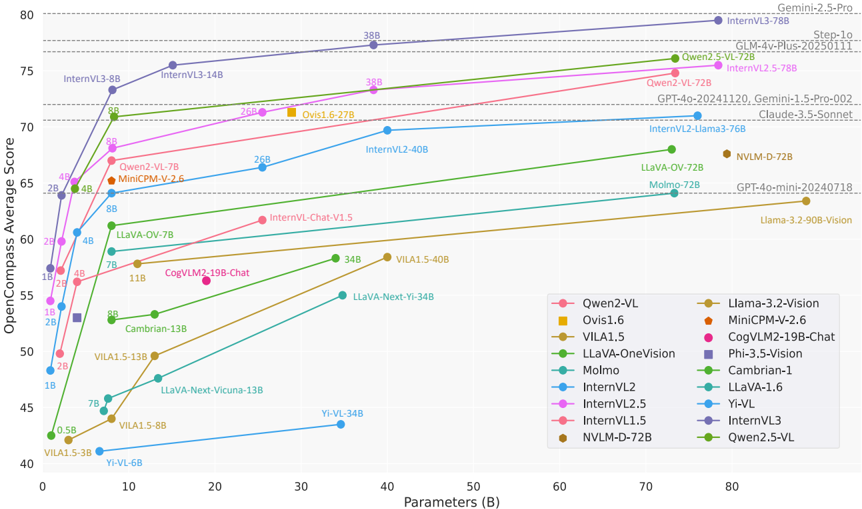
We introduce InternVL3, a significant advancement in the InternVL series featuring a native multimodal pre-training paradigm. Rather than adapting a text-only large language model (LLM) into a multimodal large language model (MLLM) that supports visual inputs, InternVL3 jointly acquires multimodal and linguistic capabilities from both diverse multimodal data and pure-text corpora during a single pre-training stage. This unified training paradigm effectively addresses the complexities and alignment challenges commonly encountered in conventional post-hoc training pipelines for MLLMs. To further improve performance and scalability, InternVL3 incorporates variable visual position encoding (V2PE) to support extended multimodal contexts, employs advanced post-training techniques such as supervised fine-tuning (SFT) and mixed preference optimization (MPO), and adopts test-time scaling strategies alongside an optimized training infrastructure. Extensive empirical evaluations demonstrate that InternVL3 delivers superior performance across a wide range of multi-modal tasks. In particular, InternVL3-78B achieves a score of 72.2 on the MMMU benchmark, setting a new state-of-the-art among open-source MLLMs. Its capabilities remain highly competitive with leading proprietary models, including ChatGPT-4o, Claude 3.5 Sonnet, and Gemini 2.5 Pro, while also maintaining strong pure-language proficiency. In pursuit of open-science principles, we will publicly release both the training data and model weights to foster further research and development in next-generation MLLMs.
Overview
CoChat Summary
TL;DR
InternVL3 introduces a native multimodal pre-training paradigm that jointly learns language and multimodal capabilities in one stage, plus V2PE, SFT/MPO post-training, test-time scaling, and infrastructure optimizations. InternVL3-78B reaches 72.2 on MMMU, setting a new state of the art among open-source MLLMs while remaining competitive with proprietary models.
Key findings
- InternVL3-78B achieves 72.2 on MMMU, 906 on OCRBench, 96.0/98.6 on VCR-EN-Easy (EM/Jaccard), and 89.0/88.7 on MMBench English/Chinese; the paper reports it as a new open-source MLLM state of the art and competitive with ChatGPT-4o, Claude 3.5 Sonnet, and Gemini 2.5 Pro.
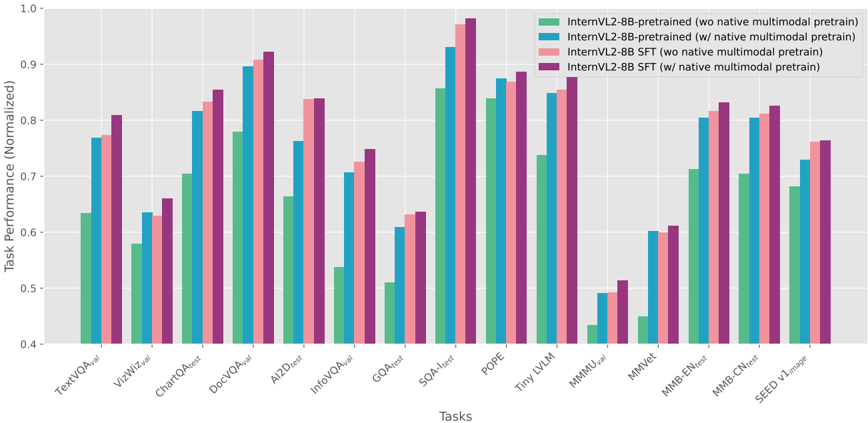
- Native multimodal pre-training is effective: replacing InternVL2-8B’s MLP warmup with native multimodal pre-training yields performance on most benchmarks comparable to the fully multi-stage-trained InternVL2-8B baseline, with further gains after instruction tuning on higher-quality data.
- MPO improves multimodal reasoning across seven benchmarks: InternVL3-78B and InternVL3-38B outperform their non-MPO counterparts by 4.1 and 4.5 points overall, respectively, even though MPO training data is a subset of SFT data.
- Test-time scaling with Best-of-8 and VisualPRM improves reasoning: on the Vision-Only split of MathVerse, best-of-8 gives increases of approximately 6.0 and 3.2 percentage points for InternVL3-38B and InternVL3-78B, respectively.
Methods
- Architecture follows “ViT-MLP-LLM”: vision encoder options are InternViT-300M and InternViT-6B; language models are pre-trained Qwen2.5 series and InternLM3-8B base models; the MLP is a two-layer randomly initialized network; pixel unshuffle reduces each 448×448 image tile to 256 visual tokens.
- Native multimodal pre-training jointly optimizes all parameters on multimodal and pure-language corpora, computes loss only on text tokens, and uses square averaging for token weights. Data combines InternVL2.5 pre-training corpus with GUI, tool usage, 3D scene, and video data, plus InternLM2.5 and open-source text data; the chosen language:multimodal ratio is 1:3, totaling about 200B tokens (50B language, 150B multimodal).
- Post-training uses SFT followed by MPO. SFT grows from 16.3M samples in InternVL2.5 to 21.7M in InternVL3; MPO uses about 300K preference samples and combines DPO preference loss, BCO quality loss, and LM generation loss. Test-time scaling uses Best-of-N with VisualPRM-8B as critic; infrastructure extends InternEVO, yielding a 50% to 200% training speedup for comparable-size models under the same compute budget.
Limitations
- The paper states a noticeable performance gap remains between InternVL3 and models like Qwen2.5-VL on certain benchmarks, such as MuirBench, implying future work may need better training data curation and model refinements.
- The paper reports minor declines on some benchmarks, such as MMHal, and states that optimizing data and training strategies for more consistent improvements remains an important future direction.
- The paper states visual grounding gains plateau at larger scales: InternVL2.5-78B reaches an average score of 92.3 while InternVL3-78B shows 91.4; it speculates this is because InternVL3’s training data expansion did not include additional grounding-specific data and the relative reduction in grounding-targeted data may have restricted localization capabilities.
Model-written summary. Check it against the paper before relying on it.
Integrity signals
Registry
Cites
Statistics
Figures
Verification
Claims the paper makes
0 Valid · 1 Not valid · 14 Not checked · 83 Own results and interpretations
A result the paper reports from its own data — it cites no other source for it, so there is none to check. The quote shows it is in the paper.
In the paper
“When compared with other competitive models, such as Qwen2-VL-72B and Qwen2.5-VL-72B, the InternVL3 series-especially the 78B variant-offers a consistent performance advantage on the multimodal understanding benchmarks.”
§ InternVL3: Exploring Advanced Training and Test-Time Recipes for Open-Source Multimodal Models > 3.6 Comprehensive Multimodal Evaluation
plainstates an association- Asserted: passes — The authors put it forward as true.
- Checkable: passes — It can be checked against evidence.
- Load-bearing: passes — The paper’s conclusions depend on it.
- Based: unclear — It is unclear why the paper says it holds.
A result the paper states — it cites no source for it, so there is none to check. The quote shows it is in the paper.
In the paper
“As a result, the number of training samples grows from 16.3M in InternVL2.5 to 21.7M in InternVL3.”
§ InternVL3: Exploring Advanced Training and Test-Time Recipes for Open-Source Multimodal Models > Data.
plainstates a cause- Asserted: passes — The authors put it forward as true.
- Checkable: passes — It can be checked against evidence.
- Load-bearing: unclear — It is unclear whether the paper’s conclusions depend on it.
- Based: passes — The paper gives a reason why it holds.
A result the paper states — it cites no source for it, so there is none to check. The quote shows it is in the paper.
In the paper
“while also maintaining strong pure-language proficiency.”
§ InternVL3: Exploring Advanced Training and Test-Time Recipes for Open-Source Multimodal Models > Abstract
boosted- Asserted: passes — The authors put it forward as true.
- Checkable: passes — It can be checked against evidence.
- Load-bearing: unclear — It is unclear whether the paper’s conclusions depend on it.
- Based: passes — The paper gives a reason why it holds.
A result the paper reports from its own data — it cites no other source for it, so there is none to check. The quote shows it is in the paper.
In the paper
“Compared with previous models, InternVL3 demonstrates substantial improvements across a wide range of task categories.”
§ InternVL3: Exploring Advanced Training and Test-Time Recipes for Open-Source Multimodal Models > 3.1 Overall Comparison to Other Advanced MLLMs
boosted- Asserted: passes — The authors put it forward as true.
- Checkable: passes — It can be checked against evidence.
- Load-bearing: passes — The paper’s conclusions depend on it.
- Based: passes — The paper gives a reason why it holds.
A result the paper reports from its own data — it cites no other source for it, so there is none to check. The quote shows it is in the paper.
In the paper
“Its capabilities remain highly competitive with leading proprietary models, including ChatGPT-4o, Claude 3.5 Sonnet, and Gemini 2.5 Pro, while also maintaining strong pure-language proficiency.”
§ InternVL3: Exploring Advanced Training and Test-Time Recipes for Open-Source Multimodal Models > Abstract
plain- Asserted: passes — The authors put it forward as true.
- Checkable: passes — It can be checked against evidence.
- Load-bearing: passes — The paper’s conclusions depend on it.
- Based: passes — The paper gives a reason why it holds.
45 more claims
Create a free account to see all 98 claims and every source verdict.
- It may state two separate claims as one. 42
- Probably not a substantial claim. 6
- The quote only partly states this claim. 1
Self-check
Percentages, sums and reported differences re-computed from the paper’s own numbers.
Each contradiction between two passages listed here was confirmed by an independent check.
Rated minor: it would not touch a result — a value no result rests on, a p-value that stays on the same side of the significance level, or a conflict that is clerical, resolved elsewhere in the paper, or outside its own findings.
In the paper
§ InternVL3: Exploring Advanced Training and Test-Time Recipes for Open-Source Multimodal Models > 3.8 Visual Grounding
“InternVL3-8B, InternVL3-9B, and InternVL3-14B yield average scores around 88.2-89.6,reflecting a consistent trend of performance gains as the model size increases.”
§ InternVL3: Exploring Advanced Training and Test-Time Recipes for Open-Source Multimodal Models > 3.6 Comprehensive Multimodal Evaluation
“InternVL3-8B 92.5 94.6 88.0 88.2 92.5 81.8 89.6 90.0 89.6 InternVL3-9B 91.8 93.2 86.6 86.4 91.0 79.9 88.0 88.5 88.2”
Rated minor: it would not touch a result — a value no result rests on, a p-value that stays on the same side of the significance level, or a conflict that is clerical, resolved elsewhere in the paper, or outside its own findings.
In the paper
§ InternVL3: Exploring Advanced Training and Test-Time Recipes for Open-Source Multimodal Models > GPT-4o Gemini 2.0 Claude Aguvis-72B Qwen2.5-VL-72B UI-TARS-72B InternVL3-8B -38B -72B
“The 8B variant (81.4%) already surpasses UI-TARS-72B”
§ InternVL3: Exploring Advanced Training and Test-Time Recipes for Open-Source Multimodal Models > GPT-4o Gemini 2.0 Claude Aguvis-72B Qwen2.5-VL-72B UI-TARS-72B InternVL3-8B -38B -72B
“InternVL3-72B achieves 90.9%, outperforming UI-TARS-72B (90.3%).”
Citations
Cites
Fei-Fei, L., Fergus, R., & Perona, P. (2005) · 2004 Conference on Computer Vision and Pattern Recognition Workshop · doi:10.1109/cvpr.2004.383 · Cited by 2,502
Liu, H., Li, C., Wu, Q., & Lee, Y. J. (2023) · Advances in Neural Information Processing Systems 36 · doi:10.52202/075280-1516 · Cited by 2,428
Making the V in VQA Matter: Elevating the Role of Image Understanding in Visual Question Answering
Goyal, Y., Khot, T., Summers-Stay, D., Batra, D., & Parikh, D. (2017) · 2017 IEEE Conference on Computer Vision and Pattern Recognition (CVPR) · doi:10.1109/cvpr.2017.670 · Cited by 2,287
Chen, Z., Wang, W., Cao, Y., Liu, Y., Gao, Z., Cui, E., Zhu, J., Ye, S., Tian, H., Liu, Z., et al. (2024) · arXiv · doi:10.48550/arxiv.2412.05271 · Cited by 2,204
Self-citationGrounding DINO: Marrying DINO with Grounded Pre-training for Open-Set Object Detection
Liu, S., Zeng, Z., Ren, T., Li, F., Zhang, H., Yang, J., Jiang, Q., Li, C., Yang, J., Su, H., et al. (2025) · Lecture Notes in Computer Science · doi:10.1007/978-3-031-72970-6_3 · Cited by 2,074
Self-citationNatural Questions: A benchmark for question answering research
Kwiatkowski, T., Palomaki, J., Redfield, O., Collins, M., Parikh, A., Alberti, C., Epstein, D., Polosukhin, I., Devlin, J., Lee, K., et al. (2019) · Transactions of the Association for Computational Linguistics · doi:10.1162/tacl_a_00276 · Cited by 2,069
MiniCPM-V: A GPT-4V Level MLLM on Your PhonePreprint
Yao, Y., Yu, T., Zhang, A., Wang, C., Cui, J., Zhu, H., Cai, T., Li, H., Zhao, W., He, Z., et al. (2024) · arXiv · doi:10.48550/arxiv.2408.01800 · Cited by 1,695
Self-citationTriviaQA: A Large Scale Distantly Supervised Challenge Dataset for Reading Comprehension
Joshi, M., Choi, E., Weld, D., & Zettlemoyer, L. (2017) · Proceedings of the 55th Annual Meeting of the Association for Computational Linguistics (Volume 1: Long Papers) · doi:10.18653/v1/p17-1147 · Cited by 1,690
Math-Shepherd: Verify and Reinforce LLMs Step-by-step without Human Annotations
Wang, P., Li, L., Shao, Z., Xu, R., Dai, D., Li, Y., Chen, D., Wu, Y., & Sui, Z. (2024) · Proceedings of the conference - Association for Computational Linguistics. Meeting · doi:10.18653/v1/2024.acl-long.510 · Cited by 1,665
TriviaQA: A Large Scale Distantly Supervised Challenge Dataset for Reading Comprehension
Joshi, M., Choi, E., Weld, D. S., & Zettlemoyer, L. (2017) · arXiv · doi:10.48550/arxiv.1705.03551 · Cited by 1,650
Research works printed but not linked: 6
- Anonymous. CG-bench: Clue-grounded question answering benchmark for long video understanding. In Submitted to The Thirteenth International Conference on Learning Representations, 2024. under review. 14, 15
- Shuai Bai, Keqin Chen, Xuejing Liu, Jialin Wang, Wenbin Ge, Sibo Song, Kai Dang, Peng Wang, Shijie Wang, Jun Tang, et al. Qwen2.5-vl technical report. arXiv preprint arXiv:2502.13923, 2025. 1, 2, 9, 10, 15 · arXiv
- Jie Cao and Jing Xiao. An augmented benchmark dataset for geometric question answering through dual parallel text encoding. In Proceedings of the 29th International Conference on Computational Linguistics, pages 1511-1520, 2022. 6
- Zhe Chen, Weiyun Wang, Hao Tian, Shenglong Ye, Zhangwei Gao, Erfei Cui, Wenwen Tong, Kongzhi Hu, Jiapeng Luo, Zheng Ma, et al. How far are we to gpt-4v? closing the gap to commercial multimodal models with open-source suites. arXiv preprint arXiv:2404.16821, 2024. 2, 3 · arXiv
- Hunter Lightman, Vineet Kosaraju, Yuri Burda, Harrison Edwards, Bowen Baker, Teddy Lee, Jan Leike, John Schulman, Ilya Sutskever, and Karl Cobbe. Let's verify step by step. In The Twelfth International Conference on Learning Representations, 2023. 7
- Minesh Mathew, Viraj Bagal, Rubèn Tito, Dimosthenis Karatzas, Ernest Valveny, and CV Jawahar. Infographicvqa. In Proceedings of the IEEE/CVF Winter Conference on Applications of Computer Vision, pages 1697-1706, 2022. 6, 7, 8, 10
Cited by
Items 1,401–1,500 of 2,641
Benchmarking and Enhancing VLM for Compressed Image Understanding
Zhang, Z., Xu, T., Li, S., Li, S., Zhang, Y., Xu, M., & Wang, Y. (2026) · International Conference on Machine Learning · doi:10.48550/arxiv.2512.20901 · Cited by 2
“5-32B (Bai et al., 2025), InternVL3-1B, InternVL3-2B, InternVL3-8B (Zhu et al., 2025) ,Janus-pro-1B and Janus-pro-7B (Chen et al., 2025), to compare VLMs with different parameter sizes.”
Self-citationText-Guided Semantic Image EncoderPreprint
Thirukovalluru, R., Han, X., Dhingra, B., Dinan, E., & Elbayad, M. (2025) · arXiv · doi:10.48550/arxiv.2511.20770 · Cited by 2
“The IE is then aligned with a pretrained text-only LLM through language alignment , which jointly fine-tunes both components on diverse image-to-text tasks while progressively unfreezing the IE and LLM across different stages to obtain the final VLM. State-of-the-art VLMs—including PerceptionLM ( PLM ) (Cho et al., 20…”
InfluentialDoes the Question Really Matter? Training-Free Data Selection for Vision-Language SFTPreprint
Sun, P., Yang, Y., Shen, H., Ban, Y., Fu, T., Wang, Y., & Li, Y. (2026) · arXiv · doi:10.48550/arxiv.2603.09715 · Cited by 2
“We further evaluate CVS with InternVL3-8B [54] as the evaluator and report the corresponding results in Appendix I. Evaluator scale We further vary the evaluator size within the Qwen2.”
Self-citationMiyai, A., Onohara, S., Baek, J., & Aizawa, K. (2025) · arXiv · doi:10.48550/arxiv.2512.14620 · Cited by 2
“5-8B [8], InternVL3-14B [63], Multilingual Open-source LMMs : Qwen2.”
Yılmaz, Y., Hanoğlu, E. G., Özkan, A. G., & Öztoprak, K. (2026) · International Journal on Document Analysis and Recognition (IJDAR) · doi:10.1007/s10032-026-00613-6 · Cited by 2
TraceAV-Bench: Benchmarking Multi-Hop Trajectory Reasoning over Long Audio-Visual VideosPreprint
Feng, H., Liang, H., Chen, M., Zeng, B., Qiang, M., Zhao, Z., Meng, Z., Sheng, Z., & Zhang, W. (2026) · arXiv · doi:10.48550/arxiv.2605.07593 · Cited by 2
“…(2025); Yao et al. (2024); Yin et al. (2024); Team et al. (2025a) has broadened the perceptual horizon of language models, enabling them to process visual Zhu et al. (2025); Steiner et al. (2024) and auditory Team (2026a); Shi et al. (2026) information far beyond the boundaries of language alone.”
One-shot Optimized Steering Vector for Hallucination Mitigation for VLMsPreprint
Shi, Y., Yang, S., & Liu, D. (2026) · arXiv · doi:10.48550/arxiv.2601.23041 · Cited by 2
“Contemporary VLMs (Bai et al., 2025b; Yang et al., 2025a; Wang et al., 2025d; Zhu et al., 2025) face two primary challenges: hallucination and safety.”
DomainCQA: Crafting Knowledge-Intensive QA from Domain-Specific Charts
Lu, Y., Zhong, L., Yang, J., Li, W., Wei, P., Wang, Y., Duan, M., & Zhang, Q. (2026) · Proceedings of the AAAI Conference on Artificial Intelligence · doi:10.1609/aaai.v40i38.40509 · Cited by 2
Self-citationWang, Y., Zhan, L., Huang, Z., Luo, T., Jiang, Y., Dong, W., Gan, L., & Chen, J. (2026) · Proceedings of the conference - Association for Computational Linguistics. Meeting · doi:10.18653/v1/2026.acl-long.2135 · Cited by 2
Self-citationVideoMind: Thinking in Steps for Long Video Understanding
Bhatnagar, S., Wang, R., Krishnakumar, K., Ahmadyan, A., Lin, Z., Mathias, L., Dong, X. L., Damavandi, B., Ahuja, N., & Moon, S. (2026) · Conference of the European Chapter of the Association for Computational Linguistics · doi:10.18653/v1/2026.eacl-industry.30 · Cited by 2
Semantically Guided Action AnticipationPreprint
Diko, A., Furnari, A., Cinque, L., & Farinella, G. M. (2024) · arXiv · doi:10.48550/arxiv.2411.15557 · Cited by 2
Global-Local Dual Perception for MLLMs in High-Resolution Text-Rich Image Translation
Lu, J., Song, T., Wu, Z., Li, P., Liang, X., Yang, H., Chen, K., Xie, N., Lu, Y., Zhao, J., et al. (2026) · Lecture notes in computer science · doi:10.1007/978-3-032-37041-9_12 · Cited by 2
Self-citationST-BiBench: Benchmarking Multi-Stream Multimodal Coordination in Bimanual Embodied Tasks for MLLMs
Wu, X., Liang, Z., Ma, Y., Hu, M., Qin, Z., & Li, X. (2026) · ACM International Conference on Multimedia (ACM MM) · doi:10.1145/3767308.3836297 · Cited by 2
“Using ST-BiBench, we evaluate over 30 MLLMs [1, 4, 5, 7–9, 16, 17, 22, 30, 31, 42–46, 58–60, 66, 67, 76, 78].”
One Token per Highly Selective Frame: Towards Extreme Compression for Long Video UnderstandingPreprint
Zhang, Z., Pang, Z., Chen, S., Hao, X., Bhat, V., & Wang, Y.-X. (2026) · arXiv · doi:10.48550/arxiv.2604.14149 · Cited by 2
“We choose the baselines with similar model size of VideoChat-Flash-2B [35] and InternVL3-2B [81], as shown in Table 1.”
Self-citationFPC-VLA: A Vision-Language-Action Framework with a Supervisor for Failure Prediction and CorrectionPreprint
Yang, Y., Duan, Z., Xie, T., Cao, F., Shen, P., Song, P., Zhao, C., Jin, P., Sun, G., Xu, S., et al. (2025) · SSRN Electronic Journal · doi:10.2139/ssrn.5912300 · Cited by 2
UniReason-Med: A Shared Grounded Reasoning Interface for 2D-to-3D Transfer in Medical VQA
Chen, M., Shu, Y., Liu, C., Piao, H., Wang, X., Li, D., & Dai, B. (2026) · Conference on Empirical Methods in Natural Language Processing (EMNLP) · doi:10.18653/2026.emnlp-main.1567 · Cited by 2
Self-citationEgo: Embedding-Guided Personalization of Vision-Language ModelsPreprint
Seifi, S., Gardier, S., Dorovatas, V., Reino, D. O., & Aljundi, R. (2026) · arXiv · doi:10.48550/arxiv.2603.09771 · Cited by 2
“Our approach is motivated by the observation that recent powerful LVLMs are capable of cross-referencing objects in multiple input images and reasoning about objects in short videos [2, 39].”
Mukherjee, A., & Ghosh, S. (2025) · International Joint Conference on Natural Language Processing and Conference of the Asia-Pacific Chapter of the Association for Computational Linguistics (IJCNLP-AACL) · doi:10.18653/v1/2025.findings-ijcnlp.140 · Cited by 2
Wang, K., & Huang, H. (2026) · Lecture notes in computer science · doi:10.1007/978-3-032-37372-4_8 · Cited by 2
CIR-CoT: Towards Interpretable Composed Image Retrieval via End-to-End Chain-of-Thought ReasoningPreprint
Lin, W., Ma, Y., Ji, J., Sun, X., & Ji, R. (2025) · arXiv · doi:10.48550/arxiv.2510.08003 · Cited by 2
“Multiple MLLMs, including recent advanced models such as InternVL3 [77], MiMo-VL [73], and Keye-VL [59], are employed to assign multi-level scores that assess consistency.”
Ye, H., Guan, Y., Ge, Y., Zhu, T., Guan, Z., Zhong, Y., Zhang, Y., Zhang, H., Wu, Y., & Tian, Z. (2026) · International Conference on Learning Representations · doi:10.48550/arxiv.2603.20209 · Cited by 2
Self-citationXian, M., Yang, Y., Gu, Q., Wang, X., & Ye, N. (2026) · International Conference on Machine Learning · doi:10.48550/arxiv.2605.11591 · Cited by 2
“5-VL-3B (Bai et al., 2025), LLaVA-OneVision-8B (An et al., 2025) and InternVL3-8B (Zhu et al., 2025).”
Self-citationGraph it first! Enabling Reasoning on Long-form Egocentric Videos through Scene GraphsPreprint
Taluzzi, A., Santambrogio, R., Mentasti, S., Plizzari, C., & Matteucci, M. (2026) · arXiv · doi:10.48550/arxiv.2606.25842 · Cited by 2
“We evaluate our approach using Gemini Flash 2.0 [14], InternVL3 (2B/8B/14B) [49], Qwen2.”
InfluentialGuiding Token-Sparse Diffusion ModelsPreprint
Krause, F., Baumann, S. A., Schusterbauer, J., Grebenkova, O., Gui, M., Hu, V. T., & Ommer, B. (2026) · arXiv · doi:10.48550/arxiv.2601.01608 · Cited by 2
“We utilize the internVL3-2b [76] model as text encoder and apply a prompt prefix and insert a two layer transformer network between the Vision Language Model (VLM) and the Cross-Attention of our DiT as proposed by Ma et al. [42].”
Liu, Z., Zhou, S., Liu, M., Deng, H., & Zhu, H. (2026) · Findings of the Association for Computational Linguistics: ACL (Findings of ACL) · doi:10.18653/v1/2026.findings-acl.663 · Cited by 2
Self-citationDeepSight: An All-in-One LM Safety ToolkitPreprint
Zhang, B., Guo, J., Li, L., Liu, D., Chen, S., Chen, G., Zheng, Z., Lin, Q., Yan, L., Qian, C., et al. (2026) · arXiv · doi:10.48550/arxiv.2602.12092 · Cited by 2
Self-citationInSight-doc: Agentic Visual Perception for Long-Document Understanding
Li, K., Xie, W., Yao, L., Wu, J., Hong, L., Huang, Y., & Zhang, N. L. (2026) · Findings of the Association for Computational Linguistics: EMNLP (Findings of EMNLP) · doi:10.18653/2026.findings-emnlp.1151 · Cited by 2
Rethinking UMM Visual Generation: Masked Modeling for Efficient Image-Only Pre-trainingPreprint
Sun, P., Xie, J., & Lin, T. (2026) · arXiv · doi:10.48550/arxiv.2603.16139 · Cited by 2
“For the auxiliary MLLM component, a frozen InternVL3-2B [68] is employed as a feature extractor, offering high-quality representations with a minimal computational footprint.”
Self-citationGraphLoom: Reliability-Calibrated Graph Evidence Routing for Multimodal KG-RAG
Ali, Z., Khan, A., Malik, A., & Kefalas, P. (2026) · ACM International Conference on Information and Knowledge Management (CIKM) · doi:10.1145/3799682.3840650 · Cited by 2
“Without the router, H-Rate increases from 10.5 to 17.3, consistent with reduced suppression of low-confidence or weakly relevant evidence.”
InfluentialTimeColor: Flexible Reference Colorization via Temporal ConcatenationPreprint
Sadihin, B. C., Meng, Y., Wang, M. H., Chen, M. J., & Su, H. (2026) · arXiv · doi:10.48550/arxiv.2601.00296 · Cited by 2
“To overcome this issue, we developed an automated curation pipeline capable of detecting, tracking, and extracting subjects using InternVL3 [9] and GroundedSAM2 [10], [11], allowing us to produce subject/background references and corresponding per-frame dense pixel-level correspondence masks at…”
Seeing Beyond the Scene: Analyzing and Mitigating Background Bias in Action RecognitionPreprint
Zhou, E. X., Chung, J., & Russakovsky, O. (2025) · arXiv · doi:10.48550/arxiv.2512.17953 · Cited by 2
“Despite the growing popularity of contrastive text-image pre-trained models like CLIP [14] and SigLIP2 [16] and video large language models (VLLMs) [2, 12, 23], background bias in these model paradigms has not been extensively studied.”
Beyond Bag-of-Words: Diagnosing Compositional Binding Failures in Vision-Language ModelsPreprint
Sbrolli, C., Yamasaki, T., & Matteucci, M. (2026) · arXiv · doi:10.48550/arxiv.2602.02043 · Cited by 2
Scope: Selective Cross-modal Orchestration of Visual Perception ExpertsPreprint
Zhang, T., Wang, S., Wang, C., Rodriguez, J., Masry, A., Jian, X., Bengio, Y., & Taslakian, P. (2025) · arXiv · doi:10.48550/arxiv.2510.12974 · Cited by 2
“Recent advances in Vision Language Models (VLMs) have demonstrated their remarkable ability to jointly understand and process visual and textual information (Hurst et al., 2024; Comanici et al., 2025; Anthropic, 2025; Bai et al., 2025b; Zhu et al., 2025).”
TomaMMU: A Comprehensive Multimodal Understanding Benchmark for Tomato Leaf DiseasesPreprint
Truong, G.-H., Quoc, K. N., & Quach, L.-D. (2026) · arXiv · doi:10.48550/arxiv.2608.08727 · Cited by 2
“[42] 0.816 0.016 0.001 0.001 0.381 0.142 0.840 0.314 ∼ 2.1 InternVL3 2B [42] 0.874 0.255 0.055 0.060 0.357 0.065 0.905 0.367 ∼ 2.2 Qwen2.”
InfluentialNegT2IBench: When Negation Changes the Picture. A Polarity Benchmark for Text-to-Image ModelsPreprint
Elfatairy, O., Bravo, M. A., Bader, J., & Akata, Z. (2026) · arXiv · doi:10.48550/arxiv.2610.03084 · Cited by 2
“5-VL-7B [64], InternVL3-8B [65], Qwen3-VL-8B and 32B [54], and InternVL3.”
When No Answer Is Correct: Diagnosing Absent Answer Detection for MLLMs in Video Understanding
Wang, Y., Lin, Y., Zhu, L., Liu, Y., Li, H. "., & Chen, Y. (2026) · Conference on Empirical Methods in Natural Language Processing (EMNLP) · doi:10.18653/2026.emnlp-main.980 · Cited by 2
Self-citationOne Adapter, Every Resolution: Gated Low-Rank Adaptation for Remote Sensing VLMsPreprint
Zhang, S., Chen, Y., Chen, Y., Zhang, X., & Li, Y. (2026) · arXiv · doi:10.48550/arxiv.2605.07562 · Cited by 2
Self-citationStreamHOI: Interaction-aware Temporal Memory Adaptation for Streaming HOI Video GenerationPreprint
Rao, Z., Zhang, H., Liu, X., Meng, Y., Zhang, G., Wan, P., Tang, F., & Lee, T.-Y. (2026) · arXiv · doi:10.48550/arxiv.2607.20174 · Cited by 2
“Since traditional metrics struggle to capture fine-grained physical contact and interaction evolution, we further use InternVL3-38B [49] as a structured evaluator.”
Self-citationAudio-Guided Keyframe Selection for Video Description Generation
Wang, S., & Huai, X. (2025) · International Conference on Image Processing, Intelligent Control and Computer Engineering (IPICE) · doi:10.1145/3768184.3768216 · Cited by 2
Continuous Perception Matters: Diagnosing Temporal Integration Failures in Multimodal ModelsPreprint
Wang, Z., Weng, Z., & Yeung, S. Y. (2024) · arXiv · doi:10.48550/arxiv.2408.07867 · Cited by 2
Xu, D., Yang, X., Li, Y., Miao, J., Li, J., & Heng, P. (2025) · arXiv · doi:10.48550/arxiv.2512.21964 · Cited by 2
“The degradation is more severe for open-source MLLMs, including general-domain models (InternVL-3-9B[55], Qwen2.”
Lan, Q., Fan, M., Zhang, H., Duan, J., Lin, M., Chen, J., Geng, B., & Jiang, X. (2026) · arXiv · doi:10.48550/arxiv.2610.06571 · Cited by 2
“General and medical VLMs extend image analysis to natural-language descriptions, question answering, and visual reasoning [4, 46, 49, 51, 56].”
Self-citationXu, Z., Li, H., Liu, J., Ura, A., Zu, S., Zhou, S. K., Navab, N., & Schüffler, P. J. (2026) · arXiv · doi:10.48550/arxiv.2610.16734 · Cited by 2
“This paradigm more closely resembles routine pathological review, where pathologists continuously redi-rect attention across tissue regions and visual scales according to the emerging diagnostic evidence.”
Self-citationLi, L., Ji, S., Luo, Z.-Y., Li, Z.-H., Zhang, D.-W., Han, J.-W., & Liu, N. (2025) · arXiv · doi:10.48550/arxiv.2511.00396
“SIS Task ( ILSO [27])”
Decoding Pedestrian Crossing Intention from Egocentric Vision via Vision Language ModelsPreprint
Li, D., Su, X., Feng, Y., & Krueger, R. (2026) · arXiv · doi:10.48550/arxiv.2606.09142 · Cited by 2
“We also evaluate InternVL3 [38] using InternVL3-2B and InternVL3-8B.”
Shan, H., Ren, X., Han, D., Zhang, Y., Shi, H., Hu, J., Zhang, Q., Zhang, Y., Dai, Y., Shen, B., et al. (2026) · arXiv · doi:10.48550/arxiv.2605.17070 · Cited by 2
“This category covers widely used open-source VLM families, including Qwen-VL (Bai et al., 2025), InternVL (Zhu et al., 2025; Wang et al., 2025), Gemma 3 (Team et al., 2025c), MiMo-VL (Team et al., 2025a), GLM-4.”
How Medical VLMs Underutilize Their Vision Encoders: A Dermatology PerspectivePreprint
Wang, J., Zhang, Y., Wang, X., & Hamm, J. (2026) · arXiv · doi:10.48550/arxiv.2609.36557 · Cited by 2
Self-citationGimbalDiffusion: Gravity-Aware Camera Control for Video Generation
Fortier-Chouinard, F., Hold-Geoffroy, Y., Deschaintre, V., Gadelha, M., & Lalonde, J. (2026) · Lecture notes in computer science · doi:10.1007/978-3-032-37450-9_11 · Cited by 2
Learning Visual Spatial Planning from Symbolic State via Modality-Gap-Aware Self-DistillationPreprint
Luo, H., Liu, J., Zhang, R., Zhong, Z., Huang, J., Xu, Z., Shi, Q., Zhou, J., Mao, S., Liu, W., et al. (2026) · arXiv · doi:10.48550/arxiv.2606.06076 · Cited by 2
When Irrelevant Text Matters: Affine Margin Shifts in Multimodal Large Language Models
Wang, Y., Yao, Z., Fu, Z., Zhang, L., & Mao, Z. (2026) · Conference on Empirical Methods in Natural Language Processing (EMNLP) · doi:10.18653/2026.emnlp-main.884 · Cited by 2
Self-citationTowards Multi-modal Multi-turn Safety: From Agentic Interaction to Strategic Alignment
Zhu, H., Chen, J., Cai, C., Sun, S., Li, H., Zhou, Y., Chan, C.-M., Wen, P., Li, L., Guo, Y., et al. (2026) · Conference on Empirical Methods in Natural Language Processing (EMNLP) · doi:10.18653/2026.emnlp-main.2239 · Cited by 2
Self-citationAligning Large Vision–Language Models at Test Time: A Trajectory-Guided Structured Sampling Approach
Jiang, T., Ni, W., de Melo, G., & Wang, L. (2026) · ACM International Conference on Multimedia (ACM MM) · doi:10.1145/3767308.3835984 · Cited by 2
Self-citationSafeAlign-VLA: A Negative-Enhanced Safe Alignment Framework for Risk-Aware Autonomous DrivingPreprint
Tian, K., Lian, Y., Yang, K., Chen, X., & Li, S. (2026) · arXiv · doi:10.48550/arxiv.2605.19524 · Cited by 2
Self-citationLi, Z., Kong, C., Bao, P., Xia, S., Tu, Y., Yu, Y., Jiang, X., & Jiang, X. (2026) · arXiv · doi:10.48550/arxiv.2602.09825 · Cited by 2
“5 (Liu et al., 2023), InstructBLIP (Dai et al., 2023), MiniGPT-4 (Zhu et al., 2023), InternVL3(Zhu et al., 2025), and Qwen2.”
InfluentialIntend, Reflect, Refine: An Adaptive Multimodal Reflection Framework for Autonomous DrivingPreprint
Chen, Z., Qiu, Y. L., Han, J., Tang, T., Chen, X., Zhang, L., Chen, Y.-C., Xu, H., & Liang, X. (2026) · arXiv · doi:10.48550/arxiv.2606.22913 · Cited by 2
Self-citationADVersa: Abductive Driving Accident Video Understanding
Li, L., Fang, J., Xiao, J., Yu, H., Lv, C., Xue, J., Li, Z. G., & Chua, T. (2026) · IEEE Transactions on Pattern Analysis and Machine Intelligence · doi:10.1109/tpami.2026.3663545 · Cited by 2
“Furthermore, we compare several leading open-source Multi-Modal Large-Language Models (MLLMs), including InternVL3(8B) [9], InternVL3.”
CineCap: Structured Reasoning with Spatio-Temporal Anchors for Cinematographic Video Captioning
Mao, X., Zeng, Y., Liu, X., Qin, W., Wang, M., Wan, P., Xing, X., & Meng, M. Q. ‐. (2026) · ACM International Conference on Multimedia (ACM MM) · doi:10.1145/3767308.3836333 · Cited by 2
“As multimodal large language models (MLLMs) [1, 33, 34, 52] are increasingly expected to understand videos at a level surpassing coarse semantic interpretation, reliable cinematographic understanding emerges as a crucial capability.”
Audio-Visual Flamingo: Open Audio-Visual Intelligence for Long and Complex VideosPreprint
Ghosh, S., Goel, A., Jayakumar, K. S., Koroshinadze, L., Anand, N., Gururani, S., Ye, H., Biswas, P., Su, Y., Hosseini-Asl, E., et al. (2026) · arXiv · doi:10.48550/arxiv.2607.16107 · Cited by 2
Query-Dependent Use of Generated Descriptions for Reliable Visual Question AnsweringPreprint
Li, Z., & Zhang, S. (2026) · arXiv · doi:10.48550/arxiv.2605.01733 · Cited by 2
“8B (Zhu et al., 2025), Qwen2.”
Jia, H., Dong, S., Dong, X., Sun, Z., Wang, J., Lan, J., Zhu, X., Zheng, B., & Zhang, K. (2026) · arXiv · doi:10.48550/arxiv.2603.01696 · Cited by 2
“For example, Qwen3-VL-8B [4] and InternVL3-8B [85] achieve 100% species accuracy, with breed accuracy of 40.54% and 19.29%, respectively.”
InfluentialSelf-citationEgoTools: Towards Tool-Centric Reasoning in Real-World Egocentric Videos
Tian, S., Kim, J., Liu, S., Li, H., Shen, Y., Li, S., Yang, Z., Kim, Y., Yao, R., Dong, Y., et al. (2026) · Conference on Empirical Methods in Natural Language Processing (EMNLP) · doi:10.18653/2026.emnlp-main.961 · Cited by 2
Self-citationV-Reflection: Transforming MLLMs from Passive Observers to Active InterrogatorsPreprint
Zhou, J., Chen, Y., Li, H., Jiang, Q., Zhou, H., Chen, Y.-C., & Zhang, L. (2026) · arXiv · doi:10.48550/arxiv.2604.03307 · Cited by 2
“Multimodal Large Language Models (MLLMs) [1, 2, 4, 40, 25, 13, 10] have achieved remarkable success in bridging intelligence with visual understanding, demonstrating sophisticated capabilities in cross-modal alignment and complex instruction following [7, 32, 30, 38, 26, 22].”
Self-citationDeepLatent: Think with Images via Parallel Latent Visual ReasoningPreprint
Lu, D., Li, Z., Shu, M., & Cao, H. (2026) · arXiv · doi:10.48550/arxiv.2606.00562 · Cited by 2
Lee, J., Kim, S., & Choi, K. S. (2026) · Findings of the Association for Computational Linguistics: EMNLP (Findings of EMNLP) · doi:10.18653/2026.findings-emnlp.1681 · Cited by 2
Remembering What Matters for Long-Horizon Robotic World ModelsPreprint
Wu, H., Shao, T., Qian, S., Zhao, Y., Zhang, F., Zhao, P., Wang, W., Huang, Y., Xu, F., Wang, K., et al. (2026) · arXiv · doi:10.48550/arxiv.2610.14583 · Cited by 2
Self-citationTinted Frames: Question Framing Blinds Vision-Language Models
Fan, W.-C., Luo, J., Kutscher, D., Sigal, L., & Gupta, R. (2026) · Conference on Empirical Methods in Natural Language Processing (EMNLP) · doi:10.18653/2026.emnlp-main.1746 · Cited by 2
Self-citationSelect, Compress, Reinvest: A Controlled Study of Visual-Token Allocation in Long-Video MLLMsPreprint
Khatri, P. (2026) · arXiv · doi:10.48550/arxiv.2609.03820 · Cited by 2
VetClaw: An Edge-Cloud Multimodal Agentic System for Veterinary Disease ScreeningPreprint
Hasan, S. M., Alsobeh, A., Zangoti, H. M., & Shahid, A. R. (2026) · arXiv · doi:10.48550/arxiv.2607.26042 · Cited by 2
“We deploy two VLMs: Qwen3-VL-32B [28] and InternVL3-38B [29] for vision-based zero-shot classification.”
Social Caption: Evaluating Social Understanding in Multimodal Models
Mathur, L., Thumu, B., Kebe, G. Y., & Morency, L. (2026) · Findings of the Association for Computational Linguistics: EMNLP (Findings of EMNLP) · doi:10.18653/2026.findings-emnlp.1613 · Cited by 2
Clarification as Supervision: Reinforcement Learning for Vision-Language InterfacesPreprint
Gkountouras, J., & Titov, I. (2025) · arXiv · doi:10.48550/arxiv.2509.26594 · Cited by 2
SciVQR: A Multidisciplinary Multimodal Benchmark for Advanced Scientific Reasoning Evaluation
Guo, L., Lin, X., Hao, D., Yue, T., Huo, P., Ma, J., Liu, Y., & Liu, J. (2026) · Findings of the Association for Computational Linguistics: ACL (Findings of ACL) · doi:10.18653/v1/2026.findings-acl.28 · Cited by 2
Self-citationOmniDiagram: Advancing Unified Diagram Code Generation via Visual Interrogation Reward
Yang, H., Zhao, X., Liu, X., Jiang, F., & Zhu, Y. (2026) · Findings of the Association for Computational Linguistics: ACL (Findings of ACL) · doi:10.18653/v1/2026.findings-acl.809 · Cited by 2
MotionPhys: Detecting AI-Generated Videos via Physical Consistency of Optical-Flow TrajectoriesPreprint
He, H., Tan, H., Tan, Z., Liu, A., & Wan, J. (2026) · arXiv · doi:10.48550/arxiv.2608.20770 · Cited by 2
“5-VL-7B (Bai et al. 2025), InternVL3-8B (Zhu et al. 2025), and MiMo-VL-7B-RL (Team et al. 2025a), together with the recent video forgery detectors BusterX (Wen et al. 2025a) and BusterX++ (Wen et al. 2025b).”
CRIT: Graph-Based Automatic Data Synthesis to Enhance Cross-Modal Multi-Hop ReasoningPreprint
Sung, J., Lyu, S., Kim, M., An, S., Nagrani, A., & Seo, P. H. (2026) · arXiv · doi:10.48550/arxiv.2604.01634 · Cited by 2
“Table 10 summarizes the performance of VLMs specialized for reasoning, including Intern3-VL [73], Qwen-3-VL-Thinking [6], GLM-4.”
Adapting Vehicle Detectors for Aerial Imagery to Unseen Domains with Weak Supervision
Fang, X., Jeon, M., Hu, S., Qin, Z., Chakraborty, S., Panev, S., Melo, C. D., & de la Torre, F. N. (2025) · IEEE/CVF International Conference on Computer Vision (ICCV) · doi:10.1109/iccv51701.2025.00758 · Cited by 2
“The lack of sufficient large-scale aerial view training data impacts the performance of not only generative foundational models but also other types of Vision Large Language Models [65] (VLLMs), such as BLIP2 [21], InternVL3 [73], and Gemini [53].”
Counteracting the Matthew Effect in Self-Improvement of LVLMs through Head-Tail Re-balancing
Guo, X., Xi, Z., Ding, Y., Zhai, Y., Shi, X., Cai, X., Gui, T., Zhang, Q., & Huang, X. (2026) · Proceedings of the conference - Association for Computational Linguistics. Meeting · doi:10.18653/v1/2026.acl-long.1010 · Cited by 2
OmniQuality-R: Advancing Reward Models Through All-Encompassing Quality AssessmentPreprint
Lu, Y.-T., Guan, F.-B., Gao, Y.-X., Zhong, Y., Peng, X.-G., Yuan, J., Liu, Y.-H., Zhang, B., Li, X., Chen, Z.-B., et al. (2025) · arXiv.org · doi:10.48550/arxiv.2510.10609 · Cited by 2
Self-citationAttention Sinks in VLMs Are Borrowed, Not SeenPreprint
Zhang, D., Martin, A., Yan, P., Sun, X., Li, J., Durme, B. V., Yates, A., Kriz, R., & Walden, W. G. (2026) · arXiv · doi:10.48550/arxiv.2610.15855 · Cited by 2
Rayeed, S. M., Ma, Q., Stewart, C. V., & Ma, Y. (2026) · arXiv · doi:10.48550/arxiv.2611.05559 · Cited by 2
CoVeR: Coverage-Based Token Pruning for Multi-View 3D Reasoning in VLMsPreprint
Bui, N.-T., Elangovan, V., Anugu, A. R., Mohan, S., Ye, W., Wang, D., Huang, J., Ranjan, R., Chharia, A., & la Torre, F. D. (2026) · arXiv · doi:10.48550/arxiv.2609.08345 · Cited by 2
Revealing the Gap in Human and VLM Scene Description through Counterfactual Semantic SaliencyPreprint
Wen, Z., Madinei, P., & Eckstein, M. P. (2026) · arXiv · doi:10.48550/arxiv.2605.13047 · Cited by 2
“We quantified the perceptual alignment between human observers and all the commonly used open-source [70, 34, 3] and closed-source [53, 2, 11] vision-language models (n=19) using two primary metrics: Top-1 Accuracy and Kendall’s rank correlation coefficient ( τ ).”
Wang, Z. (2026) · arXiv · doi:10.48550/arxiv.2606.17423 · Cited by 2
HoloGeo: Mitigating Landmark Bias in Geo-localization via Evidence-Driven Reasoning
Zhou, P., Liu, X., Yin, Y., Li, B., Wu, S., Lee, M. L., & Hsu, W. (2026) · ACM International Conference on Multimedia (ACM MM) · doi:10.1145/3767308.3835798 · Cited by 2
ReactBench: A Cause-Driven Benchmark for Multimodal Hallucination via Systematic EvaluationPreprint
Zhou, S., Jia, B., Wu, K., Shen, Y., Li, T., Wu, Y., & Lin, S. (2026) · arXiv · doi:10.48550/arxiv.2605.29579 · Cited by 2
LiteFrame: Efficient Vision Encoders Unlock Frame Scaling in Video LLMsPreprint
Kim, J., Parthasarathy, N., Qin, D., Hur, J., Sun, D., Han, B., Yang, M., & Gong, B. (2026) · arXiv · doi:10.48550/arxiv.2605.17260 · Cited by 2
ActFER: Agentic Facial Expression Recognition via Active Tool-Augmented Visual Reasoning
Liu, S., Zhang, Z., Zhao, S., Mao, X., Kan, Z., Wei, Z., Wu, S., Fu, C., Xu, T., & Chen, E. (2026) · ACM International Conference on Multimedia (ACM MM) · doi:10.1145/3767308.3835816 · Cited by 2
“Multimodal Large Language Models (MLLMs) have shown strong capabilities in visual understanding and cross-modal reasoning [2, 13, 31, 47, 51], creating new opportunities for facial expression recognition (FER), a core task in affective computing and human-centered interaction [5, 37].”
MMFace-DiT: A Dual-Stream Diffusion Transformer for High-Fidelity Multimodal Face GenerationPreprint
Krishnamurthy, B., & Rattani, A. (2026) · arXiv · doi:10.48550/arxiv.2603.29029 · Cited by 2
“To ensure rich textual conditioning, we further construct a VLM-based captioning pipeline [40] that produces multiple diverse and semantically detailed captions per image across both datasets.”
InfluentialLokesh, K., Penamakuri, A. S., Agarwal, U., Challa, A., Gowda, S. K., Gupta, S., & Mishra, A. (2026) · Proceedings of the AAAI Conference on Artificial Intelligence · doi:10.1609/aaai.v40i9.37688 · Cited by 2
Ying, J., Tian, Q., Xu, R., Zhu, X., Dong, D., Xu, J., & Tan, X. (2026) · arXiv · doi:10.48550/arxiv.2609.37655 · Cited by 2
“5-VL-32B [17], LLaVA-Video-7B [48], LLaVA-OneVision-7B [49], InternVL3-8B [42], InternVL2-8B [50], and DeepSeek-VL2 [44]; (3) the corresponding base models, Qwen2.”
Self-citationSTORM: Internalized Modeling for Spatial-Temporal Reasoning in Video-Language ModelsPreprint
Liang, Y., Chen, Y., Zhou, Y., Wang, Y., Yu, S., Deng, A., Liu, F., Zhang, Q., Chen, C., Bansal, M., et al. (2026) · arXiv · doi:10.48550/arxiv.2605.26014 · Cited by 2
“In parallel, InternVL3 [58], InternVL3.”
Self-citationSciVQR: A Multidisciplinary Multimodal Benchmark for Advanced Scientific Reasoning EvaluationPreprint
Guo, L., Lin, X., Hao, D., Yue, T., Huo, P., Ma, J., Liu, Y., & Liu, J. (2026) · arXiv · doi:10.48550/arxiv.2605.10187 · Cited by 2
Self-citationSeek-and-Solve: Benchmarking MLLMs for Visual Clue-Driven Reasoning in Daily ScenariosPreprint
Li, X., Wang, T., Zhong, Z., Zhang, Y., Zheng, Z., Isobe, T., Li, D., Lu, H., He, Y., & Jia, X. (2026) · arXiv · doi:10.48550/arxiv.2604.14041 · Cited by 2
Self-citationBEVLM: Distilling Semantic Knowledge from LLMs into Bird’s-Eye View Representations
Monninger, T., Xie, S., Chen, Q. A., & Ding, S. (2026) · Lecture notes in computer science · doi:10.1007/978-3-032-37261-1_14 · Cited by 2
What Keeps Vision-Language Models Looking at the Image?Preprint
Osaka, H., Taniguchi, S., Minegishi, G., Yamashita, K., Suzuki, M., & Matsuo, Y. (2026) · arXiv · doi:10.48550/arxiv.2607.12815 · Cited by 2
“5-VL-32B in the main text, we compare response formats, description content, and histories with question-time access on the synthetic tasks in InternVL3-14B (Zhu et al., 2025).”
InfluentialEncoded but Disconnected: Decomposing Vision-Language Model Failures under a Patching NullPreprint
Zhang, G. (2026) · arXiv · doi:10.48550/arxiv.2610.00024 · Cited by 2
SSR: Pushing the Limit of Spatial Intelligence with Structured Scene ReasoningPreprint
Zhang, Y., Xia, Y., Wang, Y., Song, M., Wu, X., Wan, W., Liu, B., Ye, A., Zhang, H., & wen, F. (2026) · arXiv · doi:10.48550/arxiv.2603.00409 · Cited by 2
“Recent Multimodal Large Language Models typically employ a pre-trained vision encoder and an MLP-based projector to map visual embeddings into the language space [5,59].”
Self-citationSphereVAD: Training-Free Video Anomaly Detection via Geodesic Inference on the Unit HyperspherePreprint
Huang, C., Wei, P., Wang, W., Wen, J., Wang, Z., Shen, L., Ren, W., & Cao, X. (2026) · arXiv · doi:10.48550/arxiv.2605.08003 · Cited by 2
Self-citationSource-Modality Monitoring in Vision-Language ModelsPreprint
Hua, T., Yun, T., & Pavlick, E. (2026) · arXiv · doi:10.48550/arxiv.2604.22038 · Cited by 2
“5-VL, InternVL3, and Gemma-3 models (Bai et al., 2025; Zhu et al., 2025; Team et al., 2025b) are trained with these wrapper tokens, while earlier models such as LLaVA-1.”
Lian, X., Yang, A., Zhu, J., Wang, P., & Zhang, Y. (2025) · arXiv · doi:10.48550/arxiv.2511.13782 · Cited by 2
“We also include the InternVL 3 series (Zhu et al. 2025) InternVL 3 9B and InternVL 3 38B. Finally, we adopt DeepSeek-R1 (Guo et al. 2025) as a baseline for linguistic centric spatial reasoning capabilities on tasks which can be symbolized or text-described.”
Self-citationRISK: A Framework for GUI Agents in E-commerce Risk Management
Chen, R., Tao, Z., Guo, J., Zhu, J., Peng, Y., Sun, Q., Zhang, T., & Chen, S. (2026) · Proceedings of the conference - Association for Computational Linguistics. Meeting · doi:10.18653/v1/2026.acl-long.1720 · Cited by 2
Self-citation
Metadata
- Authors
- Zhu, J., Wang, W., Chen, Z., Liu, Z., Ye, S., Gu, L., Tian, H., Duan, Y., Su, W., Shao, J., Gao, Z., Cui, E., Wang, X., Cao, Y., Liu, Y., Wei, X., Zhang, H., Wang, H., Xu, W., Li, H., Wang, J., Deng, N., Li, S., He, Y., Jiang, T., Luo, J., Wang, Y., He, C., Shi, B., Zhang, X., Shao, W., He, J., Xiong, Y., Qu, W., Sun, P., Jiao, P., Lv, H., Wu, L., Zhang, K., Deng, H., Ge, J., Chen, K., Wang, L., Dou, M., Lu, L., Zhu, X., Lu, T., Lin, D., Qiao, Y., Dai, J., & Wang, W.
- Affiliations
- Shanghai Artificial Intelligence Laboratory (CN)
- Chinese University of Hong Kong (HK)
- Sensetime (China) (CN)
- Shanghai Jiao Tong University (CN)
- ORCID
- Venue
- arXiv
- Publisher
- arXiv
- Published
- 2025
- ISSN
- 2331-8422 (ISSN-L)
- arXiv
- 2504.10479
- OpenAlex
- W4416053382
- Cited by
- 2,644
- References
- 138
- Citations by year
- 2026: 1999 · 2025: 638
- Type
- posted content
- Language
- en
- Open access
- green
- arxiv.org
- Licence
- Locations
- arXiv (submittedVersion, cc-by)
- Topics
- Physical Sciences › Computer Science › Computer Vision and Pattern Recognition › Multimodal Machine Learning Applications
- Physical Sciences › Computer Science › Artificial Intelligence › Domain Adaptation and Few-Shot Learning
- Physical Sciences › Computer Science › Computer Vision and Pattern Recognition › Advanced Neural Network Applications
- Keywords
- multimodal large language models, multimodal pre-training, supervised fine-tuning, test-time scaling
About these checks
Registry, retraction, Cites and statistics results are computed, not judged, with one exception: a printed reference that no index lists is read once by a model before it counts as a citation error. Claims are extracted by a model and kept only when their quote appears verbatim in the text; each cited source is then checked, with a model’s help, for whether it says what the claim relies on. Those verdicts can be wrong — read the claim’s quote and the cited source before relying on one.
A language model drew the claims from the paper on 2026-11-28, under version 3 of the claim definition (model deepseek-v4.1-flash, prompt extract-v3).
A second model labelled each claim on 2026-11-28 (model jev-1.13-20260917, definition revision gold-guideline-v0.2).
Statistics and arithmetic are recomputed, not judged.
Confidence bands are shown only for fields calibrated on our annotated test set. None is calibrated yet, so no band is shown.
What counts as a claim ›How we measure confidence ›How we check this ›
Are you an author, or do you see a problem with this page? Request a review
Data sources
Bibliographic data: Semantic Scholar, OpenAlex, Crossref.
Contains information from the Semantic Scholar Academic Graph Datasets, made available under the ODC Attribution License (ODC-BY 1.0).
Semantic Scholar’s data is described in: Kinney, R., et al. (2023). The Semantic Scholar Open Data Platform. arXiv:2301.10140.
