

The DOI matches its DataCite record; its reference list is not available; 5 of the 60 sources its claims cite were checked for support.
"Rich-Get-Richer"? Platform Attention and Earnings Inequality using Patreon Earnings Data
Open accessAbstract
Using monthly Patreon earnings, we quantify how platform attention algorithms shape earnings concentration across creator economies. Patreon is a tool for creators to monetize additional content from loyal subscribers but offers little native distribution, so its earnings proxy well for the attention creators capture on external platforms (Instagram, Twitch, YouTube, Twitter/X, Facebook, and ``Patreon-only''). Fitting power-law tails to test for a highly unequal earnings distribution, we have three key findings. First, across years and platforms the earnings tail and distribution exhibits a Pareto exponent around $α\approx 2$, closer to concentrated capital income than to labor income and consistent with a compounding, ``rich-get-richer'' dynamic (Barabasi and Albert 1999). Second, when algorithms tilt more attention toward the top, the gains are drawn disproportionately from the creator ``middle class''. Third, over time, creator inequality across social media platforms converge toward similarly heavy-tailed (and increasingly concentrated) distributions, plausibly as algorithmic recommendations rises in importance relative to user-filtered content via the social graph. While our Patreon-sourced data represents a small subset of total creator earnings on these platforms, it provides unique insight into the cross-platform algorithmic effects on earnings concentration.
Overview
AI snapshot
Written from the paper’s full text.
TL;DR
Using official Patreon monthly earnings for creators affiliated with a single external platform, the paper finds power-law earnings distributions with exponent α ≈ 2.0, indicating strong “rich-get-richer” concentration closer to capital than labor income. Platforms with lower α have lower mean/median earnings and a weaker creator middle class, and α generally declines/converges over 2018–2024 for YouTube, Instagram, Facebook, and Twitch.
Key findings
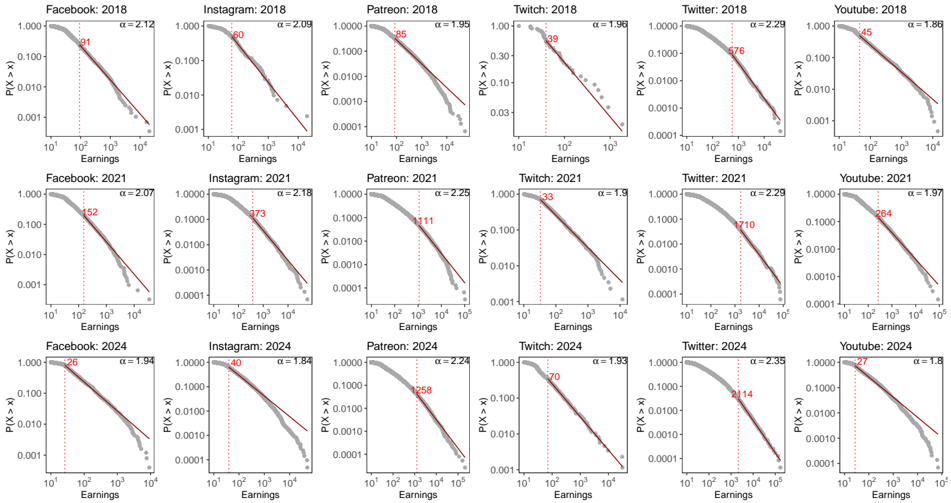
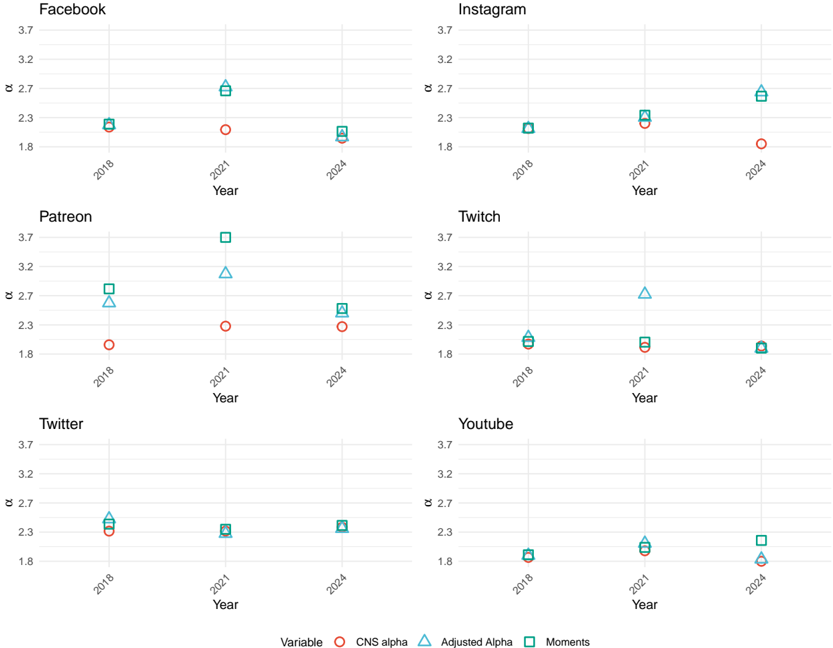
- Patreon earnings across major platforms fit a power law with average α ≈ 2.0; 2024 platform estimates include YouTube α = 1.8, Instagram α = 1.84, Twitch α = 1.93, Facebook α = 1.94, Patreon α = 2.24, and Twitter/X α = 2.35. Lower α means more concentrated earnings.
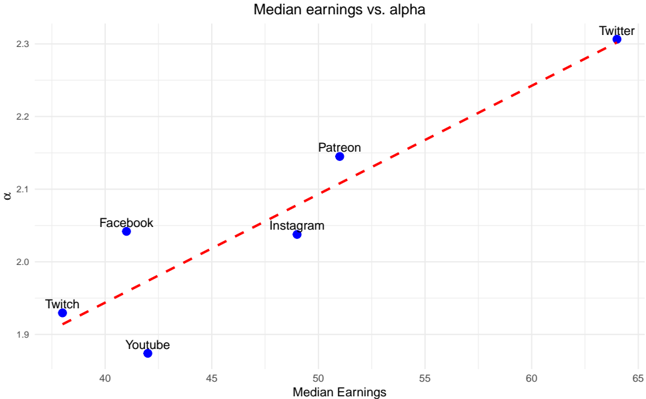
- Platforms with stronger power laws (lower α), such as YouTube and Instagram, show lower mean and median earnings and less expansive interquartile ranges, consistent with an eroded creator “middle class”; Twitter/X and Patreon show higher α and healthier middle-class earnings.
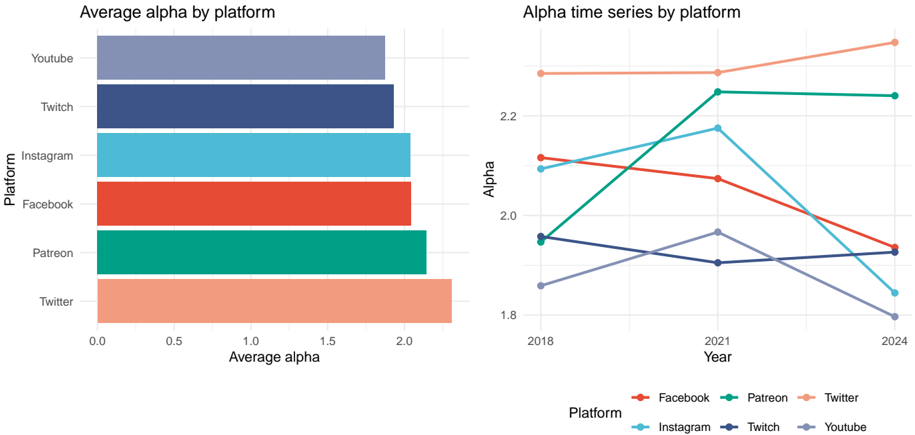
- Across 2018, 2021, and 2024, α declines and converges for YouTube, Twitch, Instagram, and Facebook; Instagram’s α worsens from around 2.1 in 2021 to 1.84 in 2024. Twitter/X’s α increases between 2021 and 2024.
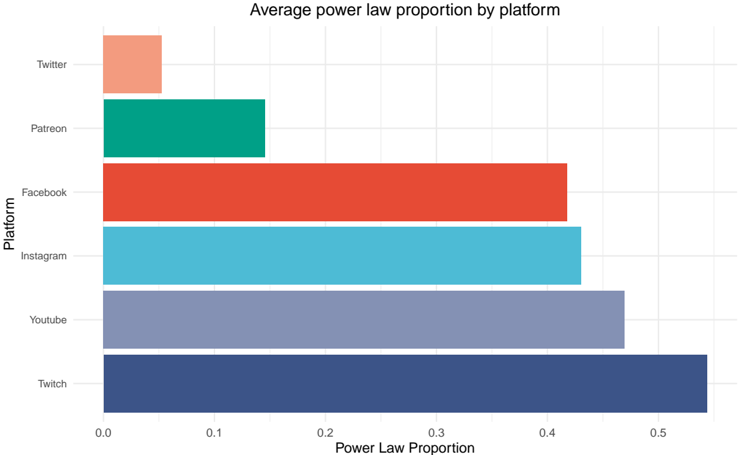
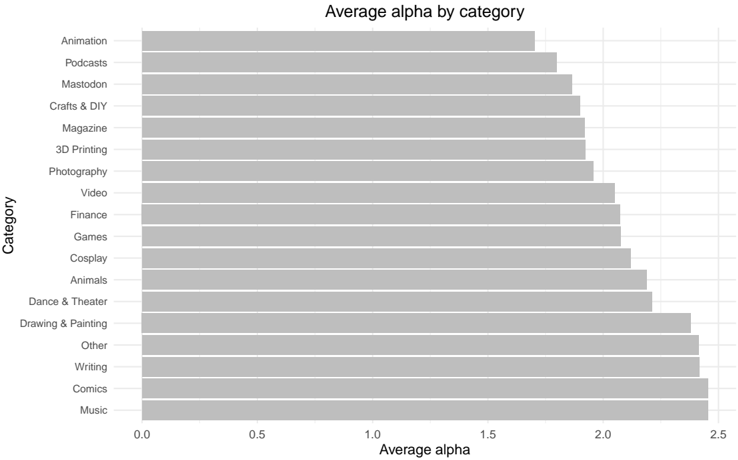
- Power-law behavior emerges early, between $26 and $70 in monthly earnings; the share of earnings following a power law ranges from 5% (Twitter/X) to almost 55% (Twitch). Animation and Podcasts have the lowest α, while Music, comics, and writing have relatively high α.
Methods
- Uses official Patreon monthly earnings data for March 2018, 2021, and 2024, with n = 104,719 creators; restricts to creators with monthly earnings above $10 and to those affiliated with only one external platform (YouTube, Instagram, Twitter/X, Twitch, Facebook, or Patreon-only).
- Imputes missing earnings, about 34.5% of creator-level earnings, using OLS on paid members, all members, NSFW status, year, and category; reported fit is R² = 0.778, RMSE ≈ $547, MAE ≈ $81, with similar cross-validated errors.
- Fits power-law tails using the Clauset et al. (2009) maximum-likelihood and Kolmogorov–Smirnov approach via the poweRlaw package in R, compares alternative estimators, and interprets α through a preferential-attachment/copying model where lower γ implies stronger rich-get-richer dynamics.
Limitations
- The paper states that cross-sectional data cannot separately identify algorithmic attention allocation from creator sorting, audience composition, or platform-specific conversion norms; Patreon earnings are only one revenue stream and provide a partial view of total creator earnings.
- The paper notes only three cross-sections are used, some platform-year estimates—especially Patreon and Instagram in the final year—are sensitive to estimation method, and Twitter/X’s favorable pattern may partly reflect NSFW audience willingness to pay rather than less concentrated algorithmic attention.
- The text makes evident that the single-platform restriction mitigates but cannot eliminate selection concerns, and the design lacks direct attention measures or quasi-experimental variation, so the findings are descriptive and not causally identified.
Model-written summary. Check it against the paper before relying on it.
Integrity signals
Registry
Cites
Statistics
Figures
Verification
Claims the paper makes
73 Own interpretation · 47 Own result · 17 No basis given · 16 Own method · 15 Not checked yet · 10 Sources not found · 4 Partly supported · 1 Not supported · 1 No full text of the sources · accuracy not yet measured
The cited sources support only part of this claim — read each source’s verdict below.
In the paper
“Online social media markets are governed by algorithmic allocations of attention (O'Reilly et al. 2024; Strauss et al. 2024), not prices.”
What the sources say
- Partly supportedcites O'Reilly et al. 2024 sourceExperimental — accuracy not yet measured
Section 2 describes algorithmic attention allocations as a key mechanism coordinating online activity, and Section 2.3 describes algorithmic sorting of social-media feeds. But the paper says these allocations ‘supplement—and at times supplant—traditional markets,’ not that prices play no role; it also describes advertisers bidding for attention (e6-12). The categorical ‘not prices’ overstates the source. (LLM, conf=0.86)
- Not matchedcites Strauss et al. 2024
Couldn’t be matched to a paper in Crossref, so it can’t be checked.
plaindirect- Asserted: passes — The authors put it forward as true.
- Checkable: passes — It can be checked against evidence.
- Load-bearing: passes — The paper’s conclusions depend on it.
- Based: passes — The paper gives a reason why it holds.
- Partly supported
A result the paper reports from its own data — it cites no other source for it, so there is none to check. The quote shows it is in the paper.
In the paper
“Power law dynamics emerge early at between $26 and $70 per monthly earnings across these platforms”
plaincorrelational- Asserted: passes — The authors put it forward as true.
- Checkable: passes — It can be checked against evidence.
- Load-bearing: passes — The paper’s conclusions depend on it.
- Based: passes — The paper gives a reason why it holds.
A result the paper reports from its own data — it cites no other source for it, so there is none to check. The quote shows it is in the paper.
In the paper
“Twitter/X, however, shows a strong power law on its right-most tail, implying that earnings become extremely concentrated but only once a higher threshold is reached ($2,114).”
boostedcorrelational- Asserted: passes — The authors put it forward as true.
- Checkable: passes — It can be checked against evidence.
- Load-bearing: passes — The paper’s conclusions depend on it.
- Based: passes — The paper gives a reason why it holds.
A result the paper reports from its own data — it cites no other source for it, so there is none to check. The quote shows it is in the paper.
In the paper
“Supporting this interpretation is our finding that creators with no other social media accounts (Patreon-only) show the second least concentrated distribution (highest α ), after Twitter/X - whose historical reliance on social graphs rather than pure recommendation may explain its relatively equitable outcomes.”
plaincorrelational- Asserted: passes — The authors put it forward as true.
- Checkable: passes — It can be checked against evidence.
- Load-bearing: passes — The paper’s conclusions depend on it.
- Based: passes — The paper gives a reason why it holds.
A result the paper reports from its own data — it cites no other source for it, so there is none to check. The quote shows it is in the paper.
In the paper
“the extreme right tail is not as concentrated as a pure power law for most platforms”
plain- Asserted: passes — The authors put it forward as true.
- Checkable: passes — It can be checked against evidence.
- Load-bearing: passes — The paper’s conclusions depend on it.
- Based: passes — The paper gives a reason why it holds.
A result the paper reports from its own data — it cites no other source for it, so there is none to check. The quote shows it is in the paper.
In the paper
“YouTube and Twitch have the lowest, i.e. most extreme, estimated α values”
hedgedcorrelational- Asserted: passes — The authors put it forward as true.
- Checkable: passes — It can be checked against evidence.
- Load-bearing: passes — The paper’s conclusions depend on it.
- Based: passes — The paper gives a reason why it holds.
A result the paper reports from its own data — it cites no other source for it, so there is none to check. The quote shows it is in the paper.
In the paper
“Patreon and Twitter/X show a much weaker power law (2.24 and 2.35, respectively).”
plain- Asserted: passes — The authors put it forward as true.
- Checkable: passes — It can be checked against evidence.
- Load-bearing: passes — The paper’s conclusions depend on it.
- Based: passes — The paper gives a reason why it holds.
A result the paper reports from its own data — it cites no other source for it, so there is none to check. The quote shows it is in the paper.
In the paper
“Twitter/X and Patreon consistently display the highest (least extreme) α values”
plaincorrelational- Asserted: passes — The authors put it forward as true.
- Checkable: passes — It can be checked against evidence.
- Load-bearing: passes — The paper’s conclusions depend on it.
- Based: passes — The paper gives a reason why it holds.
A result the paper reports from its own data — it cites no other source for it, so there is none to check. The quote shows it is in the paper.
In the paper
“Third, content categories on Patreon are broadly similar across platform-affiliated creators (see Table 1), suggesting creator populations are not so compositionally different as to invalidate comparison.”
hedged- Asserted: passes — The authors put it forward as true.
- Checkable: passes — It can be checked against evidence.
- Load-bearing: passes — The paper’s conclusions depend on it.
- Based: passes — The paper gives a reason why it holds.
A result the paper reports from its own data — it cites no other source for it, so there is none to check. The quote shows it is in the paper.
In the paper
“our results show that social media earnings data are largely dominated by a power law from very early on in the earning distribution.”
plain- Asserted: passes — The authors put it forward as true.
- Checkable: passes — It can be checked against evidence.
- Load-bearing: passes — The paper’s conclusions depend on it.
- Based: passes — The paper gives a reason why it holds.
A result the paper reports from its own data — it cites no other source for it, so there is none to check. The quote shows it is in the paper.
In the paper
“temporal trends in α show a worsening in the platform power-law relation”
plaincorrelational- Asserted: passes — The authors put it forward as true.
- Checkable: passes — It can be checked against evidence.
- Load-bearing: passes — The paper’s conclusions depend on it.
- Based: passes — The paper gives a reason why it holds.
A result the paper reports from its own data — it cites no other source for it, so there is none to check. The quote shows it is in the paper.
In the paper
“The earnings distributions for most platforms in Figure 1 exhibit a strong power law pattern around α = 2.”
boosted- Asserted: passes — The authors put it forward as true.
- Checkable: passes — It can be checked against evidence.
- Load-bearing: passes — The paper’s conclusions depend on it.
- Based: passes — The paper gives a reason why it holds.
A result the paper reports from its own data — it cites no other source for it, so there is none to check. The quote shows it is in the paper.
In the paper
“Our core finding is that monthly Patreon earnings across platforms fit a power law with exponent around α ≈ 2 . 0, indicating an extremely heavy-tailed distribution and a strong 'rich-get-richer' dynamic.”
plaincorrelational- Asserted: passes — The authors put it forward as true.
- Checkable: passes — It can be checked against evidence.
- Load-bearing: passes — The paper’s conclusions depend on it.
- Based: passes — The paper gives a reason why it holds.
A result the paper reports from its own data — it cites no other source for it, so there is none to check. The quote shows it is in the paper.
In the paper
“Instagram shows the most extreme shift, with α worsening from around 2.1 in 2021 to 1.84 in 2024, which is consistent with a growing role for algorithmic recommendations relative to social-graph mechanisms (Mignano 2022), though compositional changes in the creator population offer an alternative explanation.”
plain- Asserted: passes — The authors put it forward as true.
- Checkable: passes — It can be checked against evidence.
- Load-bearing: passes — The paper’s conclusions depend on it.
- Based: passes — The paper gives a reason why it holds.
A result the paper reports from its own data — it cites no other source for it, so there is none to check. The quote shows it is in the paper.
In the paper
“Errors are moderate in absolute terms (RMSE ≈ $547, MAE ≈ $81)”
plain- Asserted: passes — The authors put it forward as true.
- Checkable: passes — It can be checked against evidence.
- Load-bearing: passes — The paper’s conclusions depend on it.
- Based: passes — The paper gives a reason why it holds.
A result the paper reports from its own data — it cites no other source for it, so there is none to check. The quote shows it is in the paper.
In the paper
“Animation followed by Podcasts exhibit the lowest, i.e. most extreme, α values”
plaincorrelational- Asserted: passes — The authors put it forward as true.
- Checkable: passes — It can be checked against evidence.
- Load-bearing: passes — The paper’s conclusions depend on it.
- Based: passes — The paper gives a reason why it holds.
A result the paper reports from its own data — it cites no other source for it, so there is none to check. The quote shows it is in the paper.
In the paper
“It shows that the proportion of earnings following a power law distribution varies significantly across platforms, from 5% (Twitter/X) to almost 55% (Twitch).”
plaincorrelational- Asserted: passes — The authors put it forward as true.
- Checkable: passes — It can be checked against evidence.
- Load-bearing: passes — The paper’s conclusions depend on it.
- Based: passes — The paper gives a reason why it holds.
A result the paper reports from its own data — it cites no other source for it, so there is none to check. The quote shows it is in the paper.
In the paper
“Though 'NSFW' (not safe for work) creators increased on the platform by almost 30 percentage points, going from 45% and 46% of Patreon creators on Twitter/X in 2018 and 2021, respectively, to 58% in 2024”
plain- Asserted: passes — The authors put it forward as true.
- Checkable: passes — It can be checked against evidence.
- Load-bearing: unclear — It is unclear whether the paper’s conclusions depend on it.
- Based: passes — The paper gives a reason why it holds.
A result the paper reports from its own data — it cites no other source for it, so there is none to check. The quote shows it is in the paper.
In the paper
“For Patreon, discrepancies in the estimated exponents are particularly evident in the first two years (2018, 2021), where the tail decays more rapidly than the predicted line, as shown in Figure 1.”
plain- Asserted: passes — The authors put it forward as true.
- Checkable: passes — It can be checked against evidence.
- Load-bearing: unclear — It is unclear whether the paper’s conclusions depend on it.
- Based: passes — The paper gives a reason why it holds.
A result the paper reports from its own data — it cites no other source for it, so there is none to check. The quote shows it is in the paper.
In the paper
“This follows from the scale invariance properties of the power law coupled with our finding that the power law begins very early on in the earnings distribution.”
plain- Asserted: passes — The authors put it forward as true.
- Checkable: passes — It can be checked against evidence.
- Load-bearing: passes — The paper’s conclusions depend on it.
- Based: unclear — It is unclear why the paper says it holds.
A result the paper reports from its own data — it cites no other source for it, so there is none to check. The quote shows it is in the paper.
In the paper
“Roughly one-third of creator-level earnings are missing.”
plain- Asserted: passes — The authors put it forward as true.
- Checkable: passes — It can be checked against evidence.
- Load-bearing: passes — The paper’s conclusions depend on it.
- Based: passes — The paper gives a reason why it holds.
The paper states this without a source or data behind it here, so there is nothing to check it against. The quote shows it is in the paper.
In the paper
“With the majority of the distribution better explained by exponential or gamma-type distributions.”
plain- Asserted: passes — The authors put it forward as true.
- Checkable: passes — It can be checked against evidence.
- Load-bearing: unclear — It is unclear whether the paper’s conclusions depend on it.
- Based: unclear — It is unclear why the paper says it holds.
A result the paper reports from its own data — it cites no other source for it, so there is none to check. The quote shows it is in the paper.
In the paper
“Twitter/X's α increased (indicating less concentration) between 2021 and 2024”
plaindirect- Asserted: passes — The authors put it forward as true.
- Checkable: passes — It can be checked against evidence.
- Load-bearing: unclear — It is unclear whether the paper’s conclusions depend on it.
- Based: passes — The paper gives a reason why it holds.
A result the paper reports from its own data — it cites no other source for it, so there is none to check. The quote shows it is in the paper.
In the paper
“Figure 3 shows a clear association between the power law exponent ( α ) and the median of the earnings distribution: platforms with higher median earnings tend to exhibit less heavy-tailed distributions (higher α ).”
boostedcorrelational- Asserted: passes — The authors put it forward as true.
- Checkable: passes — It can be checked against evidence.
- Load-bearing: passes — The paper’s conclusions depend on it.
- Based: passes — The paper gives a reason why it holds.
The paper states this without a source or data behind it here, so there is nothing to check it against. The quote shows it is in the paper.
In the paper
“On Patreon in particular, creators can choose not to display their earnings publicly, and this choice is systematically related to their scale: higher-earning creators with more paid subscribers are dis-”
plaincorrelational- Asserted: passes — The authors put it forward as true.
- Checkable: passes — It can be checked against evidence.
- Load-bearing: passes — The paper’s conclusions depend on it.
- Based: passes — The paper gives a reason why it holds.
A result the paper reports from its own data — it cites no other source for it, so there is none to check. The quote shows it is in the paper.
In the paper
“In our data, Patreon-only and Twitter/X-only creators have more equal earnings distributions than those who monetize via more dominant platforms such as YouTube or Instagram.”
plaincorrelational- Asserted: passes — The authors put it forward as true.
- Checkable: passes — It can be checked against evidence.
- Load-bearing: passes — The paper’s conclusions depend on it.
- Based: passes — The paper gives a reason why it holds.
A result the paper reports from its own data — it cites no other source for it, so there is none to check. The quote shows it is in the paper.
In the paper
“It also shows that creators do not always multi-home to the extent often assumed. Many focus on a single platform, as in our sample”
plain- Asserted: passes — The authors put it forward as true.
- Checkable: passes — It can be checked against evidence.
- Load-bearing: passes — The paper’s conclusions depend on it.
- Based: passes — The paper gives a reason why it holds.
A result the paper reports from its own data — it cites no other source for it, so there is none to check. The quote shows it is in the paper.
In the paper
“Our analysis documents that Patreon earnings distributions across most major social media platforms closely follow power law dynamics, with an average exponent around α ≈ 2 . 0.”
boostedcorrelational- Asserted: passes — The authors put it forward as true.
- Checkable: passes — It can be checked against evidence.
- Load-bearing: passes — The paper’s conclusions depend on it.
- Based: passes — The paper gives a reason why it holds.
A result the paper reports from its own data — it cites no other source for it, so there is none to check. The quote shows it is in the paper.
In the paper
“Across Facebook, Instagram, Twitch, and YouTube, α values have generally worsened over time (getting smaller)”
plaincorrelational- Asserted: passes — The authors put it forward as true.
- Checkable: passes — It can be checked against evidence.
- Load-bearing: passes — The paper’s conclusions depend on it.
- Based: passes — The paper gives a reason why it holds.
A result the paper reports from its own data — it cites no other source for it, so there is none to check. The quote shows it is in the paper.
In the paper
“Twitch and YouTube demonstrate the highest power law proportions (0.55 and 0.47, respectively)”
boosted- Asserted: passes — The authors put it forward as true.
- Checkable: passes — It can be checked against evidence.
- Load-bearing: passes — The paper’s conclusions depend on it.
- Based: passes — The paper gives a reason why it holds.
A result the paper reports from its own data — it cites no other source for it, so there is none to check. The quote shows it is in the paper.
In the paper
“In the following sections we show that creator earnings are well described by a power-law (Pareto-type) distribution.”
boosted- Asserted: passes — The authors put it forward as true.
- Checkable: passes — It can be checked against evidence.
- Load-bearing: passes — The paper’s conclusions depend on it.
- Based: passes — The paper gives a reason why it holds.
A result the paper reports from its own data — it cites no other source for it, so there is none to check. The quote shows it is in the paper.
In the paper
“The model explains a substantial share of observed variation ( R 2 =0 . 78).”
plaincorrelational- Asserted: passes — The authors put it forward as true.
- Checkable: passes — It can be checked against evidence.
- Load-bearing: passes — The paper’s conclusions depend on it.
- Based: passes — The paper gives a reason why it holds.
A conclusion the paper draws from its own results — it cites no other source for it, so there is none to check. The quote shows it is in the paper.
In the paper
“What α ≈ 2 tells us is that the net effect of all algorithmic interventions, user behavior, and feedback loops produces an outcome consistent with very little effective exploration, even if individual components of the system are more exploratory than γ → 0 would suggest.”
plaindirect- Asserted: passes — The authors put it forward as true.
- Checkable: passes — It can be checked against evidence.
- Load-bearing: passes — The paper’s conclusions depend on it.
- Based: passes — The paper gives a reason why it holds.
- The authors state this as an assumption: With probability γ, an attention event is directed to a creator chosen uniformly at random.
- The authors state this as an assumption: With probability 1-γ, attention is directed proportionally to a creator's existing attention level.
The paper states this without a source or data behind it here, so there is nothing to check it against. The quote shows it is in the paper.
In the paper
“First, all Patreon creators use the same monetization mechanism - a subscription paywall - holding the conversion tool constant even if the propensity to convert varies across audiences.”
plain- Asserted: passes — The authors put it forward as true.
- Checkable: passes — It can be checked against evidence.
- Load-bearing: passes — The paper’s conclusions depend on it.
- Based: unclear — It is unclear why the paper says it holds.
A conclusion the paper draws from its own results — it cites no other source for it, so there is none to check. The quote shows it is in the paper.
In the paper
“Platform variation is consistent with differences in algorithmic systems: YouTube ( α = 1 . 8), Instagram ( α = 1 . 84), Twitch ( α = 1 . 93), and Facebook ( α = 1 . 94).”
plaincorrelational- Asserted: passes — The authors put it forward as true.
- Checkable: passes — It can be checked against evidence.
- Load-bearing: unclear — It is unclear whether the paper’s conclusions depend on it.
- Based: passes — The paper gives a reason why it holds.
None of the sources cited for this claim have been checked yet.
In the paper
“In the digital realm, each new click or view is more likely to go to creators who already have substantial visibility, resulting in a 'rich-get-richer' dynamic commonly observed on platforms governed by algorithmic curation (Barabasi 2005; Jackson et al. 2008; Gabaix 2009; Vidal et al. 2011; Easley, J. Kleinberg, et al. 2010; Barabási et al. 2011; Barbosa et al. 2018).”
What the sources say
hedgeddirect- Asserted: passes — The authors put it forward as true.
- Checkable: passes — It can be checked against evidence.
- Load-bearing: passes — The paper’s conclusions depend on it.
- Based: passes — The paper gives a reason why it holds.
A conclusion the paper draws from its own results — it cites no other source for it, so there is none to check. The quote shows it is in the paper.
In the paper
“Third, comparing three cross-sections (2018, 2021, 2024), we observe convergence toward steeper inequality across YouTube, Twitch, Instagram, and Facebook, with declining α values implying increasing earnings concentration.”
plaindirect- Asserted: passes — The authors put it forward as true.
- Checkable: passes — It can be checked against evidence.
- Load-bearing: passes — The paper’s conclusions depend on it.
- Based: passes — The paper gives a reason why it holds.
None of the sources cited for this claim have been checked yet.
In the paper
“where the power law typically applies to income levels only above $100,000 per annum (Drăgulescu and Yakovenko 2001; Tao et al. 2019).”
What the sources say
- Not checked — no full text of the sourcecites Drăgulescu and Yakovenko 2001 source
- Not matchedcites Tao et al. 2019
Couldn’t be matched to a paper in Crossref, so it can’t be checked.
plain- Asserted: passes — The authors put it forward as true.
- Checkable: passes — It can be checked against evidence.
- Load-bearing: passes — The paper’s conclusions depend on it.
- Based: passes — The paper gives a reason why it holds.
None of the sources cited for this claim have been checked yet.
In the paper
“This compounding of initial advantage, also called a 'superstar effect' in economics (Gabaix 2009; Autor et al. 2020), means that participants who accumulate more engagement become even more likely to attract future interactions.”
What the sources say
plaindirect- Asserted: passes — The authors put it forward as true.
- Checkable: passes — It can be checked against evidence.
- Load-bearing: passes — The paper’s conclusions depend on it.
- Based: passes — The paper gives a reason why it holds.
A conclusion the paper draws from its own results — it cites no other source for it, so there is none to check. The quote shows it is in the paper.
In the paper
“Second, the temporal trends we document within platforms (declining α for Instagram, YouTube, Facebook, and Twitch) cannot easily be explained by fixed cross-platform differences in audience culture, since those would produce level differences rather than within-platform trends.”
hedged- Asserted: passes — The authors put it forward as true.
- Checkable: passes — It can be checked against evidence.
- Load-bearing: passes — The paper’s conclusions depend on it.
- Based: passes — The paper gives a reason why it holds.
A conclusion the paper draws from its own results — it cites no other source for it, so there is none to check. The quote shows it is in the paper.
In the paper
“For these reasons, we interpret cross-platform differences in α conservatively as differences in the inequality of Patreon monetization outcomes among creators affiliated with each platform .”
hedgedcorrelational- Asserted: passes — The authors put it forward as true.
- Checkable: passes — It can be checked against evidence.
- Load-bearing: passes — The paper’s conclusions depend on it.
- Based: passes — The paper gives a reason why it holds.
A conclusion the paper draws from its own results — it cites no other source for it, so there is none to check. The quote shows it is in the paper.
In the paper
“At least part of this pattern, especially the very high maxima, is likely driven by the much larger number of creators we observe on Twitter/X and Patreon, rather than by systematically different underlying inequality across platforms.”
hedgedconditional- Asserted: passes — The authors put it forward as true.
- Checkable: passes — It can be checked against evidence.
- Load-bearing: unclear — It is unclear whether the paper’s conclusions depend on it.
- Based: passes — The paper gives a reason why it holds.
In the paper
“Instagram shows the most extreme shift, with α worsening from around 2.1 in 2021 to 1.84 in 2024, which is consistent with a growing role for algorithmic recommendations relative to social-graph mechanisms (Mignano 2022), though compositional changes in the creator population offer an alternative explanation.”
What the sources say
- Not matchedcites Mignano 2022
Couldn’t be matched to a paper in Crossref, so it can’t be checked.
hedgedcorrelational- Asserted: passes — The authors put it forward as true.
- Checkable: passes — It can be checked against evidence.
- Load-bearing: unclear — It is unclear whether the paper’s conclusions depend on it.
- Based: passes — The paper gives a reason why it holds.
- Not matched
A conclusion the paper draws from its own results — it cites no other source for it, so there is none to check. The quote shows it is in the paper.
In the paper
“Fourth, if conversion culture alone drove the observed patterns, we might expect platforms with larger creator bases to show more diverse earnings distributions through sheer variety; yet YouTube-affiliated creators show the most concentrated earnings despite YouTube's dominance as a traffic source, suggesting that attention allocation mechanisms are a plausible driver alongside conversion norms.”
hedgedconditional- Asserted: passes — The authors put it forward as true.
- Checkable: passes — It can be checked against evidence.
- Load-bearing: passes — The paper’s conclusions depend on it.
- Based: passes — The paper gives a reason why it holds.
A conclusion the paper draws from its own results — it cites no other source for it, so there is none to check. The quote shows it is in the paper.
In the paper
“The 'rich-get-richer' dynamic draws gains disproportionately from mid-tier creators.”
plaindirect- Asserted: passes — The authors put it forward as true.
- Checkable: passes — It can be checked against evidence.
- Load-bearing: passes — The paper’s conclusions depend on it.
- Based: passes — The paper gives a reason why it holds.
None of the sources cited for this claim have been checked yet.
In the paper
“This places creator earnings closer to concentrated capital income ( α ≈ 1 . 5) (Gabaix 2009; Rishabh Kumar 2024) than to labor income, suggesting multiplicative and compounding effects drive online creator earnings (Strauss et al. 2024).”
What the sources say
hedgedcorrelational- Asserted: passes — The authors put it forward as true.
- Checkable: passes — It can be checked against evidence.
- Load-bearing: passes — The paper’s conclusions depend on it.
- Based: passes — The paper gives a reason why it holds.
A conclusion the paper draws from its own results — it cites no other source for it, so there is none to check. The quote shows it is in the paper.
In the paper
“This means that opportunities for Patreon content creators on Twitter/X are likely to be greater than other comparable platforms below this threshold (especially for 'NSFW' creators).”
hedgedconditional- Asserted: passes — The authors put it forward as true.
- Checkable: passes — It can be checked against evidence.
- Load-bearing: passes — The paper’s conclusions depend on it.
- Based: passes — The paper gives a reason why it holds.
A conclusion the paper draws from its own results — it cites no other source for it, so there is none to check. The quote shows it is in the paper.
In the paper
“Second, platforms with stronger power laws (lower α ), such as YouTube and Instagram, exhibit weaker creator middle classes: lower mean and median earnings with less expansive interquartile ranges (Q25-Q75).”
plaincorrelational- Asserted: passes — The authors put it forward as true.
- Checkable: passes — It can be checked against evidence.
- Load-bearing: passes — The paper’s conclusions depend on it.
- Based: passes — The paper gives a reason why it holds.
None of the sources cited for this claim have been checked yet.
In the paper
“Unfortunately, there is little detailed evidence of the economic impact of algorithmic attention mechanisms, since platforms do not disclose creator earnings or algorithmic optimizations (T. Gillespie 2018; Mazzucato et al. 2023; O'Reilly et al. 2023; Naceva 2025).”
What the sources say
- Not matchedcites T. Gillespie 2018
Couldn’t be matched to a paper in Crossref, so it can’t be checked.
- Not checked yetcites Mazzucato et al. 2023 source
- Not matchedcites O'Reilly et al. 2023
Couldn’t be matched to a paper in Crossref, so it can’t be checked.
plain- Asserted: passes — The authors put it forward as true.
- Checkable: passes — It can be checked against evidence.
- Load-bearing: passes — The paper’s conclusions depend on it.
- Based: passes — The paper gives a reason why it holds.
- Not matched
A conclusion the paper draws from its own results — it cites no other source for it, so there is none to check. The quote shows it is in the paper.
In the paper
“Not imputing missing earnings, therefore, would introduce a significant downward bias on the right tail of the distribution.”
hedgeddirect- Asserted: passes — The authors put it forward as true.
- Checkable: passes — It can be checked against evidence.
- Load-bearing: passes — The paper’s conclusions depend on it.
- Based: passes — The paper gives a reason why it holds.
A conclusion the paper draws from its own results — it cites no other source for it, so there is none to check. The quote shows it is in the paper.
In the paper
“Third, content categories on Patreon are broadly similar across platform-affiliated creators (see Table 1), suggesting creator populations are not so compositionally different as to invalidate comparison.”
hedged- Asserted: passes — The authors put it forward as true.
- Checkable: passes — It can be checked against evidence.
- Load-bearing: passes — The paper’s conclusions depend on it.
- Based: passes — The paper gives a reason why it holds.
None of the sources cited for this claim have been checked yet.
In the paper
“We also provide some of the only evidence on content creator earnings distributions (Influencer Marketing Hub 2023; Peres et al. 2024; Naceva 2025).”
What the sources say
- Not matchedcites Influencer Marketing Hub 2023
Couldn’t be matched to a paper in Crossref, so it can’t be checked.
- Not checked — no full text of the sourcecites Peres et al. 2024 source
- Not matchedcites Naceva 2025
Couldn’t be matched to a paper in Crossref, so it can’t be checked.
hedged- Asserted: passes — The authors put it forward as true.
- Checkable: passes — It can be checked against evidence.
- Load-bearing: unclear — It is unclear whether the paper’s conclusions depend on it.
- Based: passes — The paper gives a reason why it holds.
- Not matched
What the paper did — it cites no source for this, so there is none to check. The quote shows it is in the paper.
In the paper
“However, our cross-sectional data cannot separately identify their contributions.”
plain- Asserted: passes — The authors put it forward as true.
- Checkable: passes — It can be checked against evidence.
- Load-bearing: passes — The paper’s conclusions depend on it.
- Based: passes — The paper gives a reason why it holds.
A conclusion the paper draws from its own results — it cites no other source for it, so there is none to check. The quote shows it is in the paper.
In the paper
“indicating less concentration”
hedgeddirect- Asserted: passes — The authors put it forward as true.
- Checkable: passes — It can be checked against evidence.
- Load-bearing: unclear — It is unclear whether the paper’s conclusions depend on it.
- Based: passes — The paper gives a reason why it holds.
None of the sources cited for this claim have been checked yet.
In the paper
“In the copying model (Mitzenmacher 2004; Easley, J. Kleinberg, et al. 2010; Chung et al. 2003), α ≈ 2 corresponds to near-pure preferential attachment ( γ → 0) in a one-edge-per-arrival regime, where each impression or recommendation resolves into a single allocation of attention - predominantly steered toward already-popular creators, with a small net exploratory component.”
What the sources say
plaincorrelational- Asserted: passes — The authors put it forward as true.
- Checkable: passes — It can be checked against evidence.
- Load-bearing: passes — The paper’s conclusions depend on it.
- Based: passes — The paper gives a reason why it holds.
A conclusion the paper draws from its own results — it cites no other source for it, so there is none to check. The quote shows it is in the paper.
In the paper
“Similar dynamics appear to shape content creator earnings.”
hedgedcorrelational- Asserted: passes — The authors put it forward as true.
- Checkable: unclear — It is unclear whether it could be checked against evidence.
- Load-bearing: passes — The paper’s conclusions depend on it.
- Based: passes — The paper gives a reason why it holds.
A conclusion the paper draws from its own results — it cites no other source for it, so there is none to check. The quote shows it is in the paper.
In the paper
“So long as platforms retain strongly power-law-promoting algorithms, and monetize on that same basis, earnings inequality is likely to persist.”
hedgedconditional- Asserted: passes — The authors put it forward as true.
- Checkable: passes — It can be checked against evidence.
- Load-bearing: passes — The paper’s conclusions depend on it.
- Based: passes — The paper gives a reason why it holds.
A conclusion the paper draws from its own results — it cites no other source for it, so there is none to check. The quote shows it is in the paper.
In the paper
“This pattern is consistent with strong algorithmic recommendation systems and high reliance on viral content.”
plaincorrelational- Asserted: passes — The authors put it forward as true.
- Checkable: passes — It can be checked against evidence.
- Load-bearing: unclear — It is unclear whether the paper’s conclusions depend on it.
- Based: unclear — It is unclear why the paper says it holds.
A conclusion the paper draws from its own results — it cites no other source for it, so there is none to check. The quote shows it is in the paper.
In the paper
“This indicates that high earnings for the middle layer of creators ('middleclass') are associated with less unequal platforms.”
hedgedcorrelational- Asserted: passes — The authors put it forward as true.
- Checkable: passes — It can be checked against evidence.
- Load-bearing: passes — The paper’s conclusions depend on it.
- Based: passes — The paper gives a reason why it holds.
A conclusion the paper draws from its own results — it cites no other source for it, so there is none to check. The quote shows it is in the paper.
In the paper
“suggesting more equitable earnings distributions.”
hedgedcorrelational- Asserted: passes — The authors put it forward as true.
- Checkable: passes — It can be checked against evidence.
- Load-bearing: passes — The paper’s conclusions depend on it.
- Based: passes — The paper gives a reason why it holds.
In the paper
“The more followers and views a creator has, the more they can earn (Naceva 2025).”
What the sources say
- Not matchedcites Naceva 2025
Couldn’t be matched to a paper in Crossref, so it can’t be checked.
plaindirect- Asserted: passes — The authors put it forward as true.
- Checkable: passes — It can be checked against evidence.
- Load-bearing: passes — The paper’s conclusions depend on it.
- Based: passes — The paper gives a reason why it holds.
- Not matched
A conclusion the paper draws from its own results — it cites no other source for it, so there is none to check. The quote shows it is in the paper.
In the paper
“We interpret Twitter/X's pattern as consistent with less aggressive algorithmic concentration”
hedgedcorrelational- Asserted: passes — The authors put it forward as true.
- Checkable: passes — It can be checked against evidence.
- Load-bearing: unclear — It is unclear whether the paper’s conclusions depend on it.
- Based: passes — The paper gives a reason why it holds.
A conclusion the paper draws from its own results — it cites no other source for it, so there is none to check. The quote shows it is in the paper.
In the paper
“suggesting that a large share of creator earnings is dominated by the power law distribution.”
hedgedcorrelational- Asserted: passes — The authors put it forward as true.
- Checkable: passes — It can be checked against evidence.
- Load-bearing: passes — The paper’s conclusions depend on it.
- Based: passes — The paper gives a reason why it holds.
A conclusion the paper draws from its own results — it cites no other source for it, so there is none to check. The quote shows it is in the paper.
In the paper
“Given that our power-law estimates are driven by the broad shape of the upper tail rather than exact prediction of individual creators”
plain- Asserted: passes — The authors put it forward as true.
- Checkable: passes — It can be checked against evidence.
- Load-bearing: passes — The paper’s conclusions depend on it.
- Based: passes — The paper gives a reason why it holds.
A conclusion the paper draws from its own results — it cites no other source for it, so there is none to check. The quote shows it is in the paper.
In the paper
“indicating more pronounced earnings inequality compared to other categories.”
hedgedcorrelational- Asserted: passes — The authors put it forward as true.
- Checkable: passes — It can be checked against evidence.
- Load-bearing: passes — The paper’s conclusions depend on it.
- Based: passes — The paper gives a reason why it holds.
A conclusion the paper draws from its own results — it cites no other source for it, so there is none to check. The quote shows it is in the paper.
In the paper
“reflecting a transition toward heavier tails and higher earnings inequality at the extremes”
plaincorrelational- Asserted: passes — The authors put it forward as true.
- Checkable: passes — It can be checked against evidence.
- Load-bearing: passes — The paper’s conclusions depend on it.
- Based: passes — The paper gives a reason why it holds.
What the paper did — it cites no source for this, so there is none to check. The quote shows it is in the paper.
In the paper
“Alternative explanations, including audience composition, creator sorting, and platform-specific conversion norms cannot be ruled out with cross-sectional data.”
plain- Asserted: passes — The authors put it forward as true.
- Checkable: passes — It can be checked against evidence.
- Load-bearing: passes — The paper’s conclusions depend on it.
- Based: passes — The paper gives a reason why it holds.
A conclusion the paper draws from its own results — it cites no other source for it, so there is none to check. The quote shows it is in the paper.
In the paper
“Gains to stardom are multiplicative rather than linear: outsized brand deals and advertising revenue shares accrue to a small group of superstar creators with enormous follower counts.”
plaindirect- Asserted: passes — The authors put it forward as true.
- Checkable: passes — It can be checked against evidence.
- Load-bearing: passes — The paper’s conclusions depend on it.
- Based: passes — The paper gives a reason why it holds.
A conclusion the paper draws from its own results — it cites no other source for it, so there is none to check. The quote shows it is in the paper.
In the paper
“Position matters enormously to monetization.”
boosteddirect- Asserted: passes — The authors put it forward as true.
- Checkable: passes — It can be checked against evidence.
- Load-bearing: passes — The paper’s conclusions depend on it.
- Based: passes — The paper gives a reason why it holds.
A conclusion the paper draws from its own results — it cites no other source for it, so there is none to check. The quote shows it is in the paper.
In the paper
“This means that the benefits to moving up the algorithmic 'ladder' are likely enormous at each rung, highlighting just how important it is to be higher up the screen, or the user's attention sphere.”
hedgedconditional- Asserted: passes — The authors put it forward as true.
- Checkable: unclear — It is unclear whether it could be checked against evidence.
- Load-bearing: passes — The paper’s conclusions depend on it.
- Based: passes — The paper gives a reason why it holds.
A conclusion the paper draws from its own results — it cites no other source for it, so there is none to check. The quote shows it is in the paper.
In the paper
“Intuitively, a platform with more creators has many more 'draws from the lottery' of extreme success. Even if two platforms had identical underlying earnings distributions, the one with more creators would tend to exhibit a higher observed maximum simply because it is more likely to contain an extremely successful creator.”
hedgeddirect- Asserted: passes — The authors put it forward as true.
- Checkable: passes — It can be checked against evidence.
- Load-bearing: passes — The paper’s conclusions depend on it.
- Based: passes — The paper gives a reason why it holds.
The paper states this without a source or data behind it here, so there is nothing to check it against. The quote shows it is in the paper.
In the paper
“In such distributions, the expected maximum in a sample of size N grows quickly with N (roughly like N 1 / ( α -1) in a Pareto model), so larger platforms naturally produce more extreme top observations even when the underlying tail parameter α , our measure of inequality, is the same.”
plaindirect- Asserted: passes — The authors put it forward as true.
- Checkable: passes — It can be checked against evidence.
- Load-bearing: passes — The paper’s conclusions depend on it.
- Based: passes — The paper gives a reason why it holds.
The paper states this without a source or data behind it here, so there is nothing to check it against. The quote shows it is in the paper.
In the paper
“Raw maxima and interquartile ranges can both be misleading indicators of inequality when outcomes have very heavy upper tails, as is the case for creator earnings.”
plain- Asserted: passes — The authors put it forward as true.
- Checkable: passes — It can be checked against evidence.
- Load-bearing: passes — The paper’s conclusions depend on it.
- Based: passes — The paper gives a reason why it holds.
A conclusion the paper draws from its own results — it cites no other source for it, so there is none to check. The quote shows it is in the paper.
In the paper
“a pattern consistent with amplified 'rich-get-richer' dynamics.”
hedgedcorrelational- Asserted: passes — The authors put it forward as true.
- Checkable: passes — It can be checked against evidence.
- Load-bearing: passes — The paper’s conclusions depend on it.
- Based: passes — The paper gives a reason why it holds.
In the paper
“At the same time, competition has raised total payouts to creators as platforms bid for their participation (Financial Times 2023a).”
What the sources say
- Not matchedcites Financial Times 2023a
Couldn’t be matched to a paper in Crossref, so it can’t be checked.
plaindirect- Asserted: passes — The authors put it forward as true.
- Checkable: passes — It can be checked against evidence.
- Load-bearing: unclear — It is unclear whether the paper’s conclusions depend on it.
- Based: passes — The paper gives a reason why it holds.
- Not matched
A conclusion the paper draws from its own results — it cites no other source for it, so there is none to check. The quote shows it is in the paper.
In the paper
“which is consistent with (though not definitive evidence for) growing concentration in algorithmic attention allocation.”
hedgedcorrelational- Asserted: passes — The authors put it forward as true.
- Checkable: passes — It can be checked against evidence.
- Load-bearing: passes — The paper’s conclusions depend on it.
- Based: passes — The paper gives a reason why it holds.
A conclusion the paper draws from its own results — it cites no other source for it, so there is none to check. The quote shows it is in the paper.
In the paper
“TikTok accelerated the shift away from the social graph towards purely algorithmic selection of content.”
plaindirect- Asserted: passes — The authors put it forward as true.
- Checkable: passes — It can be checked against evidence.
- Load-bearing: unclear — It is unclear whether the paper’s conclusions depend on it.
- Based: unclear — It is unclear why the paper says it holds.
A conclusion the paper draws from its own results — it cites no other source for it, so there is none to check. The quote shows it is in the paper.
In the paper
“Thus, for α ≈ 2, the probability of observing earnings above a level x falls roughly inversely with x : increasing earnings by a factor of 10 makes such high earners about 10 times rarer.”
plaincorrelational- Asserted: passes — The authors put it forward as true.
- Checkable: passes — It can be checked against evidence.
- Load-bearing: passes — The paper’s conclusions depend on it.
- Based: passes — The paper gives a reason why it holds.
- Probably not a substantial claim. 67
- It may state two separate claims as one. 63
At least one cited source doesn’t support this claim or points to a different paper, and none confirmed it — see the verdicts below.
In the paper
“It may also lower barriers to entry for content creators, but it will not change online inequality and concentration in attention and earnings unless the underlying algorithmic mechanisms changes - even if AI-generated content has the potential to foster more egalitarian ecosystems (Zhou and Lee 2024).”
What the sources say
- Disputedcites Zhou and Lee 2024 sourceExperimental — accuracy not yet measured
Split into 2 atoms — 0 confirmed, 1 partially supported, 1 disputed, 0 misattributed, 0 unverifiable. Expand the claim to see per-atom verdicts.
Checked by a reasoning model — may be wrong.
hedgedconditional- Asserted: passes — The authors put it forward as true.
- Checkable: passes — It can be checked against evidence.
- Load-bearing: fails — The paper’s conclusions may not depend on it.
- Based: passes — The paper gives a reason why it holds.
Probably not a substantial claim. The paper’s conclusions may not depend on it. It may state two separate claims as one.
- Disputed
The cited sources support only part of this claim — read each source’s verdict below.
In the paper
“AI technologies have for some time underpinned recommendation algorithms and advertising algorithms (Covington et al. 2016; Schafer 2023; Gairola 2024).”
What the sources say
- Partly supportedcites Covington et al. 2016 sourceExperimental — accuracy not yet measured
The Introduction says deep learning has had a substantial impact on YouTube recommendations, supporting the recommendation-algorithm part of the claim. The Feature Engineering section compares its ranking signals with experience in ranking ads, but does not establish that AI underpins advertising algorithms. (LLM, conf=0.86)
- Not matchedcites Schafer 2023
Couldn’t be matched to a paper in Crossref, so it can’t be checked.
- Not matchedcites Gairola 2024
Couldn’t be matched to a paper in Crossref, so it can’t be checked.
plain- Asserted: passes — The authors put it forward as true.
- Checkable: passes — It can be checked against evidence.
- Load-bearing: fails — The paper’s conclusions may not depend on it.
- Based: passes — The paper gives a reason why it holds.
Probably not a substantial claim. The paper’s conclusions may not depend on it.
- Partly supported
The cited sources support only part of this claim — read each source’s verdict below.
In the paper
“But maximizing for immediate user engagement (Immorlica et al. 2024), as a quarterly economic imperative facing the platform's shareholders, can lead to less new content being created and even less longer-term user engagement - even if potentially at the expense of diminished immediate user satisfaction (Meta 2021; Yao et al. 2024).”
What the sources say
- Not matchedcites Immorlica et al. 2024
Couldn’t be matched to a paper in Crossref, so it can’t be checked.
- Not matchedcites Meta 2021
Couldn’t be matched to a paper in Crossref, so it can’t be checked.
- Supportedcites Yao et al. 2024 source
Split into 2 atoms — 2 confirmed, 0 partially supported, 0 disputed, 0 misattributed, 0 unverifiable. Expand the claim to see per-atom verdicts.
plaindirect- Asserted: passes — The authors put it forward as true.
- Checkable: passes — It can be checked against evidence.
- Load-bearing: fails — The paper’s conclusions may not depend on it.
- Based: passes — The paper gives a reason why it holds.
Probably not a substantial claim. The paper’s conclusions may not depend on it. It may state two separate claims as one.
- Not matched
The cited sources support only part of this claim — read each source’s verdict below.
In the paper
“A central challenge facing recommender systems on mature platforms is their potential to compound initial advantage (viewership), by promoting popular, existing material and focusing less on untested 'fresh' content (Covington et al. 2016; Sutton and Barto 2018).”
What the sources say
- Supportedcites Covington et al. 2016 source
The “Example Age” Feature section says models trained on historical behavior can be biased toward the past, making recommendations reflect earlier watch likelihood rather than current popularity. Section 3.4 adds that training only on watches generated by recommendations would make it difficult for new content to surface and would bias the system toward exploitation. Together, these passages support the claimed potential to favor established videos over fresh content. (LLM, conf=0.86)
- Not matchedcites Sutton and Barto 2018
Couldn’t be matched to a paper in Crossref, so it can’t be checked.
hedgedconditional- Asserted: passes — The authors put it forward as true.
- Checkable: passes — It can be checked against evidence.
- Load-bearing: fails — The paper’s conclusions may not depend on it.
- Based: passes — The paper gives a reason why it holds.
Probably not a substantial claim. The paper’s conclusions may not depend on it.
- Supported
The paper states this without a source or data behind it here, so there is nothing to check it against. The quote shows it is in the paper.
In the paper
“Second, platforms with stronger power laws (lower α ), such as YouTube and Instagram, exhibit weaker creator middle classes: lower mean and median earnings with less expansive interquartile ranges (Q25-Q75).”
plaincorrelational- Asserted: passes — The authors put it forward as true.
- Checkable: passes — It can be checked against evidence.
- Load-bearing: passes — The paper’s conclusions depend on it.
- Based: passes — The paper gives a reason why it holds.
It may state two separate claims as one.
The paper states this without a source or data behind it here, so there is nothing to check it against. The quote shows it is in the paper.
In the paper
“Platform variation is consistent with differences in algorithmic systems: YouTube ( α = 1 . 8), Instagram ( α = 1 . 84), Twitch ( α = 1 . 93), and Facebook ( α = 1 . 94).”
plain- Asserted: passes — The authors put it forward as true.
- Checkable: passes — It can be checked against evidence.
- Load-bearing: passes — The paper’s conclusions depend on it.
- Based: passes — The paper gives a reason why it holds.
It may state two separate claims as one.
A result the paper reports from its own data — it cites no other source for it, so there is none to check. The quote shows it is in the paper.
In the paper
“YouTube, Instagram, Twitch, and Facebook consistently show well-defined power law distributions, ranging between 1.8 and 1.94 for the year 2024”
boosted- Asserted: passes — The authors put it forward as true.
- Checkable: passes — It can be checked against evidence.
- Load-bearing: passes — The paper’s conclusions depend on it.
- Based: passes — The paper gives a reason why it holds.
It may state two separate claims as one.
The paper states this without a source or data behind it here, so there is nothing to check it against. The quote shows it is in the paper.
In the paper
“Fourth, if conversion culture alone drove the observed patterns, we might expect platforms with larger creator bases to show more diverse earnings distributions through sheer variety; yet YouTube-affiliated creators show the most concentrated earnings despite YouTube's dominance as a traffic source, suggesting that attention allocation mechanisms are a plausible driver alongside conversion norms.”
hedgedcorrelational- Asserted: passes — The authors put it forward as true.
- Checkable: passes — It can be checked against evidence.
- Load-bearing: passes — The paper’s conclusions depend on it.
- Based: passes — The paper gives a reason why it holds.
It may state two separate claims as one.
A result the paper reports from its own data — it cites no other source for it, so there is none to check. The quote shows it is in the paper.
In the paper
“Third, comparing three cross-sections (2018, 2021, 2024), we observe convergence toward steeper inequality across YouTube, Twitch, Instagram, and Facebook, with declining α values implying increasing earnings concentration.”
plaincorrelational- Asserted: passes — The authors put it forward as true.
- Checkable: passes — It can be checked against evidence.
- Load-bearing: passes — The paper’s conclusions depend on it.
- Based: unclear — It is unclear why the paper says it holds.
It may state two separate claims as one.
A result the paper reports from its own data — it cites no other source for it, so there is none to check. The quote shows it is in the paper.
In the paper
“Facebook is the only platform to have fewer exclusive Patreon content creators in our data in 2024 than it had in 2021 (Table 2 in Appendix).”
plain- Asserted: passes — The authors put it forward as true.
- Checkable: passes — It can be checked against evidence.
- Load-bearing: fails — The paper’s conclusions may not depend on it.
- Based: passes — The paper gives a reason why it holds.
Probably not a substantial claim. The paper’s conclusions may not depend on it.
A result the paper reports from its own data — it cites no other source for it, so there is none to check. The quote shows it is in the paper.
In the paper
“The standard deviation of earnings is highest for Twitter/X and lowest for Facebook.”
plaincorrelational- Asserted: passes — The authors put it forward as true.
- Checkable: passes — It can be checked against evidence.
- Load-bearing: unclear — It is unclear whether the paper’s conclusions depend on it.
- Based: passes — The paper gives a reason why it holds.
It may state two separate claims as one.
A result the paper reports from its own data — it cites no other source for it, so there is none to check. The quote shows it is in the paper.
In the paper
“Patreon, however, allows creators to keep their earnings private, leading to significant missing data here, especially for larger earners, since those with more paid subscribers tend to disclose their earnings the least, we find.”
plaindirect- Asserted: passes — The authors put it forward as true.
- Checkable: passes — It can be checked against evidence.
- Load-bearing: passes — The paper’s conclusions depend on it.
- Based: passes — The paper gives a reason why it holds.
It may state two separate claims as one.
A result the paper reports from its own data — it cites no other source for it, so there is none to check. The quote shows it is in the paper.
In the paper
“The data show substantial variation in earnings across platforms. Twitter/X and Patreon have the highest mean, median, maximum, and interquartile range of earnings in our sample, while Facebook and Twitch sit at the lower end.”
plaincorrelational- Asserted: passes — The authors put it forward as true.
- Checkable: passes — It can be checked against evidence.
- Load-bearing: unclear — It is unclear whether the paper’s conclusions depend on it.
- Based: passes — The paper gives a reason why it holds.
It may state two separate claims as one.
A result the paper reports from its own data — it cites no other source for it, so there is none to check. The quote shows it is in the paper.
In the paper
“Importantly, platforms with stronger recommendation systems, such as YouTube ( α = 1 . 8) and Instagram ( α = 1 . 84), exhibit more significant earnings inequality and a weaker 'middle-class' of creators (with lower mean, median, and interquartile earnings)”
plaincorrelational- Asserted: passes — The authors put it forward as true.
- Checkable: passes — It can be checked against evidence.
- Load-bearing: passes — The paper’s conclusions depend on it.
- Based: passes — The paper gives a reason why it holds.
It may state two separate claims as one.
A result the paper reports from its own data — it cites no other source for it, so there is none to check. The quote shows it is in the paper.
In the paper
“YouTube has the lowest value in 2024, followed closely by Instagram, with values around 1.8 and 1.88.”
plain- Asserted: passes — The authors put it forward as true.
- Checkable: passes — It can be checked against evidence.
- Load-bearing: unclear — It is unclear whether the paper’s conclusions depend on it.
- Based: passes — The paper gives a reason why it holds.
It may state two separate claims as one.
A result the paper reports from its own data — it cites no other source for it, so there is none to check. The quote shows it is in the paper.
In the paper
“Instagram's α dropped from around 2.1 in 2021 to around 1.84 in 2024, a period that coincided with the platform's shift toward algorithmic recommendation.”
plaincorrelational- Asserted: passes — The authors put it forward as true.
- Checkable: passes — It can be checked against evidence.
- Load-bearing: passes — The paper’s conclusions depend on it.
- Based: passes — The paper gives a reason why it holds.
It may state two separate claims as one.
A result the paper reports from its own data — it cites no other source for it, so there is none to check. The quote shows it is in the paper.
In the paper
“The Music, comics, and writing categories all show relatively high α”
plain- Asserted: passes — The authors put it forward as true.
- Checkable: passes — It can be checked against evidence.
- Load-bearing: passes — The paper’s conclusions depend on it.
- Based: passes — The paper gives a reason why it holds.
It may state two separate claims as one.
A result the paper reports from its own data — it cites no other source for it, so there is none to check. The quote shows it is in the paper.
In the paper
“and the cross-validated errors are very similar, indicating limited overfitting.”
hedged- Asserted: passes — The authors put it forward as true.
- Checkable: passes — It can be checked against evidence.
- Load-bearing: unclear — It is unclear whether the paper’s conclusions depend on it.
- Based: passes — The paper gives a reason why it holds.
It may state two separate claims as one.
A result the paper reports from its own data — it cites no other source for it, so there is none to check. The quote shows it is in the paper.
In the paper
“a few platform-year estimates, especially Patreon and Instagram in the final year, are somewhat sensitive to the estimation method used (see Appendix A).”
plain- Asserted: passes — The authors put it forward as true.
- Checkable: passes — It can be checked against evidence.
- Load-bearing: fails — The paper’s conclusions may not depend on it.
- Based: passes — The paper gives a reason why it holds.
Probably not a substantial claim. The paper’s conclusions may not depend on it.
None of the sources cited for this claim have been checked yet.
In the paper
“It is notable that YouTube offers one of the most generous shares of ad sales, and hosts the greatest earnings inequality among Patreon creators who monetize there (Financial Times 2023b).”
plaincorrelational- Asserted: passes — The authors put it forward as true.
- Checkable: passes — It can be checked against evidence.
- Load-bearing: fails — The paper’s conclusions may not depend on it.
- Based: passes — The paper gives a reason why it holds.
Probably not a substantial claim. The paper’s conclusions may not depend on it.
A result the paper reports from its own data — it cites no other source for it, so there is none to check. The quote shows it is in the paper.
In the paper
“Temporal trends show worsening (and converging) power law earnings dynamics of Patreon creators on Instagram, YouTube, Facebook, and Twitch, where decreasing α values suggest growing dominance of top Patreon creators.”
hedgedcorrelational- Asserted: passes — The authors put it forward as true.
- Checkable: passes — It can be checked against evidence.
- Load-bearing: passes — The paper’s conclusions depend on it.
- Based: passes — The paper gives a reason why it holds.
It may state two separate claims as one.
A result the paper reports from its own data — it cites no other source for it, so there is none to check. The quote shows it is in the paper.
In the paper
“With the exception of the earnings distribution for Patreon creators, the alpha values estimated by the three methods are generally consistent, confirming the robustness of the power-law pattern in the earnings distribution.”
- Also stated in: § A Robustness and Further Analysis · p. 26 · boosted
“In nearly all other cases, the exponents estimated by the three methods are in strong agreement.”
boosted- Asserted: passes — The authors put it forward as true.
- Checkable: passes — It can be checked against evidence.
- Load-bearing: unclear — It is unclear whether the paper’s conclusions depend on it.
- Based: passes — The paper gives a reason why it holds.
It may state two separate claims as one.
- Also stated in: § A Robustness and Further Analysis · p. 26 · boosted
A result the paper reports from its own data — it cites no other source for it, so there is none to check. The quote shows it is in the paper.
In the paper
“As documented in our data, platforms vary substantially in their treatment of adult content as well, leading to different creator compositions and potentially different earnings dynamics.”
hedgeddirect- Asserted: passes — The authors put it forward as true.
- Checkable: passes — It can be checked against evidence.
- Load-bearing: fails — The paper’s conclusions may not depend on it.
- Based: passes — The paper gives a reason why it holds.
Probably not a substantial claim. The paper’s conclusions may not depend on it. It may state two separate claims as one.
A result the paper reports from its own data — it cites no other source for it, so there is none to check. The quote shows it is in the paper.
In the paper
“Instagram and Facebook also show a relatively high and similar proportion (0.40-0.43).”
plain- Asserted: passes — The authors put it forward as true.
- Checkable: passes — It can be checked against evidence.
- Load-bearing: unclear — It is unclear whether the paper’s conclusions depend on it.
- Based: passes — The paper gives a reason why it holds.
It may state two separate claims as one.
A result the paper reports from its own data — it cites no other source for it, so there is none to check. The quote shows it is in the paper.
In the paper
“Similarly, for the last year of the Instagram data, the CNS estimator deviates from the other two methods, again reflected in the faster decay of the tail relative to the predicted line.”
plainSingle case- Asserted: passes — The authors put it forward as true.
- Checkable: passes — It can be checked against evidence.
- Load-bearing: unclear — It is unclear whether the paper’s conclusions depend on it.
- Based: passes — The paper gives a reason why it holds.
It may state two separate claims as one.
A result the paper reports from its own data — it cites no other source for it, so there is none to check. The quote shows it is in the paper.
In the paper
“Twitter/X - and to some extent Patreon - stands out in this context, combining a high median income with a relatively equal earnings distribution up until a certain point.”
plaincorrelational- Asserted: passes — The authors put it forward as true.
- Checkable: passes — It can be checked against evidence.
- Load-bearing: passes — The paper’s conclusions depend on it.
- Based: passes — The paper gives a reason why it holds.
It may state two separate claims as one.
A conclusion the paper draws from its own results — it cites no other source for it, so there is none to check. The quote shows it is in the paper.
In the paper
“By contrast, if conversion is systematically rank-dependent , meaning, if larger creators convert platform attention into patrons at higher rates, because they cultivate stronger parasocial relationships, have better funnel design, or face different audience composition), then C ip may increase with A ip and can steepen or flatten the observed tail.”
hedgedconditional- Asserted: passes — The authors put it forward as true.
- Checkable: passes — It can be checked against evidence.
- Load-bearing: passes — The paper’s conclusions depend on it.
- Based: passes — The paper gives a reason why it holds.
Probably not a substantial claim. It may state two separate claims as one.
What the paper did — it cites no source for this, so there is none to check. The quote shows it is in the paper.
In the paper
“Estimations were performed for each platform and year, and results remained robust across resampled datasets.”
plain- Asserted: passes — The authors put it forward as true.
- Checkable: passes — It can be checked against evidence.
- Load-bearing: fails — The paper’s conclusions may not depend on it.
- Based: passes — The paper gives a reason why it holds.
Probably not a substantial claim. The paper’s conclusions may not depend on it. It may state two separate claims as one.
A conclusion the paper draws from its own results — it cites no other source for it, so there is none to check. The quote shows it is in the paper.
In the paper
“A smaller α (closer to 2) indicates algorithms heavily favor already popular creators (lower γ ), leading to steeply skewed attention distributions.”
hedgeddirect- Asserted: passes — The authors put it forward as true.
- Checkable: passes — It can be checked against evidence.
- Load-bearing: passes — The paper’s conclusions depend on it.
- Based: fails — The paper may give no reason why it holds.
Probably not a substantial claim. The paper may give no reason why it holds. It may state two separate claims as one.
- The authors state this as an assumption: With probability γ, an attention event is directed to a creator chosen uniformly at random.
- The authors state this as an assumption: With probability 1-γ, attention is directed proportionally to a creator's existing attention level.
A conclusion the paper draws from its own results — it cites no other source for it, so there is none to check. The quote shows it is in the paper.
In the paper
“Supporting this interpretation is our finding that creators with no other social media accounts (Patreon-only) show the second least concentrated distribution (highest α ), after Twitter/X - whose historical reliance on social graphs rather than pure recommendation may explain its relatively equitable outcomes.”
hedgedconditional- Asserted: passes — The authors put it forward as true.
- Checkable: passes — It can be checked against evidence.
- Load-bearing: passes — The paper’s conclusions depend on it.
- Based: fails — The paper may give no reason why it holds.
Probably not a substantial claim. The paper may give no reason why it holds.
A conclusion the paper draws from its own results — it cites no other source for it, so there is none to check. The quote shows it is in the paper.
In the paper
“Platform-specific power law exponents ( α ) exist and are consistent with differences in earnings inequality across platform-affiliated creators”
plaincorrelational- Asserted: passes — The authors put it forward as true.
- Checkable: passes — It can be checked against evidence.
- Load-bearing: passes — The paper’s conclusions depend on it.
- Based: passes — The paper gives a reason why it holds.
It may state two separate claims as one.
The paper states this without a source or data behind it here, so there is nothing to check it against. The quote shows it is in the paper.
In the paper
“Patreon earnings data provide concrete, measurable outcomes of these dynamics given their reliance on third-party platform algorithms for visibility.”
plain- Asserted: passes — The authors put it forward as true.
- Checkable: fails — It may be too vague to check against evidence.
- Load-bearing: passes — The paper’s conclusions depend on it.
- Based: fails — The paper may give no reason why it holds.
Probably not a substantial claim. It may be too vague to check against evidence. The paper may give no reason why it holds.
What the paper did — it cites no source for this, so there is none to check. The quote shows it is in the paper.
In the paper
“An important caveat is that γ should be understood as a reduced-form parameter capturing the net effective exploration rate, not a direct measurement of any specific platform mechanism.”
plain- Asserted: passes — The authors put it forward as true.
- Checkable: passes — It can be checked against evidence.
- Load-bearing: passes — The paper’s conclusions depend on it.
- Based: fails — The paper may give no reason why it holds.
Probably not a substantial claim. The paper may give no reason why it holds.
None of the sources cited for this claim could be matched to a paper in Crossref, so there is nothing to check it against.
In the paper
“Despite previous studies employing Patreon data (Regner 2021; El Sanyoura and A. Anderson 2022b; Hutson 2021), we provide the first systematic analysis of the earnings distribution's underlying structure and the economic processes or algorithmic mechanisms generating it.”
What the sources say
- Not matchedcites Regner 2021
Couldn’t be matched to a paper in Crossref, so it can’t be checked.
- Not matchedcites El Sanyoura and A. Anderson 2022b
Couldn’t be matched to a paper in Crossref, so it can’t be checked.
- Not matchedcites Hutson 2021
Couldn’t be matched to a paper in Crossref, so it can’t be checked.
plain- Asserted: passes — The authors put it forward as true.
- Checkable: passes — It can be checked against evidence.
- Load-bearing: passes — The paper’s conclusions depend on it.
- Based: passes — The paper gives a reason why it holds.
It may state two separate claims as one.
- Not matched
None of the sources cited for this claim have been checked yet.
In the paper
“A lower power law exponent implies higher inequality, indicating greater probability of extreme tail incomes characteristic of wealth distributions (Pareto 1896; Atkinson 1970).”
What the sources say
- Not matchedcites Pareto 1896
Couldn’t be matched to a paper in Crossref, so it can’t be checked.
- Not checked — no full text of the sourcecites Atkinson 1970 source
hedgedcorrelational- Asserted: passes — The authors put it forward as true.
- Checkable: passes — It can be checked against evidence.
- Load-bearing: passes — The paper’s conclusions depend on it.
- Based: passes — The paper gives a reason why it holds.
Probably not a substantial claim. It may state two separate claims as one.
- Not matched
None of the sources cited for this claim have been checked yet.
In the paper
“As creators gain visibility, they attract further attention through algorithmic amplification (Zappin et al. 2022; Hua et al. 2022), creating a self-reinforcing feedback loop that concentrates income among a small group of highly popular creators - a 'winner takes all' or viral effect (Rosen 1981; Rieder et al. 2018).”
What the sources say
- Not checked yetcites Zappin et al. 2022 source
Checked before — its earlier verdict is held back until a new check runs.
- Not checked yetcites Hua et al. 2022 source
Checked before — its earlier verdict is held back until a new check runs.
- Not matchedcites Rosen 1981
Couldn’t be matched to a paper in Crossref, so it can’t be checked.
plaindirect- Asserted: passes — The authors put it forward as true.
- Checkable: passes — It can be checked against evidence.
- Load-bearing: passes — The paper’s conclusions depend on it.
- Based: passes — The paper gives a reason why it holds.
Probably not a substantial claim. It may state two separate claims as one.
- Not checked yet
A conclusion the paper draws from its own results — it cites no other source for it, so there is none to check. The quote shows it is in the paper.
In the paper
“Within this mixed model, reducing γ (relying more on popularity-driven exploitation) lowers α , intensifying inequality and concentrating attention among top creators, while increasing γ raises α and produces a more balanced distribution of attention.”
plaindirect- Asserted: passes — The authors put it forward as true.
- Checkable: passes — It can be checked against evidence.
- Load-bearing: passes — The paper’s conclusions depend on it.
- Based: passes — The paper gives a reason why it holds.
It may state two separate claims as one.
- The authors state this as an assumption: With probability γ, an attention event is directed to a creator chosen uniformly at random.
- The authors state this as an assumption: With probability 1-γ, attention is directed proportionally to a creator's existing attention level.
A conclusion the paper draws from its own results — it cites no other source for it, so there is none to check. The quote shows it is in the paper.
In the paper
“Our core finding is that monthly Patreon earnings across platforms fit a power law with exponent around α ≈ 2 . 0, indicating an extremely heavy-tailed distribution and a strong 'rich-get-richer' dynamic.”
boosteddirect- Asserted: passes — The authors put it forward as true.
- Checkable: passes — It can be checked against evidence.
- Load-bearing: passes — The paper’s conclusions depend on it.
- Based: passes — The paper gives a reason why it holds.
It may state two separate claims as one.
What the paper did — it cites no source for this, so there is none to check. The quote shows it is in the paper.
In the paper
“Our data directly identify the distribution of Y ip , but do not separately identify the distributions of A ip , C ip , and R ip .”
plain- Asserted: passes — The authors put it forward as true.
- Checkable: passes — It can be checked against evidence.
- Load-bearing: passes — The paper’s conclusions depend on it.
- Based: passes — The paper gives a reason why it holds.
It may state two separate claims as one.
The paper states this without a source or data behind it here, so there is nothing to check it against. The quote shows it is in the paper.
In the paper
“We emphasize preferential attachment because it captures the global algorithmic mechanism: recommendation systems explicitly allocate attention in proportion to existing popularity.”
plaindirect- Asserted: passes — The authors put it forward as true.
- Checkable: passes — It can be checked against evidence.
- Load-bearing: passes — The paper’s conclusions depend on it.
- Based: fails — The paper may give no reason why it holds.
Probably not a substantial claim. The paper may give no reason why it holds.
What the paper did — it cites no source for this, so there is none to check. The quote shows it is in the paper.
In the paper
“A further caveat concerns the conversion rate from platform attention to Patreon subscriptions, which may vary across platforms for reasons unrelated to algorithmic attention allocation.”
hedged- Asserted: passes — The authors put it forward as true.
- Checkable: passes — It can be checked against evidence.
- Load-bearing: passes — The paper’s conclusions depend on it.
- Based: fails — The paper may give no reason why it holds.
Probably not a substantial claim. The paper may give no reason why it holds.
A conclusion the paper draws from its own results — it cites no other source for it, so there is none to check. The quote shows it is in the paper.
In the paper
“A larger α corresponds to more equitable attention distribution, arising from higher γ algorithms that are more exploratory and less biased toward existing popularity.”
plaindirect- Asserted: passes — The authors put it forward as true.
- Checkable: passes — It can be checked against evidence.
- Load-bearing: passes — The paper’s conclusions depend on it.
- Based: fails — The paper may give no reason why it holds.
Probably not a substantial claim. The paper may give no reason why it holds. It may state two separate claims as one.
- The authors state this as an assumption: With probability γ, an attention event is directed to a creator chosen uniformly at random.
- The authors state this as an assumption: With probability 1-γ, attention is directed proportionally to a creator's existing attention level.
The paper states this without a source or data behind it here, so there is nothing to check it against. The quote shows it is in the paper.
In the paper
“Our earnings data most closely proxies for algorithmic attention mechanisms on third-party platforms where these creators are active, since Patreon monetization relies almost entirely on external platforms' algorithms to generate attention, as Patreon offers minimal native discovery capabilities.”
plaindirect- Asserted: passes — The authors put it forward as true.
- Checkable: passes — It can be checked against evidence.
- Load-bearing: passes — The paper’s conclusions depend on it.
- Based: unclear — It is unclear why the paper says it holds.
It may state two separate claims as one.
- Rests on an assumption: Patreon offers minimal native distribution/discovery.
A conclusion the paper draws from its own results — it cites no other source for it, so there is none to check. The quote shows it is in the paper.
In the paper
“reflecting lighter tails and less earnings inequality.”
plaincorrelational- Asserted: passes — The authors put it forward as true.
- Checkable: passes — It can be checked against evidence.
- Load-bearing: passes — The paper’s conclusions depend on it.
- Based: passes — The paper gives a reason why it holds.
It may state two separate claims as one.
What the paper did — it cites no source for this, so there is none to check. The quote shows it is in the paper.
In the paper
“Our data provides a partial view of total creator earnings inequality and so should not be interpreted as representative of total earnings.”
plain- Asserted: passes — The authors put it forward as true.
- Checkable: passes — It can be checked against evidence.
- Load-bearing: passes — The paper’s conclusions depend on it.
- Based: passes — The paper gives a reason why it holds.
Probably not a substantial claim. It may state two separate claims as one.
A conclusion the paper draws from its own results — it cites no other source for it, so there is none to check. The quote shows it is in the paper.
In the paper
“In contrast, platforms with weaker power laws-Patreon and especially Twitter-support healthier middle-class creator ecosystems, which may reflect algorithmic differences in content discovery, though audience composition and platform-specific monetization norms could also contribute.”
hedgedcorrelational- Asserted: passes — The authors put it forward as true.
- Checkable: passes — It can be checked against evidence.
- Load-bearing: passes — The paper’s conclusions depend on it.
- Based: passes — The paper gives a reason why it holds.
It may state two separate claims as one.
The paper states this without a source or data behind it here, so there is nothing to check it against. The quote shows it is in the paper.
In the paper
“In the original Barabási-Albert (BA) model there is no random component: new links attach purely in proportion to existing degree, which generates a power-law degree distribution with density exponent α = 3.”
plaindirect- Asserted: passes — The authors put it forward as true.
- Checkable: passes — It can be checked against evidence.
- Load-bearing: fails — The paper’s conclusions may not depend on it.
- Based: fails — The paper may give no reason why it holds.
Probably not a substantial claim. The paper’s conclusions may not depend on it. The paper may give no reason why it holds. It may state two separate claims as one.
None of the sources cited for this claim could be matched to a paper in Crossref, so there is nothing to check it against.
In the paper
“Platforms that recommend the same 'viral' content to all users may generate highly unequal earnings, whereas algorithms that surface niche 'long tail' content may foster more equitable distributions (C. Anderson 2012; Brennan 2020).”
What the sources say
- Not matchedcites C. Anderson 2012
Couldn’t be matched to a paper in Crossref, so it can’t be checked.
- Not matchedcites Brennan 2020
Couldn’t be matched to a paper in Crossref, so it can’t be checked.
hedgedconditional- Asserted: passes — The authors put it forward as true.
- Checkable: passes — It can be checked against evidence.
- Load-bearing: passes — The paper’s conclusions depend on it.
- Based: passes — The paper gives a reason why it holds.
Probably not a substantial claim. It may state two separate claims as one.
- Not matched
None of the sources cited for this claim could be matched to a paper in Crossref, so there is nothing to check it against.
In the paper
“Patreon is perhaps the only large creator platform to disclose earnings, but this has not been analyzed systematically to test for cross-platform attention and earnings inequality (Regner 2021; Hutson 2021; El Sanyoura and A. Anderson 2022b,a).”
What the sources say
- Not matchedcites Regner 2021
Couldn’t be matched to a paper in Crossref, so it can’t be checked.
- Not matchedcites Hutson 2021
Couldn’t be matched to a paper in Crossref, so it can’t be checked.
- Not matchedcites El Sanyoura and A. Anderson 2022b,a
Couldn’t be matched to a paper in Crossref, so it can’t be checked.
hedged- Asserted: passes — The authors put it forward as true.
- Checkable: passes — It can be checked against evidence.
- Load-bearing: passes — The paper’s conclusions depend on it.
- Based: passes — The paper gives a reason why it holds.
It may state two separate claims as one.
- Not matched
In the paper
“suggesting relatively heavier tails and higher inequality, indicating a greater tendency for the emergence of super-hubs-nodes with degrees larger than expected in the standard preferential attachment model (Barabási and Albert 1999).”
What the sources say
- Not checked yetcites Barabási and Albert 1999 source
hedgedcorrelational- Asserted: passes — The authors put it forward as true.
- Checkable: passes — It can be checked against evidence.
- Load-bearing: passes — The paper’s conclusions depend on it.
- Based: passes — The paper gives a reason why it holds.
It may state two separate claims as one.
A conclusion the paper draws from its own results — it cites no other source for it, so there is none to check. The quote shows it is in the paper.
In the paper
“These patterns are consistent with more or less concentrated algorithmic attention allocations by each platform, but they could also reflect platform-specific conversion regimes or creator sorting into Patreon as a monetization channel.”
hedgedcorrelational- Asserted: passes — The authors put it forward as true.
- Checkable: passes — It can be checked against evidence.
- Load-bearing: passes — The paper’s conclusions depend on it.
- Based: fails — The paper may give no reason why it holds.
Probably not a substantial claim. The paper may give no reason why it holds. It may state two separate claims as one.
In the paper
“Algorithms, however, don't just create new markets and enable efficiencies (Varian 2010), they are distributional devices that decide who benefits and who does not (Hitzig et al. 2019).”
What the sources say
- Not matchedcites Hitzig et al. 2019
Couldn’t be matched to a paper in Crossref, so it can’t be checked.
plaindirect- Asserted: passes — The authors put it forward as true.
- Checkable: fails — It may be too vague to check against evidence.
- Load-bearing: passes — The paper’s conclusions depend on it.
- Based: passes — The paper gives a reason why it holds.
Probably not a substantial claim. It may be too vague to check against evidence.
- Not matched
A conclusion the paper draws from its own results — it cites no other source for it, so there is none to check. The quote shows it is in the paper.
In the paper
“Applied to platform earnings, the same attention-reinforcing mechanisms shape creators' revenue streams. If visibility and engagement are governed by these dynamics, then earnings - including earnings derived from ads, sponsorships, or subscriptions - also become concentrated among a few popular creators.”
hedgedconditional- Asserted: passes — The authors put it forward as true.
- Checkable: passes — It can be checked against evidence.
- Load-bearing: passes — The paper’s conclusions depend on it.
- Based: fails — The paper may give no reason why it holds.
Probably not a substantial claim. The paper may give no reason why it holds.
What the paper did — it cites no source for this, so there is none to check. The quote shows it is in the paper.
In the paper
“We show in Appendix C that the method is robust and has good predictive power, despite its simplicity.”
plain- Asserted: passes — The authors put it forward as true.
- Checkable: passes — It can be checked against evidence.
- Load-bearing: passes — The paper’s conclusions depend on it.
- Based: passes — The paper gives a reason why it holds.
It may state two separate claims as one.
A conclusion the paper draws from its own results — it cites no other source for it, so there is none to check. The quote shows it is in the paper.
In the paper
“The temporal trends we document are harder to attribute to compositional change alone, since they show within-platform shifts over three-year intervals, but we acknowledge that evolving creator and audience composition could contribute to these trends as well.”
hedgedconditional- Asserted: passes — The authors put it forward as true.
- Checkable: passes — It can be checked against evidence.
- Load-bearing: unclear — It is unclear whether the paper’s conclusions depend on it.
- Based: passes — The paper gives a reason why it holds.
It may state two separate claims as one.
A conclusion the paper draws from its own results — it cites no other source for it, so there is none to check. The quote shows it is in the paper.
In the paper
“Creators also self-select into platforms based on content type, audience fit, and monetization goals.”
plaindirect- Asserted: passes — The authors put it forward as true.
- Checkable: passes — It can be checked against evidence.
- Load-bearing: fails — The paper’s conclusions may not depend on it.
- Based: fails — The paper may give no reason why it holds.
Probably not a substantial claim. The paper’s conclusions may not depend on it. The paper may give no reason why it holds.
In the paper
“Facebook has recently chosen to do the opposite (TechCrunch 2025).”
What the sources say
- Not matchedcites TechCrunch 2025
Couldn’t be matched to a paper in Crossref, so it can’t be checked.
plain- Asserted: passes — The authors put it forward as true.
- Checkable: passes — It can be checked against evidence.
- Load-bearing: fails — The paper’s conclusions may not depend on it.
- Based: passes — The paper gives a reason why it holds.
Probably not a substantial claim. The paper’s conclusions may not depend on it.
- Not matched
A conclusion the paper draws from its own results — it cites no other source for it, so there is none to check. The quote shows it is in the paper.
In the paper
“They document novel empirical patterns using a creative data source, and are consistent with the hypothesis that algorithmic attention allocation drives earnings concentration - but they do not establish this causally.”
hedgedcorrelational- Asserted: passes — The authors put it forward as true.
- Checkable: passes — It can be checked against evidence.
- Load-bearing: passes — The paper’s conclusions depend on it.
- Based: passes — The paper gives a reason why it holds.
Probably not a substantial claim. It may state two separate claims as one.
In the paper
“It is notable that YouTube offers one of the most generous shares of ad sales, and hosts the greatest earnings inequality among Patreon creators who monetize there (Financial Times 2023b).”
What the sources say
- Not matchedcites Financial Times 2023b
Couldn’t be matched to a paper in Crossref, so it can’t be checked.
plain- Asserted: passes — The authors put it forward as true.
- Checkable: passes — It can be checked against evidence.
- Load-bearing: fails — The paper’s conclusions may not depend on it.
- Based: passes — The paper gives a reason why it holds.
Probably not a substantial claim. The paper’s conclusions may not depend on it.
- Not matched
What the paper did — it cites no source for this, so there is none to check. The quote shows it is in the paper.
In the paper
“we treat claims about algorithmic attention allocation as suggestive rather than definitive in the absence of direct attention measures or quasi-experimental variation in platform policies.”
hedged- Asserted: passes — The authors put it forward as true.
- Checkable: passes — It can be checked against evidence.
- Load-bearing: passes — The paper’s conclusions depend on it.
- Based: passes — The paper gives a reason why it holds.
Probably not a substantial claim.
A conclusion the paper draws from its own results — it cites no other source for it, so there is none to check. The quote shows it is in the paper.
In the paper
“Competition from TikTok appears to have locked the market into highly addictive, engagement-maximizing algorithms - a race to the bottom.”
hedgeddirect- Asserted: passes — The authors put it forward as true.
- Checkable: fails — It may be too vague to check against evidence.
- Load-bearing: fails — The paper’s conclusions may not depend on it.
- Based: fails — The paper may give no reason why it holds.
Probably not a substantial claim. It may be too vague to check against evidence. The paper’s conclusions may not depend on it. The paper may give no reason why it holds. It may state two separate claims as one.
A conclusion the paper draws from its own results — it cites no other source for it, so there is none to check. The quote shows it is in the paper.
In the paper
“If the most commercially ambitious creators concentrate on YouTube and Instagram while more niche creators gravitate toward Twitter/X or remain Patreon-only, the resulting earnings distributions would differ even under identical algorithms.”
hedgeddirect- Asserted: passes — The authors put it forward as true.
- Checkable: passes — It can be checked against evidence.
- Load-bearing: fails — The paper’s conclusions may not depend on it.
- Based: fails — The paper may give no reason why it holds.
Probably not a substantial claim. The paper’s conclusions may not depend on it. The paper may give no reason why it holds.
A conclusion the paper draws from its own results — it cites no other source for it, so there is none to check. The quote shows it is in the paper.
In the paper
“reflecting a growing permissiveness on the platform (Table 2 in Appendix).”
plaindirect- Asserted: passes — The authors put it forward as true.
- Checkable: passes — It can be checked against evidence.
- Load-bearing: fails — The paper’s conclusions may not depend on it.
- Based: passes — The paper gives a reason why it holds.
Probably not a substantial claim. The paper’s conclusions may not depend on it.
A conclusion the paper draws from its own results — it cites no other source for it, so there is none to check. The quote shows it is in the paper.
In the paper
“In contrast, platforms with lower α show a 'rich-get-richer' pattern far earlier on, where a small elite captures most of the income, leaving the middle-class of creators under-rewarded.”
plaindirect- Asserted: passes — The authors put it forward as true.
- Checkable: passes — It can be checked against evidence.
- Load-bearing: passes — The paper’s conclusions depend on it.
- Based: unclear — It is unclear why the paper says it holds.
It may state two separate claims as one.
A conclusion the paper draws from its own results — it cites no other source for it, so there is none to check. The quote shows it is in the paper.
In the paper
“The observed earnings distributions may thus partly reflect compositional differences in who uses each platform rather than (or in addition to) algorithmic effects.”
hedgedconditional- Asserted: passes — The authors put it forward as true.
- Checkable: passes — It can be checked against evidence.
- Load-bearing: fails — The paper’s conclusions may not depend on it.
- Based: passes — The paper gives a reason why it holds.
Probably not a substantial claim. The paper’s conclusions may not depend on it.
What the paper did — it cites no source for this, so there is none to check. The quote shows it is in the paper.
In the paper
“It is important to restate that our findings offer a partial and suggestive view of creator earnings dynamics.”
hedged- Asserted: passes — The authors put it forward as true.
- Checkable: fails — It may be too vague to check against evidence.
- Load-bearing: fails — The paper’s conclusions may not depend on it.
- Based: passes — The paper gives a reason why it holds.
Probably not a substantial claim. It may be too vague to check against evidence. The paper’s conclusions may not depend on it.
The paper states this without a source or data behind it here, so there is nothing to check it against. The quote shows it is in the paper.
In the paper
“Ad revenue sharing, tipping, subscriptions, and brand deals vary across platforms.”
plaincorrelational- Asserted: passes — The authors put it forward as true.
- Checkable: passes — It can be checked against evidence.
- Load-bearing: fails — The paper’s conclusions may not depend on it.
- Based: fails — The paper may give no reason why it holds.
Probably not a substantial claim. The paper’s conclusions may not depend on it. The paper may give no reason why it holds.
What the paper did — it cites no source for this, so there is none to check. The quote shows it is in the paper.
In the paper
“the sample consists of only three cross-sections (2018, 2021, 2024)”
plain- Asserted: passes — The authors put it forward as true.
- Checkable: passes — It can be checked against evidence.
- Load-bearing: fails — The paper’s conclusions may not depend on it.
- Based: passes — The paper gives a reason why it holds.
Probably not a substantial claim. The paper’s conclusions may not depend on it.
A conclusion the paper draws from its own results — it cites no other source for it, so there is none to check. The quote shows it is in the paper.
In the paper
“In this mixed model, choosing γ = 1 / 2 yields the same exponent α = 3, although the underlying mechanism differs from the original BA construction. See Appendix B.2 for the standard BA derivation.”
plain- Asserted: passes — The authors put it forward as true.
- Checkable: passes — It can be checked against evidence.
- Load-bearing: fails — The paper’s conclusions may not depend on it.
- Based: passes — The paper gives a reason why it holds.
Probably not a substantial claim. The paper’s conclusions may not depend on it.
The paper states this without a source or data behind it here, so there is nothing to check it against. The quote shows it is in the paper.
In the paper
“Formally, if individual earnings X follow a Pareto-type distribution with density p ( x ) ∝ x -α for x ≥ x min and α > 1, then the upper tail behaves as P ( X ≥ x ) ∝ x -( α -1) .”
plaincorrelational- Asserted: passes — The authors put it forward as true.
- Checkable: passes — It can be checked against evidence.
- Load-bearing: passes — The paper’s conclusions depend on it.
- Based: fails — The paper may give no reason why it holds.
Probably not a substantial claim. The paper may give no reason why it holds.
A conclusion the paper draws from its own results — it cites no other source for it, so there is none to check. The quote shows it is in the paper.
In the paper
“More competition alone is, therefore, unlikely to correct these unequalizing algorithms, especially if they dampen rational consumer choice and the usual benefits of competition on the user side.”
hedgedconditional- Asserted: passes — The authors put it forward as true.
- Checkable: fails — It may be too vague to check against evidence.
- Load-bearing: passes — The paper’s conclusions depend on it.
- Based: fails — The paper may give no reason why it holds.
Probably not a substantial claim. It may be too vague to check against evidence. The paper may give no reason why it holds.
In the paper
“The low marginal cost to distributing and selling content online adds to the power law, which arises from the feedback introduced by correlated decisions across a population (Easley, J. Kleinberg, et al. 2010).”
What the sources say
- Not checked — no full text of the sourcecites Easley, J. Kleinberg, et al. 2010 source
plaindirect- Asserted: passes — The authors put it forward as true.
- Checkable: passes — It can be checked against evidence.
- Load-bearing: fails — The paper’s conclusions may not depend on it.
- Based: passes — The paper gives a reason why it holds.
Probably not a substantial claim. The paper’s conclusions may not depend on it.
A conclusion the paper draws from its own results — it cites no other source for it, so there is none to check. The quote shows it is in the paper.
In the paper
“These trends are consistent with algorithmic systems increasingly favoring viral content over diverse creator engagement, though compositional shifts in the creator population could also contribute.”
hedgedconditional- Asserted: passes — The authors put it forward as true.
- Checkable: passes — It can be checked against evidence.
- Load-bearing: passes — The paper’s conclusions depend on it.
- Based: passes — The paper gives a reason why it holds.
It may state two separate claims as one.
A conclusion the paper draws from its own results — it cites no other source for it, so there is none to check. The quote shows it is in the paper.
In the paper
“These mechanisms are not mutually exclusive with algorithmic explanations; indeed, algorithmic design may interact with each of them.”
hedgedconditional- Asserted: passes — The authors put it forward as true.
- Checkable: fails — It may be too vague to check against evidence.
- Load-bearing: fails — The paper’s conclusions may not depend on it.
- Based: fails — The paper may give no reason why it holds.
Probably not a substantial claim. It may be too vague to check against evidence. The paper’s conclusions may not depend on it. The paper may give no reason why it holds. It may state two separate claims as one.
A conclusion the paper draws from its own results — it cites no other source for it, so there is none to check. The quote shows it is in the paper.
In the paper
“Creators on YouTube, for instance, may rely less on Patreon because YouTube's Partner Program offers substantial ad revenue, potentially creating selection effects in who monetizes via Patreon.”
hedgedconditional- Asserted: passes — The authors put it forward as true.
- Checkable: passes — It can be checked against evidence.
- Load-bearing: fails — The paper’s conclusions may not depend on it.
- Based: fails — The paper may give no reason why it holds.
Probably not a substantial claim. The paper’s conclusions may not depend on it. The paper may give no reason why it holds. It may state two separate claims as one.
The paper states this without a source or data behind it here, so there is nothing to check it against. The quote shows it is in the paper.
In the paper
“users also show a preference for longer-form content too as evidenced by the rise of lengthy podcasts.”
plaincorrelational- Asserted: passes — The authors put it forward as true.
- Checkable: passes — It can be checked against evidence.
- Load-bearing: fails — The paper’s conclusions may not depend on it.
- Based: fails — The paper may give no reason why it holds.
Probably not a substantial claim. The paper’s conclusions may not depend on it. The paper may give no reason why it holds.
What the paper did — it cites no source for this, so there is none to check. The quote shows it is in the paper.
In the paper
“Alternative explanations, including creator self-selection, audience composition, and platform-specific monetization cultures, remain plausible and are not ruled out by our design.”
hedged- Asserted: passes — The authors put it forward as true.
- Checkable: passes — It can be checked against evidence.
- Load-bearing: passes — The paper’s conclusions depend on it.
- Based: passes — The paper gives a reason why it holds.
Probably not a substantial claim. It may state two separate claims as one.
A conclusion the paper draws from its own results — it cites no other source for it, so there is none to check. The quote shows it is in the paper.
In the paper
“Patreon and Twitter/X show moderate to lower power law proportions, suggesting that only the very top of the income distribution aligns with the power law”
hedgedcorrelational- Asserted: passes — The authors put it forward as true.
- Checkable: passes — It can be checked against evidence.
- Load-bearing: passes — The paper’s conclusions depend on it.
- Based: passes — The paper gives a reason why it holds.
It may state two separate claims as one.
None of the sources cited for this claim have been checked yet.
In the paper
“Recent research suggests that incorporating mechanisms to surface underrepresented ('longer-tail') content (C. Anderson 2012) could enhance overall platform performance without necessarily sacrificing user satisfaction (Houtti et al. 2024; Yao et al. 2024).”
What the sources say
- Not matchedcites C. Anderson 2012
Couldn’t be matched to a paper in Crossref, so it can’t be checked.
- Not checked yetcites Houtti et al. 2024 source
Checked before — its earlier verdict is held back until a new check runs.
- Not checked yetcites Yao et al. 2024 source
Checked before — its earlier verdict is held back until a new check runs.
hedgedconditional- Asserted: passes — The authors put it forward as true.
- Checkable: passes — It can be checked against evidence.
- Load-bearing: fails — The paper’s conclusions may not depend on it.
- Based: passes — The paper gives a reason why it holds.
Probably not a substantial claim. The paper’s conclusions may not depend on it.
- Not matched
What the paper did — it cites no source for this, so there is none to check. The quote shows it is in the paper.
In the paper
“Since the probability of non-disclosure is strongly related to these observables (especially paid members), this specification approximates a setting in which earnings are missing at random conditional on the covariates.”
boostedcorrelational- Asserted: passes — The authors put it forward as true.
- Checkable: passes — It can be checked against evidence.
- Load-bearing: passes — The paper’s conclusions depend on it.
- Based: passes — The paper gives a reason why it holds.
It may state two separate claims as one.
A conclusion the paper draws from its own results — it cites no other source for it, so there is none to check. The quote shows it is in the paper.
In the paper
“As γ decreases, emphasizing preferential attachment, the exponent α approaches 2, indicating a stronger rich-get-richer effect with a more pronounced tail in the distribution.”
hedgeddirect- Asserted: passes — The authors put it forward as true.
- Checkable: passes — It can be checked against evidence.
- Load-bearing: fails — The paper’s conclusions may not depend on it.
- Based: passes — The paper gives a reason why it holds.
Probably not a substantial claim. The paper’s conclusions may not depend on it. It may state two separate claims as one.
A conclusion the paper draws from its own results — it cites no other source for it, so there is none to check. The quote shows it is in the paper.
In the paper
“it places creator earnings closer to concentrated capital income than labor income, consistent with compounding 'rich-get-richer' mechanisms.”
plaincorrelational- Asserted: passes — The authors put it forward as true.
- Checkable: passes — It can be checked against evidence.
- Load-bearing: passes — The paper’s conclusions depend on it.
- Based: passes — The paper gives a reason why it holds.
It may state two separate claims as one.
The paper states this without a source or data behind it here, so there is nothing to check it against. The quote shows it is in the paper.
In the paper
“Platforms also differ in how prominently creators can display external links, the friction users face when clicking out, and community norms around external monetization - factors that can affect conversion rates independently of attention distribution.”
plainconditional- Asserted: passes — The authors put it forward as true.
- Checkable: passes — It can be checked against evidence.
- Load-bearing: fails — The paper’s conclusions may not depend on it.
- Based: fails — The paper may give no reason why it holds.
Probably not a substantial claim. The paper’s conclusions may not depend on it. The paper may give no reason why it holds. It may state two separate claims as one.
A conclusion the paper draws from its own results — it cites no other source for it, so there is none to check. The quote shows it is in the paper.
In the paper
“If we were to drop these observations, the right tail of the earnings distribution would be mechanically truncated, leading to a downward bias in both estimated inequality and the fitted power-law exponent.”
hedgeddirect- Asserted: passes — The authors put it forward as true.
- Checkable: passes — It can be checked against evidence.
- Load-bearing: passes — The paper’s conclusions depend on it.
- Based: passes — The paper gives a reason why it holds.
It may state two separate claims as one.
A conclusion the paper draws from its own results — it cites no other source for it, so there is none to check. The quote shows it is in the paper.
In the paper
“To the extent that this becomes baked into a platform's business model, with associated commercial incentives, it can become difficult to dislodge through market forces alone.”
plainconditional- Asserted: passes — The authors put it forward as true.
- Checkable: fails — It may be too vague to check against evidence.
- Load-bearing: fails — The paper’s conclusions may not depend on it.
- Based: fails — The paper may give no reason why it holds.
Probably not a substantial claim. It may be too vague to check against evidence. The paper’s conclusions may not depend on it. The paper may give no reason why it holds.
What the paper did — it cites no source for this, so there is none to check. The quote shows it is in the paper.
In the paper
“Our single-platform restriction mitigates some selection concerns (these are creators who have chosen one external platform), but cannot eliminate them.”
plain- Asserted: passes — The authors put it forward as true.
- Checkable: passes — It can be checked against evidence.
- Load-bearing: passes — The paper’s conclusions depend on it.
- Based: passes — The paper gives a reason why it holds.
It may state two separate claims as one.
What the paper did — it cites no source for this, so there is none to check. The quote shows it is in the paper.
In the paper
“This is why, for characterizing inequality, we focus on the estimated exponent α rather than on raw maxima, interquartile ranges, or other platform-specific summary statistics.”
plain- Asserted: passes — The authors put it forward as true.
- Checkable: fails — It may be too vague to check against evidence.
- Load-bearing: passes — The paper’s conclusions depend on it.
- Based: passes — The paper gives a reason why it holds.
Probably not a substantial claim. It may be too vague to check against evidence.
A conclusion the paper draws from its own results — it cites no other source for it, so there is none to check. The quote shows it is in the paper.
In the paper
“For example, if 10,000 creators earn at least $100, we would expect around 1,000 to earn at least $1,000, about 100 to earn at least $10,000, and roughly 1 to earn at least $1,000,000.”
hedgedcorrelational- Asserted: passes — The authors put it forward as true.
- Checkable: passes — It can be checked against evidence.
- Load-bearing: passes — The paper’s conclusions depend on it.
- Based: passes — The paper gives a reason why it holds.
It may state two separate claims as one.
A conclusion the paper draws from its own results — it cites no other source for it, so there is none to check. The quote shows it is in the paper.
In the paper
“so in the notation p ( k ) ∝ k -α , the BA model gives α = 3.”
plain- Asserted: passes — The authors put it forward as true.
- Checkable: passes — It can be checked against evidence.
- Load-bearing: fails — The paper’s conclusions may not depend on it.
- Based: passes — The paper gives a reason why it holds.
Probably not a substantial claim. The paper’s conclusions may not depend on it.
- The authors state this as an assumption: Nodes are added uniformly over time in the BA model.
In the paper
“The preferential attachment model (Barabási and Albert 1999) is based on two mechanisms: growth, where a new node is added at each time step, and preferential attachment, where each new node connects to m existing nodes with a probability proportional to their degrees.”
What the sources say
- Not checked yetcites Barabási and Albert 1999 source
plain- Asserted: passes — The authors put it forward as true.
- Checkable: passes — It can be checked against evidence.
- Load-bearing: fails — The paper’s conclusions may not depend on it.
- Based: passes — The paper gives a reason why it holds.
Probably not a substantial claim. The paper’s conclusions may not depend on it. It may state two separate claims as one.
A conclusion the paper draws from its own results — it cites no other source for it, so there is none to check. The quote shows it is in the paper.
In the paper
“Instagram audiences, for example, may be less inclined toward direct patronage than Twitter/X audiences, independent of how attention is algorithmically distributed.”
hedgedconditional- Asserted: passes — The authors put it forward as true.
- Checkable: passes — It can be checked against evidence.
- Load-bearing: fails — The paper’s conclusions may not depend on it.
- Based: fails — The paper may give no reason why it holds.
Probably not a substantial claim. The paper’s conclusions may not depend on it. The paper may give no reason why it holds.
A conclusion the paper draws from its own results — it cites no other source for it, so there is none to check. The quote shows it is in the paper.
In the paper
“Our findings are consistent with a central role for algorithmic design in shaping earnings inequality”
hedgedconditional- Asserted: passes — The authors put it forward as true.
- Checkable: passes — It can be checked against evidence.
- Load-bearing: fails — The paper’s conclusions may not depend on it.
- Based: passes — The paper gives a reason why it holds.
Probably not a substantial claim. The paper’s conclusions may not depend on it.
A conclusion the paper draws from its own results — it cites no other source for it, so there is none to check. The quote shows it is in the paper.
In the paper
“One interpretation is that less concentrated market structures are associated with less skewed algorithmic allocation of attention and earnings.”
hedgedcorrelational- Asserted: passes — The authors put it forward as true.
- Checkable: passes — It can be checked against evidence.
- Load-bearing: passes — The paper’s conclusions depend on it.
- Based: passes — The paper gives a reason why it holds.
Probably not a substantial claim.
What the paper did — it cites no source for this, so there is none to check. The quote shows it is in the paper.
In the paper
“As discussed in Sections 2.2 and 4.2, we cannot rule out alternative mechanisms, including: audience composition, creator sorting, and platform-specific conversion norms.”
plain- Asserted: passes — The authors put it forward as true.
- Checkable: passes — It can be checked against evidence.
- Load-bearing: passes — The paper’s conclusions depend on it.
- Based: passes — The paper gives a reason why it holds.
Probably not a substantial claim.
A conclusion the paper draws from its own results — it cites no other source for it, so there is none to check. The quote shows it is in the paper.
In the paper
“If AI drives an explosion in content creation this risks reinforcing the dominance of existing platforms that intermediate and filter such content, as we come to rely on their algorithms for discovery even further.”
hedgedconditional- Asserted: passes — The authors put it forward as true.
- Checkable: fails — It may be too vague to check against evidence.
- Load-bearing: fails — The paper’s conclusions may not depend on it.
- Based: fails — The paper may give no reason why it holds.
Probably not a substantial claim. It may be too vague to check against evidence. The paper’s conclusions may not depend on it. The paper may give no reason why it holds.
The paper states this without a source or data behind it here, so there is nothing to check it against. The quote shows it is in the paper.
In the paper
“At the same time, the interquartile range focuses on the middle of the distribution and ignores the very top tail, so platforms with very different degrees of top-end concentration can have similar interquartile ranges.”
plain- Asserted: passes — The authors put it forward as true.
- Checkable: passes — It can be checked against evidence.
- Load-bearing: passes — The paper’s conclusions depend on it.
- Based: passes — The paper gives a reason why it holds.
It may state two separate claims as one.
A conclusion the paper draws from its own results — it cites no other source for it, so there is none to check. The quote shows it is in the paper.
In the paper
“Platforms with lower α values, such as YouTube and Instagram, face significant risks, including discouraging mid-tier creators and amplifying the spread of viral or harmful content.”
plaindirect- Asserted: passes — The authors put it forward as true.
- Checkable: passes — It can be checked against evidence.
- Load-bearing: passes — The paper’s conclusions depend on it.
- Based: passes — The paper gives a reason why it holds.
Probably not a substantial claim. It may state two separate claims as one.
A conclusion the paper draws from its own results — it cites no other source for it, so there is none to check. The quote shows it is in the paper.
In the paper
“Similarly, audience characteristics such as willingness to pay, cultural norms around patronage, demographic purchasing power vary across platforms and could independently shape Patreon earnings concentration.”
hedgedconditional- Asserted: passes — The authors put it forward as true.
- Checkable: passes — It can be checked against evidence.
- Load-bearing: fails — The paper’s conclusions may not depend on it.
- Based: fails — The paper may give no reason why it holds.
Probably not a substantial claim. The paper’s conclusions may not depend on it. The paper may give no reason why it holds. It may state two separate claims as one.
A conclusion the paper draws from its own results — it cites no other source for it, so there is none to check. The quote shows it is in the paper.
In the paper
“The key insight from solving this model is that the fraction of nodes with a given number of links k at time t follows a power law distribution. Specifically, the probability that a node has k links decays as k -α , where α = 1 + 1 1 -γ , a direct consequence of the rich-get-richer mechanism.”
plaindirect- Asserted: passes — The authors put it forward as true.
- Checkable: passes — It can be checked against evidence.
- Load-bearing: fails — The paper’s conclusions may not depend on it.
- Based: fails — The paper may give no reason why it holds.
Probably not a substantial claim. The paper’s conclusions may not depend on it. The paper may give no reason why it holds. It may state two separate claims as one.
None of the sources cited for this claim have been checked yet.
In the paper
“Some econophysics models distinguish a two-class structure in income distributions, where working class income follows an exponential distribution (reflecting additive processes) and rentier or capitalist class income follows a power law (reflecting multiplicative processes). See (Ludwig and Yakovenko 2022; Drăgulescu and Yakovenko 2001).”
What the sources say
plaincorrelational- Asserted: passes — The authors put it forward as true.
- Checkable: passes — It can be checked against evidence.
- Load-bearing: fails — The paper’s conclusions may not depend on it.
- Based: passes — The paper gives a reason why it holds.
Probably not a substantial claim. The paper’s conclusions may not depend on it.
A conclusion the paper draws from its own results — it cites no other source for it, so there is none to check. The quote shows it is in the paper.
In the paper
“Platform audiences may differ systematically in their propensity to financially support creators through external platforms like Patreon.”
hedgedcorrelational- Asserted: passes — The authors put it forward as true.
- Checkable: passes — It can be checked against evidence.
- Load-bearing: fails — The paper’s conclusions may not depend on it.
- Based: fails — The paper may give no reason why it holds.
Probably not a substantial claim. The paper’s conclusions may not depend on it. The paper may give no reason why it holds.
In the paper
“Hu et al. (2023) recommends modifying the learning rates of recommendation algorithms to help balance the trade-off between exploration and exploitation, ensuring that high-quality content is recognized and then promoted quickly.”
What the sources say
- Not matchedcites Hu et al. 2023
Couldn’t be matched to a paper in Crossref, so it can’t be checked.
plaindirect- Asserted: passes — The authors put it forward as true.
- Checkable: passes — It can be checked against evidence.
- Load-bearing: fails — The paper’s conclusions may not depend on it.
- Based: passes — The paper gives a reason why it holds.
Probably not a substantial claim. The paper’s conclusions may not depend on it.
- Not matched
A conclusion the paper draws from its own results — it cites no other source for it, so there is none to check. The quote shows it is in the paper.
In the paper
“This derivation shows that the power law in network connectivity depends on the parameter γ , which controls the balance between random and preferential linking.”
boosteddirect- Asserted: passes — The authors put it forward as true.
- Checkable: passes — It can be checked against evidence.
- Load-bearing: fails — The paper’s conclusions may not depend on it.
- Based: passes — The paper gives a reason why it holds.
Probably not a substantial claim. The paper’s conclusions may not depend on it.
None of the sources cited for this claim have been checked yet.
In the paper
“The relationship between platforms' algorithmic choices over what content to prioritize and their market power has been theorized in the context of advertising and data privacy (Srinivasan 2019; Strauss et al. 2024; O'Reilly et al. 2024).”
What the sources say
- Not matchedcites Srinivasan 2019
Couldn’t be matched to a paper in Crossref, so it can’t be checked.
- Not matchedcites Strauss et al. 2024
Couldn’t be matched to a paper in Crossref, so it can’t be checked.
- Not checked yetcites O'Reilly et al. 2024 source
Checked before — its earlier verdict is held back until a new check runs.
plaincorrelational- Asserted: passes — The authors put it forward as true.
- Checkable: passes — It can be checked against evidence.
- Load-bearing: fails — The paper’s conclusions may not depend on it.
- Based: passes — The paper gives a reason why it holds.
Probably not a substantial claim. The paper’s conclusions may not depend on it.
- Not matched
A conclusion the paper draws from its own results — it cites no other source for it, so there is none to check. The quote shows it is in the paper.
In the paper
“Yet this may increase within-platform inequality if top-tier creators are the main beneficiaries of competitive poaching.”
hedgedconditional- Asserted: passes — The authors put it forward as true.
- Checkable: passes — It can be checked against evidence.
- Load-bearing: fails — The paper’s conclusions may not depend on it.
- Based: fails — The paper may give no reason why it holds.
Probably not a substantial claim. The paper’s conclusions may not depend on it. The paper may give no reason why it holds.
A conclusion the paper draws from its own results — it cites no other source for it, so there is none to check. The quote shows it is in the paper.
In the paper
“An important alternative to the algorithmic explanation is that creators self-select into platforms in ways that generate the observed earnings patterns.”
plaindirect- Asserted: passes — The authors put it forward as true.
- Checkable: passes — It can be checked against evidence.
- Load-bearing: fails — The paper’s conclusions may not depend on it.
- Based: fails — The paper may give no reason why it holds.
Probably not a substantial claim. The paper’s conclusions may not depend on it. The paper may give no reason why it holds.
The authors state this as an assumption.
With probability γ, an attention event is directed to a creator chosen uniformly at random.
“With probability γ , an attention event (e.g., a new user's click, view, or follow) is directed to a creator chosen uniformly at random.”
The authors state this as an assumption.
With probability 1-γ, attention is directed proportionally to a creator's existing attention level.
“With probability 1 -γ , attention is directed proportionally to a creator's existing attention level.”
The paper relies on this without support.
Patreon offers minimal native distribution/discovery.
“As a monetization tool for selling additional content to loyal subscribers, Patreon offers little native distribution, making its earnings an ideal proxy for attention captured on external platforms (Instagram, Twitch, YouTube, Twitter/X, Facebook).”
The paper relies on this without support.
No detailed public data on other creator earnings exist.
“Unfortunately, no detailed public data on these earnings exist.”
The paper relies on this without support.
Real recommendation systems inject exploration through cold-start boosts, diversity penalties, and randomized A/B slots.
“Real recommendation systems inject exploration through cold-start boosts, diversity penalties, and randomized A/B slots.”
The paper relies on this without support.
Patreon earnings data can serve as a lens for cross-platform creator earnings inequality.
“using Patreon as a novel lens”
“documenting patterns in Patreon monetization outcomes”
The paper relies on this without support.
YouTube and Instagram have stronger recommendation systems than Twitter/X and Patreon.
“platforms with stronger recommendation systems, such as YouTube ( α = 1 . 8) and Instagram ( α = 1 . 84)”
The paper relies on this without support.
The observed cross-platform differences in Patreon earnings distributions reflect differences in platform-level earnings inequality.
“Platform-specific power law exponents ( α ) exist and are consistent with differences in earnings inequality across platform-affiliated creators”
The authors state this as an assumption.
Nodes are added uniformly over time in the BA model.
“Since nodes are added uniformly over time, P ( t i ≤ τ ) = τ/t .”
The paper relies on this without support.
On Patreon, creators can choose not to display their earnings publicly.
“On Patreon in particular, creators can choose not to display their earnings publicly”
Self-check
Percentages, sums and reported differences re-computed from the paper’s own numbers.
Each contradiction between two passages listed here was confirmed by an independent check.
Rated minor: it would not touch a result — a value no result rests on, a p-value that stays on the same side of the significance level, or a conflict that is clerical, resolved elsewhere in the paper, or outside its own findings.
In the paper
§ 2.2 Platform-to-Patreon conversion as a confound · p. 8
“Third, content categories on Patreon are broadly similar across platform-affiliated creators (see Table 1)”
§ 2.1 Data and Descriptive Statistics · p. 6
“Table 1. Summary Statistics: Patreon monthly earnings by social media platform”
Rated minor: it would not touch a result — a value no result rests on, a p-value that stays on the same side of the significance level, or a conflict that is clerical, resolved elsewhere in the paper, or outside its own findings.
In the paper
§ 2.1 Data and Descriptive Statistics · p. 6
“Twitter/X and Patreon have the highest mean, median, maximum, and interquartile range of earnings in our sample”
§ 2.1 Data and Descriptive Statistics · p. 6
“| Instagram | 35,879 | $226 | $59 | $1,076 | $10 | $33 | $59 | $142 | $60,391 | | Patreon | 83,950 | $278 | $57 | $1,667 | $10 | $31 | $57 | $154 | $211,321 |”
Rated minor: it would not touch a result — a value no result rests on, a p-value that stays on the same side of the significance level, or a conflict that is clerical, resolved elsewhere in the paper, or outside its own findings.
In the paper
“Though 'NSFW' (not safe for work) creators increased on the platform by almost 30 percentage points, going from 45% and 46% of Patreon creators on Twitter/X in 2018 and 2021, respectively, to 58% in 2024”
Reported 30 · recomputed 12
Rated minor: it would not touch a result — a value no result rests on, a p-value that stays on the same side of the significance level, or a conflict that is clerical, resolved elsewhere in the paper, or outside its own findings.
In the paper
§ C Missing Data and Imputation Validation · p. 29
“If we were to drop these observations, the right tail of the earnings distribution would be mechanically truncated, leading to a downward bias in both estimated inequality and the fitted power-law exponent.”
§ 1 Introduction · p. 3
“A lower power law exponent implies higher inequality”
Citations
No citation lists for this paper
No DOI on record — the citation lists can’t be looked up.
References 51
Research works printed but not linked: 10
- Adamic, Lada A. and Bernardo A. Huberman (2002). 'Zipf's Law and the Internet'. Glottometrics 3, pp. 143-150.
- Carlton, Dennis W and Jeffrey M Perloff (2015). Modern industrial organization (4th Edition, Global) . Vol. 4. Pearson/Addison Wesley Boston.
- Eckhardt, Giana M, Katherine E Loveland, Lauren I Labrecque, and Andrew N Smith (2023). 'The Creator Economy'. Journal of Marketing 87.1, pp. 28-48.
- El Sanyoura, Lana and Ashton Anderson (2022a). 'Quantifying the Creator Economy: A LargeScale Analysis of Patreon'. Proceedings of the International AAAI Conference on Web and Social Media . Vol. 16, pp. 829-840.
- Gillespie, Tarleton (2018). Custodians of the Internet: Platforms, Content Moderation, and the Hidden Decisions That Shape Social Media . New Haven, CT: Yale University Press.
- Hitzig, Zoë, Lily Hu, and Salomé Viljoen (2019). 'The Technological Politics of Mechanism Design'. University of Chicago Law Review 87.1.
- Hutson, Sidney Marie (2021). 'YouTube's Adpocalypse: Patreon's Perspective'. MA thesis. Miami University.
- Rosen, Sherwin (1981). 'The economics of superstars'. The American economic review 71.5, pp. 845858.
- Strauss, Ilan, Tim O'Reilly, and Mariana Mazzucato (2024). 'Amazon's Algorithmic Rents: The economics of information on Amazon'. UC Law Science and Technology Journal .
- Sutton, Richard S. and Andrew G. Barto (2018). Reinforcement Learning: An Introduction . 2nd. Cambridge, MA: MIT Press. url : http://incompleteideas.net/book/the-book-2nd.html .
Metadata
- Authors
- Strauss, I., Yang, J., & Mazzucato, M.
- Affiliations
- University of Johannesburg (ZA)
- University of Waterloo (CA)
- University College London (GB)
- Corresponding author
- Strauss, Ilan
- Venue
- arXiv
- Publisher
- arXiv
- Published
- 2025
- ISSN
- 0960-6491 (ISSN-L)
- arXiv
- 2509.26523
- OpenAlex
- W4416775758
- Cited by
- 0
- References
- 51
- FWCI
- 0.00
- Type
- journal article
- Language
- en
- Open access
- hybrid
- doi.org
- Licence
- Locations
- Industrial and Corporate Change (publishedVersion, cc-by)
- SSRN Electronic Journal (submittedVersion)
- arXiv (Cornell University) (submittedVersion, cc-by)
- arXiv (Cornell University) (cc-by)
- Topics
- Social Sciences › Sociology and Political Science › Digital Economy and Work Transformation
- Social Sciences › Business, Management and Accounting › Strategy and Management › Digital Platforms and Economics
- Social Sciences › Sociology and Political Science › Income, Poverty, and Inequality
- Keywords
- Patreon, content creators, wage inequality, power-law distribution, Pareto exponent, algorithmic recommendation, YouTube, Twitch, Instagram, social networking sites
About these checks
Registry, retraction, Cites and statistics results are computed, not judged, with one exception: a printed reference that no index lists is read once by a model before it counts as a citation error. Claims are extracted by a model and kept only when their quote appears verbatim in the text; each cited source is then checked, with a model’s help, for whether it says what the claim relies on. Those verdicts can be wrong — read the claim’s quote and the cited source before relying on one.
A language model drew the claims from the paper on 2026-11-10, under version 3 of the claim definition (model deepseek-v4.1-flash, prompt extract-v3).
A second model labelled each claim on 2026-11-10 (model jev-1.13-20260917, definition revision gold-guideline-v0.2).
Cited sources are checked with a language model’s help (gpt-6-sol).
Statistics and arithmetic are recomputed, not judged.
Confidence bands are shown only for fields calibrated on our annotated test set. None is calibrated yet, so no band is shown.
What counts as a claim ›How we measure confidence ›How we check this ›
Are you an author, or do you see a problem with this page? Request a review
