

StepAudio 3 Realtime Technical Report
Open accessThe DOI matches its DataCite record; 39 of the 39 references it cites were found in a registry or an index; none of the 30 sources its claims cite is checked for support yet.
Abstract
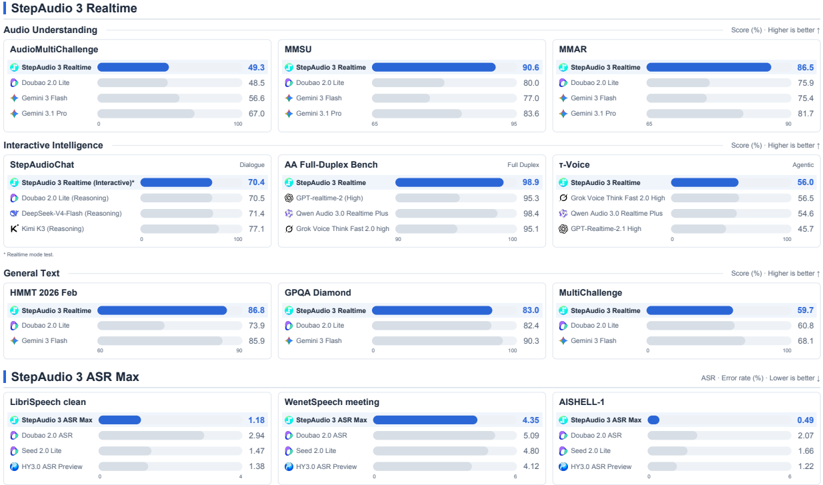
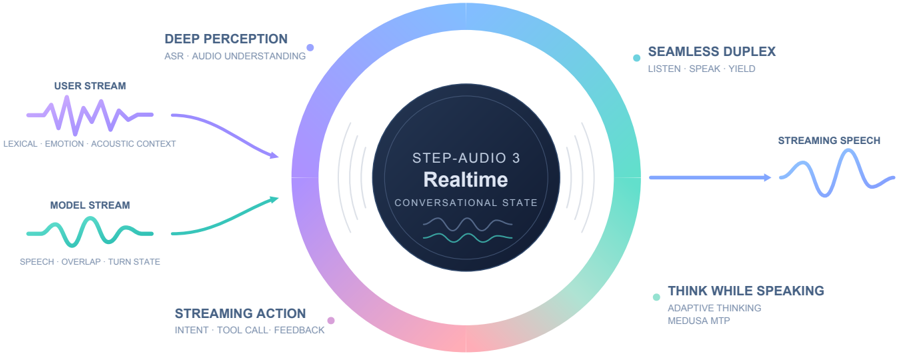
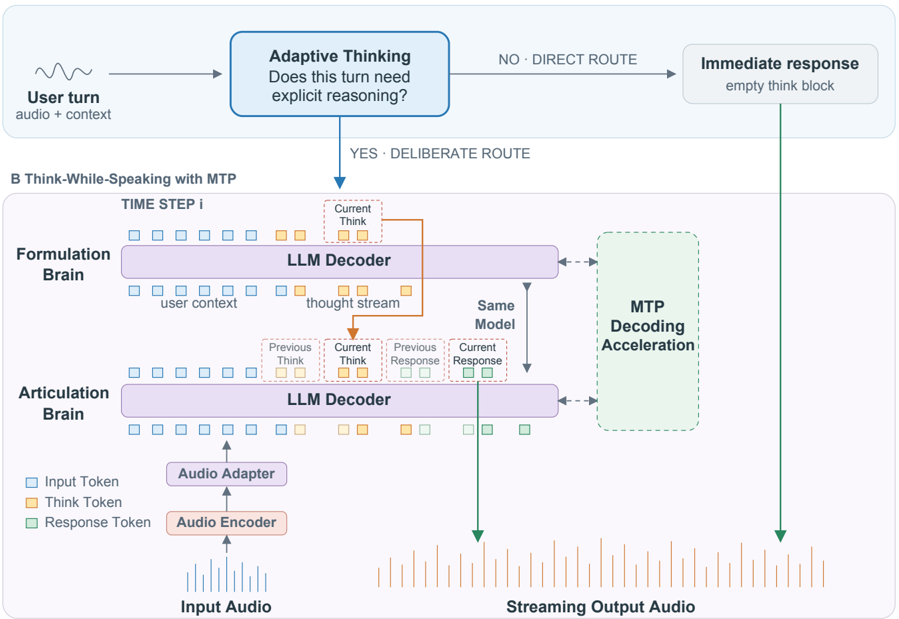
Realtime spoken interaction demands deep reasoning, prompt responses, and fluid turn-taking. We present StepAudio 3 Realtime, an audio-language foundation model organized around a continuous listen-converse-think-act loop. Deep Perception captures rich acoustic cues to interpret user intent, while Seamless Duplex models synchronized audio streams to handle pauses, backchannels, and interruptions naturally. Crucially, we resolve the tension between deep deliberation and latency via Think-While-Speaking, executing private reasoning in parallel with spoken delivery. In reasoning mode, StepAudio 3 reaches a 73.0 macro average on StepAudioChat. With Think-While-Speaking, it achieves dialogue and reasoning performance comparable to dedicated reasoning models while speaking in real time. Furthermore, an integrated Voice Agent handles asynchronous tool execution without disrupting the dialogue flow. StepAudio 3 Realtime achieves top-tier performance across key dimensions: an exceptional 90.6 on the MMSU benchmark, 98.9 Overall on the Artificial Analysis Full-Duplex Bench, and a 56.0% macro task-success rate on $τ$-Voice.
Overview
CoChat Summary
TL;DR
StepAudio 3 Realtime is an audio-language foundation model for full-duplex spoken interaction, built around a listen-converse-think-act loop with Deep Perception, Seamless Duplex, Think-While-Speaking, Adaptive Thinking, MTP, and a streaming Voice Agent. It reports top-tier full-duplex and audio-understanding results, including 98.9 Overall on the Artificial Analysis Full-Duplex Bench, 90.6 on MMSU, 73.0 macro average on StepAudioChat in reasoning mode, and 56.0% macro task success on τ-Voice.
Key findings
- Full-duplex interaction: StepAudio 3 Realtime ranks first on the Artificial Analysis Full-Duplex Bench with 98.9 Overall, including 100.0 turn taking, 99.0 user interruption handling, 98.9 pause handling, and 98.0 backchannel handling; it surpasses Qwen Audio 3.0 Realtime Plus at 98.4 Overall.
- Audio understanding: it leads four of eight benchmarks, with MMSU 90.6 versus 83.6 for Gemini 3.1 Pro and MMAR 86.5 versus 81.7; its macro average is 81.3, within 0.5 points of Gemini 3.1 Pro at 81.8, but it trails Gemini 3.1 Pro by 17.7 points on AudioMultiChallenge (49.3 versus 67.0).
- Dialogue and reasoning: in reasoning mode it reaches a 73.0 macro average on StepAudioChat, above Doubao 2.0 Lite at 70.5 and DeepSeek-V4-Flash at 71.4 but below Kimi K3 at 77.1; in realtime interaction it reaches 70.4, comparable to Doubao 2.0 Lite at 70.5.
- Agentic task completion: on τ-Voice it achieves a 56.0% macro task-success rate, close to Grok’s 56.5% and above Qwen’s 54.6% and GPT’s 45.7%, with telecom 70.2%, airline 60.0%, and retail 37.7%.
- ASR specialization: StepAudio 3 ASR Max leads the reported ASR benchmarks, including ContextASR-Bench macro-average error rates of 5.67% on English subsets and 1.23% on Mandarin subsets, compared with 6.60% and 1.69% for HY3.0 ASR Preview.
Methods
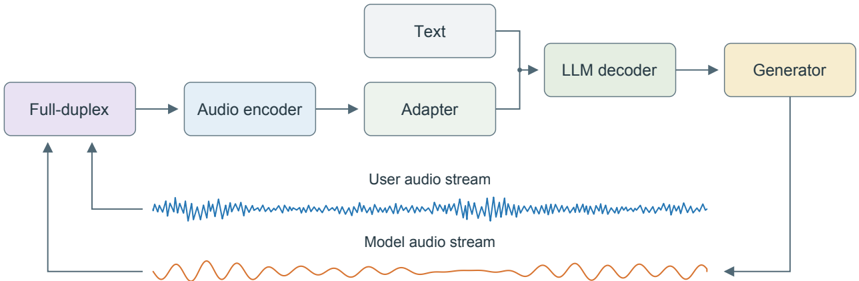
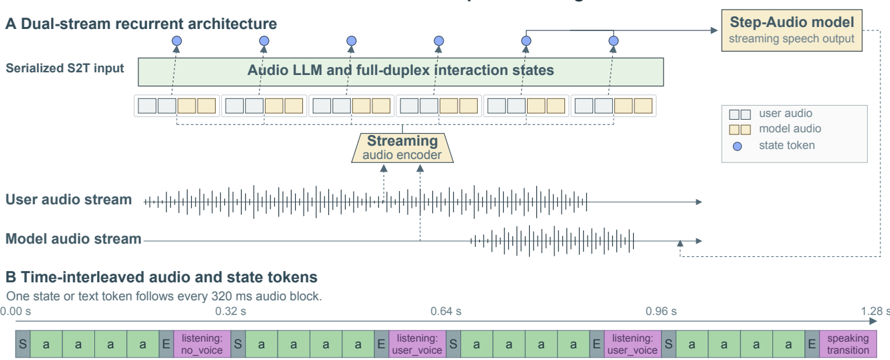
- Architecture: a mixture-of-experts model with approximately 196 billion total parameters and 11 billion active parameters per token; the language backbone is based on Step 3.7 Flash, the audio frontend uses the Qwen3-Omni Audio Transformer encoder, and an adapter maps encoder outputs into the language model’s representation space. Full-duplex input uses user and model audio streams, with audio organized into 320 ms blocks each followed by a state or text token.
- Training: three-stage pretraining (modality alignment, multimodal mixed training, cooldown) uses a fixed 32K sequence length and 1.2T training tokens; midtraining extends context to 128K and adds perception, synthetic conversational, and voice-agent data; supervised fine-tuning and post-training specialize ASR, audio understanding, full-duplex interaction, dialogue/reasoning, and tool use.
- Evaluation: ASR is evaluated on LibriSpeech test-clean/test-other, AISHELL-1, WenetSpeech test-net/test-meeting, and ContextASR-Bench; audio understanding on eight benchmarks including Big Bench Audio, MMSU, MMAU, MMAR, WildSpeech, AudioMultiChallenge, Step-Caption, and MTalk-Bench; dialogue on StepAudioChat; full-duplex on the Artificial Analysis subset of Full Duplex Bench v1 and v1.5; agentic task completion on the Artificial Analysis implementation of τ-Voice; general text on HMMT February 2026, GPQA Diamond, and MultiChallenge.
Limitations
- Stated: Adaptive Thinking reduces explicit reasoning frequency but has uneven effects; Reasoning has a think rate of 59.5% despite benefiting most from full thinking, while Faithfulness has a higher rate of 79.2% but gains only 1.72 points from full thinking. The paper also states that multi-turn constraint handling and retail task completion remain areas for improvement.
- Stated: MTP wall-clock ratios “should not be interpreted as a controlled comparison of draft depth,” and keeping strict verification for spoken output does not eliminate errors arising from incomplete private reasoning. Model merging is described as providing a balanced trade-off rather than uniform improvement over every specialized teacher.
- Evident from the text: the ASR results characterize the ASR-specialized model, not the transcription behavior of the realtime model; evaluation is benchmark-based, with no human evaluation reported in the provided text.
Model-written summary. Check it against the paper before relying on it.
Integrity signals
Registry
Cites
Statistics
Figures
Verification
Claims the paper makes
0 Valid · 2 Not valid · 13 Not checked · 84 Own results and interpretations
A result the paper reports from its own data — it cites no other source for it, so there is none to check. The quote shows it is in the paper.
In the paper
“a 56.0%macro task-success rate on τ -Voice”
§ StepAudio 3 Realtime Technical Report StepFun-Audio Team > Abstract
plain- Asserted: passes — The authors put it forward as true.
- Checkable: passes — It can be checked against evidence.
- Load-bearing: passes — The paper’s conclusions depend on it.
- Based: passes — The paper gives a reason why it holds.
A result the paper reports from its own data — it cites no other source for it, so there is none to check. The quote shows it is in the paper.
In the paper
“It ranks second on reasoning, memory, knowledge, conversational pragmatics, and persona and role consistency.”
§ StepAudio 3 Realtime Technical Report StepFun-Audio Team > Capability injection
plain- Asserted: passes — The authors put it forward as true.
- Checkable: passes — It can be checked against evidence.
- Load-bearing: unclear — It is unclear whether the paper’s conclusions depend on it.
- Based: passes — The paper gives a reason why it holds.
A result the paper reports from its own data — it cites no other source for it, so there is none to check. The quote shows it is in the paper.
In the paper
“In reasoning mode, StepAudio 3 reaches a 73.0 macro average on StepAudioChat.”
- Also stated in: § Capability injection · plain
“StepAudio 3 achieves a macro average of 73.0, above Doubao 2.0 Lite at 70.5 and DeepSeek-V4-Flash at 71.4, but below Kimi K3 at 77.1.”
§ StepAudio 3 Realtime Technical Report StepFun-Audio Team > Abstract
plain- Asserted: passes — The authors put it forward as true.
- Checkable: passes — It can be checked against evidence.
- Load-bearing: passes — The paper’s conclusions depend on it.
- Based: passes — The paper gives a reason why it holds.
- Also stated in: § Capability injection · plain
A result the paper reports from its own data — it cites no other source for it, so there is none to check. The quote shows it is in the paper.
In the paper
“an exceptional 90.6 on the MMSU benchmark”
- Also stated in: § Sampling · plain
“with its largest margins on MMSU (90.6 versus 83.6) and MMAR (86.5 versus 81.7), gains of 7.0 and 4.8 points.”
§ StepAudio 3 Realtime Technical Report StepFun-Audio Team > Abstract
plain- Asserted: passes — The authors put it forward as true.
- Checkable: passes — It can be checked against evidence.
- Load-bearing: passes — The paper’s conclusions depend on it.
- Based: passes — The paper gives a reason why it holds.
- Also stated in: § Sampling · plain
A result the paper reports from its own data — it cites no other source for it, so there is none to check. The quote shows it is in the paper.
In the paper
“StepAudio 3 Realtime leads the reported baselines on four of the eight benchmarks, with its largest margins on MMSU (90.6 versus 83.6) and MMAR (86.5 versus 81.7), gains of 7.0 and 4.8 points.”
§ StepAudio 3 Realtime Technical Report StepFun-Audio Team > Sampling
plain- Asserted: passes — The authors put it forward as true.
- Checkable: passes — It can be checked against evidence.
- Load-bearing: passes — The paper’s conclusions depend on it.
- Based: passes — The paper gives a reason why it holds.
23 more claims
Create a free account to see all 99 claims and every source verdict.
- It may state two separate claims as one. 53
- Probably not a substantial claim. 30
Citations
Cites
“Librispeech: an ASR corpus based on public domain audio books,”
Panayotov, V., Chen, G., Povey, D., & Khudanpur, S. (2015) · 2015 IEEE International Conference on Acoustics, Speech and Signal Processing (ICASSP) · doi:10.1109/icassp.2015.7178964 · Cited by 6,072
SpecAugment: A Simple Data Augmentation Method for Automatic Speech Recognition
Park, D. S., Chan, W., Zhang, Y., Chiu, C.-C., Zoph, B., Cubuk, E. D., & Le, Q. V. (2019) · Interspeech 2019 · doi:10.21437/interspeech.2019-2680 · Cited by 3,558
Toolformer: Language Models Can Teach Themselves to Use Tools
Schick, T., Dwivedi-Yu, J., Dessì, R., Raileanu, R., Lomeli, M., Zettlemoyer, L., Cancedda, N., & Scialom, T. (2023) · arXiv · doi:10.48550/arxiv.2302.04761 · Cited by 1,150
Fiscus, J. G. (2002) · 1997 IEEE Workshop on Automatic Speech Recognition and Understanding Proceedings · doi:10.1109/asru.1997.659110 · Cited by 1,091
Moshi: a speech-text foundation model for real-time dialogue
Défossez, A., Mazaré, L., Orsini, M., Royer, A., Pérez, P., Jégou, H., Grave, E., & Zeghidour, N. (2024) · arXiv · doi:10.48550/arxiv.2410.00037 · Cited by 1,027
AISHELL-1: An open-source Mandarin speech corpus and a speech recognition baseline
Bu, H., Du, J., Na, X., Wu, B., & Zheng, H. (2017) · 2017 20th Conference of the Oriental Chapter of the International Coordinating Committee on Speech Databases and Speech I/O Systems and Assessment (O-COCOSDA) · doi:10.1109/icsda.2017.8384449 · Cited by 791
ReAct: Synergizing Reasoning and Acting in Language Models
Yao, S., Zhao, J., Yu, D., Du, N., Shafran, I., Narasimhan, K., & Cao, Y. (2022) · arXiv · doi:10.48550/arxiv.2210.03629 · Cited by 608
Audiolm: A language modeling approach to audio generation
Borsos, Z., Marinier, R., Vincent, D., Kharitonov, E., Pietquin, O., Sharifi, M., Roblek, D., Teboul, O., Grangier, D., Tagliasacchi, M., et al. (2023) · IEEE/ACM Transactions on Audio, Speech, and Language Processing · doi:10.1109/taslp.2023.3288409 · Cited by 432
WENETSPEECH: A 10000+ Hours Multi-Domain Mandarin Corpus for Speech Recognition
Zhang, B., Lv, H., Guo, P., Shao, Q., Yang, C., Xie, L., Xu, X., Bu, H., Chen, X., Zeng, C., et al. (2022) · IEEE International Conference on Acoustics Speech and Signal Processing · doi:10.1109/icassp43922.2022.9746682 · Cited by 413
Self-citationStep-Audio 2 Technical ReportPreprint
Wu, B., Yan, C., Chen, H., Yi, C., Feng, C., Tian, F., Shen, F., Yu, G., Zhang, H., Li, J., et al. (2025) · arXiv (Cornell University) · doi:10.48550/arxiv.2507.16632 · Cited by 237
Gorilla: Large Language Model Connected with Massive APIs
Patil, S., Zhang, T., Wang, X., & Gonzalez, J. (2024) · Advances in Neural Information Processing Systems 37 · doi:10.52202/079017-4020 · Cited by 226
Freeze-Omni: A Smart and Low Latency Speech-to-speech Dialogue Model with Frozen LLMPreprint
Wang, X., Li, Y., Fu, C., Shen, Y., Xie, L., Li, K., Sun, X., & Ma, L. (2024) · arXiv (Cornell University) · doi:10.48550/arxiv.2411.00774 · Cited by 176
Seed-ASR: Understanding Diverse Speech and Contexts with LLM-based Speech RecognitionPreprint
Bai, Y., Chen, J., Chen, J., Chen, W., Chen, Z., Ding, C., Dong, L., Dong, Q., Du, Y., Gao, K., et al. (2024) · arXiv (Cornell University) · doi:10.48550/arxiv.2407.04675 · Cited by 152
Self-citationStep-Audio: Unified Understanding and Generation in Intelligent Speech InteractionPreprint
Huang, A., Wu, B., Wang, B., Yan, C., Hu, C., Feng, C., Tian, F., Shen, F., Li, J., Chen, M., et al. (2025) · arXiv (Cornell University) · doi:10.48550/arxiv.2502.11946 · Cited by 144
Step-Audio-R1 Technical ReportPreprint
Tian, F., Zhang, X. T., Zhang, Y., Zhang, H., Li, Y., Liu, D., Deng, Y., Wu, D., Chen, J., Zhao, L., et al. (2025) · arXiv (Cornell University) · doi:10.48550/arxiv.2511.15848 · Cited by 89
Fast Inference from Transformers via Speculative Decoding
Leviathan, Y., Kalman, M., & Matias, Y. (2022) · arXiv · doi:10.48550/arxiv.2211.17192 · Cited by 71
Paralinguistics-Aware Speech-Empowered Large Language Models for Natural Conversation
Kim, H., Seo, S., Jeong, K., Kwon, O., Kim, S. Y., Kim, J., Lee, J., Song, E., Oh, M., Ha, J.-W., et al. (2024) · neural information processing systems · doi:10.52202/079017-4166 · Cited by 43
Accelerating Large Language Model Decoding with Speculative Sampling
Chen, C., Borgeaud, S., Irving, G., Lespiau, J.-B., Sifre, L., & Jumper, J. (2023) · arXiv · doi:10.48550/arxiv.2302.01318 · Cited by 40
Gosai, A., Vuong, T., Tyagi, U., Li, S., You, W., Bavare, M., Uçar, A., 方众望, Jang, B., Liu, B., et al. (2026) · Proceedings of the conference - Association for Computational Linguistics. Meeting · doi:10.18653/v1/2026.acl-long.1654 · Cited by 34
WildSpeech-Bench: Benchmarking End-to-End SpeechLLMs in the WildPreprint
Zhang, L., Zhang, J., Lei, B., Wu, C., Liu, A., Jia, W., & Zhou, X. (2025) · arXiv (Cornell University) · doi:10.48550/arxiv.2506.21875 · Cited by 32
ContextASR-Bench: A Massive Contextual Speech Recognition BenchmarkPreprint
Wang, H., Ma, L., Guo, D., Wang, X., Xie, L., Xu, J., & Lin, J. (2025) · arXiv (Cornell University) · doi:10.48550/arxiv.2507.05727 · Cited by 31
GPQA: A Graduate-Level Google-Proof Q&A Benchmark
Rein, D., Hou, B. L., Stickland, A. C., Petty, J., Pang, R. Y., Dirani, J., Michael, J., & Bowman, S. R. (2023) · arXiv · doi:10.48550/arxiv.2311.12022 · Cited by 30
Medusa: Simple LLM Inference Acceleration Framework with Multiple Decoding Heads
Cai, T., Li, Y., Geng, Z., Peng, H., Lee, J. D., Chen, D., & Dao, T. (2024) · arXiv · doi:10.48550/arxiv.2401.10774 · Cited by 27 · cited 1×
“To reduce the decoding cost of the remaining private thinking, we use MTP3 with three prediction heads, drafting up to three future tokens at each target-model step [30, 31].”
Boosting Omni-Modal Language Models: Staged Post-Training with Visually Debiased EvaluationPreprint
Liu, C., Ma, L., Zhang, X. T., Zhang, Y., Zhang, H., Yang, X., & Tian, F. (2026) · arXiv (Cornell University) · doi:10.48550/arxiv.2605.12034 · Cited by 27
Chronological Thinking in Full-Duplex Spoken Dialogue Language Models
Wu, D., Zhang, H., Chen, C., Zhang, T., Tian, F., Yang, X., Yu, G., Liu, H., Hou, N., Hu, Y., et al. (2026) · Annual Meeting of the Special Interest Group on Discourse and Dialogue · doi:10.18653/v1/2026.sigdial-1.33 · Cited by 26
Mind-Paced Speaking: A Dual-Brain Approach to Real-Time Reasoning in Spoken Language ModelsPreprint
Wu, D., Zhang, H., Chen, J., Xiangyu, Zhang, J., Liu, H., Chng, E. S., Tian, F., Yang, X., Zhang, X., et al. (2025) · arXiv (Cornell University) · doi:10.48550/arxiv.2510.09592 · Cited by 24
Du, Y., Huang, Q., Zhu, G., Dai, Z., Chen, S., Zhu, Q., Pan, L., Chen, M., Zhang, Y., Zhou, L., et al. (2025) · arXiv (Cornell University) · doi:10.48550/arxiv.2508.18240 · Cited by 24
Code-Switching Speech Recognition Under the Lens: Model- and Data-Centric Perspectives
Liu, H., Zhang, H., Zhang, Q., Zhang, X., Shi, D., Chng, E. S., & Li, H. (2026) · IEEE Transactions on Audio Speech and Language Processing · doi:10.1109/taslpro.2026.3675776 · Cited by 21
Deng, Y., Hu, G., Sun, H., Zhang, X., Zhang, H., Tian, F., Yang, X., Yu, G., & Chng, E. S. (2025) · arXiv (Cornell University) · doi:10.48550/arxiv.2511.00850 · Cited by 18
Better & Faster Large Language Models via Multi-token Prediction
Gloeckle, F., Idrissi, B. Y., Rozière, B., Lopez-Paz, D., & Synnaeve, G. (2024) · arXiv · doi:10.48550/arxiv.2404.19737 · Cited by 15 · cited 2×
“To reduce the decoding cost of the remaining private thinking, we use MTP3 with three prediction heads, drafting up to three future tokens at each target-model step [30, 31].”
BayLing-Duplex: Native Full-Duplex Speech Dialogue with a Single Autoregressive LLMPreprint
Fang, Q., Guo, S., & Feng, Y. (2026) · arXiv (Cornell University) · doi:10.48550/arxiv.2606.14528 · Cited by 15
StepAudio 2.5 Technical ReportPreprint
Lin, B., Zhao, B., Wu, B., Yan, C., Wu, C., Yi, C., Yao, C., Liu, D., Tian, F., Tian, F., et al. (2026) · arXiv (Cornell University) · doi:10.48550/arxiv.2605.23463 · Cited by 14
Self-citationDeshpande, K., Sirdeshmukh, V., Mols, J. B., Jin, L., Hernandez-Cardona, E.-Y., Lee, D., Kritz, J., Primack, W. E., Yue, S., & Xing, C. (2025) · Findings of the Association for Computational Linguistics: ACL 2025 · doi:10.18653/v1/2025.findings-acl.958 · Cited by 13
Step-Audio-R1.5 Technical ReportPreprint
Zhang, Y., Zhang, X. T., Liu, D., Tian, F., Deng, Y., Chen, J., Lin, Q., Zhang, H., Li, Y., Gong, J., et al. (2026) · arXiv (Cornell University) · doi:10.48550/arxiv.2604.25719 · Cited by 11
Xu, J., Guo, Z., Hu, H., Chu, Y., Wang, X., He, J., Wang, Y., Shi, X., He, T., Zhu, X., et al. (2025) · arXiv · doi:10.48550/arxiv.2509.17765 · Cited by 2
Self-citationParaASR: Multi-Token Prediction for Fast and Long-Context LLM-Based Speech RecognitionPreprint
Lin, Q., Li, Y., Zhang, H., Chen, J., Huang, Y., Tian, F., Li, X., Zhang, X. T., Liu, D., Zhang, Y., et al. (2026) · arXiv (Cornell University) · doi:10.48550/arxiv.2607.29279 · Cited by 2
Self-citationKimi K3: Open Frontier Intelligence
Kimi Team, Bai, T., Bai, Y., Bao, Y., C., M., Cai, J., Cai, X., Cao, P., Cao, Y., Chai, Z., et al. (2026) · arXiv · doi:10.48550/arxiv.2607.24653
DuplexSLA: A Full-Duplex Spoken Language Model with Synchronized Speech, Language, and Action
Zhang, H., Chen, J., Wu, D., Li, Y., Zhang, Y., Zhang, X. T., Liu, C., Lin, Q., Peng, Y., Liu, H., et al. (2026) · arXiv
SpecAugment: A Simple Data Augmentation Method for Automatic Speech Recognition
Park, D. S., Chan, W., Zhang, Y., Chiu, C.-C., Zoph, B., Cubuk, E. D., & Le, Q. V. (2019) · arXiv · doi:10.48550/arxiv.1904.08779
Self-citation
Research works printed but not linked: 5
- Alec Radford, Jong Wook Kim, Tao Xu, Greg Brockman, Christine McLeavey, and Ilya Sutskever. Robust speech recognition via large-scale weak supervision. In International conference on machine learning, pages 28492-28518. PMLR, 2023.
- Changli Tang, Wenyi Yu, Guangzhi Sun, Xianzhao Chen, Tian Tan, Wei Li, Lu Lu, Zejun Ma, and Chao Zhang. Salmonn: Towards generic hearing abilities for large language models. In International Conference on Learning Representations, volume 2024, pages 16607-16629, 2024.
- Dingdong Wang, Junan Li, Jincenzi Wu, Dongchao Yang, Xueyuan Chen, Tianhua Zhang, and Helen Meng. Mmsu: A massive multi-task spoken language understanding and reasoning benchmark. In International Conference on Learning Representations, volume 2026, pages 31374-31410, 2026.
- Sakshi Sakshi, Utkarsh Tyagi, Sonal Kumar, Ashish Seth, Ramaneswaran Selvakumar, Oriol Nieto, Ramani Duraiswami, Sreyan Ghosh, and Dinesh Manocha. Mmau: A massive multi- task audio understanding and reasoning benchmark. In International Conference on Learning Representations, volume 2025, pages 84929-84964, 2025.
- Ziyang Ma, Yinghao Ma, Yanqiao Zhu, Chen Yang, Yi-Wen Chao, Ruiyang Xu, Wenxi Chen, Yuanzhe Chen, Zhuo Chen, Jian Cong, et al. Mmar: A challenging benchmark for deep reasoning in speech, audio, music, and their mix. Advances in Neural Information Processing Systems, 38, 2026.
Cited by
When History Helps and Hurts: Selective History Use across Multimodal TurnsPreprint
Sun, S., Gu, K., Fang, H., Huang, S., & Chen, B. (2026) · arXiv (Cornell University) · doi:10.48550/arxiv.2610.11948 · Cited by 1
Almost Human, Except When It Matters: VoxParity and the Decisions a Voice Should ChangePreprint
Mangla, B. (2026) · arXiv (Cornell University) · doi:10.48550/arxiv.2609.35922
TimeOmni-Live: Continuous & Live Time Series Understanding with Long-Term MemoryPreprint
Guan, T., Chemeris, A., Guo, Y., Jin, W., Li, Z., Pan, S., & Jin, M. (2026) · arXiv (Cornell University) · doi:10.48550/arxiv.2611.09502
HMU-Bench: Hierarchical Music Understanding Benchmark for Omni ModelsPreprint
Dai, Z., Wang, B., Wu, Z., Xu, Y., Shi, X., Yuan, R., Yang, X., Yan, C., & Kong, Q. (2026) · arXiv (Cornell University) · doi:10.48550/arxiv.2610.15773
MultiPartyTurnBench: Benchmarking Floor Control in Multi-Party Spoken DialoguePreprint
Mathur, P., & Manocha, D. (2026) · arXiv (Cornell University) · doi:10.48550/arxiv.2610.20172
Metadata
- Authors
- Lin, B., Zhao, B., Zhang, B., Wu, B., Yan, C., Geng, C., Wu, C., Yi, C., Feng, C., Zhu, C., Feng, C., Yao, C., Liu, D., Wan, D., Jiang, D., Li, D., Pang, D., Tian, F., Tian, F., Li, F., Yu, G., Yang, G., Zhang, H., Wang, H., Peng, J., Song, J., Xue, J., Fan, J., Zhen, J., Gao, J., Wen, J., Liang, J., Gong, J., Chen, J., Xie, L., Zhao, L., Zhang, L., Ji, L., Cai, L., Xu, M., Li, P., Yang, P., Tan, P., Lin, Q., Du, Q., Xiong, R., Li, R., Hu, S., Qin, S., Qiu, S., Tu, S., Zhou, S., Deng, T., Lu, W., Niu, W., Sun, W., Qu, W., Zhang, X., Zhang, X., Su, X., Chen, X., Liu, X., Yang, X., Wu, Y., Li, Y., Yang, Y., Huang, Y., Zhu, Y., Zhang, Y., Yan, Y., Chen, Y., Fu, Y., Luo, Y., Zhou, Y., Chen, Y., Wang, Y., Ju, Y., Yang, Y., Li, Y., Zhang, Y., Liu, Z., Yao, Z., Yuan, Z., Mou, Z., Zhang, Z., Wu, Z., Li, Z., Zhou, Z., Ren, Z., & Wang, Z.
- Venue
- arXiv
- Publisher
- arXiv
- Published
- 2026
- ISSN
- 2331-8422 (ISSN-L)
- arXiv
- 2609.14005
- OpenAlex
- W7213371127
- Semantic Scholar
- 438490f0116a9cecd6512c6719788284d19c5b42
- Cited by
- 6
- References
- 37
- Citations by year
- 2026: 6
- Type
- posted content
- Language
- en
- Open access
- green
- arxiv.org
- Licence
- Locations
- arXiv (Cornell University) (submittedVersion, cc-by-nc-nd)
- arXiv (Cornell University) (cc-by-nc-nd)
- Topics
- Physical Sciences › Computer Science › Artificial Intelligence › Speech and dialogue systems
- Physical Sciences › Computer Science › Artificial Intelligence › Speech Recognition and Synthesis
- Physical Sciences › Computer Science › Signal Processing › Speech and Audio Processing
- Keywords
- voice assistants
About these checks
Registry, retraction, Cites and statistics results are computed, not judged, with one exception: a printed reference that no index lists is read once by a model before it counts as a citation error. Claims are extracted by a model and kept only when their quote appears verbatim in the text; each cited source is then checked, with a model’s help, for whether it says what the claim relies on. Those verdicts can be wrong — read the claim’s quote and the cited source before relying on one.
A language model drew the claims from the paper on 2026-11-22, under version 3 of the claim definition (model deepseek-v4.1-flash, prompt extract-v3).
A second model labelled each claim on 2026-11-22 (model jev-1.13-20260917, definition revision gold-guideline-v0.2).
Statistics and arithmetic are recomputed, not judged.
Confidence bands are shown only for fields calibrated on our annotated test set. None is calibrated yet, so no band is shown.
What counts as a claim ›How we measure confidence ›How we check this ›
Are you an author, or do you see a problem with this page? Request a review
Data sources
Bibliographic data: Semantic Scholar, OpenAlex, Crossref.
Contains information from the Semantic Scholar Academic Graph Datasets, made available under the ODC Attribution License (ODC-BY 1.0).
Semantic Scholar’s data is described in: Kinney, R., et al. (2023). The Semantic Scholar Open Data Platform. arXiv:2301.10140.
