

A Randomized Double-blind Placebo-controlled Trial on the Effect of Magnesium Oxide in Patients With Chronic Constipation
Open accessThe DOI matches its Crossref record; 40 of the 40 references it cites were found in a registry or an index.
Abstract
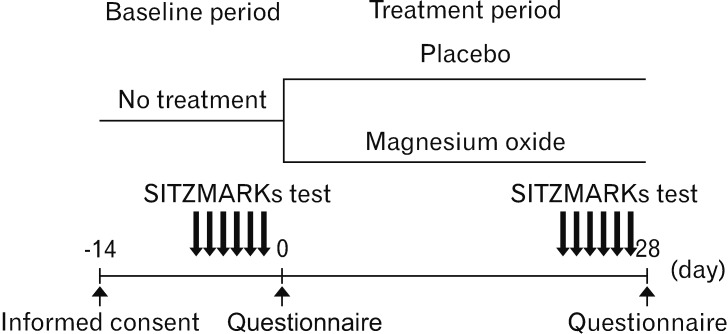
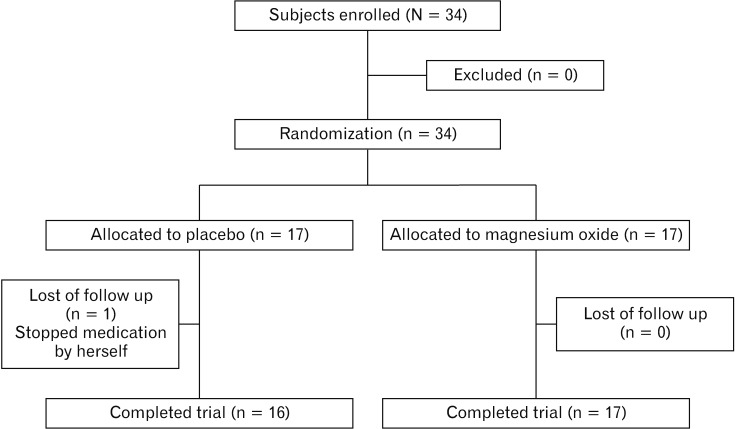
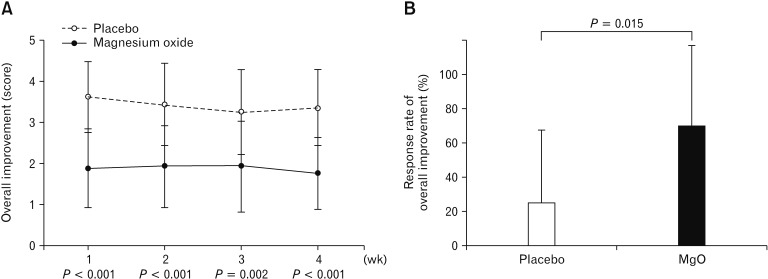
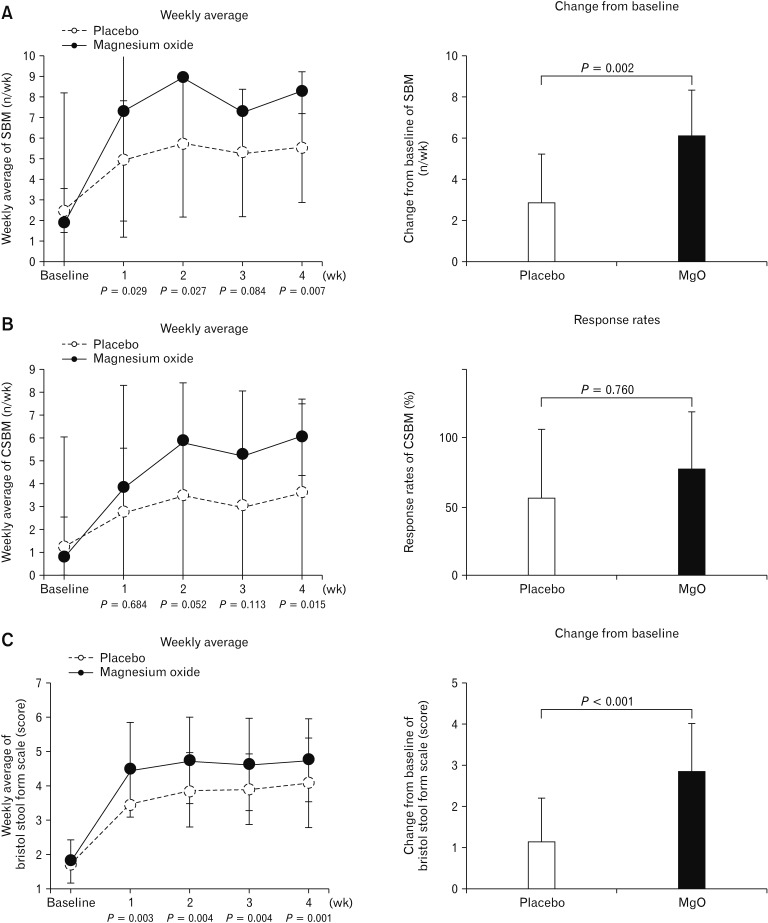
BACKGROUND/AIMS: Magnesium oxide (MgO) has been frequently used as a treatment for chronic constipation (CC) since the 1980s in Japan. The aim of this study is to evaluate its therapeutic effects of MgO in Japanese CC patients. METHODS: We conducted a randomized, double-blind placebo-controlled study. Thirty-four female patients with mild to moderate constipation were randomly assigned to either placebo (n = 17) or MgO group (n = 17) 0.5 g × 3/day for 28 days. Primary endpoint was overall improvement over the 4-week study period. Secondary endpoints were changes from baseline in spontaneous bowel movement (SBM), response rates of complete spontaneous bowel movement (CSBM), stool form, colonic transit time (CTT), abdominal symptom, and quality of life. RESULTS: = 0.003). CONCLUSION: Our placebo-controlled study demonstrated that MgO was effective treatment for improving defecation status and shortened CTT in Japanese CC patients with mild to moderate symptoms.
Overview
The claims and statistics of this paper haven’t been checked yet.
Free: it reads the open-access text and checks the first 5 claims that cite a source we can check. Create a free account to check every claim.
Integrity signals
Registry
Cites
Statistics
Figures
Verification
Claims the paper makes
The claims and statistics of this paper haven’t been checked yet.
Free: it reads the open-access text and checks the first 5 claims that cite a source we can check. Create a free account to check every claim.
Claims other papers make about this one
Each is checked against this paper’s own text: does it say what the citing paper says it does?
The source backs part of the claim, not all of it — or backs it for a different population, condition or comparison.
In the citing paper
“Compared with placebo, treatment with MgO may increase the number of CSBMs per week (MD 4.29, 95% CI 2.93-5.65) and SBMs per week (MD 3.59, 95% CI 2.64-4.54).”
From American Gastroenterological Association-American College of Gastroenterology Clinical Practice Guideline: Pharmacological Management of Chronic Idiopathic Constipation (2023) · cites this paper as [43]
Experimental — accuracy not yet measuredThe check wasn’t confident either way, so it gives no verdict — never disputed.
In the citing paper
“The available data suggest no increased reports of diarrhea with MgO compared with placebo. 43”
From American Gastroenterological Association-American College of Gastroenterology Clinical Practice Guideline: Pharmacological Management of Chronic Idiopathic Constipation (2023) · cites this paper as [43]
Experimental — accuracy not yet measured
Self-check
Percentages, sums and reported differences re-computed from the paper’s own numbers.
The self-check needs the paper’s full text.
Citations
Cites
Longstreth, G. F., Thompson, W. G., Chey, W. D., Houghton, L. A., Mearin, F., & Spiller, R. C. (2006) · Gastroenterology · doi:10.1053/j.gastro.2005.11.061 · Cited by 4,856
Lacy, B. E., Mearin, F., Chang, L., Chey, W. D., Lembo, A. J., Simren, M., & Spiller, R. (2016) · Gastroenterology · doi:10.1053/j.gastro.2016.02.031 · Cited by 2,866
Patient-Reported Outcomes after Monitoring, Surgery, or Radiotherapy for Prostate Cancer
Donovan, J. L., Hamdy, F. C., Lane, J. A., Mason, M., Metcalfe, C., Walsh, E., Blazeby, J. M., Peters, T. J., Holding, P., Bonnington, S., et al. (2016) · New England Journal of Medicine · doi:10.1056/nejmoa1606221 · Cited by 1,338
A constipation scoring system to simplify evaluation and management of constipated patients
Agachan, F., Chen, T., Pfeifer, J., Reissman, P., & Wexner, S. D. (1996) · Diseases of the Colon & Rectum · doi:10.1007/bf02056950 · Cited by 1,253
Simplified assessment of segmental colonic transit
Metcalf, A. M., Phillips, S. F., Zinsmeister, A. R., MacCarty, R. L., Beart, R. W., & Wolff, B. G. (1987) · Gastroenterology · doi:10.1016/0016-5085(87)90837-7 · Cited by 928 · cited 1×
“We also used the segmental method to evaluate the transit time for the right colon, the left colon, and the rectosigmoid colon separately.(26)”
MethodAmerican Gastroenterological Association Technical Review on Constipation
Bharucha, A. E., Pemberton, J. H., & Locke, G. R. (2013) · Gastroenterology · doi:10.1053/j.gastro.2012.10.028 · Cited by 909
Lembo, A., & Camilleri, M. (2003) · New England Journal of Medicine · doi:10.1056/nejmra020995 · Cited by 692
Development and validation of the Patient Assessment of Constipation Quality of Life questionnaire
Marquis, P., De La Loge, C., Dubois, D., McDermott, A., & Chassany, O. (2005) · Scandinavian Journal of Gastroenterology · doi:10.1080/00365520510012208 · Cited by 584
Detection of pseudodiarrhoea by simple clinical assessment of intestinal transit rate.
O'Donnell, L. J., Virjee, J., & Heaton, K. W. (1990) · BMJ · doi:10.1136/bmj.300.6722.439 · Cited by 546
Rao, S., Lembo, A. J., Shiff, S. J., Lavins, B. J., Currie, M. G., Jia, X. D., Shi, K., MacDougall, J. E., Shao, J. Z., Eng, P., et al. (2012) · American Journal of Gastroenterology · doi:10.1038/ajg.2012.255 · Cited by 384
Cited by
Chang, L., Chey, W. D., Imdad, A., Almario, C. V., Bharucha, A. E., Diem, S., Greer, K. B., Hanson, B., Harris, L. A., Ko, C., et al. (2023) · Gastroenterology · doi:10.1053/j.gastro.2023.03.214 · Cited by 185
Nakajima, A., Seki, M., Taniguchi, S., Ohta, A., Gillberg, P.-G., Mattsson, J. P., & Camilleri, M. (2018) · The Lancet Gastroenterology & Hepatology · doi:10.1016/s2468-1253(18)30123-7 · Cited by 169
Chronic Constipation: Is a Nutritional Approach Reasonable?
Bellini, M., Tonarelli, S., Barracca, F., Rettura, F., Pancetti, A., Ceccarelli, L., Ricchiuti, A., Costa, F., de Bortoli, N., Marchi, S., et al. (2021) · Nutrients · doi:10.3390/nu13103386 · Cited by 129
“Excessive use of this type of water is not recommended in elderly patients with renal insufficiency because the risk of hypermagnesemia could be higher [16].”
BackgroundMagnesium Oxide in Constipation
Mori, H., Tack, J. F., & Suzuki, H. (2021) · Nutrients · doi:10.3390/nu13020421 · Cited by 119
“conducted a randomized, double-blind placebo-controlled study comparing magnesium oxide with placebo [20].”
MethodKubota, M., Ito, K., Tomimoto, K., Kanazaki, M., Tsukiyama, K., Kubota, A., Kuroki, H., Fujita, M., & Vandenplas, Y. (2020) · Nutrients · doi:10.3390/nu12010225 · Cited by 99
“MgO is an osmotic laxative frequently used in constipation treatment for patients of all ages [10].”
BackgroundMorishita, D., Tomita, T., Mori, S., Kimura, T., Oshima, T., Fukui, H., & Miwa, H. (2021) · American Journal of Gastroenterology · doi:10.14309/ajg.0000000000000942 · Cited by 65
Self-citationKang, S., Park, M. Y., Brooks, I., Lee, J., Kim, S. H., Kim, J. Y., Oh, B., Kim, J. W., & Kwon, O. (2021) · Food Research International · doi:10.1016/j.foodres.2021.110428 · Cited by 53
Evidence-Based Clinical Guidelines for Chronic Constipation 2023
Ihara, E., Manabe, N., Ohkubo, H., Ogasawara, N., Ogino, H., Kakimoto, K., Kanazawa, M., Kawahara, H., Kusano, C., Kuribayashi, S., et al. (2024) · Digestion · doi:10.1159/000540912 · Cited by 98
Self-citationChang, L., Chey, W. D., Imdad, A., Almario, C. V., Bharucha, A. E., Diem, S. J., Greer, K. B., Hanson, B., Harris, L. A., Ko, C. W., et al. (2023) · The American Journal of Gastroenterology · doi:10.14309/ajg.0000000000002227 · Cited by 57
“The available data suggest no increased reports of diarrhea with MgO compared with placebo (43).”
BackgroundAssociation between irritable bowel syndrome and micronutrients: A systematic review
Bek, S., Teo, Y. N., Tan, X., Fan, K. H., & Siah, K. T. H. (2022) · Journal of Gastroenterology and Hepatology · doi:10.1111/jgh.15891 · Cited by 47
2022 Seoul Consensus on Clinical Practice Guidelines for Functional Constipation
Cho, Y. S., Lee, Y. J., Shin, J. E., Jung, H., Park, S., Kang, S. J., Song, K. H., Kim, J., Lim, H. C., Park, H. S., et al. (2023) · Journal of Neurogastroenterology and Motility · doi:10.5056/jnm23066 · Cited by 54
Alavi, K., Thorsen, A. J., Fang, S. H., Burgess, P. L., Trevisani, G., Lightner, A. L., Feingold, D. L., & Paquette, I. M. (2024) · Diseases of the Colon & Rectum · doi:10.1097/dcr.0000000000003430 · Cited by 29
Management of Chronic Constipation: A Comprehensive Review
Hojo, M., Shibuya, T., & Nagahara, A. (2023) · Internal Medicine · doi:10.2169/internalmedicine.2867-23 · Cited by 28
“Recently, Mori et al. (37) and Mor-ishita et al. (38) reported the results of RCTs showing the benefits of Mg oxide.”
Nakajima, A., Fujimaki, M., Arai, Y., & Emori, K. (2022) · Journal of Neurogastroenterology and Motility · doi:10.5056/jnm20263 · Cited by 20
“30 However, periodic monitoring of serum magnesium levels is strongly recommended for its safe use because the risk of developing hypermagnesemia has been shown in elderly patients and those with renal failure prescribed magnesium oxide after long-term use.”
Magnesium for disease treatment and prevention: emerging mechanisms and opportunities
Gao, Q., & Çil, O. (2024) · Trends in Pharmacological Sciences · doi:10.1016/j.tips.2024.06.004 · Cited by 21
van der Schoot, A., Creedon, A., Whelan, K., & Dimidi, E. (2023) · Neurogastroenterology & Motility · doi:10.1111/nmo.14613 · Cited by 12
“22 Bias in selective reporting was judged to be “some concerns”, while all other domains were “low-risk”.”
BackgroundNakajima, A., Shoji, A., Kokubo, K., & Igarashi, A. (2021) · Gastroenterology Research and Practice · doi:10.1155/2021/5534687 · Cited by 14
“Of the 10 eligible studies, 2 RCTs on magnesium oxide [21] and polyethylene glycol [17] were omitted from the main analyses: magnesium oxide is used as a first-line treatment option for patients with CIC, whereas the other medications are used for patients who do not respond to first-line treatment, and polyethylene g…”
BackgroundReview of the Safety Profiles of Laxatives in Pregnant Women
Brigstocke, S., Yu, V., & Nee, J. (2022) · Journal of Clinical Gastroenterology · doi:10.1097/mcg.0000000000001660 · Cited by 12
Manabe, N., Umeyama, M., Ishizaki, S., Ota, T., Kuratani, S., Katsumata, R., Fujita, M., Haruma, K., & Camilleri, M. (2023) · BMJ Open Gastroenterology · doi:10.1136/bmjgast-2023-001257 · Cited by 18
“This did not change the ratio of primary to secondary BAs but significantly increased the faecal excretion of DCA.”
Dimidi, E. (2025) · Proceedings of The Nutrition Society · doi:10.1017/s0029665125100694 · Cited by 12
“…magnesium oxide supplements significantly reduced gut transit time from baseline (mean 75 · 5, SD 37 · 3 h) to week 4 (mean 41 · 6, SD 30 · 5 h; P < 0 · 001), whereas no difference was found in the control group; however, no direct comparison between the two groups was reported at week 4 (21) .”
Bassotti, G., Villanacci, V., & Corsetti, M. (2023) · Journal of Clinical Medicine · doi:10.3390/jcm12041702 · Cited by 14
“Magnesium oxide Strong [17,18,20–23] RCT [17] [18] [20] [21] [22] [23] 0.”
BackgroundYoneda, H., Tomita, T., Kitano, T., Morishita, D., Kodani, M., Nishii, N., Sei, H., Eda, H., Sato, T., Kawai, M., et al. (2026) · Neurogastroenterology & Motility · doi:10.1111/nmo.70378 · Cited by 6
Self-citationAbe, T., Kunimoto, M., Hachiro, Y., Ohara, K., Inagaki, M., Hishiyama, H., & Murakami, M. (2021) · Journal of the Anus Rectum and Colon · doi:10.23922/jarc.2020-104 · Cited by 7
“Among these, magnesium oxide (MgO) has been frequently used in Japan since the 1980s[3].”
BackgroundKessoku, T., Ishihara, Y., Takahashi, K., Dang, T. H., Ohira, M., Horiuchi, M., Shibata, C., Uchida, A., Toriumi, Y., Misawa, N., et al. (2025) · Neurogastroenterology & Motility · doi:10.1111/nmo.70106 · Cited by 8
“Previous studies have reported that both MgO and EXB improve CSBM [13, 29], but none have directly compared the two.”
Kessoku, T., Higashibata, T., Morioka, Y., Naya, N., Koretaka, Y., Ichikawa, Y., Hisanaga, T., & Nakajima, A. (2024) · Cureus · doi:10.7759/cureus.55925 · Cited by 4
“Some clinical studies, including prospective, randomized, double-blind, placebo-controlled trials for chronic constipation; a retrospective, cohort study for OIC; and a randomized controlled trial comparing magnesium oxide to naldemedine, were reported [17-19].”
BackgroundIntake of fiber and micronutrients in patients with IBS
Roth, B., Al-Shareef, D., & Ohlsson, B. (2025) · Scandinavian Journal of Gastroenterology · doi:10.1080/00365521.2025.2535721 · Cited by 3
“Treatment with magnesium improves both constipation symptoms and quality of life [57].”
Seoul Consensus on Clinical Practice Guidelines for Functional Constipation
Song, K. H., Cho, Y. S., Shin, J. E., Jung, H., Park, S., Kang, S. J., Kim, J., Lee, Y. J., Lim, H. C., Park, H. S., et al. (2025) · Korean Journal of Gastroenterology · doi:10.4166/kjg.2024.156 · Cited by 3
Guk, J., Lokominienė, R. K., & Jatužis, D. (2025) · Frontiers in Neurology · doi:10.3389/fneur.2025.1581590 · Cited by 2
“It is typically recommended for the treatment of arrhythmias and as a supplement to enhance glycemic control and facilitate muscle cramps, hypertension, constipation, sleep quality, mood, and anxiety (39–42).”
Renzi, A., Brusciano, L., Talento, P., Marano, L., Iacobellis, F., Vallo, A., Frezza, G., Grillo, M., Palumbo, A., Palladino, E., et al. (2026) · Annals of Coloproctology · doi:10.3393/ac.2025.00899.0128 · Cited by 4
Defecation after magnesium supplementation enhances cognitive performance in triathletes
Wei, C.-C., Harris, M. B., Ye, M., Nicholls, A., AlKhatib, A. H., Dewi, L., Huang, C.-Y., & Kuo, C. (2024) · Sports Medicine and Health Science · doi:10.1016/j.smhs.2024.04.001 · Cited by 2
Usefulness of Elobixibat in Patients With Chronic Constipation After Cholecystectomy
Sakai, Y., Tsuyuguchi, T., Kumagai, J., Ohyama, H., Kaiho, T., Ohtsuka, M., & Kato, N. (2024) · Cureus · doi:10.7759/cureus.67132 · Cited by 4
“In pharmacotherapy, drugs with various mechanisms of action are available, and their usefulness has been reported [12-16].”
BackgroundSonohata, M., Kitamura, M., Hashimoto, A., & Morioka, Y. (2025) · Cureus · doi:10.7759/cureus.78212 · Cited by 2
Efficacy of elobixibat for elderly patients with chronic constipation in a clinic
Sakai, Y., Tsuyuguchi, T., Kumagai, J., Ohyama, H., Kaiho, T., Ohtsuka, M., & Kato, N. (2025) · World Journal of Gastrointestinal Pharmacology and Therapeutics · doi:10.4292/wjgpt.v16.i2.105801 · Cited by 5
Tanaka, K., Kessoku, T., Yamamoto, A., Takahashi, K., Kasai, Y., Ozaki, A., Iwaki, M., Kobayashi, T., Yoshihara, T., Misawa, N., et al. (2022) · BMJ Open · doi:10.1136/bmjopen-2021-060704 · Cited by 3
Wen, Y., Zhan, Y., Du, L., Li, J., Shen, X.-L., He, B., Chen, T., & Tang, X. (2024) · Journal of Traditional and Complementary Medicine · doi:10.1016/j.jtcme.2024.11.011 · Cited by 2
Yamamoto, A., Kessoku, T., Tanaka, K., Takahashi, K., Kasai, Y., Ozaki, A., Iwaki, M., Kobayashi, T., Yoshihara, T., Misawa, N., et al. (2022) · Contemporary Clinical Trials Communications · doi:10.1016/j.conctc.2022.100958 · Cited by 1
Hypermagnesemia in a psychiatric hospital
Takenaka, R., Emori, K., & Kawashima, H. (2025) · Psychiatry and Clinical Neurosciences Reports · doi:10.1002/pcn5.70155 · Cited by 1
Cho, J. H., Jin, C., Kwon, S., Cho, S., Park, S.-U., Jung, W., Moon, S., Park, J., Ko, C., & Cho, K. (2022) · 대한한의학회지 · doi:10.13048/jkm.22043
Tomita, T., Morishita, D., & Miwa, H. (2021) · The American Journal of Gastroenterology · doi:10.14309/ajg.0000000000001099 · Cited by 1
Self-citationOgata, T., Kessoku, T., Jono, T., Kasai, Y., Ozaki, A., Tanaka, K., Takahashi, K., Yamamoto, A., Iwaki, M., Kobayashi, T., et al. (2022) · Research Square · doi:10.21203/rs.3.rs-2001863/v1
Yoshida, T., Furukubo, T., Izumi, S., Shoji, S., & Yamakawa, T. (2024) · Renal Replacement Therapy · doi:10.1186/s41100-024-00546-y · Cited by 1
“Previous reports using MgO as a laxative have utilized doses of 1500 mg/ day [20–22]; however, a much lower dose was administered to the patients undergoing HD in the present study.”
MethodCost–utility analysis of treatment strategies for chronic constipation in Japan
Hojo, M., Igarashi, A., Shoji, A., & Nagahara, A. (2025) · Journal of Gastroenterology · doi:10.1007/s00535-025-02302-3 · Cited by 1
“In the MgO clinical trial [15], the number of participants achieving SBM24 (i.e., the total number of participants and the number achieving SBM within 24 h) was not explicitly reported in the publication.”
Chronische Obstipation und obstruktives Defäkationssyndrom
Tatu, A. M. (2026) · Die Gastroenterologie · doi:10.1007/s11377-026-00997-1
Pandit, S., & Gupta, D. (2026) · International Journal of Reproduction Contraception Obstetrics and Gynecology · doi:10.18203/2320-1770.ijrcog20262157
The mechanisms and management of fecal incontinence in geriatric neurological diseases
Sakakibara, R. (2026) · Clinical Autonomic Research · doi:10.1007/s10286-026-01232-1
Magnesium: Hype and Health Benefits
Sankararaman, S., Memel, Z., Jm, D., & Rocha, J. P. (2026) · Current Nutrition Reports · doi:10.1007/s13668-026-00786-w
“…constipation, citing two, placebo-controlled randomized control trials (RCTs) using 1.5 g of magnesium oxide daily for 4 weeks in patients with chronic constipation with a resulting higher improvement in constipation in the treatment arm compared with placebo (RR 3.92, 95% CI 2.04–7.56) [30, 31].”
InfluentialEfficacy of Magnesium Supplementation in Functional Constipation: A Systematic Review
Kadhem, H., Alasfoor, W., Ali, M. S., Sarhan, T., Bhojaraja, V. S., & Shetty, J. K. (2026) · Cureus · doi:10.7759/cureus.116715
“The seven studies included 690 patients, comprising five RCTs [15-19] and two nonrandomized studies.”
Influential
Metadata
- Authors
- Mori, S., Tomita, T., Fujimura, K., Asano, H., Ogawa, T., Yamasaki, T., Kondo, T., Kono, T., Tozawa, K., Oshima, T., Fukui, H., Kimura, T., Watari, J., & Miwa, H.
- Affiliations
- Hyogo Medical University (JP)
- Corresponding author
- Tomita, Toshihiko
- ORCID
- Venue
- Journal of Neurogastroenterology and Motility
- Published
- 2019-10-30
- Volume
- 25
- Issue
- 4
- Pages
- 563-575
- ISSN
- 2093-0879 (ISSN-L)
- 2093-0887
- PMC
- PMC6786451
- OpenAlex
- W2978309347
- Cited by
- 47
- References
- 40
- Citations by year
- 2026: 7 · 2025: 9 · 2024: 8 · 2023: 7 · 2022: 7 · 2021: 6 · 2020: 2
- FWCI
- 3.42
- Type
- journal article
- Language
- en
- Open access
- diamond
- doi.org
- Licence
- cc-by-nc
- Locations
- Journal of Neurogastroenterology and Motility (publishedVersion, cc-by-nc)
- PubMed Central (publishedVersion, cc-by-nc)
- PubMed (publishedVersion)
- Topics
- Health Sciences › Medicine › Gastroenterology › Gastrointestinal motility and disorders
- Health Sciences › Medicine › Urology › Pelvic floor disorders treatments
- Health Sciences › Medicine › Surgery › Congenital gastrointestinal and neural anomalies
- Keywords
- magnesium oxide, chronic constipation, colonic transit time, spontaneous bowel movements, stool consistency, abdominal symptoms, quality of life, Japanese patients
About these checks
Registry, retraction, Cites and statistics results are computed, not judged, with one exception: a printed reference that no index lists is read once by a model before it counts as a citation error. Claims are extracted by a model and kept only when their quote appears verbatim in the text; each cited source is then checked, with a model’s help, for whether it says what the claim relies on. Those verdicts can be wrong — read the claim’s quote and the cited source before relying on one.
Statistics and arithmetic are recomputed, not judged.
Confidence bands are shown only for fields calibrated on our annotated test set. None is calibrated yet, so no band is shown.
What counts as a claim ›How we measure confidence ›How we check this ›
Are you an author, or do you see a problem with this page? Request a review
Data sources
Bibliographic data: Semantic Scholar, OpenAlex, Crossref.
Contains information from the Semantic Scholar Academic Graph Datasets, made available under the ODC Attribution License (ODC-BY 1.0).
Semantic Scholar’s data is described in: Kinney, R., et al. (2023). The Semantic Scholar Open Data Platform. arXiv:2301.10140.
