

Précis of The Edge of Sentience: Risk and Precaution in Humans, Other Animals, and AI
Open accessThe DOI matches its Crossref record; 34 of the 34 references it cites were found in a registry or an index; none of the 37 sources its claims cite is checked for support yet.
Abstract
We often face grave practical decisions that seem to hinge on whether a system is sentient. This family of cases includes invertebrate animals, people who are unresponsive after brain injury, fetuses, neural organoids, and now AI technologies. We must decide what to do despite ongoing disagreement about the nature of sentience. In our state of uncertainty, we should pragmatically transform the question from “Is it sentient?” to “Is it a sentience candidate, an investigation priority, or neither?”. When a system is a sentience candidate, it is negligent to fail to consider precautions. We should instead evaluate precautions for their proportionality using the “PARC tests”. When we think about the problems in this way, we see that overconfidence about the absence of sentience has repeatedly led decision makers to neglect serious risks. Erring on the side of caution requires many revisions to current practice in many areas of human activity.
Overview
CoChat Summary
TL;DR
This précis summarizes Birch’s book arguing that when sentience is uncertain, decision-makers should shift from “Is it sentient?” to “Is it a sentience candidate, an investigation priority, or neither?” and apply proportionate precautions via the PARC tests. It applies this framework across unresponsive patients, fetuses, neural organoids, invertebrates, and AI.
Key findings
- The pivotal claim is a pragmatic shift from “Is it sentient?” to “Is it a sentience candidate, an investigation priority, or neither?”; when a system is a sentience candidate, it is negligent to fail to consider precautions, and precautions should be proportionate using the PARC tests: permissibility-in-principle, adequacy, reasonable necessity, and consistency.
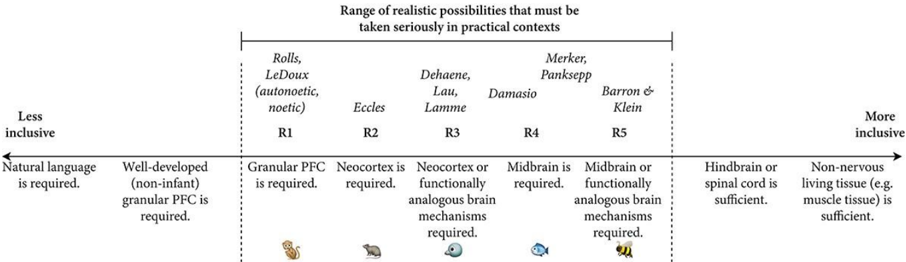
- Midbrain-centric theories (Panksepp, Damasio, Merker) describe realistic possibilities it would be irresponsible to ignore; the author says he would give this family about a 50% chance of being right, but even a 10% chance must be taken seriously when risks are serious.
- Case applications include: human fetuses as sentience candidates from the start of the second trimester; neural organoids as sentience candidates if they develop or innervate a functioning brainstem/midbrain or artificial substitute; coleoid cephalopods and Pleocyemata decapods as clear sentience candidates, while Dendrobranchiata shrimps are investigation priorities; octopuses satisfied at least seven of eight criteria in the 2021 review; a ban on octopus farming is argued by the author and 99 other experts; live boiling should not be used as a slaughter method for any decapod.
- For AI, chatbots create a powerful illusion of sentience, with more than half of users believing there is some chance they are sentient; the author says “no one is there” because each conversational step is processed separately, and more credible artificial sentience pathways are connectome emulation, evolved agents, and minimal computational architectures, under a “run-ahead principle.”
Methods
- Design: a conceptual/philosophical précis of Birch’s 2024 book, developing a consistent precautionary framework across a family of cases; it is not an empirical study.
- Data or sample: no new empirical sample; it draws on cited literature and examples, including the 2021 cephalopod/decapod review, fetal pain evidence, neural organoid studies, and AI/LLM user-attribution findings.
- Main analysis: normative and conceptual argument proposing bridging concepts (sentience candidate, investigation priority), four pillars of precautionary thinking, the PARC tests, citizens’ assemblies, and case-specific proportionality proposals.
Limitations
- Stated: the précis is “very quick and a little dense”; the author made simplifications and directs readers to the book for more careful treatment; proposals are “debate starters,” and he does not claim to have all the answers.
- Stated: the AI section has been updated slightly since 2024, and the book itself is from 2024.
- Evident: as a précis, it cannot fully present the book’s arguments or evidence; many empirical claims rely on cited studies not detailed here, and judgments about sentience candidature and proportionality have an ethical component and are contestable.
Model-written summary. Check it against the paper before relying on it.
Integrity signals
Registry
Cites
Statistics
Figures



Verification
Claims the paper makes
0 Valid · 7 Not valid · 27 Not checked · 77 Own results and interpretations
A result the paper states — it cites no source for it, so there is none to check. The quote shows it is in the paper.
In the paper
“When we turn our attention to molluscs other than the cephalopods (such as gastropod molluscs, including snails) and to other arthropods (such as arachnids, including spiders) we find a frustrating paucity of studies looking for markers of sentience.”
§ Précis of The Edge of Sentience: Risk and Precaution in Humans, Other Animals, and AI Précis of The Edge of Sentience: Risk and Precaution in Humans, Other Animals, and AI > 6. Converging on precautions.
plain- Asserted: passes — The authors put it forward as true.
- Checkable: passes — It can be checked against evidence.
- Load-bearing: passes — The paper’s conclusions depend on it.
- Based: passes — The paper gives a reason why it holds.
A result the paper states — it cites no source for it, so there is none to check. The quote shows it is in the paper.
In the paper
“But we currently lack the sort of evidence base that would be needed to inform discussions about proportionality.”
§ Précis of The Edge of Sentience: Risk and Precaution in Humans, Other Animals, and AI Précis of The Edge of Sentience: Risk and Precaution in Humans, Other Animals, and AI > 6. Converging on precautions.
plain- Asserted: passes — The authors put it forward as true.
- Checkable: passes — It can be checked against evidence.
- Load-bearing: passes — The paper’s conclusions depend on it.
- Based: passes — The paper gives a reason why it holds.
A result the paper reports from its own data — it cites no other source for it, so there is none to check. The quote shows it is in the paper.
In the paper
“We reported with high confidence that octopuses satisfied at least seven of our eight criteria.”
§ Précis of The Edge of Sentience: Risk and Precaution in Humans, Other Animals, and AI Précis of The Edge of Sentience: Risk and Precaution in Humans, Other Animals, and AI > 6. Converging on precautions.
boosted- Asserted: passes — The authors put it forward as true.
- Checkable: passes — It can be checked against evidence.
- Load-bearing: passes — The paper’s conclusions depend on it.
- Based: passes — The paper gives a reason why it holds.
In the paper
“And there is a realistic possibility that midbrain mechanisms suffice for basic sentience even if cortical injury prevents a patient from following spoken commands in any way (Panksepp et al. 2007).”
§ Précis of The Edge of Sentience: Risk and Precaution in Humans, Other Animals, and AI Précis of The Edge of Sentience: Risk and Precaution in Humans, Other Animals, and AI > 6. Converging on precautions.
What the sources say
- Not checked yetcites Panksepp et al. 2007 matched to “Does any aspect of mind survive brain damage that typically leads to a persistent vegetative state? Ethical considerations” (2007) source
hedgedstates a possible cause- Asserted: passes — The authors put it forward as true.
- Checkable: passes — It can be checked against evidence.
- Load-bearing: passes — The paper’s conclusions depend on it.
- Based: passes — The paper gives a reason why it holds.
A conclusion the paper draws from its own results — it cites no other source for it, so there is none to check. The quote shows it is in the paper.
In the paper
“Sentient animals might not impress us with their intelligence or brain size.”
§ Précis of The Edge of Sentience: Risk and Precaution in Humans, Other Animals, and AI Précis of The Edge of Sentience: Risk and Precaution in Humans, Other Animals, and AI > 6. Converging on precautions.
hedged- Asserted: passes — The authors put it forward as true.
- Checkable: passes — It can be checked against evidence.
- Load-bearing: passes — The paper’s conclusions depend on it.
- Based: passes — The paper gives a reason why it holds.
44 more claims
Create a free account to see all 111 claims and to verify the 24 references still open.
- Probably not a substantial claim. 50
- It may state two separate claims as one. 22
Self-check
Percentages, sums and reported differences re-computed from the paper’s own numbers.
Each contradiction between two passages listed here was confirmed by an independent check.
Rated minor: it would not touch a result — a value no result rests on, a p-value that stays on the same side of the significance level, or a conflict that is clerical, resolved elsewhere in the paper, or outside its own findings.
In the paper
§ Précis of The Edge of Sentience: Risk and Precaution in Humans, Other Animals, and AI Précis of The Edge of Sentience: Risk and Precaution in Humans, Other Animals, and AI > 6. Converging on precautions.
“In one remarkable study, a system mounted on electrode array was trained to play the video game Pong, showing measurable improvement across twenty minutes of gameplay (Kagan et al 2021).”
§ Précis of The Edge of Sentience: Risk and Precaution in Humans, Other Animals, and AI Précis of The Edge of Sentience: Risk and Precaution in Humans, Other Animals, and AI > References
“25. Kagan, B. J., Kitchen, A. C., Tran, N. T., Habibollahi, F., Khajehnejad, M., Parker, B. J., Bhat, A., Rollo, B., Razi, A., and Friston, K. J. (2022) In vitro neurons learn and exhibit sentience when embodied in a simulated game-world.”
Rated minor: it would not touch a result — a value no result rests on, a p-value that stays on the same side of the significance level, or a conflict that is clerical, resolved elsewhere in the paper, or outside its own findings.
In the paper
§ Précis of The Edge of Sentience: Risk and Precaution in Humans, Other Animals, and AI Précis of The Edge of Sentience: Risk and Precaution in Humans, Other Animals, and AI > 2. The concept of sentience.
“For Martha Nussbaum (2022), valenced experience implies "a felt orientation towards what is seen as good and a felt aversion to what is seen as bad", and only beings with this orientation can be wronged.”
§ Précis of The Edge of Sentience: Risk and Precaution in Humans, Other Animals, and AI Précis of The Edge of Sentience: Risk and Precaution in Humans, Other Animals, and AI > References
“35. Nussbaum, Martha C. (2023) Justice for animals: Our collective responsibility.”
Citations
Cites
Nagel, T. (1974) · The Philosophical Review · doi:10.2307/2183914 · Cited by 7,440
(1998) · Cited by 4,012
Unresponsive wakefulness syndrome: a new name for the vegetative state or apallic syndrome
the European Task Force on Disorders of Consciousness, Laureys, S., Celesia, G. G., Cohadon, F., Lavrijsen, J., León-Carrión, J., Sannita, W. G., Sazbon, L., Schmutzhard, E., von Wild, K. R., et al. (2010) · BMC Medicine · doi:10.1186/1741-7015-8-68 · Cited by 1,281
Seth, A. K., & Bayne, T. (2022) · Nature Reviews Neuroscience · doi:10.1038/s41583-022-00587-4 · Cited by 880
Defining and assessing animal pain
Sneddon, L. U., Elwood, R. W., Adamo, S. A., & Leach, M. C. (2014) · Animal Behaviour · doi:10.1016/j.anbehav.2014.09.007 · Cited by 508
In vitro neurons learn and exhibit sentience when embodied in a simulated game-world
Kagan, B. J., Kitchen, A. C., Tran, N. T., Habibollahi, F., Khajehnejad, M., Parker, B. J., Bhat, A., Rollo, B., Razi, A., & Friston, K. J. (2022) · Neuron · doi:10.1016/j.neuron.2022.09.001 · Cited by 400
The Evolution of the Sensitive Soul: Learning and the Origins of Consciousness
Ginsburg, S., & Jablonka, E. (2019) · doi:10.7551/mitpress/11006.001.0001 · Cited by 372
The search for invertebrate consciousness
Birch, J. (2022) · Noûs · doi:10.1111/nous.12351 · Cited by 254
Self-citationInsects have the capacity for subjective experience
Klein, C., & Barron, A. B. (2016) · Animal Sentience · doi:10.51291/2377-7478.1113 · Cited by 243
The Ancient Origins of Consciousness: How the Brain Created Experience
Feinberg, T. E., & Mallatt, J. M. (2016) · doi:10.7551/mitpress/10714.001.0001 · Cited by 243
Research works printed but not linked: 5
- Dennett, Daniel C. (2017) From bacteria to Bach and back: The evolution of minds. Penguin.
- Frankish, Keith (2016) Illusionism as a theory of consciousness. Journal of Consciousness Studies 23(11-12): 11-39.
- Korsgaard, Christine M. (2018) Fellow creatures: Our obligations to the other animals. Oxford University Press.
- Schneider, Susan (2020) How to catch an AI zombie: testing for consciousness in machines. In Liao, S. M. (ed.), Ethics of Artificial Intelligence. Oxford University Press.
- Smith, J. A., and Boyd, K. M. (Eds.) (1991). Lives in the balance: The ethics of using animals in biomedical research: The report of a working party of the Institute of Medical Ethics. Oxford University Press.
Cited by
AI Consciousness: A Centrist Manifesto
Birch, J. (2025) · doi:10.31234/osf.io/af7c9_v1 · Cited by 10
Self-citationArtificial Sentience: The other side of the story
SHARKEY, A. J. C. (2026) · Animal Sentience · doi:10.51291/2377-7478.1913 · Cited by 3
Lane, W. M., & Clayton, N. S. (2026) · Animal Sentience · doi:10.51291/2377-7478.1937 · Cited by 2
Koch, C. (2026) · Animal Sentience · doi:10.51291/2377-7478.1941 · Cited by 2
Futures with Digital Minds: Expert Forecasts in 2025
Caviola, L., & Saad, B. (2025) · arXiv · doi:10.48550/arxiv.2508.00536 · Cited by 8
Metadata
- Authors
- Birch, J.
- Affiliations
- London School of Economics and Political Science (GB)
- Corresponding author
- Birch, Jonathan
- ORCID
- Birch, Jonathan
- Venue
- Animal Sentience
- Publisher
- WellBeing International Publications
- Published
- 2025-01-01
- Volume
- 10
- Issue
- 38
- ISSN
- 2377-7478 (ISSN-L)
- OpenAlex
- W4415258301
- Cited by
- 18
- References
- 34
- Citations by year
- 2026: 18
- FWCI
- 22.70
- Type
- journal article
- Language
- en
- Open access
- diamond
- doi.org
- Licence
- Locations
- Animal Sentience (publishedVersion, cc-by-nc)
- DOAJ (DOAJ: Directory of Open Access Journals) (submittedVersion)
- WBI Studies Repository (submittedVersion, cc-by-nc)
- Topics
- Social Sciences › Law › Animal Law and Welfare
- Social Sciences › Arts and Humanities › Philosophy › Philosophy and Theoretical Science
- Social Sciences › Arts and Humanities › Philosophy › Philosophical Ethics and Theory
- Keywords
- sentience, precautionary principle, risk assessment, proportionality, brain organoids, brain-damaged patients, fetus, invertebrates, artificial intelligence, overconfidence, negligence
About these checks
Registry, retraction, Cites and statistics results are computed, not judged, with one exception: a printed reference that no index lists is read once by a model before it counts as a citation error. Claims are extracted by a model and kept only when their quote appears verbatim in the text; each cited source is then checked, with a model’s help, for whether it says what the claim relies on. Those verdicts can be wrong — read the claim’s quote and the cited source before relying on one.
A language model drew the claims from the paper on 2026-11-24, under version 3 of the claim definition (model deepseek-v4.1-flash, prompt extract-v3).
A second model labelled each claim on 2026-11-24 (model jev-1.13-20260917, definition revision gold-guideline-v0.2).
Statistics and arithmetic are recomputed, not judged.
Confidence bands are shown only for fields calibrated on our annotated test set. None is calibrated yet, so no band is shown.
What counts as a claim ›How we measure confidence ›How we check this ›
Are you an author, or do you see a problem with this page? Request a review
Data sources
Bibliographic data: Semantic Scholar, OpenAlex, Crossref.
Contains information from the Semantic Scholar Academic Graph Datasets, made available under the ODC Attribution License (ODC-BY 1.0).
Semantic Scholar’s data is described in: Kinney, R., et al. (2023). The Semantic Scholar Open Data Platform. arXiv:2301.10140.
