

Atmospheric methane evolution the last 40 years
Open accessPublished version of a preprint
The DOI matches its Crossref record; 86 of the 87 references it cites were found in a registry or an index.
Abstract
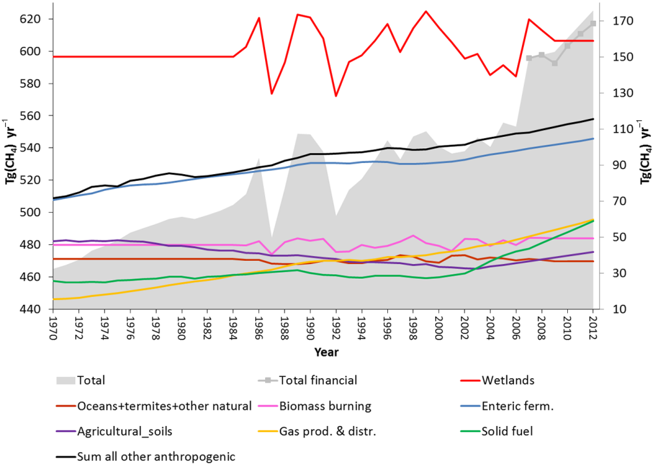
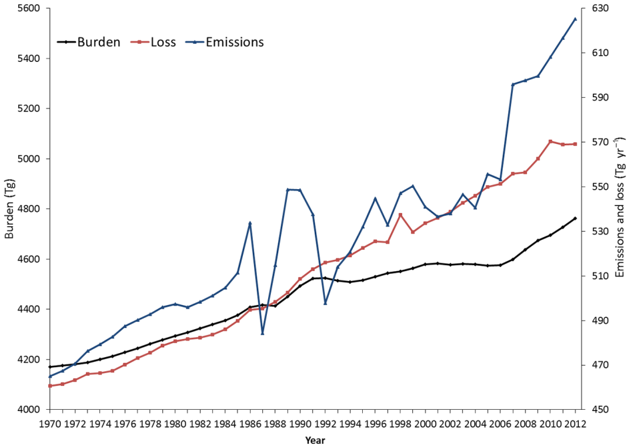
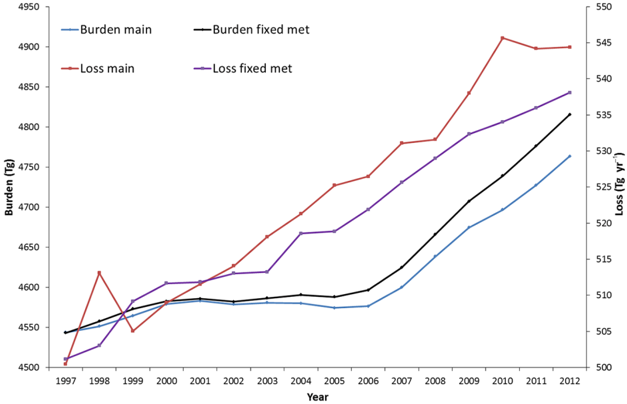
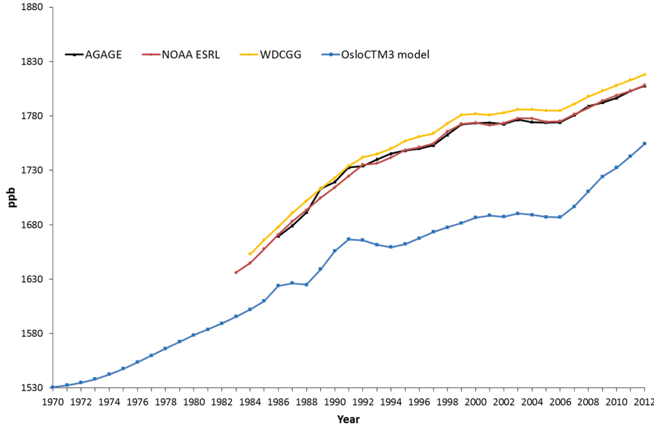
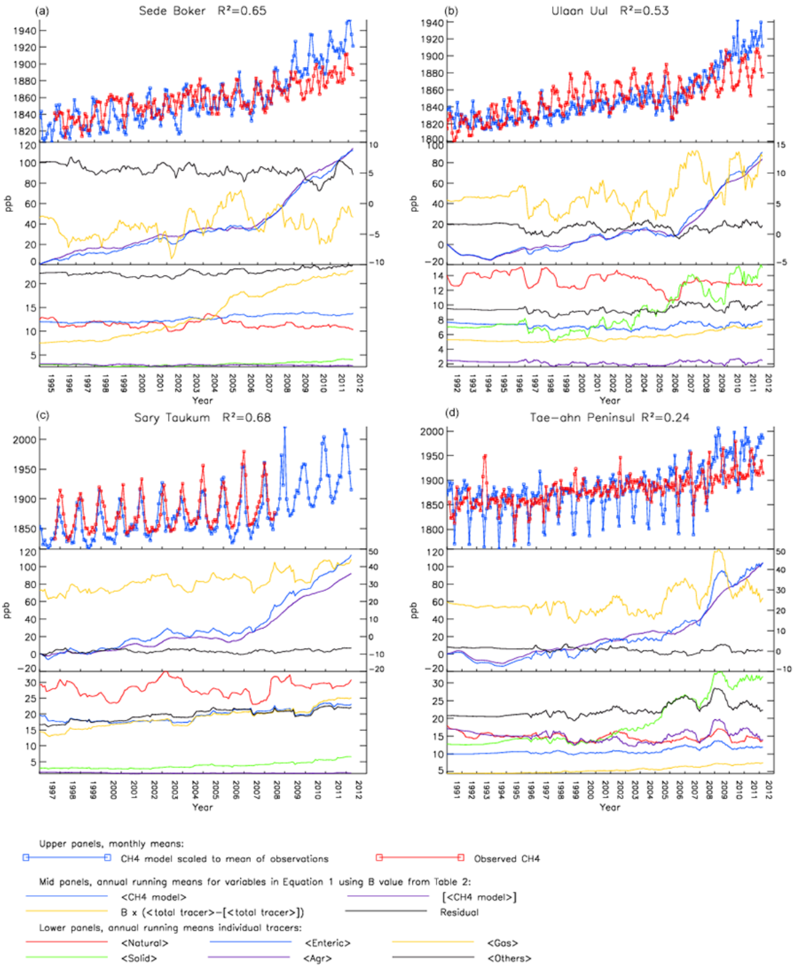
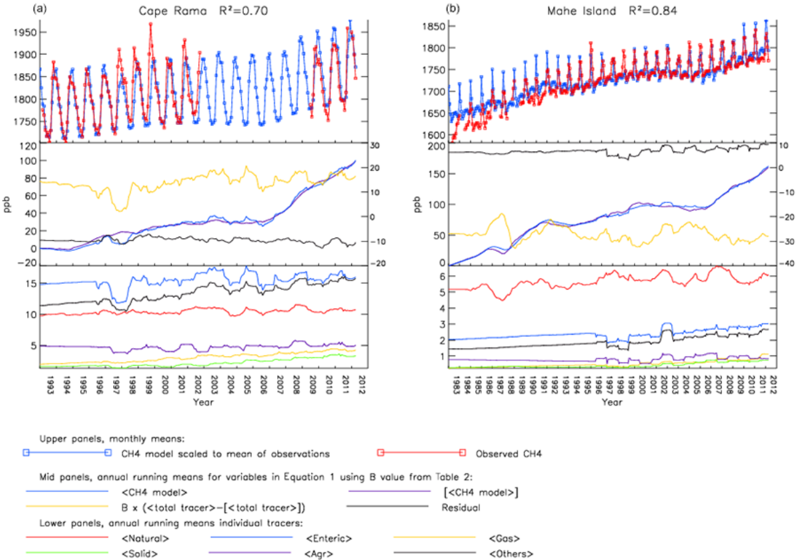
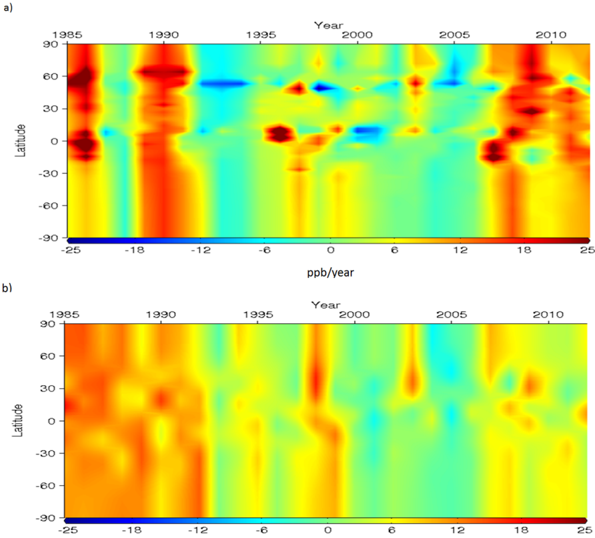
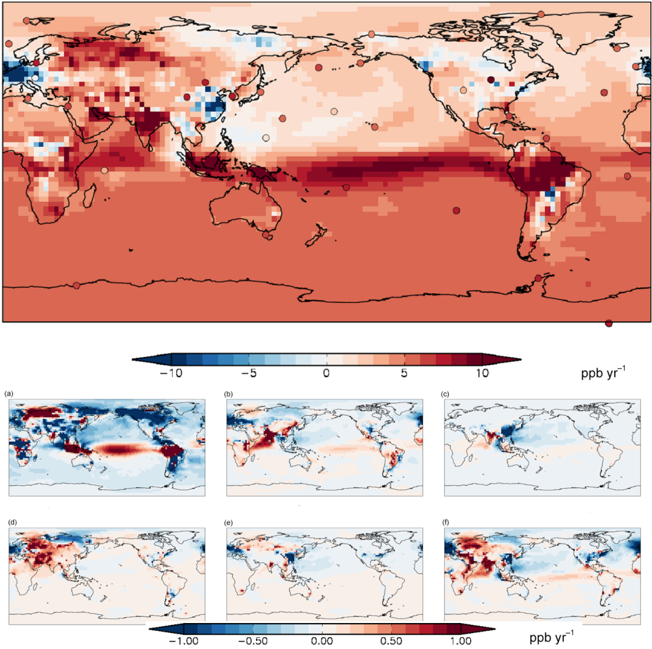
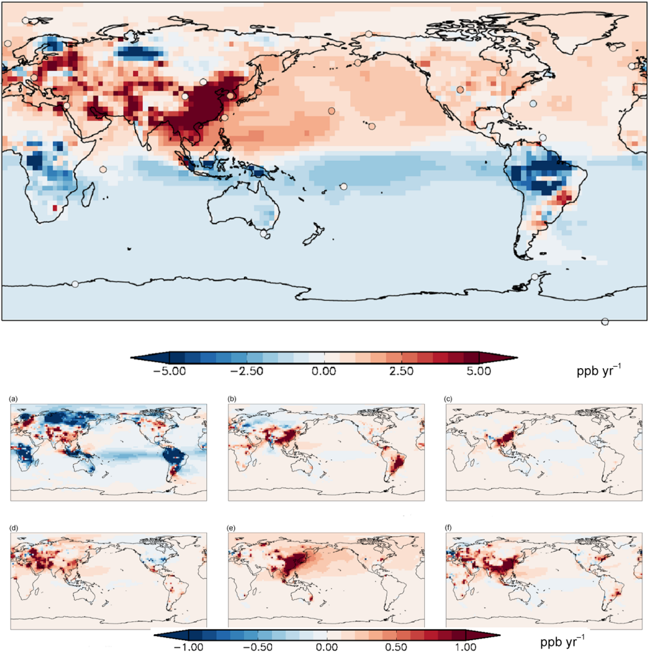
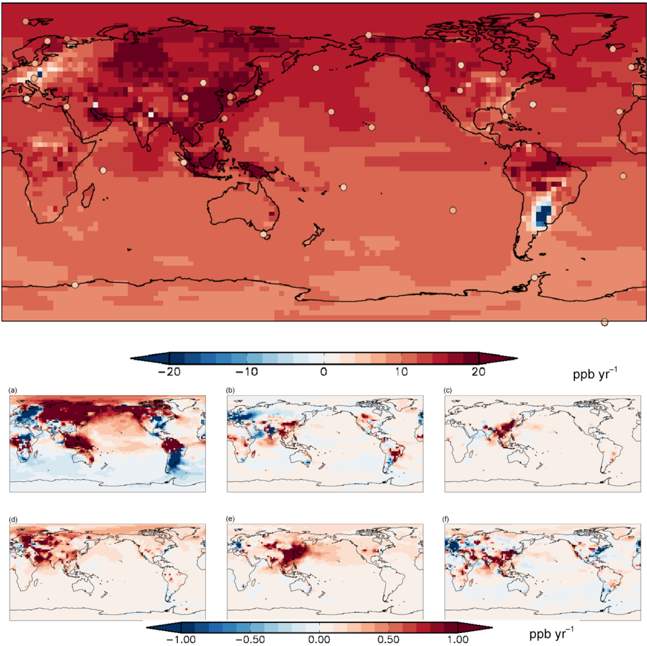
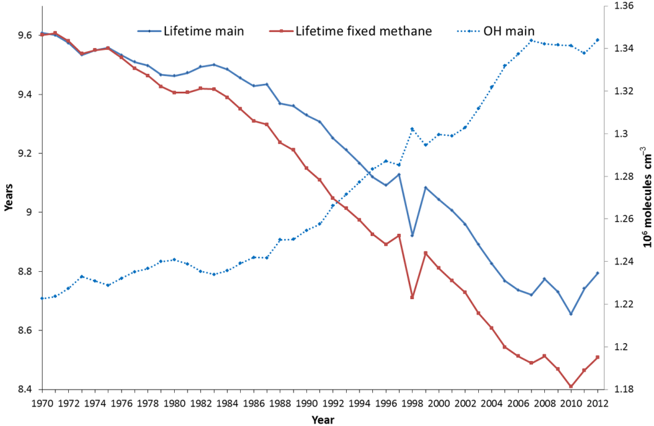
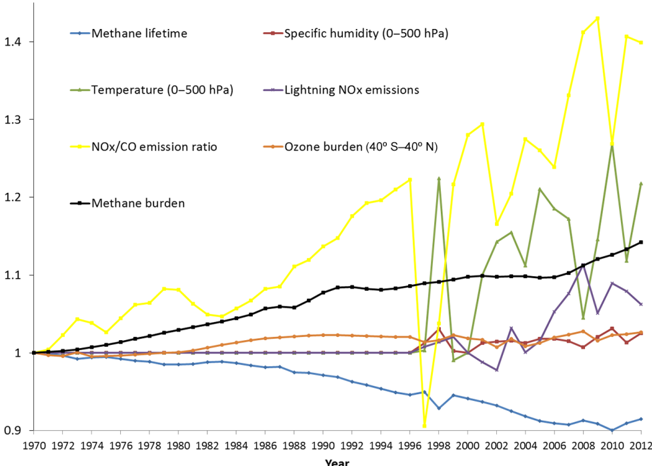
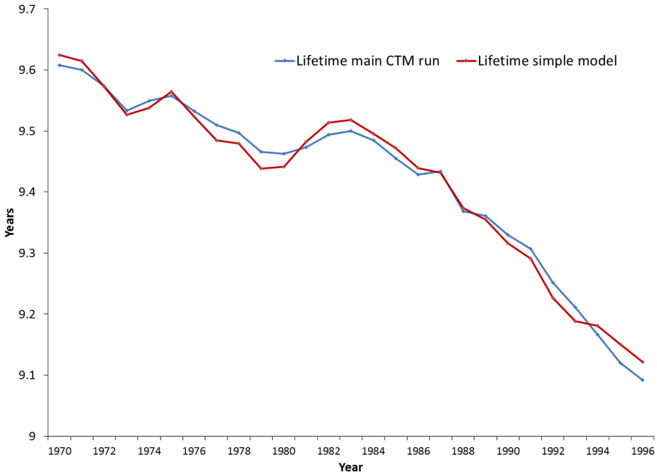
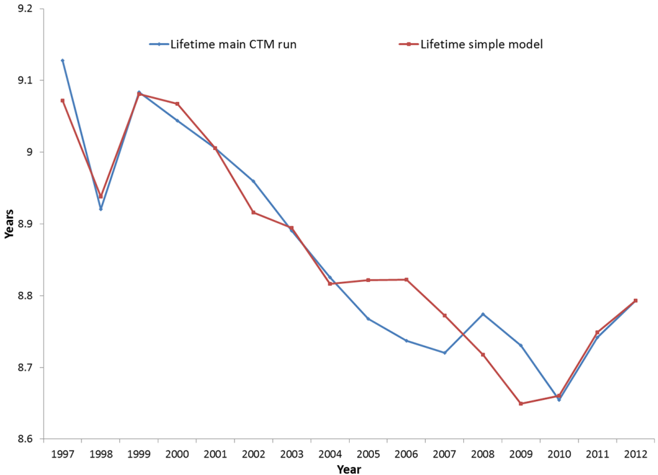
Observations at surface sites show an increase in global mean surface methane (CH 4 ) of about 180 parts per billion (ppb) (above 10 %) over the period 1984–2012. Over this period there are large fluctuations in the annual growth rate. In this work, we investigate the atmospheric CH 4 evolution over the period 1970–2012 with the Oslo CTM3 global chemical transport model (CTM) in a bottom-up approach. We thoroughly assess data from surface measurement sites in international networks and select a subset suited for comparisons with the output from the CTM. We compare model results and observations to understand causes for both long-term trends and short-term variations. Employing Oslo CTM3 we are able to reproduce the seasonal and year-to-year variations and shifts between years with consecutive growth and stagnation, both at global and regional scales. The overall CH 4 trend over the period is reproduced, but for some periods the model fails to reproduce the strength of the growth. The model overestimates the observed growth after 2006 in all regions. This seems to be explained by an overly strong increase in anthropogenic emissions in Asia, having global impact. Our findings confirm other studies questioning the timing or strength of the emission changes in Asia in the EDGAR v4.2 emission inventory over recent decades. The evolution of CH 4 is not only controlled by changes in sources, but also by changes in the chemical loss in the atmosphere and soil uptake. The atmospheric CH 4 lifetime is an indicator of the CH 4 loss. In our simulations, the atmospheric CH 4 lifetime decreases by more than 8 % from 1970 to 2012, a significant reduction of the residence time of this important greenhouse gas. Changes in CO and NO x emissions, specific humidity, and ozone column drive most of this, and we provide simple prognostic equations for the relations between those and the CH 4 lifetime. The reduced lifetime results in substantial growth in the chemical CH 4 loss (relative to its burden) and dampens the CH 4 growth.
Overview
The claims and statistics of this paper haven’t been checked yet.
Free: it reads the open-access text and checks the first 5 claims that cite a source we can check. Create a free account to check every claim.
Integrity signals
Registry
Cites
Statistics
Figures
Verification
Claims the paper makes
The claims and statistics of this paper haven’t been checked yet.
Free: it reads the open-access text and checks the first 5 claims that cite a source we can check. Create a free account to check every claim.
Self-check
Percentages, sums and reported differences re-computed from the paper’s own numbers.
The self-check needs the paper’s full text.
Citations
Cites
Guenther, A., Karl, T., Harley, P., Wiedinmyer, C., Palmer, P. I., & Geron, C. (2006) · Atmospheric Chemistry and Physics · doi:10.5194/acp-6-3181-2006 · Cited by 4,603
Anthropogenic and Natural Radiative Forcing
(2014) · Climate Change 2013 – The Physical Science Basis · doi:10.1017/cbo9781107415324.018 · Cited by 3,683 · cited 3×
“The resulting radiative forcing is second after CO2 in terms of anthropogenic forcing from greenhouse gases (Myhre et al., 2013).”
BackgroundSelf-citation(2010) · doi:10.5194/acp-10-11707-2010 · Cited by 2,859
Three decades of global methane sources and sinks
Kirschke, S., Bousquet, P., Ciais, P., Saunois, M., Canadell, J. G., Dlugokencky, E. J., Bergamaschi, P., Bergmann, D., Blake, D. R., Bruhwiler, L., et al. (2013) · Nature Geoscience · doi:10.1038/ngeo1955 · Cited by 2,247
Self-citationCarbon and Other Biogeochemical Cycles
(2014) · Climate Change 2013 – The Physical Science Basis · doi:10.1017/cbo9781107415324.015 · Cited by 1,944
Bridgham, S. D., Cadillo‐Quiroz, H., Keller, J. K., & Zhuang, Q. (2013) · Global Change Biology · doi:10.1111/gcb.12131 · Cited by 1,231 · cited 4×
“High uncertainty remains regarding the contributions from specific source sectors and regions to the CH4 emissions (Neef et al., 2010; Kirschke et al., 2013; Houweling et al., 2014; Melton et al., 2013; Bruhwiler et al., 2014; Schwietzke et al., 2014; Bridgham et al., 2013; Pison et al., 2009; Ciais et al., 2013), the…”
BackgroundInfluentialGlobal data set of biogenic VOC emissions calculated by the MEGAN model over the last 30 years
Sindelarova, K., Granier, C., Bouarar, I., Guenther, A., Tilmes, S., Stavrakou, T., Müller, J.-F., Kuhn, U., Stefani, P., & Knorr, W. (2014) · Atmospheric Chemistry and Physics · doi:10.5194/acp-14-9317-2014 · Cited by 1,147 · cited 1×
“Recently a new data set (Sindelarova et al., 2014) with MEGAN emissions covering the period 1980–2010 became available.”
BackgroundNormal Atmosphere: Large Radical and Formaldehyde Concentrations Predicted
Levy, H. (1971) · Science · doi:10.1126/science.173.3992.141 · Cited by 1,076
Contribution of anthropogenic and natural sources to atmospheric methane variability
Bousquet, P., Ciais, P., Miller, J. B., Dlugokencky, E. J., Hauglustaine, D. A., Prigent, C., Van der Werf, G. R., Peylin, P., Brunke, E.-G., Carouge, C., et al. (2006) · Nature · doi:10.1038/nature05132 · Cited by 996
Changing concentration, lifetime and climate forcing of atmospheric methane
LELIEVELD, J., CRUTZEN, P. J., & DENTENER, F. J. (1998) · Tellus B · doi:10.1034/j.1600-0889.1998.t01-1-00002.x · Cited by 733 · cited 2×
“CH4 is lost from the atmosphere by soil uptake (Curry, 2009) and chemical reactions in the atmosphere (Lelieveld et al., 1998; Crutzen, 1991).”
Background
Cited by
The Global Methane Budget 2000–2017
Saunois, M., Stavert, A. R., Poulter, B., Bousquet, P., Canadell, J. G., Jackson, R. B., Raymond, P. A., Dlugokencky, E. J., Houweling, S., Patra, P. K., et al. (2019) · doi:10.5194/essd-2019-128 · Cited by 2,760
“…Saunois et al., 2017), and an ambiguous role of OH changes that cannot explain all the observed trend but could have limited 2230 the required emission change to explain the observed atmospheric trend (e.g. Turner al., 2017; Rigby et al., 2017; Dalsøren et al., 2016; McNorton et al., 2016, 2018).”
Self-citationThe Global Methane Budget 2000–2017
Saunois, M., Stavert, A. R., Poulter, B., Bousquet, P., Canadell, J. G., Jackson, R. B., Raymond, P. A., Dlugokencky, E. J., Houweling, S., Patra, P. K., et al. (2020) · Earth System Science Data · doi:10.5194/essd-12-1561-2020 · Cited by 2,711
Self-citationThe contribution of global aviation to anthropogenic climate forcing for 2000 to 2018
Lee, D. S., Fahey, D. W., Skowron, A., Allen, M. R., Burkhardt, U., Chen, Q., Doherty, S. J., Freeman, S., Forster, P. M., Fuglestvedt, J., et al. (2021) · Atmospheric Environment · doi:10.1016/j.atmosenv.2020.117834 · Cited by 1,957
The global methane budget 2000–2012
Saunois, M., Bousquet, P., Poulter, B., Peregon, A., Ciais, P., Canadell, J. G., Dlugokencky, E. J., Etiope, G., Bastviken, D., Houweling, S., et al. (2016) · Earth System Science Data · doi:10.5194/essd-8-697-2016 · Cited by 1,060
Self-citationNisbet, E. G., Manning, M. R., Dlugokencky, E. J., Fisher, R. E., Lowry, D., Michel, S. E., Myhre, C. L., Platt, S. M., Allen, G., Bousquet, P., et al. (2019) · Global Biogeochemical Cycles · doi:10.1029/2018gb006009 · Cited by 735
“Methane mixes across the planetary troposphere in about a year and its lifetime is less than a decade (Dalsøren et al., 2016; Dlugokencky et al., 2011; Lelieveld et al., 1998).”
BackgroundResultInfluentialSelf-citation(2023) · Climate Change 2021 – The Physical Science Basis · doi:10.1017/9781009157896.008 · Cited by 637
Methane Feedbacks to the Global Climate System in a Warmer World
Dean, J. F., Middelburg, J. J., Röckmann, T., Aerts, R., Blauw, L. G., Egger, M., Jetten, M. S. M., de Jong, A. E. E., Meisel, O. H., Rasigraf, O., et al. (2018) · Reviews of Geophysics · doi:10.1002/2017rg000559 · Cited by 630
“…of the hydroxyl radical (OH) (Montzka et al., 2011) may have also contributed to the observed variations in the growth rate of atmospheric CH 4 (Dalsøren et al., 2016; Kirschke et al., 2013; McNorton, Chipper fi eld, et al., 2016; Monteil et al., 2011; Rigby et al., 2017; Turner et al., 2017).”
Global Methane Budget 2000–2020
Saunois, M., Martinez, A., Poulter, B., Zhang, Z., Raymond, P. A., Regnier, P., Canadell, J. G., Jackson, R. B., Patra, P. K., Bousquet, P., et al. (2025) · Earth System Science Data · doi:10.5194/essd-17-1873-2025 · Cited by 427
Young, P. J., Naik, V., Fiore, A. M., Gaudel, A., Guo, J., Lin, M. Y., Neu, J. L., Parrish, D. D., Rieder, H. E., Schnell, J. L., et al. (2018) · Elementa: Science of the Anthropocene · doi:10.1525/elementa.265 · Cited by 444
“As models begin to incorporate more realistic representation of atmospheric methane (e.g., Szopa et al., 2013; Dalsøren et al., 2016) with emissions prescribed from inventories and/or calculated interactively for natural sources, effort is needed to quantify the impact of this update on the spatio-temporal distributio…”
Interpreting contemporary trends in atmospheric methane
Turner, A. J., Frankenberg, C., & Kort, E. A. (2019) · Proceedings of the National Academy of Sciences · doi:10.1073/pnas.1814297116 · Cited by 426
The growing role of methane in anthropogenic climate change
Saunois, M., Jackson, R. B., Bousquet, P., Poulter, B., & Canadell, J. G. (2016) · Environmental Research Letters · doi:10.1088/1748-9326/11/12/120207 · Cited by 411
Ambiguity in the causes for decadal trends in atmospheric methane and hydroxyl
Turner, A. J., Frankenberg, C., Wennberg, P. O., & Jacob, D. J. (2017) · Proceedings of the National Academy of Sciences · doi:10.1073/pnas.1616020114 · Cited by 379
Global and regional trends of atmospheric sulfur
Aas, W., Mortier, A., Bowersox, V., Cherian, R., Faluvegi, G., Fagerli, H., Hand, J., Klimont, Z., Galy-Lacaux, C., Lehmann, C. M. B., et al. (2019) · Scientific Reports · doi:10.1038/s41598-018-37304-0 · Cited by 342
Self-citationGlobal wetland contribution to 2000–2012 atmospheric methane growth rate dynamics
Poulter, B., Bousquet, P., Canadell, J. G., Ciais, P., Peregon, A., Saunois, M., Arora, V. K., Beerling, D. J., Brovkin, V., Jones, C. D., et al. (2017) · Environmental Research Letters · doi:10.1088/1748-9326/aa8391 · Cited by 233
Zhao, Y., Saunois, M., Bousquet, P., Lin, X., Berchet, A., Hegglin, M. I., Canadell, J. G., Jackson, R. B., Hauglustaine, D. A., Szopa, S., et al. (2019) · Atmospheric Chemistry and Physics · doi:10.5194/acp-19-13701-2019 · Cited by 134
“4 %, consistent with the ACCMIP project (Naik et al., 2013) and with other atmospheric chemistry model studies (Dentener et al., 2003; John et al., 2012; Holmes et al., 2013; Dalsøren et al., 2016).”
MethodInfluentialVariability and quasi-decadal changes in the methane budget over the period 2000–2012
Saunois, M., Bousquet, P., Poulter, B., Peregon, A., Ciais, P., Canadell, J. G., Dlugokencky, E. J., Etiope, G., Bastviken, D., Houweling, S., et al. (2017) · Atmospheric Chemistry and Physics · doi:10.5194/acp-17-11135-2017 · Cited by 146
“Before 2007, increasing OH concentrations could have contributed to the stable atmospheric methane burden in this period (Dalsøren et al., 2016), without (or with less of) a need for constant global emissions.”
Self-citationMyhre, C. L., Ferré, B., Platt, S. M., Silyakova, A., Hermansen, O., Allen, G., Pisso, I., Schmidbauer, N., Stohl, A., Pitt, J., et al. (2016) · Geophysical Research Letters · doi:10.1002/2016gl068999 · Cited by 122
Self-citationChandra, N., Patra, P. K., Bisht, J. S. H., Ito, A., Umezawa, T., Saigusa, N., Morimoto, S., Aoki, S., Janssens‐Maenhout, G., Fujita, R., et al. (2020) · Journal of the Meteorological Society of Japan Ser II · doi:10.2151/jmsj.2021-015 · Cited by 125
Global methane emission estimates for 2000–2012 from CarbonTracker Europe-CH 4 v1.0
Tsuruta, A., Aalto, T., Backman, L., Hakkarainen, J., Luijkx, I. T., Krol, M., Spahni, R., Houweling, S., Laine, M., Dlugokencky, E. J., et al. (2017) · Geoscientific model development · doi:10.5194/gmd-10-1261-2017 · Cited by 129
“The mechanisms behind this increase are still debated (e.g. Heiman, 2011; Dlugokencky et al., 2011; Dalsøren et al., 2016).”
InfluentialChemical Feedback From Decreasing Carbon Monoxide Emissions
Gaubert, B., Worden, H. M., Arellano, A. F. J., Emmons, L. K., Tilmes, S., Barré, J., Martinez Alonso, S., Vitt, F., Anderson, J. L., Alkemade, F., et al. (2017) · Geophysical Research Letters · doi:10.1002/2017gl074987 · Cited by 106
“This positive trend in [OH] is consistent with other studies (Gratz et al., 2015; Dalsøren et al., 2016; McNorton et al., 2016).”
BackgroundResultDalsøren, S. B., Myhre, G., Hodnebrog, Ø., Myhre, C. L., Stohl, A., Pisso, I., Schwietzke, S., Höglund-Isaksson, L., Helmig, D., Reimann, S., et al. (2018) · Nature Geoscience · doi:10.1038/s41561-018-0073-0 · Cited by 109
Self-citationSkeie, R. B., Hodnebrog, Ø., & Myhre, G. (2023) · Communications Earth & Environment · doi:10.1038/s43247-023-00969-1 · Cited by 117
Self-citationMethyl Chloroform Continues to Constrain the Hydroxyl (OH) Variability in the Troposphere
Patra, P. K., Krol, M. C., Prinn, R. G., Takigawa, M., Mühle, J., Montzka, S. A., Lal, S., Yamashita, Y., Naus, S., Chandra, N., et al. (2021) · Journal of Geophysical Research: Atmospheres · doi:10.1029/2020jd033862 · Cited by 98
“It is most appropriate to use three-dimensional CTMs to infer the time evolution of two-dimensional OH variations (Bousquet et al., 2005; Naus et al., 2020).”
MethodResultInfluentialSelf-citationBöck, M., Schmitt, J. H. M. M., Beck, J., Seth, B., Chappellaz, J., & Fischer, H. (2017) · Proceedings of the National Academy of Sciences · doi:10.1073/pnas.1613883114 · Cited by 108
Isotopic Ratios of Tropical Methane Emissions by Atmospheric Measurement
Brownlow, R., Lowry, D., Fisher, R. E., France, J. L., Lanoisellé, M., White, B., Wooster, M. J., Zhang, T., & Nisbet, E. G. (2017) · Global Biogeochemical Cycles · doi:10.1002/2017gb005689 · Cited by 89
Atmospheric composition in the European Arctic and 30 years of the Zeppelin Observatory, Ny-Ålesund
Platt, S. M., Hov, Ø., Berg, T., Breivik, K., Eckhardt, S., Eleftheriadis, K., Evangeliou, N., Fiebig, M., Fisher, R., Hansen, G., et al. (2022) · Atmospheric chemistry and physics · doi:10.5194/acp-22-3321-2022 · Cited by 101
Self-citationOn the Causes and Consequences of Recent Trends in Atmospheric Methane
Schaefer, H. (2019) · Current Climate Change Reports · doi:10.1007/s40641-019-00140-z · Cited by 87
Enhanced methane emissions from tropical wetlands during the 2011 La Niña
Pandey, S., Houweling, S., Krol, M., Aben, I., Monteil, G., Nechita-Banda, N., Dlugokencky, E. J., Detmers, R., Hasekamp, O., Xu, X., et al. (2017) · Scientific Reports · doi:10.1038/srep45759 · Cited by 69
“Tropospheric OH concentrations are influenced by many factors, including temperature, water vapor, O 3 , NO x , CH 4 , CO, and the overhead strat-ospheric ozone column 38 .”
Hodnebrog, Ø., Dalsøren, S. B., & Myhre, G. (2018) · Atmospheric Science Letters · doi:10.1002/asl.804 · Cited by 78
“Methane concentrations in the OsloCTM3 simulations are prescribed throughout the atmosphere based on monthly mean methane concentrations for the year 2008 from the Dalsoren et al. (2016) methane study.”
MethodSelf-citationInvestigation of the global methane budget over 1980–2017 using GFDL-AM4.1
He, J., Naïk, V., Horowitz, L. W., Dlugokencky, E. J., & Thoning, K. W. (2020) · Atmospheric chemistry and physics · doi:10.5194/acp-20-805-2020 · Cited by 80
Zhao, Y., Saunois, M., Bousquet, P., Lin, X., Berchet, A., Hegglin, M. I., Canadell, J. G., Jackson, R. B., Dlugokencky, E. J., Langenfelds, R. L., et al. (2020) · Atmospheric Chemistry and Physics · doi:10.5194/acp-20-9525-2020 · Cited by 57
Akimoto, H., & Tanimoto, H. (2022) · Atmospheric Environment · doi:10.1016/j.atmosenv.2022.119033 · Cited by 67
Consumption‐Based Accounting of Global Anthropogenic CH4 Emissions
Zhang, B., Zhao, X., Wu, X., Han, M., Guan, C., & Song, S. (2018) · Earth s Future · doi:10.1029/2018ef000917 · Cited by 58
“The growth of CH4 levels in the atmosphere is highly related with increasing emissions from human activities (Montzka et al., 2011; Kirschke et al., 2013; Ghosh et al., 2015; Dalsøren et al., 2016; Hausmann et al., 2016; Nisbet et al., 2016).”
BackgroundImpact of interannual and multidecadal trends on methane-climate feedbacks and sensitivity
Cheng, C.-H., & Redfern, S. A. T. (2022) · Nature Communications · doi:10.1038/s41467-022-31345-w · Cited by 63
Xu, P., Liao, Y., Zheng, Y., Zhao, C., Zhang, X., Zheng, Z., & Luan, S. (2019) · Agricultural and Forest Meteorology · doi:10.1016/j.agrformet.2019.03.022 · Cited by 51
Bipolar carbon and hydrogen isotope constraints on the Holocene methane budget
Beck, J., Böck, M., Schmitt, J. H. M. M., Seth, B., Blunier, T., & Fischer, H. (2018) · Biogeosciences · doi:10.5194/bg-15-7155-2018 · Cited by 47
“Note that this value is 7 %–10 % higher than more recent estimates (Dalsøren et al., 2016) and accordingly the derived absolute emissions may be 7 %–10 % overestimated.”
Thanwerdas, J., Saunois, M., Berchet, A., Pison, I., & Bousquet, P. (2024) · Atmospheric chemistry and physics · doi:10.5194/acp-24-2129-2024 · Cited by 42
“The OH IAV in the tropo-sphere is usually derived from inversions using CH 3 CCl 3 constraints (Montzka et al., 2011; Rigby et al., 2017; Turner et al., 2017; Naus et al., 2019) or using global atmospheric chemistry–climate models (He et al., 2020; Dalsøren et al., 2016).”
MethodWinterstein, F., Tanalski, F., Jöckel, P., Dameris, M., & Ponater, M. (2019) · Atmospheric chemistry and physics · doi:10.5194/acp-19-7151-2019 · Cited by 44
“Other CTM studies have focused on recent changes and fluctuations of the atmospheric CH4 concentration (e.g. Dalsøren et al., 2016) or have tried to explain CH4 trends, which is a challenge because of important uncertainties in the global CH4 budget,30 i.e. the balance of surface sources and…”
BackgroundMethane at Svalbard and over the European Arctic Ocean
Platt, S. M., Eckhardt, S., Ferré, B., Fisher, R., Hermansen, O., Jansson, P. G., Lowry, D. C., Nisbet, E. G., Pisso, I., Schmidbauer, N., et al. (2018) · Atmospheric chemistry and physics · doi:10.5194/acp-18-17207-2018 · Cited by 39
Self-citationHydroxyl Radical (OH) Response to Meteorological Forcing and Implication for the Methane Budget
He, J., Naïk, V., & Horowitz, L. W. (2021) · Geophysical Research Letters · doi:10.1029/2021gl094140 · Cited by 40
“…bottom-up process-based model approach, the methane-OH sink is explicitly simulated in the model with consideration of methane-OH feedback (e.g., Dalsøren et al., 2016; He et al., 2020); however, model-to-model differences in OH, as noted above, introduce uncertainty in methane budget and…”
MethodTrends in Air Pollution in Europe, 2000–2019
Aas, W., Fagerli, H., Alástuey, A., Cavalli, F., Degórska, A., Feigenspan, S., Brenna, H., Gliß, J., Heinesen, D., Hueglin, C., et al. (2024) · Aerosol and Air Quality Research · doi:10.4209/aaqr.230237 · Cited by 34
“One possible explanation is that the oxidation capacity of the atmosphere may have increased as the emissions have decreased (Dalsøren et al. , 2016).”
BackgroundThompson, R. L., Montzka, S. A., Vollmer, M. K., Arduini, J., Crotwell, M., Krummel, P. B., Lunder, C., Mühle, J., O’Doherty, S., Prinn, R. G., et al. (2024) · Atmospheric chemistry and physics · doi:10.5194/acp-24-1415-2024 · Cited by 43
Self-citationDetectability of Arctic methane sources at six sites performing continuous atmospheric measurements
Thonat, T., Saunois, M., Bousquet, P., Pison, I., Tan, Z., Zhuang, Q., Crill, P., Thornton, B. F., Bastviken, D., Dlugokencky, E. J., et al. (2017) · Atmospheric chemistry and physics · doi:10.5194/acp-17-8371-2017 · Cited by 36
Global trade network and CH4 emission outsourcing
Liu, Y., Ma, R., Guan, C., Chen, B., & Zhang, B. (2021) · The Science of The Total Environment · doi:10.1016/j.scitotenv.2021.150008 · Cited by 29
Qi, Z., & Feng, R. (2024) · Journal of Environmental Management · doi:10.1016/j.jenvman.2024.123568 · Cited by 31
Morimoto, S., Fujita, R., Aoki, S., Goto, D., & Nakazawa, T. (2017) · Tellus B · doi:10.1080/16000889.2017.1380497 · Cited by 29
Tsimpidi, A. P., Scholz, S. M. C., Milousis, A., Mihalopoulos, N., & Karydis, V. A. (2025) · Atmospheric chemistry and physics · doi:10.5194/acp-25-10183-2025 · Cited by 36
Increase of Atmospheric Methane Observed from Space-Borne and Ground-Based Measurements
Zou, M., Xiong, X., Wu, Z., Li, S., Zhang, Y., & Chen, L. (2019) · Remote Sensing · doi:10.3390/rs11080964 · Cited by 24
Agriculture related methane emissions embodied in China's interprovincial trade
Pan, H., Zheng, X., Wu, R., Liu, X., Xiao, S., Sun, L., Hu, T. W., Gao, Z., Yang, L., Huang, C., et al. (2023) · Renewable and Sustainable Energy Reviews · doi:10.1016/j.rser.2023.113850 · Cited by 25
Gas Seepage along the Edge of the Aquitaine Shelf (France): Origin and Local Fluxes
Ruffine, L., Donval, J., Croguennec, C., Bignon, L., Birot, D., Battani, A., Bayon, G., Caprais, J., Lantéri, N., Levaché, D., et al. (2017) · Geofluids · doi:10.1155/2017/4240818 · Cited by 23
Kozicka, K., Gozdowskı, D., & Wójcik‐Gront, E. (2021) · Atmosphere · doi:10.3390/atmos12111382 · Cited by 22
Using greenhouse gases in the synthesis gas production processes: Thermodynamic conditions
Szczygieł, J., Chojnacka, K., Skrzypczak, D., Izydorczyk, G., Moustakas, K. G., & Kułażyński, M. (2022) · Journal of Environmental Management · doi:10.1016/j.jenvman.2022.116463 · Cited by 21
Bui, O. T. N., Kameyama, S., INOUE, H. Y., Ishii, M., Sasano, D., Uchida, H., & Tsunogai, U. (2018) · Tellus B · doi:10.1080/16000889.2018.1478594 · Cited by 20
“Atmospheric CH4 has increased by 180 ppb (about 10%) between 1984 and 2012, although the rate of increase was slower between 1999 and 2006 (Dalsøren et al., 2016; McNorton et al., 2016).”
BackgroundJin, Z., He, J., & Wang, W. (2024) · Remote Sensing · doi:10.3390/rs16142525 · Cited by 19
The contribution of greenhouse gases to the recent slowdown in global-mean temperature trends
Checa‐Garcia, R., Shine, K. P., & Hegglin, M. I. (2016) · Environmental Research Letters · doi:10.1088/1748-9326/11/9/094018 · Cited by 16
Li, T., Lu, Y., Yu, L., Sun, W., Zhang, Q., Zhang, W. J., Wang, G., Qin, Z., Yu, L., Li, H., et al. (2020) · Geoscientific model development · doi:10.5194/gmd-13-3769-2020 · Cited by 23
“However, the causes that drive the variations in growth rate remain unclear due to the uncertainties in estimating CH4 emissions and sinks (Ghosh et al., 2015; Saunois et al., 2016; Nisbet et al., 2019; Dalsøren et al., 2016).”
BackgroundTrends and variability in methane concentrations over the Southeastern Arabian Peninsula
Francis, D., Weston, M., Fonseca, R., Temimi, M., & Suwaidi, A. A. (2023) · Frontiers in Environmental Science · doi:10.3389/fenvs.2023.1177877 · Cited by 14
“, 2019), as evident in both surface observations (Houweling et al., 2014; Dalsoren et al., 2016) and remote sensing data collected by the instruments onboard the Greenhouse Gases Observing Satellite (GOSAT; Butz et al.”
BackgroundSensitivity of climate effects of hydrogen to leakage size, location, and chemical background
Skeie, R. B., Sandstad, M., Krishnan, S., Myhre, G., & Sand, M. (2025) · Atmospheric chemistry and physics · doi:10.5194/acp-25-4929-2025 · Cited by 15
“The NO x -to-CO emission ratio has been shown to be important for explaining the OH time evolution and changes in methane lifetime over time (Dalsøren et al., 2016; Skeie et al., 2023) The resulting H in Eq.”
Self-citationmuciPRECON: multichannel preconcentrators for portable mid-infrared hydrocarbon gas sensors
Kokoric, V., Wissel, P. A., Wilk, A., & Mizaikoff, B. (2016) · Analytical Methods · doi:10.1039/c6ay01447j · Cited by 12
Smale, D., Sherlock, V., GRIFFITH, D. W. T., Moss, R., Brailsford, G., Nichol, S. E., & Kotkamp, M. (2019) · Atmospheric measurement techniques · doi:10.5194/amt-12-637-2019 · Cited by 10
Pérez, I. A., Sánchez, M. L., García, M. D. L. Á., Pardo, N., & Fernández‐Duque, B. (2020) · Atmosphere · doi:10.3390/atmos11070769 · Cited by 10
Spatiotemporal variation in near-surface CH4 concentrations in China over the last two decades
Xu, J., Liu, Q., Wang, K., Wang, Q., Wang, L., Liu, Y., & Li, M. (2021) · Environmental Science and Pollution Research · doi:10.1007/s11356-021-14007-0 · Cited by 10
“Dalsøren et al. (2016) used the Chemistry Transfer Model (Oslo CTM3) to study the evolution of atmospheric CH4 from 1970 to 2012 and reproduced seasonal and inter-annual variations in CH4 on global and regional scales.”
MethodGermain-Piaulenne, E., Paris, J.-D., Gros, V., Quéhé, P.-Y., Pikridas, M., Baisnée, D., Berchet, A., Sciare, J., & Bourtsoukidis, E. (2024) · Atmospheric Environment X · doi:10.1016/j.aeaoa.2024.100253 · Cited by 9
Pérez, I. A., Sánchez, M. L., García, M. D. L. Á., & Pardo, N. (2016) · Atmospheric Environment · doi:10.1016/j.atmosenv.2016.11.068 · Cited by 11
“010 ppm year 1 in recent years, which might partially be explained by the global impact of the increase in anthropogenic emissions in Asia (Dalsøren et al., 2016).”
BackgroundMethane emissions from typical paddy fields in Liaohe Plain and Sanjiang Plain, Northeast China
Jia, Q., Yu, W., Zhou, L., Ri-Hong, W., Xie, Y., & Ni-Na, C. (2019) · Environmental Research Communications · doi:10.1088/2515-7620/ab06e5 · Cited by 7
Climatic impact of Arctic Ocean methane hydrate dissociation in the 21st-centuryPreprint
Vadakkepuliyambatta, S., Skeie, R. B., Myhre, G., Dalsøren, S. B., Silyakova, A., Schmidbauer, N., Myhre, C. L., & Mienert, J. (2017) · doi:10.5194/esd-2017-110 · Cited by 9
Self-citationChoi, Y., Zhou, M., Oba, M., Romero-Pérez, A., Beauchemin, K. A., Duval, S. M., Kindermann, M., & Guan, L. L. (2026) · Microbiome · doi:10.1186/s40168-025-02201-y · Cited by 7
“The recent Intergovernmental Panel on Climate Change (IPCC) 6th Assessment Report [1] claimed that mitigation of enteric methane (CH 4 ) emissions could decrease global warming over relatively short timescales due to its short atmospheric lifetime [2, 3].”
Newland, M. J., Martinerie, P., Witrant, E., Helmig, D., Worton, D. R., Hogan, C. J., Sturges, W. T., & Reeves, C. E. (2017) · Atmospheric chemistry and physics · doi:10.5194/acp-17-8269-2017 · Cited by 5
Local regressions for decomposing CO2 and CH4 time-series in a semi-arid ecosystem
Fernández‐Duque, B., Pérez, I. A., García, M. D. L. Á., Pardo, N., & Sánchez, M. L. (2019) · Atmospheric Pollution Research · doi:10.1016/j.apr.2019.10.012 · Cited by 5
Bouziane, M., Terrouche, A., Naidja, L., Ali-Khodja, H., & Huang, Z. (2025) · Journal of Hazardous Materials · doi:10.1016/j.jhazmat.2025.138014 · Cited by 4
Maazallahi, H. (2022) · Utrecht University Repository (Utrecht University) · doi:10.33540/1457 · Cited by 3
He, H., Zheng, T., Zhao, J., Yuan, X., Sun, E., Li, H., Zheng, H., Liu, X., Li, G., Zhang, Y., et al. (2024) · Frontiers in Earth Science · doi:10.3389/feart.2024.1352498 · Cited by 2
A multi-model approach to constrain the atmospheric hydrogen budget
Krishnan, S., Skeie, R. B., Hodnebrog, Ø., Myhre, G., Sand, M., Sandstad, M., Bryant, H. N., Hauglustaine, D. A., Paulot, F., Prather, M. J., et al. (2026) · Atmospheric chemistry and physics · doi:10.5194/acp-26-9509-2026 · Cited by 2
“Tropospheric OH concentration is important for atmospheric loss but cannot be directly measured; instead, nitrogen oxides (NO x ) and carbon monoxide (CO) concentrations, which in-fluence OH (Dalsøren et al., 2016) and have global satellite retrievals can be used to evaluate it”
Self-citationChoi, Y., Zhou, M., Romero-Pérez, A., Beauchemin, K. A., Duval, S. M., Kindermann, M., & Guan, L. L. (2025) · Journal of Animal Science and Biotechnology/Journal of animal science and biotechnology · doi:10.1186/s40104-025-01291-w · Cited by 2
Kim, M., Oh, Y., Ahn, M., Kang, M., Shi, H., Park, R. J., Oh, S., Joo, S., & Kim, S. (2024) · Journal of Korean Society for Atmospheric Environment · doi:10.5572/kosae.2024.40.3.361 · Cited by 2
Li, X., Xing, J., Pang, S., Zhu, Y., Zhang, S., Xiao, R., & Lu, C. (2022) · International Journal of Environmental Research and Public Health · doi:10.3390/ijerph19042437 · Cited by 3
Muriel, D. F., Yepes, F. A. L., Villegas, J. D., Guerrero-Martinez, B., & Jaramillo-Botero, A. (2026) · Agricultural and Forest Meteorology · doi:10.1016/j.agrformet.2026.111214 · Cited by 1
Methane oxidation in a stratified boreal lake Kuivajärvi
Saarela, T. (2017) · UEF eRepo (University of Eastern Finland) · Cited by 3
de Bruyn, N. (2021) · doi:10.22215/etd/2021-14581 · Cited by 1
Duque, B. F. (2021) · UVaDOC UVaDOC University of Valladolid Documentary Repository (University of Valladolid) · doi:10.35376/10324/47574
Platt, S. M. (2021) · Atmospheric chemistry and physics · doi:10.5194/acp-2021-505-ac1
Platt, S. M. (2021) · Atmospheric chemistry and physics · doi:10.5194/acp-2021-505-ac2
(2021) · Atmospheric chemistry and physics · doi:10.5194/acp-2021-505-rc2
Platt, S. M., Hov, Ã., Berg, T., et al. (2021) · Atmospheric chemistry and physics · doi:10.5194/acp-2021-505-rc1
Sundarraj, R. J. (2021) · Carleton University's Institutional Repository (MacOdrum Library, Carleton University) · doi:10.22215/etd/2021-14563
Obregón, D. (2021) · Digital Library of Theses and Dissertations (Universidade de São Paulo) · doi:10.11606/t.64.2021.tde-28092022-162936
Atmospheric Methane Data Assimilation in the CMAQ Air Quality Model
Voshtani, S. (2022) · Carleton University's Institutional Repository (MacOdrum Library, Carleton University) · doi:10.22215/etd/2022-15313
Comment on egusphere-2023-1326
Thanwerdas, J. (2023) · doi:10.5194/egusphere-2023-1326-ac1
Thompson, R. L. (2023) · doi:10.5194/egusphere-2023-1917-ac1
Exploring the Consumption-Based Methane Emissions and Related Supply Chains in China in 2018
Li, H., Peng, Y., & Zhang, B. (2025) · Journal of Energy and Climate Change · doi:10.3724/j.issn.2097-4981.jecc-2025-0018
Thanwerdas, J. (2021) · theses.fr (ABES) · doi:10.70675/ea48fa39z83abz4302z8760zcb00119a44c8 · Cited by 2
Mostefaoui, M. (2022) · theses.fr (ABES) · doi:10.70675/148afd96z25c0z4a6dz8393z8b4116fcaf8d
Characterization of regional Middle Eastern methane sources using light hydrocarbon tracers
Germain-Piaulenne, E. (2024) · theses.fr (ABES) · doi:10.70675/fd6060d4z451ez4b1ez8b96zb850896da5d1
Comment on egusphere-2025-5804
Thanwerdas, J. (2026) · doi:10.5194/egusphere-2025-5804-ac1
Global Methane Budget 2000-2012
Saunois, M., Bousquet, P., Poulter, B., Peregon, A. M., Ciais, P., Canadell, J. G., Dlugokencky, E. J., Etiope, G., Bastviken, D., Houweling, S., et al. (2016) · DOE Lawrence Berkeley National Laboratory (LBNL) Repository · doi:10.3334/cdiac/global_methane_budget_2016
Self-citation
Metadata
- Authors
- Dalsøren, S. B., Myhre, C. L., Myhre, G., Gomez-Pelaez, A. J., Søvde, O. A., Isaksen, I. S. A., Weiss, R. F., & Harth, C. M.
- Affiliations
- CICERO Center for International Climate Research (NO)
- NILU (NO)
- University of Oslo (NO)
- Scripps Institution of Oceanography (US)
- Corresponding author
- Dalsøren, Stig B.
- Myhre, Cathrine L.
- Myhre, Gunnar
- Søvde, Ole A.
- Isaksen, Ivar S. A.
- Weiss, Ray F.
- Harth, Christina M.
- ORCID
- Venue
- Atmospheric chemistry and physics
- Publisher
- Copernicus GmbH
- Published
- 2016-03-09
- Volume
- 16
- Issue
- 5
- Pages
- 3099-3126
- ISSN
- 1680-7316 (ISSN-L)
- 1680-7324
- OpenAlex
- W2097942545
- Cited by
- 96
- References
- 87
- Citations by year
- 2026: 3 · 2025: 7 · 2024: 9 · 2023: 6 · 2022: 8 · 2021: 14 · 2020: 8 · 2019: 12 · 2018: 8 · 2017: 14 · 2016: 7
- FWCI
- 10.36
- Type
- journal article
- Language
- en
- Open access
- gold
- doi.org
- Licence
- Locations
- Atmospheric chemistry and physics (publishedVersion, cc-by)
- BIBSYS Brage (BIBSYS (Norway)) (acceptedVersion, cc-by)
- Arcimis (State Meteorological Agency) (submittedVersion, cc-by-nc-nd)
- LA Referencia (Red Federada de Repositorios Institucionales de Publicaciones Científicas) (submittedVersion, other-oa)
- DOAJ (DOAJ: Directory of Open Access Journals) (submittedVersion, cc-by-sa)
- NORA - Norwegian Open Research Archives (submittedVersion, cc-by)
- NORA - Norwegian Open Research Archives (submittedVersion, other-oa)
- Funders
- European Commission (265863)
- Norges Forskningsråd (207587)
- National Oceanic and Atmospheric Administration
- Topics
- Physical Sciences › Environmental Science › Global and Planetary Change › Atmospheric and Environmental Gas Dynamics
- Physical Sciences › Earth and Planetary Sciences › Atmospheric Science › Atmospheric chemistry and aerosols
- Physical Sciences › Earth and Planetary Sciences › Atmospheric Science › Atmospheric Ozone and Climate
- Keywords
- atmospheric methane, methane trends, methane lifetime, bottom-up emission inventories, model-data comparison, greenhouse gas budget, soil methane uptake, CO and NOx emissions, ozone column, specific humidity, prognostic equations
About these checks
Registry, retraction, Cites and statistics results are computed, not judged, with one exception: a printed reference that no index lists is read once by a model before it counts as a citation error. Claims are extracted by a model and kept only when their quote appears verbatim in the text; each cited source is then checked, with a model’s help, for whether it says what the claim relies on. Those verdicts can be wrong — read the claim’s quote and the cited source before relying on one.
Statistics and arithmetic are recomputed, not judged.
Confidence bands are shown only for fields calibrated on our annotated test set. None is calibrated yet, so no band is shown.
What counts as a claim ›How we measure confidence ›How we check this ›
Are you an author, or do you see a problem with this page? Request a review
Data sources
Bibliographic data: Semantic Scholar, OpenAlex, Crossref.
Contains information from the Semantic Scholar Academic Graph Datasets, made available under the ODC Attribution License (ODC-BY 1.0).
Semantic Scholar’s data is described in: Kinney, R., et al. (2023). The Semantic Scholar Open Data Platform. arXiv:2301.10140.
