

On the role of trend and variability in the hydroxyl radical (OH) in the global methane budget
Open accessPublished version of a preprint
The DOI matches its Crossref record; 57 of the 57 references it cites were found in a registry or an index.
Abstract
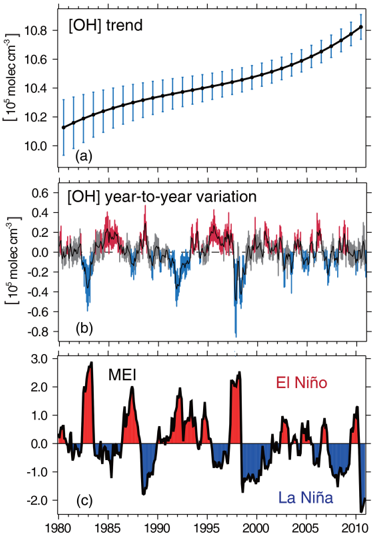
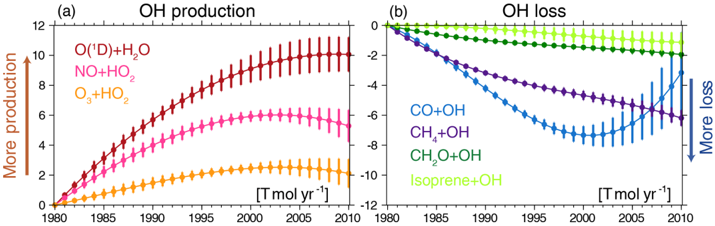
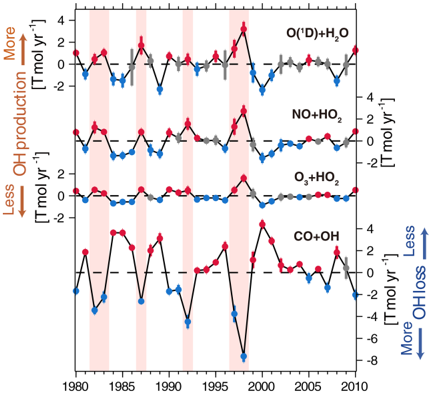
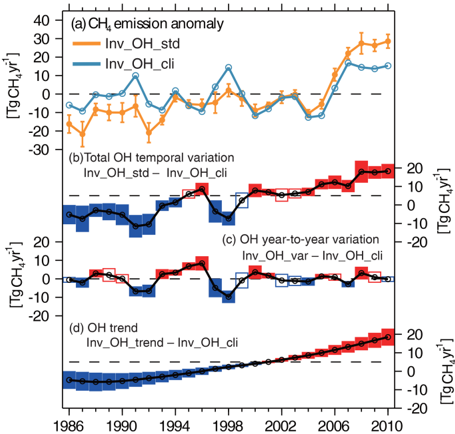
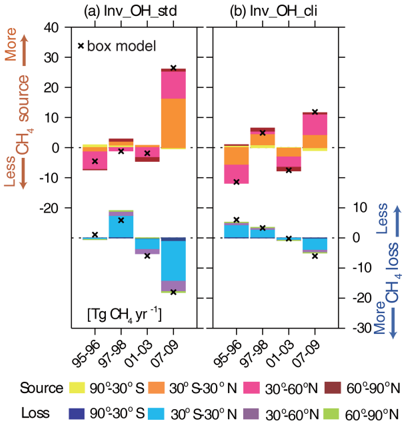
Decadal trends and interannual variations in the hydroxyl radical (OH), while poorly constrained at present, are critical for understanding the observed evolution of atmospheric methane (CH 4 ). Through analyzing the OH fields simulated by the model ensemble of the Chemistry–Climate Model Initiative (CCMI), we find (1) the negative OH anomalies during the El Niño years mainly corresponding to the enhanced carbon monoxide (CO) emissions from biomass burning and (2) a positive OH trend during 1980–2010 dominated by the elevated primary production and the reduced loss of OH due to decreasing CO after 2000. Both two-box model inversions and variational 4D inversions suggest that ignoring the negative anomaly of OH during the El Niño years leads to a large overestimation of the increase in global CH 4 emissions by up to 10 ± 3 Tg yr −1 to match the observed CH 4 increase over these years. Not accounting for the increasing OH trends given by the CCMI models leads to an underestimation of the CH 4 emission increase by 23 ± 9 Tg yr −1 from 1986 to 2010. The variational-inversion-estimated CH 4 emissions show that the tropical regions contribute most to the uncertainties related to OH. This study highlights the significant impact of climate and chemical feedbacks related to OH on the top-down estimates of the global CH 4 budget.
Overview
The claims and statistics of this paper haven’t been checked yet.
Free: it reads the open-access text and checks the first 5 claims that cite a source we can check. Create a free account to check every claim.
Integrity signals
Registry
Cites
Statistics
Figures
Verification
Claims the paper makes
The claims and statistics of this paper haven’t been checked yet.
Free: it reads the open-access text and checks the first 5 claims that cite a source we can check. Create a free account to check every claim.
Claims other papers make about this one
Each is checked against this paper’s own text: does it say what the citing paper says it does?
In the citing paper
“Global mean concentrations of tropospheric OH have been calculated to have changed little from 1850 to around 1980 [141, 142].”
From Changes in tropospheric air quality related to the protection of stratospheric ozone in a changing climate (2023) · cites this paper as [142]
In the citing paper
“Based on modeling studies for the period 1980 to 2010, Zhao et al. [142] found decreases in global concentrations of OH during El Niño years that were mainly driven by an elevated loss of OH via reaction with CO from enhanced burning of biomass (Fig. 7).”
From Changes in tropospheric air quality related to the protection of stratospheric ozone in a changing climate (2023) · cites this paper as [142]
Self-check
Percentages, sums and reported differences re-computed from the paper’s own numbers.
The self-check needs the paper’s full text.
Citations
Cites
The Global Methane Budget 2000–2017
Saunois, M., Stavert, A. R., Poulter, B., Bousquet, P., Canadell, J. G., Jackson, R. B., Raymond, P. A., Dlugokencky, E. J., Houweling, S., Patra, P. K., et al. (2019) · doi:10.5194/essd-2019-128 · Cited by 2,760 · cited 3×
“The tropical regions, where top-down-estimated CH 4 emissions show the largest sensitivity to OH changes, represent more than 60 % of CH 4 emissions worldwide (Saunois et al., 2016).”
BackgroundSelf-citationThe Global Methane Budget 2000–2017
Saunois, M., Stavert, A. R., Poulter, B., Bousquet, P., Canadell, J. G., Jackson, R. B., Raymond, P. A., Dlugokencky, E. J., Houweling, S., Patra, P. K., et al. (2020) · Earth System Science Data · doi:10.5194/essd-12-1561-2020 · Cited by 2,711
Self-citationThree decades of global methane sources and sinks
Kirschke, S., Bousquet, P., Ciais, P., Saunois, M., Canadell, J. G., Dlugokencky, E. J., Bergamaschi, P., Bergmann, D., Blake, D. R., Bruhwiler, L., et al. (2013) · Nature Geoscience · doi:10.1038/ngeo1955 · Cited by 2,247
Self-citationThe global methane budget 2000–2012
Saunois, M., Bousquet, P., Poulter, B., Peregon, A., Ciais, P., Canadell, J. G., Dlugokencky, E. J., Etiope, G., Bastviken, D., Houweling, S., et al. (2016) · Earth System Science Data · doi:10.5194/essd-8-697-2016 · Cited by 1,060
Self-citationEtminan, M., Myhre, G., Highwood, E. J., & Shine, K. P. (2016) · Geophysical Research Letters · doi:10.1002/2016gl071930 · Cited by 1,027
Contribution of anthropogenic and natural sources to atmospheric methane variability
Bousquet, P., Ciais, P., Miller, J. B., Dlugokencky, E. J., Hauglustaine, D. A., Prigent, C., Van der Werf, G. R., Peylin, P., Brunke, E.-G., Carouge, C., et al. (2006) · Nature · doi:10.1038/nature05132 · Cited by 996
Self-citationEmpirical model of global soil‐biogenic NOχemissions
Yienger, J. J., & Levy, H. (1995) · Journal of Geophysical Research: Atmospheres · doi:10.1029/95jd00370 · Cited by 853
Etheridge, D. M., Steele, L. P., Francey, R. J., & Langenfelds, R. L. (1998) · Journal of Geophysical Research: Atmospheres · doi:10.1029/98jd00923 · Cited by 600
Global Cooling After the Eruption of Mount Pinatubo: A Test of Climate Feedback by Water Vapor
Soden, B. J., Wetherald, R. T., Stenchikov, G. L., & Robock, A. (2002) · Science · doi:10.1126/science.296.5568.727 · Cited by 529
Renewed growth of atmospheric methane
Rigby, M., Prinn, R. G., Fraser, P. J., Simmonds, P. G., Langenfelds, R. L., Huang, J., Cunnold, D. M., Steele, L. P., Krummel, P. B., Weiss, R. F., et al. (2008) · Geophysical Research Letters · doi:10.1029/2008gl036037 · Cited by 521
Cited by
The Global Methane Budget 2000–2017
Saunois, M., Stavert, A. R., Poulter, B., Bousquet, P., Canadell, J. G., Jackson, R. B., Raymond, P. A., Dlugokencky, E. J., Houweling, S., Patra, P. K., et al. (2019) · doi:10.5194/essd-2019-128 · Cited by 2,760
Self-citationThe Global Methane Budget 2000–2017
Saunois, M., Stavert, A. R., Poulter, B., Bousquet, P., Canadell, J. G., Jackson, R. B., Raymond, P. A., Dlugokencky, E. J., Houweling, S., Patra, P. K., et al. (2020) · Earth System Science Data · doi:10.5194/essd-12-1561-2020 · Cited by 2,711
Self-citationHalf of global methane emissions come from highly variable aquatic ecosystem sources
Rosentreter, J. A., Borges, A. V., Deemer, B. R., Holgerson, M. A., Liu, S., Song, C., Melack, J., Raymond, P. A., Duarte, C. M., Allen, G. H., et al. (2021) · Nature Geoscience · doi:10.1038/s41561-021-00715-2 · Cited by 1,061
The global methane budget 2000–2012
Saunois, M., Bousquet, P., Poulter, B., Peregon, A., Ciais, P., Canadell, J. G., Dlugokencky, E. J., Etiope, G., Bastviken, D., Houweling, S., et al. (2016) · Earth System Science Data · doi:10.5194/essd-8-697-2016 · Cited by 1,060
Self-citationGlobal Methane Budget 2000–2020
Saunois, M., Martinez, A., Poulter, B., Zhang, Z., Raymond, P. A., Regnier, P., Canadell, J. G., Jackson, R. B., Patra, P. K., Bousquet, P., et al. (2025) · Earth System Science Data · doi:10.5194/essd-17-1873-2025 · Cited by 427
Self-citationNisbet, E. G., Manning, M., Dlugokencky, E. J., Michel, S., Lan, X., Röckmann, T., van der Gon, H. D., Schmitt, J. H. M. M., Palmer, P. I., Dyonisius, M., et al. (2023) · Global Biogeochemical Cycles · doi:10.1029/2023gb007875 · Cited by 179
“In particular, [OH] fluctuations can make a major contribution to methane growth in hot El Niño years (Zhao et al., 2020), especially when there are enhanced CO emissions from biomass burning, as CO competes with CH 4 for [OH].”
BackgroundSelf-citationSkeie, R. B., Hodnebrog, Ø., & Myhre, G. (2023) · Communications Earth & Environment · doi:10.1038/s43247-023-00969-1 · Cited by 117
Madronich, S., Sulzberger, B., Longstreth, J. D., Schikowski, T., Andersen, M. P. S., Solomon, K. R., & Wilson, S. R. (2023) · Photochemical & Photobiological Sciences · doi:10.1007/s43630-023-00369-6 · Cited by 64
“Global mean concentrations of tropospheric OH have been calculated to have changed little from 1850 to around 1980 [141, 142].”
BackgroundStevenson, D. S., Derwent, R. G., Wild, O., & Collins, W. J. (2022) · Atmospheric chemistry and physics · doi:10.5194/acp-22-14243-2022 · Cited by 91
Zhao, Y., Saunois, M., Bousquet, P., Lin, X., Berchet, A., Hegglin, M. I., Canadell, J. G., Jackson, R. B., Dlugokencky, E. J., Langenfelds, R. L., et al. (2020) · Atmospheric Chemistry and Physics · doi:10.5194/acp-20-9525-2020 · Cited by 57
Self-citationImpact of interannual and multidecadal trends on methane-climate feedbacks and sensitivity
Cheng, C.-H., & Redfern, S. A. T. (2022) · Nature Communications · doi:10.1038/s41467-022-31345-w · Cited by 63
Pimlott, M. A., Pope, R. J., Kerridge, B. J., Latter, B. G., Knappett, D., Heard, D. E., Ventress, L. J., Siddans, R., Feng, W., & Chipperfield, M. P. (2022) · Atmospheric chemistry and physics · doi:10.5194/acp-22-10467-2022 · Cited by 56
Large and increasing methane emissions from eastern Amazonia derived from satellite data, 2010–2018
Wilson, C., Chipperfield, M. P., Gloor, M. U., Parker, R. J., Boesch, H., McNorton, J., Gatti, L. V., Miller, J. B., Basso, L. S., & Monks, S. A. (2021) · Atmospheric chemistry and physics · doi:10.5194/acp-21-10643-2021 · Cited by 59
Remaud, M., Chevallier, F., Maignan, F., Belviso, S., Berchet, A., Parouffe, A., Abadie, C., Bacour, C., Lennartz, S. T., & Peylin, P. (2022) · Atmospheric chemistry and physics · doi:10.5194/acp-22-2525-2022 · Cited by 58
Self-citationNaus, S., Montzka, S. A., Patra, P. K., & Krol, M. C. (2021) · Atmospheric Chemistry and Physics · doi:10.5194/acp-21-4809-2021 · Cited by 46
“For example, El Niño years (high MEI) are associated with more wildfires, resulting in higher CO emissions which could suppress OH concentrations (Zhao et al., 2020; Nguyen et al., 2020).”
BackgroundAir pollution modulates trends and variability of the global methane budget
Zhao, Y., Zheng, B., Saunois, M., Ciais, P., Hegglin, M. I., Lu, S., Li, Y., & Bousquet, P. (2025) · Nature · doi:10.1038/s41586-025-09004-z · Cited by 67
“It accounts for only about 6% of the global OH sink 9 , serving more as an indicator of the oxidation of NMVOCs by OH rather than directly influencing OH chemistry.”
InfluentialSelf-citationZhao, Y., Saunois, M., Bousquet, P., Lin, X., Hegglin, M. I., Canadell, J. G., Jackson, R. B., & Zheng, B. (2023) · Atmospheric chemistry and physics · doi:10.5194/acp-23-789-2023 · Cited by 48
Self-citationThanwerdas, J., Saunois, M., Berchet, A., Pison, I., & Bousquet, P. (2024) · Atmospheric chemistry and physics · doi:10.5194/acp-24-2129-2024 · Cited by 42
Self-citationKaracan, C. Ö., Field, R. A., Olczak, M., Kasprzak, M., Ruiz, F. A., & Schwietzke, S. (2024) · International Journal of Coal Geology · doi:10.1016/j.coal.2024.104623 · Cited by 42
Thompson, R. L., Montzka, S. A., Vollmer, M. K., Arduini, J., Crotwell, M., Krummel, P. B., Lunder, C., Mühle, J., O’Doherty, S., Prinn, R. G., et al. (2024) · Atmospheric chemistry and physics · doi:10.5194/acp-24-1415-2024 · Cited by 43
Space-based Earth observation in support of the UNFCCC Paris Agreement
Hegglin, M. I., Bastos, A., Bovensmann, H., Buchwitz, M., Fawcett, D., Ghent, D. J., Kulk, G., Sathyendranath, S., Shepherd, T. G., Quegan, S., et al. (2022) · Frontiers in Environmental Science · doi:10.3389/fenvs.2022.941490 · Cited by 36
Self-citationJoshi, A., Pathak, M., Kuttippurath, J., & Patel, V. (2023) · Chemosphere · doi:10.1016/j.chemosphere.2023.139259 · Cited by 26
Interannual changes in atmospheric oxidation over forests determined from space
Shutter, J. D., Millet, D. B., Wells, K. C., Payne, V. H., Nowlan, C. R., & Abad, G. G. (2024) · Science Advances · doi:10.1126/sciadv.adn1115 · Cited by 24
“Past studies have shown that global mean OH levels tend to decrease during El Niño events, mainly due to higher fire CO and lower lightning NO x emissions ( 54 – 58 ).”
Climate and Tropospheric Oxidizing Capacity
Fiore, A. M., Mickley, L. J., Zhu, Q., & Baublitz, C. B. (2024) · Annual Review of Earth and Planetary Sciences · doi:10.1146/annurev-earth-032320-090307 · Cited by 41
Trends in the seasonal amplitude of atmospheric methane
Liu, G., Shen, L., Ciais, P., Lin, X., Hauglustaine, D. A., Lan, X., Turner, A. J., Xi, Y., Zhu, Y. J., & Peng, S. (2025) · Nature · doi:10.1038/s41586-025-08900-8 · Cited by 26
“As the trend in tropospheric OH concentration is mainly driven by historical emissions of carbon monoxide (CO) and nitrogen oxides (NO x ) 40–42 , here, we apply a simple emission proxy S N / S /2 for tropo-spheric OH concentration 43 (where S N and S CO are the sources of NO x and CO,…”
Self-citationD’Amico, F., Ammoscato, I., Gullì, D., Avolio, E., Feudo, T. L., Pino, M. D., Cristofanelli, P., Malacaria, L., Parise, D., Sinopoli, S., et al. (2024) · Atmosphere · doi:10.3390/atmos15080946 · Cited by 20
Radiocarbon monoxide indicates increasing atmospheric oxidizing capacity
Morgenstern, O., Moss, R., Manning, M., Zeng, G., Schaefer, H., USOSKIN, I. G., Turnbull, J. C., Brailsford, G., Nichol, S. E., & Bromley, T. M. (2025) · Nature Communications · doi:10.1038/s41467-024-55603-1 · Cited by 27
An Unexpected Seasonal Cycle in U.S. Oil and Gas Methane Emissions
Hu, L., Andrews, A. E., Montzka, S. A., Miller, S. M., Bruhwiler, L., Oh, Y., Sweeney, C., Miller, J. B., McKain, K., Espinosa, S. I., et al. (2025) · Environmental Science & Technology · doi:10.1021/acs.est.4c14090 · Cited by 28
Chua, G., Naïk, V., & Horowitz, L. W. (2023) · Atmospheric chemistry and physics · doi:10.5194/acp-23-4955-2023 · Cited by 24
“Such a decomposition allows for a clearer mechanistic understanding of the main driving factors of either the trend or IAV. addition, we analyzed the OH budget terms, similar to Zhao et al. (2020), tracing the individual emissions to changes in the various budget terms, which in turn affects [OH].”
MethodLiu, Y., Yao, X., Zhou, L., Ming, T., Li, W., & de Richter, R. K. (2024) · Atmosphere · doi:10.3390/atmos15091046 · Cited by 14
Souri, A. H., Duncan, B. N., Strode, S. A., Anderson, D. C., Manyin, M., Liu, J., Oman, L. D., Zhang, Z., & Weir, B. (2024) · Atmospheric chemistry and physics · doi:10.5194/acp-24-8677-2024 · Cited by 20
Self-citationDong, Z., Li, X., Dong, Z., Su, F., Wang, S., Shang, L., Kong, Z., & Wang, S. (2024) · The Science of The Total Environment · doi:10.1016/j.scitotenv.2024.173089 · Cited by 10
Ortega, I., Gaubert, B., Hannigan, J. W., Brasseur, G. P., Worden, H. M., Blumenstock, T., Fu, H., Hase, F., Jeseck, P., Jones, N., et al. (2023) · Elementa Science of the Anthropocene · doi:10.1525/elementa.2023.00015 · Cited by 14
Lee, B. H., Munger, J. W., Wofsy, S. C., Rizzo, L. V., Yoon, J., Turner, A. J., Thornton, J. A., & Swann, A. L. S. (2024) · Geophysical Research Letters · doi:10.1029/2023gl107214 · Cited by 12
“The sensitivity of the burden and lifetime of methane to global OH levels is well studied (Squire et al., 2015; Voulgarakis et al., 2013; Wild et al., 2020; Zhao et al., 2020).”
Malacaria, L., Sinopoli, S., Feudo, T. L., Benedetto, G. D., D’Amico, F., Ammoscato, I., Cristofanelli, P., Pino, M. D., Gullì, D., & Calidonna, C. R. (2025) · Atmospheric Pollution Research · doi:10.1016/j.apr.2025.102515 · Cited by 10
What can we learn about tropospheric OH from satellite observations of methane?
Penn, E., Jacob, D. J., Chen, Z., East, J. D., Sulprizio, M. P., Bruhwiler, L., Maasakkers, J. D., Nesser, H. O., Qu, Z., Zhang, Y., et al. (2025) · Atmospheric chemistry and physics · doi:10.5194/acp-25-2947-2025 · Cited by 13
Voshtani, S., Ménard, R., Walker, T., & Hakami, A. (2022) · Remote Sensing · doi:10.3390/rs14020375 · Cited by 7
Nonlinear and Non‐Gaussian Ensemble Assimilation of MOPITT CO
Gaubert, B., Anderson, J. G., Trudeau, M., Smith, N., McKain, K., Pétron, G., Raeder, K., Arellano, A. F., Granier, C., Emmons, L. K., et al. (2024) · Journal of Geophysical Research Atmospheres · doi:10.1029/2023jd040647 · Cited by 8
“As the primary sink of the hydroxyl radical (OH), CO indirectly controls methane (CH 4 ) lifetimes (Gaubert et al., 2017; Prather, 2007; Zhao et al., 2020), which may become increasingly important with the potential rise of hydrogen (H 2 ) emissions (Bertagni et al., 2022).”
BackgroundZhao, J., Mao, Z., Han, B., Fan, Z., Ma, S., Li, J., Wang, R., & Yu, J. (2024) · Toxics · doi:10.3390/toxics12110782 · Cited by 6
Local and regional enhancements of CH 4 , CO, and CO 2 inferred from TCCON column measurements
Mottungan, K., Roychoudhury, C., Brocchi, V., Gaubert, B., Tang, W., Mirrezaei, M. A., McKinnon, J., Guo, Y., GRIFFITH, D. W. T., Feist, D. G., et al. (2024) · Atmospheric measurement techniques · doi:10.5194/amt-17-5861-2024 · Cited by 8
Air Pollution, Fires, Climate Change and Health
Butler, C. D., & Hanigan, I. (2024) · CABI eBooks · doi:10.1079/9781800620025.0020 · Cited by 4
Effects of different emission inventories on tropospheric ozone and methane lifetime
Acquah, C., Stecher, L., Mertens, M., & Jöckel, P. (2025) · Atmospheric chemistry and physics · doi:10.5194/acp-25-13665-2025 · Cited by 3
“5”
Self-citationImproving estimates of the atmospheric oxidative capacity and Amazon fire emissions
Naus, S. (2021) · doi:10.18174/536720 · Cited by 5
Tang, Z., Yang, P., Miyazaki, K., Worden, J. R., Worden, H. M., Henze, D. K., Jones, D. B. A., & Jiang, Z. (2026) · Atmospheric chemistry and physics · doi:10.5194/acp-26-5531-2026 · Cited by 5
Sellmaier, A., Damm, E., Sachs, T., Kirbus, B., Wiekenkamp, I., Rinke, A., Pätzold, F., Nomura, D., Lampert, A., & Rex, M. (2025) · Atmospheric chemistry and physics · doi:10.5194/acp-25-17685-2025 · Cited by 2
Origin of low ozone above western North America: an investigation of sources and trends
Ryoo, J., Iraci, L. T., Cui, Y. Y., Cooper, O. R., Johnson, M. S., Chang, K., Yates, E. L., Thouret, V., Clark, H. L., Nédélec, P., et al. (2026) · Atmospheric chemistry and physics · doi:10.5194/acp-26-13595-2026 · Cited by 1
“OH feedback mechanism could have further contributed to rising CH concentrations (Zhao et al., 2020; He et al., 2026).”
Analysis of Nitric Oxide and Nitrogen Dioxide Variability at a Central Mediterranean WMO/GAW Station
D’Amico, F., Feudo, T. L., Ammoscato, I., Benedetto, G. D., Sinopoli, S., Malacaria, L., Busetto, M., Putero, D., & Calidonna, C. R. (2025) · Nitrogen · doi:10.3390/nitrogen6030084 · Cited by 2
“NO x has in fact, a notable impact on atmospheric CH 4 : NO x emissions can, in fact, increase atmospheric hydroxyl radical (OH), which is the main sink of CH 4 [17–23].”
(2021) · Atmospheric chemistry and physics · doi:10.5194/acp-2021-326-rc2
(2022) · Atmospheric chemistry and physics · doi:10.5194/acp-2022-79-rc1
(2022) · Atmospheric chemistry and physics · doi:10.5194/acp-2022-79-rc2
(2020) · Atmospheric chemistry and physics · doi:10.5194/acp-2020-624-rc1
Atmospheric Methane Data Assimilation in the CMAQ Air Quality Model
Voshtani, S. (2022) · Carleton University's Institutional Repository (MacOdrum Library, Carleton University) · doi:10.22215/etd/2022-15313
Manuscript responding to referees' comments: submitted to Global Biogeochemical CyclesPreprint
Nisbet, E. G. (2023) · ESS Open Archive · doi:10.22541/essoar.168652299.92368253/v1 · Cited by 1
Comment on egusphere-2023-1326
Thanwerdas, J. (2023) · doi:10.5194/egusphere-2023-1326-ac1
Sources and Trends of CO, O3, and Aerosols at the Mount Bachelor Observatory (2004–2022)
Bernays, N., Johnson, J., & Jaffe, D. A. (2025) · Atmosphere · doi:10.3390/atmos16010085
“The reaction of CO with the hydroxyl radical (OH) is the dominant loss process for OH and is thus a key constituent in the global atmosphere [12].”
Emulating chemistry-climate dynamics with a linear inverse model
Mei, E. J., Hakim, G. J., Taniguchi-King, M., Stiller, D., & Turner, A. J. (2025) · Atmospheric chemistry and physics · doi:10.5194/acp-25-15033-2025 · Cited by 1
Huang, W., Xiao, W., Wen, X., Wei, J., Lyu, S., Hu, C., Zhang, M., Hu, N., & Lee, X. (2025) · Atmospheric Pollution Research · doi:10.1016/j.apr.2025.102861
Thanwerdas, J. (2021) · theses.fr (ABES) · doi:10.70675/ea48fa39z83abz4302z8760zcb00119a44c8 · Cited by 2
Haszpra, L., Barcza, Z., Kern, A., Zrinyi, N., & Kljun, N. (2026) · Atmospheric chemistry and physics · doi:10.5194/acp-26-14961-2026
Kumari, S., Pandithurai, G., Padwal, P., Patil, R. D., Kumar, V. A., Leena, P. P., Patil, S. S., Waware, A., & Chaudhari, L. R. (2026) · Environmental Science Atmospheres · doi:10.1039/d6ea00013d · Cited by 1
Comment on egusphere-2025-5804
Thanwerdas, J. (2026) · doi:10.5194/egusphere-2025-5804-ac1
Rad, P. H., & Hejazi, B. (2026) · Theoretical and Applied Climatology · doi:10.1007/s00704-026-06495-2
“Although the Middle East faces accelerated methane growth from energy sectors, meteorological modulation of removal processes remains under-researched (Zhao et al. 2020).”
Global Methane Budget 2000–2020
Saunois, M., Martinez, A., Poulter, B., Zhang, Z., Raymond, P. A., Regnier, P. A. G., Canadell, J. G., Jackson, R. B., Patra, P. K., Bousquet, P., et al. (2025) · White Rose Research Online (University of Leeds, The University of Sheffield, University of York)
Self-citationPhotochemical Modeling of Wintertime HO x Sources and Sinks in a Subarctic Urban Location
Hoffman, A. J., James, R. L., Heard, D. E., Whalley, L. K., Stone, D., Seldon, S., Stutz, J., Kuhn, J., Cooperdock, S. C., Temime‐Roussel, B., et al. (2026) · ACS ES&T Air · doi:10.1021/acsestair.6c00254 · Cited by 1
The global methane budget 2000--2012
Saunois, M., Bousquet, P., Poulter, B., Peregon, A. M., Ciais, P., Canadell, J. G., Dlugokencky, E. J., Etiope, G., Bastviken, D., Houweling, S., et al. (2016) · doi:10.7892/boris.91436
Self-citationGlobal Methane Budget 2000-2012
Saunois, M., Bousquet, P., Poulter, B., Peregon, A. M., Ciais, P., Canadell, J. G., Dlugokencky, E. J., Etiope, G., Bastviken, D., Houweling, S., et al. (2016) · DOE Lawrence Berkeley National Laboratory (LBNL) Repository · doi:10.3334/cdiac/global_methane_budget_2016
Self-citationYuan, K. (2026) · Elsevier eBooks · doi:10.1016/b978-0-443-15748-6.00057-5
Hou, X., Hossaini, R., Wild, O., Mazzeo, A., Pope, R. J., Wang, Y., Wang, S., Zhao, Y., Lee, J. D., Zhu, B., et al. (2026) · Atmospheric chemistry and physics · doi:10.5194/acp-26-13767-2026 · Cited by 2
Self-citation
Metadata
- Authors
- Zhao, Y., Saunois, M., Bousquet, P., Lin, X., Berchet, A., Hegglin, M. I., Canadell, J. G., Jackson, R. B., Deushi, M., Jöckel, P., Kinnison, D., Kirner, O., Strode, S., Tilmes, S., Dlugokencky, E. J., & Zheng, B.
- Affiliations
- Centre National de la Recherche Scientifique (FR)
- University of Reading (GB)
- CSIRO Oceans and Atmosphere (AU)
- Stanford University (US)
- Meteorological Research Institute (JP)
- Deutsches Zentrum für Luft- und Raumfahrt e. V. (DLR) (DE)
- NSF National Center for Atmospheric Research (US)
- Goddard Space Flight Center (US)
- NOAA Earth System Research Laboratory (US)
- Corresponding author
- Zhao, Yuanhong
- Zheng, Bo
- ORCID
- Venue
- Atmospheric Chemistry and Physics
- Publisher
- Copernicus GmbH
- Published
- 2020-11-06
- Volume
- 20
- Issue
- 21
- Pages
- 13011-13022
- ISSN
- 1680-7316 (ISSN-L)
- 1680-7324
- OpenAlex
- W3017511928
- Semantic Scholar
- 7289a712eaa813be6cb8fb2bb9b5b8fbb84fc38e
- Cited by
- 69
- References
- 56
- Citations by year
- 2026: 10 · 2025: 14 · 2024: 14 · 2023: 10 · 2022: 9 · 2021: 6 · 2020: 4
- FWCI
- 2.69
- Type
- journal article
- Language
- en
- Open access
- gold
- doi.org
- Licence
- Locations
- Atmospheric chemistry and physics (publishedVersion, cc-by)
- Repository KITopen (Karlsruhe Institute of Technology) (publishedVersion, cc-by)
- CentAUR (University of Reading) (acceptedVersion)
- elib (German Aerospace Center) (acceptedVersion)
- HAL (submittedVersion, other-oa)
- DOAJ (DOAJ: Directory of Open Access Journals) (submittedVersion, cc-by-sa)
- NOAA Institutional Repository (submittedVersion, cc-by)
- KITopen (cc-by)
- Funders
- Gordon and Betty Moore Foundation (grant no. GBMF5439, "Advancing Understanding of the Global Methane Cycle")
- Topics
- Physical Sciences › Environmental Science › Global and Planetary Change › Atmospheric and Environmental Gas Dynamics
- Physical Sciences › Earth and Planetary Sciences › Atmospheric Science › Atmospheric chemistry and aerosols
- Physical Sciences › Earth and Planetary Sciences › Atmospheric Science › Atmospheric Ozone and Climate
- Keywords
- hydroxyl radicals, methane budget, methane emissions, El Niño, carbon monoxide, biomass burning emissions, primary production, variational inversion, top-down emission estimates
About these checks
Registry, retraction, Cites and statistics results are computed, not judged, with one exception: a printed reference that no index lists is read once by a model before it counts as a citation error. Claims are extracted by a model and kept only when their quote appears verbatim in the text; each cited source is then checked, with a model’s help, for whether it says what the claim relies on. Those verdicts can be wrong — read the claim’s quote and the cited source before relying on one.
Statistics and arithmetic are recomputed, not judged.
Confidence bands are shown only for fields calibrated on our annotated test set. None is calibrated yet, so no band is shown.
What counts as a claim ›How we measure confidence ›How we check this ›
Are you an author, or do you see a problem with this page? Request a review
Data sources
Bibliographic data: Semantic Scholar, OpenAlex, Crossref.
Contains information from the Semantic Scholar Academic Graph Datasets, made available under the ODC Attribution License (ODC-BY 1.0).
Semantic Scholar’s data is described in: Kinney, R., et al. (2023). The Semantic Scholar Open Data Platform. arXiv:2301.10140.
