

Stratospheric residence time and the lifetime of volcanic stratospheric aerosols
Open accessPublished version of a preprint
The DOI matches its Crossref record; 69 of the 70 references it cites were found in a registry or an index; none of the 53 sources its claims cite is checked for support yet.
Abstract
The amount of time that volcanic aerosols spend in the stratosphere is one of the primary factors influencing the climate impact of volcanic eruptions. Stratospheric aerosol persistence has been described in different ways, with many works quoting an approximately 12-month “residence time” for aerosol from large tropical eruptions. Here, we aim to develop a framework for describing the evolution of global stratospheric aerosol after major volcanic eruptions and quantifying its persistence, based on global satellite-based aerosol observations, tracer transport simulations, and simple conceptual modelling. We show that the stratospheric residence time of air, which is estimated through passive tracer pulse experiments and is one factor influencing the lifetime of stratospheric aerosols, is strongly dependent on the injection latitude and height, with an especially strong sensitivity to injection height in the first 4 km above the tropical tropopause. Simulated stratospheric tracer evolution is best described by a simple model which includes a lag between the injection and initiation of removal from the stratosphere. Based on analysis of global stratospheric aerosol observations, we show that the stratospheric lifetime of stratospheric aerosol from the 1991 Pinatubo eruption is approximately 22 months. We estimate the potential impact of observational uncertainties on this lifetime, finding it unlikely the lifetime of Pinatubo aerosol is less than 18 months.
Overview
CoChat Summary
TL;DR
The paper develops a framework separating stratospheric residence time of air, sulfur, and aerosol lifetime, using FLEXPART passive tracer pulse experiments and GloSSAC observations. It estimates the stratospheric aerosol lifetime from the 1991 Pinatubo eruption at about 22 months, longer than the widely quoted ~12-month residence time because it includes a 12–15-month lag before removal begins.
Key findings
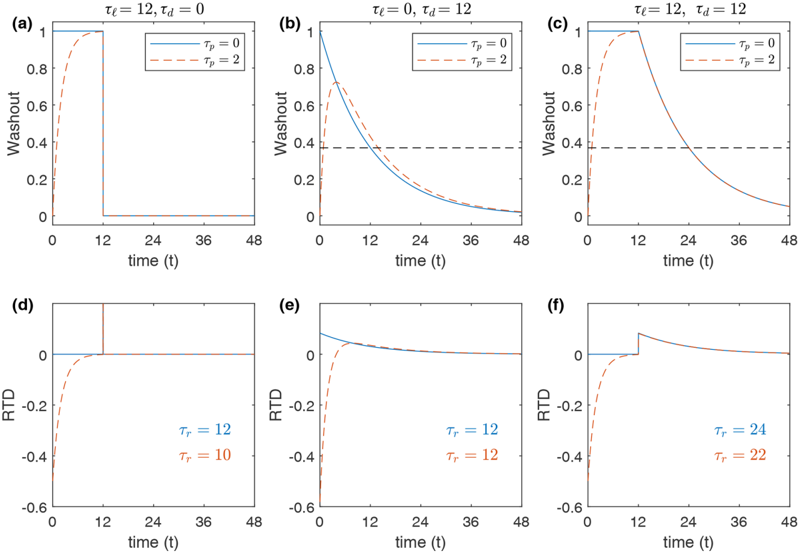
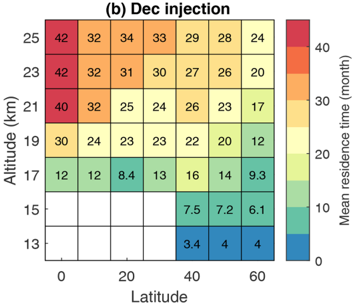
- Passive tracer residence time depends strongly on injection latitude and height: mean residence times range from ~2 months in the lower extratropical stratosphere (13 km, 50° N, June injection) to over 40 months in the tropical mid-stratosphere (≥23 km, 0° N), with a 3–4-fold increase between 17 and 21 km in the tropics. A lagged-decay model fits the washout; lag timescales reach 21 months for high tropical injections, while the well-mixed decay timescale tends toward ~20 months.
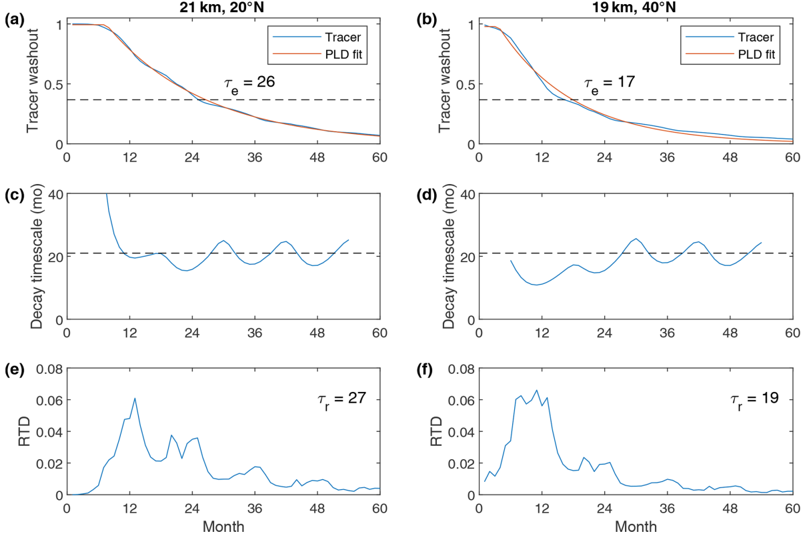
- For Pinatubo, GloSSAC-derived aerosol mass plateaus at 4.7–5.8 TgS depending on assumed size-distribution width; e-folding time is ~25 months and mean lifetime is ~22 months (Table 1: 22–23 months across σ values). HIRS gives an e-folding time of 20.4 months and a mean lifetime of 15 months. The post-plateau decay timescale reaches 13–6 months, with a mean of 9.6 months over months 24–48.
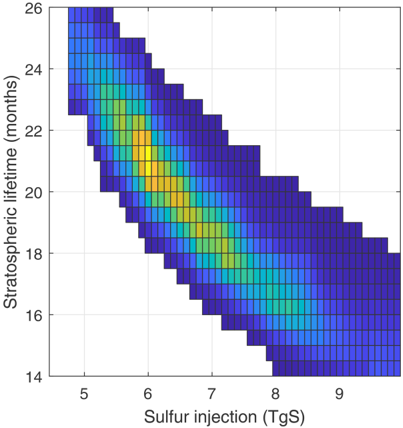
- Monte Carlo production-lag-decay experiments give a single-box lifetime distribution peaking at 23–24 months (mean 23.5 months); a two-box variant spans 12–26 months with a broad peak around 19 months. Constraining to stratospheric sulfur injection below 6.5 TgS yields a peak at 21–22 months and a minimum of 18 months, so lifetimes below 18 months are unlikely.
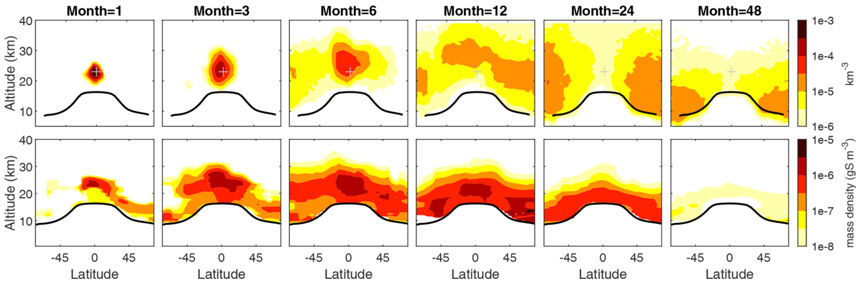
- Comparing ~40 months tracer residence time at the Pinatubo plume height (~25 km) with the 22-month aerosol lifetime suggests gravitational settling reduces residence time by roughly 18 months, or 45%.
Methods
- FLEXPART v10.0 offline dispersion model driven by 6-hourly ERA-Interim fields (1° × 1°, 61 levels); each pulse experiment releases 100,000 passive tracers advected ~5 years. Injections span 0–60° N in 5° steps and 13–26 km in 2 km steps, for June and December 1991. Residence time is the first time a tracer falls below the local tropopause; analyses include e-folding time, running 11-month exponential decay fits, and residence time distributions extended with a 20-month decay tail.
- GloSSAC v2.2 multispectral aerosol extinction (1979–2021) is converted to global stratospheric aerosol mass using Mie calculations, with effective radius inferred from the 525/1020 nm extinction ratio and σ = 1.2, 1.4, 1.6. SO2 emissions come from Carn (2022) MSVOLSO2L4; Pinatubo total emission is taken as 7.5 ± 2.2 TgS, and stratospheric injection as 5.0 ± 1.5 TgS using Ukhov et al. (2023). HIRS total-column mass estimates are used for comparison.
- A production-lag-decay (PLD) model and Monte Carlo parameter sampling (Table 2) translate observational mass uncertainty into aerosol lifetime estimates; a two-box PLD variant tests possible short-lived aerosol removed early.
Limitations
- Stated: tracer pulse experiments are limited to June and December 1991, so they do not assess interannual variability such as the QBO or meteorological variability; Pinatubo aerosol heating could alter stratospheric dynamics and make residence times inaccurate for other injection locations. Cerro Hudson’s contribution is treated as minor (<5%) and not separated from Pinatubo.
- Stated: the Pinatubo lifetime estimate is tied to GloSSAC accuracy; missing SAGE-II lower tropical stratosphere observations in the first 18 months could underestimate aerosol mass, and if substantial unobserved aerosol was quickly removed, the lifetime could be less than 22 months. The confidence interval is subjective, and HIRS has systematic errors and represents total column aerosol.
- Evident: the 22-month estimate assumes the plateau mass represents total injected sulfur converted before removal; changes in aerosol size distribution over time or a short-lived aerosol population would shift the lifetime. The passive tracer experiments ignore gravitational settling and aerosol microphysics, so they quantify air residence time rather than aerosol lifetime directly.
Model-written summary. Check it against the paper before relying on it.
Integrity signals
Registry
Cites
Statistics
Figures
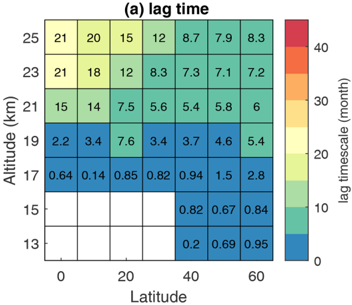
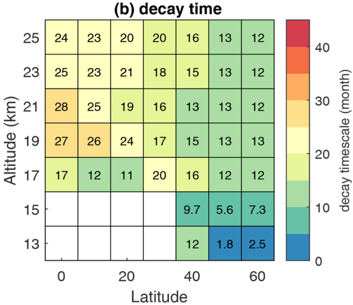
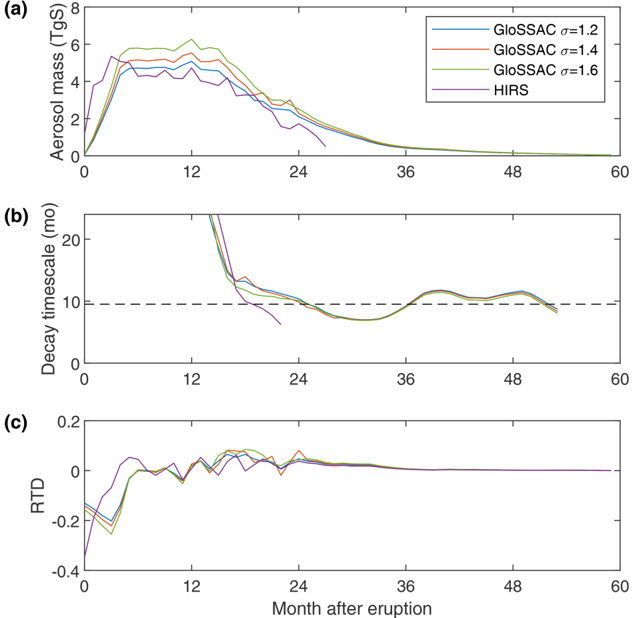
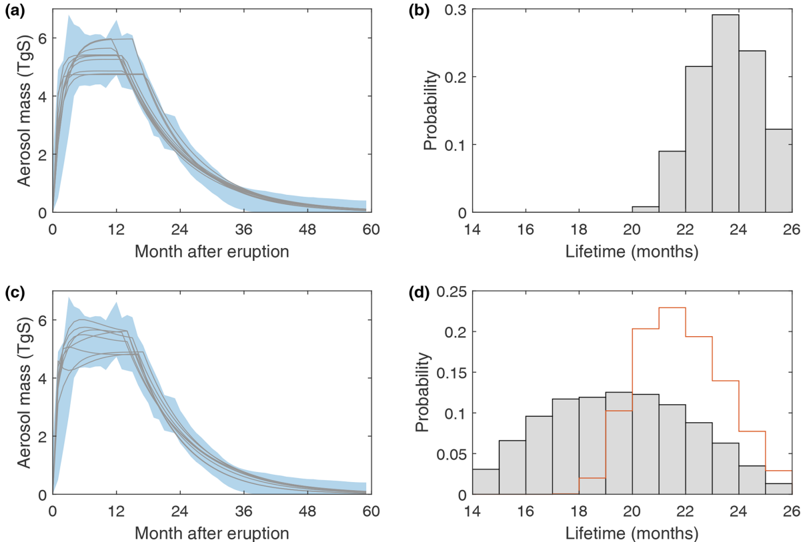
Verification
Claims the paper makes
0 Valid · 2 Not valid · 41 Not checked · 107 Own results and interpretations
A result the paper reports from its own data — it cites no other source for it, so there is none to check. The quote shows it is in the paper.
In the paper
“In the two cases shown here, the mean residence time is found to be similar to the e-folding time measured from the time of tracer injection.”
§ Stratospheric residence time and the lifetime of volcanic stratospheric aerosols > 4.1 Passive tracer pulse experiments -residence time of air
plainstates an associationn = 2- Asserted: passes — The authors put it forward as true.
- Checkable: passes — It can be checked against evidence.
- Load-bearing: unclear — It is unclear whether the paper’s conclusions depend on it.
- Based: passes — The paper gives a reason why it holds.
A result the paper reports from its own data — it cites no other source for it, so there is none to check. The quote shows it is in the paper.
In the paper
“We show that the stratospheric residence time of air, which is estimated through passive tracer pulse experiments and is one factor influencing the lifetime of stratospheric aerosols, is strongly dependent on the injection latitude and height, with an especially strong sensitivity to injection height in the first 4 km above the tropical tropopause.”
§ Stratospheric residence time and the lifetime of volcanic stratospheric aerosols > Abstract
boostedstates an association- Asserted: passes — The authors put it forward as true.
- Checkable: passes — It can be checked against evidence.
- Load-bearing: passes — The paper’s conclusions depend on it.
- Based: passes — The paper gives a reason why it holds.
A result the paper states — it cites no source for it, so there is none to check. The quote shows it is in the paper.
In the paper
“Between months 6 and 20 after the eruption, the HIRS time series follows a similar shape to the GloSSAC time series, albeit with a smaller amplitude.”
§ Stratospheric residence time and the lifetime of volcanic stratospheric aerosols > 4.2 Observations -stratospheric aerosol lifetime
plainstates an association- Asserted: passes — The authors put it forward as true.
- Checkable: passes — It can be checked against evidence.
- Load-bearing: unclear — It is unclear whether the paper’s conclusions depend on it.
- Based: passes — The paper gives a reason why it holds.
A result the paper reports from its own data — it cites no other source for it, so there is none to check. The quote shows it is in the paper.
In the paper
“In the latitude-altitude plane, mean residence time shows a clear dependence on injection altitude, increasing monotonically with injection height with only one exception (at 20° N, 19-21 km for June injection).”
§ Stratospheric residence time and the lifetime of volcanic stratospheric aerosols > 4.1 Passive tracer pulse experiments -residence time of air
boostedstates a cause- Asserted: passes — The authors put it forward as true.
- Checkable: passes — It can be checked against evidence.
- Load-bearing: unclear — It is unclear whether the paper’s conclusions depend on it.
- Based: passes — The paper gives a reason why it holds.
A result the paper reports from its own data — it cites no other source for it, so there is none to check. The quote shows it is in the paper.
In the paper
“The decay timescale varies most strongly with latitude, with larger values (24-27 months) for tropical injec-tions above 17 km compared to around 12 months for 60° N injections.”
§ Stratospheric residence time and the lifetime of volcanic stratospheric aerosols > 4.1 Passive tracer pulse experiments -residence time of air
plainstates an association- Asserted: passes — The authors put it forward as true.
- Checkable: passes — It can be checked against evidence.
- Load-bearing: passes — The paper’s conclusions depend on it.
- Based: passes — The paper gives a reason why it holds.
79 more claims
Create a free account to see all 150 claims and to verify the 43 references still open.
- It may state two separate claims as one. 53
- Probably not a substantial claim. 16
- The quote only partly states this claim. 1
Self-check
Percentages, sums and reported differences re-computed from the paper’s own numbers.
Each contradiction between two passages listed here was confirmed by an independent check.
Rated minor: it would not touch a result — a value no result rests on, a p-value that stays on the same side of the significance level, or a conflict that is clerical, resolved elsewhere in the paper, or outside its own findings.
In the paper
§ Stratospheric residence time and the lifetime of volcanic stratospheric aerosols > 4.2 Observations -stratospheric aerosol lifetime
“resulting in a mean residence time of 15 months with a range of 11-21 months.”
§ Stratospheric residence time and the lifetime of volcanic stratospheric aerosols > Appendix B: Considering Cerro Hudson
“| HIRS | 5.4 | 20 | 15 (11-20) |”
Citations
Cites
The ERA‐Interim reanalysis: configuration and performance of the data assimilation system
Dee, D. P., Uppala, S. M., Simmons, A. J., Berrisford, P., Poli, P., Kobayashi, S., Andrae, U., Balmaseda, M. A., Balsamo, G., Bauer, P., et al. (2011) · Quarterly Journal of the Royal Meteorological Society · doi:10.1002/qj.828 · Cited by 24,480
Anthropogenic and Natural Radiative Forcing
(2014) · Climate Change 2013 – The Physical Science Basis · doi:10.1017/cbo9781107415324.018 · Cited by 3,683
Volcanic eruptions and climate
Robock, A. (2000) · Reviews of Geophysics · doi:10.1029/1998rg000054 · Cited by 2,806
Stratosphere‐troposphere exchange
Holton, J. R., Haynes, P. H., McIntyre, M. E., Douglass, A. R., Rood, R. B., & Pfister, L. (1995) · Reviews of Geophysics · doi:10.1029/95rg02097 · Cited by 2,706
Technical note: The Lagrangian particle dispersion model FLEXPART version 6.2
Stohl, A., Forster, C., Frank, A., Seibert, P., & Wotawa, G. (2005) · Atmospheric Chemistry and Physics · doi:10.5194/acp-5-2461-2005 · Cited by 1,947
Atmospheric effects of the Mt Pinatubo eruption
McCormick, M. P., Thomason, L. W., & Trepte, C. R. (1995) · Nature · doi:10.1038/373399a0 · Cited by 995
Near-term Climate Change: Projections and Predictability
(2014) · Climate Change 2013 – The Physical Science Basis · doi:10.1017/cbo9781107415324.023 · Cited by 860
Introduction to Atmospheric Chemistry
Jacob, D. J. (2000) · Princeton University Press eBooks · doi:10.1515/9781400841547 · Cited by 854
Butchart, N. (2014) · Reviews of Geophysics · doi:10.1002/2013rg000448 · Cited by 791
Breaking planetary waves in the stratosphere
McIntyre, M. E., & Palmer, T. N. (1983) · Nature · doi:10.1038/305593a0 · Cited by 767
Junge, C. E., Chagnon, C. W., & Manson, J. E. (1961) · Journal of Meteorology · doi:10.1175/1520-0469(1961)018<0081:sa>2.0.co;2 · Cited by 425
Seasonal cycle of the residual mean meridional circulation in the stratosphere
Rosenlof, K. H. (1995) · Journal of Geophysical Research: Atmospheres · doi:10.1029/94jd03122 · Cited by 405
Volcanic stratospheric sulfur injections and aerosol optical depth from 500 BCE to 1900 CE
Toohey, M., & Sigl, M. (2017) · Earth System Science Data · doi:10.5194/essd-9-809-2017 · Cited by 344
Self-citationKhaykin, S., Legras, B., Bucci, S., Sellitto, P., Isaksen, L., Tencé, F., Bekki, S., Bourassa, A., Rieger, L., Zawada, D., et al. (2020) · Communications Earth & Environment · doi:10.1038/s43247-020-00022-5 · Cited by 338
Tropical stratospheric circulation deduced from satellite aerosol data
Trepte, C. R., & Hitchman, M. H. (1992) · Nature · doi:10.1038/355626a0 · Cited by 332
A global space-based stratospheric aerosol climatology: 1979–2016
Thomason, L. W., Ernest, N., Millán, L., Rieger, L., Bourassa, A., Vernier, J.-P., Manney, G., Luo, B., Arfeuille, F., & Peter, T. (2018) · Earth System Science Data · doi:10.5194/essd-10-469-2018 · Cited by 315
Global volcanic aerosol properties derived from emissions, 1990–2014, using CESM1(WACCM)
Mills, M. J., Schmidt, A., Easter, R., Solomon, S., Kinnison, D. E., Ghan, S. J., Neely, R. R., Marsh, D. R., Conley, A., Bardeen, C. G., et al. (2016) · Journal of Geophysical Research: Atmospheres · doi:10.1002/2015jd024290 · Cited by 314
A “tropical pipe” model of stratospheric transport
Plumb, R. A. (1996) · Journal of Geophysical Research: Atmospheres · doi:10.1029/95jd03002 · Cited by 309
The Hunga Tonga‐Hunga Ha'apai Hydration of the Stratosphere
Millán, L., Santee, M. L., Lambert, A., Livesey, N. J., Werner, F., Schwartz, M. J., Pumphrey, H. C., Manney, G. L., Wang, Y., Su, H., et al. (2022) · Geophysical Research Letters · doi:10.1029/2022gl099381 · Cited by 284
Climatic response to high‐latitude volcanic eruptions
Oman, L., Robock, A., Stenchikov, G., Schmidt, G. A., & Ruedy, R. (2005) · Journal of Geophysical Research: Atmospheres · doi:10.1029/2004jd005487 · Cited by 248
The poleward dispersal of Mount Pinatubo volcanic aerosol
Trepte, C. R., Veiga, R. E., & McCormick, M. P. (1993) · Journal of Geophysical Research: Atmospheres · doi:10.1029/93jd01362 · Cited by 236
Disproportionately strong climate forcing from extratropical explosive volcanic eruptions
Toohey, M., Krüger, K., Schmidt, H., Timmreck, C., Sigl, M., Stoffel, M., & Wilson, R. (2019) · Nature Geoscience · doi:10.1038/s41561-018-0286-2 · Cited by 185
Self-citationKloss, C., Berthet, G., Sellitto, P., Ploeger, F., Taha, G., Tidiga, M., Eremenko, M., Bossolasco, A., Jégou, F., Renard, J.-B., et al. (2021) · Atmospheric Chemistry and Physics · doi:10.5194/acp-21-535-2021 · Cited by 183
Transport in the Middle Atmosphere
SHEPHERD, T. G. (2007) · Journal of the Meteorological Society of Japan. Ser. II · doi:10.2151/jmsj.85b.165 · Cited by 173
Sensitivity of Aerosol Distribution and Climate Response to Stratospheric SO2 Injection Locations
Tilmes, S., Richter, J. H., Mills, M. J., Kravitz, B., MacMartin, D. G., Vitt, F., Tribbia, J. J., & Lamarque, J. (2017) · Journal of Geophysical Research: Atmospheres · doi:10.1002/2017jd026888 · Cited by 164
Sigl, M., Toohey, M., McConnell, J. R., Cole-Dai, J., & Severi, M. (2022) · Earth System Science Data · doi:10.5194/essd-14-3167-2022 · Cited by 162
Self-citationEasy Volcanic Aerosol (EVA v1.0): an idealized forcing generator for climate simulations
Toohey, M., Stevens, B., Schmidt, H., & Timmreck, C. (2016) · Geoscientific Model Development · doi:10.5194/gmd-9-4049-2016 · Cited by 162
Self-citationAtmospheric Aerosols: Properties and Climate Impacts
Boucher, O. (2015) · doi:10.1007/978-94-017-9649-1 · Cited by 160
Residence time and physical processes in lakes
Ambrosetti, W., Barbanti, L., & Sala, N. M. (2003) · Journal of Limnology · doi:10.4081/jlimnol.2003.s1.1 · Cited by 148
Timmreck, C., Mann, G. W., Aquila, V., Hommel, R., Lee, L. A., Schmidt, A., Brühl, C., Carn, S., Chin, M., Dhomse, S. S., et al. (2018) · Geoscientific Model Development · doi:10.5194/gmd-11-2581-2018 · Cited by 127
Self-citationLidar measurements of stratospheric aerosol over Mauna Loa Observatory
Barnes, J. E., & Hofmann, D. J. (1997) · Geophysical Research Letters · doi:10.1029/97gl01943 · Cited by 127
The Life Cycle of Stratospheric Aerosol Particles
Hamill, P., Jensen, E. J., Russell, P. B., & Bauman, J. J. (1997) · Bulletin of the American Meteorological Society · doi:10.1175/1520-0477(1997)078<1395:tlcosa>2.0.co;2 · Cited by 122
Marshall, L., Johnson, J. S., Mann, G. W., Lee, L., Dhomse, S. S., Regayre, L., Yoshioka, M., Carslaw, K. S., & Schmidt, A. (2019) · Journal of Geophysical Research: Atmospheres · doi:10.1029/2018jd028675 · Cited by 117
The Global Space-based Stratospheric Aerosol Climatology (version 2.0): 1979–2018
Kovilakam, M., Thomason, L. W., Ernest, N., Rieger, L., Bourassa, A., & Millán, L. (2020) · Earth System Science Data · doi:10.5194/essd-12-2607-2020 · Cited by 113
Dispersion of the volcanic sulfate cloud from a Mount Pinatubo–like eruption
Aquila, V., Oman, L. D., Stolarski, R. S., Colarco, P. R., & Newman, P. A. (2012) · Journal of Geophysical Research: Atmospheres · doi:10.1029/2011jd016968 · Cited by 105
Changing transport processes in the stratosphere by radiative heating of sulfate aerosols
Niemeier, U., & Schmidt, H. (2017) · Atmospheric Chemistry and Physics · doi:10.5194/acp-17-14871-2017 · Cited by 102
Aubry, T. J., Toohey, M., Marshall, L., Schmidt, A., & Jellinek, M. A. (2020) · Journal of Geophysical Research Atmospheres · doi:10.1029/2019jd031303 · Cited by 102
Self-citationStratospheric aerosol effective radius, surface area and volume estimated from infrared measurements
Grainger, R. G., Lambert, A., Rodgers, C. D., Taylor, F. W., & Deshler, T. (1995) · Journal of Geophysical Research Atmospheres · doi:10.1029/95jd00988 · Cited by 100
Sulfuric Acid Droplet Formation and Growth in the Stratosphere After the 1982 Eruption of El Chichón
Hofmann, D. J., & Rosen, J. M. (1983) · Science · doi:10.1126/science.222.4621.325 · Cited by 100
Dhomse, S. S., Emmerson, K. M., Mann, G. W., Bellouin, N., Carslaw, K. S., Chipperfield, M. P., Hommel, R., Abraham, N. L., Telford, P., Braesicke, P., et al. (2014) · Atmospheric Chemistry and Physics · doi:10.5194/acp-14-11221-2014 · Cited by 99
Clyne, M., Lamarque, J.-F., Mills, M. J., Khodri, M., Ball, W., Bekki, S., Dhomse, S. S., Lebas, N., Mann, G., Marshall, L., et al. (2021) · Atmospheric Chemistry and Physics · doi:10.5194/acp-21-3317-2021 · Cited by 91
Self-citation(1994) · Journal of Geophysical Research: Atmospheres · doi:10.1029/94jd02044 · Cited by 88
Young, R. E., Houben, H. C., & Toon, O. B. (1994) · Geophysical Research Letters · doi:10.1029/93gl03302 · Cited by 79
Yue, G. K., & Deepak, A. (1983) · Applied Optics · doi:10.1364/ao.22.001639 · Cited by 76
Visioni, D., Bednarz, E. M., Lee, W. R., Kravitz, B., Jones, A., Haywood, J. M., & MacMartin, D. G. (2023) · Atmospheric Chemistry and Physics · doi:10.5194/acp-23-663-2023 · Cited by 69
Seasonal Injection Strategies for Stratospheric Aerosol Geoengineering
Visioni, D., MacMartin, D. G., Kravitz, B., Tilmes, S., Mills, M. J., Richter, J. H., & Boudreau, M. P. (2019) · Geophysical Research Letters · doi:10.1029/2019gl083680 · Cited by 69 · cited 1×
“…in an expression for the amount tracer removed as secondary tracer The washout function for the secondary tracer is thus the total tracer washout function W , multiplied by the fraction of tracer in the secondary form f , divided by the total amount of tracer to be removed as secondary tracer F 2”
Quaglia, I., Timmreck, C., Niemeier, U., Visioni, D., Pitari, G., Brodowsky, C., Brühl, C., Dhomse, S. S., Franke, H., Laakso, A., et al. (2023) · Atmospheric Chemistry and Physics · doi:10.5194/acp-23-921-2023 · Cited by 69
Visioni, D., Pitari, G., Tuccella, P., & Curci, G. (2018) · Atmospheric Chemistry and Physics · doi:10.5194/acp-18-2787-2018 · Cited by 64
Pitari, G., Di Genova, G., Mancini, E., Visioni, D., Gandolfi, I., & Cionni, I. (2016) · Atmosphere · doi:10.3390/atmos7060075 · Cited by 62
A one and half year interactive MA/ECHAM4 simulation of Mount Pinatubo Aerosol
Timmreck, C., Graf, H., & Kirchner, I. (1999) · Journal of Geophysical Research Atmospheres · doi:10.1029/1999jd900088 · Cited by 62
Stratospheric Temperature and Ozone Impacts of the Hunga Tonga‐Hunga Ha'apai Water Vapor Injection
Fleming, E. L., Newman, P. A., Liang, Q., & Oman, L. D. (2024) · Journal of Geophysical Research: Atmospheres · doi:10.1029/2023jd039298 · Cited by 53 · cited 1×
“…in an expression for the amount tracer removed as secondary tracer The washout function for the secondary tracer is thus the total tracer washout function W , multiplied by the fraction of tracer in the secondary form f , divided by the total amount of tracer to be removed as secondary tracer F 2”
Transport of Cerro Hudson SO2 clouds
Doiron, S. D., Bluth, G. J. S., Schnetzler, C. C., Krueger, A. J., & Walter, L. S. (1991) · Eos, Transactions American Geophysical Union · doi:10.1029/90eo00354 · Cited by 51
Sukhodolov, T., Sheng, J.-X., Feinberg, A., Luo, B.-P., Peter, T., Revell, L., Stenke, A., Weisenstein, D. K., & Rozanov, E. (2018) · Geoscientific Model Development · doi:10.5194/gmd-11-2633-2018 · Cited by 51
Multi-Satellite Volcanic Sulfur Dioxide L4 Long-Term Global Database V4
Carn, S. (2021) · Earth Observing System Data and Information System · doi:10.5067/measures/so2/data405 · Cited by 43
Stratospheric residence time and its relationship to mean age
Hall, T., & Waugh, D. W. (2000) · Journal of Geophysical Research Atmospheres · doi:10.1029/1999jd901096 · Cited by 33
Zhou, X., Dhomse, S. S., Feng, W., Mann, G., Heddell, S., Pumphrey, H., Kerridge, B. J., Latter, B., Siddans, R., Ventress, L., et al. (2024) · Geophysical Research Letters · doi:10.1029/2023gl107630 · Cited by 31 · cited 1×
“…in an expression for the amount tracer removed as secondary tracer The washout function for the secondary tracer is thus the total tracer washout function W , multiplied by the fraction of tracer in the secondary form f , divided by the total amount of tracer to be removed as secondary tracer F 2”
Side Effects of Sulfur‐Based Geoengineering Due To Absorptivity of Sulfate Aerosols
Wunderlin, E., Chiodo, G., Sukhodolov, T., Vattioni, S., Visioni, D., & Tilmes, S. (2024) · Geophysical Research Letters · doi:10.1029/2023gl107285 · Cited by 29
Aubry, T. J., Jellinek, A. M., Degruyter, W., Bonadonna, C., Radić, V., Clyne, M., & Quainoo, A. (2016) · Journal of Geophysical Research: Atmospheres · doi:10.1002/2016jd025405 · Cited by 28
Intercomparison of in-situ aircraft and satellite aerosol measurements in the stratosphere
Sandvik, O. S., Friberg, J., Martinsson, B. G., van Velthoven, P. F. J., Hermann, M., & Zahn, A. (2019) · Scientific Reports · doi:10.1038/s41598-019-52089-6 · Cited by 21
The Evolution of the Hunga Hydration in a Moistening Stratosphere
Millán, L., Read, W. G., Santee, M. L., Lambert, A., Manney, G. L., Neu, J. L., Pitts, M. C., Werner, F., Livesey, N. J., & Schwartz, M. J. (2024) · Geophysical Research Letters · doi:10.1029/2024gl110841 · Cited by 19
What CloudSat cannot see: liquid water content profiles inferred from MODIS and CALIOP observations
Schulte, R., Lebsock, M., & Haynes, J. M. (2023) · Atmospheric measurement techniques · doi:10.5194/amt-16-3531-2023 · Cited by 19
Emulating inconsistencies in stratospheric aerosol injection
Farley, J., MacMartin, D. G., Visioni, D., & Kravitz, B. (2024) · Environmental Research Climate · doi:10.1088/2752-5295/ad519c · Cited by 16
Volcanic forcing of high-latitude Northern Hemisphere eruptions
Fuglestvedt, H. F., Zhuo, Z., Toohey, M., & Krüger, K. (2024) · npj Climate and Atmospheric Science · doi:10.1038/s41612-023-00539-4 · Cited by 15
Self-citationSun, H., Bourguet, S., Eastham, S., & Keith, D. (2023) · Geophysical Research Letters · doi:10.1029/2023gl105371 · Cited by 14 · cited 2×
“We interpret these results as suggesting that lifetimes below 18 months are unlikely given the observed aerosol mass time series and sulfur injection amounts and the uncertainties on these observations”
Global Space-based Stratospheric Aerosol Climatology Version 2.2
Thomason, L. W. (2026) · Earth Observing System Data and Information System · doi:10.5067/glossac-l3-v2.2 · Cited by 14
Ukhov, A., Stenchikov, G., Osipov, S., Krotkov, N., Gorkavyi, N., Li, C., Dubovik, O., & Lopatin, A. (2023) · Journal of Geophysical Research: Atmospheres · doi:10.1029/2022jd038446 · Cited by 13
Initial atmospheric conditions control transport of volcanic volatiles, forcing and impacts
Zhuo, Z., Fuglestvedt, H. F., Toohey, M., & Krüger, K. (2024) · Atmospheric Chemistry and Physics · doi:10.5194/acp-24-6233-2024 · Cited by 11
Self-citationBrown, F., Marshall, L., Haynes, P. H., Garcia, R. R., Birner, T., & Schmidt, A. (2023) · Atmospheric Chemistry and Physics · doi:10.5194/acp-23-5335-2023 · Cited by 9
Stratospheric transport and tropospheric sink of solar geoengineering aerosol: a Lagrangian analysis
Sun, H., Bourguet, S., Luan, L., & Keith, D. (2024) · npj Climate and Atmospheric Science · doi:10.1038/s41612-024-00664-8 · Cited by 6 · cited 1×
“…of stratospheric residence time for a well-mixed tracer This result (equivalent to 608 d) is comparable to the 576 d aerosol decay timescale found by Sun et al. (2024) in their Lagrangian model exper-iment after a 10-year stratospheric aerosol injection period, although it should be noted their…”
Stratospheric aerosol measurements over Mauna Loa Observatory, Hawaii
Barnes, J. E., & Hofmann, D. J. (n.d.) · IGARSS 2000. IEEE 2000 International Geoscience and Remote Sensing Symposium. Taking the Pulse of the Planet: The Role of Remote Sensing in Managing the Environment. Proceedings (Cat. No.00CH37120) · doi:10.1109/igarss.2000.857302
Research works printed but not linked: 2
- Fogler, H. S., Pearson, ISBN 978-0133887518, 2020.
- Thomason, L. W. and Peter, T. (Eds.): Assessment of Stratospheric Aerosol Properties (ASAP), SPARC Report No. 4, WCRP-124, WMO/TD-No. 1295, 2006.
Cited by
The January 2022 Hunga eruption cooled the southern hemisphere in 2022 and 2023
Gupta, A. K., Mittal, T., Fauria, K. E., Bennartz, R., & Kok, J. F. (2025) · Communications Earth & Environment · doi:10.1038/s43247-025-02181-9 · Cited by 24
A Climate Intervention Dynamical Emulator (CIDER) for scenario space exploration
Farley, J., MacMartin, D. G., Visioni, D., Kravitz, B., Bednarz, E., Duffey, A., Henry, M., & Akherati, A. (2026) · Geoscientific model development · doi:10.5194/gmd-19-1809-2026 · Cited by 12
Stratospheric Injection Lifetimes
Schoeberl, M. R., Toohey, M., Wang, Y., & Ueyama, R. (2025) · Journal of Geophysical Research Atmospheres · doi:10.1029/2025jd043928 · Cited by 10
Self-citationSánchez, R. M., Bastien-Olvera, B. A., Calderón, O., Estrada, F., & Altamirano, M. (2025) · Scientific Data · doi:10.1038/s41597-025-05496-6 · Cited by 6
Fu, T., He, Y., Jia, Y., Jing, D., & Yi, F. (2025) · Atmospheric Research · doi:10.1016/j.atmosres.2025.108347 · Cited by 4
Self-citation
Metadata
- Authors
- Toohey, M., Jia, Y., Khanal, S., & Tegtmeier, S.
- Affiliations
- University of Saskatchewan (CA)
- Cooperative Institute for Research in Environmental Sciences (US)
- Corresponding author
- Toohey, Matthew
- Venue
- Atmospheric Chemistry and Physics
- Publisher
- Copernicus GmbH
- Published
- 2025-04-02
- Volume
- 25
- Issue
- 6
- Pages
- 3821-3839
- ISSN
- 1680-7316 (ISSN-L)
- 1680-7324
- OpenAlex
- W4409166519
- Cited by
- 29
- References
- 69
- Citations by year
- 2026: 19 · 2025: 9
- FWCI
- 6.37
- Type
- journal article
- Language
- en
- Open access
- gold
- doi.org
- Licence
- Locations
- Atmospheric chemistry and physics (publishedVersion, cc-by)
- HARVEST (University of Saskatchewan) (acceptedVersion, cc-by)
- NOAA Institutional Repository (submittedVersion, cc-by)
- DOAJ (DOAJ: Directory of Open Access Journals) (submittedVersion)
- Funders
- Canadian Space Agency (21SUASOCSA)
- Topics
- Physical Sciences › Environmental Science › Global and Planetary Change › Atmospheric aerosols and clouds
- Physical Sciences › Earth and Planetary Sciences › Atmospheric Science › Atmospheric Ozone and Climate
- Physical Sciences › Earth and Planetary Sciences › Atmospheric Science › Atmospheric chemistry and aerosols
- Keywords
- stratospheric residence time, aerosol lifetime, Mount Pinatubo eruption, tropical tropopause, injection height, aerosol removal, observational uncertainty
About these checks
Registry, retraction, Cites and statistics results are computed, not judged, with one exception: a printed reference that no index lists is read once by a model before it counts as a citation error. Claims are extracted by a model and kept only when their quote appears verbatim in the text; each cited source is then checked, with a model’s help, for whether it says what the claim relies on. Those verdicts can be wrong — read the claim’s quote and the cited source before relying on one.
A language model drew the claims from the paper on 2026-11-24, under version 3 of the claim definition (model deepseek-v4.1-flash, prompt extract-v3).
A second model labelled each claim on 2026-11-24 (model jev-1.13-20260917, definition revision gold-guideline-v0.2).
Statistics and arithmetic are recomputed, not judged.
Confidence bands are shown only for fields calibrated on our annotated test set. None is calibrated yet, so no band is shown.
What counts as a claim ›How we measure confidence ›How we check this ›
Are you an author, or do you see a problem with this page? Request a review
Data sources
Bibliographic data: Semantic Scholar, OpenAlex, Crossref.
Contains information from the Semantic Scholar Academic Graph Datasets, made available under the ODC Attribution License (ODC-BY 1.0).
Semantic Scholar’s data is described in: Kinney, R., et al. (2023). The Semantic Scholar Open Data Platform. arXiv:2301.10140.
