

Spatial variability of the modern radiocarbon reservoir effect in the high-altitude lake Laguna del Peinado (southern Puna Plateau, Argentina)
Open accessPublished version of a preprint
The DOI matches its Crossref record; 66 of the 68 references it cites were found in a registry or an index, and 1 are not checked yet; none of the 14 sources its claims cite is checked for support yet.
Abstract
The high-altitude lakes of the Altiplano–Puna Plateau in the Central Andes commonly have large radiocarbon reservoir effects. This, combined with the general scarcity of terrestrial organic matter, makes obtaining a reliable and accurate chronological model based on radiocarbon ages a challenge. As a result, age–depth models based on radiocarbon dating are often constructed by correcting for the modern reservoir effect, but commonly without consideration of spatial and possible temporal variations of reservoir ages within the lake and across the basin. In order to get a better constraint on the spatial variability of the radiocarbon reservoir effects, we analyse 14 C ages of modern terrestrial and aquatic plants from the El Peinado basin in the southern Puna Plateau, which hosts Laguna del Peinado fed by hydrothermal springs. The oldest 14 C ages of modern samples ( > 18 000 and > 26 000 BP) were found in hot springs discharging into the lake, likely resulting from the input of 14 C-depleted carbon from old groundwater and 14 C-free magmatic CO 2 . In the littoral and central part of Laguna del Peinado, 14 C ages of modern samples were several thousand years younger ( > 13 000 and > 12 000 BP) compared to the inflowing waters as a result of CO 2 exchange with the atmosphere. Altogether, our findings reveal a spatial variability of up to 14 000 14 C years of the modern reservoir effect between the hot springs and the northern part of the Peinado lake basin. Temporal changes of reservoir effects in sediment records are more difficult to quantify, but 14 C ages from a short core from Laguna del Peinado may suggest temporal reservoir age variations of a few thousand years. This study has implications for accurate 14 C-based chronologies for palaeoclimate studies in the Altiplano–Puna Plateau and similar settings. Our results highlight the need to consider spatial and likely also temporal variations in the reservoir effects when constructing age–depth models.
Checked 2026-11-23 · 1 reference not checked yet
Overview
CoChat Summary
TL;DR
Modern terrestrial and aquatic plants from the El Peinado basin show large and spatially variable radiocarbon reservoir effects, with the oldest ages in hydrothermal springs and younger ages in the lake littoral and central basin. The authors attribute these effects to old groundwater and ¹⁴C-free magmatic CO₂ and argue that a single reservoir correction is unreliable for age-depth models in this setting.
Key findings
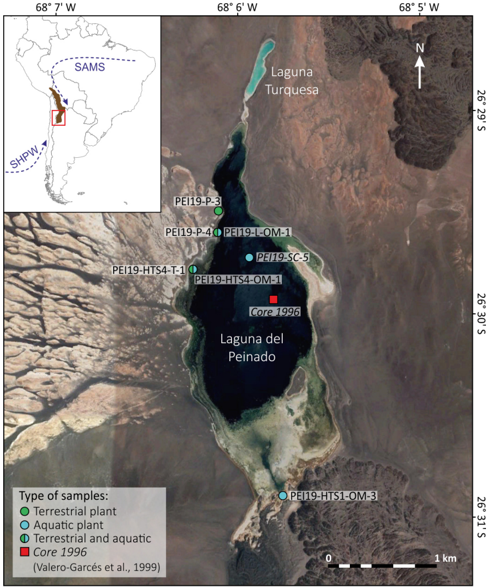
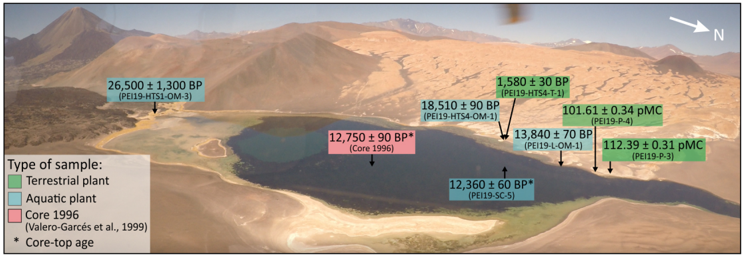
- Modern aquatic samples ranged from 12,360 ± 60 BP (core-top aquatic macrophytes, central lake) to 26,500 ± 1300 BP (microbial mats, southern shore hot spring), with western hot spring microbial mats at 18,510 ± 90 BP and littoral aquatic macrophytes at 13,840 ± 70 BP; the paper reports spatial variability of up to 14,000 ¹⁴C years between the hot springs and the northern part of the Peinado lake basin.
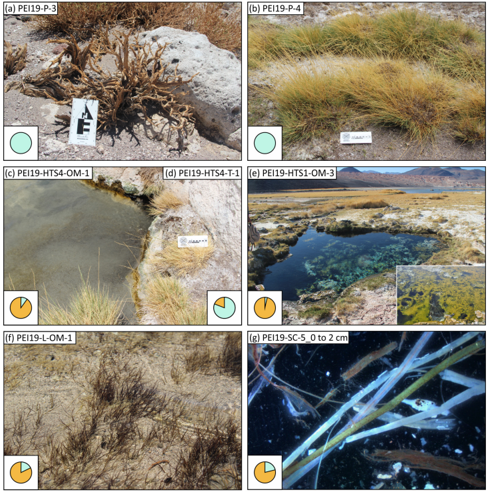
- Terrestrial plants away from the shore gave modern ages: *Adesmia* sp. 112.39 ± 0.31 pMC (1994–1996 cal CE) and Poaceae 101.61 ± 0.34 pMC (2018–2019 cal CE); a Poaceae near a hot spring gave 1580 ± 30 BP, indicating incorporation of ¹⁴C-depleted carbon.
- The end-member mixing model showed the highest dead-carbon proportions in southern and western hot spring microbial mats (96.4 % and 90.2 %, respectively), while lake modern aquatic macrophytes ranged between ∼78 % and 82 %.
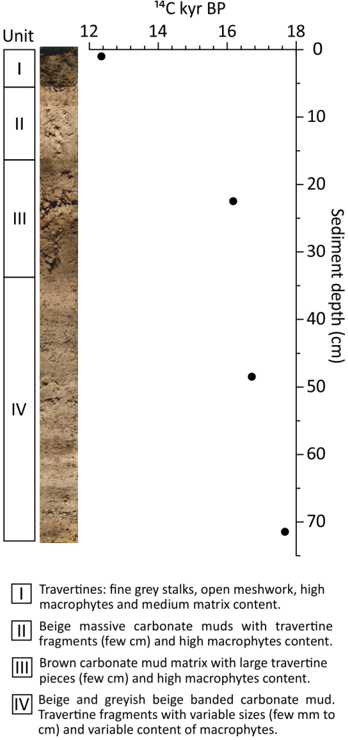
- Down-core aquatic macrophyte ages were 16,180 ± 80 BP (22–23 cm), 16,720 ± 90 BP (48–49 cm), and 17,680 ± 90 BP (71–72 cm); the core-top age of 12,360 ± 60 BP was ∼400 ¹⁴C years younger than a previously published core, which may suggest temporal reservoir age variations of a few thousand years.
Methods
- Fieldwork in January and November 2019 collected 10 samples: 7 modern samples (3 terrestrial plants, 2 microbial mats from hot springs, aquatic macrophytes from the lake littoral zone, and aquatic macrophytes from the sediment core-top at 0–2 cm depth) and 3 plant macrofossil samples from a short core at 22–23, 48–49, and 71–72 cm depth; short cores (<1 m) were retrieved from Laguna del Peinado in two profiles, with core PEI19-SC-5 from the central basin at 3.2 m water depth.
- AMS ¹⁴C measurements were carried out at the Poznan Radiocarbon Laboratory after acid-base-acid pretreatment; F¹⁴C values were calculated with the R package “rintcal,” post-bomb dates were calibrated with CALIBomb, and a simple end-member mixing model estimated dead carbon as Dead carbon (%) = 1 − F¹⁴C in sample/F¹⁴C in reference plant × 100, using sample PEI19-P-4 as the local atmospheric reference.
- δ¹³C_carb was analysed in four carbonate matrix sediment samples at 0–2, 24–26, 46–48, and 71–72 cm depths and in one microbial mat sample from the southern hot spring at GFZ Potsdam.
Limitations
- Paper-stated: temporal changes of reservoir effects in sediment records are more difficult to quantify; the down-core age-depth relation remains a matter of debate; the authors cannot fully exclude a hiatus or a major decrease of the reservoir effect during deposition of the uppermost 22 cm; they lack robust data to support either possibility, and the true age of the Peinado sediments remains unsolved due to lack of critical assessment of potential bias in U/Th dating.
- Paper-stated: ³H data are lacking for the El Peinado basin, so the interpretation that the system is almost entirely supported by old groundwater is inferred from regional studies; the influence of short-term lake-level fluctuations on modern reservoir effects remains elusive due to the lack of systematic studies.
- Evident from the text: the study is based on a limited sample set (10 samples total and one short core), and one date has a high σ due to a small sample size (0.05 mgC); spatial and temporal interpretations rely on a single core and comparison with a previously published core.
Model-written summary. Check it against the paper before relying on it.
Integrity signals
Registry
Cites
Statistics
Figures
Verification
Claims the paper makes
0 Valid · 0 Not valid · 11 Not checked · 39 Own results and interpretations
A result the paper reports from its own data — it cites no other source for it, so there is none to check. The quote shows it is in the paper.
In the paper
“14 C ages from a short core from Laguna del Peinado may suggest temporal reservoir age variations of a few thousand years.”
§ Spatial variability of the modern radiocarbon reservoir effect in the high-altitude lake Laguna del Peinado (southern Puna Plateau, Argentina) > Abstract
hedgedstates a possible causeSingle case- Asserted: passes — The authors put it forward as true.
- Checkable: passes — It can be checked against evidence.
- Load-bearing: passes — The paper’s conclusions depend on it.
- Based: passes — The paper gives a reason why it holds.
A result the paper states — it cites no source for it, so there is none to check. The quote shows it is in the paper.
In the paper
“This would be in agreement with our observations in the modern environment revealing decreasing reservoir effects with increasing distance to the hydrothermal springs due to extended DIC equilibration with atmospheric CO 2 .”
§ Spatial variability of the modern radiocarbon reservoir effect in the high-altitude lake Laguna del Peinado (southern Puna Plateau, Argentina) > 5.3 14 C reservoir effect in surface sediments
hedgedstates a cause- Asserted: passes — The authors put it forward as true.
- Checkable: passes — It can be checked against evidence.
- Load-bearing: passes — The paper’s conclusions depend on it.
- Based: passes — The paper gives a reason why it holds.
A result the paper states — it cites no source for it, so there is none to check. The quote shows it is in the paper.
In the paper
“An influence of volcanic CO 2 is further supported by permanent bubbling in the southern shore hot spring pool as well as in the seepage areas on the west coast.”
§ Spatial variability of the modern radiocarbon reservoir effect in the high-altitude lake Laguna del Peinado (southern Puna Plateau, Argentina) > 5.2.3 14 C-free volcanic CO 2
plainstates an association- Asserted: passes — The authors put it forward as true.
- Checkable: passes — It can be checked against evidence.
- Load-bearing: passes — The paper’s conclusions depend on it.
- Based: passes — The paper gives a reason why it holds.
A result the paper reports from its own data — it cites no other source for it, so there is none to check. The quote shows it is in the paper.
In the paper
“The four down-core 14 C ages from aquatic macrophytes (Potamogetonaceae) in our core PEI19-SC-5 are in chronological order (Table 1, Fig. 3).”
§ Spatial variability of the modern radiocarbon reservoir effect in the high-altitude lake Laguna del Peinado (southern Puna Plateau, Argentina) > 5.4 Down-core 14 C ages
plain- Asserted: passes — The authors put it forward as true.
- Checkable: passes — It can be checked against evidence.
- Load-bearing: passes — The paper’s conclusions depend on it.
- Based: passes — The paper gives a reason why it holds.
A result the paper reports from its own data — it cites no other source for it, so there is none to check. The quote shows it is in the paper.
In the paper
“our findings reveal a spatial variability of up to 14 000 14 C years of the modern reservoir effect between the hot springs and the northern part of the Peinado lake basin.”
§ Spatial variability of the modern radiocarbon reservoir effect in the high-altitude lake Laguna del Peinado (southern Puna Plateau, Argentina) > Abstract
plainstates an association- Asserted: passes — The authors put it forward as true.
- Checkable: passes — It can be checked against evidence.
- Load-bearing: passes — The paper’s conclusions depend on it.
- Based: passes — The paper gives a reason why it holds.
25 more claims
Create a free account to see all 50 claims and to verify the 10 references still open.
- It may state two separate claims as one. 11
- The quote only partly states this claim. 2
- Probably not a substantial claim. 10
Self-check
Percentages, sums and reported differences re-computed from the paper’s own numbers.
Each contradiction between two passages listed here was confirmed by an independent check.
Rated minor: it would not touch a result — a value no result rests on, a p-value that stays on the same side of the significance level, or a conflict that is clerical, resolved elsewhere in the paper, or outside its own findings.
In the paper
§ Spatial variability of the modern radiocarbon reservoir effect in the high-altitude lake Laguna del Peinado (southern Puna Plateau, Argentina) > 5.2.3 14 C-free volcanic CO 2
“Degassing of magmatic CO 2 might have also caused the age of 1580 ± 30 BP for a modern terrestrial plant from the western shore (Table 1, Figs. 1 and 2c).”
§ Spatial variability of the modern radiocarbon reservoir effect in the high-altitude lake Laguna del Peinado (southern Puna Plateau, Argentina) > 5.1 Spatial variability of the 14 C reservoir effect in the El Peinado basin
“Another Poaceae sample (PEI19-HTS4-T-1) growing in the vicinity of a hydrothermal spring (∼ 15 cm) revealed an age of 1580 ± 30 BP, indicating incorporation of 14 C-depleted carbon (∼ 20 %; Table 1, Fig. 2d).”
Rated minor: it would not touch a result — a value no result rests on, a p-value that stays on the same side of the significance level, or a conflict that is clerical, resolved elsewhere in the paper, or outside its own findings.
In the paper
§ Spatial variability of the modern radiocarbon reservoir effect in the high-altitude lake Laguna del Peinado (southern Puna Plateau, Argentina) > 5.2.3 14 C-free volcanic CO 2
“Moreover, the aquatic plant with the oldest 14 C age has a proportion of modern carbon (∼ 4 %; Table 1, Fig. 2d)”
§ Spatial variability of the modern radiocarbon reservoir effect in the high-altitude lake Laguna del Peinado (southern Puna Plateau, Argentina) > 4 Results
“The oldest measured age was found in microbial mats from the southern shore hot spring pool (26 500 ± 1300 BP; Figs. 1 and 2e).”
Citations
Cites
Suspending OpenMP Tasks on Asynchronous Events: Extending the Taskwait Construct
Pereira, R., Martin, M., Roussel, A., Carribault, P., & Gautier, T. (2023) · Lecture Notes in Computer Science · doi:10.1007/978-3-031-40744-4_5 · Cited by 12,935
Discussion Reporting of 14 C Data
Stuiver, M., & Polach, H. A. (1977) · Radiocarbon · doi:10.1017/s0033822200003672 · Cited by 5,640
Atmospheric radiocarbon for the period 1950–2010
Hua, Q., Barbetti, M., & Rakowski, A. Z. (2013) · Radiocarbon · doi:10.2458/azu_js_rc.v55i2.16177 · Cited by 1,019
THE EVOLUTION OF THE ALTIPLANO-PUNA PLATEAU OF THE CENTRAL ANDES
Allmendinger, R. W., Jordan, T. E., Kay, S. M., & Isacks, B. L. (1997) · Annual Review of Earth and Planetary Sciences · doi:10.1146/annurev.earth.25.1.139 · Cited by 910
Discussion: Reporting and Calibration of Post-Bomb 14 C Data
(2004) · Radiocarbon · doi:10.1017/s0033822200033154 · Cited by 906 · cited 2×
“Two post-bomb dates from terrestrial plant samples collected at the shore without contact to lake water were calibrated with CALIBomb (Reimer et al., 2004; Reimer and Reimer, 2023) using the Southern Hemisphere Zone 1-2 calibration data set (Hua et al., 2022).”
MethodA 25,000-Year Tropical Climate History from Bolivian Ice Cores
Thompson, L. G. (1998) · Science · doi:10.1126/science.282.5395.1858 · Cited by 795
Late Glacial Stage and Holocene Tropical Ice Core Records from Huascarán, Peru
Thompson, L. G., Mosley-Thompson, E., Davis, M. E., Lin, P. N., Henderson, K. A., Cole-Dai, J., Bolzan, J. F., & Liu, K. B. (1995) · Science · doi:10.1126/science.269.5220.46 · Cited by 713
Garreaud, R. D. (2009) · Advances in geosciences · doi:10.5194/adgeo-22-3-2009 · Cited by 699 · cited 17×
“The Altiplano-Puna Plateau is the second highest and largest plateau in the world after Tibet (Allmendinger et al., 1997).”
BackgroundInfluentialATMOSPHERIC RADIOCARBON FOR THE PERIOD 1950–2019
Hua, Q., Turnbull, J. C., Santos, G. M., Rakowski, A. Z., Ancapichún, S., De Pol-Holz, R., Hammer, S., Lehman, S. J., Levin, I., Miller, J. B., et al. (2022) · Radiocarbon · doi:10.1017/rdc.2021.95 · Cited by 458
Tectonics and Climate of the Southern Central Andes
Strecker, M. R., Alonso, R. N., Bookhagen, B., Carrapa, B., Hilley, G. E., Sobel, E. R., & Trauth, M. H. (2007) · Annual Review of Earth and Planetary Sciences · doi:10.1146/annurev.earth.35.031306.140158 · Cited by 412
Cited by
Unresolved: Persistent Problems with the White Sands Locality 2 Geochronology
Rhode, D., Neudorf, C. M., Rachal, D. M., Davis, L. G., Madsen, D. B., & Dello‐Russo, R. D. (2024) · PaleoAmerica · doi:10.1080/20555563.2024.2345979 · Cited by 14
Vignoni, P. A., Jurikova, H., Schröder, B., Tjallingii, R., Córdoba, F. E., Lecomte, K. L., Pinkerneil, S., Grudzinska, I., Schleicher, A. M., Viotto, S., et al. (2023) · Geochimica et Cosmochimica Acta · doi:10.1016/j.gca.2023.11.032 · Cited by 11
Self-citationPaleolimnological Records in the Southwestern Pampa Plain
Córdoba, F. E., Seitz, C., Pisani, N., Santamans, C. D., Guerra, L., Navarro, D. D., Stutz, S., & Piovano, E. L. (2025) · Springer eBooks · doi:10.1007/978-3-031-86028-7_17 · Cited by 4
Self-citationFreshwater reservoir effect for mollusks in the lower and central Murray River, Australia
Stringer, C. A., Levchenko, V. A., Hua, Q., Wilson, C., May, J.-H., Drysdale, R. N., Garvey, J., & Prendergast, A. L. (2026) · Radiocarbon · doi:10.1017/rdc.2026.10234
Metadata
- Authors
- Vignoni, P. A., Córdoba, F. E., Tjallingii, R., Santamans, C., Lupo, L. C., & Brauer, A.
- Affiliations
- University of Potsdam (DE)
- Consejo Nacional de Investigaciones Científicas y Técnicas (AR)
- GFZ Helmholtz Centre for Geosciences (DE)
- Corresponding author
- Vignoni, Paula A.
- ORCID
- Venue
- Geochronology
- Publisher
- Copernicus GmbH
- Published
- 2023-08-08
- Volume
- 5
- Issue
- 2
- Pages
- 333-344
- ISSN
- 2628-3719 (ISSN-L)
- OpenAlex
- W4385660216
- Semantic Scholar
- b712335871e75f5e6cb8da495b7c22eedf5cc39d
- Cited by
- 6
- References
- 68
- Citations by year
- 2026: 2 · 2025: 1 · 2024: 2 · 2023: 1
- FWCI
- 2.53
- Type
- journal article
- Language
- en
- Open access
- diamond
- doi.org
- Licence
- Locations
- Geochronology (publishedVersion, cc-by)
- Publication Database GFZ (GFZ German Research Centre for Geosciences) (submittedVersion, cc-by)
- DOAJ (DOAJ: Directory of Open Access Journals) (submittedVersion)
- Funders
- Deutsche Forschungsgemeinschaft (STRATEGy DFG 373/34-1)
- Helmholtz-Zentrum Potsdam - Deutsches GeoForschungsZentrum GFZ (-)
- Agencia Nacional de Promoción Científica y Tecnológica (PICT-2019-01336)
- Consejo Nacional de Investigaciones Científicas y Técnicas (PUE 2017-22920170100027CO, GII StRATEGy 163-A 1.1)
- Topics
- Social Sciences › Archeology › Archaeology and ancient environmental studies
- Physical Sciences › Earth and Planetary Sciences › Atmospheric Science › Geology and Paleoclimatology Research
- Physical Sciences › Earth and Planetary Sciences › Geochemistry and Petrology › Groundwater and Isotope Geochemistry
- Keywords
- radiocarbon reservoir effect, spatial variability, Puna Plateau, high-altitude lakes, hydrothermal springs, magmatic CO2, atmospheric CO2 exchange, age-depth model, lake sediments
About these checks
Registry, retraction, Cites and statistics results are computed, not judged, with one exception: a printed reference that no index lists is read once by a model before it counts as a citation error. Claims are extracted by a model and kept only when their quote appears verbatim in the text; each cited source is then checked, with a model’s help, for whether it says what the claim relies on. Those verdicts can be wrong — read the claim’s quote and the cited source before relying on one.
A language model drew the claims from the paper on 2026-11-23, under version 3 of the claim definition (model deepseek-v4.1-flash, prompt extract-v3).
A second model labelled each claim on 2026-11-23 (model jev-1.13-20260917, definition revision gold-guideline-v0.2).
Statistics and arithmetic are recomputed, not judged.
Confidence bands are shown only for fields calibrated on our annotated test set. None is calibrated yet, so no band is shown.
What counts as a claim ›How we measure confidence ›How we check this ›
Are you an author, or do you see a problem with this page? Request a review
How to cite
Cite CoChat for the checks on this page, and the paper for its own findings.
- This page
- CoChat. (2026). Citation check: Spatial variability of the modern radiocarbon reservoir effect in the high-altitude lake Laguna del Peinado (southern Puna Plateau, Argentina). https://app.cochat.ai/papers/10.5194/gchron-5-333-2023
- The paper
- Vignoni, P. A., Córdoba, F. E., Tjallingii, R., Santamans, C., Lupo, L. C., & Brauer, A. (2023). Spatial variability of the modern radiocarbon reservoir effect in the high-altitude lake Laguna del Peinado (southern Puna Plateau, Argentina). Geochronology. https://doi.org/10.5194/gchron-5-333-2023
Data sources
Bibliographic data: Semantic Scholar, OpenAlex, Crossref.
Contains information from the Semantic Scholar Academic Graph Datasets, made available under the ODC Attribution License (ODC-BY 1.0).
Semantic Scholar’s data is described in: Kinney, R., et al. (2023). The Semantic Scholar Open Data Platform. arXiv:2301.10140.
