

Hybrid forecasting: blending climate predictions with AI models
Open accessPublished version of a preprint
The DOI matches its Crossref record; 164 of the 164 references it cites were found in a registry or an index.
Abstract
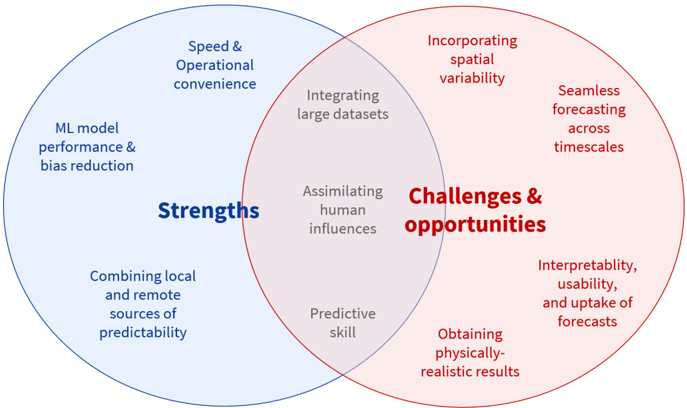
Hybrid hydroclimatic forecasting systems employ data-driven (statistical or machine learning) methods to harness and integrate a broad variety of predictions from dynamical, physics-based models – such as numerical weather prediction, climate, land, hydrology, and Earth system models – into a final prediction product. They are recognized as a promising way of enhancing the prediction skill of meteorological and hydroclimatic variables and events, including rainfall, temperature, streamflow, floods, droughts, tropical cyclones, or atmospheric rivers. Hybrid forecasting methods are now receiving growing attention due to advances in weather and climate prediction systems at subseasonal to decadal scales, a better appreciation of the strengths of AI, and expanding access to computational resources and methods. Such systems are attractive because they may avoid the need to run a computationally expensive offline land model, can minimize the effect of biases that exist within dynamical outputs, benefit from the strengths of machine learning, and can learn from large datasets, while combining different sources of predictability with varying time horizons. Here we review recent developments in hybrid hydroclimatic forecasting and outline key challenges and opportunities for further research. These include obtaining physically explainable results, assimilating human influences from novel data sources, integrating new ensemble techniques to improve predictive skill, creating seamless prediction schemes that merge short to long lead times, incorporating initial land surface and ocean/ice conditions, acknowledging spatial variability in landscape and atmospheric forcing, and increasing the operational uptake of hybrid prediction schemes.
Overview
The claims and statistics of this paper haven’t been checked yet.
Free: it reads the open-access text and checks the first 5 claims that cite a source we can check. Create a free account to check every claim.
Integrity signals
Registry
Cites
Statistics
Figures
Verification
Claims the paper makes
The claims and statistics of this paper haven’t been checked yet.
Free: it reads the open-access text and checks the first 5 claims that cite a source we can check. Create a free account to check every claim.
Self-check
Percentages, sums and reported differences re-computed from the paper’s own numbers.
The self-check needs the paper’s full text.
Citations
Cites
River flow forecasting through conceptual models part I — A discussion of principles
Nash, J. E., & Sutcliffe, J. V. (1970) · Journal of Hydrology · doi:10.1016/0022-1694(70)90255-6 · Cited by 23,674
Convolutional LSTM Network: A Machine Learning Approach for Precipitation Nowcasting
Shi, X., Chen, Z., Wang, H., Yeung, D.-Y., Wong, W.-K., & Woo, W.-C. (2015) · arXiv · doi:10.48550/arxiv.1506.04214 · Cited by 7,709
Deep learning and process understanding for data-driven Earth system science
Reichstein, M., Camps-Valls, G., Stevens, B., Jung, M., Denzler, J., Carvalhais, N., & Prabhat (2019) · Nature · doi:10.1038/s41586-019-0912-1 · Cited by 5,673
Stationarity Is Dead: Whither Water Management?
Milly, P. C. D., Betancourt, J., Falkenmark, M., Hirsch, R. M., Kundzewicz, Z. W., Lettenmaier, D. P., & Stouffer, R. J. (2008) · Science · doi:10.1126/science.1151915 · Cited by 4,537
The quiet revolution of numerical weather prediction
Bauer, P., Thorpe, A., & Brunet, G. (2015) · Nature · doi:10.1038/nature14956 · Cited by 2,729 · cited 1×
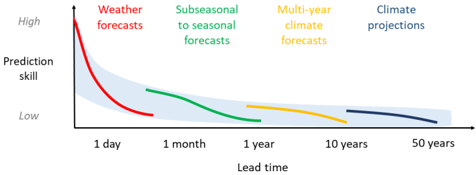
“been advancing by about one day per decade, such that ‘today’s 6-day forecast is as accurate as the 5-day forecast ten years ago’ (Bauer et al., 2015, p.47). Low flows may have skill up to 20 days in the case of Fundel et al. (2013) and even longer in other cases, especially with good information on initial conditions…”
BackgroundImprovement of a parsimonious model for streamflow simulation
Perrin, C., Michel, C., & Andréassian, V. (2003) · Journal of Hydrology · doi:10.1016/s0022-1694(03)00225-7 · Cited by 1,821 · cited 1×
“(2016) used a combination of historical observations and downscaled dynamical forecasts of rainfall and potential evapotranspiration in southern Australia from POAMA (Predictive Ocean Atmosphere Model for Australia) to drive the conceptual rainfall–runoff model GR4J (Perrin et al., 2003).”
MethodFlood Prediction Using Machine Learning Models: Literature Review
Mosavi, A., Ozturk, P., & Chau, K.-W. (2018) · Water · doi:10.3390/w10111536 · Cited by 1,672 · cited 2×
“Environment Agency, 2022), close co-operation is needed between the hydrology, forecasting, and ML communities to explore their potential either alone or in hybrid frameworks (Mosavi et al., 2018), build trust (Haupt et al.”
BackgroundMethodKratzert, F., Klotz, D., Shalev, G., Klambauer, G., Hochreiter, S., & Nearing, G. (2019) · Hydrology and Earth System Sciences · doi:10.5194/hess-23-5089-2019 · Cited by 1,223 · cited 1×
“Since long (50 year + ) hydroclimatic time series data are not available everywhere (Krabbenhoft, 2022), methods are required that can draw on pooled multi-site approaches with similar catchment and climate characteristics (Kratzert et al., 2019a .”
BackgroundSelf-citationThe CAMELS data set: catchment attributes and meteorology for large-sample studies
Addor, N., Newman, A. J., Mizukami, N., & Clark, M. P. (2017) · Hydrology and Earth System Sciences · doi:10.5194/hess-21-5293-2017 · Cited by 1,037 · cited 2×
“Such models may start to emerge with the growing availability of observational training datasets, such as the national CAMELS datasets (available for the USA, United Kingdom, Chile, Brazil, Australia, and soon France and Switzerland; e.g. Newman et al., 2015; Addor et al., 2017; Coxon et al., 2020) and international C…”
BackgroundSkilful precipitation nowcasting using deep generative models of radar
Ravuri, S., Lenc, K., Willson, M., Kangin, D., Lam, R., Mirowski, P., Fitzsimons, M., Athanassiadou, M., Kashem, S., Madge, S., et al. (2021) · Nature · doi:10.1038/s41586-021-03854-z · Cited by 1,024
Research works printed but not linked: 5
- Bisson, J. and Roberge, F.: Prévision des apports naturels: Ex- périence d'Hydro-Québec, workshop on flow predictions, in: IEEE Institute of Electrical and Electronics Engineers, Novem- ber 1983, Toronto, 1983.
- Fang, K. and Shen, C.: Near-real-time forecast of satellite-based soil moisture using long short-term memory with an adaptive data integration kernel, J. Hydrometeorol., 21, 399-413, 2020b. · DOI · Paper page
- Feng, D., Beck, H., Lawson, K., and Shen, C.: The suitability of differentiable, learnable hydrologic models for ungauged regions and climate change impact assessment, Hydrol. Earth Syst. Sci. Discuss. [preprint], https://doi.org/10.5194/hess-2022-245, in re- view, 2022a. · doi:10.5194/hess-2022-245
- Hoedt, P.-J., Kratzert, F., Klotz, D., Halmich, C., Holzleitner, M., Nearing, G. S., Hochreiter, S., and Klambauer, G.: Mc- lstm: Mass-conserving LSTM, Vol. 139, International Confer- ence on Machine Learning, 18-24 July 2021, Virtual, 4275- 4286, https://proceedings.mlr.press/v139/hoedt21a.html (last ac- cess: 6 May 2023), 2021.
- Thielen-del Pozo, J. and Bruen, M.: Overview of forecast com- munication and use of ensemble hydrometeorological fore- casts, Handbook of Hydrometeorological Ensemble Forecasting, Springer, 1037-1045, https://doi.org/10.1007/978-3-642-40457- 3_40-1, 2019. · doi:10.1007/978-3-642-40457-3_40-1
Cited by
A review of hybrid deep learning applications for streamflow forecasting
Ng, K. W., Huang, Y. F., Koo, C. H., Chong, K. L., El‐Shafie, A., & Ahmed, A. N. (2023) · Journal of Hydrology · doi:10.1016/j.jhydrol.2023.130141 · Cited by 257
Hai, T., Abba, S. I., Al‐Areeq, A. M., Tangang, F., Samantaray, S., Sahoo, A., Siqueira, H. V., Maroufpoor, S., Demir, V., Bokde, N. D., et al. (2023) · Engineering Applications of Artificial Intelligence · doi:10.1016/j.engappai.2023.107559 · Cited by 149
Artificial intelligence and numerical weather prediction models: A technical survey
Waqas, M., Humphries, U. W., Chueasa, B., & Wangwongchai, A. (2024) · Natural Hazards Research · doi:10.1016/j.nhres.2024.11.004 · Cited by 155
Materia, S., García, L. P., van Straaten, C., O, S., Mamalakis, A., Cavicchia, L., Coumou, D., de Luca, P., Kretschmer, M., & Donat, M. (2024) · WIREs Climate Change · doi:10.1002/wcc.914 · Cited by 130
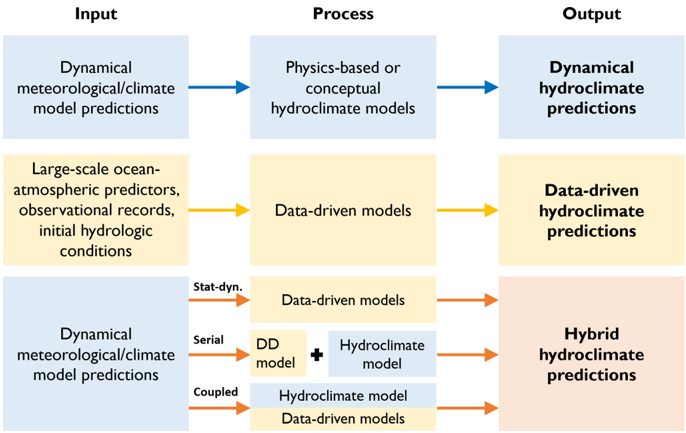
“The third category of hybrid predictions, statistical-dynamical forecasting (Slater et al., 2023) combines dynamical predictions with different empirical, purely data-driven approaches (Figure 2d).”
Shah, P., Pahari, S., Bhavsar, R., & Kwon, J. S. (2024) · Computers & Chemical Engineering · doi:10.1016/j.compchemeng.2024.108926 · Cited by 134
Metadata
- Authors
- Slater, L. J., Arnal, L., Boucher, M.-A., Chang, A. Y.-Y., Moulds, S., Murphy, C., Nearing, G., Shalev, G., Shen, C., Speight, L., Villarini, G., Wilby, R. L., Wood, A., & Zappa, M.
- Affiliations
- University of Oxford (GB)
- University of Saskatchewan (CA)
- Université de Sherbrooke (CA)
- Swiss Federal Institute for Forest, Snow and Landscape Research (CH)
- National University of Ireland, Maynooth (IE)
- Google (United States) (US)
- Google (Israel) (IL)
- Pennsylvania State University (US)
- University of Iowa (US)
- Loughborough University (GB)
- NSF National Center for Atmospheric Research (US)
- Corresponding author
- Slater, Louise J.
- ORCID
- Venue
- Hydrology and Earth System Sciences
- Publisher
- Copernicus GmbH
- Published
- 2023-05-15
- Volume
- 27
- Issue
- 9
- Pages
- 1865-1889
- ISSN
- 1027-5606 (ISSN-L)
- 1607-7938
- OpenAlex
- W4387437512
- Cited by
- 281
- References
- 163
- Citations by year
- 2026: 89 · 2025: 94 · 2024: 66 · 2023: 28
- FWCI
- 23.08
- Type
- journal article
- Language
- en
- Open access
- gold
- doi.org
- Licence
- Locations
- Hydrology and earth system sciences (publishedVersion, cc-by)
- Maynooth University ePrints and eTheses Archive (Maynooth University) (acceptedVersion)
- DORA WSL (Swiss Federal Institute for Forest, Snow and Landscape Research) (submittedVersion, cc-by)
- HARVEST (University of Saskatchewan) (submittedVersion, cc-by)
- DOAJ (DOAJ: Directory of Open Access Journals) (submittedVersion, cc-by-sa)
- Loughborough University Research Repository (Loughborough University) (submittedVersion, cc-by)
- Edinburgh Research Explorer (University of Edinburgh) (submittedVersion, cc-by)
- Repository for Publications and Research Data (ETH Zurich) (submittedVersion, cc-by)
- ETH Zürich Research Collection
- Funders
- UK Research and Innovation (MR/V022008/1, NE/S015728/1)
- Swiss Federal Institute for Forest, Snow and Landscape Research (MaLeFix (Extremes))
- Canada First Research Excellence Fund (Global Water Futures programme)
- U.S. Army Corps of Engineers (USACE Institute for Water Resources)
- Science Foundation Ireland (SFI/17/CDA/4783)
- Topics
- Physical Sciences › Environmental Science › Environmental Engineering › Hydrological Forecasting Using AI
- Physical Sciences › Earth and Planetary Sciences › Atmospheric Science › Meteorological Phenomena and Simulations
- Physical Sciences › Environmental Science › Global and Planetary Change › Climate variability and models
- Keywords
- hybrid forecasting, machine learning, numerical weather prediction, ensemble forecasting, streamflow forecasting, flood forecasting, drought forecasting, tropical cyclones, atmospheric rivers, data assimilation, operational forecasting
About these checks
Registry, retraction, Cites and statistics results are computed, not judged, with one exception: a printed reference that no index lists is read once by a model before it counts as a citation error. Claims are extracted by a model and kept only when their quote appears verbatim in the text; each cited source is then checked, with a model’s help, for whether it says what the claim relies on. Those verdicts can be wrong — read the claim’s quote and the cited source before relying on one.
Statistics and arithmetic are recomputed, not judged.
Confidence bands are shown only for fields calibrated on our annotated test set. None is calibrated yet, so no band is shown.
What counts as a claim ›How we measure confidence ›How we check this ›
Are you an author, or do you see a problem with this page? Request a review
How to cite
Cite CoChat for the checks on this page, and the paper for its own findings.
- This page
- CoChat. (2026). Citation check: Hybrid forecasting: blending climate predictions with AI models. https://app.cochat.ai/papers/10.5194/hess-27-1865-2023
- The paper
- Slater, L. J., Arnal, L., Boucher, M.-A., Chang, A. Y.-Y., Moulds, S., Murphy, C., Nearing, G., Shalev, G., Shen, C., Speight, L., Villarini, G., Wilby, R. L., Wood, A., & Zappa, M. (2023). Hybrid forecasting: blending climate predictions with AI models. Hydrology and Earth System Sciences. https://doi.org/10.5194/hess-27-1865-2023
Data sources
Bibliographic data: Semantic Scholar, OpenAlex, Crossref.
Contains information from the Semantic Scholar Academic Graph Datasets, made available under the ODC Attribution License (ODC-BY 1.0).
Semantic Scholar’s data is described in: Kinney, R., et al. (2023). The Semantic Scholar Open Data Platform. arXiv:2301.10140.
