

Hybrid forecasting: blending climate predictions with AI models
Open accessPublished version of a preprint
The DOI matches its Crossref record; 167 of the 167 references it cites were found in a registry or an index.
Abstract
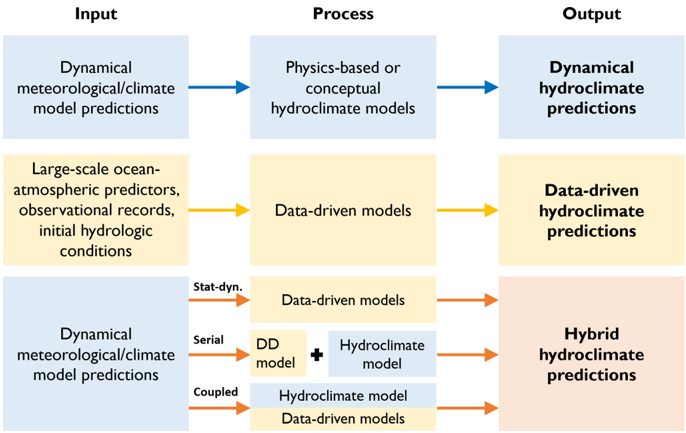
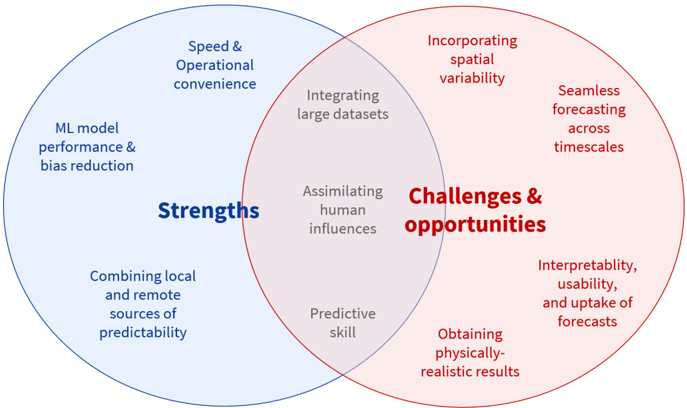
Hybrid hydroclimatic forecasting systems employ data-driven (statistical or machine learning) methods to harness and integrate a broad variety of predictions from dynamical, physics-based models – such as numerical weather prediction, climate, land, hydrology, and Earth system models – into a final prediction product. They are recognized as a promising way of enhancing the prediction skill of meteorological and hydroclimatic variables and events, including rainfall, temperature, streamflow, floods, droughts, tropical cyclones, or atmospheric rivers. Hybrid forecasting methods are now receiving growing attention due to advances in weather and climate prediction systems at subseasonal to decadal scales, a better appreciation of the strengths of AI, and expanding access to computational resources and methods. Such systems are attractive because they may avoid the need to run a computationally expensive offline land model, can minimize the effect of biases that exist within dynamical outputs, benefit from the strengths of machine learning, and can learn from large datasets, while combining different sources of predictability with varying time horizons. Here we review recent developments in hybrid hydroclimatic forecasting and outline key challenges and opportunities for further research. These include obtaining physically explainable results, assimilating human influences from novel data sources, integrating new ensemble techniques to improve predictive skill, creating seamless prediction schemes that merge short to long lead times, incorporating initial land surface and ocean/ice conditions, acknowledging spatial variability in landscape and atmospheric forcing, and increasing the operational uptake of hybrid prediction schemes.
Overview
The claims and statistics of this paper haven’t been checked yet.
Free: it reads the open-access text and checks the first 5 claims that cite a source we can check. Create a free account to check every claim.
Integrity signals
Registry
Cites
Statistics
Figures
Verification
Claims the paper makes
The claims and statistics of this paper haven’t been checked yet.
Free: it reads the open-access text and checks the first 5 claims that cite a source we can check. Create a free account to check every claim.
Self-check
Percentages, sums and reported differences re-computed from the paper’s own numbers.
The self-check needs the paper’s full text.
Citations
Cites
River flow forecasting through conceptual models part I — A discussion of principles
Nash, J. E., & Sutcliffe, J. V. (1970) · Journal of Hydrology · doi:10.1016/0022-1694(70)90255-6 · Cited by 23,674
Convolutional LSTM Network: A Machine Learning Approach for Precipitation Nowcasting
Shi, X., Chen, Z., Wang, H., Yeung, D.-Y., Wong, W.-K., & Woo, W.-C. (2015) · arXiv · doi:10.48550/arxiv.1506.04214 · Cited by 7,709
Deep learning and process understanding for data-driven Earth system science
Reichstein, M., Camps-Valls, G., Stevens, B., Jung, M., Denzler, J., Carvalhais, N., & Prabhat (2019) · Nature · doi:10.1038/s41586-019-0912-1 · Cited by 5,673
Stationarity Is Dead: Whither Water Management?
Milly, P. C. D., Betancourt, J., Falkenmark, M., Hirsch, R. M., Kundzewicz, Z. W., Lettenmaier, D. P., & Stouffer, R. J. (2008) · Science · doi:10.1126/science.1151915 · Cited by 4,537
The quiet revolution of numerical weather prediction
Bauer, P., Thorpe, A., & Brunet, G. (2015) · Nature · doi:10.1038/nature14956 · Cited by 2,729 · cited 1×
“been advancing by about one day per decade, such that ‘today’s 6-day forecast is as accurate as the 5-day forecast ten years ago’ (Bauer et al., 2015, p.47). Low flows may have skill up to 20 days in the case of Fundel et al. (2013) and even longer in other cases, especially with good information on initial conditions…”
BackgroundImprovement of a parsimonious model for streamflow simulation
Perrin, C., Michel, C., & Andréassian, V. (2003) · Journal of Hydrology · doi:10.1016/s0022-1694(03)00225-7 · Cited by 1,821 · cited 1×
“(2016) used a combination of historical observations and downscaled dynamical forecasts of rainfall and potential evapotranspiration in southern Australia from POAMA (Predictive Ocean Atmosphere Model for Australia) to drive the conceptual rainfall–runoff model GR4J (Perrin et al., 2003).”
MethodFlood Prediction Using Machine Learning Models: Literature Review
Mosavi, A., Ozturk, P., & Chau, K.-W. (2018) · Water · doi:10.3390/w10111536 · Cited by 1,672 · cited 2×
“Environment Agency, 2022), close co-operation is needed between the hydrology, forecasting, and ML communities to explore their potential either alone or in hybrid frameworks (Mosavi et al., 2018), build trust (Haupt et al.”
BackgroundMethodKratzert, F., Klotz, D., Shalev, G., Klambauer, G., Hochreiter, S., & Nearing, G. (2019) · Hydrology and Earth System Sciences · doi:10.5194/hess-23-5089-2019 · Cited by 1,223 · cited 1×
“Since long (50 year + ) hydroclimatic time series data are not available everywhere (Krabbenhoft, 2022), methods are required that can draw on pooled multi-site approaches with similar catchment and climate characteristics (Kratzert et al., 2019a .”
BackgroundSelf-citationThe CAMELS data set: catchment attributes and meteorology for large-sample studies
Addor, N., Newman, A. J., Mizukami, N., & Clark, M. P. (2017) · Hydrology and Earth System Sciences · doi:10.5194/hess-21-5293-2017 · Cited by 1,037 · cited 2×
“Such models may start to emerge with the growing availability of observational training datasets, such as the national CAMELS datasets (available for the USA, United Kingdom, Chile, Brazil, Australia, and soon France and Switzerland; e.g. Newman et al., 2015; Addor et al., 2017; Coxon et al., 2020) and international C…”
BackgroundSkilful precipitation nowcasting using deep generative models of radar
Ravuri, S., Lenc, K., Willson, M., Kangin, D., Lam, R., Mirowski, P., Fitzsimons, M., Athanassiadou, M., Kashem, S., Madge, S., et al. (2021) · Nature · doi:10.1038/s41586-021-03854-z · Cited by 1,024
Research works printed but not linked: 3
- Bisson, J. and Roberge, F.: Prévision des apports naturels: Ex- périence d'Hydro-Québec, workshop on flow predictions, in: IEEE Institute of Electrical and Electronics Engineers, Novem- ber 1983, Toronto, 1983.
- Fang, K. and Shen, C.: Near-real-time forecast of satellite-based soil moisture using long short-term memory with an adaptive data integration kernel, J. Hydrometeorol., 21, 399-413, 2020b. · DOI · Paper page
- Hoedt, P.-J., Kratzert, F., Klotz, D., Halmich, C., Holzleitner, M., Nearing, G. S., Hochreiter, S., and Klambauer, G.: Mc- lstm: Mass-conserving LSTM, Vol. 139, International Confer- ence on Machine Learning, 18-24 July 2021, Virtual, 4275- 4286, https://proceedings.mlr.press/v139/hoedt21a.html (last ac- cess: 6 May 2023), 2021.
Cited by
A review of hybrid deep learning applications for streamflow forecasting
Ng, K. W., Huang, Y. F., Koo, C. H., Chong, K. L., El‐Shafie, A., & Ahmed, A. N. (2023) · Journal of Hydrology · doi:10.1016/j.jhydrol.2023.130141 · Cited by 257
Hai, T., Abba, S. I., Al‐Areeq, A. M., Tangang, F., Samantaray, S., Sahoo, A., Siqueira, H. V., Maroufpoor, S., Demir, V., Bokde, N. D., et al. (2023) · Engineering Applications of Artificial Intelligence · doi:10.1016/j.engappai.2023.107559 · Cited by 151
Artificial intelligence and numerical weather prediction models: A technical survey
Waqas, M., Humphries, U. W., Chueasa, B., & Wangwongchai, A. (2024) · Natural Hazards Research · doi:10.1016/j.nhres.2024.11.004 · Cited by 155
Materia, S., García, L. P., van Straaten, C., O, S., Mamalakis, A., Cavicchia, L., Coumou, D., de Luca, P., Kretschmer, M., & Donat, M. (2024) · WIREs Climate Change · doi:10.1002/wcc.914 · Cited by 130
“The third category of hybrid predictions, statistical-dynamical forecasting (Slater et al., 2023) combines dynamical predictions with different empirical, purely data-driven approaches (Figure 2d).”
Shah, P., Pahari, S., Bhavsar, R., & Kwon, J. S. (2024) · Computers & Chemical Engineering · doi:10.1016/j.compchemeng.2024.108926 · Cited by 135
Maity, R., Srivastava, A., Sarkar, S., & Khan, M. I. (2024) · Applied Computing and Geosciences · doi:10.1016/j.acags.2024.100206 · Cited by 100
Biazar, S. M., Golmohammadi, G., Nedhunuri, R. R., Shaghaghi, S., & Mohammadi, K. (2025) · Sustainability · doi:10.3390/su17052250 · Cited by 92
Mamun, M. N. H., Sarker, M. R., Sarkar, M. A. R., Roy, S. K., Nihad, S. A. I., McKenzie, A. M., Hossain, M. I., & Kabir, M. (2024) · Scientific Reports · doi:10.1038/s41598-023-51111-2 · Cited by 76
“Ensemble methods, data assimilation techniques, and hybrid models that combine the strengths of physical models and data-driven approaches may improve the skill and reliability of long-term drought predictions 120,121 .”
MethodKadiyala, L., Mermer, O., Samuel, R. D. J., Sermet, Y., & Demir, İ. (2024) · Hydrology · doi:10.3390/hydrology11090148 · Cited by 90
“Furthermore, while studies like Sermet and Demir [13] and Slater et al. [6] have explored AI applications in flood management and climate prediction, respectively, our research enhances these approaches by utilizing MLLMs for dynamic, real-time analysis.”
Optimal Postprocessing Strategies With LSTM for Global Streamflow Prediction in Ungauged Basins
Tang, S., Sun, F., Liu, W., Wang, H., Yao, F., & Li, Z. (2023) · Water Resources Research · doi:10.1029/2022wr034352 · Cited by 71
Yu, Q., Tolson, B. A., Shen, H., Han, M., Mai, J., & Lin, J. (2024) · Hydrology and earth system sciences · doi:10.5194/hess-28-2107-2024 · Cited by 70
Liu, J., Koch, J., Stisen, S., Troldborg, L., & Schneider, R. J. M. (2024) · Hydrology and earth system sciences · doi:10.5194/hess-28-2871-2024 · Cited by 69
“…algorithms, is deemed necessary and will have far-reaching implications for a range of applications A straightforward approach to developing hybrid models is to set up a serial system that uses the outputs of existing PBMs as inputs for LSTM modeling (Amendola et al., 2020; Slater et al., 2023).”
BackgroundSharifhosseini, S. M., Niknam, T., Taabodi, M. H., Aghajari, H. A., Sheybani, E., Javidi, G., & Pourbehzadi, M. (2024) · Energies · doi:10.3390/en17215385 · Cited by 63
Zellou, B., Moçayd, N. E., & Bergou, E. H. (2023) · Natural hazards and earth system sciences · doi:10.5194/nhess-23-3543-2023 · Cited by 59
Challenges and opportunities of ML and explainable AI in large-sample hydrology
Slater, L. J., Blougouras, G., Deng, L., Deng, Q., Ford, E., van Dijke, A. J. H., Huang, F., Jiang, S., Liu, Y., Moulds, S., et al. (2025) · Philosophical Transactions of the Royal Society A Mathematical Physical and Engineering Sciences · doi:10.1098/rsta.2024.0287 · Cited by 76
Self-citationOlubusola, O., Mhlongo, N. Z., Daraojimba, D. O., Ajayi-Nifise, A. O., & Falaiye, T. (2024) · World Journal of Advanced Research and Reviews · doi:10.30574/wjarr.2024.21.2.0444 · Cited by 54
Hasan, F., Medley, P. B., Drake, J. B., & Chen, G. (2024) · Water · doi:10.3390/w16131904 · Cited by 61
Hybrid modeling design patterns
Rudolph, M., Kurz, S., & Rakitsch, B. (2024) · Journal of Mathematics in Industry · doi:10.1186/s13362-024-00141-0 · Cited by 56
“Hybrid modeling is diverse with applications ranging from molecular modeling in drug discovery [45], over various simulation tasks in climate science [46] or various engineering disciplines [47], to modeling sensor data for virtual sensing.”
BackgroundLópez, E. O., Kaplan, D., & Linhoss, A. C. (2024) · Water Resources Research · doi:10.1029/2023wr036337 · Cited by 48
Dasgupta, A., Arnal, L., Emerton, R., Harrigan, S., Matthews, G., Muhammad, A., O’Regan, K., Ciria, T. P., Valdez, E., van Osnabrugge, B., et al. (2023) · Journal of Flood Risk Management · doi:10.1111/jfr3.12880 · Cited by 50
Self-citationIn-depth simulation of rainfall–runoff relationships using machine learning methods
Fuladipanah, M., Shahhosseini, A., Rathnayake, N., Azamathulla, H. M., Rathnayake, U., Meddage, D. P. P., & Tota‐Maharaj, K. (2024) · Water Practice & Technology · doi:10.2166/wpt.2024.147 · Cited by 43
Enhancing Deep Learning Soil Moisture Forecasting Models by Integrating Physics-based Models
Li, L., Dai, Y., Wei, Z., Shangguan, W., Wei, N., Zhang, Y., Li, Q., & Li, X. (2024) · Advances in Atmospheric Sciences · doi:10.1007/s00376-023-3181-8 · Cited by 46
Prudhomme, C., Zsótér, E., Matthews, G., Melet, A., Grimaldi, S., Zuo, H., Hansford, E., Harrigan, S., Mazzetti, C., de Boisséson, E., et al. (2024) · Meteorological Applications · doi:10.1002/met.2192 · Cited by 45
“Hybrid data-driven and process-based forecasts are also growing in popularity as they allow the efficiency and convenience of machine learning methods to be combined with the physically-informed process-based models (Slater et al., 2023).”
BackgroundEspinoza, E. A., Loritz, R., Kratzert, F., Klotz, D., Gauch, M., Chaves, M. Á., Bäuerle, N., & Ehret, U. (2025) · Hydrology and earth system sciences · doi:10.5194/hess-29-1277-2025 · Cited by 48
“…with Frame et al. (2022) and helps to challenge the notion that data-driven methods are less capable of extrapolation (Reichstein et al., 2019; Slater et al., 2023) In the case of the hybrid model, although the LSTM exhibits a slightly lower median error, the error distributions of both…”
Hybrid approaches enhance hydrological model usability for local streamflow prediction
Du, Y., & Pechlivanidis, I. G. (2025) · Communications Earth & Environment · doi:10.1038/s43247-025-02324-y · Cited by 45
Araya, D., Mendoza, P. A., Castro, E. M., & McPhee, J. (2023) · Hydrology and earth system sciences · doi:10.5194/hess-27-4385-2023 · Cited by 39
Isaak, D. J., & Luce, C. H. (2023) · Canadian Water Resources Journal / Revue canadienne des ressources hydriques · doi:10.1080/07011784.2023.2176788 · Cited by 35
Liu, C., Xie, T., Li, W., Hu, C., Jiang, Y., Li, R., & Song, Q. (2024) · Journal of Environmental Management · doi:10.1016/j.jenvman.2024.121466 · Cited by 38
Govett, M., Bah, B., Bauer, P., Bérod, D. D., Bouchet, V. S., Corti, S., Davis, C. A., Duan, Y., Graham, T. R., Honda, Y., et al. (2024) · Bulletin of the American Meteorological Society · doi:10.1175/bams-d-23-0220.1 · Cited by 42
Mei, Z., Peng, T., Chen, L., Singh, V. P., Yi, B., Leng, Z., Gan, X., & Xie, T. (2024) · Water Resources Management · doi:10.1007/s11269-024-03975-w · Cited by 35
“However, ML models are opaque and are not based on physical mechanisms, resulting in low interpretability of streamflow prediction (Awchi 2014 ; Slater et al. 2023 ).”
Suthar, G., Singh, S., Kaul, N., Khandelwal, S., & Singhal, R. P. (2023) · Remote Sensing Applications Society and Environment · doi:10.1016/j.rsase.2023.101048 · Cited by 32
Resilience of UK crop yields to compound climate change
Slater, L. J., Huntingford, C., Pywell, R. F., Redhead, J. W., & Kendon, E. (2022) · Earth System Dynamics · doi:10.5194/esd-13-1377-2022 · Cited by 33
Self-citationDong, Z., Hu, H., Liu, H., Baoligao, B., Mu, X., Wen, J., Liu, D., Chen, L., Ming, G., Chen, X., et al. (2024) · Journal of Hydrology · doi:10.1016/j.jhydrol.2024.130941 · Cited by 30
Yavuz, V. S. (2025) · Journal of Water and Climate Change · doi:10.2166/wcc.2025.798 · Cited by 36
Uncertainties as a Guide for Global Water Model Advancement
Reinecke, R., Stein, L., Gnann, S. J., Andersson, J., Arheimer, B., Bierkens, M. F. P., Bonetti, S., Güntner, A., Kollet, S. J., Mishra, S., et al. (2025) · Wiley Interdisciplinary Reviews Water · doi:10.1002/wat2.70025 · Cited by 33
“Hybrid models of classical GWMs and ML (Kraft et al. , 2022; Slater et al. , 2023), such as differentiable models (Shen et al. , 2023), are developed to reap the benefits of both worlds while circumventing their respective limitations.”
Self-citationRapid Flood Inundation Forecast Using Fourier Neural Operator
Sun, A. Y., Li, Z., Lee, W., Huang, Q., Scanlon, B. R., & Dawson, C. N. (2023) · IEEE International Conference on Computer Vision Workshops · doi:10.1109/iccvw60793.2023.00401 · Cited by 43
López-Chacón, S. R., Salazar, F., & Bladé, E. (2023) · Water · doi:10.3390/w15112020 · Cited by 32
Xu, Q., Shi, Y., Bamber, J. L., Tuo, Y., Ludwig, R., & Zhu, X. X. (2025) · Earth-Science Reviews · doi:10.1016/j.earscirev.2025.105276 · Cited by 36
Impacts of hot-dry conditions on hydropower production in Switzerland
Otero, N., Horton, P., Martius, O., Allen, S., Zappa, M., Wechsler, T., & Schaefli, B. (2023) · Environmental Research Letters · doi:10.1088/1748-9326/acd8d7 · Cited by 27
Self-citationKnowledge‐Guided Machine Learning for Global Change Ecology Research
Jin, Z., Liu, L., Yang, Q. L., Jia, X., Tao, S., Guo, Y., Ghosh, R., Wang, S., Zhu, Q., Jung, M., et al. (2026) · Global Change Biology · doi:10.1111/gcb.70742 · Cited by 30
Hlaing, P. T., Humphries, U. W., & Waqas, M. (2024) · MethodsX · doi:10.1016/j.mex.2024.102792 · Cited by 28
“The literature indicates a growing consensus on the need for novel regionalization approaches that can leverage the strengths of both process-based and data-driven models [ 21 ].”
BackgroundRong, Y., Wang, W., Wu, P., Wang, P., Zhang, C., Wang, C., & Huo, Z. (2024) · Water Resources Research · doi:10.1029/2023wr036809 · Cited by 24
“Therefore, developing novel hybrid DL models that integrate more domain knowledge into data‐driven approaches becomes imperative (Slater et al., 2023).”
Analyzing the Relationship between Agricultural AI Adoption and Government-Subsidized Insurance
Osorio, C. P., Leucci, F., & Porrini, D. (2024) · Agriculture · doi:10.3390/agriculture14101804 · Cited by 23
Enhancing Research-to-Operations in Hydrological Forecasting: Innovations across Scales and Horizons
Pechlivanidis, I. G., Du, Y., Bennett, J., Boucher, M., Chang, A. Y.-Y., Crochemore, L., Dasgupta, A., Baldassarre, G. D., Luterbacher, J., Pappenberger, F., et al. (2025) · Bulletin of the American Meteorological Society · doi:10.1175/bams-d-24-0322.1 · Cited by 27
Self-citationLiu, L., Liang, X., Xu, Y., Guo, Y., Wang, Q. J., & Gu, H. (2024) · Journal of Hydrology · doi:10.1016/j.jhydrol.2024.131993 · Cited by 24
Xu, L., Yu, H., Chen, Z., Du, W., Chen, N., & Huang, M. J. (2023) · Remote Sensing · doi:10.3390/rs15133410 · Cited by 22
Wesselkamp, M., Chantry, M., Pinnington, E., Choulga, M., Boussetta, S., Kalweit, G., Bödecker, J., Dormann, C. F., Pappenberger, F., & Balsamo, G. (2025) · Geoscientific model development · doi:10.5194/gmd-18-921-2025 · Cited by 22
Chang, A. Y.-Y., Bogner, K., Grams, C. M., Monhart, S., Domeisen, D. I. V., & Zappa, M. (2023) · Journal of Hydrometeorology · doi:10.1175/jhm-d-21-0245.1 · Cited by 21
Self-citationInvestigating permafrost carbon dynamics in Alaska with artificial intelligence
Gay, B. A., Züfle, A. E., Pastick, N. J., Armstrong, A., Watts, J. D., Dirmeyer, P. A., Miner, K. R., Wessels, K., Qu, J. J., & Miller, C. E. (2023) · Environmental Research Letters · doi:10.1088/1748-9326/ad0607 · Cited by 21
Synthetic Forecast Ensembles for Evaluating Forecast Informed Reservoir Operations
Brodeur, Z., Delaney, C. J., Whitin, B., & Steinschneider, S. (2024) · Water Resources Research · doi:10.1029/2023wr034898 · Cited by 23
“…and climatological weather sequences as inputs, thereby limiting skill for medium-range forecasting (Troin et al., 2021), or they use remotely sensed or climate model forecast information as input and therefore cannot extend prior to the satellite era (Nevo et al., 2022; Slater et al., 2023).”
BackgroundAdombi, A. V. D. P., Chesnaux, R., Boucher, M., Braun, M., & Lavoie, J. (2024) · Journal of Hydrology · doi:10.1016/j.jhydrol.2024.131370 · Cited by 25
Self-citationWang, W. H., Shen, S., & Yuan, Y. (2026) · International Scientific Technical and Economic Research · doi:10.71451/istaer2601 · Cited by 20
Ding, C., Wang, Z., Tan, Z., & Zhang, X. (2026) · Expert Systems with Applications · doi:10.1016/j.eswa.2026.132862 · Cited by 20
Skillful Decadal Flood Prediction
Moulds, S., Slater, L. J., Dunstone, N., & Smith, D. M. (2023) · Geophysical Research Letters · doi:10.1029/2022gl100650 · Cited by 21
Self-citationKowal, K., Slater, L. J., García‐López, A. A., & Loon, A. F. V. (2022) · International Journal of Climatology · doi:10.1002/joc.7969 · Cited by 18
Self-citationWater Resources’ AI–ML Data Uncertainty Risk and Mitigation Using Data Assimilation
Martin, N., & White, J. T. (2024) · Water · doi:10.3390/w16192758 · Cited by 19
AI Improves the Accuracy, Reliability, and Economic Value of Continental‐Scale Flood Predictions
Tran, V. N., Kim, T., Xu, D., Tran, H., Le, M., Tran, T., Kim, J., Tran, T. D., Wright, D. B., Restrepo, P. J., et al. (2025) · AGU Advances · doi:10.1029/2025av001678 · Cited by 21
“The rapid development of deep learning (DL) has introduced a promising direction, commonly referred to as artificial intelligence (AI)‐based methods (Slater et al., 2023; Towler et al., 2023).”
Alif, H. A. (2025) · Theoretical and Applied Climatology · doi:10.1007/s00704-025-05746-y · Cited by 17
“Prediction accuracy is enhanced, and a foundation for spatially sensitive energy planning is established by hybrid models that integrate data-driven approaches with physical modeling (Slater et al. 2023).”
Hybrid multi-model ensemble learning for reconstructing gridded runoff of Europe for 500 years
Singh, U. K., Máca, P., Hanel, M., Markonis, Y., Nidamanuri, . R., Nasreen, S., Blöcher, J. R., Strnad, F., Vorel, J., Říha, L., et al. (2023) · Information Fusion · doi:10.1016/j.inffus.2023.101807 · Cited by 17
Du, S., Jiang, S. S., Ren, L., Yuan, S., Yang, X., Liu, Y., Gong, X., & Xu, C. (2023) · The Science of The Total Environment · doi:10.1016/j.scitotenv.2023.166422 · Cited by 19
AI for atmosphere–ocean sciences: advancements, challenges and ways forward
Luo, J., Xia, J., Pan, B., Ham, Y.-G., Li, X., Shangguan, W., Xue, W., Wang, Y., Mu, B., Hong, Y., et al. (2026) · National Science Review · doi:10.1093/nsr/nwag063 · Cited by 25
“Furthermore, hybrid physics–AI methods often require fewer labeled data points than purely data-driven approaches, as the physical components guide or regularize the learning process [215 ].”
Luo, Y., Wang, H., Cao, J., Li, J., Tian, Q., Leng, G., & Niyogi, D. (2024) · Precision Agriculture · doi:10.1007/s11119-024-10149-6 · Cited by 19
“Hybrid method, integrating data-driven methods (statistical or machine learning) and predictions from dynamical, physics-based models (such as climate, hydrology, and crop growth models), is a promising way of enhancing the prediction skill in different forecasting (Slater et al., 2023).”
Tang, T., Chen, T., & Gui, G. (2024) · IEEE Journal of Selected Topics in Applied Earth Observations and Remote Sensing · doi:10.1109/jstars.2024.3449441 · Cited by 16
Hybridizing Machine Learning Algorithms With Numerical Models for Accurate Wind Power Forecasting
Abad‐Santjago, Á., Peláez-Rodríguez, C., Pérez‐Aracil, J., Sanz, J., Casanova-Mateo, C., & Salcedo‐Sanz, S. (2025) · Expert Systems · doi:10.1111/exsy.13830 · Cited by 17
Huang, L., Antolini, F., Mostafavi, A., Blessing, R., Garcia, M., & Brody, S. D. (2025) · Computer-Aided Civil and Infrastructure Engineering · doi:10.1111/mice.13490 · Cited by 19
Energy Forecasting Model for Ground Movement Operation in Green Airport
Ajayi, A., Luk, P. C. K., Lao, L., & Khan, M. F. (2023) · Energies · doi:10.3390/en16135008 · Cited by 15
Forecasting bathing water quality in the UK : A critical review
Krupska, K. U., Speight, L. J., Robinson, J. S., Gilbert, A. J., & Cloke, H. (2024) · Wiley Interdisciplinary Reviews Water · doi:10.1002/wat2.1718 · Cited by 19
“Advances in machine learning combined with physically based meteorological and hydrological models offer exciting potential for improving the predictive skill of a range of hydroclimatic events including bathing water failures (Slater et al., 2023).”
BackgroundSelf-citationMa, C., Yao, J., Mo, Y., Zhou, G., Xu, Y., & He, X. (2024) · Journal of Hydrology Regional Studies · doi:10.1016/j.ejrh.2024.101964 · Cited by 21
Ecosystem stability assessment under hydroclimatic anomalies in the arid region of Northwest China
Chang, S., Gao, X., Li, J., Li, Q., Song, X., An, Y., & Lo, K. (2024) · Ecological Indicators · doi:10.1016/j.ecolind.2024.112831 · Cited by 15
Robles, K. P. V., Solmerin, J. G., Pugat, G. C. E., & Monjardin, C. E. F. (2026) · Water · doi:10.3390/w18010119 · Cited by 20
“Recent literature shows a clear shift toward integrated, data-rich, and adaptive forecasting systems that combine physical principles with artificial intelligence, reflecting the increasing need for resilience under climate uncertainty [35].”
Talha, M., Nejadhashemi, A. P., & Moller, K. (2025) · Heliyon · doi:10.1016/j.heliyon.2025.e41974 · Cited by 16
How suitable are copula models for post-processing global precipitation forecasts?
Huang, Z., & Zhao, T. (2025) · Journal of Hydrology · doi:10.1016/j.jhydrol.2025.133005 · Cited by 16
Jumadi, J., Danardono, D., Roziaty, E., Ulinuha, A., Supari, S., Choy, L. K., Sattar, F., & Nawaz, M. (2025) · Sustainability · doi:10.3390/su17209281 · Cited by 16
Seasonal forecasts have sufficient skill to inform some agricultural decisions
Kondal, A., Hegewisch, K. C., Liu, M., Abatzoglou, J. T., Adam, J. C., Nijssen, B., & Rajagopalan, K. (2024) · Environmental Research Letters · doi:10.1088/1748-9326/ad8bde · Cited by 14
“New approaches, including AI and hybrid AI and biophysical approaches, are evolving (Slater et al 2023) and the trend in accuracy improvements can be expected to continue.”
Enhancing seasonal fire predictions with hybrid dynamical and random forest models
Vázquez, M. Á. T., Herrera, S., Gincheva, A., Halifa‐Marín, A., Cavicchia, L., Giuseppe, F. D., Montávez, J. P., & Turco, M. (2025) · npj natural hazards. · doi:10.1038/s44304-025-00069-4 · Cited by 17
Bamal, A., Uddin, M. G., & Olbert, A. I. (2025) · Journal of Hydrology Regional Studies · doi:10.1016/j.ejrh.2025.102677 · Cited by 20
Luo, J., Huang, S., Wang, Y., Singh, V. P., Liu, J., Huang, Q., Leng, G., Li, J., Wu, H., Zheng, X., et al. (2024) · Journal of Hydrology · doi:10.1016/j.jhydrol.2024.132225 · Cited by 12
Farooq, R., Imteaz, M. A., & Mekanik, F. (2025) · Earth Science Informatics · doi:10.1007/s12145-025-01724-0 · Cited by 13
“Rainfall prediction models such as artificial neural networks (ANN) (Mandal and Jothiprakash 2012; Ghumman et al. 2022; Ahmed et al. 2023; Slater et al. 2023) and support vector machines (SVMs) (Samantaray et al. 2020) were developed with past rainfall data as input.”
Perspectives on Artificial Intelligence for Predictions in Ecohydrology
Massoud, E., Hoffman, F. M., Shi, Z., Tang, J., Alhajjar, E., Barnes, M. L., Braghiere, R. K., Cardon, Z. G., Collier, N., Crompton, O. V., et al. (2023) · Artificial Intelligence for the Earth Systems · doi:10.1175/aies-d-23-0005.1 · Cited by 13
Mojgani, R., Chattopadhyay, A., & Hassanzadeh, P. (2024) · Journal of Advances in Modeling Earth Systems · doi:10.1029/2023ms004033 · Cited by 16
“Challenges with interpretability hinder understanding the root cause(s) of the model errors and fixing them.”
BackgroundAI and the Environment: Innovative Approaches to Climate Change
Singh, M., Arora, V., & Kulshreshta, K. (2024) · Practice, progress, and proficiency in sustainability · doi:10.4018/979-8-3693-6336-2.ch001 · Cited by 11
Modi, P. A., Jennings, K. S., Kasprzyk, J. R., Small, E. E., Wobus, C. W., & Livneh, B. (2025) · Journal of Advances in Modeling Earth Systems · doi:10.1029/2024ms004582 · Cited by 14
“…the hydrological interpretability of deep‐learning models is evident, offering significant scope for the advancement of streamflow forecasting through architectural modifications (De La Fuente et al., 2023) and the development of hybrid models (Feng, Liu, et al., 2022; Slater et al., 2023).”
Protocols for Water and Environmental Modeling Using Machine Learning in California
He, M., Sandhu, P., Namadi, P., Reyes, E., Guivetchi, K., & Chung, F. I. (2025) · Hydrology · doi:10.3390/hydrology12030059 · Cited by 13
Singh, V. K., Tiwari, G., Singh, A., Samanta, R., Srivastava, A. K., Bisht, D. S., Routray, A., Kumar, S., Patel, S. S., & Lodh, A. (2025) · Meteorological Applications · doi:10.1002/met.70067 · Cited by 11
Liu, W., Mo, L., Li, X., Xiao, W., Huang, H., & Zhang, Y. (2025) · Expert Systems with Applications · doi:10.1016/j.eswa.2025.129974 · Cited by 17
Rahman, S. M., Raihan, A., & Abudalfa, S. I. (2026) · Environmental Management · doi:10.1007/s00267-026-02402-7 · Cited by 15
Arnal, L., Clark, M., Pietroniro, A., Vionnet, V., Casson, D. R., Whitfield, P. H., Fortin, V., Wood, A. W., Knoben, W. J. M., Newton, B., et al. (2024) · Hydrology and earth system sciences · doi:10.5194/hess-28-4127-2024 · Cited by 15
Self-citationA hybrid deep learning framework for improving short-term precipitation forecasts
Salehi, S., & Neyshabouri, S. A. A. S. (2025) · Environmental Modelling & Software · doi:10.1016/j.envsoft.2025.106635 · Cited by 11
Renewable microgrid optimization using AI: A B-SLR approach and future research directions
Sarin, G., Srivastava, A., Srivastava, I., Bhattacharjee, S., Gujaran, S., & Reddy, Y. Y. S. (2025) · Energy Reports · doi:10.1016/j.egyr.2025.11.087 · Cited by 10
Sutanto, S. J., Paparrizos, S., Kumar, U., Datta, D. K., & Ludwig, F. (2024) · Climate Services · doi:10.1016/j.cliser.2024.100459 · Cited by 13
Charoensuk, T., Luchner, J., Balbarini, N., Sisomphon, P., & Bauer‐Gottwein, P. (2024) · Journal of Hydrology Regional Studies · doi:10.1016/j.ejrh.2024.101737 · Cited by 15
“Many of the mentioned studies take a forward-looking approach to improving the performance of flood forecasting systems by focusing on new technologies and data sources (Chiang et al., 2022 and Slater et al., 2023).”
Lorenz, D. J., Otkin, J. A., Zaitchik, B. F., Hain, C., Holmes, T., & Anderson, M. C. (2024) · Journal of Hydrometeorology · doi:10.1175/jhm-d-23-0074.1 · Cited by 13
Domain knowledge-driven variational recurrent networks for drought monitoring
Zhang, M., Fernández‐Torres, M., & Camps‐Valls, G. (2024) · Remote Sensing of Environment · doi:10.1016/j.rse.2024.114252 · Cited by 12
Hartmann, M., Morozovska, K., & Laneryd, T. (2024) · Electric Power Systems Research · doi:10.1016/j.epsr.2024.110527 · Cited by 10
Kaya, Y. (2025) · Journal of Hydrology · doi:10.1016/j.jhydrol.2025.133948 · Cited by 10
STAT-LSTM: A multivariate spatiotemporal feature aggregation model for SPEI-based drought prediction
Chen, Y., Wu, H., Xie, N., Liang, X., Jiang, L., Qiu, M., & Li, Y. (2025) · Earth Science Informatics · doi:10.1007/s12145-025-01813-0 · Cited by 11
“With an improved understanding of the advantages of artificial intelligence, as well as advancements in computational resources and methodologies, hybrid prediction approaches are gaining increasing attention (Slater et al. 2023).”
Critical science for the next decade of climate risk management
Parsons, M., Nalau, J., Muccione, V., van Aalst, M., Dessai, S., Doeffinger, T., Fu, X., Hasegawa, T., Khojasteh, D., Kidane, R., et al. (2025) · Climate Risk Management · doi:10.1016/j.crm.2025.100770 · Cited by 10
A Statistical Forecasting Model for Extremes of the Fire Behaviour Index in Australia
Taylor, R., Marshall, A. G., Crimp, S. J., Cary, G. J., & Harris, S. L. (2024) · Atmosphere · doi:10.3390/atmos15040470 · Cited by 9
A Weighted Likelihood Ensemble Approach for Failure Prediction of Water Pipes
Zali, R. B., Latifi, M., Javadi, A. A., & Farmani, R. (2024) · Journal of Water Resources Planning and Management · doi:10.1061/jwrmd5.wreng-6655 · Cited by 9
Li, Y., Xü, K., Wu, Z., Zhu, Z., & Wang, Q. J. (2023) · Hydrology and earth system sciences · doi:10.5194/hess-27-4187-2023 · Cited by 10
Metadata
- Authors
- Slater, L. J., Arnal, L., Boucher, M.-A., Chang, A. Y.-Y., Moulds, S., Murphy, C., Nearing, G., Shalev, G., Shen, C., Speight, L., Villarini, G., Wilby, R. L., Wood, A., & Zappa, M.
- Affiliations
- University of Oxford (GB)
- University of Saskatchewan (CA)
- Université de Sherbrooke (CA)
- Swiss Federal Institute for Forest, Snow and Landscape Research (CH)
- National University of Ireland, Maynooth (IE)
- Google (United States) (US)
- Google (Israel) (IL)
- Pennsylvania State University (US)
- University of Iowa (US)
- Loughborough University (GB)
- NSF National Center for Atmospheric Research (US)
- Corresponding author
- Slater, Louise J.
- ORCID
- Venue
- Hydrology and Earth System Sciences
- Publisher
- Copernicus GmbH
- Published
- 2023-05-15
- Volume
- 27
- Issue
- 9
- Pages
- 1865-1889
- ISSN
- 1027-5606 (ISSN-L)
- 1607-7938
- OpenAlex
- W4387437512
- Semantic Scholar
- 70def1c9bdf053b526f5798935508cbb1ef1c214
- Cited by
- 281
- References
- 163
- Citations by year
- 2026: 89 · 2025: 94 · 2024: 66 · 2023: 28
- FWCI
- 23.08
- Type
- journal article
- Language
- en
- Open access
- gold
- doi.org
- Licence
- Locations
- Hydrology and earth system sciences (publishedVersion, cc-by)
- Maynooth University ePrints and eTheses Archive (Maynooth University) (acceptedVersion)
- DORA WSL (Swiss Federal Institute for Forest, Snow and Landscape Research) (submittedVersion, cc-by)
- HARVEST (University of Saskatchewan) (submittedVersion, cc-by)
- DOAJ (DOAJ: Directory of Open Access Journals) (submittedVersion, cc-by-sa)
- Loughborough University Research Repository (Loughborough University) (submittedVersion, cc-by)
- Edinburgh Research Explorer (University of Edinburgh) (submittedVersion, cc-by)
- Repository for Publications and Research Data (ETH Zurich) (submittedVersion, cc-by)
- ETH Zürich Research Collection
- Funders
- UK Research and Innovation (MR/V022008/1, NE/S015728/1)
- Swiss Federal Institute for Forest, Snow and Landscape Research (MaLeFix (Extremes))
- Canada First Research Excellence Fund (Global Water Futures programme)
- U.S. Army Corps of Engineers (USACE Institute for Water Resources)
- Science Foundation Ireland (SFI/17/CDA/4783)
- Topics
- Physical Sciences › Environmental Science › Environmental Engineering › Hydrological Forecasting Using AI
- Physical Sciences › Earth and Planetary Sciences › Atmospheric Science › Meteorological Phenomena and Simulations
- Physical Sciences › Environmental Science › Global and Planetary Change › Climate variability and models
- Keywords
- hybrid forecasting, machine learning, numerical weather prediction, ensemble forecasting, streamflow forecasting, flood forecasting, drought forecasting, tropical cyclones, atmospheric rivers, data assimilation, operational forecasting
About these checks
Registry, retraction, Cites and statistics results are computed, not judged, with one exception: a printed reference that no index lists is read once by a model before it counts as a citation error. Claims are extracted by a model and kept only when their quote appears verbatim in the text; each cited source is then checked, with a model’s help, for whether it says what the claim relies on. Those verdicts can be wrong — read the claim’s quote and the cited source before relying on one.
Statistics and arithmetic are recomputed, not judged.
Confidence bands are shown only for fields calibrated on our annotated test set. None is calibrated yet, so no band is shown.
What counts as a claim ›How we measure confidence ›How we check this ›
Are you an author, or do you see a problem with this page? Request a review
Data sources
Bibliographic data: Semantic Scholar, OpenAlex, Crossref.
Contains information from the Semantic Scholar Academic Graph Datasets, made available under the ODC Attribution License (ODC-BY 1.0).
Semantic Scholar’s data is described in: Kinney, R., et al. (2023). The Semantic Scholar Open Data Platform. arXiv:2301.10140.
