

The DOI matches its Crossref record; 74 of the 74 references it cites were found in a registry or an index.
Consequences of bullying victimization in childhood and adolescence: A systematic review and meta-analysis
Open accessAbstract
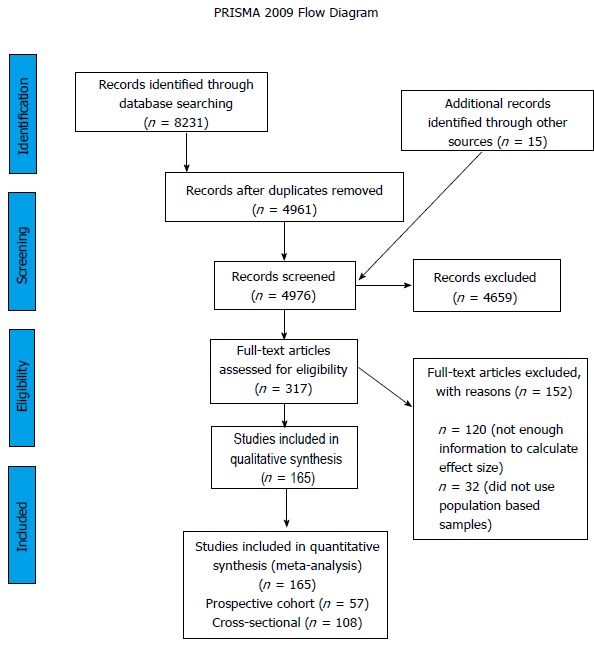
AIM: To identify health and psychosocial problems associated with bullying victimization and conduct a meta-analysis summarizing the causal evidence. METHODS: A systematic review was conducted using PubMed, EMBASE, ERIC and PsycINFO electronic databases up to 28 February 2015. The study included published longitudinal and cross-sectional articles that examined health and psychosocial consequences of bullying victimization. All meta-analyses were based on quality-effects models. Evidence for causality was assessed using Bradford Hill criteria and the grading system developed by the World Cancer Research Fund. RESULTS: Out of 317 articles assessed for eligibility, 165 satisfied the predetermined inclusion criteria for meta-analysis. Statistically significant associations were observed between bullying victimization and a wide range of adverse health and psychosocial problems. The evidence was strongest for causal associations between bullying victimization and mental health problems such as depression, anxiety, poor general health and suicidal ideation and behaviours. Probable causal associations existed between bullying victimization and tobacco and illicit drug use. CONCLUSION: Strong evidence exists for a causal relationship between bullying victimization, mental health problems and substance use. Evidence also exists for associations between bullying victimization and other adverse health and psychosocial problems, however, there is insufficient evidence to conclude causality. The strong evidence that bullying victimization is causative of mental illness highlights the need for schools to implement effective interventions to address bullying behaviours.
Overview
The claims and statistics of this paper haven’t been checked yet.
Run the check — free, no account needed. It reads the open-access text and checks the sources it cites.
Integrity signals
Registry
Cites
Statistics
Figures
Verification
Claims the paper makes
The claims and statistics of this paper haven’t been checked yet.
Run the check — free, no account needed. It reads the open-access text and checks the sources it cites.
Claims other papers make about this one
Each is checked against this paper’s own text: does it say what the citing paper says it does?
The cited source says what the claim attributes to it.
In the citing paper
“Peer victimisation affects 10%–35% of adolescents and is both a precursor and an outcome of emotional symptoms (Cook, Williams, Guerra, Kim, & Sadek, 2010; Modecki, Minchin, Harbaugh, Guerra, & Runions, 2014; Moore et al., 2017; Reijntjes, Kamphuis, Prinzie, & Telch, 2010).”
From A cross‐lagged twin study of emotional symptoms, social isolation and peer victimisation from early adolescence to emerging adulthood (2023) · cites this paper as Moore et al., 2017
Self-check
Percentages, sums and reported differences re-computed from the paper’s own numbers.
The self-check needs the paper’s full text.
Citations
Cites
Preferred Reporting Items for Systematic Reviews and Meta-Analyses: the PRISMA statement
Moher, D., Liberati, A., Tetzlaff, J., Altman, D. G., & for the PRISMA Group (2009) · BMJ · doi:10.1136/bmj.b2535 · Cited by 83,823
Preferred Reporting Items for Systematic Reviews and Meta-Analyses: The PRISMA Statement
Moher, D., Liberati, A., Tetzlaff, J., Altman, D. G., & The PRISMA Group (2009) · PLoS Medicine · doi:10.1371/journal.pmed.1000097 · Cited by 64,042
Preferred reporting items for systematic reviews and meta-analyses: The PRISMA statement
Moher, D., Liberati, A., Tetzlaff, J., Altman, D. G., & the PRISMA Group* (2009) · Annals of Internal Medicine · doi:10.7326/0003-4819-151-4-200908180-00135 · Cited by 37,554
Dermyshi, E., Wang, Y., Yan, C., Hong, W., Qiu, G., Gong, X., & Zhang, T. (2017) · Neonatology · doi:10.1159/000454668 · Cited by 24,586
Meta-analysis of Observational Studies in Epidemiology<SUBTITLE>A Proposal for Reporting</SUBTITLE>
Stroup, D. F. (2000) · JAMA · doi:10.1001/jama.283.15.2008 · Cited by 20,623
(2014) · Medical Entomology and Zoology · Cited by 17,633
Child abuse: Adolescent records vs. adult recall
Femina, D. D., Yeager, C. A., & Lewis, D. O. (1990) · Child Abuse & Neglect · doi:10.1016/0145-2134(90)90033-p · Cited by 8,820
The environment and disease: association or causation?
Hill, A. B. (2015) · Journal of the Royal Society of Medicine · doi:10.1177/0141076814562718 · Cited by 7,804
The Environment and Disease: Association or Causation?
Hill, A. B. (1965) · Proceedings of the Royal Society of Medicine · doi:10.1177/003591576505800503 · Cited by 6,974
Bullying at school: what we know and what we can do
(1994) · Choice Reviews Online · doi:10.5860/choice.32-1080 · Cited by 4,755
Research works printed but not linked: 3
- Von Schoon I, Montgomery SM. The relationship between early life experiences and adult depression. Z Psychosom Med Psychoanal 1997;43:319-333.
- Koolhaas J, Hermann P, Kemperman C, Bohu sB, Van Den Hoofdakker R, Beersma D. Single social defeat in male rats induces a gradual but long-lasting behavioral change: A model of depression. Neurosci Res Commun 1990;7:35-41.
- 10.2307/27647135 · DOI
Cited by
Sorted by citations
Stanaway, J. D., Afshin, A., Gakidou, E., Lim, S. S., Abate, D., Abate, K. H., Abbafati, C., Abbasi, N., Abbastabar, H., Abd-Allah, F., et al. (2018) · The Lancet · doi:10.1016/s0140-6736(18)32225-6 · Cited by 4,943
Thapar, A., Eyre, O., Patel, V., & Brent, D. (2022) · The Lancet · doi:10.1016/s0140-6736(22)01012-1 · Cited by 869
Self-harm, suicidal behaviours, and cyberbullying in children and young people: systematic review
John, A., Glendenning, A. C., Marchant, A., Montgomery, P., Stewart, A., Wood, S., Lloyd, K., & Hawton, K. (2018) · Journal of Medical Internet Research · doi:10.2196/jmir.9044 · Cited by 580
Protective factors against bullying and cyberbullying: A systematic review of meta-analyses
Zych, I., Farrington, D. P., & Ttofi, M. M. (2018) · Aggression and Violent Behavior · doi:10.1016/j.avb.2018.06.008 · Cited by 529
Biswas, T., Scott, J. G., Münir, K., Thomas, H. J., Huda, M. M., Hasan, M. M., de Vries, T. D., Baxter, J., & Mamun, A. A. (2020) · EClinicalMedicine · doi:10.1016/j.eclinm.2020.100276 · Cited by 377
Self-citation
Metadata
- Authors
- Moore, S. E., Norman, R. E., Suetani, S., Thomas, H. J., Sly, P. D., & Scott, J. G.
- Affiliations
- Queensland University of Technology (AU)
- Corresponding author
- Scott, James G
- Venue
- World Journal of Psychiatry
- Publisher
- Baishideng Publishing Group Inc.
- Published
- 2017
- Volume
- 7
- Issue
- 1
- Pages
- 60
- ISSN
- 2220-3206 (ISSN-L)
- PMC
- PMC5371173
- OpenAlex
- W2599301087
- Cited by
- 1,320
- References
- 74
- Citations by year
- 2026: 180 · 2025: 210 · 2024: 201 · 2023: 163 · 2022: 191 · 2021: 165 · 2020: 97 · 2019: 65 · 2018: 35 · 2017: 10
- FWCI
- 8.91
- Type
- journal article
- Language
- en
- Open access
- diamond
- doi.org
- Licence
- cc-by-nc
- Locations
- World Journal of Psychiatry (publishedVersion, cc-by-nc)
- Europe PMC (PubMed Central) (publishedVersion, cc-by-nc)
- PubMed Central (publishedVersion, cc-by-nc)
- PubMed (publishedVersion)
- QUT ePrints (Queensland University of Technology) (submittedVersion, cc-by-nc)
- Deakin Research Online (Deakin University) (submittedVersion)
- Figshare (submittedVersion, cc-by-nc)
- Griffith Research Online (submittedVersion, cc-by-nc)
- Faculty of Health; Institute of Health and Biomedical Innovation
- Topics
- Social Sciences › Psychology › Social Psychology › Bullying, Victimization, and Aggression
- Social Sciences › Business, Management and Accounting › Organizational Behavior and Human Resource Management › Workplace Violence and Bullying
- Social Sciences › Psychology › Clinical Psychology › Child Abuse and Trauma
- Keywords
- bullying victimization, childhood bullying, adolescent bullying, mental illness, depression, anxiety, suicidal ideation, suicidal behavior, substance use, tobacco use, illicit drug use, psychosocial problems, causal evidence, school-based intervention
About these checks
Registry, retraction, Cites and statistics results are computed, not judged, with one exception: a printed reference that no index lists is read once by a model before it counts as a citation error. Claims are extracted by a model and kept only when their quote appears verbatim in the text; each cited source is then checked, with a model’s help, for whether it says what the claim relies on. Those verdicts can be wrong — read the claim’s quote and the cited source before relying on one.
Statistics and arithmetic are recomputed, not judged.
Confidence bands are shown only for fields calibrated on our annotated test set. None is calibrated yet, so no band is shown.
What counts as a claim ›How we measure confidence ›How we check this ›
Are you an author, or do you see a problem with this page? Request a review
