

Recommendation for the Entropy Sources Used for Random Bit Generation
Open accessThe DOI matches its Crossref record; 24 of the 24 references it cites were found in a registry or an index; none of the 20 sources its claims cite is checked for support yet.
Abstract
Reports on Computer Systems TechnologyThe Information Technology Laboratory (ITL) at the National Institute of Standards and Technology (NIST) promotes the U.S. economy and public welfare by providing technical leadership for the Nation's measurement and standards infrastructure.ITL develops tests, test methods, reference data, proof of concept implementations, and technical analyses to advance the development and productive use of information technology.ITL's responsibilities include the development of management, administrative, technical, and physical standards and guidelines for the cost-effective security and privacy of other than national security-related information in Federal information systems.The Special Publication 800-series reports on ITL's research, guidelines, and outreach efforts in information system security, and its collaborative activities with industry, government, and academic organizations.
Overview
CoChat Summary
TL;DR
NIST SP 800-90B specifies design principles, requirements, and validation tests for entropy sources used by Random Bit Generators, including health tests, IID testing, and min-entropy estimators. It defines separate IID and non-IID validation tracks and provides approved continuous health tests and entropy estimation methods.
Key findings
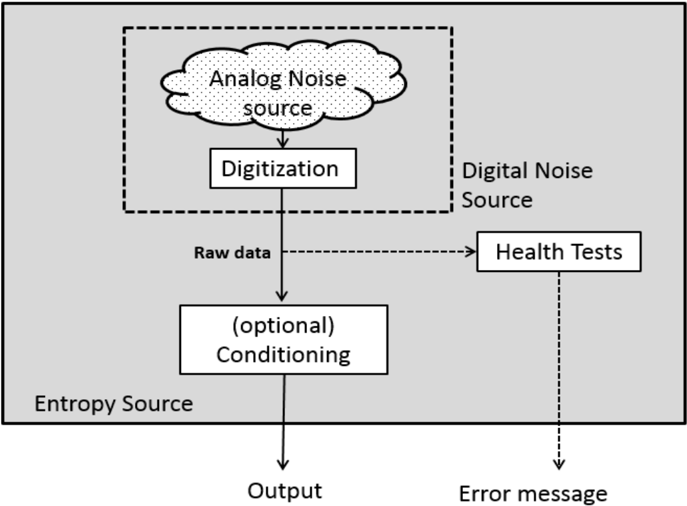
- The entropy source model consists of a noise source, an optional conditioning component, and health tests; validation requires at least 1,000,000 sequential noise-source samples, and restart tests use 1000 restarts × 1000 consecutive samples in a 1000×1000 matrix.
- Two approved continuous health tests are specified: the Repetition Count test and the Adaptive Proportion test; the recommended false positive probability is between 2^-20 and 2^-40, startup tests run continuous tests over at least 1024 consecutive samples, and for α = 2^-20 and H = 2.0 bits per sample the Repetition Count cutoff is C = 11.
- The IID track uses the Most Common Value estimate; the non-IID track requires taking the minimum of ten estimators: Most Common Value, Collision, Markov, Compression, t-Tuple, Longest Repeated Substring, Multi Most Common in Window, Lag, MultiMMC, and LZ78Y; Collision, Markov, and Compression are applied only to binary inputs.
- IID testing uses permutation testing with 10,000 permutations plus chi-square tests, with type I error 0.001; vetted conditioning components include HMAC, CMAC, CBC-MAC, approved hash functions, Hash_df, and Block_Cipher_df.
Methods
- Design and validation framework: entropy source validation is performed by an NVLAP-accredited laboratory with CAVP/CMVP review, based on documentation, data collection, restart tests, and conditioning-component entropy assessment.
- Statistical analysis: IID assumption is tested via permutation and chi-square procedures; entropy is estimated using the IID Most Common Value estimate or the non-IID battery of ten estimators; health testing uses the Repetition Count and Adaptive Proportion tests or developer-defined alternatives.
- Data and sample requirements: a sequential dataset of at least 1,000,000 samples is required, a conditioned sequential dataset of at least 1,000,000 outputs is required for non-vetted conditioning components, restart data form a 1000×1000 matrix, and alphabets larger than 256 symbols are reduced to at most 256 symbols.
Limitations
- Stated: the testing approach assumes the developer understands the behavior of the randomness source and has made a good-faith effort to produce a suitable entropy source; the entropy estimation methods rely on statistical assumptions that may not hold for all noise sources and should not replace in-depth analysis.
- Stated: continuous health tests are resource-constrained and usually detect only gross failures; the Repetition Count test detects only catastrophic failures, and continuous tests may allow poor entropy outputs before an alarm is signaled.
- Evident from the text: this is a recommendation/specification rather than an empirical study, and validation depends on submitter documentation and laboratory testing; some requirements may be out-of-scope for CAVP or CMVP validation testing.
Model-written summary. Check it against the paper before relying on it.
Integrity signals
Registry
Cites
Statistics
Figures


Verification
Claims the paper makes
0 Valid · 2 Not valid · 15 Not checked · 96 Own results and interpretations
A result the paper states — it cites no source for it, so there is none to check. The quote shows it is in the paper.
In the paper
“For example, a noise source evaluated at eight bits of min-entropy per sample has a cutoff value of six repetitions to ensure a false-positive rate of approximately once per 10 12 samples generated.”
plainstates a cause- Asserted: passes — The authors put it forward as true.
- Checkable: passes — It can be checked against evidence.
- Load-bearing: unclear — It is unclear whether the paper’s conclusions depend on it.
- Based: passes — The paper gives a reason why it holds.
A result the paper states — it cites no source for it, so there is none to check. The quote shows it is in the paper.
In the paper
“If that noise source somehow failed to the point that each sample had a 1/16 probability of being the same as the previous sample, so that it was providing only four bits of min-entropy per sample, it would still be expected to take about one million samples before the repetition count test would notice the problem.”
hedgedstates a cause- Asserted: passes — The authors put it forward as true.
- Checkable: passes — It can be checked against evidence.
- Load-bearing: unclear — It is unclear whether the paper’s conclusions depend on it.
- Based: passes — The paper gives a reason why it holds.
In the paper
“While the estimators (except for the Markov) were originally designed for application to independent outputs, the tests have performed well when applied to data with dependencies.”
What the sources say
- Not matchedcites [HD12]
This doesn’t read as a citation we can look up.
boosted- Asserted: passes — The authors put it forward as true.
- Checkable: passes — It can be checked against evidence.
- Load-bearing: unclear — It is unclear whether the paper’s conclusions depend on it.
- Based: passes — The paper gives a reason why it holds.
- Not matched
A conclusion the paper draws from its own results — it cites no other source for it, so there is none to check. The quote shows it is in the paper.
In the paper
“However, the conditioning component may reduce the entropy of the output.”
hedgedstates a possible cause- Asserted: passes — The authors put it forward as true.
- Checkable: passes — It can be checked against evidence.
- Load-bearing: passes — The paper’s conclusions depend on it.
- Based: passes — The paper gives a reason why it holds.
A conclusion the paper draws from its own results — it cites no other source for it, so there is none to check. The quote shows it is in the paper.
In the paper
“The entropy estimate of a noise source, calculated from a single, long-output sequence, might provide an overestimate if the noise source generates correlated sequences after restarts.”
hedgedstates a possible cause- Asserted: passes — The authors put it forward as true.
- Checkable: passes — It can be checked against evidence.
- Load-bearing: passes — The paper’s conclusions depend on it.
- Based: passes — The paper gives a reason why it holds.
35 more claims
Create a free account to see all 113 claims and every source verdict.
- Probably not a substantial claim. 60
- It may state two separate claims as one. 23
Self-check
Percentages, sums and reported differences re-computed from the paper’s own numbers.
Each contradiction between two passages listed here was confirmed by an independent check.
Rated minor: it would not touch a result — a value no result rests on, a p-value that stays on the same side of the significance level, or a conflict that is clerical, resolved elsewhere in the paper, or outside its own findings.
In the paper
§ 6.3.1 The Most Common Value Estimate
“𝑝𝑝 𝑢𝑢 = 0.4 + 2.576 √ 0.012 = 0.6895.”
§ 6.3.1 The Most Common Value Estimate
“The min-entropy estimate is -log2 (0.6822) = 0.5363.”
Citations
Cites
A tutorial on hidden Markov models and selected applications in speech recognition
Rabiner, L. R. (1989) · Proceedings of the IEEE · doi:10.1109/5.18626 · Cited by 22,743
Bellman, R. E. (2010) · doi:10.1515/9781400835386 · Cited by 14,588
Prediction and Entropy of Printed English
Shannon, C. E. (1951) · Bell System Technical Journal · doi:10.1002/j.1538-7305.1951.tb01366.x · Cited by 2,686
Data Compression: The Complete Reference
(2009) · Kybernetes · doi:10.1108/k.2009.06738eae.001 · Cited by 1,591
An Introduction to Probability Theory and its Applications.
Kendall, D. G., & Feller, W. (1951) · Journal of the Royal Statistical Society. Series A (General) · doi:10.2307/2980979 · Cited by 1,283
SHA-3 standard: permutation-based hash and extendable-output functions
National Institute of Standards and Technology (US) (2015) · doi:10.6028/nist.fips.202 · Cited by 783
Advanced Encryption Standard (AES)
National Institute of Standards and Technology (US) (2001) · doi:10.6028/nist.fips.197 · Cited by 642
“Balls into Bins” — A Simple and Tight Analysis
Raab, M., & Steger, A. (1998) · Lecture Notes in Computer Science · doi:10.1007/3-540-49543-6_13 · Cited by 455
Recommendation for Key Management Part 1: General
Barker, E. (2016) · doi:10.6028/nist.sp.800-57pt1r4 · Cited by 396
Self-citationNational Institute of Standards and Technology (US) (2015) · doi:10.6028/nist.fips.180-4 · Cited by 350
Cited by
Items 101–200 of 485
Pawlowski, M., Jara, A., & Ogorzalek, M. (2015) · Sensors · doi:10.3390/s151026838 · Cited by 15
Chaos-based cryptography for cloud computing
Tobin, P., Tobin, L., McKeever, M., et al. (2016) · Irish Signals and Systems Conference · doi:10.1109/issc.2016.7528457 · Cited by 15
“The final design comprises several chaos sources but to adhere to conference maximum page guidelines, the discussion is limited to thresholding a single nonlinear Lorenz chaotic oscillator whose initial condition (IC) is a natural noise source, as recommended in [6].”
BackgroundMing, H., Hu, H., Lv, F., & Yu, R. (2022) · Nonlinear Dynamics · doi:10.1007/s11071-022-07838-0 · Cited by 18
“The generated true random bits are evaluated by the National Institute of Standards and Technology (NIST) SP800-22 [38], NIST SP800-90B [39], and TestU01 [40].”
MethodA dynamically reconfigurable entropy source circuit for high-throughput true random number generator
Jin, L., Yi, M., Xiao, Y., Sun, L., Lu, Y., & Liang, H. (2023) · Microelectronics Journal · doi:10.1016/j.mejo.2023.105690 · Cited by 19
Tanizawa, K., Kato, K., & Futami, F. (2024) · Journal of Lightwave Technology · doi:10.1109/jlt.2024.3353268 · Cited by 20
Entropy Extraction from Bio-Signals in Healthcare IoT
Vasyltsov, I., & Lee, S. (2015) · doi:10.1145/2732209.2732213 · Cited by 15
BloothAir: A Secure Aerial Relay System Using Bluetooth Connected Autonomous Drones
Li, K., Lü, N., Zheng, J., Zhang, P., Ni, W., & Tovar, E. (2021) · ACM Transactions on Cyber-Physical Systems · doi:10.1145/3448254 · Cited by 19
“In Table 2, the p-values [44, 45] of the secret keys are calculated in each of the tests.”
MethodFomichev, M., Hesse, J., Almon, L., Lippert, T., Han, J. Y., & Hollick, M. (2021) · International Conference on Mobile Systems, Applications, and Services · doi:10.1145/3458864.3467883 · Cited by 18
“To assessmin-entropy, we apply theNIST SP 800-90B test suite [31, 44].”
MethodA High-Quality Entropy Source Using van der Waals Heterojunction for True Random Number Generation
Abraham, N., Watanabe, K., Taniguchi, T., & Majumdar, K. (2022) · ACS Nano · doi:10.1021/acsnano.1c11084 · Cited by 19
“(MCV) estimator.(19) For non-IID sequences, the MCV estimator tends to overestimate the entropy and requires the use of multiple estimators for min-entropy assessment.”
BackgroundMethodInfluentialHybrid Hadamard and controlled-Hadamard based quantum random number generators in IBM QX
Salehi, R., Razaghi, M., & Fotouhi, B. (2022) · Physica Scripta · doi:10.1088/1402-4896/ac698b · Cited by 15
Enabling Ubiquitous Hardware Security via Energy-Efficient Primitives and Systems : (Invited Paper)
Alioto, M., & Taneja, S. (2019) · Custom Integrated Circuits Conference · doi:10.1109/cicc.2019.8780123 · Cited by 18
“Regarding TRNGs, output streams need to comply with the NIST statistical suite [22], the NIST 800-90B recommendations [49], and the FIPS 140-3 requirements.”
MethodCan Deep Learning Break a True Random Number Generator?
Yu, Y., Moraitis, M., & Dubrova, E. (2021) · IEEE Transactions on Circuits & Systems II Express Briefs · doi:10.1109/tcsii.2021.3066338 · Cited by 18
“We also verified that they have the same level of entropy as the original TRNG [16] using the NIST SP 800-90B [17] entropy assessment tests.”
MethodHow to Test the Randomness From the Wireless Channel for Security?
Qu, Z., Zhao, S., Xu, J., et al. (2021) · IEEE Transactions on Information Forensics and Security · doi:10.1109/tifs.2021.3092051 · Cited by 14
Counter-Interception and Counter-Exploitation Features of Noise Radar Technology
Galati, G., Pavan, G., Savci, K., et al. (2021) · Remote Sensing · doi:10.3390/rs13224509 · Cited by 14
Anandakumar, N. N., Hashmi, M., & Sanadhya, S. K. (2022) · IET Circuits Devices & Systems · doi:10.1049/cds2.12111 · Cited by 14
A Novel Security Key Generation Method for SRAM PUF Based on Fourier Analysis
Liu, W., Lu, Z., Liu, H., et al. (2018) · IEEE Access · doi:10.1109/access.2018.2868824 · Cited by 14
Peetermans, A., & Verbauwhede, I. M. R. (2024) · IEEE Transactions on Circuits and Systems I Regular Papers · doi:10.1109/tcsi.2023.3343114 · Cited by 20
“International standardization bodies: NIST [5], BSI [6] and ISO [7], require the existence of a stochastic model, capable of estimating the available entropy density in the TRNG output stream.”
BackgroundEnhanced quantum image encryption using DNA–QTRNG and Sattolo-RQFT shuffling
Gururaja, T. S., & Praveenkumar, P. (2025) · The Journal of Supercomputing · doi:10.1007/s11227-025-07085-1 · Cited by 15
“D quantum walk and a sine map demonstrate good chaotic dynamics [49, 50].”
A Robust and Healthy Against PVT Variations TRNG Based on Frequency Collapse
Serrano, R., Duran, C., Sarmiento, M., Hoang, T.-T., Tsukamoto, A., Suzaki, K., & Pham, C. (2022) · IEEE Access · doi:10.1109/access.2022.3167690 · Cited by 15
“The NIST SP800-90B provides an entropy test to determine the robustness of the entropy source [3].”
MethodPreventing relay attacks and providing perfect forward secrecy using PHYSEC on 8-bit µC
Zenger, C., Pietersz, M., & Paar, C. (2016) · IEEE International Conference on Communications workshops · doi:10.1109/iccw.2016.7503773 · Cited by 13
“To achieve a security level of 128-bit from the collected key material gained from the common channel, we applied the bit-wise online entropy estimation based on SP-draft [17] by NIST.”
BackgroundMethodTomasi, A., Meneghetti, A., Massari, N., Gasparini, L., Rucatti, D., & Xu, H. (2018) · Journal of Lightwave Technology · doi:10.1109/jlt.2018.2829210 · Cited by 16
“This test is very well known and indeed recommended by NIST as a test of independence for binary and especially non-binary RNG output; see [19], Section 5.”
BackgroundMethodSP 800–22 and GM/T 0005–2012 Tests: Clearly Obsolete, Possibly Harmful
Saarinen, M.-J. O. (2022) · IEEE European Symposium on Security and Privacy Workshops (EuroS&PW) · doi:10.1109/eurospw55150.2022.00011 · Cited by 22
Highly Reliable and Secure PUF Using Resistive Memory Integrated Into a 28 nm CMOS Process
Esatu, T. K., Prakash, A., Li, Z., et al. (2023) · IEEE Transactions on Electron Devices · doi:10.1109/ted.2023.3251953 · Cited by 12
“Three randomness components of Intel’s TRNG (non-deterministic hardware sources for RDRAND), Intel RDRAND (digital RNG), and the reported 28 nm ReRAM PUF scheme are tested with 100 bit-streams (1 Mb/bit stream and total 100 Mb) using the NIST SP800-90B test suite [26].”
MethodDevelopment of the Unified Security Requirements of PUFs During the Standardization Process
Bruneau, N., Danger, J., Facon, A., Guilley, S., Hamaguchi, S., Hori, Y., Kang, Y., & Schaub, A. (2019) · Lecture notes in computer science · doi:10.1007/978-3-030-12942-2_24 · Cited by 15
High-throughput Von Neumann post-processing for random number generator
Zhang, R., Chen, S., Wan, C., & Shinohara, H. (2018) · International Symposium on VLSI Design, Automation and Test · doi:10.1109/vlsi-dat.2018.8373253 · Cited by 13
“However, as mentioned in [1,2], due to the instability of the circuits post-processing is needed to attain high statistical characteristic.”
BackgroundSingle-System-Based Generation of Certified Randomness Using Leggett-Garg Inequality
Nath, P. P., Saha, D., Home, D., & Sinha, U. (2024) · Physical Review Letters · doi:10.1103/physrevlett.133.020802 · Cited by 18
“Each bit string had an appropriate length and successfully passed the SP-800-90B entropy test[60][61] for randomness.”
De-Correlation and De-Bias Post-Processing Circuits for True Random Number Generator
Zhang, R., Zhang, H., Wang, X., Ziyang, Y., Liu, K., Nishizawa, S., Niitsu, K., & Shinohara, H. (2024) · IEEE Transactions on Circuits and Systems I Regular Papers · doi:10.1109/tcsi.2024.3421663 · Cited by 14
“The randomness is verified by NIST SP 800-22 [21], 800-90B [22], and ENT [23], respectively.”
MethodHuang, Y., Fan, F., Huang, C., Yang, H., & Gu, M. (2024) · IEEE Transactions on Information Forensics and Security · doi:10.1109/tifs.2024.3447242 · Cited by 14
“The classic statistical-based test suites of entropy estimation include Diehard [10], TestU01 [11], SP 800-22 [12], and 90B (six of which are statistical-based entropy estimators) [13].”
BackgroundMethodJitter-based Adaptive True Random Number Generation Circuits for FPGAs in the Cloud
Li, X., Stanwicks, P., Provelengios, G., Tessier, R., & Holcomb, D. E. (2023) · ACM Transactions on Reconfigurable Technology and Systems · doi:10.1145/3487554 · Cited by 13
Lee, J. S., & Cleaver, G. (2017) · Heliyon · doi:10.1016/j.heliyon.2017.e00422 · Cited by 14
“Details on the security strength for approved RGBs can be found in [27, 28, 29].”
BackgroundA 1 Gbps Chaos-Based Stream Cipher Implemented in 0.18 μm CMOS Technology
Garcia-Bosque, M., Díez-Señorans, G., Pérez-Resa, A., Sánchez‐Azqueta, C., Aldea, C., & Celma, S. (2019) · Electronics · doi:10.3390/electronics8060623 · Cited by 12
On Entropy and Bit Patterns of Ring Oscillator Jitter
Saarinen, M.-J. O. (2021) · Asian Hardware Oriented Security and Trust Symposium (AsianHOST) · doi:10.1109/asianhost53231.2021.9699508 · Cited by 14
Kaner, S., Garipcan, A. M., & Erdem, E. (2025) · Journal of King Saud University Computer and Information Sciences · doi:10.1007/s44443-025-00271-4 · Cited by 11
“In addition, NIST SP 800-90B (Turan et al. 2018) provides minimum entropy estimation methods to evaluate the quality of entropy sources.”
On the Additional Chi-Square Tests for the IID Assumption of NIST SP 800-90B
Kang, J.-S., Park, H., & Yeom, Y. (2017) · Conference on Privacy, Security and Trust · doi:10.1109/pst.2017.00051 · Cited by 10
“In this section, we analyze the additional chi-square tests in SP 800-90B [7] from the view point of the nonparametric statistical method.”
BackgroundMethodInfluentialModelling cryptographic distinguishers using machine learning
Brunetta, C., & Picazo‐Sanchez, P. (2021) · Journal of Cryptographic Engineering · doi:10.1007/s13389-021-00262-x · Cited by 11
“HMAC with a secure hash function, AES-128 or SHA-2 family, and a bit string obtained by a secure random source [3,24].”
BackgroundSánchez-Solano, S., Rojas-Muñoz, L. F., Martínez‐Rodríguez, M. C., & Brox, P. (2024) · Sensors · doi:10.3390/s24175674 · Cited by 15
“This is the case for the randomness tests provided by the NIST SP 800-22 standard [65] or the entropy estimation procedures defined in the NIST SP 800-90 recommendation [66].”
MethodA High-Entropy True Random Number Generator with Keccak Conditioning for FPGA
Piscopo, V., Dolmeta, A., Mirigaldi, M., Martina, M., & Masera, G. (2025) · Sensors · doi:10.3390/s25061678 · Cited by 14
“According to NIST recommendations [14], two essential tests are required: • Repetition Count Test : The purpose of this test is to verify that the data stream does not become stuck at any single value, whether 0 or 1.”
InfluentialTowards a Dependable True Random Number Generator With Self-Repair Capabilities
Martín, H., Natale, G. D., & Entrena, L. (2017) · IEEE Transactions on Circuits and Systems I Regular Papers · doi:10.1109/tcsi.2017.2711033 · Cited by 11
“raw data [3] and those that test some physical parameter that is”
BackgroundMethodInfluentialPUF-Based Two-Factor Authentication Protocol for Securing the Power Grid Against Insider Threat
Hutto, K., Paul, S., Newberg, B., Boyapati, V., Vunnam, Y., Grijalva, S., & Mooney, V. J., III (2022) · IEEE Kansas Power and Energy Conference (KPEC) · doi:10.1109/kpec54747.2022.9814751 · Cited by 12
“We enrolled one NXP microcontroller with a chosen counter and AES key derived from a true random number generator (TRNG) [16].”
MethodWiP: Applicability of ISO Standard Side-Channel Leakage Tests to NIST Post-Quantum Cryptography
Saarinen, M.-J. O. (2022) · IEEE International Symposium on Hardware Oriented Security and Trust (HOST) · doi:10.1109/host54066.2022.9839849 · Cited by 11
Mathew, S. K., Hsu, S. K., Krishnamurthy, R. K., Johnston, D., Newman, P., Satpathy, S. K., Suresh, V., Anders, M. A., Kaul, H., Chen, G., et al. (2015) · European Solid-State Circuits Conference (ESSCIRC) · doi:10.1109/esscirc.2015.7313842 · Cited by 11
The entropy of wireless statistics
Hennebert, C., Hossayni, H., & Lauradoux, C. (2014) · European Conference on Networks and Communications · doi:10.1109/eucnc.2014.6882689 · Cited by 10
Field-Programmable Gate Array-Based True Random Number Generator Using Capacitive Oscillators
Hajduk, Z. (2024) · Electronics · doi:10.3390/electronics13234819 · Cited by 9
“Table 2 shows, in turn, the results of the NIST SP800-22 statistical test of the TRNG without post-processing, as well as the TRNG throughput and an initial estimate of the minimum byte entropy [42] for a few arbitrary chosen voltage supply values of the FPGA I/O buffer (V CCO ).”
Analysis of Vulnerabilities That Can Occur When Generating One-Time Password
Kim, H., Han, J., Park, C., & Yi, O. (2020) · Applied Sciences · doi:10.3390/app10082961 · Cited by 13
“[20] SP800-90C describes the overall RNG structure combining 90A and 90B, as shown in Figure 1 [12].”
BackgroundHigh rate true random number generator using beta radiation
Park, K. H., Park, S. M., Choi, B. G., et al. (2020) · AIP conference proceedings · doi:10.1063/5.0031879 · Cited by 9
A monolithic SPAD-based random number generator for cryptographic application
Massari, N., Tontini, A., Parmesan, L., et al. (2022) · Proceedings of ESSCIRC · doi:10.1109/esscirc55480.2022.9911498 · Cited by 9
“To verify the statistical quality of the RNG output, we ran the AIS-31 tests (test procedure B) and the NIST SP 800-90B estimators [16] on the random bits produced by the chip before the cryptographic post-processing.”
MethodJeong, J., Lee, G. S., Park, T., et al. (2022) · Scientific Reports · doi:10.1038/s41598-022-24658-9 · Cited by 9
Spatially Multiplexed Quantum Entropy Source With Single LD for 100-Gbps Random Numbers and Beyond
Tanizawa, K., Kato, K., & Futami, F. (2023) · IEEE Photonics Technology Letters · doi:10.1109/lpt.2023.3234260 · Cited by 9
“The generated RN sequences passed the randomness test according to NIST SP800-90B [11].”
MethodOn-Line Evaluation and Monitoring of Security Features of an RO-Based PUF/TRNG for IoT Devices
Rojas-Muñoz, L. F., Sánchez-Solano, S., Martínez‐Rodríguez, M. C., & Brox, P. (2023) · Sensors · doi:10.3390/s23084070 · Cited by 10
“Abbreviations The following abbreviations are used in this manuscript: ASIC Application-Specific Integrated Circuit AXI Advanced Extensible Interface BRAM Block Random-Access Memory CLB Configurable Logic Block DRAM Dynamic Random-Access Memory ECC Error-Correcting Code FPGA Field-Programmable Gate Array FSM Finite St…”
MethodInfluentialSecret key generation scheme from WiFi and LTE reference signals
Ngassa, C. L. K., Molière, R., Delaveau, F., et al. (2017) · Analog Integrated Circuits and Signal Processing · doi:10.1007/s10470-017-0941-3 · Cited by 9
“Our computation uses NIST’s tests for Estimating the Min-entropy of non-IID Sources described in [11].”
MethodEffects of Wireless Power Transfer on LoRaWAN Join Procedure
Danish, S. M., Qureshi, H. K., Jangsher, S., et al. (2018) · doi:10.1109/iwcmc.2018.8450426 · Cited by 9
“Readers are referred to [14] for more details.”
BackgroundMethodModern random number generator design – Case study on a secured PLL-based TRNG
Fischer, V., Bernard, F., & Bochard, N. (2019) · it - Information Technology · doi:10.1515/itit-2018-0025 · Cited by 9
“In contrast to the German approach, the American standard NIST SP 800-90 A to C [4, 5, 6] requires neither a statistical model, nor dedicated tests.”
ResultOn the feasibility of deriving cryptographic keys from MEMS sensors
Willers, O., Huth, C., Guajardo, J., et al. (2019) · Journal of Cryptographic Engineering · doi:10.1007/s13389-019-00208-4 · Cited by 9
A True Random Number Generator Based on Gait Data for the Internet of You
Cámara, C., Martín, H., Lopez, P. P., & Entrena, L. (2020) · IEEE Access · doi:10.1109/access.2020.2986822 · Cited by 13
Recommendation for Cryptographic Key GenerationPreprint
Barker, E. B., Roginsky, A. L., & Davis, R. (2020) · doi:10.6028/nist.sp.800-133r2-draft · Cited by 10
Self-citationMutual entity authentication of quantum key distribution network system using authentication qubits
Park, H., Park, B. K., Woo, M. K., Kang, M.-S., Choi, J.-W., Kang, J.-S., Yeom, Y., & Han, S.-W. (2023) · EPJ Quantum Technology · doi:10.1140/epjqt/s40507-023-00205-x · Cited by 11
In-line rate encrypted links using pre-shared post-quantum keys and DPUs
Aguilera, A. C., García, C. R., Lawo, D. C., Imaña, J. L., Monroy, I. T., & Olmos, J. J. V. (2024) · Scientific Reports · doi:10.1038/s41598-024-71861-x · Cited by 16
A resource efficient pseudo random number generator based on sawtooth maps for Internet of Things
Zia, U., McCartney, M., Scotney, B., Carracedo, J. M., & Sajjad, A. (2023) · Security and Privacy · doi:10.1002/spy2.304 · Cited by 11
In-NVRAM Unified PUF and TRNG Based on Standard CMOS Technology
Serrano, R., Sarmiento, M., Duran, C., Dang, T.-K., Hoang, T.-T., & Pham, C. (2023) · IEEE International Symposium on Circuits and Systems proceedings · doi:10.1109/iscas46773.2023.10181362 · Cited by 10
“The TRNG passes the statistical and entropy tests provided by the NIST SP800-22 [12] and SP800-90B [13], respectively.”
MethodOn the Development of a One-Time Pad Generator for Personalising Cloud Security
Tobin, P., Tobin, L., McKeever, M., & Blackledge, J. (2017) · Arrow - TU Dublin (Technological University Dublin) · doi:10.21427/d7vf9v · Cited by 11
Spatial Context Tree Weighting for Physical Unclonable Functions
Pehl, M., Tretschok, T., Becker, D. S., et al. (2020) · European Conference on Circuit Theory and Design · doi:10.1109/ecctd49232.2020.9218325 · Cited by 8
“For example, NIST [5] provides a test suite for TRNG entropy sources which does not explore spatial effects.”
Using ECG signal as an entropy source for efficient generation of long random bit sequences
Islam, M. S. (2022) · Journal of King Saud University - Computer and Information Sciences · doi:10.1016/j.jksuci.2022.01.001 · Cited by 8
Jeon, D., Lee, D., Kim, D. K., et al. (2022) · IEEE Journal of Solid-State Circuits · doi:10.1109/jssc.2022.3189351 · Cited by 8
“The min-entropy indicates the unpredictability of a PUF bitcell output [23].”
BackgroundMethodAnalysis of entropy source for random number generation based on optical PUFs
Chen, K., Wang, P., Huang, F. C., Leng, X., & Yao, Y. (2023) · Journal of Applied Physics · doi:10.1063/5.0147153 · Cited by 9
Immler, V., Hiller, M., Liu, Q., et al. (2018) · Journal of Hardware and Systems Security · doi:10.1007/s41635-018-0056-z · Cited by 8
Constructive and Destructive Aspects of Adaptive Wormholes for the 5G Tactile Internet
Zenger, C., Zimmer, J., Pietersz, M., Driessen, B., & Paar, C. (2016) · ACM Conference on Security and Privacy in Wireless and Mobile Networks (WiSec) · doi:10.1145/2939918.2939923 · Cited by 7
Recommendation for Key ManagementPreprint
Barker, E. B. (2019) · doi:10.6028/nist.sp.800-57pt1r5-draft · Cited by 8
Self-citationLiu, Y.-X., Huang, K.-X., Bai, Y., Yang, Z., & Li, J. (2023) · Chinese Physics Letters · doi:10.1088/0256-307x/40/7/070303 · Cited by 9
A novel PRNG for fiber optic transmission
Senouci, S., Madoune, S. A., Senouci, M. R., et al. (2025) · Chaos Solitons & Fractals · doi:10.1016/j.chaos.2025.116038 · Cited by 7
An Efficient Vth-Tilting PUF Design in 3nm GAA and 8nm FinFET Technologies
Karpinskyy, B., Lee, Y. K., Noh, S., et al. (2025) · Digest of technical papers/Digest of technical papers - IEEE International Solid-State Circuits Conference · doi:10.1109/isscc49661.2025.10904512 · Cited by 7
Optical fibre-based quantum random number generator: stochastic modelling and measurements
Dudek, M., Siudem, G., Kwaśnik, G., Żołnowski, W., & Życzkowski, M. (2025) · Scientific Reports · doi:10.1038/s41598-025-95414-y · Cited by 9
“The two most important standards that validate QRNGs are BSI AIS 20/31 36 and NIST SP 800-90B 37 .”
Zhang, Y., Zhong, K., & Zhang, J. (2025) · IEEE Transactions on Computer-Aided Design of Integrated Circuits and Systems · doi:10.1109/tcad.2025.3572838 · Cited by 9
“2) NIST SP 800-90B Test: NIST SP 800-90B test focuses on testing the null hypotheses of a digital sequence and employs a distinct method for estimating the statistical distribution and min-entropy of the random sequences [33].”
Smartphone sensors as random bit generators
Loutfi, J., Chehab, A., Elhajj, I. H., et al. (2014) · IEEE/ACS International Conference on Computer Systems and Applications (AICCSA) · doi:10.1109/aiccsa.2014.7073279 · Cited by 7
Min-entropy estimation for semiconductor superlattice true random number generators
Liu, J., Xie, J., Lu, C., Wu, H., Ding, P., Chen, X., & Feng, H. (2022) · Scientific Reports · doi:10.1038/s41598-022-06815-2 · Cited by 9
“The NIST Special Publication 800-90B 55 , whose latest version was published in January 2018, is a typical representative of entropy estimation.”
BackgroundOh, M., Lee, S., Kang, Y., & Choi, D. (2022) · ETRI Journal · doi:10.4218/etrij.2021-0455 · Cited by 9
A SKG Security Challenge: Indoor SKG Under an On-The-Shoulder Eavesdropping Attack
Mayya, A., Mitev, M., Chorti, A., et al. (2023) · Globecom · doi:10.1109/globecom54140.2023.10437629 · Cited by 7
“When this estimator is used to evaluate min-entropy, it is equivalent to the most common value estimate of the NIST [19] suite.”
MethodInfluentialJamming Attack Analysis of Wireless Power Transfer on LoRaWAN Join Procedure
Danish, S. M., Qureshi, H. K., & Jangsher, S. (2018) · IEEE Globecom Workshops (GC Wkshps) · doi:10.1109/glocomw.2018.8644280 · Cited by 8
“Authors in [5] made a comparison of LoRaWAN random number generation process with NIST model for random bit generation [15].”
BackgroundMethodEntropy source characterization in HfO2 RRAM for TRNG applications
Pebay-Peyroula, F., Dalgaty, T., & Vianello, E. (2020) · International Conference on Design & Technology of Integrated Systems in Nanoscale Era (DTIS) · doi:10.1109/dtis48698.2020.9081294 · Cited by 9
“We analyze the bit streams with the standard NIST test suites: SP800-90B [5] is related to recommendations and tests for entropy sources, while SP800-22 [6] defines statistical test suites for complete TRNG.”
MethodA Unified NVRAM and TRNG in Standard CMOS Technology
Serrano, R., Duran, C., Sarmiento, M., & Pham, C. (2022) · IEEE Access · doi:10.1109/access.2022.3193639 · Cited by 8
A Robust and Sponge-Like PRNG with Improved Efficiency
Hutchinson, D. (2017) · Lecture notes in computer science · doi:10.1007/978-3-319-69453-5_21 · Cited by 7
“Alternatively, this could merely be an identifier of the system on which the PRNG is implemented, along with the current time of the system clock, which could be hashed to provide the seed, though in the security games the seed is chosen uniformly at random.”
BackgroundQuantum Random Number Generation Based on Multi-photon Detection
Aungskunsiri, K., Jantarachote, S., Wongpanya, K., Amarit, R., Punpetch, P., & Sumriddetchkajorn, S. (2023) · ACS Omega · doi:10.1021/acsomega.3c04584 · Cited by 10
A Nonlinear Stream Cipher for Encryption of Test Patterns in Streaming Scan Networks
Rajski, J., Trawka, M., Tyszer, J., & Włodarczak, B. (2024) · IEEE Transactions on Circuits and Systems I Regular Papers · doi:10.1109/tcsi.2024.3447080 · Cited by 11
“They also passed four additional statistical tests [46], as shown in the table.”
InfluentialCryptomite: A versatile and user-friendly library of randomness extractors
Foreman, C., Yeung, R., Edgington, A., & Curchod, F. J. (2025) · Quantum · doi:10.22331/q-2025-01-08-1584 · Cited by 21
“Toeplitz(n_1, m) # Perform Toeplitz extraction and return the output: return toeplitz.extract(raw_key_bits, seed_bits) import cryptomite from math import floor, log2 def improved_privacy_amplification(raw_key_bits: list, seed_bits: list, n_1 = 1.738 * 10**9, epsilon = 10**(-10), m = 41378264, r =…”
InfluentialSmart Channel State Information Pre-Processing for Authentication and Symmetric Key Distillation
Srinivasan, M., Skaperas, S., Mitev, M., Shakiba-Herfeh, M., Shehzad, M. K., Sehier, P., & Chorti, A. (2023) · IEEE Transactions on Machine Learning in Communications and Networking · doi:10.1109/tmlcn.2023.3321285 · Cited by 10
“using the min-entropy metric [34], [35].”
Bifurcation Generated True Random Numbers In Nonlinear Micromechanical Resonators
Chen, T.-Y., & Li, W. (2024) · IEEE International Conference on Micro Electro Mechanical Systems (MEMS) · doi:10.1109/mems58180.2024.10439431 · Cited by 7
Harnessing Entropy: RRAM Crossbar-based Unified PUF and RNG
Rajendran, G., Zahoor, F., Thakker, S. S., Singh, S., Merchant, F., Rana, V., & Chattopadhyay, A. (2024) · International Conference on VLSI Design · doi:10.1109/vlsid60093.2024.00099 · Cited by 6
“One of the recommended building blocks by NIST is using the AES as a conditioning component to generate a high-quality random bit stream [19].”
MethodEnhancing PUF Based Challenge–Response Sets by Exploiting Various Background Noise Configurations
Martín, H., Lopez, P. P., Natale, G. D., et al. (2019) · Electronics · doi:10.3390/electronics8020145 · Cited by 6
Analysis on Entropy Sources based on Smartphone Sensors
Lv, N., Chen, T., & Ma, Y. (2020) · doi:10.1145/3442520.3442528 · Cited by 6
“The final version was officially published in January 2018 [13] which replaced the second draft published in 2016 [15].”
BackgroundMRCO: A Multi-ring Convergence Oscillator-based High-Efficiency True Random Number Generator
Ni, T., Peng, Q., Bian, J., Yao, L., Huang, Z., Yan, A., & Wen, X. (2022) · Asian Hardware Oriented Security and Trust Symposium (AsianHOST) · doi:10.1109/asianhost56390.2022.10022291 · Cited by 8
“The non-independent identical distribution test of the NIST SP800-90B test evaluates the randomness of the data by ten minimum entropy estimators and finally uses the smallest value among all estimators as the minimum entropy [20].”
MethodSun, J., Safranski, C., Koswatta, S., Hashemi, P., & Kent, A. D. (2025) · Journal of Physics D Applied Physics · doi:10.1088/1361-6463/ae27da · Cited by 8
“Figure 3 shows an EP-sMTJ of approximately 35 nm in diameter with a synthetic antiferromagnetic FL, producing ∼ 0.5 Gb s − 1 bitstreams that pass the NIST SP 800-22r1a (and NIST SP 800-90B, not shown) randomness tests [42, 43].”
InfluentialGeneralized LRS Estimator for Min-Entropy Estimation
Woo, J., Yoo, C., Kim, Y. S., et al. (2023) · IEEE Transactions on Information Forensics and Security · doi:10.1109/tifs.2023.3280745 · Cited by 5
“It is worth mentioning that the compression estimator of NIST SP 800-90B also suffers from this underestimation problem for inverted near-uniform distributed sources [1], [16].”
BackgroundInfluentialDas, S., Krause, S., Giering, K.-U., Pousa, R. J. B., Bassoli, R., & Fitzek, F. H. P. (2024) · Computer Networks · doi:10.1016/j.comnet.2024.110781 · Cited by 8
Efficient hardware implementation and analysis of true random‐number generator based on beta source
Park, S., Choi, B. G., Kang, T., et al. (2020) · ETRI Journal · doi:10.4218/etrij.2020-0083 · Cited by 5
“As a representative standard to evaluate the safety of noise sources, a second draft complementing the existing SP 800-90B was published by NIST on January 27, 2016 [14].”
BackgroundImproving Data Security, Privacy, and Interoperability for the IEEE Biometric Open Protocol Standard
Filho, E. M. D. L., Filho, G. P. R., de Sousa, R. T., & Gonçalves, V. P. (2020) · IEEE Access · doi:10.1109/access.2020.3046630 · Cited by 6
“Lemma 1: The k is Random Number Generated [41].”
BackgroundMethodInfluentialDynamic control of entropy and power consumption in TRNGs for IoT applications
Martín, H., Millán, E. S., & Entrena, L. (2017) · IEICE Electronics Express · doi:10.1587/elex.14.20171157 · Cited by 5
Ortiz‐Martin, L., Picazo‐Sanchez, P., & Lopez, P. P. (2019) · Future Generation Computer Systems · doi:10.1016/j.future.2019.12.002 · Cited by 6
Cause Analysis Method of Entropy Loss in Physically Unclonable Functions
Shiozaki, M., Hori, Y., Oyama, T., et al. (2020) · IEEE International Symposium on Circuits and Systems proceedings · doi:10.1109/iscas45731.2020.9180410 · Cited by 5
The entropy of a distributed computation random number generation from memory interleaving
Antoniadis, K., Blanchard, P., Guerraoui, R., & Stainer, J. (2017) · Distributed Computing · doi:10.1007/s00446-017-0311-5 · Cited by 7
ExTru: A Lightweight, Fast, and Secure Expirable Trust for the Internet of Things
Kamali, H. M., Azar, K. Z., Roshanisefat, S., et al. (2020) · IEEE Dallas Circuits and Systems Conference (DCAS) · doi:10.1109/dcas51144.2020.9330632 · Cited by 5
“Also, the ERO TRNG is equipped with standard-statistical-tests applied post-fabrication, such as Repetition-Count test and the Adaptive-Proportion test, as described in NIST SP 800-90B [13], any attempt at weakening the TRNG during regular operation (i.”
MethodBuilding a Modern TRNG: An Entropy Source Interface for RISC-V
Saarinen, M.-J. O., Newell, G. R., & Marshall, B. (2020) · doi:10.1145/3411504.3421212 · Cited by 9
“This minimum requirement is satisfied if (in a NIST SP 800-90B [49] assessment) 128 bits of output entropy can be obtained from each 256-bit (16 × 16-bit) PollEntropy output sequence via a vetted cryptographic conditioning algorithm (see Section 3.”
BackgroundMethodInfluential
Metadata
- Authors
- Turan, M. S., Barker, E., Kelsey, J., McKay, K. A., Baish, M. L., & Boyle, M.
- Venue
- NIST Special Publication 800-90B
- Published
- 2018-01
- OpenAlex
- W2784781042
- Cited by
- 489
- References
- 24
- Citations by year
- 2026: 59 · 2025: 63 · 2024: 64 · 2023: 66 · 2022: 58 · 2021: 38 · 2020: 41 · 2019: 34 · 2018: 17
- Type
- report
- Language
- en
- Open access
- gold
- doi.org
- Funders
- Information Technology Laboratory
- Topics
- Physical Sciences › Computer Science › Artificial Intelligence › Cryptographic Implementations and Security
- Physical Sciences › Physics and Astronomy › Atomic and Molecular Physics, and Optics › Quantum Information and Cryptography
- Physical Sciences › Computer Science › Hardware and Architecture › Physical Unclonable Functions (PUFs) and Hardware Security
- Keywords
- entropy source, random bit generation, random number generation, cryptographic randomness, entropy estimation
About these checks
Registry, retraction, Cites and statistics results are computed, not judged, with one exception: a printed reference that no index lists is read once by a model before it counts as a citation error. Claims are extracted by a model and kept only when their quote appears verbatim in the text; each cited source is then checked, with a model’s help, for whether it says what the claim relies on. Those verdicts can be wrong — read the claim’s quote and the cited source before relying on one.
A language model drew the claims from the paper on 2026-09-28, under version 3 of the claim definition (model deepseek-v4.1-flash, prompt extract-v3).
A second model labelled each claim on 2026-09-28 (model jev-1.13-20260917, definition revision gold-guideline-v0.2).
Statistics and arithmetic are recomputed, not judged.
Confidence bands are shown only for fields calibrated on our annotated test set. None is calibrated yet, so no band is shown.
What counts as a claim ›How we measure confidence ›How we check this ›
Are you an author, or do you see a problem with this page? Request a review
Data sources
Bibliographic data: Semantic Scholar, OpenAlex, Crossref.
Contains information from the Semantic Scholar Academic Graph Datasets, made available under the ODC Attribution License (ODC-BY 1.0).
Semantic Scholar’s data is described in: Kinney, R., et al. (2023). The Semantic Scholar Open Data Platform. arXiv:2301.10140.
