

Recommendation for the Entropy Sources Used for Random Bit Generation
Open accessThe DOI matches its Crossref record; 24 of the 24 references it cites were found in a registry or an index; none of the 20 sources its claims cite is checked for support yet.
Abstract
Reports on Computer Systems TechnologyThe Information Technology Laboratory (ITL) at the National Institute of Standards and Technology (NIST) promotes the U.S. economy and public welfare by providing technical leadership for the Nation's measurement and standards infrastructure.ITL develops tests, test methods, reference data, proof of concept implementations, and technical analyses to advance the development and productive use of information technology.ITL's responsibilities include the development of management, administrative, technical, and physical standards and guidelines for the cost-effective security and privacy of other than national security-related information in Federal information systems.The Special Publication 800-series reports on ITL's research, guidelines, and outreach efforts in information system security, and its collaborative activities with industry, government, and academic organizations.
Overview
CoChat Summary
TL;DR
NIST SP 800-90B specifies design principles, requirements, and validation tests for entropy sources used by Random Bit Generators, including health tests, IID testing, and min-entropy estimators. It defines separate IID and non-IID validation tracks and provides approved continuous health tests and entropy estimation methods.
Key findings
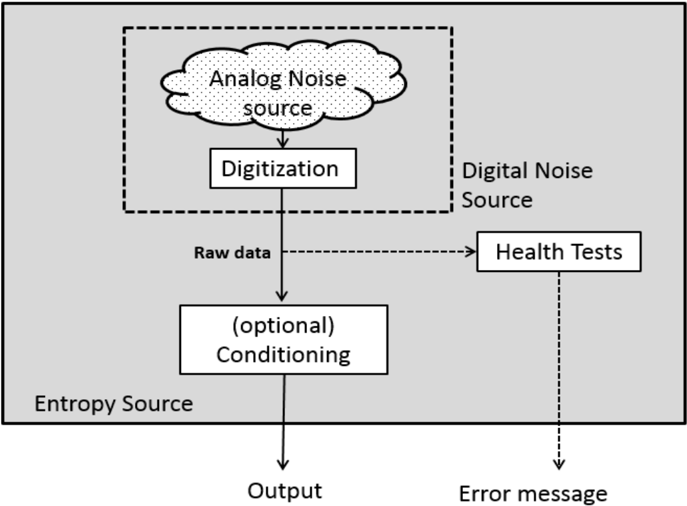
- The entropy source model consists of a noise source, an optional conditioning component, and health tests; validation requires at least 1,000,000 sequential noise-source samples, and restart tests use 1000 restarts × 1000 consecutive samples in a 1000×1000 matrix.
- Two approved continuous health tests are specified: the Repetition Count test and the Adaptive Proportion test; the recommended false positive probability is between 2^-20 and 2^-40, startup tests run continuous tests over at least 1024 consecutive samples, and for α = 2^-20 and H = 2.0 bits per sample the Repetition Count cutoff is C = 11.
- The IID track uses the Most Common Value estimate; the non-IID track requires taking the minimum of ten estimators: Most Common Value, Collision, Markov, Compression, t-Tuple, Longest Repeated Substring, Multi Most Common in Window, Lag, MultiMMC, and LZ78Y; Collision, Markov, and Compression are applied only to binary inputs.
- IID testing uses permutation testing with 10,000 permutations plus chi-square tests, with type I error 0.001; vetted conditioning components include HMAC, CMAC, CBC-MAC, approved hash functions, Hash_df, and Block_Cipher_df.
Methods
- Design and validation framework: entropy source validation is performed by an NVLAP-accredited laboratory with CAVP/CMVP review, based on documentation, data collection, restart tests, and conditioning-component entropy assessment.
- Statistical analysis: IID assumption is tested via permutation and chi-square procedures; entropy is estimated using the IID Most Common Value estimate or the non-IID battery of ten estimators; health testing uses the Repetition Count and Adaptive Proportion tests or developer-defined alternatives.
- Data and sample requirements: a sequential dataset of at least 1,000,000 samples is required, a conditioned sequential dataset of at least 1,000,000 outputs is required for non-vetted conditioning components, restart data form a 1000×1000 matrix, and alphabets larger than 256 symbols are reduced to at most 256 symbols.
Limitations
- Stated: the testing approach assumes the developer understands the behavior of the randomness source and has made a good-faith effort to produce a suitable entropy source; the entropy estimation methods rely on statistical assumptions that may not hold for all noise sources and should not replace in-depth analysis.
- Stated: continuous health tests are resource-constrained and usually detect only gross failures; the Repetition Count test detects only catastrophic failures, and continuous tests may allow poor entropy outputs before an alarm is signaled.
- Evident from the text: this is a recommendation/specification rather than an empirical study, and validation depends on submitter documentation and laboratory testing; some requirements may be out-of-scope for CAVP or CMVP validation testing.
Model-written summary. Check it against the paper before relying on it.
Integrity signals
Registry
Cites
Statistics
Figures


Verification
Claims the paper makes
0 Valid · 2 Not valid · 15 Not checked · 96 Own results and interpretations
A result the paper states — it cites no source for it, so there is none to check. The quote shows it is in the paper.
In the paper
“For example, a noise source evaluated at eight bits of min-entropy per sample has a cutoff value of six repetitions to ensure a false-positive rate of approximately once per 10 12 samples generated.”
plainstates a cause- Asserted: passes — The authors put it forward as true.
- Checkable: passes — It can be checked against evidence.
- Load-bearing: unclear — It is unclear whether the paper’s conclusions depend on it.
- Based: passes — The paper gives a reason why it holds.
A result the paper states — it cites no source for it, so there is none to check. The quote shows it is in the paper.
In the paper
“If that noise source somehow failed to the point that each sample had a 1/16 probability of being the same as the previous sample, so that it was providing only four bits of min-entropy per sample, it would still be expected to take about one million samples before the repetition count test would notice the problem.”
hedgedstates a cause- Asserted: passes — The authors put it forward as true.
- Checkable: passes — It can be checked against evidence.
- Load-bearing: unclear — It is unclear whether the paper’s conclusions depend on it.
- Based: passes — The paper gives a reason why it holds.
In the paper
“While the estimators (except for the Markov) were originally designed for application to independent outputs, the tests have performed well when applied to data with dependencies.”
What the sources say
- Not matchedcites [HD12]
This doesn’t read as a citation we can look up.
boosted- Asserted: passes — The authors put it forward as true.
- Checkable: passes — It can be checked against evidence.
- Load-bearing: unclear — It is unclear whether the paper’s conclusions depend on it.
- Based: passes — The paper gives a reason why it holds.
- Not matched
A conclusion the paper draws from its own results — it cites no other source for it, so there is none to check. The quote shows it is in the paper.
In the paper
“However, the conditioning component may reduce the entropy of the output.”
hedgedstates a possible cause- Asserted: passes — The authors put it forward as true.
- Checkable: passes — It can be checked against evidence.
- Load-bearing: passes — The paper’s conclusions depend on it.
- Based: passes — The paper gives a reason why it holds.
A conclusion the paper draws from its own results — it cites no other source for it, so there is none to check. The quote shows it is in the paper.
In the paper
“The entropy estimate of a noise source, calculated from a single, long-output sequence, might provide an overestimate if the noise source generates correlated sequences after restarts.”
hedgedstates a possible cause- Asserted: passes — The authors put it forward as true.
- Checkable: passes — It can be checked against evidence.
- Load-bearing: passes — The paper’s conclusions depend on it.
- Based: passes — The paper gives a reason why it holds.
35 more claims
Create a free account to see all 113 claims and every source verdict.
- Probably not a substantial claim. 60
- It may state two separate claims as one. 23
Self-check
Percentages, sums and reported differences re-computed from the paper’s own numbers.
Each contradiction between two passages listed here was confirmed by an independent check.
Rated minor: it would not touch a result — a value no result rests on, a p-value that stays on the same side of the significance level, or a conflict that is clerical, resolved elsewhere in the paper, or outside its own findings.
In the paper
§ 6.3.1 The Most Common Value Estimate
“𝑝𝑝 𝑢𝑢 = 0.4 + 2.576 √ 0.012 = 0.6895.”
§ 6.3.1 The Most Common Value Estimate
“The min-entropy estimate is -log2 (0.6822) = 0.5363.”
Citations
Cites
A tutorial on hidden Markov models and selected applications in speech recognition
Rabiner, L. R. (1989) · Proceedings of the IEEE · doi:10.1109/5.18626 · Cited by 22,743
Bellman, R. E. (2010) · doi:10.1515/9781400835386 · Cited by 14,588
Prediction and Entropy of Printed English
Shannon, C. E. (1951) · Bell System Technical Journal · doi:10.1002/j.1538-7305.1951.tb01366.x · Cited by 2,686
Data Compression: The Complete Reference
(2009) · Kybernetes · doi:10.1108/k.2009.06738eae.001 · Cited by 1,591
An Introduction to Probability Theory and its Applications.
Kendall, D. G., & Feller, W. (1951) · Journal of the Royal Statistical Society. Series A (General) · doi:10.2307/2980979 · Cited by 1,283
SHA-3 standard: permutation-based hash and extendable-output functions
National Institute of Standards and Technology (US) (2015) · doi:10.6028/nist.fips.202 · Cited by 783
Advanced Encryption Standard (AES)
National Institute of Standards and Technology (US) (2001) · doi:10.6028/nist.fips.197 · Cited by 642
“Balls into Bins” — A Simple and Tight Analysis
Raab, M., & Steger, A. (1998) · Lecture Notes in Computer Science · doi:10.1007/3-540-49543-6_13 · Cited by 455
Recommendation for Key Management Part 1: General
Barker, E. (2016) · doi:10.6028/nist.sp.800-57pt1r4 · Cited by 396
Self-citationNational Institute of Standards and Technology (US) (2015) · doi:10.6028/nist.fips.180-4 · Cited by 350
Cited by
Items 201–300 of 485
A Stochastic Algorithm to Design Min-Entropy Tuning Controllers for True Random Number Generators
Addabbo, T., Fort, A., Moretti, R., Mugnaini, M., Papini, D., & Vignoli, V. (2022) · IEEE Transactions on Circuits and Systems I Regular Papers · doi:10.1109/tcsi.2022.3151794 · Cited by 5
Backtracking Search for Optimal Parameters of a PLL-based True Random Number Generator
Colombier, B., Bochard, N., Bernard, F., & Bossuet, L. (2020) · Design, Automation, and Test in Europe · doi:10.23919/date48585.2020.9116307 · Cited by 7
Observations on NIST SP 800-90B entropy estimators
Aslan, M., Doğanaksoy, A., Saygı, Z., Turan, M. S., & Sulak, F. (2025) · Cryptography and Communications · doi:10.1007/s12095-025-00778-7 · Cited by 14
Self-citationDistributed Ledger-Based Authentication and Authorization of IoT Devices in Federated Environments
Jarosz, M., Wrona, K., & Zieliński, Z. (2024) · Electronics · doi:10.3390/electronics13193932 · Cited by 11
Quantum Secure Key Generation for QKD Protocols Using Quantum Gates
Gururaja, T. S., Praveenkumar, P., & Chaubey, N. K. (2024) · Advances in information security, privacy, and ethics book series · doi:10.4018/979-8-3693-9220-1.ch012 · Cited by 4
A Lightweight Hybrid Random Number Generator With Dynamic Entropy Injection
Akter, S., Williams, S., Kirtonia, P., Bayoumi, M., & Khalil, K. (2025) · IEEE Open Journal of Circuits and Systems · doi:10.1109/ojcas.2025.3582975 · Cited by 5
“The NIST SP800-90B Evaluation provides guidelines for entropy testing, focusing on ensuring that sources of randomness used in RNGs produce high-quality, unpredictable output [56].”
Improved entropy bounds for parity filtered self-timed ring based random number generators
Gomez, A. I., Kiderlen, M., & Pausinger, F. (2021) · Information Processing Letters · doi:10.1016/j.ipl.2021.106212 · Cited by 5
Testing and Reliability Enhancement of Security Primitives
Anik, T. H., Danger, J., Diankha, O., Ebrahimabadi, M., Frisch, C., Guilley, S., Karimi, N., Pehl, M., & Takarabt, S. (2021) · Proceedings · doi:10.1109/dft52944.2021.9568297 · Cited by 5
“Whereas the previous methods try to distinguish the actual TRNG output from an ideal one, the NIST SP 800-90B [10] estimates the min-entropy.”
MethodElectromagnetic Side-Channel Analysis Against TERO-Based TRNG
Osuka, S., Fujimoto, D., Kawamura, S., & Hayashi, Y. (2022) · IEEE Transactions on Electromagnetic Compatibility · doi:10.1109/temc.2022.3189372 · Cited by 6
“The SP 800-90B [4], a special publication of the National Institute for Standards and Technology (NIST), contains the requirements for”
BackgroundA Lightweight M_TRNG Design based on MUX Cell Entropy using Multiphase Sampling
Yao, L., Liang, H., Zhang, H., et al. (2022) · Asian Hardware Oriented Security and Trust Symposium (AsianHOST) · doi:10.1109/asianhost56390.2022.10022099 · Cited by 4
“First, the quality of the entropy source is assessed using the estimator described in NIST SP800-90B [18].”
MethodArbekov, I. M., & Molotkov, S. N. (2024) · Physics-Uspekhi · doi:10.3367/ufne.2024.02.039658 · Cited by 4
A Low-Complexity Start–Stop True Random Number Generator for FPGAs
Matuszewski, Ł., & Jessa, M. (2024) · Applied Sciences · doi:10.3390/app14135642 · Cited by 6
Analysing All-Optical Random Bit Sequences Using Gap-Based Approaches
Lange, C., Ahrens, A., Singh, J., & Grote, O. (2024) · Sensors · doi:10.3390/s24144474 · Cited by 4
A Secure and Efficient Software Random Number Generator Applicable to Internet of Things
He, D., Huang, W., Chen, L., & Chan, S. (2024) · IEEE Internet of Things Journal · doi:10.1109/jiot.2024.3468451 · Cited by 4
“In [44], no specific entropy value standard is provided.”
OpenTRNG: an open-source initiative for ring-oscillator based TRNGs
Pebay-Peyroula, F., Benea, L., Carmona, M., & Wacquez, R. (2024) · doi:10.1109/dttis62212.2024.10780212 · Cited by 4
Machine Learning Predictors for Min-Entropy Estimation
Blanco-Romero, J., Lorenzo, V., Mendoza, F. A., & Díaz-Sánchez, D. (2025) · Entropy · doi:10.3390/e27020156 · Cited by 6
“In this paper the emphasis will be put on: • Entropy tests, as those found in NIST Special Publication 800-90B [7], which estimate the entropy of a noise source based on appropriate samples (cf. [8], [9], [10], etc.).”
BackgroundQuantum Phase True Random Number Generation for Secure Sustainable 6G Communication
Gururaja, T. S., & Praveenkumar, P. (2025) · International Conference on Wireless Communications, Signal Processing and Networking (WiSPNET) · doi:10.1109/wispnet64060.2025.11005305 · Cited by 4
An Architecture for Learning Stream Distributions with Application to RNG Testing
Althoff, A., & Kastner, R. (2017) · Proceedings - ACM IEEE Design Automation Conference · doi:10.1145/3061639.3062199 · Cited by 4
“Several of the papers mentioned above present work designed to detect problems at the output of the RNG in accordance with the paradigm discussed in the relevant U.S. National Institute of Standards and Technology recommendation [19].”
MethodOn the Security of TRNGs Based on Multiple Ring Oscillators
Wu, X., Ma, Y., Yang, J., Chen, T., & Lin, J. (2019) · Lecture notes of the Institute for Computer Sciences, Social Informatics and Telecommunications Engineering · doi:10.1007/978-3-030-37231-6_5 · Cited by 5
Sequence Alignment Algorithm for Statistical Similarity Assessment
Nikonowicz, J., Matuszewski, Ł., & Kubczak, P. (2021) · IEEE Access · doi:10.1109/access.2021.3098340 · Cited by 5
“On the collected data set, the chi-square test [14], standard deviation [15], or entropy estimation is applied [16].”
MethodGeneration of True Random Numbers using Entropy Sources Present within Portable Computers
Koushik, R. M., Perichiappan, A., Om, H., Banerji, A., Eswaran, S., & Honnavalli, P. B. (2021) · IEEE International Conference on Electronics, Computing and Communication Technologies (CONECCT) · doi:10.1109/conecct52877.2021.9622734 · Cited by 4
“Each of the three entropy sources was validated in accordance with NIST Special Publication 800-90b by performing min-entropy tests on the sample datasets.”
MethodInfluentialImplementation and Evaluation of Ring Oscillator-based True Random Number Generator
Torii, N., Minagawa, R., Omae, H. K., & Hayashi, K. (2022) · International Journal of Networking and Computing · doi:10.15803/ijnc.12.2_372 · Cited by 6
LENTO: Unpredictable Latency-based continuous authEntication for Network inTensive IoT envirOnments
Al-Sadi, M., Pietro, R. D., Lombardi, F., & Signorini, M. (2022) · Future Generation Computer Systems · doi:10.1016/j.future.2022.09.023 · Cited by 4
An Evaluation Procedure for Comparing Clock Jitter Measurement Methods
Garay, A. J. M., Bernard, F., Fischer, V., Haddad, P., & Mureddu, U. (2023) · Lecture notes in computer science · doi:10.1007/978-3-031-25319-5_9 · Cited by 4
Singh, M. P., & Karkhur, Y. (2023) · International Conference on Information Systems and Computer Networks (ISCON) · doi:10.1109/iscon57294.2023.10112186 · Cited by 4
“Kyungroul et al. [10] presented a ransomware detection model using file header entropy [14].”
MethodAnalysis of a Programmable Quantum Annealer as a Random Number Generator
Pelofske, E. (2024) · IEEE Transactions on Information Forensics and Security · doi:10.1109/tifs.2024.3364054 · Cited by 5
“In this case, we apply the NIST SP 800-90B testsuite (titled Recommendation for the Entropy Sources Used for Random Bit Generation ) [61] 3 in order to compute min-entropy estimates on the quantum annealing bitstrings.”
MethodImpact of the Flicker Noise on the Ring Oscillator-based TRNGs
Benea, L., Carmona, M., Fischer, V., Pebay-Peyroula, F., & Wacquez, R. (2024) · IACR Transactions on Cryptographic Hardware and Embedded Systems · doi:10.46586/tches.v2024.i2.870-889 · Cited by 9
“The statistical quality of the generated digital noise is then verified using statistical tests [TBK + 18], [KS11].”
MethodA New Gap-based Approach for Analysing All-Optical Random Bit Sequences
Ahrens, A., Lange, C., Singh, J., & Grote, O. (2024) · International Conference on Microwaves, Radar & Wireless Communications · doi:10.23919/mikon60251.2024.10633991 · Cited by 4
“Criteria for measuring randomness of bit sequences are published e. g. by the National Institute of Standards and Technology (NIST) [9].”
BackgroundMethodDevelopment of the RISC-V entropy source interface
Saarinen, M.-J. O., Newell, G. R., & Marshall, B. (2022) · Journal of Cryptographic Engineering · doi:10.1007/s13389-021-00275-6 · Cited by 6
“The min-entropy assessment methodology in SP 80090B [52] has an additional safety margin in its confidence intervals, and therefore there must be consistently more than 12 bits of min-entropy per 16-bit word.”
BackgroundMethodInfluentialPark, H., Kang, J.-S., & Yeom, Y. (2016) · 정보보호학회논문지 · doi:10.13089/jkiisc.2016.26.1.49 · Cited by 4
“현재 드래프트(draft) 상태에 놓여있는 NIST의 SP 800-90B[7] 문서는 정보이론을 근간으로 한 엔트로피(entropy)에 기반을 둔 측도(measure)를 사용하여 진난수발생기의 안전성을 평가하고자 하는 노력을 보여주고 있다.”
How to Prevent to Delegate Authentication
Alimomeni, M., & Safavi–Naini, R. (2015) · Lecture notes of the Institute for Computer Sciences, Social Informatics and Telecommunications Engineering · doi:10.1007/978-3-319-28865-9_26 · Cited by 4
Interactive Security of Ransomware with Heuristic Random Bit Generator
Rastogi, R. P., Agarwal, G., & Shukla, R. K. (2020) · Lecture notes in electrical engineering · doi:10.1007/978-981-15-7961-5_90 · Cited by 4
Discussion on the Full Entropy Assumption of the SP 800-90 Series
Buller, D. (2022) · doi:10.6028/nist.ir.8427.ipd · Cited by 4
Photonic reservoir computing based min-entropy evaluation for random number generators
Wang, J., Cai, Q., Zhang, J., et al. (2025) · Science China Information Sciences · doi:10.1007/s11432-025-4382-4 · Cited by 3
“For white chaos true random number sequences, we evaluate the min-entropy of the white chaos by retaining n ( n = 1, 2, ... , 8) most significant bits (MSBs).”
Noise-Rejecting Photonic Integrated Circuit for Robust Quantum Random Number Generation
Smith, P. R., Marangon, D. G., Paraiso, T. K., Dynes, J. F., & Shields, A. J. (2025) · Optical Fiber Communication Conference · doi:10.1364/ofc.2026.tu3k.6 · Cited by 4
Ma, Z., Liu, G., Eastman, A., Kaufman, K., Armanuzzaman, M., Tan, X., Jesse, K., Walls, R. J., & Zhao, Z. (2025) · ACM SIGSAC Conference on Computer and Communications Security (CCS) · doi:10.1145/3719027.3765039 · Cited by 5
Quantum secure image encryption using hybrid QTRNG and QPRNG
Gururaja, T. S., & Praveenkumar, P. (2026) · Scientific Reports · doi:10.1038/s41598-026-35111-6 · Cited by 5
Nujumudeen, F., Mubarak, M., Sharma, Y. K., Lilhore, U. K., Aldossary, S. M., Hussien, S. A., Ghith, E. S., & Khan, M. M. (2026) · Peer-to-Peer Networking and Applications · doi:10.1007/s12083-025-02188-1 · Cited by 7
“Furthermore, this greater efficiency makes it possible to deploy on sub-$1 IoT edge devices while establishing the principle of theoretical security using entropy sources compliant with NIST SP 800-90B [9] and appropriate resource limitations.”
Benea, L., Carmona, M., Pebay-Peyroula, F., & Wacquez, R. (2022) · Euromicro Conference on Digital System Design (DSD) · doi:10.1109/dsd57027.2022.00077 · Cited by 6
An HLS implementation of on-the-fly randomness test for TRNGs
Oya, R., Fujieda, N., & Ichikawa, S. (2022) · International Symposium on Computing and Networking · doi:10.1109/candar57322.2022.00028 · Cited by 3
Overview of Quantum Key Distribution Network Key-Delivery Specifications
Mehić, M., Raß, S., Dervisevic, E., Fazio, P., Jakovlev, S., & Vozn̆ák, M. (2025) · International Conference on Quantum Communications, Networking, and Computing (QCNC) · doi:10.1109/qcnc64685.2025.00021 · Cited by 6
On the Impact of Metastability in Jitter Based TRNG
Pebay-Peyroula, F., Benea, L., Carmona, M., & Wacquez, R. (2025) · IEEE International Symposium on Hardware Oriented Security and Trust (HOST) · doi:10.1109/host64725.2025.11050059 · Cited by 4
“This maximum achievable entropy comfortably exceeds the required threshold set by current standards, such as BSI AIS 20/31 [4] and NIST SP 800-90 [5], which mandate a Shannon entropy of at least 0.9998.”
InfluentialApplications of certified randomness
Amer, O., Chakrabarti, S., Chakraborty, K., Eloul, S., Kumar, N., Lim, C., Liu, M., Niroula, P., Satsangi, Y., Shaydulin, R., et al. (2025) · Nature Reviews Physics · doi:10.1038/s42254-025-00845-1 · Cited by 14
A Hardware One-Time Pad Prototype Generator for Localising Cloud Security
Tobin, P., Tobin, L., McKeever, M., & Blackledge, J. (2017) · Arrow - TU Dublin (Technological University Dublin) · doi:10.21427/d73z5p · Cited by 2
An All-Digital True Random Number Generator Based on Chaotic Cellular Automata Topology
Best, S., & Xu, X. (2019) · doi:10.1109/iccad45719.2019.8942050 · Cited by 5
“Based on the definition in [35], the random numbers generated by TRNG test chips are IID.”
BackgroundMethodInfluentialSecure Random Number Generation in Continuous Variable Systems
Haw, J. Y., Assad, S. M., & Lam, P. K. (2020) · Quantum science and technology · doi:10.1007/978-3-319-72596-3_6 · Cited by 4
Benkhaddra, I., Senouci, M. R., Madoune, S. A., Senouci, A., Tanougast, C., Sadoudi, S., & Lei, H. (2022) · Displays · doi:10.1016/j.displa.2022.102274 · Cited by 5
Peetermans, A., & Verbauwhede, I. M. R. (2022) · IACR Transactions on Cryptographic Hardware and Embedded Systems · doi:10.46586/tches.v2022.i4.88-109 · Cited by 6
Multiplexing quantum tunneling diodes for random number generation
Aungskunsiri, K., Amarit, R., Jantarachote, S., Wongpanya, K., Punpetch, P., & Sumriddetchkajorn, S. (2023) · Review of Scientific Instruments · doi:10.1063/5.0113995 · Cited by 3
A true random number generator with high bit rate and low energy efficiency
Cheng, X., Zhang, Y., Zhu, H., & Zhou, Y. (2023) · International Journal of Circuit Theory and Applications · doi:10.1002/cta.3563 · Cited by 4
Side-channel attack on COSO-based TRNG to estimate output bits
Hayashi, K., Minagawa, R., & Torii, N. (2022) · International Symposium on Computing and Networking Workshops (CANDARW) · doi:10.1109/candarw57323.2022.00051 · Cited by 5
“As a result, COSO-based TRNG with both countermeasures passed statistical tests of AIS20/31 and IID test of SP80090B, and our proposed attacks could not predict the random numbers.”
MethodChoi, Y., Kang, J.-S., & Yeom, Y. (2023) · Entropy · doi:10.3390/e25071056 · Cited by 3
“[17] is a min-entropy estimation tool, which estimates the min-entropy of output sequences by collecting 1,000,000 n-bit output sequences.”
BackgroundMethodInfluentialWitek, K., Caccia, M., Kucewicz, W., et al. (2023) · International Conference on Mixed Design of Integrated Circuits and Systems (MIXDES) · doi:10.23919/mixdes58562.2023.10203268 · Cited by 3
Optimizing Linear Correctors: A Tight Output Min-Entropy Bound and Selection Technique
Grujić, M., & Verbauwhede, I. M. R. (2023) · IEEE Transactions on Information Forensics and Security · doi:10.1109/tifs.2023.3326986 · Cited by 3
“999, as it is the maximum between the requirement of the latest version of AIS-31 [3] (0.98) and NIST SP 800-90B [1] upper bound for the min-entropy rate after non-cryptographic post-processing (0.999).”
BackgroundMethodInfluentialLee, M. H., Kim, S.-J., Yoon, S. I., Lee, J. K., Ko, H. S., Kim, G., Hong, S., Lee, K., & Kim, Y. K. (2023) · Small Science · doi:10.1002/smsc.202300224 · Cited by 6
“[51,52] Table 1 shows the result of the test.”
BackgroundFPGA Latch Primitive based Efficient True Random Number Generators
Esen, M. M., Uzun, Ş., & Göncü, E. (2023) · IEEE International Conference on Electronics, Circuits and Systems (ICECS) · doi:10.1109/icecs58634.2023.10382907 · Cited by 3
“The noise source’s initial entropy estimate is calculated using the formula H I = min ( H original , nxH bitstring , H submitter ) [20].”
BackgroundMethodArbekov, I. M., & Molotkov, S. N. (2024) · Uspekhi Fizicheskih Nauk · doi:10.3367/ufnr.2024.02.039658 · Cited by 3
Rethinking Contemporary Deep Learning Techniques for Error Correction in Biometric Data
Lai, Y.-L., Dong, X., Jin, Z., Jia, W., Tistarelli, M., & Li, X. (2024) · International Journal of Computer Vision · doi:10.1007/s11263-024-02280-8 · Cited by 3
“Besides, NIST Special Publication 800-90B (Turan et al., 2018) highlights challenges in generating and validating cryptographic entropy from arbitrary sources.”
Feasibility of PUF-Based Authentication on ATtiny Devices with Off-the-Shelf SRAM
Gondesen, F., Mitra, S., & Lam, K. (2020) · ACM Workshop on Cyber-Physical System Security (CPSS) · doi:10.1145/3384941.3409591 · Cited by 3
Pure randomness extracted from two poor sources
Monroe, D. (2016) · Communications of the ACM · doi:10.1145/3014386 · Cited by 3
Statistical Randomness Tests of Long Sequences by Dynamic Partitioning
AKCENGİZ, Z., Aslan, M., Karabayir, O., Doğanaksoy, A., Uğuz, M., & Sulak, F. (2020) · doi:10.1109/iscturkey51113.2020.9308005 · Cited by 3
“The random variable used in collision estimate method described in [11] suggests partitioning sequences dynamically in testing.”
MethodInfluentialDesign and Implementation of a flexible Multi-purpose Cryptographic System on low cost FPGA
Maache, A., & Kalache, A. (2023) · International journal of electrical and computer engineering systems · doi:10.32985/ijeces.14.1.6 · Cited by 3
“Practically, the compression estimator of NIST 800-90B [50] was used, which is an extension of Maurer’s test to approximate the lower bound on the min-entropy.”
Secure self-seeding with power-up SRAM states
Krentz, K.-F., Meinel, C., & Graupner, H. (2017) · IEEE Symposium on Computers and Communications (ISCC) · doi:10.1109/iscc.2017.8024696 · Cited by 3
“The min-entropy of I/Q LSBs was estimated using an opensource implementation of NIST 800-90B [28].”
MethodBojanova, I., Yesha, Y., & Black, P. E. (2018) · IEEE Annual Computer Software and Applications Conference (COMPSAC) · doi:10.1109/compsac.2018.00110 · Cited by 3
Design Principles for True Random Number Generators for Security Applications
Grujić, M., Rožić, V., Johnston, D., et al. (2019) · Proceedings - ACM IEEE Design Automation Conference · doi:10.1145/3316781.3323482 · Cited by 3
“TRNG design approach requires proper entropy justification and estimation [13] or stochastic model of the noise source [5].”
MethodInfluentialSelf-citationRecommendation for Cryptographic Key GenerationPreprint
Barker, E. B. (2019) · doi:10.6028/nist.sp.800-133r1-draft · Cited by 3
Self-citationReport on the Block Cipher Modes of Operation in the 800-38 Series
Mouha, N., & Dworkin, M. J. (2023) · doi:10.6028/nist.ir.8459.ipd · Cited by 11
True random number generators for cryptography : Design, securing and evaluation
Petura, O. (2019) · theses.fr (ABES) · doi:10.70675/56ae3bc6zaac4z4d36z925dza40646fe196c · Cited by 15
Detecting Weak Keys in Manufacturing Certificates: A Case Study
Chi, A., Enright, B., & McGrew, D. A. (2023) · Annual Computer Security Applications Conference · doi:10.1145/3627106.3627120 · Cited by 2
“See Section 7.18 of the NIST CMVP Implementation Guidance [17], and Section 3.14 of NIST Special Publication (SP) 800-90B [21].”
BackgroundInfluentialOkuma, T., Kanno, K., & Uchida, A. (2024) · Frontiers in Complex Systems · doi:10.3389/fcpxs.2024.1379464 · Cited by 2
Švarcmajer, M., Köhler, M., Krpić, Z., & Lukić, I. (2025) · Sensors · doi:10.3390/s25175298 · Cited by 3
Rényi Divergence-Based Uniformity Guarantees for k -Universal Hash Functions
Pathegama, M., & Barg, A. (2025) · IEEE Transactions on Information Theory · doi:10.1109/tit.2025.3619440 · Cited by 2
“As already mentioned, information-theoretic security results often rely on uniformity guarantees based in min-entropy [33].”
Physical-Layer Secure Optical Transmission Based on Randomized Quantization Noise
Luo, H., Zhang, Z., Dai, L., Wu, D., Yang, Q., Deng, L., Liu, D., Dai, X., & Cheng, M. (2025) · IEEE Transactions on Information Forensics and Security · doi:10.1109/tifs.2025.3620673 · Cited by 3
“Inaddition, the randomness and entropy of the generated keystream are quantitatively evaluated by NIST random test suites, including SP 800-22 [34] and SP 800-90b [35].”
Bilal, M., Ullah, I., Zhang, X., & Hayat, U. (2026) · Physica Scripta · doi:10.1088/1402-4896/ae3034 · Cited by 2
Hosmani, S. G., Raja Sekar, K., Raveendran, A., Desalphine, V., Pasupuleti, H. B., & Sudarsan, S. D. (2026) · International Conference on VLSI Design · doi:10.1109/vlsid68508.2026.00033 · Cited by 5
Strangio, S., Dimaggio, E., Marian, D., Catania, A., Toral-López, A., Pieri, F., Iannaccone, G., & Fiori, G. (2026) · Advanced Functional Materials · doi:10.1002/adfm.202529572 · Cited by 4
Code generator matrices as RNG conditioners
Tomasi, A., Meneghetti, A., & Sala, M. (2017) · Finite Fields and Their Applications · doi:10.1016/j.ffa.2017.05.005 · Cited by 2
“We follow the recommendations set out by NIST [BK12] for the precise meaning to be given to these terms.”
MethodInfluentialA High-Throughput Random Binary Sequence Generator Based on ECG
Zenieh, C., Al-Mahairi, M. M., & Haddad, M. (2022) · IEEE Access · doi:10.1109/access.2022.3185057 · Cited by 2
“Another aspect of the health testing strategy is determining the likely failure modes for the noise source [28].”
BackgroundMethodInfluentialA Closer Look at the Chaotic Ring Oscillators based TRNG Design
Su, S., Yang, B., Rožić, V., Yang, M., Zhu, M., Wei, S., & Liu, L. (2023) · IACR Transactions on Cryptographic Hardware and Embedded Systems · doi:10.46586/tches.v2023.i2.381-417 · Cited by 6
Testing and reliability enhancement of security primitives: Methodology and experimental validation
Anik, M. T. H., Danger, J., Diankha, O., Ebrahimabadi, M., Frisch, C., Guilley, S., Karimi, N., Pehl, M., & Takarabt, S. (2023) · Microelectronics Reliability · doi:10.1016/j.microrel.2023.115055 · Cited by 3
White-Box PRNG: A Secure Pseudo-Random Number Generator under the White-Box Attack Model
Deng, W. (2023) · International Conference on Cryptography, Security and Privacy (CSP) · doi:10.1109/csp58884.2023.00020 · Cited by 2
High-performance hardware primitives based on sub-10 nm nanodiodes for cryptography applications
Chen, K., Li, N., Luo, Y., & Yao, Y. (2024) · Journal of Materials Chemistry C · doi:10.1039/d4tc02206h · Cited by 2
Investigation of Commercial Off-The-Shelf ReRAM Modules for Use as Runtime-Accessible TRNG
Arul, T., Mexis, N., George, A. E., Frank, F., Anagnostopoulos, N. A., & Katzenbeisser, S. (2024) · Euromicro Conference on Digital System Design (DSD) · doi:10.1109/dsd64264.2024.00014 · Cited by 4
“Inorder to verify that the collected bits exhibit truly random behaviour, the NIST SP800-22 statistical test suite [3] and the NIST SP800-90B entropy source test suite [4] have been used on the post-processed bits acquired from five Adesto ReRAM modules and six Fujitsu ReRAM modules.”
MethodInfluentialHash-Based Message Authentication Code with a Reverse Fuzzy Extractor for a CMOS Image Sensor
Rogi, Y., Hagizaki, M., Oyama, T., Ogawa, H., Yoshida, K., Fujino, T., & Okura, S. (2025) · Electronics · doi:10.3390/electronics14101971 · Cited by 2
The General Data Protection Regulation's Practical Impact on Software Architecture
Francesco, G. P. D. (2019) · Computer · doi:10.1109/mc.2018.2888771 · Cited by 2
Designing a Random Number Generator for Secure Communication with WISP
Kösemen, C., & Dalkılıç, G. (2017) · International Conference on Compute and Data Analysis (ICCDA) · doi:10.1145/3093241.3093285 · Cited by 2
“As SHA-1 outputs 160-bit results, 320-bit sequences of harvested data are given as input, so the input size is reduced by 50% in output [13].”
BackgroundOn the Effectiveness of Electric Network Frequency (ENF) as a Source of Randomness
Revadigar, G., Javali, C., Li, Y., et al. (2019) · doi:10.1109/trustcom/bigdatase.2019.00123 · Cited by 2
“As per NIST standards [11], [12], the random bit-strings from public sources together with other mandatory secret inputs/strings are used to first generate the internal seed .”
BackgroundMethodInfluentialAccelerated implementation for testing IID assumption of NIST SP 800-90B using GPU
Kim, Y., & Yeom, Y. (2021) · PeerJ Computer Science · doi:10.7717/peerj-cs.404 · Cited by 2
Convolution Neural Network‐Based Sensitive Security Parameter Identification and Analysis
Kim, H., Kim, D., & Yi, O. (2022) · Wireless Communications and Mobile Computing · doi:10.1155/2022/9584894 · Cited by 2
“A deterministic random number generator (DRBG) is used to ensure unbiasedness and independence between bits, and various entropy sources (noise sources) are collected and mixed to satisfy the unpredictability and security strength recommended by the country and then input into the DRBG [6, 8].”
BackgroundMethodInfluentialExpectation Entropy as a Password Strength Metric
Reaz, K., & Wunder, G. (2022) · IEEE Conference on Communications and Network Security · doi:10.1109/cns56114.2022.9947259 · Cited by 2
“NIST’s Entropy Estimation Suite [3] is the industry standard solution to estimate min-entropy using 10 tests as described in [4], [5].”
MethodSpecial Session: Security Verification & Testing for SR-Latch TRNGs
Bahrami, J., Ebrahimabadi, M., Danger, J., Guilley, S., & Karimi, N. (2023) · IEEE VLSI Test Symposium (VTS) · doi:10.1109/vts56346.2023.10140057 · Cited by 3
“In practice, the Entropy Source Validation (ESV) defers the evaluation to a Special Publication (SP) of the NIST, referred to as NIST SP 800 90B [21].”
MethodLightweight cryptographic secure random number generator for IoT devices
Răstoceanu, F., Rughinis, R. V., & Trancă, D.-C. (2023) · International Conference on Control Systems and Computer Science · doi:10.1109/cscs59211.2023.00036 · Cited by 2
Enhancing Quality and Security of the PLL-TRNG
Fischer, V., Bernard, F., Bochard, N., et al. (2023) · IACR Transactions on Cryptographic Hardware and Embedded Systems · doi:10.46586/tches.v2023.i4.211-237 · Cited by 2
True Random Number Generation Using Process Scheduling of Android Systems
Song, P., Zeng, Y., Liu, Z., et al. (2018) · International Conference on Networking and Network Applications (NaNA) · doi:10.1109/nana.2018.8648763 · Cited by 2
“EXPERIMENTAL RESULTS The min-entropy of random numbers can be calculated to evaluate their quality, and the method proposed in [15] is used to calculate the min-entropy of random numbers.”
MethodTime-Invariant Cryptographic Key Generation from Cardiac Signals
Alharbi, S. R., Islam, M. S., & Al-Ahmadi, S. A. (2019) · Advances in intelligent systems and computing · doi:10.1007/978-3-030-32523-7_23 · Cited by 2
A True Random Number Generator Method Embedded in Wireless Communication Systems
Suzuki, T., & Kaminaga, M. (2020) · IEICE Transactions on Fundamentals of Electronics Communications and Computer Sciences · doi:10.1587/transfun.2019eap1130 · Cited by 3
Grozov, V., Guirik, A. V., Budko, M. B., et al. (2021) · International Congress on Ultra Modern Telecommunications and Control Systems and Workshops (ICUMT) · doi:10.1109/icumt54235.2021.9631603 · Cited by 2
Quantum Tunneling Noise-based Entropy Core for True Random Number GenerationPreprint
Kadam, A. A., Hajare, H., Singh, A. K., Somappa, L., Baghini, M. S., & Ganguly, U. (2024) · Research Square · doi:10.21203/rs.3.rs-4363886/v1 · Cited by 2
NIST SP 800-90B Compliant Perpendicular Magnetic Tunnel Junction Based True Random Number Generator
Jia, Q., Egan, S., Lv, Y., & Wang, J.-P. (2025) · 2025 IEEE 36th Magnetic Recording Conference (TMRC) · doi:10.1109/tmrc66824.2025.11192720 · Cited by 1
Metadata
- Authors
- Turan, M. S., Barker, E., Kelsey, J., McKay, K. A., Baish, M. L., & Boyle, M.
- Venue
- NIST Special Publication 800-90B
- Published
- 2018-01
- OpenAlex
- W2784781042
- Cited by
- 489
- References
- 24
- Citations by year
- 2026: 59 · 2025: 63 · 2024: 64 · 2023: 66 · 2022: 58 · 2021: 38 · 2020: 41 · 2019: 34 · 2018: 17
- Type
- report
- Language
- en
- Open access
- gold
- doi.org
- Funders
- Information Technology Laboratory
- Topics
- Physical Sciences › Computer Science › Artificial Intelligence › Cryptographic Implementations and Security
- Physical Sciences › Physics and Astronomy › Atomic and Molecular Physics, and Optics › Quantum Information and Cryptography
- Physical Sciences › Computer Science › Hardware and Architecture › Physical Unclonable Functions (PUFs) and Hardware Security
- Keywords
- entropy source, random bit generation, random number generation, cryptographic randomness, entropy estimation
About these checks
Registry, retraction, Cites and statistics results are computed, not judged, with one exception: a printed reference that no index lists is read once by a model before it counts as a citation error. Claims are extracted by a model and kept only when their quote appears verbatim in the text; each cited source is then checked, with a model’s help, for whether it says what the claim relies on. Those verdicts can be wrong — read the claim’s quote and the cited source before relying on one.
A language model drew the claims from the paper on 2026-09-28, under version 3 of the claim definition (model deepseek-v4.1-flash, prompt extract-v3).
A second model labelled each claim on 2026-09-28 (model jev-1.13-20260917, definition revision gold-guideline-v0.2).
Statistics and arithmetic are recomputed, not judged.
Confidence bands are shown only for fields calibrated on our annotated test set. None is calibrated yet, so no band is shown.
What counts as a claim ›How we measure confidence ›How we check this ›
Are you an author, or do you see a problem with this page? Request a review
Data sources
Bibliographic data: Semantic Scholar, OpenAlex, Crossref.
Contains information from the Semantic Scholar Academic Graph Datasets, made available under the ODC Attribution License (ODC-BY 1.0).
Semantic Scholar’s data is described in: Kinney, R., et al. (2023). The Semantic Scholar Open Data Platform. arXiv:2301.10140.
