

Recommendation for the Entropy Sources Used for Random Bit Generation
Open accessThe DOI matches its Crossref record; 24 of the 24 references it cites were found in a registry or an index; none of the 20 sources its claims cite is checked for support yet.
Abstract
Reports on Computer Systems TechnologyThe Information Technology Laboratory (ITL) at the National Institute of Standards and Technology (NIST) promotes the U.S. economy and public welfare by providing technical leadership for the Nation's measurement and standards infrastructure.ITL develops tests, test methods, reference data, proof of concept implementations, and technical analyses to advance the development and productive use of information technology.ITL's responsibilities include the development of management, administrative, technical, and physical standards and guidelines for the cost-effective security and privacy of other than national security-related information in Federal information systems.The Special Publication 800-series reports on ITL's research, guidelines, and outreach efforts in information system security, and its collaborative activities with industry, government, and academic organizations.
Overview
CoChat Summary
TL;DR
NIST SP 800-90B specifies design principles, requirements, and validation tests for entropy sources used by Random Bit Generators, including health tests, IID testing, and min-entropy estimators. It defines separate IID and non-IID validation tracks and provides approved continuous health tests and entropy estimation methods.
Key findings
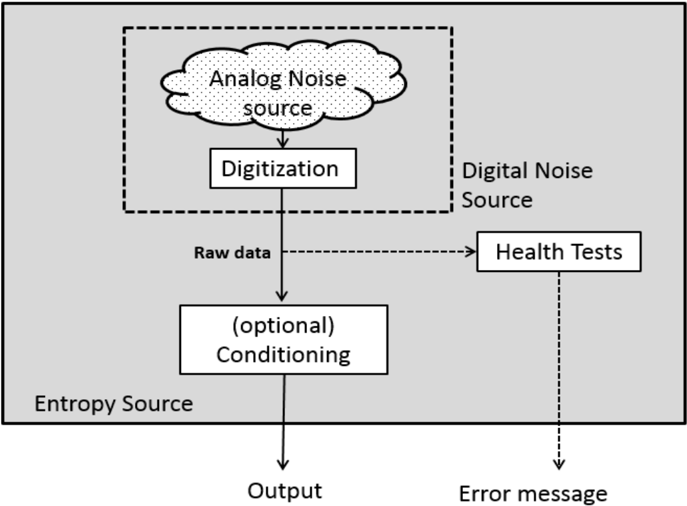
- The entropy source model consists of a noise source, an optional conditioning component, and health tests; validation requires at least 1,000,000 sequential noise-source samples, and restart tests use 1000 restarts × 1000 consecutive samples in a 1000×1000 matrix.
- Two approved continuous health tests are specified: the Repetition Count test and the Adaptive Proportion test; the recommended false positive probability is between 2^-20 and 2^-40, startup tests run continuous tests over at least 1024 consecutive samples, and for α = 2^-20 and H = 2.0 bits per sample the Repetition Count cutoff is C = 11.
- The IID track uses the Most Common Value estimate; the non-IID track requires taking the minimum of ten estimators: Most Common Value, Collision, Markov, Compression, t-Tuple, Longest Repeated Substring, Multi Most Common in Window, Lag, MultiMMC, and LZ78Y; Collision, Markov, and Compression are applied only to binary inputs.
- IID testing uses permutation testing with 10,000 permutations plus chi-square tests, with type I error 0.001; vetted conditioning components include HMAC, CMAC, CBC-MAC, approved hash functions, Hash_df, and Block_Cipher_df.
Methods
- Design and validation framework: entropy source validation is performed by an NVLAP-accredited laboratory with CAVP/CMVP review, based on documentation, data collection, restart tests, and conditioning-component entropy assessment.
- Statistical analysis: IID assumption is tested via permutation and chi-square procedures; entropy is estimated using the IID Most Common Value estimate or the non-IID battery of ten estimators; health testing uses the Repetition Count and Adaptive Proportion tests or developer-defined alternatives.
- Data and sample requirements: a sequential dataset of at least 1,000,000 samples is required, a conditioned sequential dataset of at least 1,000,000 outputs is required for non-vetted conditioning components, restart data form a 1000×1000 matrix, and alphabets larger than 256 symbols are reduced to at most 256 symbols.
Limitations
- Stated: the testing approach assumes the developer understands the behavior of the randomness source and has made a good-faith effort to produce a suitable entropy source; the entropy estimation methods rely on statistical assumptions that may not hold for all noise sources and should not replace in-depth analysis.
- Stated: continuous health tests are resource-constrained and usually detect only gross failures; the Repetition Count test detects only catastrophic failures, and continuous tests may allow poor entropy outputs before an alarm is signaled.
- Evident from the text: this is a recommendation/specification rather than an empirical study, and validation depends on submitter documentation and laboratory testing; some requirements may be out-of-scope for CAVP or CMVP validation testing.
Model-written summary. Check it against the paper before relying on it.
Integrity signals
Registry
Cites
Statistics
Figures


Verification
Claims the paper makes
0 Valid · 2 Not valid · 15 Not checked · 96 Own results and interpretations
A result the paper states — it cites no source for it, so there is none to check. The quote shows it is in the paper.
In the paper
“For example, a noise source evaluated at eight bits of min-entropy per sample has a cutoff value of six repetitions to ensure a false-positive rate of approximately once per 10 12 samples generated.”
plainstates a cause- Asserted: passes — The authors put it forward as true.
- Checkable: passes — It can be checked against evidence.
- Load-bearing: unclear — It is unclear whether the paper’s conclusions depend on it.
- Based: passes — The paper gives a reason why it holds.
A result the paper states — it cites no source for it, so there is none to check. The quote shows it is in the paper.
In the paper
“If that noise source somehow failed to the point that each sample had a 1/16 probability of being the same as the previous sample, so that it was providing only four bits of min-entropy per sample, it would still be expected to take about one million samples before the repetition count test would notice the problem.”
hedgedstates a cause- Asserted: passes — The authors put it forward as true.
- Checkable: passes — It can be checked against evidence.
- Load-bearing: unclear — It is unclear whether the paper’s conclusions depend on it.
- Based: passes — The paper gives a reason why it holds.
In the paper
“While the estimators (except for the Markov) were originally designed for application to independent outputs, the tests have performed well when applied to data with dependencies.”
What the sources say
- Not matchedcites [HD12]
This doesn’t read as a citation we can look up.
boosted- Asserted: passes — The authors put it forward as true.
- Checkable: passes — It can be checked against evidence.
- Load-bearing: unclear — It is unclear whether the paper’s conclusions depend on it.
- Based: passes — The paper gives a reason why it holds.
- Not matched
A conclusion the paper draws from its own results — it cites no other source for it, so there is none to check. The quote shows it is in the paper.
In the paper
“However, the conditioning component may reduce the entropy of the output.”
hedgedstates a possible cause- Asserted: passes — The authors put it forward as true.
- Checkable: passes — It can be checked against evidence.
- Load-bearing: passes — The paper’s conclusions depend on it.
- Based: passes — The paper gives a reason why it holds.
A conclusion the paper draws from its own results — it cites no other source for it, so there is none to check. The quote shows it is in the paper.
In the paper
“The entropy estimate of a noise source, calculated from a single, long-output sequence, might provide an overestimate if the noise source generates correlated sequences after restarts.”
hedgedstates a possible cause- Asserted: passes — The authors put it forward as true.
- Checkable: passes — It can be checked against evidence.
- Load-bearing: passes — The paper’s conclusions depend on it.
- Based: passes — The paper gives a reason why it holds.
35 more claims
Create a free account to see all 113 claims and every source verdict.
- Probably not a substantial claim. 60
- It may state two separate claims as one. 23
Self-check
Percentages, sums and reported differences re-computed from the paper’s own numbers.
Each contradiction between two passages listed here was confirmed by an independent check.
Rated minor: it would not touch a result — a value no result rests on, a p-value that stays on the same side of the significance level, or a conflict that is clerical, resolved elsewhere in the paper, or outside its own findings.
In the paper
§ 6.3.1 The Most Common Value Estimate
“𝑝𝑝 𝑢𝑢 = 0.4 + 2.576 √ 0.012 = 0.6895.”
§ 6.3.1 The Most Common Value Estimate
“The min-entropy estimate is -log2 (0.6822) = 0.5363.”
Citations
Cites
A tutorial on hidden Markov models and selected applications in speech recognition
Rabiner, L. R. (1989) · Proceedings of the IEEE · doi:10.1109/5.18626 · Cited by 22,743
Bellman, R. E. (2010) · doi:10.1515/9781400835386 · Cited by 14,588
Prediction and Entropy of Printed English
Shannon, C. E. (1951) · Bell System Technical Journal · doi:10.1002/j.1538-7305.1951.tb01366.x · Cited by 2,686
Data Compression: The Complete Reference
(2009) · Kybernetes · doi:10.1108/k.2009.06738eae.001 · Cited by 1,591
An Introduction to Probability Theory and its Applications.
Kendall, D. G., & Feller, W. (1951) · Journal of the Royal Statistical Society. Series A (General) · doi:10.2307/2980979 · Cited by 1,283
SHA-3 standard: permutation-based hash and extendable-output functions
National Institute of Standards and Technology (US) (2015) · doi:10.6028/nist.fips.202 · Cited by 783
Advanced Encryption Standard (AES)
National Institute of Standards and Technology (US) (2001) · doi:10.6028/nist.fips.197 · Cited by 642
“Balls into Bins” — A Simple and Tight Analysis
Raab, M., & Steger, A. (1998) · Lecture Notes in Computer Science · doi:10.1007/3-540-49543-6_13 · Cited by 455
Recommendation for Key Management Part 1: General
Barker, E. (2016) · doi:10.6028/nist.sp.800-57pt1r4 · Cited by 396
Self-citationNational Institute of Standards and Technology (US) (2015) · doi:10.6028/nist.fips.180-4 · Cited by 350
Cited by
Items 401–485 of 485
Quasi-Monte Carlo Radiative TransferPreprint
Shulman, S. (2024) · SSRN Electronic Journal · doi:10.2139/ssrn.4873795
Ahlgren, I., West, J., Lee, K., Thiruvathukal, G. K., & Klingensmith, N. (2024) · IEEE Workshop on Design Automation for CPS and IoT (DESTION) · doi:10.1109/destion62938.2024.00008 · Cited by 2
“Furthermore, generating strong passwords, storing them securely, and periodically rotating them have all proven to be stub-bornly difficult tasks for humans [23], [25], [6], [27], [8].”
BackgroundNovel Hybrid Arbitar Based True Random Number Generation Circuits for FPGAs in the CloudPreprint
Narayanapuram, B., & Panda, J. (2024) · Research Square · doi:10.21203/rs.3.rs-4816474/v1
Bringing Data Converter Pairs into Chaotic Oscillation for Built-in Self-Test and Entropy Generation
Callegari, S. (2024) · IntechOpen eBooks · doi:10.5772/intechopen.1005654 · Cited by 1
Test Data Encryption with a New Stream Cipher
Rajski, J., Trawka, M., Tyszer, J., & Włodarczak, B. (2024) · IEEE International Test Conference (ITC) · doi:10.1109/itc51657.2024.00052 · Cited by 1
“The next tests belong to the NIST Test Suite SP800-90B [37].”
InfluentialSingle Event Upset Tolerant TRNG Design and Its Tests Under Radiation
Yılmaz, Ö. O., Demirköz, B. M., & Yalcin, M. E. (2024) · Conference on Design of Circuits and Integrated Systems · doi:10.1109/dcis62603.2024.10769157
Online Testing Entropy and Entropy Tests with a Two State Markov Model
Johnston, D. (2024) · Lecture notes in computer science · doi:10.1007/978-3-031-80408-3_8
Generation, evaluation and comparison of DNA-based (pseudo) random sequences
Горбенко, І. Д., & Derevianko, Y. A. (2024) · Eastern-European Journal of Enterprise Technologies · doi:10.15587/1729-4061.2024.314808
Feedback reinforced accelerated aging for improved physical unclonable function stability
Hunt-Schroeder, E., & Xia, T. (2025) · Microelectronics Reliability · doi:10.1016/j.microrel.2025.115592
Design of a High Jitter Harmonic Injected Ring Oscillator for Entropy Sources
Ye, Z., & Ikeda, M. (2024) · IEEE International Conference on Integrated Circuits, Technologies and Applications (ICTA) · doi:10.1109/icta64028.2024.10860508
Enabling Certifiable Asymmetric Cryptography for Hardware Attestation Protocols
Barry, J. (2024) · Cyber Research Conference - Ireland (Cyber-RCI) · doi:10.1109/cyber-rci60769.2024.10939787
“SP 800-90C [22] specifies constructions for the implementation of RBGs that include Deterministic RBG mechanisms as specified in SP 800-90A [23] and that use entropy sources as specified in SP 800-90B [24].”
A high speed 3-edge ring oscillator based TRNG with TDC using clock gating-TROT
Ariveni, L., Samson, M., Jamal, K., Daniel, J., Vandana, B., Nautiyal, M., & Singla, A. K. (2025) · AIP conference proceedings · doi:10.1063/5.0261649
Crespo, M. L., Micco, L. D., Antonelli, M., Lopresti, R. E., Silva, A., Florian, W., Ordóñez, L. G. G., & Cicuttin, A. (2025) · Nonlinear Dynamics · doi:10.1007/s11071-025-11370-2 · Cited by 1
“NIST furnishes a series of documents with design and evaluation criteria for Random Bit Generators (RBG): Special Publication (SP) 800-22 based on the randomness notion [14] and SP 800-90 based on the concept of entropy [15].”
InfluentialUltra-Compact and High-Throughput True Random Number Generator for FPGAs
Cojocaru, G., & Immler, V. (2025) · ACM Great Lakes Symposium on VLSI (GLSVLSI) · doi:10.1145/3716368.3735228
Lo, T.-Y., Tseng, C.-H., & Hwang, S.-K. (2025) · OptoElectronics and Communications Conference and International Conference on Photonics in Switching and Computing (OECC/PSC) · doi:10.23919/oecc/psc62146.2025.11111479
“The minimum entropy, as recommended by the National Institute of Standards and Technology Special Publication 800-90B [9], is then estimated.”
Methods for obtaining DNA-based pseudorandom and random sequences using block encryption
Горбенко, І. Д., Yesina, M. V., & Derevianko, Y. A. (2024) · International Conference on Dependable Systems, Services and Technologies (DESSERT) · doi:10.1109/dessert65323.2024.11122214
“The use of such crypto-primitives for sequence enhancement/conditioning is justified in AIS 20/31 [1] and NIST 800-90B [11].”
Park, S., Kim, S., Park, C.-W., & Choi, J. W. (2025) · Photonics · doi:10.3390/photonics12090851
A Proposal of an Embedded On-the-fly Filter for a Circuit-based Random Number Generator
Hide, C., Sato, R., Nogami, Y., & Kodera, Y. (2025) · International Technical Conference on Circuits/Systems, Computers and Communications (ITC-CSCC) · doi:10.1109/itc-cscc66376.2025.11137754
“It provides appropriate evaluation criteria for standardized entropy [4].”
Kim, J., & Chen, V. (2025) · IEEE Journal of Solid-State Circuits · doi:10.1109/jssc.2025.3602728
Current tendencies in Free-Running Oscillators: a review
Luengo, E. A. (2025) · Statistics and Computing · doi:10.1007/s11222-025-10750-3 · Cited by 1
“This evaluation is essential to comply with test standards such as NIST 800-90B (Turan et al. 2018) and AIS-31 (Rukhin et al. 2021), as well as in applications that require the expansion of entropy sources, such as in RISC-V systems.”
Garıpcan, A. M., & Erdem, E. (2025) · Firat University Journal of Experimental and Computational Engineering · doi:10.62520/fujece.1667526 · Cited by 1
Feasibility of Quantum Key Distribution Between Supersonic Aircraft
McKiernan, S., & Collins, R. J. (2025) · IET Quantum Communication · doi:10.1049/qtc2.70018
Zhang, R., Cao, Y., Zhang, H., Cheng, Q., Nishizawa, S., Niitsu, K., & Shinohara, H. (2025) · IEEE Transactions on Circuits and Systems I Regular Papers · doi:10.1109/tcsi.2025.3621604
“The post-processed output successfully passes the NIST SP 800-22 [34] and SP 800-90B [35] randomness test suites.”
A Secure Multimodal Electrochemical Sensor for Sustainable Biomanufacturing
Yasar, A., Caygara, D., Patel, Y. H., Pemaraj, A., Boisvert, L., Magyar, A., Yu, T., Dufort, B., Poo, T.-L., & Yazicigil, R. T. (2025) · doi:10.1109/esserc66193.2025.11213984 · Cited by 1
A Simulator for Wrong-Way Driver Detection
Luz, P., Metzner, M., & Schwieger, V. (2025) · International Journal of Intelligent Transportation Systems Research · doi:10.1007/s13177-025-00578-6
“Due to the deterministic nature of computers, this is only possible by means of exter-nal observation of a physical process that produces entropy, like thermal noise or nuclear decay [13, 14].”
Calmon, F., Habach, R., Uhring, W., et al. (2025) · IEEE Interregional NEWCAS Conference (NEWCAS) · doi:10.1109/newcas64648.2025.11107005
A Method of Cryptographically Strong Pseudorandom Sequences Generation for Forming a One-Time Pad
Андреевич, Г. В., Budko, M. Y., & Guirik, A. V. (2025) · Conference of Open Innovations Association (FRUCT) · doi:10.23919/fruct67853.2025.11239304
Secure Password Generator Based on Secure Pseudo-Random Number Generator
Chen, A. C. H. (2026) · International Conference on Emerging Trends and Innovations in ICT (ICEI) · doi:10.1109/icei65890.2026.11447511
“Based on the guidelines in NIST SP 800-90B [22], the threshold p -value is 0.001.”
InfluentialPOCA: First Power-on Chip Authentication and Key Exchange for Secure Provisioning in System-on-Chip
Sami, M. S. U. I., Shuvo, A. M., Rahman, F., Cron, A., Donchin, D. R., Borza, M., Farahmandi, F., & Tehranipoor, M. (2025) · IEEE Transactions on Very Large Scale Integration (VLSI) Systems · doi:10.1109/tvlsi.2025.3603150
“It is essential to note that the POCA protocol requires a built-in self-test (BIST) for TRNG health verification before authentication, consistent with NIST SP 800-90B [55] and FIPS 140-3 [57].”
Hybrid Password Hardening Encryption
Ding, Z., & Wang, D. (2025) · IEEE Transactions on Information Forensics and Security · doi:10.1109/tifs.2025.3650025
“The root key k must have min-entropy H ∞ ( k ) ≥ 256 bits to meet or exceed NIST SP 800-90B [40] recommendations for 256-bit security.”
Self-Compensating StrongARM Latch for High-Speed Energy-Efficient True Random Number Generators
Huang, X., & Islam, M. (2026) · IEEE Transactions on Circuits and Systems I Regular Papers · doi:10.1109/tcsi.2025.3643984
“Then the NIST SP800-22 [20] and NIST SP800-90B [21] are implemented to check the robustness and e ff ectiveness of the proposed self-compensating StrongARM latch.”
Security Analysis of Quantum Key Distribution Based on Quantum Entanglement
Chen, A. C. H. (2025) · IEEE North Karnataka Subsection Flagship International Conference (NKCon) · doi:10.1109/nkcon66957.2025.11345730
“According to NIST SP 800-90B [9], the p -value threshold for these tests is set at 0.001.”
InfluentialValidation Framework for Module Lattice-Based Post-Quantum Digital Signature Scheme
Havanur, S. G., Kumar, R., & Jacob, A. (2025) · IEEE International Conference on Public Key Infrastructure and its Applications (PKIA) · doi:10.1109/pkia67529.2025.11347178 · Cited by 1
“…validation framework encompasses comprehensive testing approaches including deterministic algorithm verification through consistent outputs with fixed seeds, and non-deterministic mode validation ensuring proper randomness generation conforming to NIST SP 800-90 series standards [21], [22], [23].”
Quaternary true random number generator comprising gated p+–i–n+ diodes
Heo, H., Shin, Y., Jeon, J., Park, T., Ryu, S., Cho, K., & Kim, S. (2026) · Science China Information Sciences · doi:10.1007/s11432-025-4626-6 · Cited by 1
“Furthermore, the security strength of the secret key can be quantified by the min-entropy, which is calculated using the most common value (MCV) estimator [31].”
Theoretical Min-Entropy Bounds for Physical-Layer Key Generation over Weibull Fading Channels
Han, D., Ma, Y., & Lu, X. (2025) · IEEE International Conference on Trust, Security and Privacy in Computing and Communications (TrustCom) · doi:10.1109/trustcom66490.2025.00063
“…a continuous success predictions event ϵ of length r + 1 with 99% confidence can be represented by the following equation: where n refers to the total count of predictions, while x is the positive real solution of the polynomial [18]: Where x can be easily determined by approximation methods.”
InfluentialHarikaran, S., Karthikabharani, S., Gururaja, T. S., et al. (2025) · doi:10.1109/iscs69371.2025.11386361
An Eye-Opening Arbiter PUF With Auto-Error Detection and PVT-Robust Masking Achieving a BER of 2e -8
Driemeyer, B., Mandry, H., Wiens, D.-P., Kauffman, J. G., Becker, J., & Ortmanns, M. (2026) · IEEE Journal of Solid-State Circuits · doi:10.1109/jssc.2026.3663673
“To assess the randomness of the fingerprints, both the autocorrelation function (ACF) and the NIST SP 800-22 statistical test suite [36] are applied, and the resulting entropy is analyzed with the NIST SP 800-90B entropy test suite [37].”
Enciso, Z. M., Liu, J., Cheng, B., Pei, L., Davis, S., Qin, Y., Jia, Z., Hu, X. S., Shi, Y., Niemier, M. T., et al. (2026) · IEEE Journal of Solid-State Circuits · doi:10.1109/jssc.2026.3669040 · Cited by 2
“3) In-Word Gaussian Random Number Generation: Unlike pseudorandom RNGs, true RNGs (TRNGs) require a physical process capable of producing entropy [30].”
Hardware-Accelerated Cryptographic Random Engine for Simulation-Oriented Systems
Kurian, M. G., & Chen, Y. (2026) · Electronics · doi:10.3390/electronics15061297 · Cited by 1
On the min-entropy of equilibrium graphs in network creation games
Lin, C.-C., & Hung, C. (2026) · Scientific Reports · doi:10.1038/s41598-026-43792-2
“…Definition 2, we have As Equation illustrates, for the graph G to be more “informative” or “predictable” (c.f., min-entropy for predictability of an entropy source 20 ), that is, to have smaller value of I f ( G ) , we expect to have smaller value of ( v i ) and larger expected value of f ( v i ) .”
Tseng, C.-H., Uchida, A., & Hwang, S.-K. (2026) · International Conference on Artificial Intelligence in Information and Communication (ICAIIC) · doi:10.1109/icaiic68212.2026.11454317
“To quantitatively assess the entropy throughput, the digitized bandwidth-enhanced chaos is analyzed using the NIST SP 800-90B entropy estimation suite [13].”
Génération d'aléa dans les circuits électroniques numériques exploitant des cellules oscillantes
Mureddu, U. (2019) · theses.fr (ABES) · doi:10.70675/3c8fc16czf301z4560z8287z56b43e278cc8
Ribouh, S. (2020) · theses.fr (ABES) · doi:10.70675/09340afcz8f29z4ac8za794z7de1520fe8e8 · Cited by 4
Allini, E. N. (2020) · theses.fr (ABES) · doi:10.70675/c8d90846z6a5ez45d8zb0f9ze15f9eba0e82 · Cited by 2
Concevoir des circuits sécurisés à très faible consommation : une alternative basée sur l’asynchrone
Gimenez, G. (2021) · theses.fr (ABES) · doi:10.70675/67615de8zf950z4d02z9dd1z33698f6bb4ff · Cited by 3
System Integration of High-Performance Continuous-Variable Quantum Key Distribution
Piétri, Y. (2024) · theses.fr (ABES) · doi:10.70675/db1a062ez48e2z464czbcbaz8de1a6ebb41a
Integrating Remote Quantum Random Number Generator as a Shared Resource into GNU/Linux via D-Bus
Petručeņa, K., Kozlovičs, S., Kalniņa, E., et al. (2026) · ACM Transactions on Privacy and Security · doi:10.1145/3799895
“Stephan Müller, for example, rewrote /dev/random , implementing a “non-physical” (according to the classification of German BSI AIS 20/30 [32]) TRNG based on CPU execution time jitter [27] that meets NIST SP 800-90B, C and FIPS 140-3 standards for software-based entropy sources [3, 25, 28, 40].”
Chhaperwal, M., Kumar, A., & Majumdar, K. (2026) · ACS Photonics · doi:10.1021/acsphotonics.5c03153 · Cited by 1
PUFs and TRNGs for Hardware-Based Authentication and Security
Cabacinho, J., Casaleiro, J., & Oliveira, L. B. (2026) · Advances in computational intelligence and robotics book series · doi:10.4018/979-8-3373-0990-3.ch006
Vazamentos de Temporização e Exaustão de Entropia Quântica em ML-KEM (Kyber) com QRNG
Paixão, A. C. P., Mobilon, E., Pizzini, L. R., et al. (2026) · doi:10.5753/wqunets.2026.22958
“Na rede, evidenciamos que ataques de repetição [Syverson 1994] exauriam a en-tropia do QRNG [Turan et al. 2018, NIST 2015].”
Kwon, S., Lee, T., Kim, D. W., Hwang, S., & Kim, S. (2026) · Advanced Functional Materials · doi:10.1002/adfm.76481
“In addition to the response-bit randomness evaluated by NIST SP 800–22, the entropy of the PUF-generated responses was further assessed using NIST SP 800–90B [ 43 ].”
Design and analysis of an arduino-based low-cost true random number generator
Kaner, S., Garıpcan, A. M., & Erdem, E. (2026) · International Journal of Pure and Applied Sciences · doi:10.29132/ijpas.1804208
Gupta, B., & Rana, S. (2026) · SSRN Electronic Journal · doi:10.2139/ssrn.6981149
Mellor, V., & Ahmad, F. B. (2026) · Quantum Reports · doi:10.3390/quantum8030062 · Cited by 1
“To provide direct evidence for Assumption 2, we estimate the conditional min-entropy of the quantised output using the NIST SP 800-90B entropy-source estimators [33], which target H ∞ rather than Shannon entropy.”
Adversarially Mixed Secret Key Generation for Side-Channel Defense for the Cloud
Karanam, V. S. S. L., Sakkaff, Z., & Balasooriyalage, P. (2026) · IEEE Secure Development Conference (SecDev) · doi:10.1145/3805773.3805999
Wu, S., Ma, Z., Yang, B., Wang, Y., Yang, Z., Chen, W., Wang, H., Zhu, M., Zhang, A., & Liu, L. (2026) · IEEE Symposium on VLSI Technology and Circuits (VLSI Technology and Circuits) · doi:10.1109/vlsitechnologyandcir65830.2026.11577306
DTSM: Digital Twin-Enabled Secure Multicast Signcryption Protocol for Low-Altitude UAV Networks
Liu, L., Cao, J., Ma, R., Deng, B., Li, G., Zhang, Y., & Li, H. (2026) · IEEE Transactions on Dependable and Secure Computing · doi:10.1109/tdsc.2026.3713051
“In implementation, the sender should employ a standards compliant Random Bit Generator (RBG), a DRBG instantiated from an approved entropy source, with sufficient entropy input, protected internal state, and backtracking resistance [47], [48], [49].”
Complexity Analysis of FMR Driven Chaotic Magnetization Dynamics in a Nanodisk
Kolli, A., Merbouche, H., Loubens, G. D., et al. (2026) · IEEE International Magnetic Conference - Short Papers (INTERMAG Short Papers) · doi:10.1109/intermagshortpapers68882.2026.11596435
“3b. before being subjected to the NIST Randomness Test Suite [8].”
AI-Enhanced Tesla Lamp Entropy Generation System for Cryptographic Application
Akimova, D., Glazyrina, N., Karilov, R., & Polat, A. (2026) · IEEE International Conference on Smart Information Systems and Technologies (SIST) · doi:10.1109/sist61674.2026.11596220 · Cited by 1
Genomik verilerin güvenliği için transformer ağı destekli DNA şifreleme
Kaya, A., & Türkoğlu, İ. (2026) · Gazi Üniversitesi Mühendislik-Mimarlık Fakültesi Dergisi · doi:10.17341/gazimmfd.1619337
Zheng, Z., & Chen, X. (2026) · ACM International Conference on Bioinformatics, Computational Biology and Biomedicine · doi:10.1145/3807503.3819358
Jia, Q., Egan, S., Lv, Y., & Wang, J. (2026) · IEEE Transactions on Electron Devices · doi:10.1109/ted.2026.3715464 · Cited by 1
Quantifying Randomness in Stochastic Bit Sequences
Lange, C., Ahrens, A., Krishnakumar, Y. K., Engert, D., & Yin, M. (2026) · Sensors · doi:10.3390/s26154825
Security of NIST SP800-90A Hash-based DRBGs in the Seedless Model
Chung, W., Lee, B., Hwang, S., Kim, S., & Lee, J. (2026) · IEEE European Symposium on Security and Privacy · doi:10.1109/eurosp68448.2026.00013
“This issue is also raised for NIST SP800-90B [13] and SP800-90C [14].”
TDMRans: Toward a Two-Stage Detection Method of Ransomware Encryption Behavior in Storage System
Hu, G., Chen, F., & Shao, J. (2026) · IEEE Transactions on Network Science and Engineering · doi:10.1109/tnse.2026.3719148 · Cited by 1
FPGA Implementation of a Hybrid Chaotic True Random Number Generator Using Fibonacci Ring Oscillator
Mohamed, M. E., Sayed, W. S., Madian, A. H., & Said, L. A. (2026) · International Conference on Modern Circuits and Systems Technologies · doi:10.1109/mocast70204.2026.11626365
“The primary objective is to verify that the bits are Independent and Identically Distributed (IID), meaning that each bit is not influenced by previous values and originates from the same probability distribution [10].”
Secrets That Survive Everything: Runtime Credential Exposure in Production Web ApplicationsPreprint
Gorijala, H. K. (2026) · Qeios · doi:10.32388/0mecs9
Yanushevskyi, S., & Dobrovolsky, Y. (2026) · Technology and design in electronic equipment · doi:10.15222/tkea2026.1.32
From Algebraic Correctness to Zero Trust Deployment: An Assurance Framework for ML-KEM
Edwards, W., Vukovic, M., & Wallace, J. W. (2026) · Electronics · doi:10.3390/electronics15153427
$\mu$RNG: A Framework for Assessing Randomness in Intermittent Computing Devices
Sah, P., & Hicks, M. (2026) · Proceedings - International Symposium on Computer Architecture/Proceedings · doi:10.1109/isca66397.2026.00086
“Integrate the entropy source with lightweight NIST-recommended health tests [90] to verify sufficient entropy accumulation.”
Zhuravlev, V. (2026) · International Siberian workshops and tutorials on electron devices and materials · doi:10.1109/edm69524.2026.11632138
“NIST publications cover both statistical testing of RNG/PRNG outputs (SP 800-22) and recommendations for constructing and validating cryptographic random bit generators, including entropysources(SP800-90B)[1],[2],[3],[4].”
Domenico, L. D. (2026) · Springer eBooks · doi:10.1007/978-3-032-30243-4_16
Müller, S. (2026) · Springer eBooks · doi:10.1007/978-3-032-30243-4_17
Müller, S. (2026) · Springer eBooks · doi:10.1007/978-3-032-30243-4_18
Darcy, Q. (2026) · Springer eBooks · doi:10.1007/978-3-032-30243-4_15
Korhan, H., Bayraktar, M., Vista, F., Schmit, Y., Duncán, J. C. M., & Chatzinotas, S. (2026) · IEEE Access · doi:10.1109/access.2026.3727139
“The statistical test suites, such as SP 800-22, can still be useful as smoke tests; however, they are not a replacement for an entropy claim, since passing tests is not a guarantee of unpredictability under side information [68], [69], [70].”
An On-Chip Continuous Entropy-Quality Monitoring Method for Random-Number Source Output Streams
Guan, P., Chen, J., Zhou, J., et al. (2026) · Electronics · doi:10.3390/electronics15184101
Jóźwiak, P. P. (2026) · Communications in computer and information science · doi:10.1007/978-3-032-37936-8_16
Srichan, C., Wongthanavasu, S., & Danvirutai, P. (2026) · IEEE Access · doi:10.1109/access.2026.3734114
“NIST SP 800-90A specifies approved DRBG mechanisms [2], SP 800-90B addresses entropy sources [3], and SP 800-90C specifies RBG constructions [4].”
A WGAN-GP, CNN, and Polynomial Neural Network-Based Random Number Generator
Papadopoulos, A. D., Ακριώτου, Μ., & Syvridis, D. (2026) · IEEE Access · doi:10.1109/access.2026.3736506
“Randomness is evaluated using the NIST SP 800-22, NIST SP 800-90B entropy-estimation [29], and Dieharder test suites.”
COSOI: True Random Number Generator Based on Coherent Sampling using the FD-SOI technology
Benea, L., Pebay-Peyroula, F., Carmona, M., & Wacquez, R. (2024) · WiPiEC Journal - Works in Progress in Embedded Computing Journal · doi:10.64552/wipiec.v10i2.60 · Cited by 1
“…current standards imposed by BSI (Bundesamt für Sicherheit in der Informationstechnik) [1], NIST (National Institute of Standards and Technology) [2] and ISO (International Organization for Standardization) [3] demand a stochastic model capable of estimating the entropy of the generated bits.”
Sample-Conditional Mixtures of Entropy Estimators for Short Sequences Under a Uniform Marginal Null
Sosa-Gómez, G. (2026) · Entropy · doi:10.3390/e28101073
“Certification of physical and non-physical entropy sources under SP 800-90B [6] and AIS 20/31 [23] is based on min-entropy H ∞ = − log 2 max x p x , estimated by dedicated procedures (most-common-value, collision, Markov, and compression estimators), because H ∞ bounds the success probability of an…”
InfluentialSecure RSA Key Generation Using a 1D Hybrid Logistic-Tent Map and SHA-256 Hash Conditioning
Rachmawati, D., Lydia, M. S., Budiman, M. A., et al. (2026) · Engineering Technology & Applied Science Research · doi:10.48084/etasr.20165
“…with prior hash-based post-processing [21], the caution that hashing alone does not guarantee PRNG security [22], and NIST conditioning guidance [29]: • Partition the chaotic bitstream 8 into 256-bit blocks: • Apply SHA-256 to each block: (cid:2) (cid:5) SHA - 256 (cid:6)8 (cid:2) (cid:10) ,…”
A Universal, Provably Uniform Conditioning Framework via Negative Binomial Convergence
Kuang, R. (2026) · Journal of Cybersecurity and Privacy · doi:10.3390/jcp6050170
Certified randomness amplification by dynamically probing remote random quantum states
Liu, M., Niroula, P., DeCross, M., Foreman, C., Kon, W. Y., Primaatmaja, I. W., Allman, M. S., Campora, J. P., Isanaka, A., Singhal, K., et al. (2025) · arXiv · doi:10.48550/arxiv.2511.03686
Metadata
- Authors
- Turan, M. S., Barker, E., Kelsey, J., McKay, K. A., Baish, M. L., & Boyle, M.
- Venue
- NIST Special Publication 800-90B
- Published
- 2018-01
- OpenAlex
- W2784781042
- Cited by
- 489
- References
- 24
- Citations by year
- 2026: 59 · 2025: 63 · 2024: 64 · 2023: 66 · 2022: 58 · 2021: 38 · 2020: 41 · 2019: 34 · 2018: 17
- Type
- report
- Language
- en
- Open access
- gold
- doi.org
- Funders
- Information Technology Laboratory
- Topics
- Physical Sciences › Computer Science › Artificial Intelligence › Cryptographic Implementations and Security
- Physical Sciences › Physics and Astronomy › Atomic and Molecular Physics, and Optics › Quantum Information and Cryptography
- Physical Sciences › Computer Science › Hardware and Architecture › Physical Unclonable Functions (PUFs) and Hardware Security
- Keywords
- entropy source, random bit generation, random number generation, cryptographic randomness, entropy estimation
About these checks
Registry, retraction, Cites and statistics results are computed, not judged, with one exception: a printed reference that no index lists is read once by a model before it counts as a citation error. Claims are extracted by a model and kept only when their quote appears verbatim in the text; each cited source is then checked, with a model’s help, for whether it says what the claim relies on. Those verdicts can be wrong — read the claim’s quote and the cited source before relying on one.
A language model drew the claims from the paper on 2026-09-28, under version 3 of the claim definition (model deepseek-v4.1-flash, prompt extract-v3).
A second model labelled each claim on 2026-09-28 (model jev-1.13-20260917, definition revision gold-guideline-v0.2).
Statistics and arithmetic are recomputed, not judged.
Confidence bands are shown only for fields calibrated on our annotated test set. None is calibrated yet, so no band is shown.
What counts as a claim ›How we measure confidence ›How we check this ›
Are you an author, or do you see a problem with this page? Request a review
Data sources
Bibliographic data: Semantic Scholar, OpenAlex, Crossref.
Contains information from the Semantic Scholar Academic Graph Datasets, made available under the ODC Attribution License (ODC-BY 1.0).
Semantic Scholar’s data is described in: Kinney, R., et al. (2023). The Semantic Scholar Open Data Platform. arXiv:2301.10140.
