

Recommendation for the Entropy Sources Used for Random Bit Generation
Open accessThe DOI matches its Crossref record; 24 of the 24 references it cites were found in a registry or an index; none of the 20 sources its claims cite is checked for support yet.
Abstract
Reports on Computer Systems TechnologyThe Information Technology Laboratory (ITL) at the National Institute of Standards and Technology (NIST) promotes the U.S. economy and public welfare by providing technical leadership for the Nation's measurement and standards infrastructure.ITL develops tests, test methods, reference data, proof of concept implementations, and technical analyses to advance the development and productive use of information technology.ITL's responsibilities include the development of management, administrative, technical, and physical standards and guidelines for the cost-effective security and privacy of other than national security-related information in Federal information systems.The Special Publication 800-series reports on ITL's research, guidelines, and outreach efforts in information system security, and its collaborative activities with industry, government, and academic organizations.
Overview
CoChat Summary
TL;DR
NIST SP 800-90B specifies design principles, requirements, and validation tests for entropy sources used by Random Bit Generators, including health tests, IID testing, and min-entropy estimators. It defines separate IID and non-IID validation tracks and provides approved continuous health tests and entropy estimation methods.
Key findings
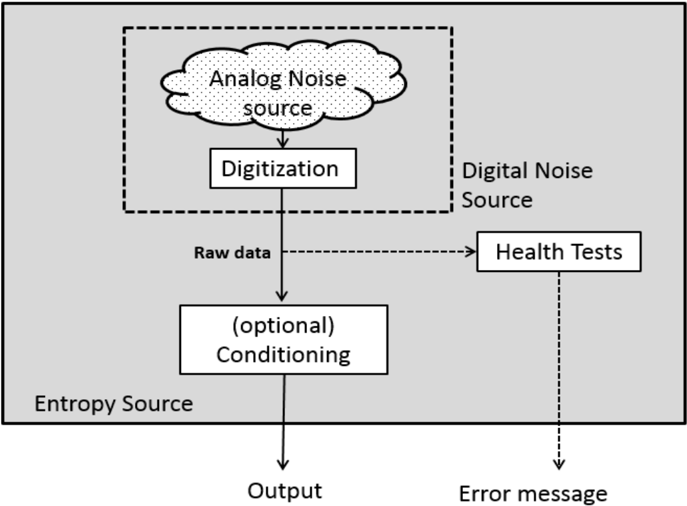
- The entropy source model consists of a noise source, an optional conditioning component, and health tests; validation requires at least 1,000,000 sequential noise-source samples, and restart tests use 1000 restarts × 1000 consecutive samples in a 1000×1000 matrix.
- Two approved continuous health tests are specified: the Repetition Count test and the Adaptive Proportion test; the recommended false positive probability is between 2^-20 and 2^-40, startup tests run continuous tests over at least 1024 consecutive samples, and for α = 2^-20 and H = 2.0 bits per sample the Repetition Count cutoff is C = 11.
- The IID track uses the Most Common Value estimate; the non-IID track requires taking the minimum of ten estimators: Most Common Value, Collision, Markov, Compression, t-Tuple, Longest Repeated Substring, Multi Most Common in Window, Lag, MultiMMC, and LZ78Y; Collision, Markov, and Compression are applied only to binary inputs.
- IID testing uses permutation testing with 10,000 permutations plus chi-square tests, with type I error 0.001; vetted conditioning components include HMAC, CMAC, CBC-MAC, approved hash functions, Hash_df, and Block_Cipher_df.
Methods
- Design and validation framework: entropy source validation is performed by an NVLAP-accredited laboratory with CAVP/CMVP review, based on documentation, data collection, restart tests, and conditioning-component entropy assessment.
- Statistical analysis: IID assumption is tested via permutation and chi-square procedures; entropy is estimated using the IID Most Common Value estimate or the non-IID battery of ten estimators; health testing uses the Repetition Count and Adaptive Proportion tests or developer-defined alternatives.
- Data and sample requirements: a sequential dataset of at least 1,000,000 samples is required, a conditioned sequential dataset of at least 1,000,000 outputs is required for non-vetted conditioning components, restart data form a 1000×1000 matrix, and alphabets larger than 256 symbols are reduced to at most 256 symbols.
Limitations
- Stated: the testing approach assumes the developer understands the behavior of the randomness source and has made a good-faith effort to produce a suitable entropy source; the entropy estimation methods rely on statistical assumptions that may not hold for all noise sources and should not replace in-depth analysis.
- Stated: continuous health tests are resource-constrained and usually detect only gross failures; the Repetition Count test detects only catastrophic failures, and continuous tests may allow poor entropy outputs before an alarm is signaled.
- Evident from the text: this is a recommendation/specification rather than an empirical study, and validation depends on submitter documentation and laboratory testing; some requirements may be out-of-scope for CAVP or CMVP validation testing.
Model-written summary. Check it against the paper before relying on it.
Integrity signals
Registry
Cites
Statistics
Figures


Verification
Claims the paper makes
0 Valid · 2 Not valid · 15 Not checked · 96 Own results and interpretations
A result the paper states — it cites no source for it, so there is none to check. The quote shows it is in the paper.
In the paper
“For example, a noise source evaluated at eight bits of min-entropy per sample has a cutoff value of six repetitions to ensure a false-positive rate of approximately once per 10 12 samples generated.”
plainstates a cause- Asserted: passes — The authors put it forward as true.
- Checkable: passes — It can be checked against evidence.
- Load-bearing: unclear — It is unclear whether the paper’s conclusions depend on it.
- Based: passes — The paper gives a reason why it holds.
A result the paper states — it cites no source for it, so there is none to check. The quote shows it is in the paper.
In the paper
“If that noise source somehow failed to the point that each sample had a 1/16 probability of being the same as the previous sample, so that it was providing only four bits of min-entropy per sample, it would still be expected to take about one million samples before the repetition count test would notice the problem.”
hedgedstates a cause- Asserted: passes — The authors put it forward as true.
- Checkable: passes — It can be checked against evidence.
- Load-bearing: unclear — It is unclear whether the paper’s conclusions depend on it.
- Based: passes — The paper gives a reason why it holds.
In the paper
“While the estimators (except for the Markov) were originally designed for application to independent outputs, the tests have performed well when applied to data with dependencies.”
What the sources say
- Not matchedcites [HD12]
This doesn’t read as a citation we can look up.
boosted- Asserted: passes — The authors put it forward as true.
- Checkable: passes — It can be checked against evidence.
- Load-bearing: unclear — It is unclear whether the paper’s conclusions depend on it.
- Based: passes — The paper gives a reason why it holds.
- Not matched
A conclusion the paper draws from its own results — it cites no other source for it, so there is none to check. The quote shows it is in the paper.
In the paper
“However, the conditioning component may reduce the entropy of the output.”
hedgedstates a possible cause- Asserted: passes — The authors put it forward as true.
- Checkable: passes — It can be checked against evidence.
- Load-bearing: passes — The paper’s conclusions depend on it.
- Based: passes — The paper gives a reason why it holds.
A conclusion the paper draws from its own results — it cites no other source for it, so there is none to check. The quote shows it is in the paper.
In the paper
“The entropy estimate of a noise source, calculated from a single, long-output sequence, might provide an overestimate if the noise source generates correlated sequences after restarts.”
hedgedstates a possible cause- Asserted: passes — The authors put it forward as true.
- Checkable: passes — It can be checked against evidence.
- Load-bearing: passes — The paper’s conclusions depend on it.
- Based: passes — The paper gives a reason why it holds.
35 more claims
Create a free account to see all 113 claims and every source verdict.
- Probably not a substantial claim. 60
- It may state two separate claims as one. 23
Self-check
Percentages, sums and reported differences re-computed from the paper’s own numbers.
Each contradiction between two passages listed here was confirmed by an independent check.
Rated minor: it would not touch a result — a value no result rests on, a p-value that stays on the same side of the significance level, or a conflict that is clerical, resolved elsewhere in the paper, or outside its own findings.
In the paper
§ 6.3.1 The Most Common Value Estimate
“𝑝𝑝 𝑢𝑢 = 0.4 + 2.576 √ 0.012 = 0.6895.”
§ 6.3.1 The Most Common Value Estimate
“The min-entropy estimate is -log2 (0.6822) = 0.5363.”
Citations
Cites
A tutorial on hidden Markov models and selected applications in speech recognition
Rabiner, L. R. (1989) · Proceedings of the IEEE · doi:10.1109/5.18626 · Cited by 22,743
Bellman, R. E. (2010) · doi:10.1515/9781400835386 · Cited by 14,588
Prediction and Entropy of Printed English
Shannon, C. E. (1951) · Bell System Technical Journal · doi:10.1002/j.1538-7305.1951.tb01366.x · Cited by 2,686
Data Compression: The Complete Reference
(2009) · Kybernetes · doi:10.1108/k.2009.06738eae.001 · Cited by 1,591
An Introduction to Probability Theory and its Applications.
Kendall, D. G., & Feller, W. (1951) · Journal of the Royal Statistical Society. Series A (General) · doi:10.2307/2980979 · Cited by 1,283
SHA-3 standard: permutation-based hash and extendable-output functions
National Institute of Standards and Technology (US) (2015) · doi:10.6028/nist.fips.202 · Cited by 783
Advanced Encryption Standard (AES)
National Institute of Standards and Technology (US) (2001) · doi:10.6028/nist.fips.197 · Cited by 642
“Balls into Bins” — A Simple and Tight Analysis
Raab, M., & Steger, A. (1998) · Lecture Notes in Computer Science · doi:10.1007/3-540-49543-6_13 · Cited by 455
Recommendation for Key Management Part 1: General
Barker, E. (2016) · doi:10.6028/nist.sp.800-57pt1r4 · Cited by 396
Self-citationNational Institute of Standards and Technology (US) (2015) · doi:10.6028/nist.fips.180-4 · Cited by 350
Cited by
Items 301–400 of 485
Nanoscale CMOS Memory-Based Security Primitive Design
Holcomb, D. E. (2017) · CRC Press eBooks · doi:10.1201/9781315265056-3 · Cited by 1
The Generation of Random Numbers Using the Quantum Tunnel Effect in Transistors
Vezeteu, P. V., Popescu, I., & Năstac, I. (2019) · IEEE International Symposium for Design and Technology in Electronic Packaging (SIITME) · doi:10.1109/siitme47687.2019.8990743 · Cited by 1
“Also, it must fulfill the design requirements, have the processing speed, resolution (conversion frequency) and maintain the generation rate imposed by the source [28].”
BackgroundWeighted approximate Bayesian computation via Sanov’s theorem
Viscardi, C., Boreale, M., & Corradi, F. (2021) · Computational Statistics · doi:10.1007/s00180-021-01093-4 · Cited by 1
DIM‐Based Random Number Generation Using Quantum Noise Resources
Wi, H., Lee, S., & Yi, O. (2022) · Wireless Communications and Mobile Computing · doi:10.1155/2022/8984789 · Cited by 1
Tamper Resistant Reconfigurable Preamplifier Physical Unclonable Function With Self-Destruct
Hunt-Schroeder, E., & Xia, T. (2024) · IEEE Transactions on Computer-Aided Design of Integrated Circuits and Systems · doi:10.1109/tcad.2024.3367818 · Cited by 2
“In the upcoming section, we use standardized NIST [18] assessments to quantify the reduction in minimum entropy based on the number of times that the PUF is reconfigured.”
BackgroundMethodHistogram-Based Estimation of CIR Entropy for Multipath Propagation Environments
Eponeshnikov, A. V., & Sulimov, A. I. (2024) · International Conference on Electrical Engineering and Photonics (EExPolytech) · doi:10.1109/eexpolytech62224.2024.10755705 · Cited by 1
“This induces the channel uncertainty that impacts the communication reliability and security [4].”
Overview of PUFs and Emerging Chaotic Structures
Tindall, D. G., Beal, A. N., & Morris, T. H. (2024) · IEEE Physical Assurance and Inspection of Electronics (PAINE) · doi:10.1109/paine62042.2024.10792741 · Cited by 1
“In Special Publication 800-90B, “Recommendation for the Entropy Sources Used for Random Bit Generation”, Turan et al. [7] provided the system model where the digital noise source could be a chaotic PUF as shown in Figure 1c. Note that for security applications, RNG implementations should…”
Kowalski, D. R., & Mosteiro, M. A. (2025) · IEEE Transactions on Information Theory · doi:10.1109/tit.2025.3542767 · Cited by 1
A DID-based one-time session key authentication mechanism for secure human-AI chatbot communication
Son, W., Kwon, S., & Lee, J.-H. (2025) · Computers & Electrical Engineering · doi:10.1016/j.compeleceng.2025.110622 · Cited by 2
Lee, W., Sim, C., Kim, C., Jeon, J.-W., Jung, H., Kim, T., & Kim, C. (2025) · IEEE Solid-State Circuits Letters · doi:10.1109/lssc.2025.3608187 · Cited by 1
“M bits per TRNG instance, evaluated by the NIST SP800-22 [9] and NIST SP800-90B [10].”
Entropy measurement and online quality control of bit streams by a true random bit generator
Fabrello, C. G., Rossi, V., Witek, K., Trombetta, A., Baszczyk, M., Dorosz, P., Kucewicz, W., & Caccia, M. (2025) · Frontiers in Computer Science · doi:10.3389/fcomp.2025.1642566 · Cited by 3
On the Complexity of Deterministic Distributed Wireless Link Scheduling
Kowalski, D. R., & Mosteiro, M. A. (2025) · IEEE International Conference on Distributed Computing Systems (ICDCS) · doi:10.1109/icdcs63083.2025.00070 · Cited by 1
“Such restriction is due to the physical difficulty of generating truly random bits, see [3], [26].”
Effective Use of PV Systems for a Sustainable Energy Solution: A Case Study
Kaya, F., Akpolat, A. N., & Akar, O. (2025) · Firat University Journal of Experimental and Computational Engineering · doi:10.62520/fujece.1694314 · Cited by 1
Simple True Random Number Generator Using Capacitive Oscillators for FPGA Implementation
Hajduk, Z. (2025) · Electronics · doi:10.3390/electronics14214228 · Cited by 1
Toward a Practical Key Generation System for V2X Communications
Fu, H., Peng, L., Zhang, J., Liu, M., Chen, X., & Hu, A. (2025) · IEEE Transactions on Mobile Computing · doi:10.1109/tmc.2025.3640580 · Cited by 4
“The min-entropy also was evaluated through the assessment tool 5 provided by NIST based on [53].”
Femtosecond-laser-based true-random-number generator: Entropy as a service
Paithankar, P., Sharma, A., Kar, S., & Varshney, S. (2025) · Physical Review Applied · doi:10.1103/pnyx-thqz · Cited by 1
Ahmed, H. O., Redif, S., & Li, Y. (2025) · IEEE Transactions on Circuits and Systems I Regular Papers · doi:10.1109/tcsi.2025.3636579 · Cited by 2
“Following the min-entropy model in NIST SP 800-90B [34], we assume: max α ∈{ 0 ,..., 2 w − 1 } for some m ≤ w .”
Construction of correctors using resilient fragmentary Boolean functions
Hu, Y., Zhang, Y., & Wu, W. (2025) · Designs Codes and Cryptography · doi:10.1007/s10623-025-01771-0 · Cited by 1
“According to TRNGs-related standard, including NIST SP 800-90B[31] in US and AIS-31[14] in Germany, post-processing methods for raw random numbers can be categorized into two primary approaches: cryptographic post-processing and algorithmic post-processing.”
Han, D., Ma, Y., Chen, T., Jia, S., Lv, N., Zheng, F., & Lu, X. (2025) · IEEE Transactions on Information Forensics and Security · doi:10.1109/tifs.2025.3607168 · Cited by 1
“In our evaluation, all observed underestimations on i.i.d. and low-width first-order Markov models can be attributed to the Compression Estimate [2].”
InfluentialKuang, R. (2026) · Physical review. E · doi:10.1103/24hx-9y3l · Cited by 2
RANVDS: Client-Side Detection of Insecure RAN Configurations in Operational 2G–5G Networks
Rocha, L. L. D., Carneiro, V. G. A., & Pinto, E. L. (2026) · IEEE Open Journal of the Communications Society · doi:10.1109/ojcoms.2026.3673071 · Cited by 1
“These statistics correspond to core concepts in the National Institute of Standards and Technology (NIST) SP 800-22 and SP 800-90B statistical testing philosophy (uniformity, entropy of the outputs, and independence of successive values) [72], [73].”
Randomness Tests: Theory and Practice
Shen', A. K. (2020) · Lecture notes in computer science · doi:10.1007/978-3-030-48006-6_18 · Cited by 2
A Study on Output Bit Tampering of True Random Number Generators Using Time-Varying EM Waves
Osuka, S., Fujimoto, D., Beckers, A., Gierlichs, B., Verbauwhede, I. M. R., & Hayashi, Y. (2021) · Asia-Pacific International Symposium on Electromagnetic Compatibility (APEMC) · doi:10.1109/apemc49932.2021.9596679 · Cited by 1
“Random numbers generated by TRNGs are used for various cryptographic systems as session keys, nonces, initialization vectors, and masks [1].”
BackgroundMethodInfluentialCodesign for Generation of Large Random Sequences on Zynq FPGA
Hernández-Morales, B. M., Díaz-Santiago, S., & Mancillas-López, C. (2022) · IEEE Embedded Systems Letters · doi:10.1109/les.2022.3184653 · Cited by 1
“Entropy reflects the uncertainty associated with predicting the outcome of an experiment [11], and in the case of generators of this type, an ideal entropy measure is required.”
BackgroundAn Empirical Study on the Quality of Entropy Sources in Linux Random Number Generator
Du, M., Ma, Y., Lv, N., et al. (2022) · International Conference on Communications · doi:10.1109/icc45855.2022.9839285 · Cited by 1
“The maximum value of X is log 2 k when X has a uniform probability distribution, i.e., p 2) 90B Entropy Estimators: The latest official version of 90B by now was published in January 2018 [14].”
BackgroundERÖZ, E., Tanyıldızı, E., & Özkaynak, F. (2023) · International Conference on Computational Intelligence and Knowledge Economy (ICCIKE) · doi:10.1109/iccike58312.2023.10131768 · Cited by 1
“[41-44] can be examined for details on the NIST test suite, what statistical features each test examines, and other details of the tests.”
BackgroundPhysical Unclonable Functions (PUFs)
Tehranipoor, M. M., Anandakumar, N. N., & Farahmandi, F. (2023) · Springer eBooks · doi:10.1007/978-3-031-31034-8_1 · Cited by 1
Let’s shake on it: Extracting secure shared keys from Wi-Fi CSI
Avrahami, T., Amrani, O., & Wool, A. (2023) · IEEE International Conference on Mobile Ad-Hoc and Smart Systems (MASS) · doi:10.1109/mass58611.2023.00065 · Cited by 1
A Method of Cryptographically Strong Pseudorandom Sequences Generation Based on the Blender
Grozov, V., Guirik, A. V., & Budko, M. Y. (2023) · International Congress on Ultra Modern Telecommunications and Control Systems and Workshops (ICUMT) · doi:10.1109/icumt61075.2023.10333097 · Cited by 1
“A linear complexity profile, which is a measure of a PRS cryptographic quality, was also constructed [15, 21, 22].”
BackgroundLS-14 test suite for long sequences
AKCENGİZ, Z., Aslan, M., Doğanaksoy, A., SULAK, F., & Uğuz, M. (2024) · Hacettepe Journal of Mathematics and Statistics · doi:10.15672/hujms.1190807 · Cited by 2
“This approach is constructed by inspiring one of the entropy estimation method recommended by NIST; the collision estimate method [39].”
MethodMbit/s-range alkali vapour spin noise quantum random number generators
Koterle, M., Beguš, S., Pirman, J., et al. (2024) · EPJ Quantum Technology · doi:10.1140/epjqt/s40507-024-00221-5 · Cited by 1
Procurement of QKD Technology Platform as a Logic Puzzle Solution
Balodis, R., & Opmane, I. (2024) · Smart innovation, systems and technologies · doi:10.1007/978-981-99-8612-5_36 · Cited by 1
Holubnychiy, D. Y., Kandii, S., Yesina, M. V., & Gorbenko, D. Y. (2024) · Radiotekhnika · doi:10.30837/rt.2024.1.216.02 · Cited by 1
Colloidal particles as noise source for random number generation
Scholz, A. S., Arya, P., & Aghassi‐Hagmann, J. (2024) · AIP Advances · doi:10.1063/5.0223329 · Cited by 1
Ring Oscillators with Additional Phase Detectors as a Random Source in a Random Number Generator
Matuszewski, Ł., Jessa, M., & Nikonowicz, J. (2024) · Entropy · doi:10.3390/e27010015 · Cited by 2
A Novel High-Performance Random Number Generation Algorithm
Zhang, X., Zhou, Z., Xu, S., et al. (2025) · Communications in computer and information science · doi:10.1007/978-981-96-4509-1_22 · Cited by 1
On Designing PUF-Based TRNGs with Known Answer Tests
Yu, Y., Dubrova, E., Näslund, M., et al. (2018) · IEEE Nordic Circuits and Systems Conference (NorCAS) · doi:10.1109/norchip.2018.8573489 · Cited by 1
“The TRNG was further assessed by the NIST 800-90B entropy estimation suite [24].”
MethodNew Approach to Constructing Noise Source Based on Race Conditions
Kim, S., Lee, S. J., Hong, D., et al. (2019) · IEICE Transactions on Fundamentals of Electronics Communications and Computer Sciences · doi:10.1587/transfun.e102.a.1272 · Cited by 1
Atmospheric pressure air microplasma current time series for true random bit generation
Allagui, A., Majzoub, S., Elwakil, A. S., Rojas, A. E., & Alawadhi, H. (2020) · Scientific Reports · doi:10.1038/s41598-020-77956-5 · Cited by 1
Горбенко, І. Д., & Zamula, A. A. (2021) · Eastern-European Journal of Enterprise Technologies · doi:10.15587/1729-4061.2021.234674 · Cited by 1
An Online Platform for Testing and Evaluating Random Number Generators
Kubczak, P., Woźniak, W., Nikonowicz, J., Matuszewski, Ł., & Jessa, M. (2021) · International Conference on Software, Telecommunications and Computer Networks (SoftCOM) · doi:10.23919/softcom52868.2021.9559127 · Cited by 1
Awaludin, A. M., Pratama, D., & Kim, H. (2021) · Lecture notes in computer science · doi:10.1007/978-3-030-89432-0_13 · Cited by 2
On Designing PUF-Based TRNGs with Known Answer Tests
Yu, Y., Dubrova, E., Näslund, M., et al. (2018) · IEEE Nordic Circuits and Systems Conference (NorCAS) · doi:10.1109/norchip.2018.8573460 · Cited by 1
Old World and New Insight: Solving Problem with a Gestalt Switch
Xiu, L. (2022) · Springer eBooks · doi:10.1007/978-981-16-9065-5_6 · Cited by 1
Generalized Longest Repeated Substring Min-Entropy Estimator
Woo, J., Yoo, C., Kim, Y. S., et al. (2022) · IEEE International Symposium on Information Theory (ISIT) · doi:10.1109/isit50566.2022.9834465 · Cited by 1
“For non-IID sources, NIST SP 800-90B proposes ten different min-entropy estimators [4].”
BackgroundMethodInfluentialAppraisal of a Random Bit Generator Utilizing Smartphone Sensors as Entropy Source
Kutschera, S., Zugaj, W., & Slany, W. (2022) · International Conference on Electrical, Computer, Communications and Mechatronics Engineering (ICECCME) · doi:10.1109/iceccme55909.2022.9987848 · Cited by 1
Kutschera, S., Slany, W., Ratschiller, P., Gursch, S., & Dagenborg, H. (2023) · Entropy · doi:10.3390/e25060854 · Cited by 1
Schaffer, K., & Calis, A. (2022) · doi:10.6028/nist.sp.800-140dr1 · Cited by 1
Generation of Pseudorandom and Prime Numbers for Cryptographic Applications
Mammeri, Z. (2024) · Wiley eBooks · doi:10.1002/9781394207510.ch16 · Cited by 1
PUF-based AKE: Attacks, Entropy and Post-Quantum Security
Panja, S., Tripathi, N., & Safavi–Naini, R. (2025) · ACM Workshop on CPS&IoT Security and Privacy (CPSIoTSec) · doi:10.1145/3733801.3764199
“The NIST Statistical Test Suite [47] provide a”
Efficient Bound for Conditional Min-Entropy of Physical Unclonable Functions Beyond IID
Wilde, F., Frisch, C., & Pehl, M. (2019) · IEEE International Workshop on Information Forensics and Security · doi:10.1109/wifs47025.2019.9035098
“According to NIST, H∞ − 1 bit provides a lower bound for average key rank if at most k∗ < k guesses are made per device [10].”
BackgroundOne-to-Cloud One-Time Pad Data Encryption: Introducing Virtual Prototyping with PSpice
Tobin, P., Tobin, L., & Blanquer, R. G. (2017) · Arrow - TU Dublin (Technological University Dublin) · doi:10.21427/d77r67
“For this reason, the team chose analogue chaos oscillators which produce signals with an infinite number of states and the prototype may be classified as a true random number generator (TRNG) [12].”
BackgroundHigh-speed implementation of MultiMCW entropy estimation method
Kim, W., Park, H., Yeom, Y., et al. (2017) · doi:10.1109/ains.2017.8270425
“Counter.most_common() and len(S) are used in the mostCommon function.”
BackgroundInfluentialQuantum random number generation by coherent detection of phase noisePreprint
Álvarez, J.-R., Sarmiento, S., Lázaro, J. A., et al. (2019) · arXiv (Cornell University) · doi:10.48550/arxiv.1906.03763
“Indeed, governments are implementing technical standards on the usage of random number generators [3].”
BackgroundComments on Cryptographic Entropy Measurement.Preprint
Johnston, A. M. (2019) · IACR Cryptology ePrint Archive
A Love Affair Between Bias Amplifiers and Broken Noise Sources
Teşeleanu, G. (2020) · Lecture notes in computer science · doi:10.1007/978-3-030-61078-4_22
Explicit Renyi Entropy for Hidden Markov Models
Breitner, J., & Skórski, M. (2020) · IEEE International Symposium on Information Theory (ISIT) · doi:10.1109/isit44484.2020.9174390
“As per modern paradigms in the design of harwadre random number generators [4], the security is evaluated by developing a model for the stochastic source and evaluating the entropy in the outcome.”
BackgroundMethodShi, B., Xiong, X., Yang, Y., Ge, L., & Wu, J. (2020) · Asia Communications and Photonics Conference · doi:10.1364/acpc.2020.m4a.44
“5GS/s sampling rate respectively, we evaluated the minimum entropy of mesoscopic chaos using NIST SP 800-90B tests [7], which calculate the minimum entropy of physical entropy sources in 10 aspects.”
MethodSoftware-based Random Number Generators for Resource Constrained Devices
Noh, S., Kim, J., & Shin, Y. (2020) · International Conference on Information and Communication Technology Convergence (ICTC) · doi:10.1109/ictc49870.2020.9289294
Significant Uniformity Digital Models on the Set of Probabilistic Points
Kuznetsov, V. M., Pesoshin, V., Gumirov, A., & Вадимовна, Ш. Д. (2021) · Studies in systems, decision and control · doi:10.1007/978-3-030-66077-2_2
How to Test the Randomness from the Wireless Channel for Security?Preprint
Qu, Z., Zhao, S., Xu, J., et al. (2021) · arXiv (Cornell University) · doi:10.48550/arxiv.2106.07715
Salgueiro, G., Monteiro, T., Costa, D., et al. (2021) · doi:10.5753/wquantum.2021.17222
A novel technique for random number generation using CMOS image sensor
Lakshmi, A. A., Suganthi, M., Jeeva, R. A., & David, D. G. (2022) · AIP conference proceedings · doi:10.1063/5.0078536
Analysis of entropy extraction efficiencies in random number generation systems
Wang, C., Wang, S., Chen, W., Yin, Z., & Han, Z. (2016) · International Journal of Quantum Information · doi:10.1142/s0219749916300011
CMVP approved security functions :
Schaffer, K., & Calis, A. (2022) · doi:10.6028/nist.sp.800-140cr1
Randomness for Randomness Testing
Berend, D., Dolev, S., & Kumar, M. (2022) · Lecture notes in computer science · doi:10.1007/978-3-031-07689-3_11
On the Equilibrium Graph Min-Entropy of Network CreationPreprint
Lin, C.-C., & Hung, C. (2022) · SSRN Electronic Journal · doi:10.2139/ssrn.4197585
A Mathematically Generated Noise Technique for Ultrasound Systems
Choi, H., & Shin, S.-H. (2022) · Sensors · doi:10.3390/s22249709
“In the document NIST SP 800-90B, a physical source dependent on hardware and a non-physical noise source using system data are defined [42]; thus, we selected local time and a non-physical noise source to compare performance as a noise source generated by software.”
Method6.1 Encryption Techniques for Test Data
Weir, M. (2022) · European Test and Telemetry Conference (ETTC) · doi:10.5162/ettc2022/6.1
IMPLEMENTATION AND STUDY OF THE RANDOM NUMBER GENERATOR BASED ON PARALLEL MIXING
Dragnysh, N. V. (2022) · Известия Южного федерального университета. Технические науки · doi:10.18522/2311-3103-2022-5-97-105
Discussion on the full entropy assumption of the SP 800-90 series
Roginsky, A. L., Turan, M. S., Buller, D., & Kaufer, A. (2023) · doi:10.6028/nist.ir.8427
Self-citationCombined Random Number Generator on Programmable Logic Integrated Circuits
Ivaniuk, A. A. (2023) · Digital Transformation · doi:10.35596/1729-7648-2023-29-1-36-47
Салієва, О. В., Карпінець, В. В., ГРИЦАК, А., et al. (2023) · Measuring and computing devices in technological processes · doi:10.31891/2219-9365-2023-73-1-22
Wang, X., Zhang, R., & Shinohara, H. (2023) · IEICE Transactions on Fundamentals of Electronics Communications and Computer Sciences · doi:10.1587/transfun.2023kep0011 · Cited by 1
Kim, H., & Yi, O. (2023) · Applied Sciences · doi:10.3390/app13158761
Infrastructure Supporting Logic Locking
Azar, K. Z., Kamali, H. M., Farahmandi, F., et al. (2023) · Springer eBooks · doi:10.1007/978-3-031-37989-5_6
A SKG Security Challenge: Indoor SKG Under an On-The-Shoulder Eavesdropping AttackPreprint
Mayya, A., Mitev, M., Chorti, A., et al. (2023) · doi:10.36227/techrxiv.24298372.v1
A SKG Security Challenge: Indoor SKG Under an On-The-Shoulder Eavesdropping AttackPreprint
Mayya, A., Mitev, M., Chorti, A., et al. (2023) · doi:10.36227/techrxiv.24298372
Pawlowski, M. P., Jara, A. J., & OGORZAŁEK, M. J. (2015) · Research Briefs on Information and Communication Technology Evolution · doi:10.56801/rebicte.v1i.4
Fujieda, N., Ichikawa, S., Oya, R., & Kishibe, H. (2023) · IEICE Transactions on Information and Systems · doi:10.1587/transinf.2023pap0001
“Some implementations adopted tests defined in standards such as AIS–31 [32], FIPS 140–2 [33], NIST 800–22 [34], and NIST 800–90B [35].”
MASTERING CLOUD SECURITY: TECHNIQUES AND BEST PRACTICES
Haq, M. N. U., & Sharma, M. K. (2023) · GRF BOOKS · doi:10.52458/9788196869434.2023.eb.grf.ch-07 · Cited by 1
A Process based Algorithm for Random Number Generation
Sharma, D. R. (2023) · International Journal of Silkroad Institute of Research and Training · doi:10.3126/ijsirt.v1i2.61772
Žitko, R. (2024) · Research Square · doi:10.21203/rs.3.rs-3970536/v1
Enhancing Prediction Entropy Estimation of RNG for On-the-Fly Test
Ma, Y., Gu, W., Chen, T., et al. (2024) · Lecture notes in computer science · doi:10.1007/978-981-97-1238-0_6
Chizhevsky, V. N., Lahmitski, M. V., Dedkov, E., et al. (2023) · Russian Microelectronics · doi:10.1134/s1063739723600425
“At a first approximation, from this data one can evaluate, for instance, min-entropy [11] which gives the value higher 3 bits.”
Entropy Sources from Tunnelling in Standard CMOS Structures
Keledjian, J., & Lehmann, T. (2024) · Circuits Systems and Signal Processing · doi:10.1007/s00034-024-02683-5 · Cited by 1
“Entropy (or min-entropy) can be numerically estimated through the means of a software test suite that implements the NIST SP800-90B [36] and NIST SP800-22 [3] criterion.”
Memristors in the Context of Security: A Brief Meta-Review of the State of the ArtPreprint
Tekles, A., Mexis, N., & Katzenbeisser, S. (2024) · Preprints.org · doi:10.20944/preprints202405.1555.v1
Sichere Zufallszahlengenerierung in Systemen mit kontinuierlichen Variablen
Haw, J. Y., Assad, S. M., & Lam, P. K. (2024) · Springer eBooks · doi:10.1007/978-3-031-54998-4_6
Random Number Generator Using Magneto Optic Effect
Mito, S., & Arai, S. (2024) · IEEJ Transactions on Fundamentals and Materials · doi:10.1541/ieejfms.144.194
Metadata
- Authors
- Turan, M. S., Barker, E., Kelsey, J., McKay, K. A., Baish, M. L., & Boyle, M.
- Venue
- NIST Special Publication 800-90B
- Published
- 2018-01
- OpenAlex
- W2784781042
- Cited by
- 489
- References
- 24
- Citations by year
- 2026: 59 · 2025: 63 · 2024: 64 · 2023: 66 · 2022: 58 · 2021: 38 · 2020: 41 · 2019: 34 · 2018: 17
- Type
- report
- Language
- en
- Open access
- gold
- doi.org
- Funders
- Information Technology Laboratory
- Topics
- Physical Sciences › Computer Science › Artificial Intelligence › Cryptographic Implementations and Security
- Physical Sciences › Physics and Astronomy › Atomic and Molecular Physics, and Optics › Quantum Information and Cryptography
- Physical Sciences › Computer Science › Hardware and Architecture › Physical Unclonable Functions (PUFs) and Hardware Security
- Keywords
- entropy source, random bit generation, random number generation, cryptographic randomness, entropy estimation
About these checks
Registry, retraction, Cites and statistics results are computed, not judged, with one exception: a printed reference that no index lists is read once by a model before it counts as a citation error. Claims are extracted by a model and kept only when their quote appears verbatim in the text; each cited source is then checked, with a model’s help, for whether it says what the claim relies on. Those verdicts can be wrong — read the claim’s quote and the cited source before relying on one.
A language model drew the claims from the paper on 2026-09-28, under version 3 of the claim definition (model deepseek-v4.1-flash, prompt extract-v3).
A second model labelled each claim on 2026-09-28 (model jev-1.13-20260917, definition revision gold-guideline-v0.2).
Statistics and arithmetic are recomputed, not judged.
Confidence bands are shown only for fields calibrated on our annotated test set. None is calibrated yet, so no band is shown.
What counts as a claim ›How we measure confidence ›How we check this ›
Are you an author, or do you see a problem with this page? Request a review
Data sources
Bibliographic data: Semantic Scholar, OpenAlex, Crossref.
Contains information from the Semantic Scholar Academic Graph Datasets, made available under the ODC Attribution License (ODC-BY 1.0).
Semantic Scholar’s data is described in: Kinney, R., et al. (2023). The Semantic Scholar Open Data Platform. arXiv:2301.10140.
