

The effect of interactivity with a music video game on second language vocabulary recall
Open accessThe DOI matches its Crossref record; 64 of the 64 references it cites were found in a registry or an index.
Abstract
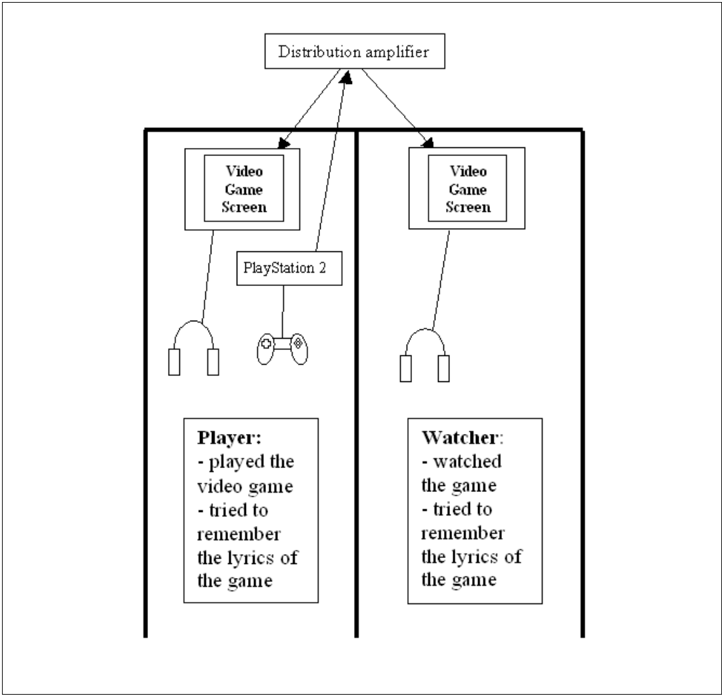
Video games are potential sources of second language input; however, the medium's fundamental characteristic, interactivity, has not been thoroughly examined in terms of its effect on learning outcomes.This experimental study investigated to what degree, if at all, video game interactivity would help or hinder the noticing and recall of second language vocabulary.Eighty randomly-selected Japanese university undergraduates were paired based on similar English language and game proficiencies.One subject played an Englishlanguage music video game for 20 minutes while the paired subject watched the game simultaneously on another monitor.Following gameplay, a vocabulary recall test, a cognitive load measure, an experience questionnaire, and a two-week delayed vocabulary recall test were administered.Results were analyzed using paired samples t-tests and various analyses of variance.Both the players and the watchers of the video game recalled vocabulary from the game, but the players recalled significantly less vocabulary than the watchers.This seems to be a result of the extraneous cognitive load induced by the interactivity of the game; the players perceived the game and its language to be significantly more difficult than the watchers did.Players also reported difficulty simultaneously attending to gameplay and vocabulary.Both players and watchers forgot significant amounts of vocabulary over the course of the study.We relate these findings to theories and studies of vocabulary acquisition and video game-based language learning, and then suggest implications for language teaching and learning with interactive multimedia.
Overview
The claims and statistics of this paper haven’t been checked yet.
Free: it reads the open-access text and checks the first 5 claims that cite a source we can check. Create a free account to check every claim.
Integrity signals
Registry
Cites
Statistics
Figures
Verification
Claims the paper makes
The claims and statistics of this paper haven’t been checked yet.
Free: it reads the open-access text and checks the first 5 claims that cite a source we can check. Create a free account to check every claim.
Claims other papers make about this one
Each is checked against this paper’s own text: does it say what the citing paper says it does?
The cited source says what the claim attributes to it.
In the citing paper
“In other words, although deHaan et al. (2010) instructed the Players to memorize the lyrics, it did not occupy a significant role in succeeding in game-play.”
From Readers, Players, and Watchers: EFL Students’ Vocabulary Acquisition through Digital Video Games (2017) · cites this paper as deHaan et al. (2010)
The cited source says what the claim attributes to it.
In the citing paper
“the most influential outlier (deHaan et al., 2010) had a very large negative effect ( d = -2.43).”
From Second language (L2) gains through digital game-based language learning (DGBLL): A meta-analysis (2022) · cites this paper as deHaan et al., 2010
The cited source says what the claim attributes to it.
In the citing paper
“It is also worth noting that deHaan et al. (2010) appears to be an outlier (see Figure 1).”
From Second language (L2) gains through digital game-based language learning (DGBLL): A meta-analysis (2022) · cites this paper as deHaan et al. (2010)
Self-check
Percentages, sums and reported differences re-computed from the paper’s own numbers.
The self-check needs the paper’s full text.
Citations
Cites
Faul, F., Erdfelder, E., Lang, A.-G., & Buchner, A. (2007) · Behavior Research Methods · doi:10.3758/bf03193146 · Cited by 65,971
The magical number seven, plus or minus two: Some limits on our capacity for processing information.
Miller, G. A. (1994) · Psychological Review · doi:10.1037/0033-295x.101.2.343 · Cited by 17,161
Mayer, R. E. (2009) · doi:10.1017/cbo9780511811678 · Cited by 7,800
Mayer, R. (2020) · doi:10.1017/9781316941355 · Cited by 7,777
What Video Games Have to Teach Us about Learning and Literacy
(2004) · Education + Training · doi:10.1108/et.2004.00446dae.002 · Cited by 6,674
Defining virtual reality: Dimensions determining telepresence
Steuer, J. (1992) · Journal of Communication · doi:10.1111/j.1460-2466.1992.tb00812.x · Cited by 5,459
Cognitive load theory, learning difficulty, and instructional design
Sweller, J. (1994) · Learning and Instruction · doi:10.1016/0959-4752(94)90003-5 · Cited by 5,426 · cited 2×
“, a fast food restaurant), since more complete schema can contribute to lower cognitive load (Douglas & Hargadon, 2001; Sweller, 1994).”
BackgroundBaddeley, A. (1992) · Science · doi:10.1126/science.1736359 · Cited by 5,258
Cognitive Load Theory and Instructional Design: Recent Developments
Paas, F., Renkl, A., & Sweller, J. (2003) · Educational Psychologist · doi:10.1207/s15326985ep3801_1 · Cited by 3,041 · cited 3×
“Language Learning & Technology http://llt.msu.edu/vol14num2/dehaanreedkuwada.pdf June 2010, Volume 14, Number 2 pp. 74–94 Copyright © 2010, ISSN 1094-3501 74 THE EFFECT OF INTERACTIVITY WITH A MUSIC VIDEO GAME ON SECOND LANGUAGE VOCABULARY RECALL”
Background(2020) · Encyclopedia of Education and Information Technologies · doi:10.1007/978-3-030-10576-1_300187 · Cited by 2,893
Research works printed but not linked: 6
- deHaan, J. (2005a). Learning language through video games: A theoretical framework, an analysis of game genres and questions for future research. In S. Schaffer & M. Price (Eds.), Interactive Convergence: Critical Issues in Multimedia (vol. 10), Chapter 14, pp. 229-239. Retrieved from http://www.inter- disciplinary.net/publishing/idp/eBooks/icindex.htm
- Engelkamp, J. (2001). Action memory: A system-oriented approach. In H. D. Zimmer, R. Cohen, M. Guynn, J. Engelkamp, R. Kormi-Nouri, & M. N. Foley (Eds.), Memory for action: A distinct form of episodic memory? (pp. 49-96). New York: Oxford University Press.
- Knight, S. (1994). Dictionary: The tool of last resort in foreign language reading? A new perspective. Modern Language Journal, 78(3), 285-299.
- Schmidt, R. W. (2001). Attention. In P. Robinson (Ed.), Cognition and second language instruction
- Squire, K. D. (2006). From content to context: Video games as designed experiences Educational Researcher, 35(8), 19-29.
- Um, E. J., & deHaan, J. (2005). Video games and cognitive apprenticeship-based learning. Proceedings of the Association for Educational Communications and Technology, USA, 28, 499-505.
Cited by
Foundations of Game-Based Learning
Plass, J. L., Homer, B. D., & Kinzer, C. K. (2015) · Educational Psychologist · doi:10.1080/00461520.2015.1122533 · Cited by 1,697
“An indication for the cause of the lower learning outcome of players was that they reported perceiving the game as more difficult than the observers (deHaan, Reed, & Kuwada, 2010).”
BackgroundTechnologies for foreign language learning: a review of technology types and their effectiveness
Golonka, E. M., Bowles, A. R., Frank, V. M., Richardson, D. L., & Freynik, S. (2014) · Computer Assisted Language Learning · doi:10.1080/09588221.2012.700315 · Cited by 1,144
Boyle, E. A., Hainey, T., Connolly, T. M., Gray, G., Earp, J., Ott, M., Lim, T., Ninaus, M., Ribeiro, C., & Pereira, J. (2016) · Computers & Education · doi:10.1016/j.compedu.2015.11.003 · Cited by 1,133
Our Princess Is in Another Castle: A Review of Trends in Serious Gaming for Education
Young, M. F., Slota, S., Cutter, A. B., Jalette, G., Mullin, G., Lai, B., Simeoni, Z., Tran, M., & Yukhymenko, M. (2012) · Review of Educational Research · doi:10.3102/0034654312436980 · Cited by 736
“Further exploration by DeHaan and Kono (2010) established additional evidence of this effect: University undergraduate observers were taught very effectively by the video game, learning more than twice as much vocabulary as the players themselves (DeHaan, Reed, & Kuwada, 2010).”
BackgroundZhang, R., & Zou, D. (2022) · Computer Assisted Language Learning · doi:10.1080/09588221.2020.1744666 · Cited by 345
“…were not mature enough five years ago, and they were not well integrated in language learning to assist students to enter flow states (e.g. in deHaan, Reed, & Kuwada ’ s (2010) research); however, they have been largely improved in recent years and can be well embedded in learning systems to…”
Background
Metadata
- Authors
- deHaan, J., Reed, W. M., & Kuwanda, K.
- Affiliations
- University of Shizuoka (JP)
- ORCID
- deHaan, Jonathan
- Venue
- Language Learning & Technology
- Published
- 2010-06-01
- Volume
- 14
- Issue
- 2
- Pages
- 74-94
- ISSN
- 1094-3501 (ISSN-L)
- OpenAlex
- W2122519738
- Semantic Scholar
- 1437861666d4c5cc3a951a752808f1222f26cfae
- Cited by
- 266
- References
- 62
- Citations by year
- 2026: 10 · 2025: 12 · 2024: 39 · 2023: 11 · 2022: 18 · 2021: 28 · 2020: 16 · 2019: 16 · 2018: 19 · 2017: 12 · 2016: 15 · 2015: 17 · 2014: 16 · 2013: 14 · 2012: 17
- FWCI
- 22.72
- Type
- journal article
- Language
- en
- Open access
- diamond
- doi.org
- Licence
- Locations
- Language learning & technology (publishedVersion, cc-by-nc-nd)
- DOAJ (DOAJ: Directory of Open Access Journals) (submittedVersion, cc-by-sa)
- ScholarSpace (University of Hawaii at Manoa) (submittedVersion)
- Topics
- Social Sciences › Psychology › Developmental and Educational Psychology › Second Language Acquisition and Learning
- Social Sciences › Psychology › Developmental and Educational Psychology › Educational Games and Gamification
- Social Sciences › Arts and Humanities › Language and Linguistics › Subtitles and Audiovisual Media
- Keywords
- music video games, vocabulary acquisition, extraneous cognitive load, noticing, Japanese learners of English, interactive multimedia, delayed recall
About these checks
Registry, retraction, Cites and statistics results are computed, not judged, with one exception: a printed reference that no index lists is read once by a model before it counts as a citation error. Claims are extracted by a model and kept only when their quote appears verbatim in the text; each cited source is then checked, with a model’s help, for whether it says what the claim relies on. Those verdicts can be wrong — read the claim’s quote and the cited source before relying on one.
Statistics and arithmetic are recomputed, not judged.
Confidence bands are shown only for fields calibrated on our annotated test set. None is calibrated yet, so no band is shown.
What counts as a claim ›How we measure confidence ›How we check this ›
Are you an author, or do you see a problem with this page? Request a review
Data sources
Bibliographic data: Semantic Scholar, OpenAlex, Crossref.
Contains information from the Semantic Scholar Academic Graph Datasets, made available under the ODC Attribution License (ODC-BY 1.0).
Semantic Scholar’s data is described in: Kinney, R., et al. (2023). The Semantic Scholar Open Data Platform. arXiv:2301.10140.
