

The effect of interactivity with a music video game on second language vocabulary recall
Open accessThe DOI matches its Crossref record; 64 of the 64 references it cites were found in a registry or an index.
Abstract
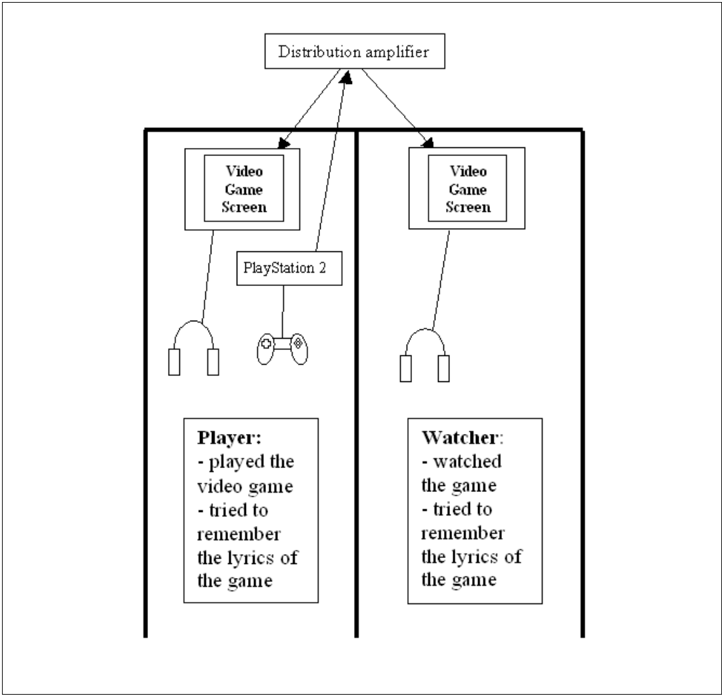
Video games are potential sources of second language input; however, the medium's fundamental characteristic, interactivity, has not been thoroughly examined in terms of its effect on learning outcomes.This experimental study investigated to what degree, if at all, video game interactivity would help or hinder the noticing and recall of second language vocabulary.Eighty randomly-selected Japanese university undergraduates were paired based on similar English language and game proficiencies.One subject played an Englishlanguage music video game for 20 minutes while the paired subject watched the game simultaneously on another monitor.Following gameplay, a vocabulary recall test, a cognitive load measure, an experience questionnaire, and a two-week delayed vocabulary recall test were administered.Results were analyzed using paired samples t-tests and various analyses of variance.Both the players and the watchers of the video game recalled vocabulary from the game, but the players recalled significantly less vocabulary than the watchers.This seems to be a result of the extraneous cognitive load induced by the interactivity of the game; the players perceived the game and its language to be significantly more difficult than the watchers did.Players also reported difficulty simultaneously attending to gameplay and vocabulary.Both players and watchers forgot significant amounts of vocabulary over the course of the study.We relate these findings to theories and studies of vocabulary acquisition and video game-based language learning, and then suggest implications for language teaching and learning with interactive multimedia.
Overview
The claims and statistics of this paper haven’t been checked yet.
Free: it reads the open-access text and checks the first 5 claims that cite a source we can check. Create a free account to check every claim.
Integrity signals
Registry
Cites
Statistics
Figures
Verification
Claims the paper makes
The claims and statistics of this paper haven’t been checked yet.
Free: it reads the open-access text and checks the first 5 claims that cite a source we can check. Create a free account to check every claim.
Claims other papers make about this one
Each is checked against this paper’s own text: does it say what the citing paper says it does?
The cited source says what the claim attributes to it.
In the citing paper
“In other words, although deHaan et al. (2010) instructed the Players to memorize the lyrics, it did not occupy a significant role in succeeding in game-play.”
From Readers, Players, and Watchers: EFL Students’ Vocabulary Acquisition through Digital Video Games (2017) · cites this paper as deHaan et al. (2010)
The cited source says what the claim attributes to it.
In the citing paper
“the most influential outlier (deHaan et al., 2010) had a very large negative effect ( d = -2.43).”
From Second language (L2) gains through digital game-based language learning (DGBLL): A meta-analysis (2022) · cites this paper as deHaan et al., 2010
The cited source says what the claim attributes to it.
In the citing paper
“It is also worth noting that deHaan et al. (2010) appears to be an outlier (see Figure 1).”
From Second language (L2) gains through digital game-based language learning (DGBLL): A meta-analysis (2022) · cites this paper as deHaan et al. (2010)
Self-check
Percentages, sums and reported differences re-computed from the paper’s own numbers.
The self-check needs the paper’s full text.
Citations
Cites
Faul, F., Erdfelder, E., Lang, A.-G., & Buchner, A. (2007) · Behavior Research Methods · doi:10.3758/bf03193146 · Cited by 65,971
The magical number seven, plus or minus two: Some limits on our capacity for processing information.
Miller, G. A. (1994) · Psychological Review · doi:10.1037/0033-295x.101.2.343 · Cited by 17,161
Mayer, R. E. (2009) · doi:10.1017/cbo9780511811678 · Cited by 7,800
Mayer, R. (2020) · doi:10.1017/9781316941355 · Cited by 7,777
What Video Games Have to Teach Us about Learning and Literacy
(2004) · Education + Training · doi:10.1108/et.2004.00446dae.002 · Cited by 6,674
Defining virtual reality: Dimensions determining telepresence
Steuer, J. (1992) · Journal of Communication · doi:10.1111/j.1460-2466.1992.tb00812.x · Cited by 5,459
Cognitive load theory, learning difficulty, and instructional design
Sweller, J. (1994) · Learning and Instruction · doi:10.1016/0959-4752(94)90003-5 · Cited by 5,426 · cited 2×
“, a fast food restaurant), since more complete schema can contribute to lower cognitive load (Douglas & Hargadon, 2001; Sweller, 1994).”
BackgroundBaddeley, A. (1992) · Science · doi:10.1126/science.1736359 · Cited by 5,258
Cognitive Load Theory and Instructional Design: Recent Developments
Paas, F., Renkl, A., & Sweller, J. (2003) · Educational Psychologist · doi:10.1207/s15326985ep3801_1 · Cited by 3,041 · cited 3×
“Language Learning & Technology http://llt.msu.edu/vol14num2/dehaanreedkuwada.pdf June 2010, Volume 14, Number 2 pp. 74–94 Copyright © 2010, ISSN 1094-3501 74 THE EFFECT OF INTERACTIVITY WITH A MUSIC VIDEO GAME ON SECOND LANGUAGE VOCABULARY RECALL”
Background(2020) · Encyclopedia of Education and Information Technologies · doi:10.1007/978-3-030-10576-1_300187 · Cited by 2,893
Paas, F. G. W. C. (1992) · Journal of Educational Psychology · doi:10.1037/0022-0663.84.4.429 · Cited by 2,150 · cited 1×
“The participants completed a Cognitive Load Subjective Experience Questionnaire targeting invested mental effort (based on Paas, 1992; Cronbach’s alpha > 0.85 as cited in Paas, Van Merrienboer, & Adam, 1994) and perceptions of material difficulty (based on Kalyuga et al., 1998; Cronbach’s alpha =…”
MethodInfluential(1995) · Medical Entomology and Zoology · Cited by 1,917
Focus on Form: A Design Feature in Language Teaching Methodology
Long, M. (1991) · Studies in Bilingualism · doi:10.1075/sibil.2.07lon · Cited by 1,775 · cited 3×
“Long (1991) explicated the need for language learners to selfinitiate momentary transfers of attention to elements of language; if the player and watcher had had more agency with their media (i.e., been allowed to pause the game, or control how they interacted with the game), the results may have…”
BackgroundInfluentialFrom Content to Context: Videogames as Designed Experience
Squire, K. (2006) · Educational Researcher · doi:10.3102/0013189x035008019 · Cited by 1,091 · cited 1×
“Video and computer games are receiving increasing attention by researchers and practitioners in education; however, most of the theory and pedagogy focus on general education (e.g., Squire, 2006) or language and literacy development of native speakers (e.g., Gee, 2007; Steinkhueler, 2007).”
BackgroundInput, Interaction, and the Second Language Learner
Gass, S. M., & Gass, S. M. (2013) · Routledge eBooks · doi:10.4324/9780203053560 · Cited by 1,016
Managing split-attention and redundancy in multimedia instruction
Kalyuga, S., Chandler, P., & Sweller, J. (1999) · Applied Cognitive Psychology · doi:10.1002/(sici)1099-0720(199908)13:4<351::aid-acp589>3.0.co;2-6 · Cited by 929 · cited 3×
“, Schmidt, 2001) and split attention effects (Kalyuga et al., 1999).”
BackgroundEffects of Multimedia Annotations on Vocabulary Acquisition
CHUN, D. M., & PLASS, J. L. (1996) · The Modern Language Journal · doi:10.1111/j.1540-4781.1996.tb01159.x · Cited by 759 · cited 1×
“…instructional multimedia that assist language learning: (a) glosses: text and/or images that provide additional information for unknown lexical items (e.g., Chun & Plass, 1996a, 1996b; Laufer & Hill, 2000) and (b) simultaneously-presented aural and video information (e.g., Hernandez, 2004).”
BackgroundAttention, Memory, and the “Noticing” Hypothesis
Robinson, P. (1995) · Language Learning · doi:10.1111/j.1467-1770.1995.tb00441.x · Cited by 745 · cited 2×
“The importance of attention’s role in second language acquisition has been established both theoretically and empirically (Leow, 2000; Mackey, Gass, & McDonough, 2000; Robinson, 1995; Rosa & O’Neil, 1999; Schmidt, 2001; Tomlin & Villa, 1994).”
BackgroundMeasurement of Cognitive Load in Instructional Research
Paas, F. G. W. C., van Merriënboer, J. J. G., & Adam, J. J. (1994) · Perceptual and Motor Skills · doi:10.2466/pms.1994.79.1.419 · Cited by 731 · cited 1×
“Language Learning & Technology 76 Plass and Jones (2005) presented an interactionist and cognitivist model of language learning with multimedia by synthesizing Gass’ (1997) second language acquisition model and Mayer’s (2001) cognitive theory of multimedia.”
MethodAttention in Cognitive Science and Second Language Acquisition
Tomlin, R. S., & Villa, V. (1994) · Studies in Second Language Acquisition · doi:10.1017/s0272263100012870 · Cited by 700 · cited 1×
“The importance of attention’s role in second language acquisition has been established both theoretically and empirically (Leow, 2000; Mackey, Gass, & McDonough, 2000; Robinson, 1995; Rosa & O’Neil, 1999; Schmidt, 2001; Tomlin & Villa, 1994).”
BackgroundHOW DO LEARNERS PERCEIVE INTERACTIONAL FEEDBACK?
Mackey, A., Gass, S., & McDonough, K. (2000) · Studies in Second Language Acquisition · doi:10.1017/s0272263100004010 · Cited by 630
Levels of Expertise and Instructional Design
Kalyuga, S., Chandler, P., & Sweller, J. (1998) · Human Factors: The Journal of the Human Factors and Ergonomics Society · doi:10.1518/001872098779480587 · Cited by 520 · cited 1×
“…completed a Cognitive Load Subjective Experience Questionnaire targeting invested mental effort (based on Paas, 1992; Cronbach’s alpha > 0.85 as cited in Paas, Van Merrienboer, & Adam, 1994) and perceptions of material difficulty (based on Kalyuga et al., 1998; Cronbach’s alpha = .4583).”
MethodInfluentialSecond Language Use, Socialization, and Learning in Internet Interest Communities and Online Gaming
THORNE, S. L., BLACK, R. W., & SYKES, J. M. (2009) · The Modern Language Journal · doi:10.1111/j.1540-4781.2009.00974.x · Cited by 516
Vocabulary enhancement activities and reading for meaning in second language vocabulary acquisition
Paribakht, T. S., & Wesche, M. (1996) · Second Language Vocabulary Acquisition · doi:10.1017/cbo9781139524643.013 · Cited by 485 · cited 1×
“Paribakht and Wesche (1997) suggest that explicit instruction may support a more complete acquisition of vocabulary; studies on instructional techniques might range from pre-gameplay activities (i.e., schema activation) to multimedia glosses of vocabulary (as suggested by the studies reviewed by…”
BackgroundRott, S. (1999) · Studies in Second Language Acquisition · doi:10.1017/s0272263199004039 · Cited by 475 · cited 1×
“As in previous studies involving incidental vocabulary acquisition (Knight, 1994; Rott, 1999), both the watchers and the players of the game forgot vocabulary over time.”
ResultMultimedia CALL: Lessons to be learned from research on instructed SLA
Chapelle, C. (1998) · Language Learning & Technology · doi:10.64152/10125/25030 · Cited by 468 · cited 3×
“Second language acquisition theory delineates the importance of noticing linguistic information in a media environment (Chapelle, 1998; Schmidt, 2001), and video games seem to be a medium with various features that can support the language acquisition process (deHaan, 2005a), yet the particular…”
BackgroundMurray, J. H. (1997) · Cited by 466
Foreign Language Research in Cross-Cultural Perspective
(1991) · Studies in Bilingualism · doi:10.1075/sibil.2 · Cited by 413
Chris Crawford on Interactive Storytelling
Crawford, C. S. (2004) · Cited by 407
Wolf, M. J. P., & Perron, B. (2013) · Routledge eBooks · doi:10.4324/9780203700457 · Cited by 389
EXPLICITNESS, INTAKE, AND THE ISSUE OF AWARENESS: Another Piece to the Puzzle
Rosa, E., & O'Neill, M. D. (1999) · Studies in Second Language Acquisition · doi:10.1017/s0272263199004015 · Cited by 356
Cultural Framing of Computer/Video Games.
Squire, K. D. (2002) · Cited by 327
Laufer, B., & Hill, M. (2000) · Language Learning & Technology · doi:10.64152/10125/25073 · Cited by 314 · cited 2×
“Language Learning & Technology http://llt.msu.edu/vol14num2/dehaanreedkuwada.pdf June 2010, Volume 14, Number 2 pp. 74–94 Copyright © 2010, ISSN 1094-3501 74 THE EFFECT OF INTERACTIVITY WITH A MUSIC VIDEO GAME ON SECOND LANGUAGE VOCABULARY RECALL”
BackgroundInteractivity in the Context of Designed Experiences
Heeter, C. (2000) · Journal of Interactive Advertising · doi:10.1080/15252019.2000.10722040 · Cited by 269 · cited 1×
“While interactivity certainly characterizes video games, it is a challenging construct to frame and to study as it is “overused and underdefined” (Heeter, 2000, p. 75) and perhaps “the most grossly misunderstood and callously misused term associated with computers” (Crawford, 2005, p. 25).”
BackgroundA STUDY OF THE ROLE OF AWARENESS IN FOREIGN LANGUAGE BEHAVIOR: Aware versus Unaware Learners
Leow, R. P. (2000) · Studies in Second Language Acquisition · doi:10.1017/s0272263100004046 · Cited by 262 · cited 1×
“The importance of attention’s role in second language acquisition has been established both theoretically and empirically (Leow, 2000; Mackey, Gass, & McDonough, 2000; Robinson, 1995; Rosa & O’Neil, 1999; Schmidt, 2001; Tomlin & Villa, 1994).”
BackgroundInteractivity: A forgotten art?
Sims, R. (1997) · Computers in Human Behavior · doi:10.1016/s0747-5632(97)00004-6 · Cited by 260 · cited 9×
“More agentive (i.e., “immersive virtual”; Sims, 1997, p. 167) interactivities (e.g., video games with more controllable in-game tasks that foster deeper consideration of language) may support better incidental second language vocabulary recall outcomes than the “basic stimulus-response” (Sims,…”
BackgroundMethodInfluentialMassively Multiplayer Online Gaming as a Constellation of Literacy Practices
Steinkuehler, C. (2007) · E-Learning and Digital Media · doi:10.2304/elea.2007.4.3.297 · Cited by 257 · cited 1×
“Language Learning & Technology 77 Kalyuga, Chandler, and Sweller (1999) described instructional media that cause split attention and extraneous cognitive load as having “several sources of information [that] are difficult or impossible to understand in isolation and must be mentally integrated to achieve understanding…”
BackgroundBaer, R. H., & Wolf, M. J. P. (2002) · Cited by 242
Endogenous fantasy and learning in digital games
Habgood, M. P. J., Ainsworth, S. E., & Benford, S. (2005) · Simulation & Gaming · doi:10.1177/1046878105282276 · Cited by 208
Multimedia Learning in Second Language Acquisition
Plass, J. L., & Jones, L. C. (2005) · The Cambridge Handbook of Multimedia Learning · doi:10.1017/cbo9780511816819.030 · Cited by 178 · cited 4×
“…environments (like the multiplayer games studied by Sykes et al., 2008, and Zheng et al., 2009) and language elements, it may be possible to broaden Plass and Jones’ (2005) discussion of apprehended input in second language multimedia environments to include a consideration of the user’s physical…”
BackgroundMethodInfluentialFacilitating reading comprehension with multimedia
Chun, D. M., & Plass, J. L. (1996) · System · doi:10.1016/s0346-251x(96)00038-3 · Cited by 159 · cited 1×
“…instructional multimedia that assist language learning: (a) glosses: text and/or images that provide additional information for unknown lexical items (e.g., Chun & Plass, 1996a, 1996b; Laufer & Hill, 2000) and (b) simultaneously-presented aural and video information (e.g., Hernandez, 2004).”
BackgroundSchwienhorst, K. (2002) · Simulation & Gaming · doi:10.1177/1046878102332008 · Cited by 157 · cited 1×
“…and the controlled experimental research design seemed to have prevented the learners from “select[ing] and organiz[ing] their own learning resources” (Schwienhorst, 2002, p. 197) or focusing the learners on the “meaning and purpose” (Culley, Mulford, & Milbury-Steen, 1986, p. 70) of language.”
BackgroundOther-repetition as a resource for participation in the activity of playing a video game
MARSH, A. P., & TAINIO, L. (2009) · The Modern Language Journal · doi:10.1111/j.1540-4781.2009.00853.x · Cited by 152 · cited 2×
“Piirainen-Marsh and Tainio (2009) studied small groups of players interacting with (i.e., repeating, analyzing, and using language from) a console roleplaying game, Sykes, Oskoz, and Thorne (2008) described meaning-making and pragmatic development among players in massively multiplayer online…”
BackgroundSimulation/Gaming and the Acquisition of Communicative Competence in Another Language
García-Carbonell, A., Rising, B., Montero, B., & Watts, F. (2001) · Simulation & Gaming · doi:10.1177/104687810103200405 · Cited by 141
Scientific Inquiry in Educational Multi-user Virtual Environments
Nelson, B. C., & Ketelhut, D. J. (2007) · Educational Psychology Review · doi:10.1007/s10648-007-9048-1 · Cited by 134 · cited 1×
“Language Learning & Technology 80 technology, for example Nelson and Ketelhut’s (2007) virtual inquiry worlds.”
BackgroundAttitude and Self-Efficacy Change
Zheng, D., Young, M. F., Brewer, R. A., & Wagner, M. (2010) · CALICO Journal · doi:10.11139/cj.27.1.205-231 · Cited by 130 · cited 1×
“…other interactivities (such as those mentioned by Sims, 1997), learning environments (like the multiplayer games studied by Sykes et al., 2008, and Zheng et al., 2009) and language elements, it may be possible to broaden Plass and Jones’ (2005) discussion of apprehended input in second language…”
BackgroundCommentary: You're not studying, you're just...
Purushotma, R. (2005) · Language Learning & Technology · doi:10.64152/10125/44010 · Cited by 116 · cited 4×
“Language teachers or learners may also not be aided by discussions focusing on game features such as: comprehensible input, self study opportunities, subtitles, repetition, and authentic language (Baltra, 1990; deHaan, 2005a; Hubbard, 1991; Meskill, 1990; Purushotma, 2005); these are features games share with other ed…”
BackgroundInfluentialArnseth, H. C. (2006) · Cited by 110
The pleasures of immersion and engagement: schemas, scripts and the fifth business
Douglas, J. Y., & Hargadon, A. (2001) · Digital Creativity · doi:10.1076/digc.12.3.153.3231 · Cited by 109
Language Learning through Computer Adventure Games
Baltra, A. (1990) · Simulation & Gaming · doi:10.1177/104687819002100408 · Cited by 96 · cited 5×
“…for video games’ support of second language acquisition that focus on the benefits of playful learning (Hubbard, 1991; Prensky, 2001), motivation, (Baltra, 1990; Carrier, 1991; deHaan, 2005a; Hubbard, 1991; Li & Topolewski, 2002), rewards (Li & Topolewski, 2002), or positive affect…”
BackgroundInfluentialAcquisition of Japanese as a Foreign Language Through a Baseball Video Game
deHaan, J. W. (2005) · Foreign Language Annals · doi:10.1111/j.1944-9720.2005.tb02492.x · Cited by 87
Self-citationVIDEO GAMES: PERSPECTIVE, POINT-OF-VIEW, AND IMMERSION
Taylor, L. N. (2002) · Cited by 76
Evaluating Computer Games for Language Learning
Hubbard, P. (1991) · Simulation & Gaming · doi:10.1177/1046878191222006 · Cited by 74 · cited 9×
“…not be especially helped by general posits for video games’ support of second language acquisition that focus on the benefits of playful learning (Hubbard, 1991; Prensky, 2001), motivation, (Baltra, 1990; Carrier, 1991; deHaan, 2005a; Hubbard, 1991; Li & Topolewski, 2002), rewards (Li &…”
BackgroundInfluentialPellouchoud, E., Smith, M. E., McEvoy, L., & Gevins, A. (1999) · Epilepsia · doi:10.1111/j.1528-1157.1999.tb00905.x · Cited by 60 · cited 2×
“This finding extends the research conducted by Pellouchoud et al. (1999); their participants also experienced higher cognitive load when playing a video game than when watching a video game.”
BackgroundResult10 Key Principles for Designing Video Games for Foreign Language Learning
Purushotma, R., Thorne, S. L., & Wheatley, J. K. (2009) · PDXScholar (Portland State University) · Cited by 55
Locating an Ecological Psychology Methodology for Situated Action
Kulikowich, J. M., & Young, M. F. (2001) · Journal of the Learning Sciences · doi:10.1207/s15327809jls10-1-2_7 · Cited by 41 · cited 1×
“Pedagogical scaffolds may be essential for a user’s understanding of many complex games and learning environments (Allen & Otto, 1996; Gee, 2003; Kulikowich & Young, 2001; Um & deHaan, 2005).”
BackgroundClark, R. E. (2001) · Cited by 37
ZIP & TERRY: A New Attempt at Designing Language Learning Simulation
Li, R.-C., & Topolewski, D. (2002) · Simulation & Gaming · doi:10.1177/1046878102332006 · Cited by 35 · cited 1×
“…language acquisition that focus on the benefits of playful learning (Hubbard, 1991; Prensky, 2001), motivation, (Baltra, 1990; Carrier, 1991; deHaan, 2005a; Hubbard, 1991; Li & Topolewski, 2002), rewards (Li & Topolewski, 2002), or positive affect (Garcia-Carbonell, Rising, Montero, & Watts, 2001).”
Where in the World of English is Carmen Sandiego?
Meskill, C. (1990) · Simulation & Gaming · doi:10.1177/104687819002100410 · Cited by 28 · cited 4×
“Language teachers or learners may also not be aided by discussions focusing on game features such as: comprehensible input, self study opportunities, subtitles, repetition, and authentic language (Baltra, 1990; deHaan, 2005a; Hubbard, 1991; Meskill, 1990; Purushotma, 2005); these are features games share with other ed…”
BackgroundInfluentialA Foreign-Language Adventure Game: Progress Report on an Application of AI to Language Instruction
Culley, G. R., Mulford, G. W., & Milbury-Steen, J. (1986) · CALICO Journal · doi:10.1558/cj.v4i2.69-87 · Cited by 19
Escape from Planet Jar-Gon: or, what video games have to teach academics about teaching and writing
Prensky, M. (2003) · On the Horizon The International Journal of Learning Futures · doi:10.1108/oth.2003.27411cae.002 · Cited by 15 · cited 1×
“…studies could focus not only on the scaffolds game designers use to introduce players to the mechanics of a particular game (outlined in Gee, 2003; Prensky, 2003; Um & deHaan, 2005), but also strategies that multimedia designers and classroom teachers use to encourage learners to focus more…”
BackgroundHostile Thoughts, Presence and Violent Virtual Video Games
Tamborini, R., Eastin, M. S., Lachlan, K. A., SKALSKI, P. D., Fediuk, T. A., & Brady, R. (2001) · Cited by 13
Simulations in English Language Teaching: A Cooperative Approach
Carrier, M. (1991) · Simulation & Gaming · doi:10.1177/1046878191222007 · Cited by 9 · cited 2×
“Second language teachers, students or media designers may not be especially helped by general posits for video games’ support of second language acquisition that focus on the benefits of playful learning (Hubbard, 1991; Prensky, 2001), motivation, (Baltra, 1990; Carrier, 1991; deHaan, 2005a; Hubbard, 1991; Li & Topole…”
Background
Research works printed but not linked: 6
- deHaan, J. (2005a). Learning language through video games: A theoretical framework, an analysis of game genres and questions for future research. In S. Schaffer & M. Price (Eds.), Interactive Convergence: Critical Issues in Multimedia (vol. 10), Chapter 14, pp. 229-239. Retrieved from http://www.inter- disciplinary.net/publishing/idp/eBooks/icindex.htm
- Engelkamp, J. (2001). Action memory: A system-oriented approach. In H. D. Zimmer, R. Cohen, M. Guynn, J. Engelkamp, R. Kormi-Nouri, & M. N. Foley (Eds.), Memory for action: A distinct form of episodic memory? (pp. 49-96). New York: Oxford University Press.
- Knight, S. (1994). Dictionary: The tool of last resort in foreign language reading? A new perspective. Modern Language Journal, 78(3), 285-299.
- Schmidt, R. W. (2001). Attention. In P. Robinson (Ed.), Cognition and second language instruction
- Squire, K. D. (2006). From content to context: Video games as designed experiences Educational Researcher, 35(8), 19-29.
- Um, E. J., & deHaan, J. (2005). Video games and cognitive apprenticeship-based learning. Proceedings of the Association for Educational Communications and Technology, USA, 28, 499-505.
Cited by
Foundations of Game-Based Learning
Plass, J. L., Homer, B. D., & Kinzer, C. K. (2015) · Educational Psychologist · doi:10.1080/00461520.2015.1122533 · Cited by 1,697
“An indication for the cause of the lower learning outcome of players was that they reported perceiving the game as more difficult than the observers (deHaan, Reed, & Kuwada, 2010).”
BackgroundTechnologies for foreign language learning: a review of technology types and their effectiveness
Golonka, E. M., Bowles, A. R., Frank, V. M., Richardson, D. L., & Freynik, S. (2014) · Computer Assisted Language Learning · doi:10.1080/09588221.2012.700315 · Cited by 1,144
Boyle, E. A., Hainey, T., Connolly, T. M., Gray, G., Earp, J., Ott, M., Lim, T., Ninaus, M., Ribeiro, C., & Pereira, J. (2016) · Computers & Education · doi:10.1016/j.compedu.2015.11.003 · Cited by 1,133
Our Princess Is in Another Castle: A Review of Trends in Serious Gaming for Education
Young, M. F., Slota, S., Cutter, A. B., Jalette, G., Mullin, G., Lai, B., Simeoni, Z., Tran, M., & Yukhymenko, M. (2012) · Review of Educational Research · doi:10.3102/0034654312436980 · Cited by 736
“Further exploration by DeHaan and Kono (2010) established additional evidence of this effect: University undergraduate observers were taught very effectively by the video game, learning more than twice as much vocabulary as the players themselves (DeHaan, Reed, & Kuwada, 2010).”
BackgroundZhang, R., & Zou, D. (2022) · Computer Assisted Language Learning · doi:10.1080/09588221.2020.1744666 · Cited by 345
“…were not mature enough five years ago, and they were not well integrated in language learning to assist students to enter flow states (e.g. in deHaan, Reed, & Kuwada ’ s (2010) research); however, they have been largely improved in recent years and can be well embedded in learning systems to…”
Background
Metadata
- Authors
- deHaan, J., Reed, W. M., & Kuwanda, K.
- Affiliations
- University of Shizuoka (JP)
- ORCID
- deHaan, Jonathan
- Venue
- Language Learning & Technology
- Published
- 2010-06-01
- Volume
- 14
- Issue
- 2
- Pages
- 74-94
- ISSN
- 1094-3501 (ISSN-L)
- OpenAlex
- W2122519738
- Semantic Scholar
- 1437861666d4c5cc3a951a752808f1222f26cfae
- Cited by
- 266
- References
- 62
- Citations by year
- 2026: 10 · 2025: 12 · 2024: 39 · 2023: 11 · 2022: 18 · 2021: 28 · 2020: 16 · 2019: 16 · 2018: 19 · 2017: 12 · 2016: 15 · 2015: 17 · 2014: 16 · 2013: 14 · 2012: 17
- FWCI
- 22.72
- Type
- journal article
- Language
- en
- Open access
- diamond
- doi.org
- Licence
- Locations
- Language learning & technology (publishedVersion, cc-by-nc-nd)
- DOAJ (DOAJ: Directory of Open Access Journals) (submittedVersion, cc-by-sa)
- ScholarSpace (University of Hawaii at Manoa) (submittedVersion)
- Topics
- Social Sciences › Psychology › Developmental and Educational Psychology › Second Language Acquisition and Learning
- Social Sciences › Psychology › Developmental and Educational Psychology › Educational Games and Gamification
- Social Sciences › Arts and Humanities › Language and Linguistics › Subtitles and Audiovisual Media
- Keywords
- music video games, vocabulary acquisition, extraneous cognitive load, noticing, Japanese learners of English, interactive multimedia, delayed recall
About these checks
Registry, retraction, Cites and statistics results are computed, not judged, with one exception: a printed reference that no index lists is read once by a model before it counts as a citation error. Claims are extracted by a model and kept only when their quote appears verbatim in the text; each cited source is then checked, with a model’s help, for whether it says what the claim relies on. Those verdicts can be wrong — read the claim’s quote and the cited source before relying on one.
Statistics and arithmetic are recomputed, not judged.
Confidence bands are shown only for fields calibrated on our annotated test set. None is calibrated yet, so no band is shown.
What counts as a claim ›How we measure confidence ›How we check this ›
Are you an author, or do you see a problem with this page? Request a review
Data sources
Bibliographic data: Semantic Scholar, OpenAlex, Crossref.
Contains information from the Semantic Scholar Academic Graph Datasets, made available under the ODC Attribution License (ODC-BY 1.0).
Semantic Scholar’s data is described in: Kinney, R., et al. (2023). The Semantic Scholar Open Data Platform. arXiv:2301.10140.
