

Effects of bimodal divided attention on cortical representations of linguistic context during continuous speech perception in noise
Open accessThe DOI matches its Crossref record; 73 of the 73 references it cites were found in a registry or an index; 3 of the 46 sources its claims cite were checked for support.
Abstract
Speech perception often takes place in environments with competing sensory inputs, both within the auditory modality and across modalities; for example, following a conversation in a noisy cafe while simultaneously reading a menu. This study examined the extent to which dividing attention between auditory and visual modalities (bimodal divided attention) influences linguistic context processing across hierarchical levels during continuous speech perception in noise. Electroencephalographic (EEG) responses were recorded while participants listened to audiobook stories in multitalker babble as a secondary task, concurrently performing a demanding primary visual task that imposed either low or high cognitive load. Behaviorally, speech comprehension accuracy was significantly lower under high-load than low-load dual-task conditions. Multivariate temporal response function (mTRF) encoding models were used to predict EEG responses from information-theoretic measures (entropy and surprisal) indexing linguistic context at sublexical, word-form, and sentence levels. Significant neutral tracking was observed at the word-form and sentence levels, but not the sublexical level. Critically, neutral tracking of sentence-level linguistic representations was significantly reduced under high compared to low load, with effects emerging at latencies beyond 200 ms. In contrast, neutral tracking of word-form-level representations was unaffected by dual-task load. mTRF analyses further revealed that neutral tracking of acoustic features was not modulated by dual-task load. These findings indicate that bimodal divided attention selectively disrupts cortical representations of sentence-level linguistic context, while lower-level processing remains relatively preserved. Such impairments in higher-level linguistic processing may contribute to reduced speech comprehension during multitasking in noisy environments.
Overview
CoChat Summary
TL;DR
Bimodal divided attention during continuous speech-in-noise selectively reduced cortical tracking of sentence-level linguistic context, while word-form and acoustic tracking were largely unaffected. Higher visual task load also impaired behavioral speech comprehension and enhanced visual tracking.
Key findings
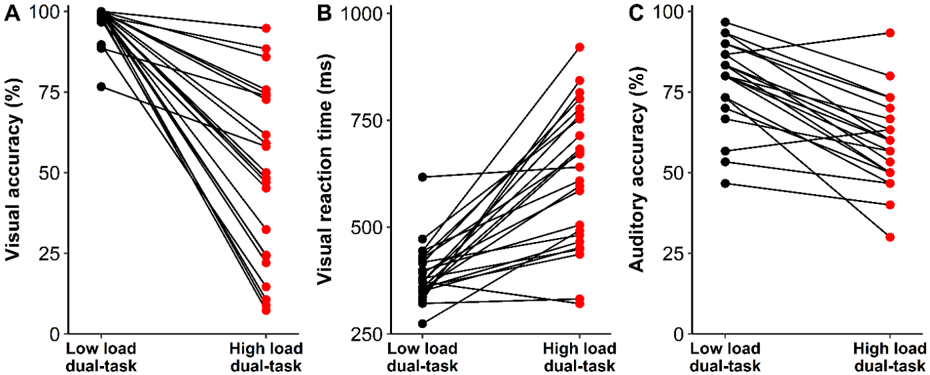
- High visual load lowered behavioral speech comprehension: story understanding was 49.6% (SD = 23.4%) vs. 77.0% (SD = 18.0%) in low load, t(23) = -5.983, p < 0.001; perceived effort was 8.5 (SD = 1.50) vs. 4.83 (SD = 2.22), t(23) = 10.498, p < 0.001. Visual accuracy was lower and visual RT slower under high load.
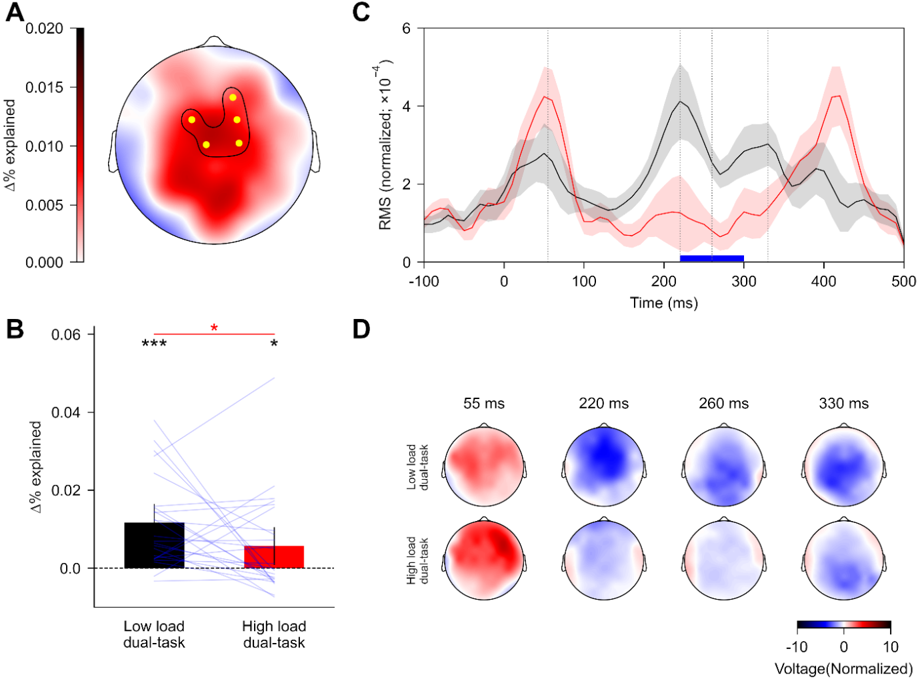
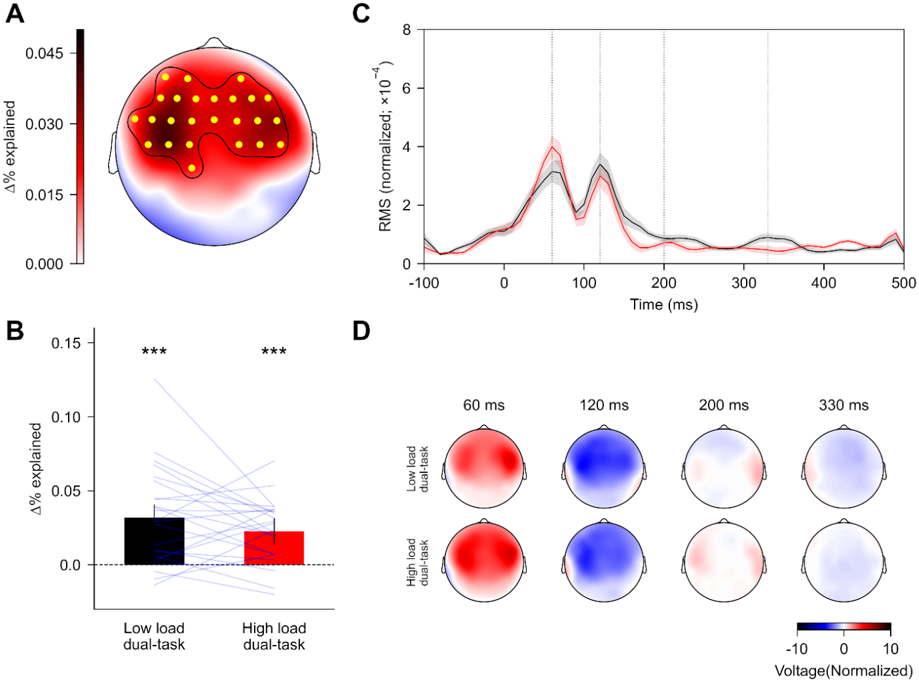
- Sentence-level linguistic tracking was significantly reduced under high vs. low load: Δ% explained mean = 0.006 (SD = 0.013) vs. 0.012 (SD = 0.012), t(23) = 1.818, p = 0.041, Cohen’s d = 0.499, BF = 1.771; mTRF amplitudes were smaller from 220 to 300 ms (p = 0.005).
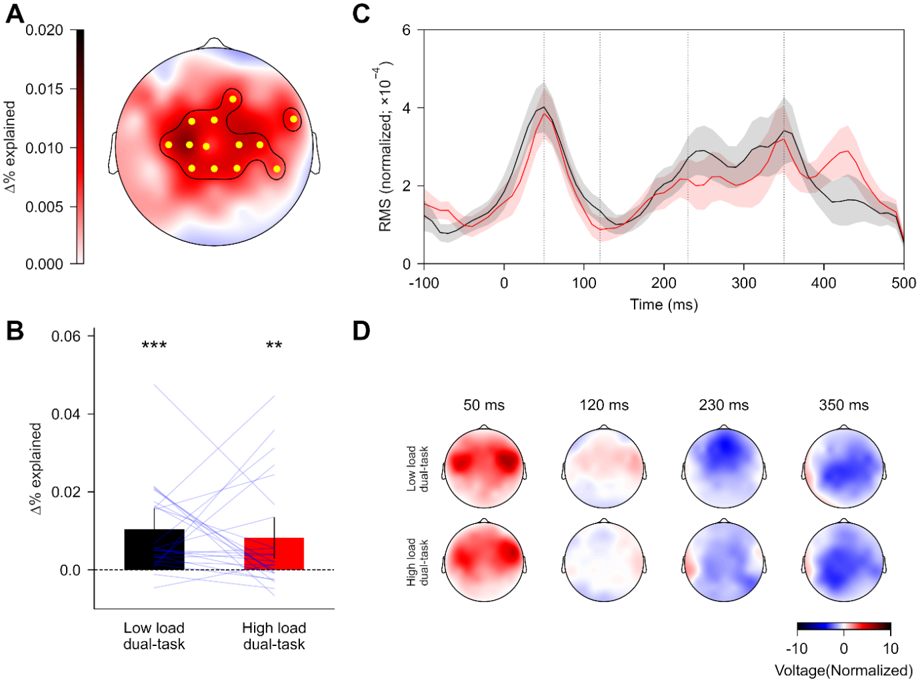
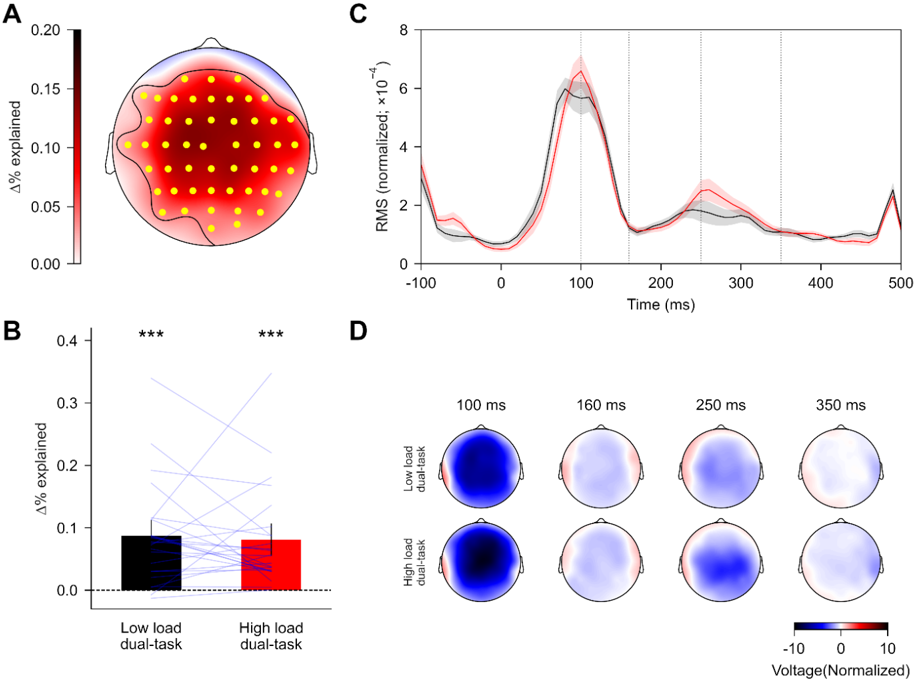
- Word-form tracking was robust but not significantly affected by load: t(23) = 0.618, p = 0.271, Cohen’s d = 0.176, BF = 0.511. Sublexical predictors did not significantly enhance model performance (tmax = 2.64, p = 0.220).
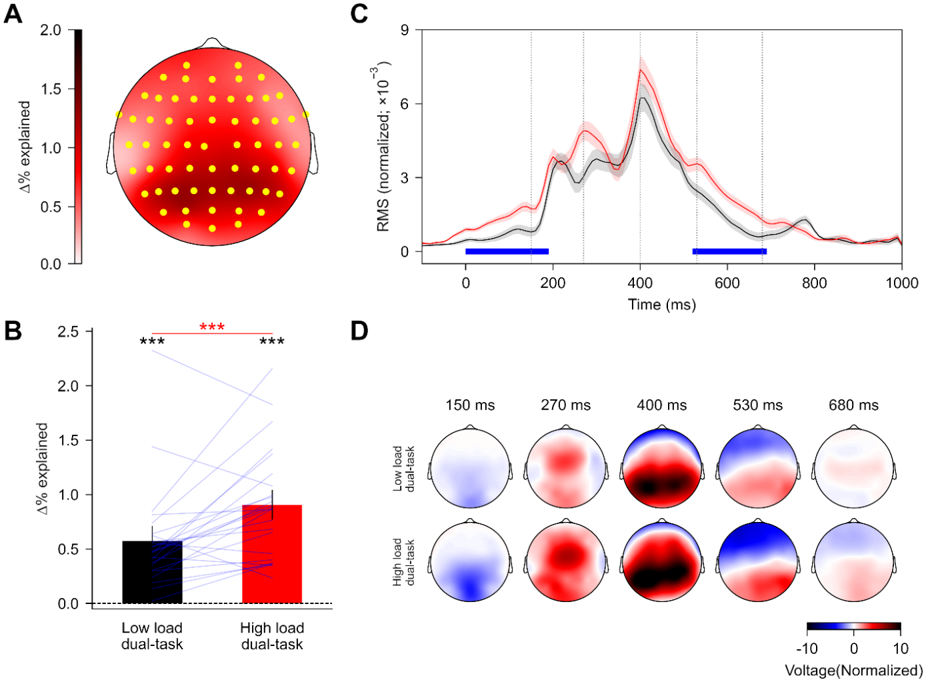
- Acoustic tracking did not significantly change with load: envelope t(23) = 0.34, p = 0.365, d = 0.076, BF = 0.454; onsets t(23) = 1.498, p = 0.074, d = 0.332, BF = 1.147. Visual tracking was enhanced under high load: Δ% explained mean = 0.907 (SD = 0.504) vs. 0.573 (SD = 0.469), t(23) = 3.571, p < 0.001, d = 0.684, BF = 45.993.
Methods
- 24 younger adults (20 females), aged 18–23, native English speakers with normal hearing and normal or corrected-to-normal vision; EEG recorded with 64 active electrodes at 5 kHz.
- Dual-task paradigm: primary visuospatial n-back task under low load (0-back) or high load (3-back), while participants listened to ~60-s excerpts from *Alice’s Adventures in Wonderland* in multitalker babble at 5 dB SNR; 15 trials per condition, with story comprehension questions.
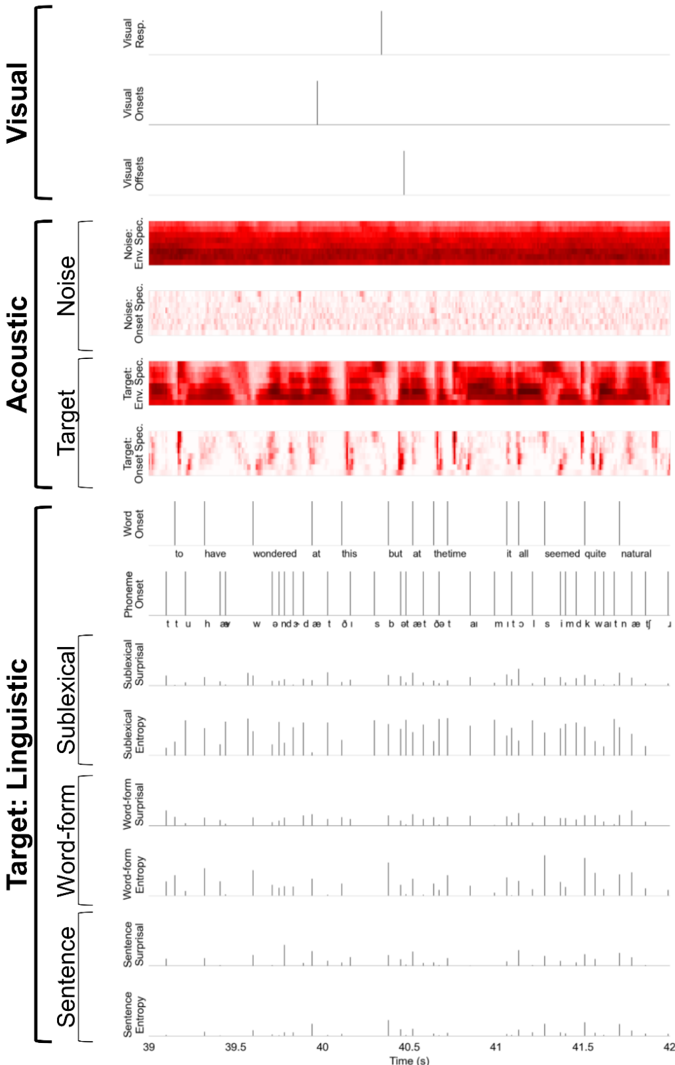
- Multivariate temporal response function (mTRF) encoding models predicted EEG from visual, acoustic (envelope and onset spectrograms), and linguistic predictors (surprisal and entropy at sublexical, word-form, and sentence levels); models used 5-fold cross-validation and cluster-based permutation tests.
Limitations
- Stated: the study used a fixed segment of multi-talker babble at a single SNR of 5 dB, so it is unclear whether findings extend to other noise types or more negative/favorable SNRs; dual-task costs may also depend on task pairing, such as visual-object vs. visual-spatial tasks.
- Evident from the text: the sample was limited to 24 younger adults aged 18–23, mostly female, and auditory stimuli were presented monaurally to the right ear; the current study compared only low- and high-load dual-task conditions, with no auditory single-task condition.
- The paper notes that sublexical tracking was not significant here, unlike prior quiet-listening studies, and suggests this may be because sublexical context processing is more vulnerable to noise interference.
Model-written summary. Check it against the paper before relying on it.
Integrity signals
Registry
Cites
Statistics
Figures
Verification
Claims the paper makes
3 Valid · 0 Not valid · 21 Not checked · 55 Own results and interpretations
The sources with a verdict support this claim; the rest weren’t checked yet, have no full text we could read, or their verdicts aren’t rated yet.
In the paper
“This study largely replicated prior findings demonstrating the parallel use of linguistic context across multiple hierarchical levels”
§ Effects of bimodal divided attention on cortical representations of linguistic context during continuous speech perception in noise > Hierarchical levels of linguistic context processing in quiet and noise
What the sources say
- Not checked yetcites Brodbeck et al., 2022 matched to “Parallel processing in speech perception with local and global representations of linguistic context” (2022) source
- Not checked yetcites Karunathilake et al., 2025 matched to “Neural Dynamics of the Processing of Speech Features: Evidence for a Progression of Features from Acoustic to Sentential Processing” (2025) source
- Supportedcites Xie et al., 2023 matched to “Cortical Tracking of Continuous Speech Under Bimodal Divided Attention” (2023) source
The Results ('Task effects appear to be similar across different context levels') state that each of the three hierarchical context levels — sublexical, word-form, and sentence — independently contributed significantly to neural prediction (sublexical tmax = 5.22, word-form tmax = 3.92, sentence tmax = 4.98, all p < 0.001; Figure 6C), i.e. parallel tracking of linguistic context at multiple levels. The Methods ('Linguistic models') frame this as replicating prior work: 'Previous work suggests that listeners maintain multiple such predictive models, differing in complexity, in parallel (Brodbeck et al., 2022),' and the Results note their linguistic response pattern is 'consistent with previous results (Brodbeck et al., 2022).' So the attributed content — that this study largely reproduced prior evidence of parallel multi-level linguistic context use — is in our copy; the paper simply does not use the word 'replicated' for that specific point. (LLM, conf=0.80)
plain- Asserted: passes — The authors put it forward as true.
- Checkable: passes — It can be checked against evidence.
- Load-bearing: passes — The paper’s conclusions depend on it.
- Based: passes — The paper gives a reason why it holds.
Every source the paper cites for this claim was checked and supports it.
In the paper
“The absence of dual-task load effects at the sublexical or word-form levels is consistent with previous findings reported by Xie et al. (2023), who examined continuous speech perception under quiet listening conditions.”
§ Effects of bimodal divided attention on cortical representations of linguistic context during continuous speech perception in noise > Hierarchical levels of linguistic context processing in quiet and noise
What the sources say
- Supportedcites Xie et al. (2023) matched to “Cortical Tracking of Continuous Speech Under Bimodal Divided Attention” (2023) source
The Results ("Divided Attention, but Not Visual Load, Reduces Late Tracking of Linguistic Information") state that, for mTRFs, "the effect of task condition was not significant for sublexical or word-form context but was for sentence context," and that prediction accuracy across the three context levels "was not significantly different between the low and high load dual-task condition (t(15) = 1.02, p = 0.32)"; Table 1 summarises sublexical/word-form/sentence as "Auditory single-task > Low load = High load," and the Discussion ("Neural Tracking of Word Onsets Was Not Affected by Divided Attention") likewise reports word-onset tracking as robust to attentional-load manipulation. The characterisation of the study as continuous-speech perception in quiet is consistent with our copy's Methods: ~60 s audiobook story segments presented diotically at 70 dB SPL with no background noise, recorded in an acoustically shielded booth (the paper never uses the phrase "quiet listening," but no noise condition exists). Note that the source does report a divided-attention (single-task vs. dual-task) reduction at these levels; the claim is confined to the absence of load effects, which the source supports. (LLM, conf=0.85)
plain- Asserted: passes — The authors put it forward as true.
- Checkable: passes — It can be checked against evidence.
- Load-bearing: unclear — It is unclear whether the paper’s conclusions depend on it.
- Based: passes — The paper gives a reason why it holds.
- Supported
Every source the paper cites for this claim was checked and supports it.
In the paper
“Together, these findings indicate that behavioral declines under dual-task conditions predominantly reflect disruptions to later, post-perceptual stages of continuous speech processing (Xie et al., 2023).”
§ Effects of bimodal divided attention on cortical representations of linguistic context during continuous speech perception in noise > Locus of effects of bimodal divided attention on continuous speech processing
What the sources say
- Supportedcites Xie et al., 2023 matched to “Cortical Tracking of Continuous Speech Under Bimodal Divided Attention” (2023) source
The Discussion subsection 'Locus of Effects of Bimodal Divided Attention on Continuous Speech Processing' states that the neural-behavioral dissociation 'suggests that bimodal divided attention largely impacts only late, post-perceptual processes of continuous speech processing,' with decreased behavioral performance posited to originate from higher-order processes (semantic integration, memory formation). The Abstract and Conclusion (same wording, 'These findings indicate that behavioral effects of bimodal divided attention on continuous speech processing occur not because of impaired early sensory representations but likely at later cognitive processing stages') carry the same point, and the results (neural tracking affected only at latencies >200 ms) supply the 'predominantly/later' qualifier. The citing sentence reproduces the source's own hedged framing at comparable strength, so nothing attributed here exceeds the source. (LLM, conf=0.90)
hedgedstates a cause- Asserted: passes — The authors put it forward as true.
- Checkable: passes — It can be checked against evidence.
- Load-bearing: passes — The paper’s conclusions depend on it.
- Based: passes — The paper gives a reason why it holds.
- Supported
A result the paper reports from its own data — it cites no other source for it, so there is none to check. The quote shows it is in the paper.
In the paper
“Behaviorally, speech comprehension accuracy was significantly lower under high-load than low-load dual-task conditions.”
- Also stated in: § 388 · plain
“Auditory Accuracy Low load > High load”
§ Effects of bimodal divided attention on cortical representations of linguistic context during continuous speech perception in noise > Abstract
plainstates a causen = 24- Asserted: passes — The authors put it forward as true.
- Checkable: passes — It can be checked against evidence.
- Load-bearing: passes — The paper’s conclusions depend on it.
- Based: passes — The paper gives a reason why it holds.
- Rests on an assumption not shown here.
- Also stated in: § 388 · plain
A result the paper reports from its own data — it cites no other source for it, so there is none to check. The quote shows it is in the paper.
In the paper
“Neural (Δ% explained) Visual Low load < High load”
§ Effects of bimodal divided attention on cortical representations of linguistic context during continuous speech perception in noise > 388
plainstates an associationn = 24- Asserted: passes — The authors put it forward as true.
- Checkable: passes — It can be checked against evidence.
- Load-bearing: passes — The paper’s conclusions depend on it.
- Based: passes — The paper gives a reason why it holds.
- Rests on an assumption not shown here.
42 more claims
Create a free account to see all 79 claims and to verify the 39 references still open.
- It may state two separate claims as one. 17
- The quote only partly states this claim. 3
- Probably not a substantial claim. 18
Statistics recomputed
Every reported test result, recomputed from its test statistic and degrees of freedom. A result shows as not adding up only once an independent check has confirmed it.
- Not confirmedt(23) = 0.34reported p = .365 · recomputed p = .737
“t(23) = 0.34, p = .365”
- Consistentt(23) = 10.498reported p < .001 · recomputed p < .001
“t(23) = 10.498,p < .001”
- Consistentt(23) = -5.983reported p < .001 · recomputed p < .001
“t(23) = -5.983,p < .001”
- Consistentt(23) = 8.791reported p < .001 · recomputed p < .001
“t (23) = 8.791, p < .001”
- Consistentt(23) = -6.866reported p < .001 · recomputed p < .001
“t (23) = -6.866,p < .001”
4 more recomputed tests
Create a free account to see every test the Stats check recomputed.
Self-check
Percentages, sums and reported differences re-computed from the paper’s own numbers.
Each contradiction between two passages listed here was confirmed by an independent check.
Rated minor: it would not touch a result — a value no result rests on, a p-value that stays on the same side of the significance level, or a conflict that is clerical, resolved elsewhere in the paper, or outside its own findings.
In the paper
§ Effects of bimodal divided attention on cortical representations of linguistic context during continuous speech perception in noise > 388
“Additionally, task condition did not significantly influence the prediction power for the acoustic envelope predictor [t(23) = 1.498, p = 0.074, Cohen's d = 0.332, BF = 1.147; Figure 6B].”
§ Effects of bimodal divided attention on cortical representations of linguistic context during continuous speech perception in noise > 388
“Additionally, task condition did not significantly influence the prediction power for the acoustic envelope predictor [t(23) = 0.34, p = 0.365, Cohen's d = 0.076, BF = 0.454; Figure 5B].”
Rated minor: it would not touch a result — a value no result rests on, a p-value that stays on the same side of the significance level, or a conflict that is clerical, resolved elsewhere in the paper, or outside its own findings.
In the paper
§ Effects of bimodal divided attention on cortical representations of linguistic context during continuous speech perception in noise > Sublexical model.
“The sublexical model uses a 5-gram model (Heafield, 2011) trained on phoneme sequences from all sentences in the SUBTLEX-US corpus (Keuleers et al., 2010), without word boundary removed.”
§ Effects of bimodal divided attention on cortical representations of linguistic context during continuous speech perception in noise > References
“Keuleers, E., Brysbaert, M., & New, B. (2010). SUBTLEX-NL: A new measure for Dutch word frequency based on film subtitles.”
Citations
Cites
Delorme, A., & Makeig, S. (2004) · Journal of Neuroscience Methods · doi:10.1016/j.jneumeth.2003.10.009 · Cited by 24,371
An Integrative Theory of Prefrontal Cortex Function
Miller, E. K., & Cohen, J. D. (2001) · Annual Review of Neuroscience · doi:10.1146/annurev.neuro.24.1.167 · Cited by 12,803 · cited 2×
“…to sublexical or word-form levels, sentence-level context processing depends on the tracking and integration of linguistic information over longer timescale and therefore draws more heavily on domain-general cognitive resources (Alexander & Brown, 2018; Miller & Cohen, 2001; Shain et al., 2022).”
Nonparametric statistical testing of EEG- and MEG-data
Maris, E., & Oostenveld, R. (2007) · Journal of Neuroscience Methods · doi:10.1016/j.jneumeth.2007.03.024 · Cited by 8,496
The cortical organization of speech processing
Hickok, G., & Poeppel, D. (2007) · Nature Reviews Neuroscience · doi:10.1038/nrn2113 · Cited by 5,495
Broadbent, D. E. (1958) · doi:10.1037/10037-000 · Cited by 4,337
MEG and EEG data analysis with MNE-Python
Gramfort, A. (2013) · Frontiers in Neuroscience · doi:10.3389/fnins.2013.00267 · Cited by 3,784
Using confidence intervals in within-subject designs
Loftus, G. R., & Masson, M. E. J. (1994) · Psychonomic Bulletin & Review · doi:10.3758/bf03210951 · Cited by 2,448
ICLabel: An automated electroencephalographic independent component classifier, dataset, and website
Pion-Tonachini, L., Kreutz-Delgado, K., & Makeig, S. (2019) · NeuroImage · doi:10.1016/j.neuroimage.2019.05.026 · Cited by 2,267
Varga, A., & Steeneken, H. J. M. (1993) · Speech Communication · doi:10.1016/0167-6393(93)90095-3 · Cited by 2,105
Distracted and confused? Selective attention under load
Lavie, N. (2005) · Trends in Cognitive Sciences · doi:10.1016/j.tics.2004.12.004 · Cited by 2,102
Research works printed but not linked: 1
- Brodbeck, C., Hong, L. E., & Simon, J. Z. (2018b). Rapid transformation from auditory to linguistic representations of continuous speech. Current Biology, 28(24), 3976-3983. · DOI · Paper page
Cited by
Still being checked.
Metadata
- Authors
- Xie, Z.
- Affiliations
- Florida State University (US)
- Corresponding author
- Xie, Zilong
- ORCID
- Xie, Zilong
- Venue
- bioRxiv (Cold Spring Harbor Laboratory)
- Publisher
- openRxiv
- Published
- 2026-05-01
- OpenAlex
- W7160077270
- Cited by
- 0
- References
- 68
- Type
- posted content
- Language
- en
- Open access
- green
- doi.org
- Licence
- Locations
- bioRxiv (Cold Spring Harbor Laboratory) (submittedVersion, cc-by-nc-nd)
- Funders
- Florida State University
- Topics
- Life Sciences › Neuroscience › Cognitive Neuroscience › Neurobiology of Language and Bilingualism
- Social Sciences › Psychology › Experimental and Cognitive Psychology › Phonetics and Phonology Research
- Social Sciences › Psychology › Experimental and Cognitive Psychology › Multisensory perception and integration
- Keywords
- speech perception in noise, multi-talker babble, sentence-level representation, sublexical processing, cognitive load, neural encoding models, speech understanding, multitasking
About these checks
Registry, retraction, Cites and statistics results are computed, not judged, with one exception: a printed reference that no index lists is read once by a model before it counts as a citation error. Claims are extracted by a model and kept only when their quote appears verbatim in the text; each cited source is then checked, with a model’s help, for whether it says what the claim relies on. Those verdicts can be wrong — read the claim’s quote and the cited source before relying on one.
A language model drew the claims from the paper on 2026-11-19, under version 3 of the claim definition (model deepseek-v4.1-flash, prompt extract-v3).
A second model labelled each claim on 2026-11-19 (model jev-1.13-20260917, definition revision gold-guideline-v0.2).
Cited sources are checked with a language model’s help (qwen3.8-omni-flash).
Statistics and arithmetic are recomputed, not judged.
Confidence bands are shown only for fields calibrated on our annotated test set. None is calibrated yet, so no band is shown.
What counts as a claim ›How we measure confidence ›How we check this ›
Are you an author, or do you see a problem with this page? Request a review
Data sources
Bibliographic data: Semantic Scholar, OpenAlex, Crossref.
Contains information from the Semantic Scholar Academic Graph Datasets, made available under the ODC Attribution License (ODC-BY 1.0).
Semantic Scholar’s data is described in: Kinney, R., et al. (2023). The Semantic Scholar Open Data Platform. arXiv:2301.10140.
