

The DOI matches its Crossref record; 67 of the 67 references it cites were found in a registry or an index.
Genome-wide dynamics of Pol II elongation and its interplay with promoter proximal pausing, chromatin, and exons
Open accessAbstract
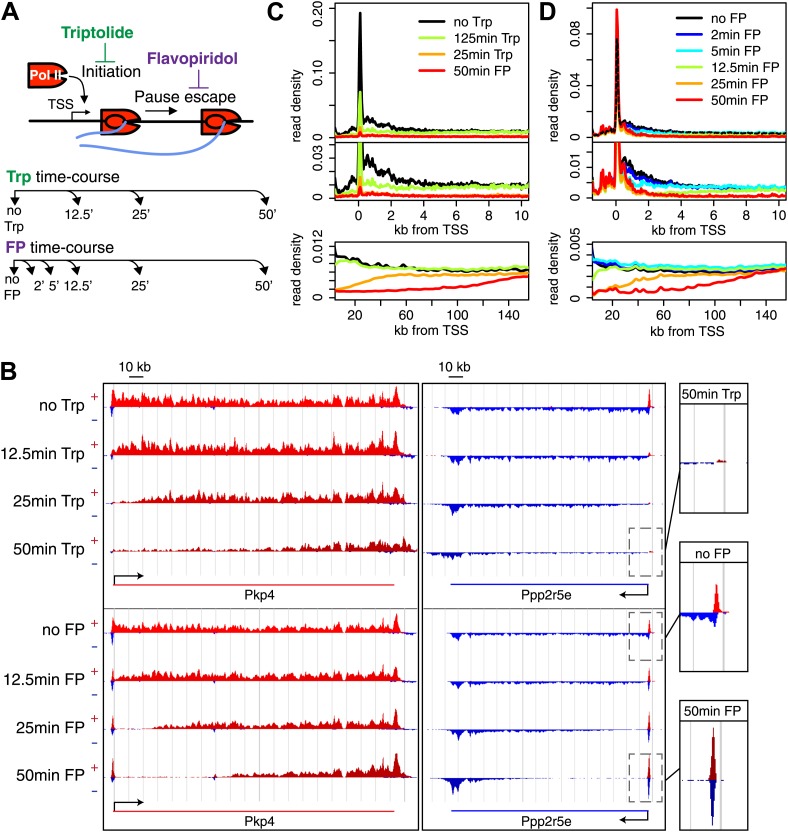
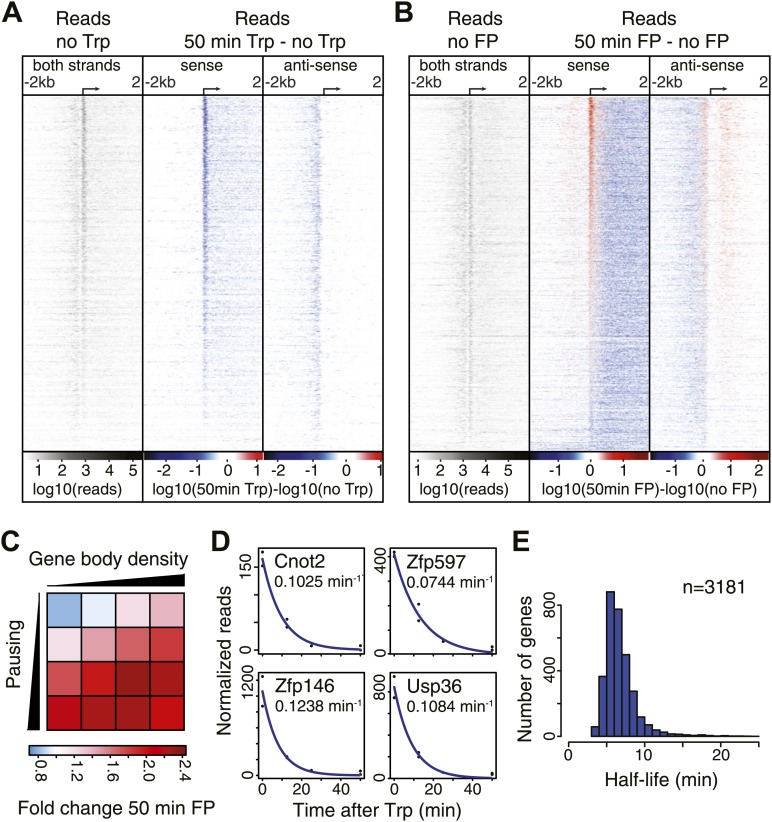
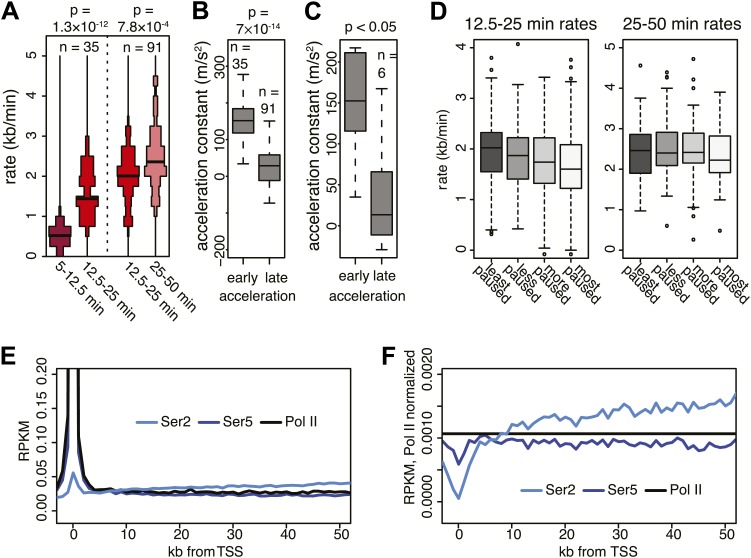
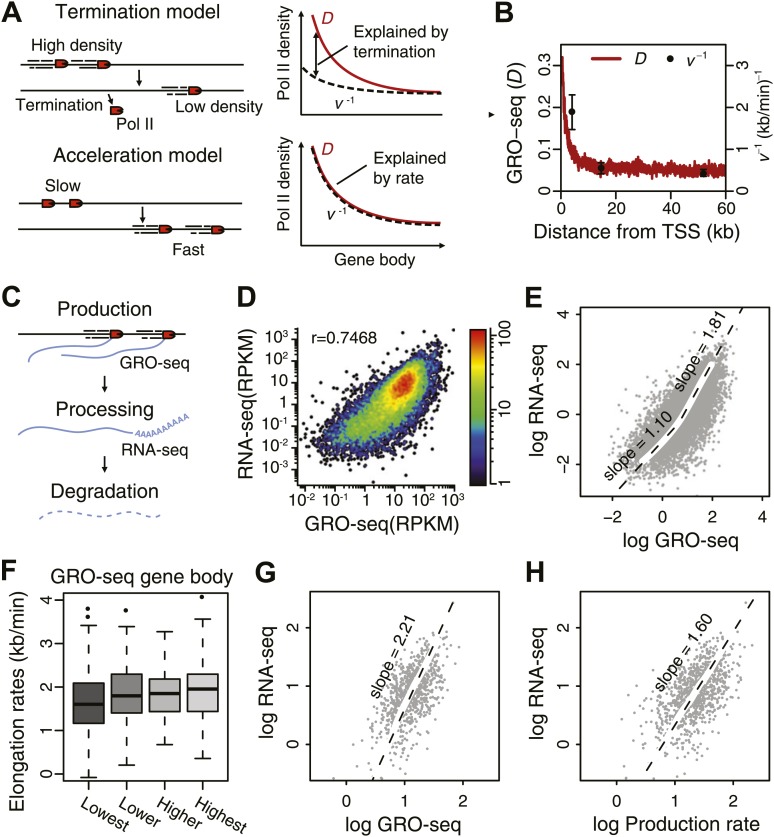
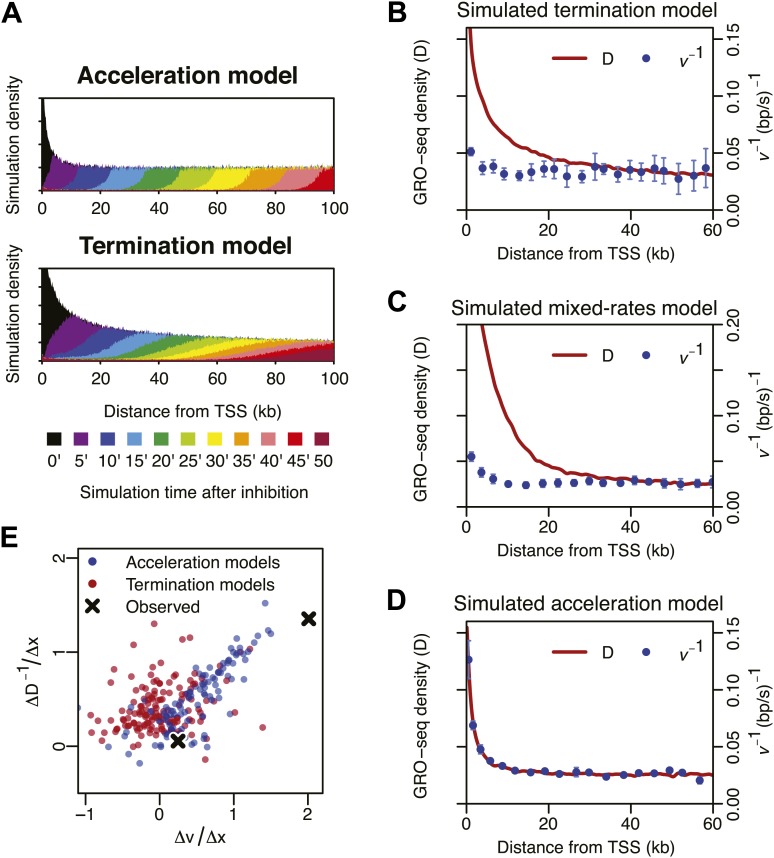
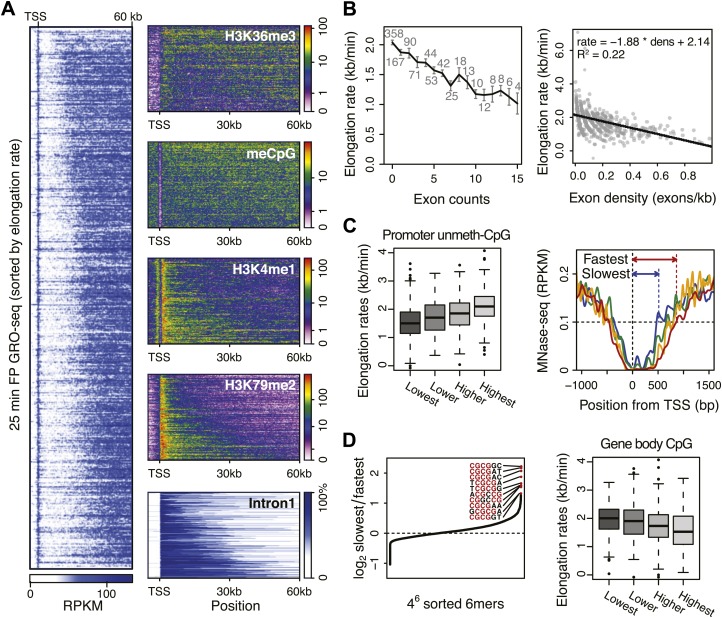
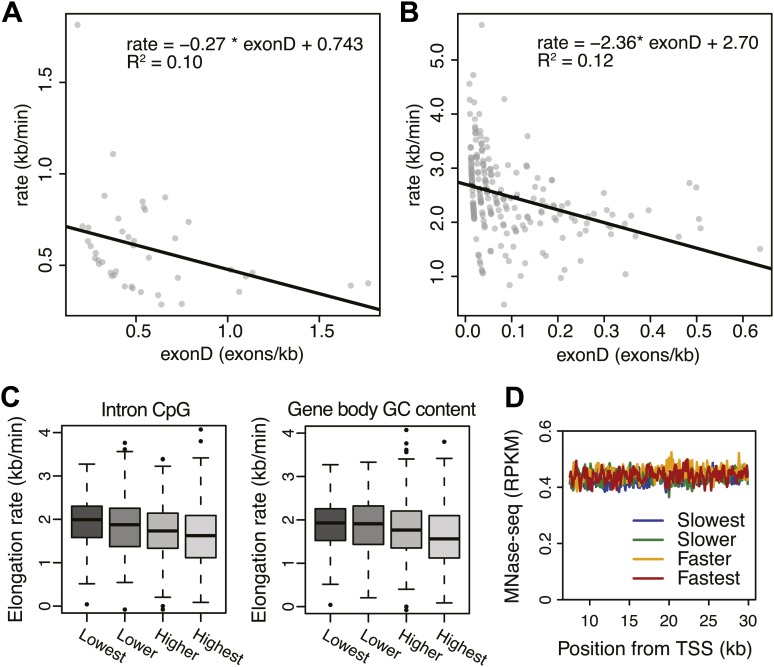
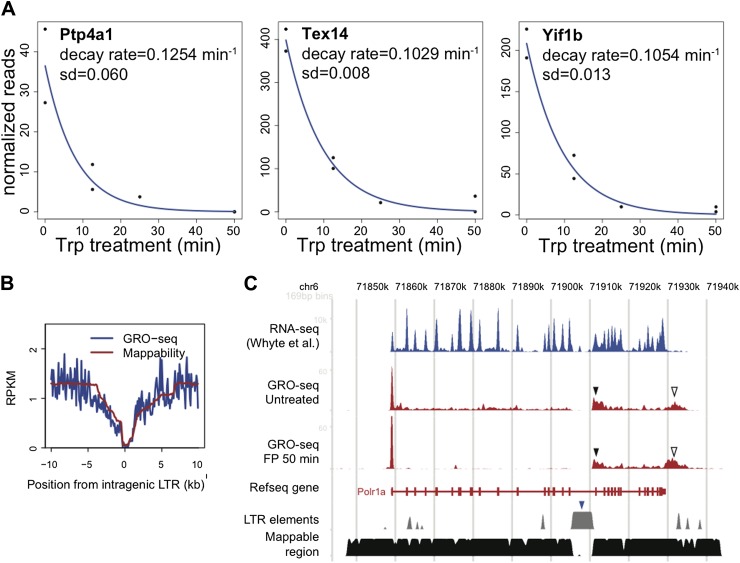
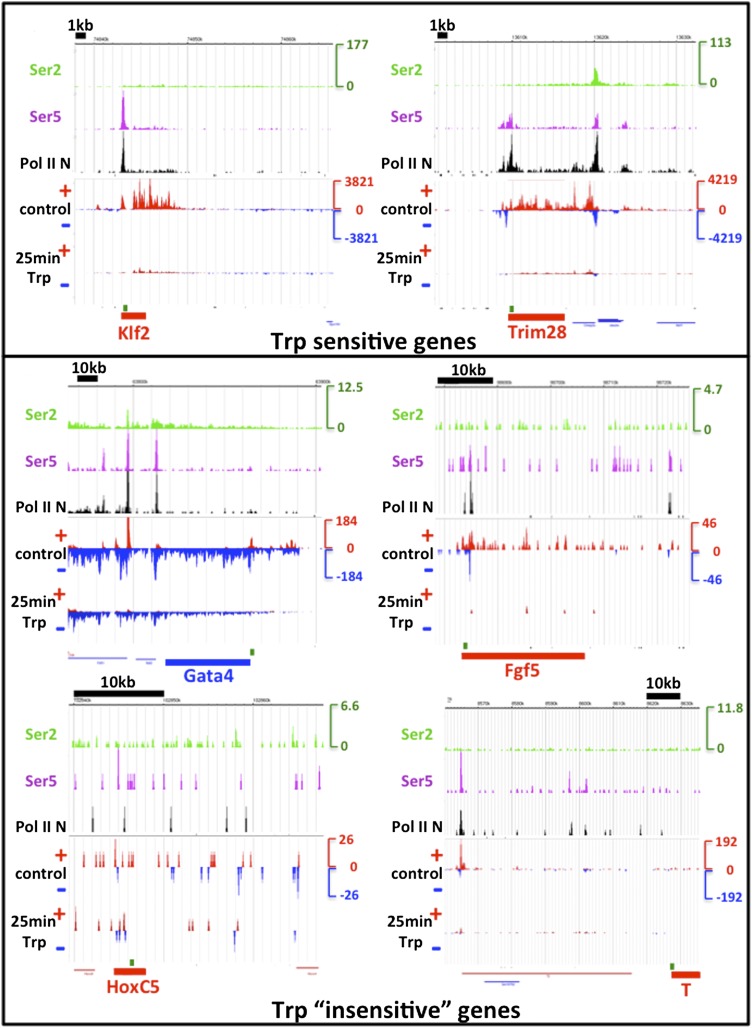
Production of mRNA depends critically on the rate of RNA polymerase II (Pol II) elongation. To dissect Pol II dynamics in mouse ES cells, we inhibited Pol II transcription at either initiation or promoter-proximal pause escape with Triptolide or Flavopiridol, and tracked Pol II kinetically using GRO-seq. Both inhibitors block transcription of more than 95% of genes, showing that pause escape, like initiation, is a ubiquitous and crucial step within the transcription cycle. Moreover, paused Pol II is relatively stable, as evidenced from half-life measurements at ∼3200 genes. Finally, tracking the progression of Pol II after drug treatment establishes Pol II elongation rates at over 1000 genes. Notably, Pol II accelerates dramatically while transcribing through genes, but slows at exons. Furthermore, intergenic variance in elongation rates is substantial, and is influenced by a positive effect of H3K79me2 and negative effects of exon density and CG content within genes.
Overview
The claims and statistics of this paper haven’t been checked yet.
Run the check — free, no account needed. It reads the open-access text and checks the sources it cites.
Integrity signals
Registry
Cites
Statistics
Figures
Verification
Claims the paper makes
The claims and statistics of this paper haven’t been checked yet.
Run the check — free, no account needed. It reads the open-access text and checks the sources it cites.
Claims other papers make about this one
Each is checked against this paper’s own text: does it say what the citing paper says it does?
The source backs part of the claim, not all of it — or backs it for a different population, condition or comparison.
In the citing paper
“Inhibition of P‐TEFb and thus repression of the release of RNA Pol II from promoter‐proximal pausing has been shown to block transcription of almost all genes (Henriques et al, 2013; Jonkers et al, 2014).”
From RNA polymerase II speed: a key player in controlling and adapting transcriptome composition (2021) · cites this paper as Jonkers et al, 2014
Experimental — accuracy not yet measuredThe source backs part of the claim, not all of it — or backs it for a different population, condition or comparison.
In the citing paper
“RNA Pol II speed was furthermore also shown to be highly variable within individual genes, as RNA Pol II accelerates while traveling throughout the gene body, starting at 0.5 kb/min in the first 10–15 kb and accelerating up to 2–4 kb/min downstream (Danko et al, 2013; Fuchs et al, 2014b; Jonkers et al, 2014; Saponaro et al, 2014).”
From RNA polymerase II speed: a key player in controlling and adapting transcriptome composition (2021) · cites this paper as Jonkers et al, 2014
Experimental — accuracy not yet measuredThe source backs part of the claim, not all of it — or backs it for a different population, condition or comparison.
In the citing paper
“In mammals and many other metazoans, promoter‐proximal pausing occurs 25–50 base pairs downstream from the TSS and is a major rate‐limiting step of the transcription cycle (Jonkers et al, 2014; Mayer et al, 2015).”
From RNA polymerase II speed: a key player in controlling and adapting transcriptome composition (2021) · cites this paper as Jonkers et al, 2014
Experimental — accuracy not yet measuredThe source backs part of the claim, not all of it — or backs it for a different population, condition or comparison.
In the citing paper
“All these techniques showed in various human cell lines that the average RNA Pol II speed ranges between 1.25 kb/min and 3.5 kb/min (Danko et al, 2013; Fuchs et al, 2014b; Jonkers et al, 2014; Saponaro et al, 2014; Veloso et al, 2014; Liang et al, 2018; Baluapuri et al, 2019; Gregersen et al, 2020).”
From RNA polymerase II speed: a key player in controlling and adapting transcriptome composition (2021) · cites this paper as Jonkers et al, 2014
Experimental — accuracy not yet measuredThe source backs part of the claim, not all of it — or backs it for a different population, condition or comparison.
In the citing paper
“Although no general correlation has been found between nucleosome occupancy and RNA Pol II speed (Jonkers et al, 2014), nucleosomes bound within exons could nonetheless slow down RNA Pol II transcription.”
From RNA polymerase II speed: a key player in controlling and adapting transcriptome composition (2021) · cites this paper as Jonkers et al, 2014
Experimental — accuracy not yet measured
The source backs part of the claim, not all of it — or backs it for a different population, condition or comparison.
In the citing paper
“Moreover, the GC content within gene bodies has been shown to correlate negatively with RNA Pol II speed (Jonkers et al, 2014; Veloso et al, 2014).”
From RNA polymerase II speed: a key player in controlling and adapting transcriptome composition (2021) · cites this paper as Jonkers et al, 2014
Experimental — accuracy not yet measuredThe source backs part of the claim, not all of it — or backs it for a different population, condition or comparison.
In the citing paper
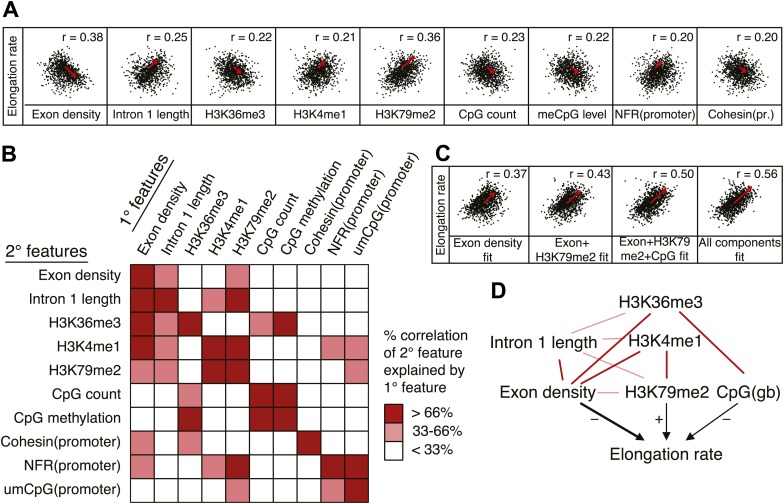
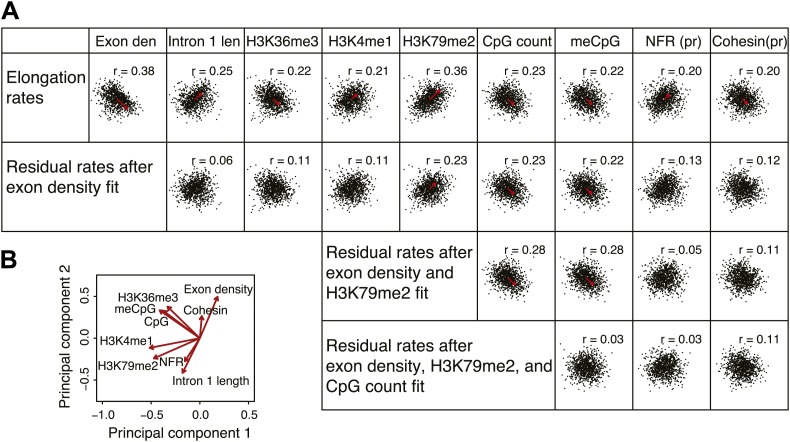
“Genome‐wide studies have shown that H3K79me2, H2B mono‐ubiquitylation, and H4K20me1 positively correlate with RNA Pol II speed in the gene body (Fuchs et al, 2014a; Jonkers et al, 2014; Veloso et al, 2014).”
From RNA polymerase II speed: a key player in controlling and adapting transcriptome composition (2021) · cites this paper as Jonkers et al, 2014
Experimental — accuracy not yet measuredThe cited source says what the claim attributes to it.
In the citing paper
“Indeed, fast transcription correlates with distal localization of H3K36me3 (Jonkers et al, 2014).”
From RNA polymerase II speed: a key player in controlling and adapting transcriptome composition (2021) · cites this paper as Jonkers et al, 2014
The cited source says what the claim attributes to it.
In the citing paper
“Indeed, genes with the highest measured RNA Pol II velocity have been shown to generate more mRNAs (Danko et al, 2013; Jonkers et al, 2014; Cohen et al, 2018).”
From RNA polymerase II speed: a key player in controlling and adapting transcriptome composition (2021) · cites this paper as Jonkers et al, 2014
The cited source says what the claim attributes to it.
In the citing paper
“Indeed, a positive correlation has been identified between intron 1 size and RNA Pol II speed (Jonkers et al, 2014)”
From RNA polymerase II speed: a key player in controlling and adapting transcriptome composition (2021) · cites this paper as Jonkers et al, 2014
The cited source says what the claim attributes to it.
In the citing paper
“Conversely, exon density correlates negatively with RNA Pol II velocity (Jonkers et al, 2014; Veloso et al, 2014)”
From RNA polymerase II speed: a key player in controlling and adapting transcriptome composition (2021) · cites this paper as Jonkers et al, 2014
Self-check
Percentages, sums and reported differences re-computed from the paper’s own numbers.
The self-check needs the paper’s full text.
Citations
Cites
1 retracted
Genomic organization of human transcription initiation complexes
Venters, B. J., & Pugh, B. F. (2013) · Nature · doi:10.1038/nature12535 · Cited by 79
RetractedLandscape of transcription in human cells
Djebali, S., Davis, C. A., Merkel, A., Dobin, A., Lassmann, T., Mortazavi, A., Tanzer, A., Lagarde, J., Lin, W., Schlesinger, F., et al. (2012) · Nature · doi:10.1038/nature11233 · Cited by 5,187
Nascent RNA Sequencing Reveals Widespread Pausing and Divergent Initiation at Human Promoters
Core, L. J., Waterfall, J. J., & Lis, J. T. (2008) · Science · doi:10.1126/science.1162228 · Cited by 1,986
Self-citationDNA-binding factors shape the mouse methylome at distal regulatory regions
Stadler, M. B., Murr, R., Burger, L., Ivanek, R., Lienert, F., Schöler, A., Nimwegen, E. V., Wirbelauer, C., Oakeley, E. J., Gaidatzis, D., et al. (2011) · Nature · doi:10.1038/nature10716 · Cited by 1,383
c-Myc Regulates Transcriptional Pause Release
Rahl, P. B., Lin, C. Y., Seila, A. C., Flynn, R. A., McCuine, S., Burge, C. B., Sharp, P. A., & Young, R. A. (2010) · Cell · doi:10.1016/j.cell.2010.03.030 · Cited by 1,279
Promoter-proximal pausing of RNA polymerase II: emerging roles in metazoans
Adelman, K., & Lis, J. T. (2012) · Nature Reviews Genetics · doi:10.1038/nrg3293 · Cited by 1,221
Self-citationControlling the elongation phase of transcription with P-TEFb
Peterlin, B. M., & Price, D. H. (2006) · Molecular Cell · doi:10.1016/j.molcel.2006.06.014 · Cited by 1,144
CTCF-promoted RNA polymerase II pausing links DNA methylation to splicing
Shukla, S., Kavak, E., Gregory, M., Imashimizu, M., Shutinoski, B., Kashlev, M., Oberdoerffer, P., Sandberg, R., & Oberdoerffer, S. (2011) · Nature · doi:10.1038/nature10442 · Cited by 973
Precise Maps of RNA Polymerase Reveal How Promoters Direct Initiation and Pausing
Kwak, H., Fuda, N. J., Core, L. J., & Lis, J. T. (2013) · Science · doi:10.1126/science.1229386 · Cited by 849
Self-citationYamaguchi, Y., Takagi, T., Wada, T., Yano, K., Furuya, A., Sugimoto, S., Hasegawa, J., & Handa, H. (1999) · Cell · doi:10.1016/s0092-8674(00)80713-8 · Cited by 841
Cited by
Sorted by citations
Predicting splicing from primary sequence with deep learning
Jaganathan, K., Kyriazopoulou Panagiotopoulou, S., McRae, J. F., Darbandi, S. F., Knowles, D., Li, Y. I., Kosmicki, J. A., Arbelaez, J., Cui, W., Schwartz, G. B., et al. (2019) · Cell · doi:10.1016/j.cell.2018.12.015 · Cited by 2,853
Higher-Order Inter-chromosomal Hubs Shape 3D Genome Organization in the Nucleus
Quinodoz, S. A., Ollikainen, N., Tabak, B., Palla, A., Schmidt, J. M., Detmar, E., Lai, M. M., Shishkin, A. A., Bhat, P., Takei, Y., et al. (2018) · Cell · doi:10.1016/j.cell.2018.05.024 · Cited by 892
Getting up to speed with transcription elongation by RNA polymerase II
Jonkers, I., & Lis, J. T. (2015) · Nature Reviews Molecular Cell Biology · doi:10.1038/nrm3953 · Cited by 876
Self-citationEukaryotic core promoters and the functional basis of transcription initiation
Haberle, V., & Stark, A. (2018) · Nature Reviews Molecular Cell Biology · doi:10.1038/s41580-018-0028-8 · Cited by 774
The Biogenesis of Nascent Circular RNAs
Zhang, Y., Xue, W., Li, X., Zhang, J., Chen, S., Zhang, J.-L., Yang, L., & Chen, L.-L. (2016) · Cell Reports · doi:10.1016/j.celrep.2016.03.058 · Cited by 643
Metadata
- Authors
- Jonkers, I., Kwak, H., & Lis, J. T.
- Affiliations
- Cornell University (US)
- Howard Hughes Medical Institute (US)
- Corresponding author
- Jonkers, Iris
- Lis, John T
- Venue
- eLife
- Publisher
- eLife Sciences Publications, Ltd
- Published
- 2014-04-29
- Volume
- 3
- Pages
- e02407-e02407
- ISSN
- 2050-084X (ISSN-L)
- PMC
- PMC4001325
- OpenAlex
- W2038894647
- Cited by
- 581
- References
- 67
- Citations by year
- 2026: 26 · 2025: 40 · 2024: 52 · 2023: 48 · 2022: 46 · 2021: 74 · 2020: 40 · 2019: 57 · 2018: 53 · 2017: 53 · 2016: 49 · 2015: 35 · 2014: 8
- FWCI
- 19.80
- Type
- journal article
- Language
- en
- Open access
- gold
- doi.org
- Licence
- Locations
- eLife (publishedVersion, cc-by)
- Europe PMC (PubMed Central) (publishedVersion, cc-by)
- PubMed Central (publishedVersion, cc-by)
- PubMed (publishedVersion)
- DOAJ (DOAJ: Directory of Open Access Journals) (submittedVersion, cc-by-sa)
- University of Groningen research database (University of Groningen / Centre for Information Technology) (submittedVersion, cc-by)
- Funders
- National Institutes of Health (GM25232)
- Helen Hay Whitney Foundation
- Howard Hughes Medical Institute
- Topics
- Life Sciences › Biochemistry, Genetics and Molecular Biology › Molecular Biology › Genomics and Chromatin Dynamics
- Life Sciences › Biochemistry, Genetics and Molecular Biology › Molecular Biology › RNA Research and Splicing
- Life Sciences › Biochemistry, Genetics and Molecular Biology › Molecular Biology › Epigenetics and DNA Methylation
- Keywords
- RNA polymerase II elongation, promoter-proximal pausing, transcription kinetics, mouse embryonic stem cells, triptolide, flavopiridol, GRO-seq, H3K79me2, chromatin
- MeSH terms
- Animals, Cells, Cultured, Chromatin, Diterpenes, Epoxy Compounds, Exons, Flavonoids, Humans, Phenanthrenes, Piperidines, Promoter Regions, Genetic, RNA Polymerase II, RNA, Messenger, Transcription, Genetic, Genetic Variation, Gene Library, Sequence Alignment, Sequence Analysis, DNA, Chromatin Immunoprecipitation, Mice, Embryonic Stem Cells, Genetic Association Studies
About these checks
Registry, retraction, Cites and statistics results are computed, not judged, with one exception: a printed reference that no index lists is read once by a model before it counts as a citation error. Claims are extracted by a model and kept only when their quote appears verbatim in the text; each cited source is then checked, with a model’s help, for whether it says what the claim relies on. Those verdicts can be wrong — read the claim’s quote and the cited source before relying on one.
Statistics and arithmetic are recomputed, not judged.
Confidence bands are shown only for fields calibrated on our annotated test set. None is calibrated yet, so no band is shown.
What counts as a claim ›How we measure confidence ›How we check this ›
Are you an author, or do you see a problem with this page? Request a review
