

The DOI matches its Crossref record; 41 of the 41 references it cites were found in a registry or an index; none of the 29 sources its claims cite is checked for support yet.
5A's Behavior Change Model Improves Nutrition Knowledge and Intake Among Adolescent Athletes
Open accessAbstract
This study compared the effects of 12 weeks of intensive nutrition education (IE) using the 5A's behavioral change model and basic nutrition education (BE) on nutritional knowledge and nutrient intake among Korean adolescent athletes. This study included elite adolescent athletes (IE group: n = 65, BE group: n = 65) at a physical education high school in Seoul. In this prospective, randomized, controlled trial, the athletes' body composition, nutritional knowledge, nutrient intake, and self-management practices were evaluated at the beginning and end of the intervention. Both groups had increased levels of nutrition knowledge between pre- and post-test, but the change in total score for nutrition knowledge was significantly higher in the IE group than in the BE group (p < 0.001). Energy intake post-test increased significantly in the IE group (from 2,185 to 2,651 kcal/day, p < 0.001) but not in the BE group. The intake of carbohydrates, protein, and fat also increased significantly in the IE group (carbohydrates: from 298 to 352 g/day, protein: from 86 to 106 g/day, fat: from 71 to 88 g/day, all p < 0.001), but the change in the BE group was not significant. Additionally, the IE group showed a significant overall increase in vitamins and minerals compared to the BE group at post-test. Adolescent athletes in the IE group showed improved nutritional knowledge and intake compared to those in the BE group 12 weeks after the intervention.
Overview
CoChat Summary
TL;DR
In a 12-week prospective controlled trial with 130 Korean adolescent athletes, intensive nutrition education using the 5A’s behavior change model improved nutrition knowledge and nutrient intake more than basic group nutrition education. The intensive group increased energy and macronutrient intake, while the basic education group showed no significant changes.
Key findings
- Nutrition knowledge total score improved in both groups, but the IE group’s increase was significantly greater than the BE group’s: IE changed from 26.9 to 63.9 (change 37.0 ± 16.7) vs BE from 28.5 to 48.1 (change 19.6 ± 14.8), p < 0.001.
- Energy intake increased significantly in the IE group from 2,185 to 2,651 kcal/day (p < 0.001), but not in the BE group (2,199.6 to 2,140.3 kcal/day; change −59.3 ± 796.3). Carbohydrate (298 to 352 g/day), protein (86 to 106 g/day), and fat (71 to 88 g/day) also increased significantly in the IE group (all p < 0.001), while BE changes were not significant.
- The IE group showed significantly greater increases in vitamins and minerals than the BE group at post-test; the change in average intake of all minerals investigated was significantly higher in the IE group (p ≤ 0.001). Vitamins A, D, and C remained below the Korean dietary reference intake in both groups despite the intervention.
- Self-management practices improved significantly within the IE group for mental readiness, daily living, personal routine, training, and physical conditioning management (p < 0.05), while the BE group showed no significant changes; however, there were no significant between-group differences in change.
Methods
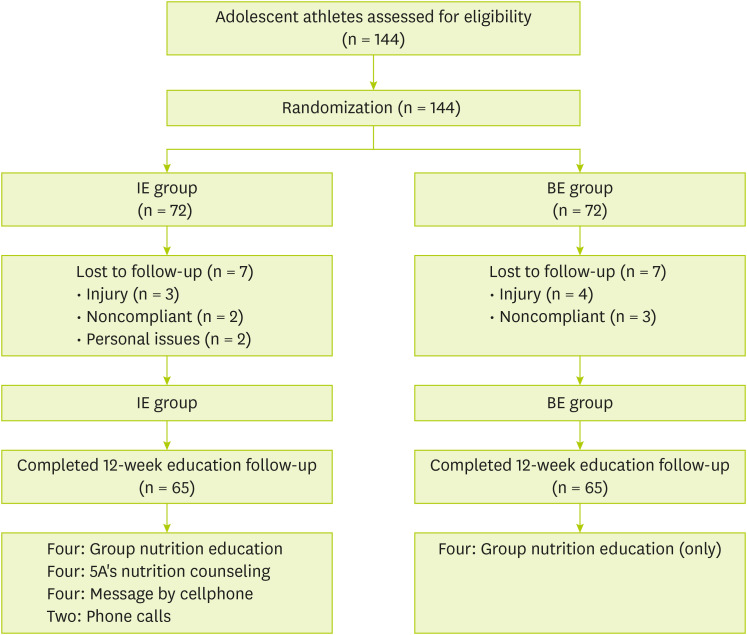
- Prospective controlled trial conducted at a physical education high school in Seoul, South Korea, from May to September 2018. Participants were 144 adolescent athletes aged 16–18 years (86 boys, 58 girls); 14 withdrew, leaving 130 analyzed (IE n = 65, BE n = 65).
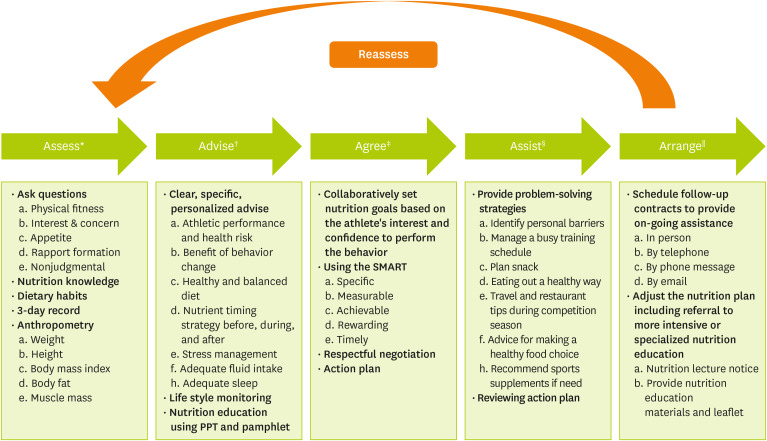
- The IE group received four group nutrition education sessions plus four face-to-face 5A’s counseling meetings (approximately 20 minutes each), four mobile messages, and two phone calls. The BE group received only four group nutrition education sessions.
- Outcomes assessed at baseline and post-intervention included body composition, nutrition knowledge (109-item questionnaire), nutrient intake (3-day food records analyzed with CAN-Pro 5.0), and athlete self-management practices (35-item questionnaire). Statistical analysis used independent and paired t tests, chi-squared tests, and SPSS version 23, with p < 0.05 considered significant.
Limitations
- Stated: possible bias toward compliance among participants receiving both education and counseling; the sample was limited to one physical education high school and may not fully represent all Korean adolescent athletes; nutritional differences between male and female athletes were not considered, although no significant gender differences were found between groups.
- Stated: athletic performance was not directly evaluated in this study.
- Evident from Table 1: baseline daily exercise time differed significantly between groups (IE 4.5 ± 1.3 hr vs BE 5.0 ± 0.8 hr, p = 0.022), despite the text stating no significant baseline differences; nutrient intake was assessed using self-reported 3-day food records.
Model-written summary. Check it against the paper before relying on it.
Integrity signals
Registry
Cites
Statistics
Figures
Verification
Claims the paper makes
0 Valid · 0 Not valid · 28 Not checked · 57 Own results and interpretations
A result the paper reports from its own data — it cites no other source for it, so there is none to check. The quote shows it is in the paper.
In the paper
“while the BE group showed no significant changes”
§ 5A's Behavior Change Model Improves Nutrition Knowledge and Intake Among Adolescent Athletes > RESULTS > Assessment of athlete self-management practices
plainn = 65- Asserted: passes — The authors put it forward as true.
- Checkable: passes — It can be checked against evidence.
- Load-bearing: unclear — It is unclear whether the paper’s conclusions depend on it.
- Based: passes — The paper gives a reason why it holds.
A result the paper reports from its own data — it cites no other source for it, so there is none to check. The quote shows it is in the paper.
In the paper
“Energy intake post-test increased significantly in the IE group (from 2,185 to 2,651 kcal/day, p < 0.001)”
- Also stated in: § Nutrient intake of participants · plain
“The IE group exhibited a significant post-test increase in energy intake (p < 0.001)”
§ 5A's Behavior Change Model Improves Nutrition Knowledge and Intake Among Adolescent Athletes > Abstract
plainstates a causen = 65 ·- Asserted: passes — The authors put it forward as true.
- Checkable: passes — It can be checked against evidence.
- Load-bearing: passes — The paper’s conclusions depend on it.
- Based: passes — The paper gives a reason why it holds.
- Also stated in: § Nutrient intake of participants · plain
None of the sources cited for this claim have been checked yet.
In the paper
“At pre-test, despite the considerable amount of regular exercise time, both groups had significantly lower daily energy intake than indicated by the sports nutrition recommendation (SNR) [21] and the KDRI [22].”
§ 5A's Behavior Change Model Improves Nutrition Knowledge and Intake Among Adolescent Athletes > DISCUSSION
What the sources say
plain- Asserted: passes — The authors put it forward as true.
- Checkable: passes — It can be checked against evidence.
- Load-bearing: passes — The paper’s conclusions depend on it.
- Based: passes — The paper gives a reason why it holds.
A result the paper reports from its own data — it cites no other source for it, so there is none to check. The quote shows it is in the paper.
In the paper
“Calcium, potassium, magnesium, and manganese intakes were lower than the KDRIs at both pre- and post-test in both groups.”
§ 5A's Behavior Change Model Improves Nutrition Knowledge and Intake Among Adolescent Athletes > RESULTS > Nutrient intake of participants
plain- Asserted: passes — The authors put it forward as true.
- Checkable: passes — It can be checked against evidence.
- Load-bearing: unclear — It is unclear whether the paper’s conclusions depend on it.
- Based: passes — The paper gives a reason why it holds.
A result the paper reports from its own data — it cites no other source for it, so there is none to check. The quote shows it is in the paper.
In the paper
“Knowledge about protein increased significantly in the post-test (p < 0.001)”
§ 5A's Behavior Change Model Improves Nutrition Knowledge and Intake Among Adolescent Athletes > RESULTS > Nutrition knowledge of the participants
plain- Asserted: passes — The authors put it forward as true.
- Checkable: passes — It can be checked against evidence.
- Load-bearing: passes — The paper’s conclusions depend on it.
- Based: passes — The paper gives a reason why it holds.
40 more claims
Create a free account to see all 85 claims and to verify the 23 references still open.
- It may state two separate claims as one. 30
- Probably not a substantial claim. 17
- The quote only partly states this claim. 2
Self-check
Percentages, sums and reported differences re-computed from the paper’s own numbers.
Each contradiction between two passages listed here was confirmed by an independent check.
Rated minor: it would not touch a result — a value no result rests on, a p-value that stays on the same side of the significance level, or a conflict that is clerical, resolved elsewhere in the paper, or outside its own findings.
In the paper
§ 5A's Behavior Change Model Improves Nutrition Knowledge and Intake Among Adolescent Athletes > RESULTS > General and anthropometric characteristics
“No significant differences were noted between the IE and BE groups.”
§ 5A's Behavior Change Model Improves Nutrition Knowledge and Intake Among Adolescent Athletes > RESULTS > General and anthropometric characteristics
“| Daily exercise time (hr) | Daily exercise time (hr) | 4.5 ± 1.3 | 5.0 ± 0.8 | 0.022 |”
Rated minor: it would not touch a result — a value no result rests on, a p-value that stays on the same side of the significance level, or a conflict that is clerical, resolved elsewhere in the paper, or outside its own findings.
In the paper
“The questionnaires comprised questions on carbohydrates (23), proteins (18), fats (23), macronutrients (25), vitamins/minerals (25), fluid intake (6), and exercise/supplements (14). The total number of questions was 109;”
§ 5A's Behavior Change Model Improves Nutrition Knowledge and Intake Among Adolescent Athletes > MATERIALS AND METHODS > Assessment
Reported 109 · recomputed 134
Rated minor: it would not touch a result — a value no result rests on, a p-value that stays on the same side of the significance level, or a conflict that is clerical, resolved elsewhere in the paper, or outside its own findings.
In the paper
§ 5A's Behavior Change Model Improves Nutrition Knowledge and Intake Among Adolescent Athletes > DISCUSSION
“At the post-test, the average daily intake of vitamins and minerals in the IE group significantly improved, except for vitamin A, but the intake in the BE group did not improve.”
§ 5A's Behavior Change Model Improves Nutrition Knowledge and Intake Among Adolescent Athletes > RESULTS > Nutrient intake of participants
“| | Vitamin C (mg) | 60.6 ± 27.6 | 64.8 ± 25.6 | 4.2 ± 31.4 | 52.0 ± 14.4 | 58.6 ± 32.6 | 6.6 ± 34.5 | 0.677 |”
Rated minor: it would not touch a result — a value no result rests on, a p-value that stays on the same side of the significance level, or a conflict that is clerical, resolved elsewhere in the paper, or outside its own findings.
In the paper
§ 5A's Behavior Change Model Improves Nutrition Knowledge and Intake Among Adolescent Athletes > RESULTS > Nutrition knowledge of the participants
“At pre-test, sports nutrition knowledge had the lowest correct answer rate among the six categories,”
§ 5A's Behavior Change Model Improves Nutrition Knowledge and Intake Among Adolescent Athletes > RESULTS > Nutrition knowledge of the participants
“| Fat (n = 23) | 4.2 ± 3.7 | 11.0 ± 4.5† | 6.7 ± 5.8 | 5.7 ± 5.1 | 9.9 ± 5.3† | 4.1 ± 5.6 | 0.010 |”
Rated minor: it would not touch a result — a value no result rests on, a p-value that stays on the same side of the significance level, or a conflict that is clerical, resolved elsewhere in the paper, or outside its own findings.
In the paper
§ 5A's Behavior Change Model Improves Nutrition Knowledge and Intake Among Adolescent Athletes > RESULTS > Nutrient intake of participants
“Both groups showed significantly lower vitamin D intake post-test.”
§ 5A's Behavior Change Model Improves Nutrition Knowledge and Intake Among Adolescent Athletes > RESULTS > Nutrient intake of participants
“| | Vitamin D (μg) | 4.3 ± 3.0 | 5.2 ± 3.8 | 0.8 ± 5.3 | 9.7 ± 4.4 | 3.7 ± 3.0‡ | −6.0 ± 5.8 | < 0.001 |”
Citations
Cites
Data Resource Profile: The Korea National Health and Nutrition Examination Survey (KNHANES)
Kweon, S., Kim, Y., Jang, M.-J., Kim, Y., Kim, K., Choi, S., Chun, C., Khang, Y.-H., & Oh, K. (2014) · International Journal of Epidemiology · doi:10.1093/ije/dyt228 · Cited by 2,189
Nutrition and Athletic Performance
(2016) · Medicine & Science in Sports & Exercise · doi:10.1249/mss.0000000000000852 · Cited by 1,305
Nutrition and Athletic Performance
(2009) · Medicine & Science in Sports & Exercise · doi:10.1249/mss.0b013e31890eb86 · Cited by 1,084 · cited 1×
“Exercise performance is optimized by increasing lean muscle, reducing body fat, and consuming adequate fuel before, during, and after training and competition [8].”
BackgroundEvaluating primary care behavioral counseling interventions An evidence-based approach
Whitlock, E. (2002) · American Journal of Preventive Medicine · doi:10.1016/s0749-3797(02)00415-4 · Cited by 1,057
Mikkilä, V., Räsänen, L., Raitakari, O. T., Pietinen, P., & Viikari, J. (2005) · British Journal of Nutrition · doi:10.1079/bjn20051418 · Cited by 984
International Society of Sports Nutrition Position Stand: protein and exercise
Jäger, R., Kerksick, C. M., Campbell, B. I., Cribb, P. J., Wells, S. D., Skwiat, T. M., Purpura, M., Ziegenfuss, T. N., Ferrando, A. A., Arent, S. M., et al. (2017) · Journal of the International Society of Sports Nutrition · doi:10.1186/s12970-017-0177-8 · Cited by 873 · cited 1×
“Inadequate energy intake can use protein as an energy substrate, and total energy intake must be considered when assessing protein requirements [26].”
BackgroundInternational Society of Sports Nutrition position stand: protein and exercise
Campbell, B., Kreider, R. B., Ziegenfuss, T., La Bounty, P., Roberts, M., Burke, D., Landis, J., Lopez, H., & Antonio, J. (2007) · Journal of the International Society of Sports Nutrition · doi:10.1186/1550-2783-4-8 · Cited by 716
Johnstone, A. M., Murison, S. D., Duncan, J. S., Rance, K. A., & Speakman, J. R. (2005) · The American Journal of Clinical Nutrition · doi:10.1093/ajcn/82.5.941 · Cited by 514
A high-protein diet for reducing body fat: mechanisms and possible caveats
Pesta, D. H., & Samuel, V. T. (2014) · Nutrition & Metabolism · doi:10.1186/1743-7075-11-53 · Cited by 276 · cited 1×
“Moreover, the intake of carbohydrates and proteins has a greater thermogenic effects compared to fat, which plays a crucial role in the strength and endurance performance of athletes [25].”
BackgroundMetabolic adaptation to weight loss: implications for the athlete
Trexler, E. T., Smith‐Ryan, A. E., & Norton, L. E. (2014) · Journal of the International Society of Sports Nutrition · doi:10.1186/1550-2783-11-7 · Cited by 207
Research works printed but not linked: 7
- Thomas, 2016, Med Sci Sports Exerc, 48, 543
- Hornstrom, 2011, Food Nutr Sci, 2, 109
- Kim, 2003, Korean J Sport Sci, 14, 125
- Smith, 2015, J Sports Med (Hindawi Publ Corp), 2015, 734649
- Ministry of Health and Welfare, 2020, 2020 Dietary reference intakes for Koreans: vitamins
- Ministry of Health and Welfare, 2020, 2020 Dietary reference intakes for Koreans: minerals
- Sturgiss, 2017, Can Fam Physician, 63, 506
Cited by
Nutrition Education Among Adolescents in Nepal
Sunuwar, D. R., Dirghayu, K. C., & Chaudhary, N. K. (2025) · Springer eBooks · doi:10.1007/978-3-031-32047-7_179-1
Yi, X. (2026) · Frontiers in Pain Research · doi:10.3389/fpain.2026.1769480
Health benefits and challenges of Ramadan fasting: a narrative review and practical lifestyle model
Adelowo, A. B., Odunaye-Badmus, S., Tukur, H. M., & Monye, I. N. (2026) · Lifestyle Medicine Advances · doi:10.1136/lma-2026-000046
Metadata
- Authors
- Lee, S., Hwang, Y., & Lim, H.
- Affiliations
- Kyung Hee University (KR)
- Corresponding author
- Lim, Hyunjung
- Venue
- Clinical Nutrition Research
- Publisher
- Korean Society of Clinical Nutrition
- Published
- 2024
- Volume
- 13
- Issue
- 4
- Pages
- 244
- ISSN
- 2287-3732 (ISSN-L)
- 2287-3740
- PMC
- PMC11543449
- OpenAlex
- W4403988535
- Semantic Scholar
- 5a18018c95875731d0ed0674e06ec36711e50658
- Cited by
- 3
- References
- 41
- Citations by year
- 2026: 2 · 2025: 1
- FWCI
- 0.68
- Type
- journal article
- Language
- en
- Open access
- diamond
- dx.doi.org
- Licence
- cc-by-nc
- creativecommons.org/licenses/by-nc/4.0/ (tdm)
- Locations
- Clinical Nutrition Research (publishedVersion, cc-by-nc)
- PubMed Central (publishedVersion, cc-by-nc)
- PubMed (publishedVersion)
- Topics
- Health Sciences › Nursing › Nutrition and Dietetics › Nutrition, Health and Food Behavior
- Health Sciences › Medicine › Public Health, Environmental and Occupational Health › Health and Lifestyle Studies
- Health Sciences › Nursing › Nutrition and Dietetics › Dietetics, Nutrition, and Education
- Keywords
- nutrition education, youth athletes, nutrition knowledge, nutrient intake, energy intake, macronutrient intake, micronutrient intake, self-management strategies, body composition, elite athletes, high school physical education
About these checks
Registry, retraction, Cites and statistics results are computed, not judged, with one exception: a printed reference that no index lists is read once by a model before it counts as a citation error. Claims are extracted by a model and kept only when their quote appears verbatim in the text; each cited source is then checked, with a model’s help, for whether it says what the claim relies on. Those verdicts can be wrong — read the claim’s quote and the cited source before relying on one.
A language model drew the claims from the paper on 2026-11-14, under version 3 of the claim definition (model deepseek-v4.1-flash, prompt extract-v3).
A second model labelled each claim on 2026-11-14 (model jev-1.13-20260917, definition revision gold-guideline-v0.2).
Statistics and arithmetic are recomputed, not judged.
Confidence bands are shown only for fields calibrated on our annotated test set. None is calibrated yet, so no band is shown.
What counts as a claim ›How we measure confidence ›How we check this ›
Are you an author, or do you see a problem with this page? Request a review
How to cite
Cite CoChat for the checks on this page, and the paper for its own findings.
- This page
- CoChat. (2026). Citation check: 5A's Behavior Change Model Improves Nutrition Knowledge and Intake Among Adolescent Athletes. https://app.cochat.ai/papers/10.7762/cnr.2024.13.4.244
- The paper
- Lee, S., Hwang, Y., & Lim, H. (2024). 5A's Behavior Change Model Improves Nutrition Knowledge and Intake Among Adolescent Athletes. Clinical Nutrition Research. https://doi.org/10.7762/cnr.2024.13.4.244
Data sources
Bibliographic data: Semantic Scholar, OpenAlex, Crossref.
Contains information from the Semantic Scholar Academic Graph Datasets, made available under the ODC Attribution License (ODC-BY 1.0).
Semantic Scholar’s data is described in: Kinney, R., et al. (2023). The Semantic Scholar Open Data Platform. arXiv:2301.10140.
