

mHealth innovations as health system strengthening tools: 12 common applications and a visual framework
Open accessThe DOI matches its Crossref record; 18 of the 19 references it cites were found in a registry or an index.
Abstract
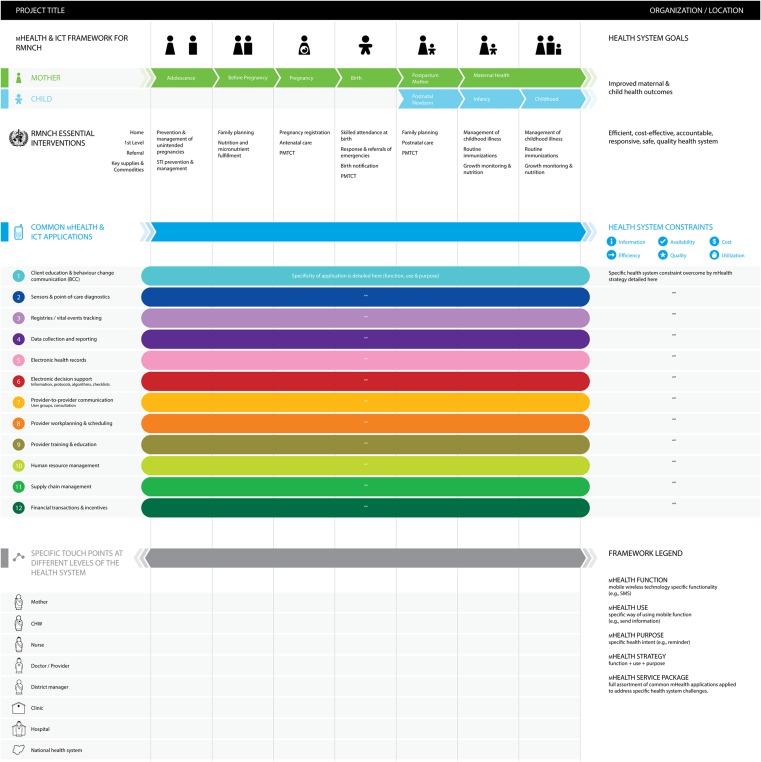
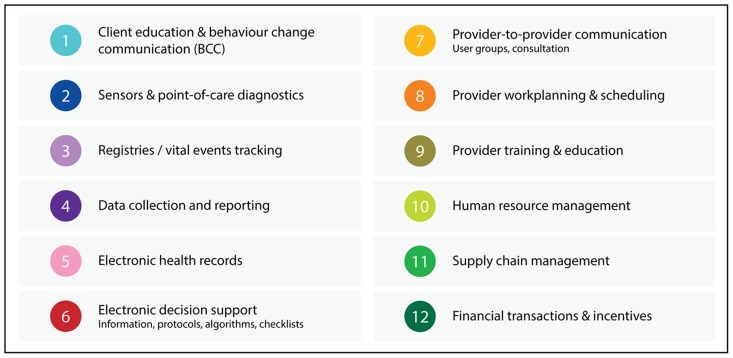
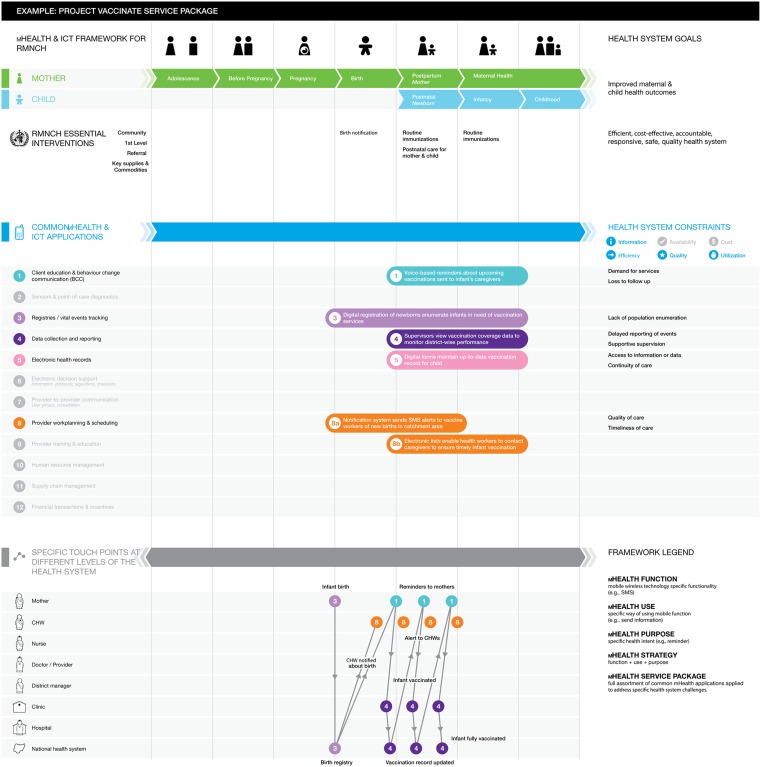
This new framework lays out 12 common mHealth applications used as health systems strengthening innovations across the reproductive health continuum.T he rapid proliferation of mHealth projects-albeit mainly pilot efforts-has generated considerable enthusiasm among governments, donors, and implementers of health programs.1 In many instances, these pilot projects have demonstrated conceptually how mHealth can alleviate specific health system constraints that hinder effective coverage of health interventions.Large-scale implementation or integration of these mHealth innovations into health programs has been limited, however, by a shortage of empirical evidence supporting their value in terms of cost, performance, and health outcomes.[1][2][3][4] Governments in low-and middleincome countries face numerous challenges and competing priorities, impeding their ability to adopt innovations.2 Thus, they need robust, credible evidence about mHealth projects in order to consider mHealth alongside essential health interventions, and guidance about which mHealth solutions they should consider to achieve broader health system goals.2 Their tolerance for system instability or failure can be low, even when the status quo may be equally, or more, unreliable.Current larger-scale effectiveness and implementation research initiatives are working to address the evidence gaps and to demonstrate the impact of mHealth investments on health system targets. 1 Other efforts are underway to synthesize such findings.5 MHEALTH AS A HEALTH SYSTEMS STRENGTHENING TOOLRecent mHealth reviews have proposed that innovators focus on the public health principles underlying mHealth initiatives, rather than on specific mHealth technologies.6 International agencies and research organizations have also endeavored to frame mHealth interventions within the broader context of health system goals or health outcomes.2 The term ''health system'' includes all activities in which the primary purpose is to promote, restore, or maintain health.7 Some elements of a framework for evaluating health systems performance by relating the goals of the health system to its essential functions have been proposed previously, which we believe can serve as a model for articulating and justifying mHealth initiatives and investments.7 Applying a health systems lens to the evaluation of mHealth initiatives requires different indicators and methodologies, shifting the assessment from whether the mHealth initiative ''works'' to process evaluation or proxy indicators of the health outcome(s) of interest.This new way of thinking would facilitate selection of mHealth tools that are appropriate for identified challenges.In other words, it would drive people to first identify the key obstacles, or constraints, to delivering proven health interventions effectively, and to then apply appropriate mHealth strategies that could overcome these health system constraints.8 Presenting mHealth as a range of tools for overcoming known health system constraints, as a health systems ''catalyst,'' may also improve communication between mHealth innovators and health program implementers.Communicating mHealth technologies as tools that can enhance delivery of life-saving interventions through improvements in health systems performance, such as coverage, quality, equity, or efficiency, will resonate with health decision-makers.7 Hence, rather than being perceived as siloed, standalone solutions, mHealth strategies should be viewed as integrable systems that should fit into existing health system functions and complement the health
Overview
The claims and statistics of this paper haven’t been checked yet.
Free: it reads the open-access text and checks the first 5 claims that cite a source we can check. Create a free account to check every claim.
Integrity signals
Registry
Cites
Statistics
Figures
Verification
Claims the paper makes
The claims and statistics of this paper haven’t been checked yet.
Free: it reads the open-access text and checks the first 5 claims that cite a source we can check. Create a free account to check every claim.
Claims other papers make about this one
Each is checked against this paper’s own text: does it say what the citing paper says it does?
The source backs part of the claim, not all of it — or backs it for a different population, condition or comparison.
In the citing paper
“Equipping frontline health workers with mobile phone applications may enhance the delivery of maternal, neonatal, and child health services as well as the accuracy of data capture and recording [16, 26, 35, 36].”
From Qualitative Assessment of the Feasibility, Usability, and Acceptability of a Mobile Client Data App for Community-Based Maternal, Neonatal, and Child Care in Rural Ghana (2016) · cites this paper as [16]
Experimental — accuracy not yet measuredThe cited source says what the claim attributes to it.
In the citing paper
“The twelve most common applications of mHealth as described by Labrique et al. [23] provides a robust framework that was applied in this study to categorize eHealth projects in Kenya.”
From Assessing the feasibility of eHealth and mHealth: a systematic review and analysis of initiatives implemented in Kenya (2017) · cites this paper as [23]
In the citing paper
“There was considerable variety in the quantity and quality of content across the application domains (8) under which we categorised the 76 publications in the review.”
From Assessing the impact of mHealth interventions in low- and middle-income countries – what has been shown to work? (2014) · cites this paper as [8]
In the citing paper
“Our review covers the scope of mHealth as postulated by Labrique et al. (8) as comprehensively as possible.”
From Assessing the impact of mHealth interventions in low- and middle-income countries – what has been shown to work? (2014) · cites this paper as [8]
In the citing paper
“Strategies using mHealth have been considered a strengthening tool to overcome health system constrains.26”
Self-check
Percentages, sums and reported differences re-computed from the paper’s own numbers.
The self-check needs the paper’s full text.
Citations
Cites
The world health report 2000 - Health systems: improving performance
Reinhardt, U. E., & Cheng, T.-M. (2000) · Europe PMC (PubMed Central) · doi:10.1590/s0042-96862000000800020 · Cited by 3,467
Lester, R. T., Ritvo, P., Mills, E. J., Kariri, A., Karanja, S., Chung, M. H., Jack, W., Habyarimana, J., Sadatsafavi, M., Najafzadeh, M., et al. (2010) · The Lancet · doi:10.1016/s0140-6736(10)61997-6 · Cited by 1,278 · cited 1×
“engage 1 or more actors (such as a pregnant woman, a husband, family, community)—influences health behaviors, such as adherence to medication or use of health services.(3,14) The”
BackgroundFree, C., Phillips, G., Watson, L., Galli, L., Felix, L., Edwards, P., Patel, V., & Haines, A. (2013) · PLoS Medicine · doi:10.1371/journal.pmed.1001363 · Cited by 1,187 · cited 1×
“engage 1 or more actors (such as a pregnant woman, a husband, family, community)—influences health behaviors, such as adherence to medication or use of health services.(3,14) The”
BackgroundThe World Health Report 2005 - make every mother and child count
Lerberghe, W. V., Manuel, A., Matthews, Z., & Wolfheim, C. (2005) · ePrints Soton (University of Southampton) · Cited by 1,015
Overcoming health-systems constraints to achieve the Millennium Development Goals
Travis, P., Bennett, S., Haines, A., Pang, T., Bhutta, Z., Hyder, A. A., Pielemeier, N. R., Mills, A., & Evans, T. (2004) · The Lancet · doi:10.1016/s0140-6736(04)16987-0 · Cited by 860
Bashshur, R., Shannon, G., Krupinski, E., & Grigsby, J. (2011) · Telemedicine and e-Health · doi:10.1089/tmj.2011.0103 · Cited by 490 · cited 1×
“The first part of the framework aims to address a previously identified challenge in mHealth: to systematically describe the constituent parts of an mHealth strategy or platform.(11) To do this, we define relationships between common applications of mHealth and ICT and the health systems constraints that they address.”
BackgroundTamrat, T., & Kachnowski, S. (2012) · Maternal and Child Health Journal · doi:10.1007/s10995-011-0836-3 · Cited by 312
E-imci: improving pediatric health care in low-income countries
DeRenzi, B., Lesh, N., Parikh, T., Sims, C., Maokla, W., Chemba, M., Hamisi, Y., S hellenberg, D., Mitchell, M., & Borriello, G. (2008) · Proceedings of the SIGCHI Conference on Human Factors in Computing Systems · doi:10.1145/1357054.1357174 · Cited by 166
Barrington, J., Wereko-Brobby, O., Ward, P., Mwafongo, W., & Kungulwe, S. (2010) · Malaria Journal · doi:10.1186/1475-2875-9-298 · Cited by 163
Mobile Phone Tools for Field‐Based Health care Workers in Low‐Income Countries
DeRenzi, B., Borriello, G., Jackson, J., Kumar, V. S., Parikh, T. S., Virk, P., & Lesh, N. (2011) · Mount Sinai Journal of Medicine: A Journal of Translational and Personalized Medicine · doi:10.1002/msj.20256 · Cited by 123
Research works printed but not linked: 3
- CommCare HQ [Internet]. Cambridge, MA: Dimagi; c2013 [cited 2013 Mar 13] CommCare accredited social health activist (ASHA); [about 1 screen]. Available from: http://www.commcarehq.org/users/commcare_asha/
- Dimagi [Internet]. Cambridge, MA: Dimagi; c2013 [cited 2013 Mar 13] E-IMCI is mobile device based job aid for implementers of IMCI; [about 1 screen]. Available from: http://www.dimagi.com/mobile-e-imci/
- MTN Press Office. MTN Group delivered satisfactory set of results to June 2012 [press release]. Johannesburg, South Africa: MTN; 2012 Aug 8 [cited 2013 Mar 14] Available from: http://pressoffice.mg.co.za/mtn/PressRelease.php?StoryID = 232675
Cited by
Items 401–500 of 598
Agbehadji, I. E., Abayomi, A., Millham, R. C., Biney, E. A., & Yeboah, K. O. (2019) · International Conference on Smart City Applications (SCA) · doi:10.1145/3368756.3369034 · Cited by 4
“The authors of [18] describes a framework that support interoperability of mHealth application and ICT framework.”
BackgroundInfluentialM-health for maternal health- bridging the gaps!!
Marwah, S., & Mittal, P. (2017) · International Journal of Reproduction Contraception Obstetrics and Gynecology · doi:10.18203/2320-1770.ijrcog20175822 · Cited by 5
“Efforts to catalogue and grade the m-Health for RMNCH evidence base are underway (WHO mTERG).(14) Involvement of trained Safe Motherhood Action Groups (SMAGs) or Traditional Birth Attendants (TBAs) in community based interventions/activities is contemplated.”
Backgroundda Costa, P. H. A., Martins, L. F., Ronzani, T. M., & Colugnati, F. A. B. (2017) · Reciis · doi:10.29397/reciis.v11i4.1279 · Cited by 4
Bolan, N. E., Newman, S. D., & Nemeth, L. S. (2018) · International Journal of Childbirth · doi:10.1891/2156-5287.8.4.252 · Cited by 7
Tokosi, T. O., & Twum‐Darko, M. (2021) · JMIR Research Protocols · doi:10.2196/24589 · Cited by 4
“Some applications using MHCS modalities include data collection (web) [23,24], patient health education (web) [6], patient health self-management (text) [25,26], behaviour change communication (images, audio, text) [27], sensors and point-of-care devices (camera, microphone, GPS, accelerometer, digital compass, Blueto…”
MethodCommentary: The emperor's new phone
Fottrell, E. F. (2015) · BMJ · doi:10.1136/bmj.h2051 · Cited by 4
Evaluation of eHealth Implementations in Uganda: Investigating Practices, Challenges and InsightsPreprint
Nabukenya, J., & Ashaba, J. (2019) · Research Square · doi:10.21203/rs.2.12339/v1 · Cited by 5
“Some aspects that threaten ICT systems implementation in the health sector involve economic resources, income disparities, exorbitant costs of usage fees, excessive costs for even rudimentary health information systems, lack of human trained resources, lack of governmental policies that address a well-defined health s…”
BackgroundDesmond, N., Henrion, M., Gondwe, M. J., O’Byrne, T., Tam, P. I., Nyirenda, D., Pollock, L., Majamanda, M. D., Makwero, M., Geldof, M., et al. (2024) · PLOS Global Public Health · doi:10.1371/journal.pgph.0002786 · Cited by 5
“…materials, reminders, decision-making, and adherence to standards and guidelines in care [17]. mHealth has been increasingly recognised as a health systems strengthening tool [18], but there has been comparatively less progress in the evaluation and scale-up of effective mHealth solutions [19].”
Mobile Health for Lifestyle Modification among Health Check-up Clients: A Qualitative Study
Poorirerngpoom, N., Hanvoravongchai, P., & Ratanachina, J. (2025) · Asian Journal of Social Health and Behavior · doi:10.4103/shb.shb_393_24 · Cited by 6
Pourrazavi, S., Azimi, S., Fakhari, A., Barzegar, H., & Farahbakhsh, M. (2024) · Health Promotion Perspectives · doi:10.34172/hpp.43077 · Cited by 5
Mobile Health (mHealth) Across Maternity Care Continuum
Ameyaw, E. K., & Baatiema, L. (2025) · Springer eBooks · doi:10.1007/978-981-92-1290-3_88 · Cited by 7
Drabarek, D., Hoang, D. T., Yapa, H. M., Dang, T. T. H., Vu, H. D., Nguyen, T. A., Do, T. T., Nguyen, B. H., Vu, D. H., Fox, G. J., et al. (2025) · PLOS Global Public Health · doi:10.1371/journal.pgph.0004454 · Cited by 6
“…across a range of communicable and non-communicable conditions, there is a limited and mixed evidence-base demonstrating the ‘effectiveness’ of mHealth technologies in improving treatment outcomes and healthcare delivery in practice [17–19], or their positive impact on health systems [20,21].”
Ekong, I., Esan, O. T., Chukwu, E., & Kawu, M. (2020) · International Journal of Information Technology and Web Engineering · doi:10.4018/ijitwe.2020040105 · Cited by 3
Impacto de las llamadas telefónicas en una unidad de hospitalización a domicilio
Corts, A. M. T., Díez, B. V., Lopez-Arellano, E. M., & Pachón, L. P. (2021) · Hospital a Domicilio · doi:10.22585/hospdomic.v5i3.133 · Cited by 3
Skin-Related Neglected Tropical Diseases (Skin-NTDs)—A New Challenge
Hay, R. J., & Asiedu, K. B. (2019) · MDPI eBooks · doi:10.3390/books978-3-03921-254-5 · Cited by 3
Birth and death notification via mobile devices
Vasudevan, L., Henschke, N., Glenton, C., Lewin, S. A., Maayan, N., Eyers, J. E., Fønhus, M. S., Tamrat, T., & Mehl, G. L. (2018) · Cochrane Database of Systematic Reviews · doi:10.1002/14651858.cd012909 · Cited by 5
Self-citationTremblay, M. C., Cucciniello, M., Tarricone, R., Porumbescu, G. A., & Desouza, K. C. (2020) · Lecture notes in computer science · doi:10.1007/978-3-030-64823-7_1 · Cited by 3
Fotso, J. C., & TSUI, A. O. (2015) · African Population Studies · doi:10.11564/29-1-712 · Cited by 4
“…visual images and location to enable analysts to evaluate the severity of symptoms, location of infected cases, and behavioral response patterns (Labrique et al., 2013). mHealth applications fall into five broad groups: 1) information and education to share information about important health…”
BackgroundMobile applications: effective tools against HIV in Africa
Linguissi, L. S. G., Ouattara, A. K., Kamangu, E. N., Mbalawa, C. G., & Nkenfou, C. N. (2017) · Health and Technology · doi:10.1007/s12553-017-0200-8 · Cited by 5
“Health workers are secondary beneficiaries of the innovative use of mobile phones, by receiving information on new or updated guidelines [6, 20], especially for PMTCT [39, 61].”
BackgroundAuthentication & Integration Approaches for mHealth Apps from a Usability View
Teng, Z., Zhang, P., Li, X., Nock, W., Gilmore, D. M., Rodriguez-Cancio, M., White, J., Nesbitt, J. C., & Schmidt, D. C. (2021) · Advances in Electrical and Electronic Engineering · doi:10.15598/aeee.v19i1.3301 · Cited by 4
mHealth initiatives in Portugal
Duque, C., Mamede, H. S., & Morgado, L. C. (2017) · Iberian Conference on Information Systems and Technologies (CISTI) · doi:10.23919/cisti.2017.7975803 · Cited by 5
Implementing DHIS2 Feedback via Short Message Service: A Case Study for Uganda WEMR Health Workers
Sujatmiko, N. F. (2015) · NVA (Nasjonalt vitenarkiv) · Cited by 6
Global Health: Science and Practice … 5 Years In
Salem, R. M., & Hodgins, S. (2018) · Global Health Science and Practice · doi:10.9745/ghsp-d-18-00196 · Cited by 3
Kaufman, M. R., Wright, K., Eschliman, E. L., Levine, D., & Simon, J. (2023) · JMIR Formative Research · doi:10.2196/48515 · Cited by 2
“Although usability studies, including those for digital health interventions [52,53], can provide important insights for future intervention, their potential benefit is often limited by their results not being fully and transparently reported [53,54].”
BackgroundDegaga, S. D., Yesuf, S. S., & Aweke, G. T. (2025) · Frontiers in Digital Health · doi:10.3389/fdgth.2025.1554995 · Cited by 7
Okeke, E. B., Forman, D., Taylor, E., Hyde, E., Parente, F., Kanmodi, K. K., & Wordsworth, S. (2025) · BMC Public Health · doi:10.1186/s12889-025-25600-0 · Cited by 6
“Cross-sectional surveys also serve as effective tools in formative research on digital health, enabling baseline assessments prior to intervention design [9].”
InfluentialLilan, S., Osborn, T. L., Musonye, W. M., Kasudi, J., Otieno, B. H., Etyang, I., Tu, J., Korley, E., & Wasanga, C. (2026) · JMIR Human Factors · doi:10.2196/79107 · Cited by 1
“Ongoing development is guided by field feedback, platform analytics, and emerging implementation needs [18,20,23,72,73].”
Iellamo, A. D., Rozhenko, O., Strelchenko-Yankovska, Y., Kalashnyk, N., Burta, I., Ekwuluo, C. E., Hryshyna, Y., Firsova, O., & Sheremet, V. (2026) · Frontiers in Nutrition · doi:10.3389/fnut.2026.1745609 · Cited by 5
“The ability of caregivers to access the chatbot during periods of insecurity or limited facility access likely contributed to its repeated use and high satisfaction, mirroring trends seen in other digital health deployments during crises (44–47).”
Beyond Euphemisms: Rethinking LLMs for SRH in Conservative Contexts
Humayun, A., Zubair, B., & Mustafa, M. (2026) · CHI Conference on Human Factors in Computing Systems · doi:10.1145/3772318.3791315 · Cited by 2
“Labrique et al. [34] established one of the first systematic frameworks for mHealth, identifying twelve common applications (e.g., client education, provider training, data capture) and situating them within broader health system strengthening.”
Towards an SMS-based social network for health workers in rural areas in Myanmar
Vogt, J., Martin, E., Portmann, E., & Mahmud, N. (2014) · International Conference on Informatics, Electronics & Vision (ICIEV) · doi:10.1109/iciev.2014.6850859 · Cited by 2
Biau, S., Bonnet, E., Dagenais, C., Allegri, M. D., Traore, Z. I., Ouedraogo, A. W., Sow, A., Dubois-Nguyen, K., & Ridde, V. (2021) · JMIR Research Protocols · doi:10.2196/28780 · Cited by 3
“Mobile health (mHealth) has the potential to support health systems [27] and help fill persistent gaps by facilitating communication and information exchange [28].”
Doukani, A. (2022) · Springer eBooks · doi:10.1007/978-3-030-89594-5_109 · Cited by 2
Improving safety claims in digital health interventions using the digital health assessment method
Harrison, S., Maple, C. R., Epiphaniou, G., & Arvanitis, T. N. (2024) · Digital Health · doi:10.1177/20552076241258756 · Cited by 3
“11,39,46,47 We use a qualitative HazID study due to the cooperation between simplicity of understanding, the use of multidisciplinary teams and the reliance on the experience of the team in the subject under assessment.”
MethodWondimu, S., Abawari, M. J., & Kebede, Y. (2025) · PLOS Digital Health · doi:10.1371/journal.pdig.0000587 · Cited by 3
Choudhry, V., Weiner, B. J., Karkhanis, P., Avinandan, V., Shah, N., Bahl, N., Wadhwa, R., Sridhar, P., & Chandurkar, D. (2020) · Gates Open Research · doi:10.12688/gatesopenres.13128.1 · Cited by 2
“These interventions may focus on the demand-side influencers, such as client education and behaviour-change communication, or on service delivery personnels, such as health workers at the facility or community level (Abejirinde et al., 2018; Labrique et al., 2013).”
Background(2022) · Journal of System and Management Sciences · doi:10.33168/jsms.2022.0317 · Cited by 4
Higgins‐Steele, A., Noordam, A. C., Crawford, J., & Fotso, J. C. (2015) · African Population Studies · doi:10.11564/29-1-715 · Cited by 4
“Use of mobile phones – for example through two-way communication, voice messages and/or short message services (SMS) – can overcome persistent health system constraints across the continuum of care (Labrique et al. 2013).”
BackgroundPitse, S. B., & Heever, H. V. D. (2018) · clinics in Mother and Child Health · doi:10.4172/2090-7214.1000298 · Cited by 1
Form‐based security in mobile health data collection systems
Katarahweire, M., Bainomugisha, E., Mughal, K. A., & Ngubiri, J. (2021) · Security and Privacy · doi:10.1002/spy2.155 · Cited by 2
Increasing the demand for vaccination through mHealth in Quetta City, Balochistan in Pakistan
Khan, E. A., Panezai, M., Shahid, B., Shahabuddin, A., & Akber, S. (2021) · Journal of Global Health Reports · doi:10.29392/001c.28999 · Cited by 4
Agbehadji, I. E., Millham, R. C., Abayomi, A., Biney, E. A., & Yeboah, K. O. (2020) · Lecture notes in intelligent transportation and infrastructure · doi:10.1007/978-3-030-37629-1_28 · Cited by 2
Savai, S. M., Kamano, J. H., Misoi, L., Wakholi, P., Hasan, M. K., & Were, M. C. (2022) · PLOS Digital Health · doi:10.1371/journal.pdig.0000096 · Cited by 3
Godara, B., Kumar, N., Boursin, F., Jobit, G., Amara, A., & Agagliate, T. (2019) · International Conference on Information and Communication Technologies and Development (ICTD) · doi:10.1145/3287098.3287151 · Cited by 2
Effect of Coronavirus Worldwide through Misusing of Wireless Sensor Networks
Miah, M. R., Rahman, A. S., Khan, M. S., Hannan, M. A., Hossain, M. S., Shahriar, C. S., Hossain, S. A. M. I., Talukdar, M. T. H., Samdany, A. A., Alam, M. S., et al. (2021) · American Journal of Bioinformatics Research · Cited by 3
Doukani, A. (2022) · Springer eBooks · doi:10.1007/978-3-030-48277-0_109-3 · Cited by 2
Ferguson, S. G., Jahnel, T., Elliston, K. G., & Shiffman, S. S. (2020) · Cambridge University Press eBooks · doi:10.1017/9781316995808.029 · Cited by 2
Recent Finance Advances in Information Technology for Inclusive Development: A Systematic ReviewPreprint
Asongu, S. A., & Nwachukwu, J. C. (2018) · SSRN Electronic Journal · doi:10.2139/ssrn.3276499 · Cited by 6
Unkels, R., Manzi, F., Kapologwe, N., Baker, U., Ahmad, A., Nabiev, R., Berndtsson, M., Baraka, J., Hanson, C., & Hirose, A. (2022) · medRxiv · doi:10.1101/2022.02.07.22270225 · Cited by 3
“Digitalization at the first step of a health management information system – where data is generated - has the potential to alleviate these problems [13].”
BackgroundRinawan, F. R., Susanti, A. I., Amelia, I., Ardisasmita, M. N., Widarti, Dewi, R. K., Ferdian, D., Purnama, W. G., & Purbasari, A. (2020) · Research Square · doi:10.21203/rs.3.rs-15584/v1 · Cited by 3
“Then, identifying the key obstacles in its implementation is a continuing process (12).”
BackgroundRinawan, F. R., Susanti, A. I., Amelia, I., Ardisasmita, M. N., -, W., Dewi, R. K., Ferdian, D., Purnama, W. G., & Purbasari, A. (2020) · Research Square · doi:10.21203/rs.3.rs-15584/v3 · Cited by 2
“Then, identifying the key obstacles in its implementation is a continuing process (22).”
BackgroundInteroperability frameworks linking mHealth applications to electronic record systemsPreprint
Ndlovu, K., Mars, M., & Scott, R. E. (2020) · Research Square · doi:10.21203/rs.3.rs-117624/v1 · Cited by 2
Digital public health technologies: rationale for a multidisciplinary research laboratoryPreprint
Андрейченко, А. Е., Gorbacheva, A. M., Denisova, D., Okhotin, A., Kriuchkova, A., Pushkina, N., & Барчук, А. А. (2022) · OSF Preprints (OSF Preprints) · doi:10.31219/osf.io/2kxbm · Cited by 2
Unkels, R., Ahmad, A., Manzi, F., Kasembe, A., Kapologwe, N., Nabiev, R., Berndtsson, M., Hirose, A., & Hanson, C. (2023) · medRxiv · doi:10.1101/2023.04.12.23288456 · Cited by 2
“Smart Paper Technology (SPT) is one approach to digitalize data processing and may improve data quality through automatization (10).”
BackgroundKhizar, M., Ruel‐Bergeron, J. C., Zavala, E., Chang, K., Kang, Y., de Pee, S., Black, R. E., & Christian, P. S. (2024) · Annals of the New York Academy of Sciences · doi:10.1111/nyas.15196 · Cited by 12
“73 A systematic review listed existing nutrition-specific applications like CHAT, SELTIAN, and others for the promotion of a higher intake of vegetables, fruits, and physical activity and for providing dietary recommendations for weight loss and anorexia nervosa among adolescents.”
‘We are not done’: reclaiming care after mobile health in Burkina Faso
Duclos, V., Sawadogo, N., & Sanou, H. (2024) · Anthropology and Medicine · doi:10.1080/13648470.2024.2378735 · Cited by 2
Liyanage, A., Wurhofer, D., Sareban, M., Treff, G., Niebauer, J., & Hussein, R. (2025) · Journal of Medical Systems · doi:10.1007/s10916-025-02172-5 · Cited by 1
“These services help individuals, health workers, and system users manage problems and enhance access to high-quality information and medical actions [7].”
Diabetes care in urban India: Perceptions from primary healthcare providers
Huda, R. K., Singh, J., Agneebh, Kumar, P., Kumar, M., & Laxmikant (2025) · Social Sciences & Humanities Open · doi:10.1016/j.ssaho.2025.102038 · Cited by 1
Schäfer, L. N., Rampanjato, Z., Bogler, L., Rajemison, E. N., Knauß, S., Emmrich, J., Randriamiarisoa, M. L., Andriamasy, H. E., Truss, L. M., Vieira, B., et al. (2025) · BMC Health Services Research · doi:10.1186/s12913-025-13770-x · Cited by 1
“Developing health finance mechanisms that employ technologies such as mHealth (mobile health) and mobile money, including mobile health wallets, is a relatively recent approach to improving health financing [19–21].”
Ombech, E. A., Gatakaa, H. W., Oloo, E., Oduol, M., Ang'ela, P. B., Etee, P., Nasike, G., Khamala, W., Ameyo, B., Lokaala, S., et al. (2025) · Frontiers in Digital Health · doi:10.3389/fdgth.2025.1584733 · Cited by 1
Multidimensional determinants of malnutrition among under five children in western India
Jasani, K. M., & Aghera, N. (2026) · Discover Public Health · doi:10.1186/s12982-026-02231-3 · Cited by 1
Nyatuka, D. R., Sakikhales, M., Cherinet, P., & Jabin, M. S. R. (2026) · Frontiers in Digital Health · doi:10.3389/fdgth.2026.1860667 · Cited by 1
Health Innovation Project: A Concept Paper on a Virtual Health Promotion Program for Men
Tong, S. F., Khoo, E. M., Low, W. Y., Ng, C. J., Wong, C. H., Yusoff, H. B. M., Bakar, A. I. A., Tan, H. M., & Jiwa, M. (2014) · Journal of Men s Health · doi:10.1089/jomh.2013.0020 · Cited by 1
“Labrique et al. 44 summarized the different applications that can be used in mHealth innovations— all represent great potential to improve healthcare, either on their own or in combination. mHealth innovations are not without problems.”
mHealth: only as good as the company it keeps
Bloomfield, G. S. (2015) · The Lancet Diabetes & Endocrinology · doi:10.1016/s2213-8587(15)00455-6 · Cited by 1
Göttelmann, P., Meier, M., Maurer, A., Staudacher, D., & Spirig, R. (2017) · Springer eBooks · doi:10.1007/978-3-658-13644-4_1 · Cited by 3
Intensive Longitudinal Designs
Wright, A. G. C., & Hallquist, M. N. (2020) · Cambridge University Press eBooks · doi:10.1017/9781316995808.028 · Cited by 1
Bank, W. (2018) · World Bank, Washington, DC eBooks · doi:10.1596/29730 · Cited by 1
Singh, R. M., Sharma, H. K., & Choudhary, B. (2022) · International Conference on Computational Intelligence and Sustainable Engineering Solutions (CISES) · doi:10.1109/cises54857.2022.9844349 · Cited by 1
Karkada, S. R., Noronha, J. A., Lewis, M., & Ullal, C. (2024) · Journal of Advanced Nursing · doi:10.1111/jan.16301 · Cited by 3
Public Health Informatics: An Overview
Mekonnen, Z. A. (2024) · Sustainable development goals series · doi:10.1007/978-3-031-71118-3_2 · Cited by 1
Component Architecture of mHealth Service Platform
Kim, J. A., & Kim, D. (2019) · Lecture notes in computer science · doi:10.1007/978-3-030-24308-1_8 · Cited by 1
Early Detection of Preeclampsia using a Rule-Based System Information System
Aini, F. N., Widyawati, M. N., & Suryono, S. (2019) · Journal of Physics Conference Series · doi:10.1088/1742-6596/1179/1/012139 · Cited by 5
“Information system is a solution of the many problems that exist in health services such as lack of available resources, length of reporting process, length of administrative process, incomplete data available, delays in diagnosing and handling, far distance to get to health services, high costs transportation to heal…”
BackgroundWeb-Based Comprehensive Assessment for Postpartum Care using Rule-Based Algorithm
Mujahidah, S., Suryono, S., & Widyawati, M. N. (2019) · Journal of Physics Conference Series · doi:10.1088/1742-6596/1179/1/012142 · Cited by 5
“[25] Labrique AB, Vasudevan L, Kochi E, Fabricant R, Mehl G.”
BackgroundRangachari, P., Dellsperger, K. C., & Rethemeyer, R. K. (2019) · Journal of Hospital Management and Health Policy · doi:10.21037/jhmhp.2019.08.01 · Cited by 1
Mujahidah, S., & Widyawati, M. N. (2019) · Jurnal Keperawatan Silampari · doi:10.31539/jks.v3i1.515 · Cited by 2
Mobile Health monitoring systems model for chronic diseases patients in developing countries
Kalema, B. M., & Musoma, R. M. (2019) · IEEE Annual Information Technology, Electronics and Mobile Communication Conference (IEMCON) · doi:10.1109/iemcon.2019.8936181 · Cited by 1
“The improvement of the South African telecommunication backbone and information and communication technology (ICT) infrastructures have not been exhaustively leveraged to depend on mobile health systems to offer easy- to use- and cost effective solutions to improve the health standards of chronic disease patients [7];…”
BackgroundWomen Empowerment Employing ICT In Pakistan
Qamar, F., Jhanjhi, N. Z., Hamid, B., & Humayun, M. (2021) · Advances in human and social aspects of technology book series · doi:10.4018/978-1-7998-7114-9.ch016 · Cited by 1
Medical Advice Through Mobil Phone During the COVID-19 Pandemia, June - July 2020 at Nicaragua
Medrano, F., Castro, P., Vásquez, J. A., Gámez, A., Pérez, A., Palacios, L. D., & Williams, J. M. (2020) · Journal of Virology Research & Reports · doi:10.47363/jvrr/2020(1)109
“very useful in different situations: nature disaster, epidemics, pandemics, health information to far areas [7-9].”
BackgroundA Dynamic Scientific Model for Recovery of Coronavirus Disease
Miah, M. R., Rahman, A. S., Samdany, A. A., & Chowdhury, S. H. (2021) · Cited by 1
Nature-Inspired Search Method For Location Optimization of Smart Health Care System
Freeman, E., Agbehadji, I. E., & Millham, R. C. (2019) · International Conference on Mechatronics, Remote Sensing, Information Systems and Industrial Information Technologies (ICMRSISIIT) · doi:10.1109/icmrsisiit46373.2020.9405900 · Cited by 1
“[6] opines that “mHealth and ICT Framework” has helped to bridge the gap on lack of a uniform framework to support Reproductive, Maternal, Newborn, and Child Health (RMNCH) intervention.”
BackgroundDoukani, A. (2021) · Springer eBooks · doi:10.1007/978-3-030-48277-0_109-1 · Cited by 2
Utility of mHealth initiatives in the Indian context
Gunamany, S. (2022) · International Journal of Community Medicine and Public Health · doi:10.18203/2394-6040.ijcmph20221260 · Cited by 1
Fitzsimmons, E. C. (2016) · The Keep (Eastern Illinois University) · Cited by 1
The Adoption of Mobile Health Systems in Hospitals: An Empirical Cross-City Study in China
Duan, B. (2019) · Figshare · Cited by 2
Fabra, I. T. (2019) · CentAUR (University of Reading) · doi:10.48683/1926.00084760 · Cited by 1
Mobile health innovation for pregnant women and newborns in the COVID-19 pandemic: a commentaryPreprint
Lund, S. B., rensen, B. S., rrelund, A. N., Barrie, A. M. F., Frellsen, A., Nejsum, A., af Ugglas, A., & Nielsen, H. S. (2020) · Authorea · doi:10.22541/au.158705361.11417557 · Cited by 1
Rinawan, F. R., Susanti, A. I., Amelia, I., Ardisasmita, M. N., -, W., Dewi, R. K., Ferdian, D., Purnama, W. G., & Purbasari, A. (2020) · Research Square · doi:10.21203/rs.3.rs-15584/v2 · Cited by 1
“Then, identifying the key obstacles in its implementation is a continuing process (22).”
BackgroundNhavoto, J. A., Grönlund, Å., & Klein, G. O. (2019) · doi:10.2196/preprints.17321 · Cited by 1
Mangale, D. I. (2015) · DukeSpace (Duke University)
Combating Malaria: The Potential of mHealth
Thomas, A. G. (2014)
Modelado experimental de un sistema de e-salud aplicado en cooperación al desarrollo
Lasprilla, S. B. (2015) · UPM Digital Archive (Technical University of Madrid) · doi:10.20868/upm.thesis.39097 · Cited by 2
A thousand words about cardiac mobile health
Noori, V. J., & Guzik, P. (2014) · Journal of Medical Science · doi:10.20883/medical.e68
m ‐Health and Global Healthcare
Istepanian, R. S. H., & Woodward, B. (2016) · Wiley eBooks · doi:10.1002/9781119302889.ch6
m ‐Health Care Models and Applications
Istepanian, R. S. H., & Woodward, B. (2016) · Wiley eBooks · doi:10.1002/9781119302889.ch5 · Cited by 1
Improving Global Health With Smartphone Technology: A Decade in Review of mHealth Initiatives
Nimkar, S., & Gilles, E. E. (2018) · International Journal of E-Health and Medical Communications · doi:10.4018/ijehmc.2018070101 · Cited by 3
Chirundu, D. (2018) · TEXILA INTERNATIONAL JOURNAL OF CLINICAL RESEARCH · doi:10.21522/tijcr.2014.05.01.art003
Williams, C. K. O. (2018) · Springer eBooks · doi:10.1007/978-3-319-99238-9_1
Use of information and communication technologies (ICT) in community health programmes
Agarwal, S., & Zan, T. (2019) · doi:10.1093/med/9780198806653.003.0026
Prabhune, A. G., Manoharan, A., & Arul, M. (2019) · International Journal of Community Medicine and Public Health · doi:10.18203/2394-6040.ijcmph20191815 · Cited by 1
Challenges and Opportunities of Big Data in Healthcare Mobile ApplicationsPreprint
Nafchi, M. A., & Nafchi, M. A. (2019) · arXiv (Cornell University) · doi:10.48550/arxiv.1906.10166
“Mhealth apps can be divided into areas such as education, electronic health record, human resource management, supply chain management, and Vital Events Tracking[4].”
Background
Metadata
- Authors
- Labrique, A. B., Vasudevan, L., Kochi, E., Fabricant, R., & Mehl, G.
- Affiliations
- Johns Hopkins University (US)
- United Nations Children's Fund (US)
- World Health Organization (CH)
- Corresponding author
- Mehl, Garrett
- Venue
- Global Health: Science and Practice
- Published
- 2013-08
- Volume
- 1
- Issue
- 2
- Pages
- 160-171
- ISSN
- 2169-575X (ISSN-L)
- PMC
- PMC4168567
- OpenAlex
- W2149328406
- Cited by
- 601
- References
- 19
- Citations by year
- 2026: 50 · 2025: 37 · 2024: 27 · 2023: 34 · 2022: 43 · 2021: 62 · 2020: 54 · 2019: 65 · 2018: 89 · 2017: 54 · 2016: 38 · 2015: 31 · 2014: 16 · 2013: 1
- FWCI
- 51.92
- Type
- journal article
- Language
- en
- Open access
- diamond
- doi.org
- Licence
- cc-by
- Locations
- Global Health Science and Practice (publishedVersion, cc-by)
- PubMed Central (publishedVersion, cc-by)
- PubMed (publishedVersion)
- Funders
- World Health Organization
- UNICEF
- Johns Hopkins University
- Topics
- Health Sciences › Health Professions › General Health Professions › Mobile Health and mHealth Applications
- Physical Sciences › Computer Science › Information Systems › ICT in Developing Communities
- Health Sciences › Health Professions › Health Information Management › Health, Technology, Consumer Behavior
- Keywords
- mobile health, health system strengthening, health system constraints, mobile health apps, visual framework, health system performance evaluation, health system goals, low- and middle-income countries
About these checks
Registry, retraction, Cites and statistics results are computed, not judged, with one exception: a printed reference that no index lists is read once by a model before it counts as a citation error. Claims are extracted by a model and kept only when their quote appears verbatim in the text; each cited source is then checked, with a model’s help, for whether it says what the claim relies on. Those verdicts can be wrong — read the claim’s quote and the cited source before relying on one.
Statistics and arithmetic are recomputed, not judged.
Confidence bands are shown only for fields calibrated on our annotated test set. None is calibrated yet, so no band is shown.
What counts as a claim ›How we measure confidence ›How we check this ›
Are you an author, or do you see a problem with this page? Request a review
Data sources
Bibliographic data: Semantic Scholar, OpenAlex, Crossref.
Contains information from the Semantic Scholar Academic Graph Datasets, made available under the ODC Attribution License (ODC-BY 1.0).
Semantic Scholar’s data is described in: Kinney, R., et al. (2023). The Semantic Scholar Open Data Platform. arXiv:2301.10140.
