

The DOI matches its Crossref record; 34 of the 34 references it cites were found in a registry or an index.
Association of Chronic Low-grade Inflammation With Risk of Alzheimer Disease in ApoE4 Carriers
Open accessAbstract
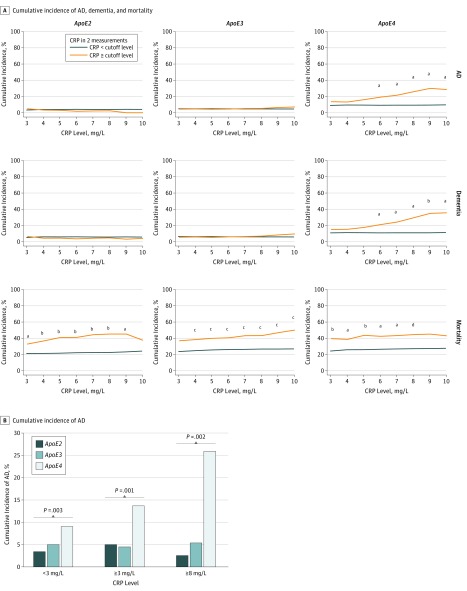
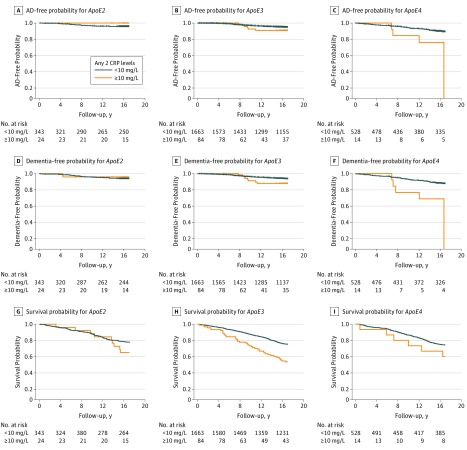
Importance: The association between peripheral inflammatory biomarkers and Alzheimer disease (AD) is not consistent in the literature. It is possible that chronic inflammation, rather than 1 episode of inflammation, interacts with genetic vulnerability to increase the risk for AD. Objective: To study the interaction between the apolipoprotein E (ApoE) genotype and chronic low-grade inflammation and its association with the incidence of AD. Design, Setting, and Participants: In this cohort study, data from 2656 members of the Framingham Heart Study offspring cohort (Generation 2; August 13, 1971-November 27, 2017) were evaluated, including longitudinal measures of serum C-reactive protein (CRP), diagnoses of incident dementia including AD, and brain volume. Chronic low-grade inflammation was defined as having CRP at a high cutoff level at a minimum of 2 time points. Statistical analysis was performed from December 1, 1979, to December 31, 2015. Main Outcomes and Measures: Development of AD and brain volumes. Results: Of the 3130 eligible participants, 2656 (84.9%; 1227 men and 1429 women; mean [SD] age at last CRP measurement, 61.6 [9.5] years) with both ApoE status and longitudinal CRP measurements were included in this study analysis. Median (interquartile range) CRP levels increased with mean (SD) age (43.3 [9.6] years, 0.95 mg/L [0.40-2.35 mg/L] vs 59.1 [9.6] years, 2.04 mg/L [0.93-4.75 mg/L] vs 61.6 [9.5] years, 2.21 mg/L [1.05-5.12 mg/L]; P < .001), but less so among those with ApoE4 alleles, followed by ApoE3 then ApoE2 genotypes. During the 17 years of follow-up, 194 individuals (7.3%) developed dementia, 152 (78.4%) of whom had AD. ApoE4 coupled with chronic low-grade inflammation, defined as a CRP level of 8 mg/L or higher, was associated with an increased risk of AD, especially in the absence of cardiovascular diseases (hazard ratio, 6.63; 95% CI, 1.80-24.50; P = .005), as well as an increased risk of earlier disease onset compared with ApoE4 carriers without chronic inflammation (hazard ratio, 3.52; 95% CI, 1.27-9.75; P = .009). This phenomenon was not observed among ApoE3 and ApoE2 carriers with chronic low-grade inflammation. Finally, a subset of 1761 individuals (66.3%) underwent brain magnetic resonance imaging, and the interaction between ApoE4 and chronic low-grade inflammation was associated with brain atrophy in the temporal lobe (β = -0.88, SE = 0.22; P < .001) and hippocampus (β = -0.04, SE = 0.01; P = .005), after adjusting for confounders. Conclusions and Relevance: In this study, peripheral chronic low-grade inflammation in participants with ApoE4 was associated with shortened latency for onset of AD. Rigorously treating chronic systemic inflammation based on genetic risk could be effective for the prevention and intervention of AD.
Overview
The claims and statistics of this paper haven’t been checked yet.
Run the check — free, no account needed. It reads the open-access text and checks the sources it cites.
Integrity signals
Registry
Cites
Statistics
Figures
Verification
Claims the paper makes
The claims and statistics of this paper haven’t been checked yet.
Run the check — free, no account needed. It reads the open-access text and checks the sources it cites.
Claims other papers make about this one
Each is checked against this paper’s own text: does it say what the citing paper says it does?
The source backs part of the claim, not all of it — or backs it for a different population, condition or comparison.
In the citing paper
“As some proinflammatory proteins in blood impact APOE genotypes differently for AD risk [4, 20]”
From Blood PCSK9 Impacts Alzheimer's Disease Risk in an APOE Genotype‐Dependent Manner: A Prospective Cohort Study (2026) · cites this paper as [20]
Experimental — accuracy not yet measuredThe source backs part of the claim, not all of it — or backs it for a different population, condition or comparison.
In the citing paper
“Our findings of an inflammatory phenotype in resting APOE4 iAstrocytes could explain the mechanistic link between chronic inflammation and AD pathogenesis in APOE4 carriers (Tao et al., 2018).”
From APOE2, E3, and E4 differentially modulate cellular homeostasis, cholesterol metabolism, and inflammatory response in isogenic iPSC-derived astrocytes (2022) · cites this paper as Tao et al., 2018
Experimental — accuracy not yet measuredThe cited source says what the claim attributes to it.
In the citing paper
“In APOE4 carriers, chronic inflammation has been linked to an accelerated onset of AD symptoms [77].”
Self-check
Percentages, sums and reported differences re-computed from the paper’s own numbers.
The self-check needs the paper’s full text.
Citations
Cites
Strittmatter, W. J., Saunders, A. M., Schmechel, D., Pericak-Vance, M., Enghild, J., Salvesen, G. S., & Roses, A. D. (1993) · Proceedings of the National Academy of Sciences · doi:10.1073/pnas.90.5.1977 · Cited by 4,268
AN INVESTIGATION OF CORONARY HEART DISEASE IN FAMILIES
Kannel, W. B., Feinleib, M., McNAMARA, P. M., Garrison, R. J., & Castelli, W. P. (1979) · American Journal of Epidemiology · doi:10.1093/oxfordjournals.aje.a112813 · Cited by 1,639
Rost, N. S., Wolf, P. A., Kase, C. S., Kelly‐Hayes, M., Silbershatz, H., Massaro, J. M., D’Agostino, R. B., Franzblau, C., & Wilson, P. W. F. (2001) · Stroke · doi:10.1161/hs1101.098151 · Cited by 806
Self-citationDeCarli, C., Massaro, J., Harvey, D., Hald, J., Tullberg, M., Au, R., Beiser, A., D’Agostino, R., & Wolf, P. A. (2005) · Neurobiology of Aging · doi:10.1016/j.neurobiolaging.2004.05.004 · Cited by 680
Self-citationJEUKENDRUP, A. E., VET-JOOP, K., STURK, A., STEGEN, J. H. J. C., SENDEN, J., SARIS, W. H. M., & WAGENMAKERS, A. J. M. (2000) · Clinical Science · doi:10.1042/cs0980047 · Cited by 371
Inflammatory biomarkers are associated with total brain volume
Jefferson, A. L., Massaro, J. M., Wolf, P. A., Seshadri, S. S., Au, R., Vasan, R. S., Larson, M. G., Meigs, J. B., Keaney, J. F., Lipinska, I., et al. (2007) · Neurology · doi:10.1212/01.wnl.0000257815.20548.df · Cited by 277
Self-citationPeriodontal disease associates with higher brain amyloid load in normal elderly
Kamer, A. R., Pirraglia, E., Tsui, W., Rusinek, H., Vallabhajosula, S., Mosconi, L., Li, Y., McHugh, P. F., Craig, R. G., Svetcov, S., et al. (2014) · Neurobiology of Aging · doi:10.1016/j.neurobiolaging.2014.10.038 · Cited by 276
Cardiac Index Is Associated With Brain Aging: The Framingham Heart Study
Jefferson, A. L., Himali, J. J., Beiser, A. S., Au, R., Massaro, J. M., Seshadri, S., Gona, P., Salton, C. J., DeCarli, C., O'Donnell, C. J., et al. (2010) · Circulation · doi:10.1161/circulationaha.109.905091 · Cited by 256
Self-citationWilson, P. W. F., Nam, B., Pencina, M. J., D’Agostino, R. B., Benjamin, E. J., & O’Donnell, C. J. (2005) · Archives of Internal Medicine · doi:10.1001/archinte.165.21.2473 · Cited by 236
Wang, T. J., Nam, B., Wilson, P. W. F., Wolf, P. A., Levy, D. A., Polak, J. F., D’Agostino, R. B., & O’Donnell, C. J. (2002) · Arteriosclerosis Thrombosis and Vascular Biology · doi:10.1161/01.atv.0000034543.78801.69 · Cited by 236
Cited by
Sorted by citations
ApoE in Alzheimer’s disease: pathophysiology and therapeutic strategies
Raulin, A.-C., Doss, S. V., Trottier, Z. A., Ikezu, T. C., Bu, G., & Liu, C.-C. (2022) · Molecular Neurodegeneration · doi:10.1186/s13024-022-00574-4 · Cited by 756
“Contrary to this trend in genotype, cumulative incidence of AD was shown to markedly increase as levels of serum CRP increase, with the greatest effect in APOE4 carriers [126].”
Peripheral and central immune system crosstalk in Alzheimer disease — a research prospectus
Bettcher, B. M., Tansey, M. G., Dorothée, G., & Heneka, M. T. (2021) · Nature Reviews Neurology · doi:10.1038/s41582-021-00549-x · Cited by 427
Alzheimer’s disease: insights into pathology, molecular mechanisms, and therapy
Zheng, Q., & Wang, X. (2024) · Protein & Cell · doi:10.1093/procel/pwae026 · Cited by 483
Webers, A., Heneka, M. T., & Gleeson, P. A. (2019) · Immunology and Cell Biology · doi:10.1111/imcb.12301 · Cited by 377
“we know about conditions associated with chronic inflammation and susceptibility to AD? There is evidence of a correlation between systemic chronic inflammation, as determined by elevated C-reactive protein, and AD risk.(100) Inflammatory conditions are also increasingly linked to AD.”
BackgroundAPOE mediated neuroinflammation and neurodegeneration in Alzheimer’s disease
Parhizkar, S., & Holtzman, D. M. (2022) · Seminars in Immunology · doi:10.1016/j.smim.2022.101594 · Cited by 255
Understanding multifactorial brain changes in type 2 diabetes: a biomarker perspective
Biessels, G. J., Nobili, F. M., Teunissen, C. E., Simó, R., & Scheltens, P. (2020) · The Lancet Neurology · doi:10.1016/s1474-4422(20)30139-3 · Cited by 195
Genetic associations for two biological age measures point to distinct aging phenotypes
Kuo, C., Pilling, L. C., Liu, Z., Atkins, J. L., & Levine, M. E. (2021) · Aging Cell · doi:10.1111/acel.13376 · Cited by 173
“Although the underlying mechanism is not fully understood, it has been reported that high inflammation (high CRP) is associated with increased risk of Alzheimer's disease among e4 genotypes (e3e4 or e4e4) but less so among non- e4 genotypes (Tao et al., 2018).”
BackgroundAPOE alleles and diet in brain aging and Alzheimer's disease
Yassine, H. N., & Finch, C. E. (2020) · Frontiers in Aging Neuroscience · doi:10.3389/fnagi.2020.00150 · Cited by 145
“The older Caucasians and African Americans differed widely in the frequency of ‘523.”
BackgroundResultInfluentialMetabolic Syndrome as a Risk Factor for Alzheimer’s Disease: A Focus on Insulin Resistance
Ezkurdia, A., Ramírez, M. J., & Solas, M. (2023) · International Journal of Molecular Sciences · doi:10.3390/ijms24054354 · Cited by 160
“Other possible mechanisms linking DM and AD have also been described, such as chronic inflammation and oxidative stress [25,34,146].”
BackgroundExercise suppresses neuroinflammation for alleviating Alzheimer’s disease
Wang, M., Zhang, H., Liang, J., Huang, J., & Chen, N. (2023) · Journal of Neuroinflammation · doi:10.1186/s12974-023-02753-6 · Cited by 154
“Large-scale samples also show the increased C-reactive protein (CRP) in the blood of the people at middle age, which is similar with AD patients [106].”
ResultSleep Disturbance as Potential Risk and Progression Factor for Parkinson’s Disease
Bohnen, N. I., & Hu, M. T. M. (2019) · Journal of Parkinson s Disease · doi:10.3233/jpd-191627 · Cited by 146
Inflammation in Neurological Disorders: The Thin Boundary Between Brain and Periphery
Cervellati, C., Trentini, A., Pecorelli, A., & Valacchi, G. (2020) · Antioxidants and Redox Signaling · doi:10.1089/ars.2020.8076 · Cited by 140
Arellanes, I. C., Choe, N., Solomon, V. A., He, X., Kavin, B., Martinez, A. E., Kono, N., Buennagel, D. P., Hazra, N., Kim, G., et al. (2020) · EBioMedicine · doi:10.1016/j.ebiom.2020.102883 · Cited by 141
“This finding contributes to our understanding as to why APOE 4 carriers with limited omega-3 intake might be at a greater risk of neuroinflammation and AD progression [30] .”
BackgroundHoffman, J. D., Yanckello, L. M., Chlipala, G. E., Hammond, T. C., McCulloch, S. D., Parikh, I. J., Sun, S., Morganti, J. M., Green, S. J., & Lin, A. (2019) · PLoS ONE · doi:10.1371/journal.pone.0221828 · Cited by 137
The role of innate immunity in Alzheimer's disease
Ennerfelt, H. E., & Lukens, J. R. (2020) · Immunological Reviews · doi:10.1111/imr.12896 · Cited by 124
The role of peripheral inflammatory insults in Alzheimer’s disease: a review and research roadmap
Walker, K. A., Page, L. M. L., Terrando, N., Duggan, M. R., Heneka, M. T., & Bettcher, B. M. (2023) · Molecular Neurodegeneration · doi:10.1186/s13024-023-00627-2 · Cited by 121
Microglia-Astrocyte Communication in Alzheimer’s Disease
Wu, Y., & Eisel, U. L. M. (2023) · Journal of Alzheimer s Disease · doi:10.3233/jad-230199 · Cited by 125
Duong, M. T., Nasrallah, I. M., Wolk, D. A., Chang, C. C. Y., & Chang, T. (2021) · Frontiers in Aging Neuroscience · doi:10.3389/fnagi.2021.647990 · Cited by 110
“In VCID and AD, crosstalk of systemic and neuroinflammatory pathways leads to stromal dysfunction (Holmes et al., 2009; Tao et al., 2018).”
BackgroundCerebral Small Vessel Disease and Alzheimer's Disease: A Review
Kim, H. W., Hong, J., & Jeon, J. C. (2020) · Frontiers in Neurology · doi:10.3389/fneur.2020.00927 · Cited by 111
de Leeuw, S. M., Kirschner, A. W. T., Lindner, K., Rust, R., Budny, V., Wolski, W. E., Gavin, A.-C., Nitsch, R. M., & Tackenberg, C. (2022) · Stem Cell Reports · doi:10.1016/j.stemcr.2021.11.007 · Cited by 105
Alzheimer's disease pathophysiology in the Retina
Gaire, B. P., Koronyo, Y., Fuchs, D.-T. S., Shi, H., Rentsendorj, A., Danziger, R., Vit, J., Mirzaei, N., Doustar, J., Sheyn, J., et al. (2024) · Progress in Retinal and Eye Research · doi:10.1016/j.preteyeres.2024.101273 · Cited by 107
Soda, K. (2022) · Cells · doi:10.3390/cells11010164 · Cited by 91
Re-thinking the Etiological Framework of Neurodegeneration
Castillo, X., Castro‐Obregón, S., Gutiérrez-Becker, B., Gutiérrez‐Ospina, G., Karalis, N., Khalil, A. A., López‐Noguerola, J. S., Rodríguez, L. L., Martínez‐Martínez, E., Perez‐Cruz, C., et al. (2019) · Frontiers in Neuroscience · doi:10.3389/fnins.2019.00728 · Cited by 80
“In AD, systemic inflammation during prodromal stages shortens disease onset (Tao et al., 2018), whereas dysregulation of the gastrointestinal function and colonic inflammation diminished immune competence and preceded motor symptoms in PD patients (Dobbs et al.”
BackgroundFriedberg, J. S., Aytan, N., Cherry, J. D., Xia, W., Standring, O. J., Alvarez, V. E., Nicks, R., Svirsky, S. E., Meng, G., Jun, G., et al. (2020) · Scientific Reports · doi:10.1038/s41598-020-59869-5 · Cited by 82
Self-citationAPOE ε4 carriers share immune-related proteomic changes across neurodegenerative diseases
Shvetcov, A., Johnson, E. C. B., Winchester, L. M., Walker, K. A., Wilkins, H. M., Thompson, T. G., Rothstein, J. D., Krish, V., Imam, F. B., The Global Neurodegeneration Proteomics Consortium (GNPC), et al. (2025) · Nature Medicine · doi:10.1038/s41591-025-03835-z · Cited by 78
“While this immune response protects younger APOE ε4 carriers from infectious diseases, prolonged states of inflammation and cytokine release are likely deleterious with age 34,35 .”
AmeliMojarad, M., & AmeliMojarad, M. (2024) · CNS Neuroscience & Therapeutics · doi:10.1111/cns.14856 · Cited by 73
“12,49 Due to its dysregulation of neuroinflammation and elevation of AD risk, the missense mutation R47H of TREM2 is linked to AD risk.”
BackgroundRemembering your A, B, C's: Alzheimer's disease and ABCA1
Lewandowski, C. T., Laham, M. S., & Thatcher, G. R. J. (2022) · Acta Pharmaceutica Sinica B · doi:10.1016/j.apsb.2022.01.011 · Cited by 76
Marciniak, R., Šumec, R., Vyhnálek, M., Bendíčková, K., Lázničková, P., Forte, G., Jeleník, A., Římalová, V., Frič, J., Hort, J., et al. (2020) · Clinical Interventions in Aging · doi:10.2147/cia.s249196 · Cited by 72
Wang, S., Li, B., Solomon, V. A., Fonteh, A. N., Rapoport, S. I., Bennett, D. A., Arvanitakis, Z., Chui, H. C., Sullivan, P. M., & Yassine, H. N. (2022) · Molecular Neurodegeneration · doi:10.1186/s13024-022-00549-5 · Cited by 68
“[19] Participants with APOE4 and elevated plasma C reactive protein (CRP) levels had a shortened latency for the onset of AD (n = 2562).”
BackgroundSi, S., Li, J., Tewara, M. A., & Xue, F. (2021) · Frontiers in Immunology · doi:10.3389/fimmu.2021.720876 · Cited by 64
“C-reactive protein (CRP) is a major acutephase reactant and a sensitive biomarker of chronic low-grade inflammation (2) that has been viewed as a risk factor for cardiovascular diseases (3), cancers (2), type 2 diabetes (4), Alzheimer’s disease (AD) (5), schizophrenia (6), and autoimmune diseases (7), etc.”
BackgroundChernick, D., Ortiz‐Valle, S., Jeong, A., Qu, W., & Li, L. (2019) · Neuroscience Letters · doi:10.1016/j.neulet.2019.134306 · Cited by 64
Wang, Y., Mishra, A., & Brinton, R. D. (2020) · F1000Research · doi:10.12688/f1000research.21599.1 · Cited by 65
García, A. R., Finch, C. E., Gatz, M., Kraft, T. S., Rodriguez, D. E., Charifson, M., Rodríguez, D. E., Buetow, K. H., Beheim, B., Allayee, H., et al. (2021) · eLife · doi:10.7554/elife.68231 · Cited by 61
Shang, X., Zhu, Z., Zhang, X., Huang, Y., Zhang, X., Liu, J., Wang, W., Tang, S., Yu, H., Ge, Z., et al. (2022) · EClinicalMedicine · doi:10.1016/j.eclinm.2022.101335 · Cited by 60
Self-citationAge and Sex Influence the Neuro-inflammatory Response to a Peripheral Acute LPS Challenge
Murtaj, V., Belloli, S., Di Grigoli, G., Pannese, M., Ballarini, E., Rodriguez-Menendez, V., Marmiroli, P., Cappelli, A., Masiello, V., Monterisi, C., et al. (2019) · Frontiers in Aging Neuroscience · doi:10.3389/fnagi.2019.00299 · Cited by 58
“Neuroinflammation has also been recognized as a pathophysiological mechanism of dementia, especially AD, again with frailty as a modulating factor of the disease clinical expression (Tao et al., 2018; Wallace et al., 2019).”
BackgroundHDL Proteome and Alzheimer’s Disease: Evidence of a Link
Marsillach, J., Adorni, M. P., Zimetti, F., Papotti, B., Zuliani, G., & Cervellati, C. (2020) · Antioxidants · doi:10.3390/antiox9121224 · Cited by 62
“In humans, the presence of chronic low-grade inflammation was associated with increased risk of AD, and to shorter latency of disease onset, only in APOE4 carriers [85].”
BackgroundChen, J., Doyle, M. F., Fang, Y., Mez, J., Crane, P. K., Scollard, P., ADSP Data Harmonization Consortium Cognitive Harmonization Core, Satizabal, C. L., Alosco, M. L., Qiu, W. Q., et al. (2023) · Aging Cell · doi:10.1111/acel.13955 · Cited by 56
“In the Framingham Heart Study (FHS), chronic peripheral inflammation measured with CRP increased the risk for dementia and AD dementia but only in apolipoprotein E ( APOE ) ε 4 carriers (Tao et al., 2018 ).”
BackgroundSelf-citationCoates, A. M., Morgillo, S., Yandell, C. A., Scholey, A. B., Buckley, J. D., Dyer, K. A., & Hill, A. M. (2020) · Nutrients · doi:10.3390/nu12041180 · Cited by 55
“C Reactive Protein Values for CRP above 3 mg/L were excluded as they were considered to reflect low-grade inflammation [47].”
BackgroundLiang, T., Hang, W., Chen, J., Wu, Y., Wen, B., Xu, K., Ding, B., & Chen, J. (2021) · Cell & Bioscience · doi:10.1186/s13578-021-00563-y · Cited by 54
Naler, L. B., Hsieh, Y.-P., Geng, S., Zhou, Z., Li, L., & Lu, C. (2022) · Communications Biology · doi:10.1038/s42003-022-03035-2 · Cited by 55
Hegazy, S. H., Thomassen, J. Q., Rasmussen, I. J., Nordestgaard, B. G., Tybjærg‐Hansen, A., & Frikke‐Schmidt, R. (2022) · Alzheimer s & Dementia · doi:10.1002/alz.12568 · Cited by 56
Walker, K. A., Gross, A. L., Moghekar, A., Soldan, A., Pettigrew, C. A., Hou, X., Lu, H., Alfini, A. J., Bilgel, M., Miller, M. I., et al. (2020) · Brain Behavior and Immunity · doi:10.1016/j.bbi.2020.01.006 · Cited by 52
“Consistent with previous work which suggests that inflammation and APOE ε4 allele possession may act synergistically to promote neurodegenerative changes and increase AD risk (Tao et al., 2018), our results indicate that APOE ε4 allele possession magnifies the association between inflammation and reduced network conne…”
ResultRelationships between Inflammation and Age-Related Neurocognitive Changes
Jin, R., Chan, A. K. Y., Wu, J., & Lee, T. M. C. (2022) · International Journal of Molecular Sciences · doi:10.3390/ijms232012573 · Cited by 54
“Previous research has also revealed that genetic susceptibility and chronic inflammation interaction in people with a high level of C-reactive protein (CRP; ≤ 8 mg/L), an indicator of inflammation states secreted in response to cytokines that indicates an increased risk of AD and of earlier disease onset [17].”
BackgroundZhang, Z., Na, H., Gan, Q., Tao, Q., Alekseyev, Y., Hu, J., Yan, Z., Yang, J. B., Tian, H., Zhu, S., et al. (2021) · Aging Cell · doi:10.1111/acel.13501 · Cited by 45
Self-citationTao, Q., Alvin Ang, T. F., Akhter-Khan, S. C., Itchapurapu, I. S., Killiany, R., Zhang, X., Budson, A. E., Turk, K. W., Goldstein, L., Mez, J., et al. (2021) · Neurology · doi:10.1212/wnl.0000000000012512 · Cited by 45
“, high CRP levels).(3) Such inflammatory response may increase susceptibility to AD, especially among those already at risk (i.”
BackgroundSelf-citationRubinstein, T., Brickman, A. M., Cheng, B., Burkett, S., Park, H., Annavajhala, M. K., Uhlemann, A., Andrews, H., Gutierrez, J., Paster, B. J., et al. (2024) · Alzheimer s & Dementia · doi:10.1002/alz.13683 · Cited by 45
Dvir-Szternfeld, R., Castellani, G., Arad, M., Cahalon, L., Colaiuta, S. P., Keren‐Shaul, H., Croese, T., Burgaletto, C., Baruch, K., Ulland, T. K., et al. (2021) · Nature Aging · doi:10.1038/s43587-021-00149-w · Cited by 42
Long, S., Chen, Y., Yi, M., Yang, Z., Wei, M., Li, T., Ni, J., Shi, J., & Tian, J. (2022) · Journal of Clinical Neuroscience · doi:10.1016/j.jocn.2022.11.016 · Cited by 48
APOE genetics influence murine gut microbiome
Zajac, D. J., Green, S. J., Johnson, L. A., & Estus, S. (2022) · Scientific Reports · doi:10.1038/s41598-022-05763-1 · Cited by 41
Insomnia symptom severity and cognitive performance: Moderating role of APOE genotype
Baril, A., Beiser, A., Sanchez, E., Mysliwiec, V., Redline, S. S., Gottlieb, D. J., O’Connor, G. T., Gonzales, M. M., Himali, D., Seshadri, S. S., et al. (2021) · Alzheimer s & Dementia · doi:10.1002/alz.12405 · Cited by 47
Endothelial Progenitor Cells and Vascular Alterations in Alzheimer’s Disease
Custodia, A., Ouro, A., Romaus‐Sanjurjo, D., Peleteiro, J. M. P., de Vries, H. E., Castillo, J., & Sobrino, T. (2022) · Frontiers in Aging Neuroscience · doi:10.3389/fnagi.2021.811210 · Cited by 45
Insulin resistance in Alzheimer’s disease: The genetics and metabolomics links
Amin, A. M., Mostafa, H. M. A., & Khojah, H. M. J. (2022) · Clinica Chimica Acta · doi:10.1016/j.cca.2022.12.016 · Cited by 45
Apolipoprotein E Effects on Mammalian Ovarian Steroidogenesis and Human Fertility
Oriá, R. B., de Almeida, J. Z., Moreira, C. N., Guerrant, R. L., & Figueiredo, J. R. (2020) · Trends in Endocrinology and Metabolism · doi:10.1016/j.tem.2020.06.003 · Cited by 45
Comorbidity‐driven multi‐modal subtype analysis in mild cognitive impairment of Alzheimer's disease
Katabathula, S., Davis, P. B., & Xu, R. (2022) · Alzheimer s & Dementia · doi:10.1002/alz.12792 · Cited by 43
Yamaguchi, S., Murakami, T., Satoh, M., Komiyama, T., Ohi, T., Miyoshi, Y., Endo, K., Hiratsuka, T., Hara, A., Tatsumi, Y., et al. (2023) · Neurology · doi:10.1212/wnl.0000000000207579 · Cited by 42
“In a previous study showing a cross-sectional association between chronic systemic inflammation and hippocampal volume, CRP ≥3 mg/L at ≥2 time points was defined as chronic low-grade inflammation.(41) Periodontitis is a chronic inflammation and increases CRP in severe cases(42); however, in this study, only 11 partici…”
BackgroundInflammation: A Major Target for Compounds to Control Alzheimer’s Disease
Maccioni, R. B., Navarrete, L. P., González, A., González-Canacer, A., Guzmán‐Martínez, L., & Cortés, N. (2020) · Journal of Alzheimer s Disease · doi:10.3233/jad-191014 · Cited by 42
Crossing borders in Alzheimer’s disease: A T cell’s perspective
van Olst, L., Coenen, L., Nieuwland, J. M., Rodriguez-Mogeda, C., de Wit, N. M., Kamermans, A., Middeldorp, J., & de Vries, H. E. (2022) · Advanced Drug Delivery Reviews · doi:10.1016/j.addr.2022.114398 · Cited by 45
The Role of Apolipoprotein E Isoforms in Alzheimer’s Disease
Roda, A. R., Montoliu‐Gaya, L., & Villegas, S. (2019) · Journal of Alzheimer s Disease · doi:10.3233/jad-180740 · Cited by 41
Association of CD14 with incident dementia and markers of brain aging and injury
Pase, M. P., Himali, J. J., Beiser, A., DeCarli, C. S., McGrath, E. R., Satizábal, C. L., Aparicio, H. J., Adams, H. H. H., Reiner, A. P., Longstreth, W. T., et al. (2019) · Neurology · doi:10.1212/wnl.0000000000008682 · Cited by 39
“SBP, mm Hg, mean (SD) 133 (19) 131 (20) 135 (21) 134 (22)”
Self-citationUchio, R., Muroyama, K., Okuda-Hanafusa, C., Kawasaki, K., Yamamoto, Y., & Murosaki, S. (2019) · Nutrients · doi:10.3390/nu11081822 · Cited by 38
“Previous reports have indicated that chronic low-grade inflammation is potentially associated with an increased risk of metabolic syndrome [7], atherosclerotic disease [8], Alzheimer’s disease [9], and cancer [10].”
BackgroundJun, G., You, Y., Zhu, C., Meng, G., Chung, J., Panitch, R., Hu, J., Xia, W., Bennett, D. A., Foroud, T., et al. (2022) · Alzheimer s & Dementia · doi:10.1002/alz.12607 · Cited by 35
Self-citationLipids and brain inflammation in APOE4-associated dementia
Duro, M. V. V., Ebright, B., & Yassine, H. N. (2021) · Current Opinion in Lipidology · doi:10.1097/mol.0000000000000801 · Cited by 39
“The correlation between APOE4 and inflammation was clearly demonstrated in the Framingham cohort, where participants with APOE4 and elevated plasma C-reactive protein levels had a greater risk of developing AD dementia than age and sex-matched APOE2 and APOE3 carriers [60].”
BackgroundAssociation between inflammatory biomarkers and cognitive aging
Fang, Y., Doyle, M. F., Chen, J., Alosco, M. L., Mez, J. B., Satizábal, C. L., Qiu, W. Q., Murabito, J. M., & Lunetta, K. L. (2022) · PLoS ONE · doi:10.1371/journal.pone.0274350 · Cited by 38
Self-citationZhang, Z., Gan, Q., Han, J., Tao, Q., Qiu, W. Q., & Madri, J. A. (2023) · Journal of Cerebral Blood Flow & Metabolism · doi:10.1177/0271678x231170041 · Cited by 37
Self-citationAltered SPMs and age‐associated decrease in brain DHA in APOE4 female mice
Martinsen, A., Tejera, N., Vauzour, D., Harden, G., Dick, J., Shinde, S., Barden, A. E., Mori, T. A., & Minihane, A. M. (2019) · The FASEB Journal · doi:10.1096/fj.201900423r · Cited by 38
“Neuroinflammation plays a key role in neuronal function and AD pathology (49).”
BackgroundAlzheimer's disease mechanisms in peripheral cells: Promises and challenges
Trushina, E. V. (2019) · Alzheimer s & Dementia Translational Research & Clinical Interventions · doi:10.1016/j.trci.2019.06.008 · Cited by 35
Targeting Infectious Agents as a Therapeutic Strategy in Alzheimer’s Disease
Fülöp, T., Munawara, U., Larbi, A., Desroches, M., Rodrigues, S., Catanzaro, M., Guidolin, A., Khalil, A., Bernier, F., Barron, A. E., et al. (2020) · CNS Drugs · doi:10.1007/s40263-020-00737-1 · Cited by 32
Senescent accelerated prone 8 (SAMP8) mice as a model of age dependent neuroinflammation
Fernández, A., Quintana, E., Velasco, P., Moreno-Jimenez, B., de Andrés, B., Gaspar, M.-L., Liste, I., Vilar, M., Mira, H., & Cano, E. (2021) · Journal of Neuroinflammation · doi:10.1186/s12974-021-02104-3 · Cited by 38
Uchio, R., Kawasaki, K., Okuda-Hanafusa, C., Saji, R., Muroyama, K., Murosaki, S., Yamamoto, Y., & Hirose, Y. (2021) · Nutrition Journal · doi:10.1186/s12937-021-00748-8 · Cited by 42
“Previous reports indicated that chronic low-grade inflammation is potentially associated with an increased risk of metabolic syndrome [7], atherosclerotic disease [8], Alzheimer’s disease [9], neurodegenerative disease [2], sickness behaviors and mood disturbance [10], cancer [11], and mortality [12, 13].”
BackgroundThe emerging role of brain neuroinflammatory responses in Alzheimer’s disease
AmeliMojarad, M., AmeliMojarad, M., & Cui, X. (2024) · Frontiers in Aging Neuroscience · doi:10.3389/fnagi.2024.1391517 · Cited by 34
Systemic inflammation as a moderator between sleep and incident dementia
Baril, A., Beiser, A., Redline, S. S., McGrath, E. R., Aparicio, H. J., Gottlieb, D. J., Seshadri, S. S., Pase, M. P., & Himali, J. J. (2020) · SLEEP · doi:10.1093/sleep/zsaa164 · Cited by 31
The Role of Chronic Infection in Alzheimer’s Disease: Instigators, Co-conspirators, or Bystanders?
Butler, L., & Walker, K. A. (2021) · Current Clinical Microbiology Reports · doi:10.1007/s40588-021-00168-6 · Cited by 30
Asthma amplifies dementia risk: Evidence from CSF biomarkers and cognitive decline
Nair, A. K., Hulle, C. A. V., Bendlin, B. B., Zetterberg, H., Blennow, K., Wild, N., Kollmorgen, G., Suridjan, I., Busse, W. W., & Rosenkranz, M. A. (2022) · Alzheimer s & Dementia Translational Research & Clinical Interventions · doi:10.1002/trc2.12315 · Cited by 31
Botchway, B. O., Okoye, F. C., Chen, Y., Arthur, W. E., & Fang, M. (2022) · Aging and disease · doi:10.14336/ad.2021.0616 · Cited by 32
Wandering along the epigenetic timeline
Topart, C., Werner, E., & Arimondo, P. B. (2020) · Clinical Epigenetics · doi:10.1186/s13148-020-00893-7 · Cited by 34
“Chronic inflammation promotes numerous age-related pathologies, such as cance r [90] and neurodegenerative diseases [91, 92], hence the need to prevent it.”
BackgroundInflammatory and Pro-resolving Mediators in Frontotemporal Dementia and Alzheimer’s Disease
Fraga, V. G., Magalhaes, C. A., Loures, C. D. M. G., de Souza, L. C., Guimarães, H. C., Zauli, D. A. G., Ferriani, M. D. G. C., Ferreira, C. N., Caramelli, P., Sousa, L. P., et al. (2019) · Neuroscience · doi:10.1016/j.neuroscience.2019.09.008 · Cited by 28
Mekli, K., Lophatananon, A., Maharani, A., Nazroo, J. Y., & Muir, K. R. (2023) · PLoS ONE · doi:10.1371/journal.pone.0288045 · Cited by 28
Biological brain age and resilience in cognitively unimpaired 70‐year‐old individuals
Marseglia, A., Dartora, C. M., Samuelsson, J., Poulakis, K., Mohanty, R., Shams, S., Lindberg, O. E., Rydén, L., Sterner, T. R., Skoog, J., et al. (2024) · Alzheimer s & Dementia · doi:10.1002/alz.14435 · Cited by 27
“53,54 More recently, Hayek and coll.”
Oxytocin and elderly MRI-based hippocampus and amygdala volume: a 7-year follow-up study
Orihashi, R., Mizoguchi, Y., Imamura, Y., Yamada, S., Ueno, T., & Monji, A. (2020) · Brain Communications · doi:10.1093/braincomms/fcaa081 · Cited by 27
“Alzheimer’s disease is related to inflammation and treating chronic systemic inflammation may be effective in the prevention and intervention of Alzheimer’s disease (Tao et al. , 2018).”
Ferguson, A., Tank, R., Lyall, L. M., Ward, J., Celis-Morales, C. A., Strawbridge, R. J., Ho, F. K. W., Whelan, C. D., Gill, J. M. R., Welsh, P. I., et al. (2020) · Journal of Alzheimer s Disease · doi:10.3233/jad-200338 · Cited by 26
Beyond the amyloid cascade: An update of Alzheimer's disease pathophysiology
Gouilly, D., Rafiq, M., Nogueira, L., Salabert, A., Payoux, P., Péran, P., & Pariente, J. (2023) · Revue Neurologique · doi:10.1016/j.neurol.2022.12.006 · Cited by 31
Myasoedova, E., Sattui, S. E., Lee, J., O'Brien, J. T., & Makris, U. E. (2024) · The Lancet Rheumatology · doi:10.1016/s2665-9913(24)00190-5 · Cited by 29
Fang, Y., Doyle, M. F., Alosco, M. L., Mez, J., Satizábal, C. L., Qiu, W. Q., Lunetta, K. L., & Murabito, J. M. (2022) · Journal of Alzheimer s Disease · doi:10.3233/jad-215533 · Cited by 25
Self-citationMhatre‐Winters, I., Eid, A., Han, Y., Tieu, K., & Richardson, J. R. (2022) · International Journal of Molecular Sciences · doi:10.3390/ijms23179829 · Cited by 26
“Importantly, this is consistent with clinical data from healthy individuals carrying the APOE3 or APOE4 gene; APOE4 females show a greater increase in both pro-inflammatory cytokine release and gene expression [82,85,86].”
ResultAyyubova, G., Kodali, M., Upadhya, R., Madhu, L. N., Attaluri, S., Somayaji, Y., Shuai, B., Rao, S., Shankar, G., & Shetty, A. K. (2023) · Journal of Neuroinflammation · doi:10.1186/s12974-023-02971-y · Cited by 25
Abbatecola, A. M., Giuliani, A., Biscetti, L., Scisciola, L., Battista, P., Barbieri, M., Sabbatinelli, J., & Olivieri, F. (2024) · Ageing Research Reviews · doi:10.1016/j.arr.2024.102257 · Cited by 22
Abdulhameed, N., Babin, A., Hansen, K. M., Weaver, R. R., Banks, W. A., Talbot, K., & Rhea, E. M. (2024) · Alzheimer s Research & Therapy · doi:10.1186/s13195-024-01537-1 · Cited by 25
“Alzheimer’s disease (AD) is a progressive neurocognitive/ neurodegenerative disorder [1, 2] that leads to the most common type of dementia [3, 4].”
Low, A., Su, L., Stefaniak, J. D., Mak, E., Dounavi, M., Terrera, G. M., Ritchie, K. A., Ritchie, C. W., Markus, H. S., & O'Brien, J. T. (2020) · Neurobiology of Aging · doi:10.1016/j.neurobiolaging.2020.10.029 · Cited by 26
Saleh, R. N. M., West, A. L., Ostermann, A. I., Schebb, N. H., Calder, P. C., & Minihane, A. M. (2021) · Frontiers in Nutrition · doi:10.3389/fnut.2021.723813 · Cited by 22
Zhao, X., Lu, J., Zhang, J., Liu, C., Wang, H., Wāng, Y., & Du, Q. (2024) · Psychoneuroendocrinology · doi:10.1016/j.psyneuen.2024.107065 · Cited by 22
C-reactive protein: the nexus between inflammation and protein misfolding diseases
Roy, A., Zeller, J., Nero, T. L., Klepetko, J., Eisenhardt, S. U., Parker, M. W., McFadyen, J. D., & Peter, K. (2025) · Frontiers in Immunology · doi:10.3389/fimmu.2025.1612703 · Cited by 23
Na, H., Yang, J. B., Zhang, Z., Gan, Q., Tian, H., Rajab, I. M., Potempa, L. A., Tao, Q., & Qiu, W. Q. (2023) · Neurobiology of Aging · doi:10.1016/j.neurobiolaging.2023.02.013 · Cited by 27
Self-citationMechanisms of comorbidity between Alzheimer's disease and pain
Yao, K., Wang, S., Xu, Z., Fan, Z., Chen, Z., Jia, P., Tu, S., Liu, Y., Lin, X., Xu, Y., et al. (2025) · Alzheimer s & Dementia · doi:10.1002/alz.14605 · Cited by 23
“99,100 This process activates glial cells, intensifying neuroinflammation.”
Kelliny, S., Zhou, X., & Bobrovskaya, L. (2025) · Journal of Neuroscience Research · doi:10.1002/jnr.70046 · Cited by 27
“Also, a chronic inflammatory state is linked to earlier onset of the disease in APOEε4 carriers (Tao et al. 2018).”
Huang, J., Tao, Q., Ang, T. F. A., Farrell, J. J., Zhu, C., Wang, Y., Stein, T. D., Lunetta, K. L., Massaro, J. M., Mez, J., et al. (2022) · Translational Psychiatry · doi:10.1038/s41398-022-02281-6 · Cited by 21
“DISCUSSION The results of this study extend our previous finding that elevated CRP impacts AD risk among APOE ε4 carriers [8] and the wellestablished relationship between inflammation and AD [40–42].”
MethodResultSelf-citationHe, C., Wu, D., Wei, X., Li, Y., Liao, Y., & Yang, D. (2023) · Nutrition Metabolism and Cardiovascular Diseases · doi:10.1016/j.numecd.2023.10.006 · Cited by 22
Faraji, P., Kühn, H., & Ahmadian, S. (2024) · Journal of Molecular Neuroscience · doi:10.1007/s12031-024-02224-4 · Cited by 25
“In a medium-scale (some 2500 patients) epidemiological study, the impact of chronic low-grade peripheral inflammation in APOE4 allele carriers was tested on the onset of AD (Tao et al. 2018).”
BackgroundChen, X. R., Initiative, A. D. N., Shao, Y., & Sadowski, M. J. (2021) · Journal of Alzheimer s Disease · doi:10.3233/jad-210434 · Cited by 22
Statins for vascular dementia: A hype or hope
Raja, H. G., Al-Kuraishy, H. M., Shokr, M. M., Al-Gareeb, A. I., Al‐Harchan, N. A., Alruwaili, M., Papadakis, M., Alexiou, A. T., & Batiha, G. E. (2024) · Neuroscience · doi:10.1016/j.neuroscience.2024.12.059 · Cited by 21
“A cohort study indicated that high levels of systemic inflammatory biomarkers hasten the development of AD (Tao et al., 2018) .”
The Prevalence and Risk Factors of Cerebral Microbleeds: A Community-Based Study in China
Luo, Q., Tang, H., Xu, X., Huang, J., Wang, P., He, G., Song, X., Huang, Y., Chen, S., Yan, F., et al. (2021) · Therapeutics and Clinical Risk Management · doi:10.2147/tcrm.s297708 · Cited by 17
“Also, APOE ε4 carriers were tended to produce a stronger neuroinflammatory responding to peripheral systemic inflammation.(28) CR1, a receptor for complement C3b/ C4b, is also a central or peripheral factor involving complement mediated inflammation.”
Background
Metadata
- Authors
- Tao, Q., Ang, T. F. A., DeCarli, C., Auerbach, S. H., Devine, S., Stein, T. D., Zhang, X., Massaro, J., Au, R., & Qiu, W. Q.
- Affiliations
- Boston University (US)
- University of California Davis Medical Center (US)
- Corresponding author
- Au, Rhoda
- Qiu, Wei Qiao
- ORCID
- Venue
- JAMA Network Open
- Publisher
- American Medical Association (AMA)
- Published
- 2018-10-19
- Volume
- 1
- Issue
- 6
- Pages
- e183597
- ISSN
- 2574-3805 (ISSN-L)
- PMC
- PMC6324596
- OpenAlex
- W2896917224
- Cited by
- 239
- References
- 34
- Citations by year
- 2026: 19 · 2025: 38 · 2024: 40 · 2023: 33 · 2022: 38 · 2021: 32 · 2020: 26 · 2019: 13
- FWCI
- 13.87
- Type
- journal article
- Language
- en
- Open access
- gold
- doi.org
- Licence
- cc-by
- Locations
- JAMA Network Open (publishedVersion, cc-by)
- Europe PMC (PubMed Central) (publishedVersion, cc-by)
- PubMed Central (publishedVersion, cc-by)
- PubMed (publishedVersion)
- Funders
- National Institutes of Health (n01hc25195-41-0-1)
- National Institute on Aging (P30AG010129, K24AG050842, U01AG052409, R01AG054076)
- National Heart, Lung, and Blood Institute (N01‐HC25195)
- National Institute of Neurological Disorders and Stroke (R01NS017950)
- Topics
- Health Sciences › Medicine › Psychiatry and Mental health › Dementia and Cognitive Impairment Research
- Life Sciences › Neuroscience › Cellular and Molecular Neuroscience › Alzheimer's disease research and treatments
- Life Sciences › Neuroscience › Neurology › Neuroinflammation and Neurodegeneration Mechanisms
- Keywords
- Alzheimer's disease, low-grade inflammation, apolipoprotein E, APOE ε4 carriers, C-reactive protein, inflammatory markers, dementia incidence, brain volume, cardiovascular disease, Framingham Offspring cohort, APOE3, APOE2
- MeSH terms
- Adult, Aged, Aged, 80 and over, Alzheimer Disease, Brain, C-Reactive Protein, Chronic Disease, Female, Humans, Inflammation, Longitudinal Studies, Magnetic Resonance Imaging, Male, Middle Aged, Risk Factors, Cohort Studies, Apolipoprotein E4
About these checks
Registry, retraction, Cites and statistics results are computed, not judged, with one exception: a printed reference that no index lists is read once by a model before it counts as a citation error. Claims are extracted by a model and kept only when their quote appears verbatim in the text; each cited source is then checked, with a model’s help, for whether it says what the claim relies on. Those verdicts can be wrong — read the claim’s quote and the cited source before relying on one.
Statistics and arithmetic are recomputed, not judged.
Confidence bands are shown only for fields calibrated on our annotated test set. None is calibrated yet, so no band is shown.
What counts as a claim ›How we measure confidence ›How we check this ›
Are you an author, or do you see a problem with this page? Request a review
