

3D Printed Dual‐Porosity Scaffolds: The Combined Effect of Stiffness and Porosity in the Modulation of Macrophage Polarization
Open accessThe DOI matches its Crossref record; 44 of the 45 references it cites were found in a registry or an index.
Abstract
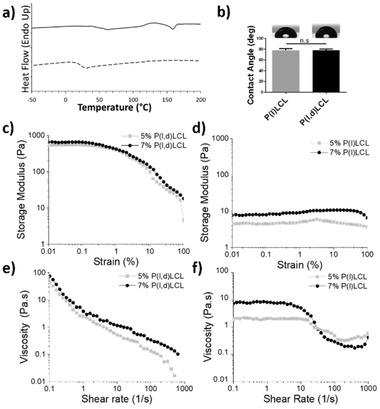
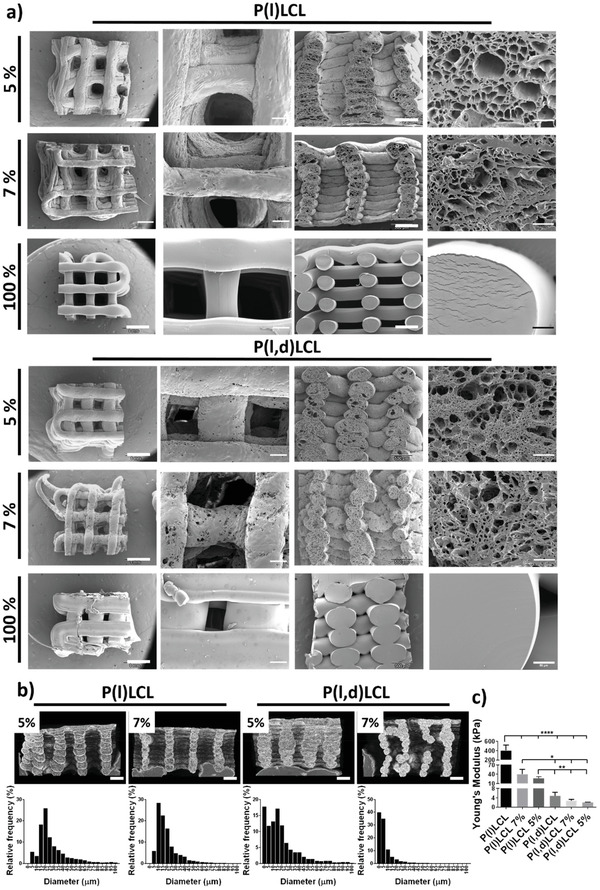
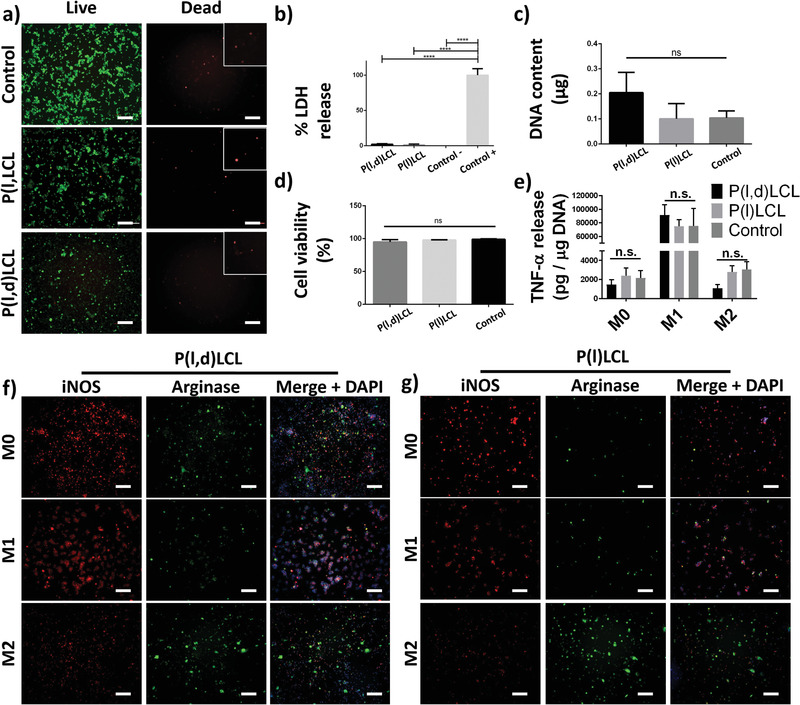
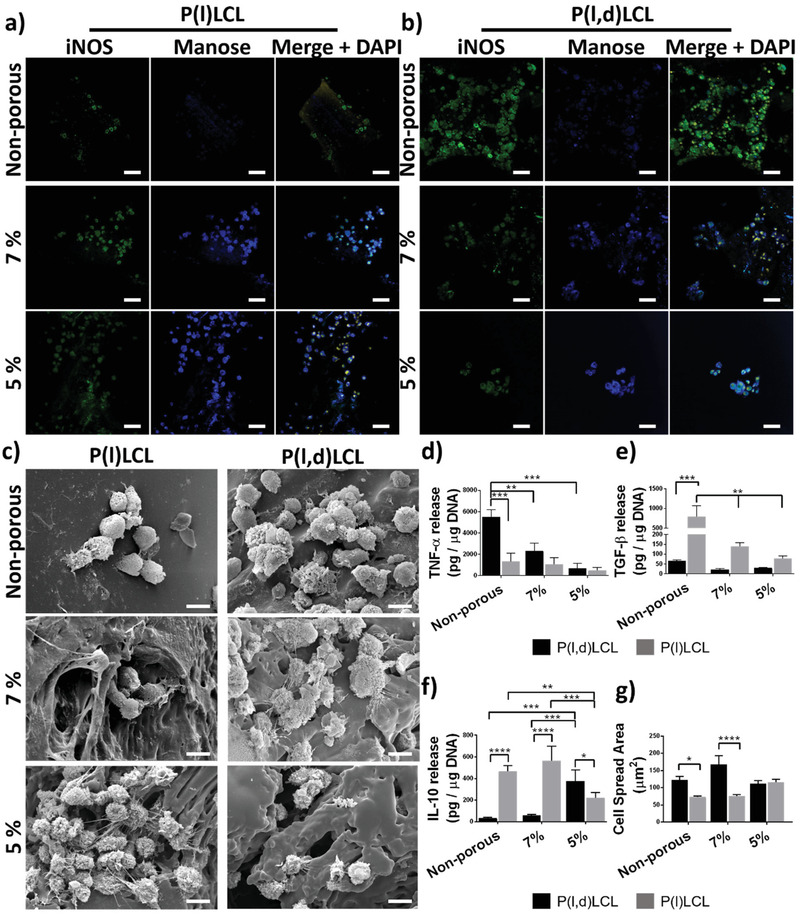
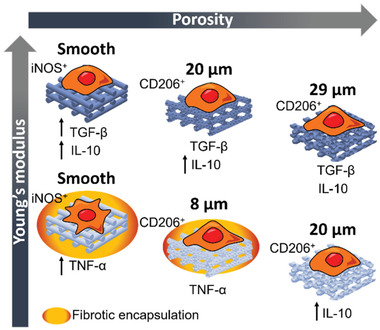
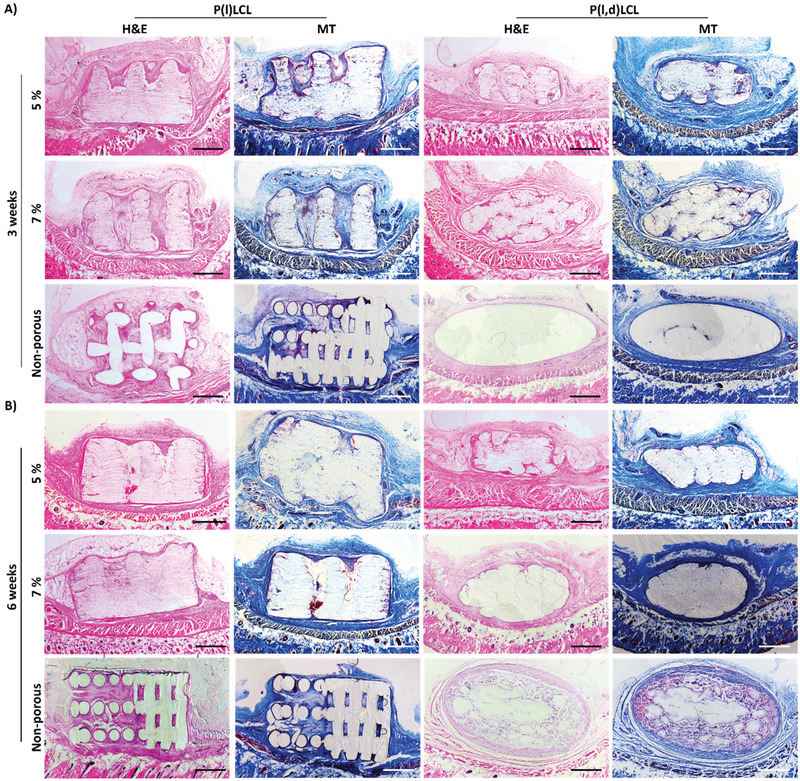
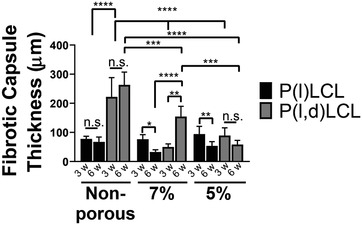
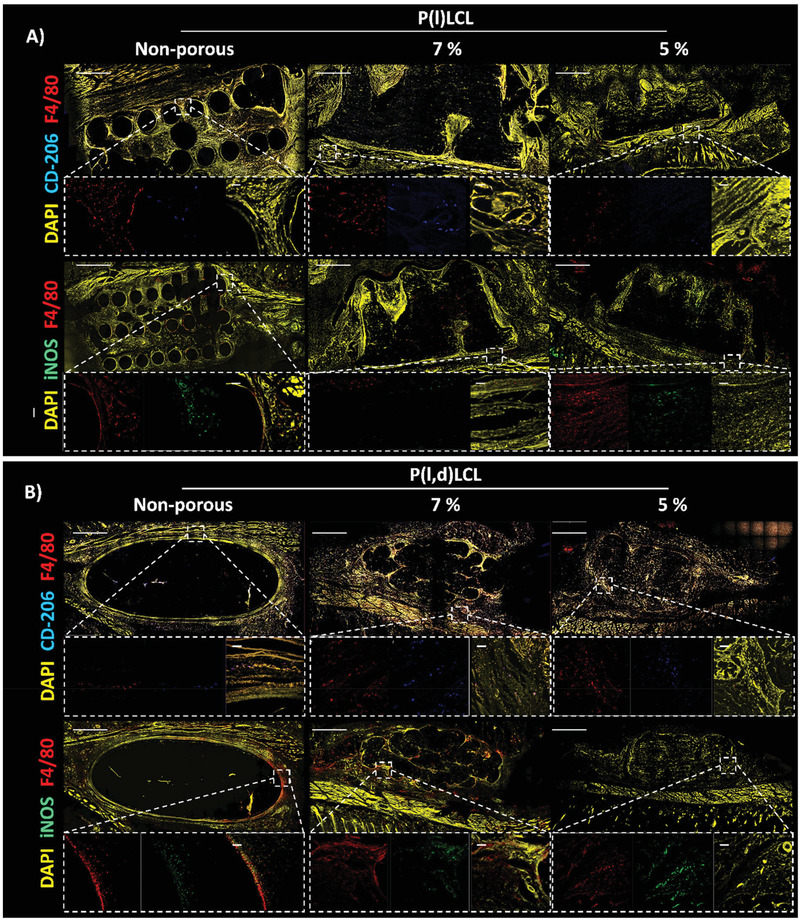
Tissue regeneration evolves toward the biofabrication of sophisticated 3D scaffolds. However, the success of these will be contingent to their capability to integrate within the host. The control of the mechanical or topographical properties of the implant appears as an ideal method to modulate the immune response. However, the interplay between these properties is yet not clear. Dual‐porosity scaffolds with varying mechanical and topographical features are created, and their immunomodulatory properties in rat alveolar macrophages in vitro and in vivo in a rat subcutaneous model are evaluated. Scaffolds are fabricated via additive manufacturing and thermally induced phase separation methods from two copolymers with virtually identical chemistries, but different stiffness. The introduction of porosity enables the modulation of macrophages toward anti‐inflammatory phenotypes, with secretion of IL‐10 and TGF‐β. Soft scaffolds (<5 kPa) result in a pro‐inflammatory phenotype in contrast to stiffer (>40 kPa) scaffolds of comparable porosities supporting a pro‐healing phenotype, which appears to be related to the surface spread area of cells. In vivo, stiff scaffolds integrate, while softer scaffolds appear encapsulated after three weeks of implantation, resulting in chronic inflammation after six weeks. The results demonstrate the importance of evaluating the interplay between topography and stiffness of candidate scaffolds.
Overview
The claims and statistics of this paper haven’t been checked yet.
Free: it reads the open-access text and checks the first 5 claims that cite a source we can check. Create a free account to check every claim.
Integrity signals
Registry
Cites
Statistics
Figures
Verification
Claims the paper makes
The claims and statistics of this paper haven’t been checked yet.
Free: it reads the open-access text and checks the first 5 claims that cite a source we can check. Create a free account to check every claim.
Claims other papers make about this one
Each is checked against this paper’s own text: does it say what the citing paper says it does?
The source backs part of the claim, not all of it — or backs it for a different population, condition or comparison.
In the citing paper
“Interestingly, due to the complexity of the regulatory signaling pathways no uniform consensus on the optimal stiffness ranges exist that promotes an immediate shift to the resolution state.”
From Unraveling and Harnessing the Immune Response at the Cell–Biomaterial Interface for Tissue Engineering Purposes (2024) · cites this paper as [154]
Experimental — accuracy not yet measuredThe cited source says what the claim attributes to it.
In the citing paper
“Conversely, other studies have reported opposite trends, highlighting the complexity of macrophage responses to substrate stiffness.”
From Soft tissue-mimicking hydrogel stiffness modulates polarisation of human monocyte-derived macrophages (2025) · cites this paper as [19]
Self-check
Percentages, sums and reported differences re-computed from the paper’s own numbers.
The self-check needs the paper’s full text.
Citations
Cites
The chemokine system in diverse forms of macrophage activation and polarization
MANTOVANI, A., SICA, A., SOZZANI, S., ALLAVENA, P., VECCHI, A., & LOCATI, M. (2004) · Trends in Immunology · doi:10.1016/j.it.2004.09.015 · Cited by 6,534
Role of YAP/TAZ in mechanotransduction
Dupont, S., Morsut, L., Aragona, M., Enzo, E., Giulitti, S., Cordenonsi, M., Zanconato, F., Le Digabel, J., Forcato, M., Bicciato, S., et al. (2011) · Nature · doi:10.1038/nature10137 · Cited by 5,979
Scaffolds in tissue engineering bone and cartilage
Hutmacher, D. W. (2000) · Biomaterials · doi:10.1016/s0142-9612(00)00121-6 · Cited by 4,994
Macrophage plasticity, polarization, and function in health and disease
Shapouri‐Moghaddam, A., Mohammadian, S., Vazini, H., Taghadosi, M., Esmaeili, S., Mardani, F., Seifi, B., Mohammadi, A., Afshari, J. T., & Sahebkar, A. (2018) · Journal of Cellular Physiology · doi:10.1002/jcp.26429 · Cited by 4,930
Macrophage plasticity and polarization in tissue repair and remodelling
Mantovani, A., Biswas, S. K., Galdiero, M. R., Sica, A., & Locati, M. (2013) · The Journal of Pathology · doi:10.1002/path.4133 · Cited by 2,384
Modulation of macrophage phenotype by cell shape
McWhorter, F. Y., Wang, T., Nguyen, P., Chung, T., & Liu, W. F. (2013) · Proceedings of the National Academy of Sciences · doi:10.1073/pnas.1308887110 · Cited by 1,482
Hutmacher, D. W. (2001) · Journal of Biomaterials Science, Polymer Edition · doi:10.1163/156856201744489 · Cited by 1,409
Zwitterionic hydrogels implanted in mice resist the foreign-body reaction
Zhang, L., Cao, Z., Bai, T., Carr, L., Ella-Menye, J.-R., Irvin, C., Ratner, B. D., & Jiang, S. (2013) · Nature Biotechnology · doi:10.1038/nbt.2580 · Cited by 1,035
Biomaterial based modulation of macrophage polarization: a review and suggested design principles
Sridharan, R., Cameron, A. R., Kelly, D. J., Kearney, C. J., & O’Brien, F. J. (2015) · Materials Today · doi:10.1016/j.mattod.2015.01.019 · Cited by 826
Titanium surface characteristics, including topography and wettability, alter macrophage activation
Hotchkiss, K. M., Reddy, G. B., Hyzy, S. L., Schwartz, Z., Boyan, B. D., & Olivares-Navarrete, R. (2016) · Acta Biomaterialia · doi:10.1016/j.actbio.2015.12.003 · Cited by 680
Cited by
Biocompatible Synthetic Polymers for Tissue Engineering Purposes
Terzopoulou, Z., Zamboulis, A., Koumentakou, I., Michailidou, G., Noordam, M. J., & Bikiaris, D. N. (2022) · Biomacromolecules · doi:10.1021/acs.biomac.2c00047 · Cited by 230
Tolabi, H., Davari, N., Khajehmohammadi, M., Malektaj, H., Nazemi, K., Vahedi, S., Ghalandari, B., Reis, R. L., Ghorbani, F., & Oliveira, J. M. (2023) · Advanced Materials · doi:10.1002/adma.202208852 · Cited by 161
Heras, K. L., García-Orue, I., Rancan, F., Igartúa, M., Santos‐Vizcaíno, E., & Hernández, R. M. (2024) · Advanced Drug Delivery Reviews · doi:10.1016/j.addr.2024.115342 · Cited by 158
Sang, X., Zhao, X., Yan, L., Jin, X. Y., Wang, X., Wang, J., Yin, Z., Zhang, Y., & Meng, Z. (2022) · Tissue Engineering and Regenerative Medicine · doi:10.1007/s13770-022-00437-5 · Cited by 124
“In addition, the polarization of macrophages from the M1 to M2 phenotype has been shown to promote effective angiogenesis and tissue repair [47, 48].”
BackgroundRational design of hydrogels for immunomodulation
Bu, W., Wu, Y., Ghaemmaghami, A. M., Sun, H., & Mata, Á. (2022) · Regenerative Biomaterials · doi:10.1093/rb/rbac009 · Cited by 121
Metadata
- Authors
- Camarero‐Espinosa, S., Carlos‐Oliveira, M., Liu, H., Mano, J. F., Bouvy, N., & Moroni, L.
- Affiliations
- Ikerbasque (ES)
- Maastricht University (NL)
- Maastricht University Medical Centre (NL)
- University of Aveiro (PT)
- Corresponding author
- Moroni, Lorenzo
- Venue
- Advanced Healthcare Materials
- Publisher
- Wiley
- Published
- 2021-11-12
- Volume
- 11
- Issue
- 1
- Pages
- e2101415-e2101415
- ISSN
- 2192-2640 (ISSN-L)
- 2192-2659
- PMC
- PMC11468864
- OpenAlex
- W3209588035
- Cited by
- 71
- References
- 45
- Citations by year
- 2026: 10 · 2025: 22 · 2024: 14 · 2023: 12 · 2022: 12 · 2021: 1
- FWCI
- 2.96
- Type
- journal article
- Language
- en
- Open access
- hybrid
- doi.org
- Licence
- Locations
- Advanced Healthcare Materials (publishedVersion, cc-by-nc)
- PubMed Central (publishedVersion, cc-by-nc)
- PubMed (publishedVersion)
- Research Publications (Maastricht University) (publishedVersion, cc-by-nc)
- Communities in ADDI (University of the Basque Country) (submittedVersion, cc-by-nc)
- Hispana (submittedVersion, cc-by-nc)
- Research Publications (Maastricht University) (submittedVersion, other-oa)
- Funders
- H2020 European Research Council (637308)
- Foundation for Science and Technology
- Ministério da Ciência, Tecnologia e Ensino Superior
- Topics
- Physical Sciences › Engineering › Biomedical Engineering › Bone Tissue Engineering Materials
- Physical Sciences › Engineering › Biomedical Engineering › 3D Printing in Biomedical Research
- Health Sciences › Medicine › Surgery › Tissue Engineering and Regenerative Medicine
- Keywords
- 3D-printed scaffolds, macrophage polarization, stiffness, porosity, surface topography, immunomodulation, alveolar macrophages, IL-10, TGF-beta, chronic inflammation, tissue integration, thermally induced phase separation, copolymers, additive manufacturing
- MeSH terms
- Animals, Macrophage Activation, Macrophages, Porosity, Rats, Tissue Scaffolds, Printing, Three-Dimensional
About these checks
Registry, retraction, Cites and statistics results are computed, not judged, with one exception: a printed reference that no index lists is read once by a model before it counts as a citation error. Claims are extracted by a model and kept only when their quote appears verbatim in the text; each cited source is then checked, with a model’s help, for whether it says what the claim relies on. Those verdicts can be wrong — read the claim’s quote and the cited source before relying on one.
Statistics and arithmetic are recomputed, not judged.
Confidence bands are shown only for fields calibrated on our annotated test set. None is calibrated yet, so no band is shown.
What counts as a claim ›How we measure confidence ›How we check this ›
Are you an author, or do you see a problem with this page? Request a review
How to cite
Cite CoChat for the checks on this page, and the paper for its own findings.
- This page
- CoChat. (2026). Citation check: 3D Printed Dual‐Porosity Scaffolds: The Combined Effect of Stiffness and Porosity in the Modulation of Macrophage Polarization. https://app.cochat.ai/papers/10.1002/adhm.202101415
- The paper
- Camarero‐Espinosa, S., Carlos‐Oliveira, M., Liu, H., Mano, J. F., Bouvy, N., & Moroni, L. (2022). 3D Printed Dual‐Porosity Scaffolds: The Combined Effect of Stiffness and Porosity in the Modulation of Macrophage Polarization. Advanced Healthcare Materials. https://doi.org/10.1002/adhm.202101415
Data sources
Bibliographic data: Semantic Scholar, OpenAlex, Crossref.
Contains information from the Semantic Scholar Academic Graph Datasets, made available under the ODC Attribution License (ODC-BY 1.0).
Semantic Scholar’s data is described in: Kinney, R., et al. (2023). The Semantic Scholar Open Data Platform. arXiv:2301.10140.
