

Self‐Powered Bio‐Inspired Spider‐Net‐Coding Interface Using Single‐Electrode Triboelectric Nanogenerator
Open accessThe DOI matches its Crossref record; 88 of the 89 references it cites were found in a registry or an index.
Abstract
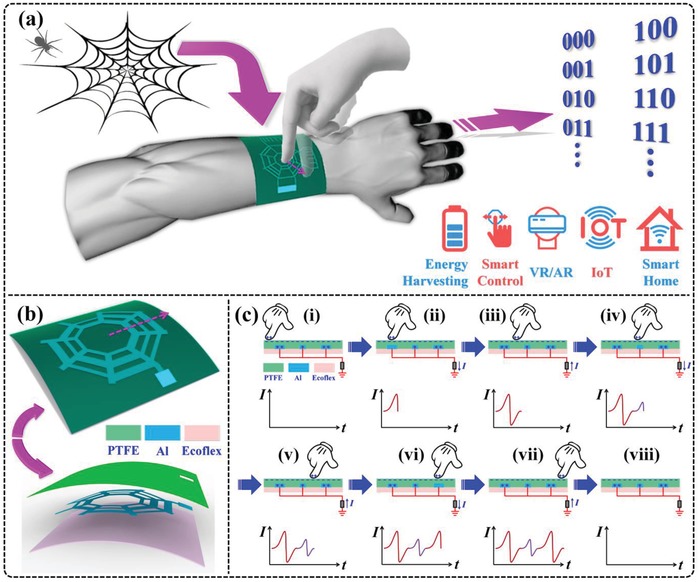
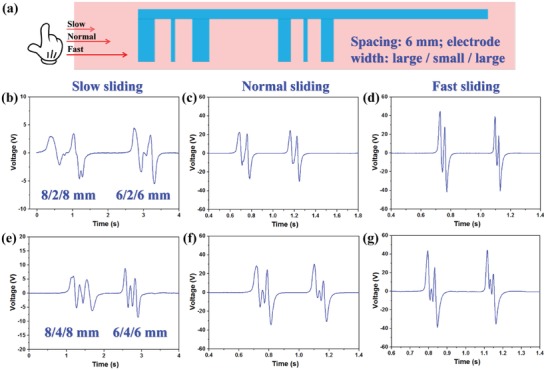
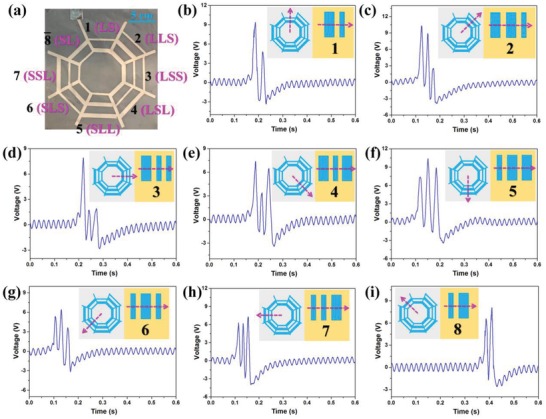
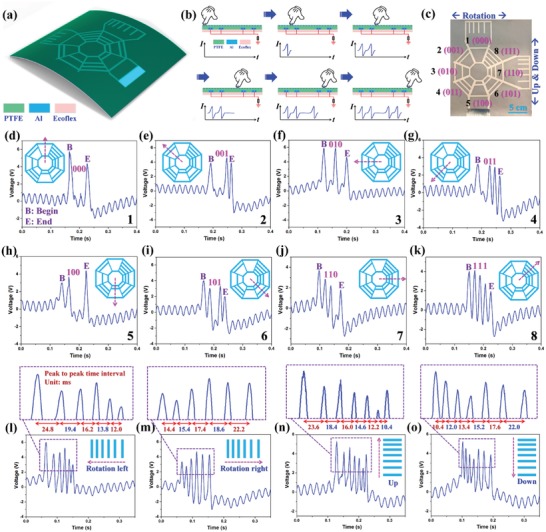
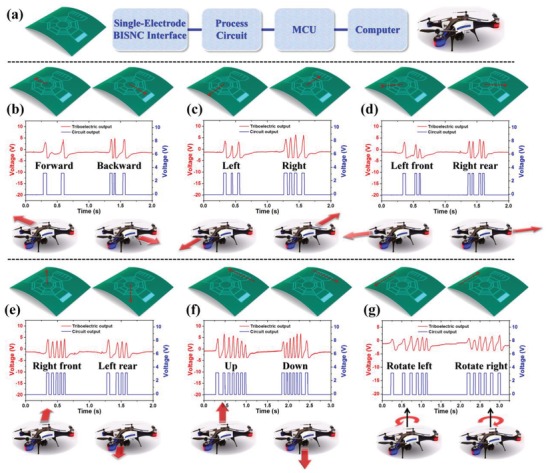
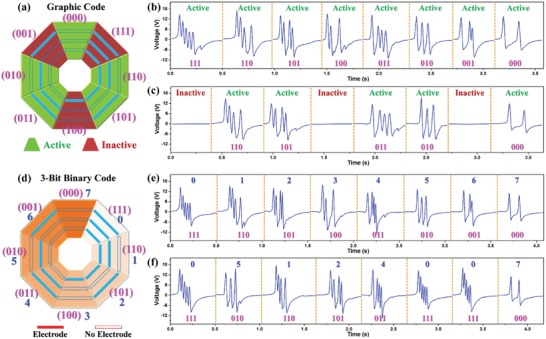
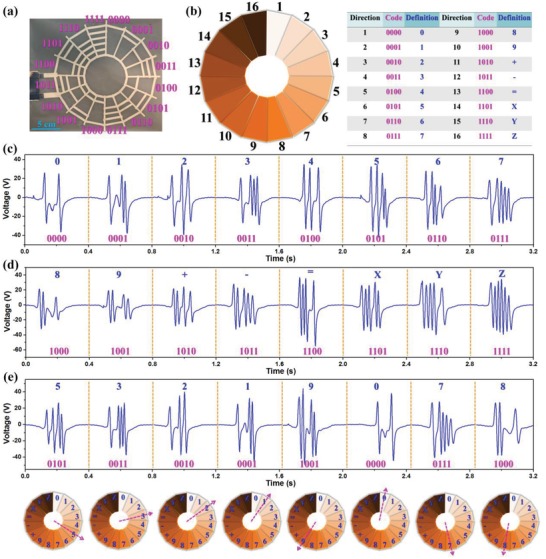
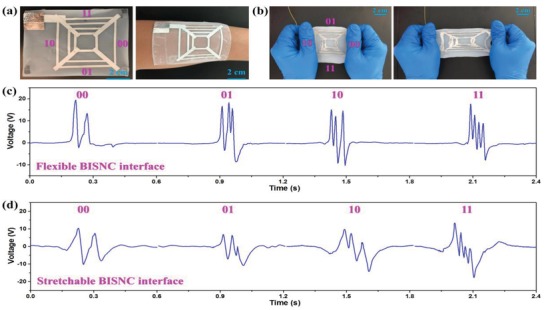
Human–machine interfaces are essential components between various human and machine interactions such as entertainment, robotics control, smart home, virtual/augmented reality, etc. Recently, various triboelectric‐based interfaces have been developed toward flexible wearable and battery‐less applications. However, most of them exhibit complicated structures and a large number of electrodes for multidirectional control. Herein, a bio‐inspired spider‐net‐coding (BISNC) interface with great flexibility, scalability, and single‐electrode output is proposed, through connecting information‐coding electrodes into a single triboelectric electrode. Two types of coding designs are investigated, i.e., information coding by large/small electrode width (L/S coding) and information coding with/without electrode at a predefined position (0/1 coding). The BISNC interface shows high scalability with a single electrode for detection and/or control of multiple directions, by detecting different output signal patterns. In addition, it also has excellent reliability and robustness in actual usage scenarios, since recognition of signal patterns is in regardless of absolute amplitude and thereby not affected by sliding speed/force, humidity, etc. Based on the spider‐net‐coding concept, single‐electrode interfaces for multidirectional 3D control, security code systems, and flexible wearable electronics are successfully developed, indicating the great potentials of this technology in diversified applications such as human–machine interaction, virtual/augmented reality, security, robotics, Internet of Things, etc.
Overview
The claims and statistics of this paper haven’t been checked yet.
Free: it reads the open-access text and checks the first 5 claims that cite a source we can check. Create a free account to check every claim.
Integrity signals
Registry
Cites
Statistics
Figures
Verification
Claims the paper makes
The claims and statistics of this paper haven’t been checked yet.
Free: it reads the open-access text and checks the first 5 claims that cite a source we can check. Create a free account to check every claim.
Claims other papers make about this one
Each is checked against this paper’s own text: does it say what the citing paper says it does?
In the citing paper
“Previously, TENG has been applied as a sensory device in VR/AR system. For example, Lee’s group (23–26) has reported human-machine interfaces for VR applications based on this kind of self-powered sensors.”
From Self-powered electro-tactile system for virtual tactile experiences (2021) · cites this paper as [23]
Self-check
Percentages, sums and reported differences re-computed from the paper’s own numbers.
The self-check needs the paper’s full text.
Citations
Cites
Flexible triboelectric generator
Fan, F.-R., Tian, Z.-Q., & Lin Wang, Z. (2012) · Nano Energy · doi:10.1016/j.nanoen.2012.01.004 · Cited by 6,705
Fully integrated wearable sensor arrays for multiplexed in situ perspiration analysis
Gao, W., Emaminejad, S., Nyein, H. Y. Y., Challa, S., Chen, K., Peck, A., Fahad, H. M., Ota, H., Shiraki, H., Kiriya, D., et al. (2016) · Nature · doi:10.1038/nature16521 · Cited by 5,087
Hammock, M. L., Chortos, A., Tee, B. C. ‐., Tok, J. B. ‐., & Bao, Z. (2013) · Advanced Materials · doi:10.1002/adma.201302240 · Cited by 2,396
Pursuing prosthetic electronic skin
Chortos, A., Liu, J., & Bao, Z. (2016) · Nature Materials · doi:10.1038/nmat4671 · Cited by 2,396
Skin electronics from scalable fabrication of an intrinsically stretchable transistor array
Wang, S., Xu, J., Wang, W., Wang, G.-J. N., Rastak, R., Molina-Lopez, F., Chung, J. W., Niu, S., Feig, V. R., Lopez, J., et al. (2018) · Nature · doi:10.1038/nature25494 · Cited by 2,198
Wearable Electronics and Smart Textiles: A Critical Review
Stoppa, M., & Chiolerio, A. (2014) · Sensors · doi:10.3390/s140711957 · Cited by 2,107
Lab-on-Skin: A Review of Flexible and Stretchable Electronics for Wearable Health Monitoring
Liu, Y., Pharr, M., & Salvatore, G. A. (2017) · ACS Nano · doi:10.1021/acsnano.7b04898 · Cited by 1,725
Bariya, M., Nyein, H. Y. Y., & Javey, A. (2018) · Nature Electronics · doi:10.1038/s41928-018-0043-y · Cited by 1,486
Skin-inspired highly stretchable and conformable matrix networks for multifunctional sensing
Hua, Q., Sun, J., Liu, H., Bao, R., Yu, R., Zhai, J., Pan, C., & Wang, Z. L. (2018) · Nature Communications · doi:10.1038/s41467-017-02685-9 · Cited by 1,413
Recent Advances in Flexible and Stretchable Bio‐Electronic Devices Integrated with Nanomaterials
Choi, S., Lee, H., Ghaffari, R., Hyeon, T., & Kim, D. (2016) · Advanced Materials · doi:10.1002/adma.201504150 · Cited by 1,104
Research works printed but not linked: 3
- Wu C., 2018, Adv. Energy Mater., 8, 1802906
- Kim J., 2018, Int. Conf. Information Science and Applications, 15
- Chong Z., 2018, 2018 Joint Int. Advanced Engineering and Technology Research Conf. (JIAET 2018), 206
Cited by
Zhu, M., Sun, Z., Zhang, Z., Shi, Q., He, T., Liu, H., Chen, T., & Lee, C. (2020) · Science Advances · doi:10.1126/sciadv.aaz8693 · Cited by 784
Self-citationWearable Sensors‐Enabled Human–Machine Interaction Systems: From Design to Application
Yin, R., Wang, D., Zhao, S., Lou, Z., & Shen, G. (2021) · Advanced Functional Materials · doi:10.1002/adfm.202008936 · Cited by 769
Shi, Q., Dong, B., He, T., Sun, Z., Zhu, J., Zhang, Z., & Lee, C. (2020) · InfoMat · doi:10.1002/inf2.12122 · Cited by 661
“As depicted in Figure 7F, a single-electrode triboelectric interface is developed based on the bio-inspired spidernet structure.(259) All the electrode patterns are connected into one spider-net layout, with unique information coding (eg, binary 0 and 1 coding) introduced on the grating electrodes along the eight radi…”
MethodSelf-citationFrom contact electrification to triboelectric nanogenerators
Wang, Z. L. (2021) · Reports on Progress in Physics · doi:10.1088/1361-6633/ac0a50 · Cited by 553
“For example, a singleelectrode TENG textile was prepared with different coding designs for remote control of vehicles or virtual reality games [165, 166].”
MethodRetractedWen, F., Zhang, Z., He, T., & Lee, C. (2021) · Nature Communications · doi:10.1038/s41467-021-25637-w · Cited by 494
Self-citation
Metadata
- Authors
- Shi, Q., & Lee, C.
- Affiliations
- National University of Singapore (SG)
- Corresponding author
- Lee, Chengkuo
- Venue
- Advanced Science
- Publisher
- Wiley
- Published
- 2019-05-29
- Volume
- 6
- Issue
- 15
- Pages
- 1900617-1900617
- ISSN
- 2198-3844 (ISSN-L)
- PMC
- PMC6685466
- OpenAlex
- W2947518122
- Cited by
- 174
- References
- 89
- Citations by year
- 2026: 8 · 2025: 14 · 2024: 21 · 2023: 23 · 2022: 28 · 2021: 33 · 2020: 34 · 2019: 12
- FWCI
- 9.43
- Type
- journal article
- Language
- en
- Open access
- gold
- doi.org
- Licence
- cc-by
- creativecommons.org/licenses/by/4.0/ (vor)
- doi.wiley.com/10.1002/tdm_license_1.1 (tdm)
- Locations
- Advanced Science (publishedVersion, cc-by)
- Europe PMC (PubMed Central) (publishedVersion, cc-by)
- PubMed Central (publishedVersion, cc-by)
- PubMed (publishedVersion)
- National University of Singapore (submittedVersion)
- DOAJ (DOAJ: Directory of Open Access Journals) (submittedVersion)
- Funders
- National University of Singapore
- Topics
- Physical Sciences › Engineering › Biomedical Engineering › Advanced Sensor and Energy Harvesting Materials
- Physical Sciences › Engineering › Electrical and Electronic Engineering › Nanomaterials and Printing Technologies
- Life Sciences › Neuroscience › Cognitive Neuroscience › Tactile and Sensory Interactions
- Keywords
- triboelectric nanogenerator, biomimetic design, human-machine interaction, wearable electronics, battery-free devices, flexible electronics
About these checks
Registry, retraction, Cites and statistics results are computed, not judged, with one exception: a printed reference that no index lists is read once by a model before it counts as a citation error. Claims are extracted by a model and kept only when their quote appears verbatim in the text; each cited source is then checked, with a model’s help, for whether it says what the claim relies on. Those verdicts can be wrong — read the claim’s quote and the cited source before relying on one.
Statistics and arithmetic are recomputed, not judged.
Confidence bands are shown only for fields calibrated on our annotated test set. None is calibrated yet, so no band is shown.
What counts as a claim ›How we measure confidence ›How we check this ›
Are you an author, or do you see a problem with this page? Request a review
How to cite
Cite CoChat for the checks on this page, and the paper for its own findings.
- This page
- CoChat. (2026). Citation check: Self‐Powered Bio‐Inspired Spider‐Net‐Coding Interface Using Single‐Electrode Triboelectric Nanogenerator. https://app.cochat.ai/papers/10.1002/advs.201900617
- The paper
- Shi, Q., & Lee, C. (2019). Self‐Powered Bio‐Inspired Spider‐Net‐Coding Interface Using Single‐Electrode Triboelectric Nanogenerator. Advanced Science. https://doi.org/10.1002/advs.201900617
Data sources
Bibliographic data: Semantic Scholar, OpenAlex, Crossref.
Contains information from the Semantic Scholar Academic Graph Datasets, made available under the ODC Attribution License (ODC-BY 1.0).
Semantic Scholar’s data is described in: Kinney, R., et al. (2023). The Semantic Scholar Open Data Platform. arXiv:2301.10140.
