

The DOI matches its Crossref record; 16 of the 16 references it cites were found in a registry or an index.
The tau isoform 1N4R confers vulnerability of MAPT knockout human iPSC‐derived neurons to amyloid beta and phosphorylated tau‐induced neuronal dysfunction
Abstract
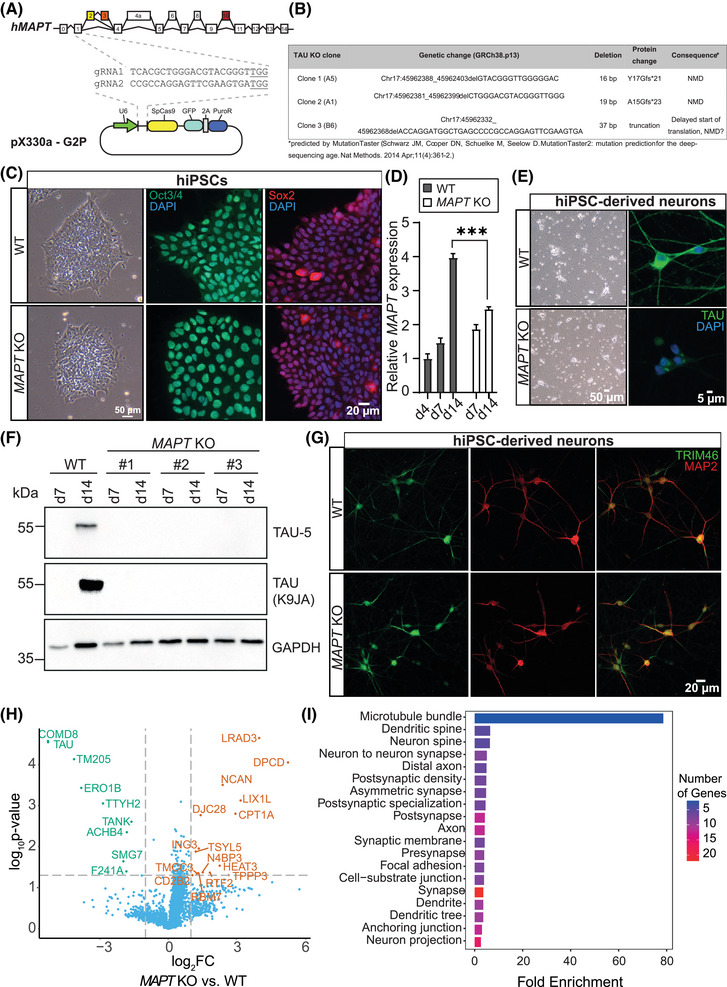
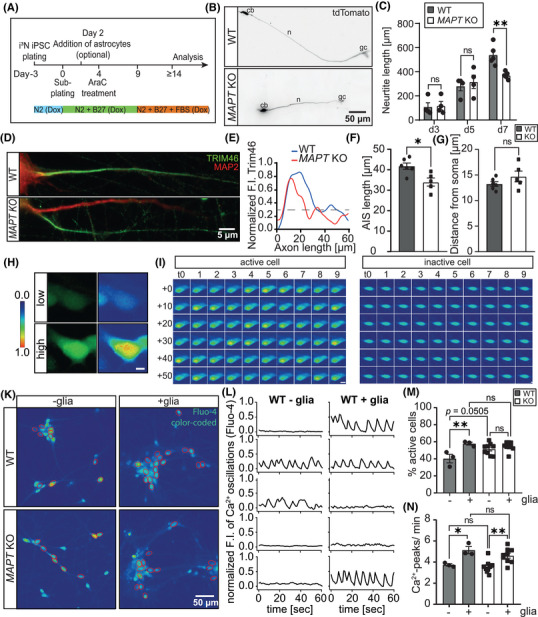
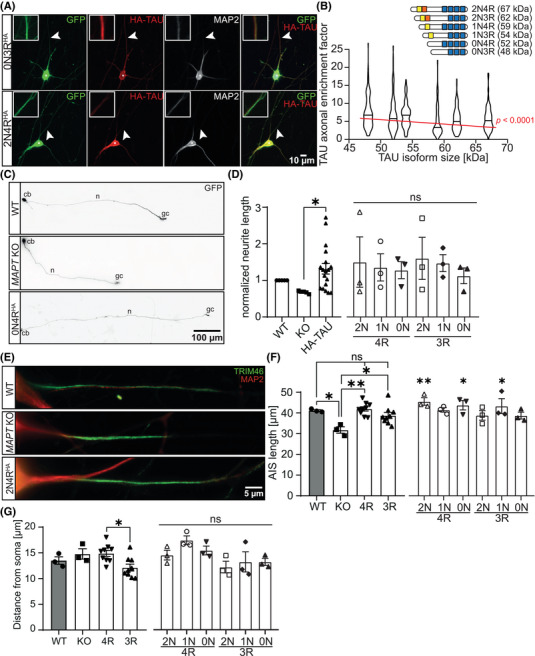
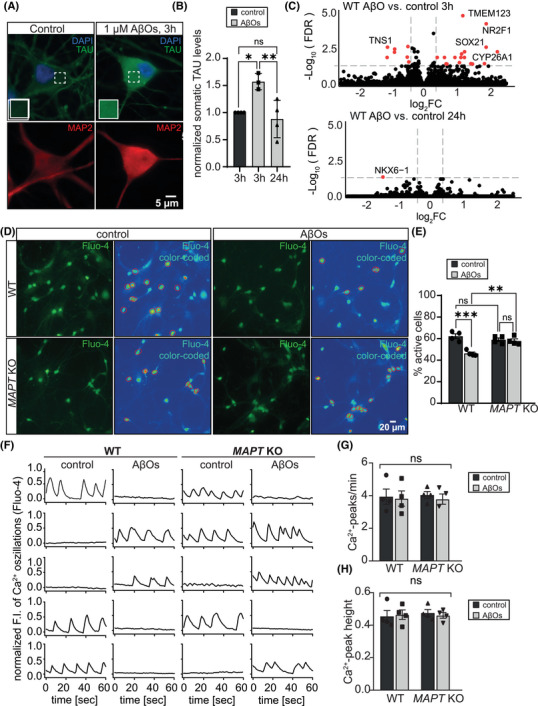
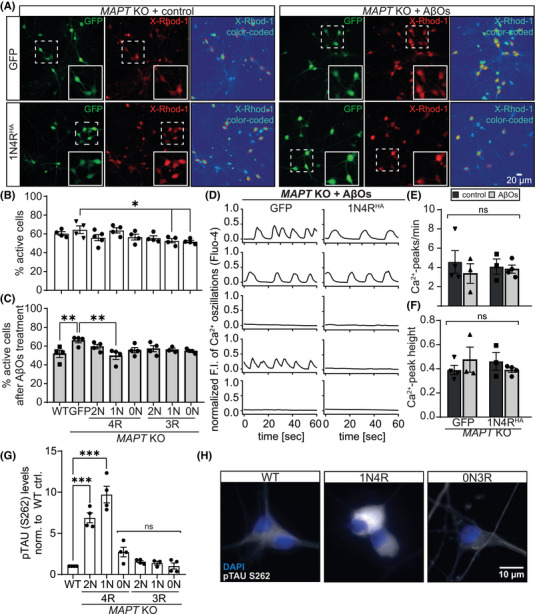
INTRODUCTION: Human tau protein, composed of six brain‐specific isoforms, is a major driver of Alzheimer's disease (AD). The role of its isoforms however remains unclear and human AD models are scarce. METHODS: We generated human MAPT – (tau–) knockout (KO) induced pluripotent stem cells (iPSC) using CRISPR/Cas9, differentiated these into glutamatergic neurons, and assessed isoform‐specific functions of tau in these neurons. We used omic‐ approaches, live‐cell imaging, subcompartmental analysis, and lentivirus‐based reintroduction of specific tau isoforms to investigate isoform‐mediated neuronal dysfunction in an AD model. RESULTS: Tau KO human iPSC‐derived neurons showed decreased neurite outgrowth and axon initial segment length and, notably, resisted amyloid beta oligomer (AβO)–induced neuronal activity reduction. Introducing the 1N4R‐tau isoform, but not other isoforms, confers AβO vulnerability and increases KxGS phosphorylation of tau, without altering neuronal activity or microtubule modifications. DISCUSSION: While tau KO impacts neuronal development and activity, tau‐KO also confers resistance against AβO insult. 1N4R‐tau likely mediates AβO‐induced and phosphorylated tau toxicity, representing a novel prime therapeutic target for AD. Highlights: Tau knockout alters neurite growth and axon initial segment formation in human neurons. Tau isoforms show differential axonal localization in human neurons. Tau depletion protects against amyloid beta oligomer (AβO)–mediated neurotoxicity. 1N4R tau mediates AβO‐induced toxicity in human neurons.
Overview
The claims and statistics of this paper haven’t been checked yet.
Run the check — free, no account needed. It reads the open-access text and checks the sources it cites.
Integrity signals
Registry
Cites
Statistics
Figures
Verification
Claims the paper makes
The claims and statistics of this paper haven’t been checked yet.
Run the check — free, no account needed. It reads the open-access text and checks the sources it cites.
Claims other papers make about this one
Each is checked against this paper’s own text: does it say what the citing paper says it does?
In the citing paper
“tau knockout in primary hippocampal neurons and human iPSC-derived neurons reduces neurite outgrowth43–45.”
From Multi-omic phenotyping of MAPT V337M neurons reveals early changes in axonogenesis and tau phosphorylation (2026) · cites this paper as [44]
Self-check
Percentages, sums and reported differences re-computed from the paper’s own numbers.
The self-check needs the paper’s full text.
Citations
Cites
Knopman, D. S., Amieva, H., Petersen, R. C., Chételat, G., Holtzman, D. M., Hyman, B. T., Nixon, R. A., & Jones, D. T. (2021) · Nature Reviews Disease Primers · doi:10.1038/s41572-021-00269-y · Cited by 2,606
Tangle and neuron numbers, but not amyloid load, predict cognitive status in Alzheimer’s disease
Giannakopoulos, P., Herrmann, F. R., Bussière, T., Bouras, C., Kövari, E., Perl, D. P., Morrison, J. H., Gold, G., & Hof, P. R. (2003) · Neurology · doi:10.1212/01.wnl.0000063311.58879.01 · Cited by 1,118
Goedert, M., & Jakes, R. (1990) · The EMBO Journal · doi:10.1002/j.1460-2075.1990.tb07870.x · Cited by 929
Alzheimer's disease: experimental models and reality
Drummond, E., & Wisniewski, T. (2017) · Acta Neuropathologica · doi:10.1007/s00401-016-1662-x · Cited by 810
Zempel, H., Thies, E., Mandelkow, E., & Mandelkow, E.-M. (2010) · The Journal of Neuroscience · doi:10.1523/jneurosci.2357-10.2010 · Cited by 686 · cited 1×
“9,45,71 Pathological mis-sorting of tau and reduced neuronal activity measured by calcium oscillations were observed shortly after A β O exposure in our neurons, which was abolished after sustained exposure.”
Self-citationNeuropathology of nondemented aging: presumptive evidence for preclinical Alzheimer disease
Price, J. L., McKeel, D. W., Buckles, V. D., Roe, C. M., Xiong, C., Grundman, M., Hansen, L. A., Petersen, R. C., Parisi, J. E., Dickson, D. W., et al. (2009) · Neurobiology of Aging · doi:10.1016/j.neurobiolaging.2009.04.002 · Cited by 661
Kuperstein, I., Broersen, K., Benilova, I., Rozenski, J., Jonckheere, W., Debulpaep, M., Vandersteen, A., Segers‐Nolten, I., Van Der Werf, K., Subramaniam, V., et al. (2010) · The EMBO Journal · doi:10.1038/emboj.2010.211 · Cited by 532
DeVos, S. L., Miller, R. L., Schoch, K. M., Holmes, B. B., Kebodeaux, C. S., Wegener, A. J., Chen, G., Shen, T., Tran, H., Nichols, B., et al. (2017) · Science Translational Medicine · doi:10.1126/scitranslmed.aag0481 · Cited by 516
Wang, C., Ward, M. E., Chen, R., Liu, K., Tracy, T. E., Chen, X., Xie, M., Sohn, P. D., Ludwig, C., Meyer-Franke, A., et al. (2017) · Stem Cell Reports · doi:10.1016/j.stemcr.2017.08.019 · Cited by 400
Johnson, M. A., Weick, J. P., Pearce, R. A., & Zhang, S.-C. (2007) · The Journal of Neuroscience · doi:10.1523/jneurosci.4562-06.2007 · Cited by 318
Zempel, H., Luedtke, J., Kumar, Y., Biernat, J., Dawson, H., Mandelkow, E., & Mandelkow, E. (2013) · The EMBO Journal · doi:10.1038/emboj.2013.207 · Cited by 283 · cited 5×
“9,61 Three hours of treatment were sufficient to induce pathological mis-sorting of tau in human WT iNeurons, indicatingthatA β Oscanbeusedinthesecellstostudythepathomech-anism of AD (Figure 4A,B).”
InfluentialDendritic Tau in Alzheimer’s Disease
Ittner, A., & Ittner, L. M. (2018) · Neuron · doi:10.1016/j.neuron.2018.06.003 · Cited by 278
Frandemiche, M. L., De Seranno, S., Rush, T., Borel, E., Elie, A., Arnal, I., Lanté, F., & Buisson, A. (2014) · The Journal of Neuroscience · doi:10.1523/jneurosci.4261-13.2014 · Cited by 272
Tau Does Not Stabilize Axonal Microtubules but Rather Enables Them to Have Long Labile Domains
Qiang, L., Sun, X., Austin, T. O., Muralidharan, H., Jean, D. C., Liu, M., Yu, W., & Baas, P. W. (2018) · Current Biology · doi:10.1016/j.cub.2018.05.045 · Cited by 222
Baas, P. W., & Qiang, L. (2019) · Trends in Cell Biology · doi:10.1016/j.tcb.2019.02.007 · Cited by 123
Tau isoform composition influences rate and extent of filament formation
Zhong, Q., Congdon, E. E., Nagaraja, H. N., & Kuret, J. (2012) · Journal of Biological Chemistry · doi:10.1074/jbc.m112.364067 · Cited by 122
Research works printed but not linked: 66
- 10.1002/alz.13784 · DOI
- 10.1155/2012/873270 · DOI
- 10.1242/jcs.114.6.1179 · DOI · Paper page
- 10.1038/343461a0 · DOI · Paper page
- 10.1523/JNEUROSCI.11‐06‐01515.1991 · DOI · Paper page
- 10.1523/JNEUROSCI.18‐21‐08660.1998 · DOI
- 10.1002/ALZ.052863 · DOI
- 10.1093/BRAIN/AWZ090 · DOI · Paper page
- 10.1002/1531-8249(199903)45:3 · DOI
- 10.1097/NEN.0B013E31825018F7 · DOI · Paper page
- 10.1073/pnas.092136199 · DOI · Paper page
- 10.1126/SCIENCE.1141736 · DOI · Paper page
- 10.1523/jneurosci.2610‐10.2011 · DOI · Paper page
- 10.1126/SCIENCE.1194653 · DOI · Paper page
- 10.1016/0896‐6273(89)90210‐9 · DOI · Paper page
- 10.1021/bi00158a027 · DOI
- 10.1093/HMG/DDS238 · DOI · Paper page
- 10.1016/J.IJDEVNEU.2009.06.001 · DOI
- 10.1002/hipo.20255 · DOI
- 10.1371/journal.pone.0084849 · DOI
- 10.1074/jbc.M117.784702 · DOI
- 10.3389/fnins.2021.643115 · DOI
- 10.4103/1673‐5374.389644 · DOI
- 10.1007/S00415‐024‐12314‐3 · DOI · Paper page
- 10.1038/nmeth.2840 · DOI
- 10.1007/978‐1‐0716‐3629‐9_31/FIGURES/2 · DOI
- 10.3390/ijms22042034 · DOI
- 10.1007/978-1-0716-3629-9_31 · DOI
- 10.1016/J.STEM.2018.05.020 · DOI
- 10.1038/s41592‐019‐0638‐x · DOI
- 10.1038/NMETH.3901 · DOI · Paper page
- 10.1007/978‐1‐4939‐6598‐4_20 · DOI
- 10.1007/978-1-0716-3629-9_29 · DOI
- 10.1002/CYTO.A.20022 · DOI
- 10.1371/JOURNAL.PONE.0033093 · DOI · Paper page
- 10.1128/JVI.72.11.8463‐8471.1998 · DOI · Paper page
- 10.1038/s41467‐021‐24900‐4 · DOI
- 10.1038/nbt.3519 · DOI · Paper page
- 10.12688/f1000research.7563.2 · DOI · Paper page
- 10.1186/S13059‐014‐0550‐8/FIGURES/9 · DOI
- 10.1101/060012 · DOI
- 10.1158/1541‐7786.MCR‐16‐0459/14585/AM/THE‐LANDSCAPE‐OF‐ISOFORM‐SWITCHES‐IN‐HUMAN · DOI
- 10.1073/PNAS.1307202110/SUPPL_FILE/SD01.PDF · DOI
- 10.1093/NAR/GKX428 · DOI
- 10.1093/NAR/GKR1065 · DOI · Paper page
- 10.1038/s41587‐019‐0036‐z · DOI
- 10.1002/PROT.25674 · DOI · Paper page
- 10.1016/J.NEUROSCIENCE.2021.01.041 · DOI
- 10.1038/nmeth.2890 · DOI · Paper page
- 10.1080/15548627.2018.1509607 · DOI
- 10.1016/j.cell.2010.06.036 · DOI · Paper page
- 10.1126/SCIENCE.AAI8764/SUPPL_FILE/MOVIES_S5‐S10.ZIP · DOI
- 10.1016/J.NEULET.2021.135656 · DOI
- 10.1038/s41380‐024‐02463‐2 · DOI
- 10.1002/j.1460‐2075.1989.tb03390.x · DOI · Paper page
- 10.1101/2024.06.28.601286 · DOI
- 10.1038/emboj.2011.376 · DOI
- 10.1016/J.CELL.2021.12.041/ATTACHMENT/418D38D8‐6F98‐4567‐AE33‐02B961DF13F7/MMC6.XLSX · DOI
- 10.1074/JBC.M115.641902 · DOI
- 10.1016/J.BBAMCR.2018.07.018 · DOI
- 10.1016/J.NEUROBIOLAGING.2014.10.020 · DOI
- 10.3389/FNSYN.2023.1129036/BIBTEX · DOI
- 10.3389/FCELL.2022.969547/BIBTEX · DOI
- 10.1016/J.ARR.2021.101417 · DOI
- 10.1117/1.NPH.7.1.011402 · DOI
- 10.1016/J.TINS.2014.08.004 · DOI · Paper page
Cited by
Mohl, G. A., Dixon, G., Marzette, E., McKetney, J., Samelson, A. J., Serras, C. P., Jin, J., Ariqat, N., Keys, A., Chavira, C., et al. (2026) · npj Dementia · doi:10.1038/s44400-026-00076-w · Cited by 5
Metadata
- Authors
- Buchholz, S., Kabbani, M. A. A., Bell‐Simons, M., Kluge, L., Cagmak, C., Klimek, J., Haag, N., Iohan, L. C., Coulon, A., Costa, M. R., Kilinc, D., & Zempel, H.
- Venue
- Alzheimer's & Dementia
- Publisher
- Wiley
- Published
- 2025-02-28
- Volume
- 21
- Issue
- 5
- ISSN
- 1552-5260
- 1552-5279
- PMC
- PMC12089071
- Cited by
- 26
- References
- 16
- Language
- en
- Funders
- Jürgen Manchot Stiftung
- Else Kröner-Fresenius-Stiftung
- Deutsche Forschungsgemeinschaft
- Studienstiftung des Deutschen Volkes
About these checks
Registry, retraction, Cites and statistics results are computed, not judged, with one exception: a printed reference that no index lists is read once by a model before it counts as a citation error. Claims are extracted by a model and kept only when their quote appears verbatim in the text; each cited source is then checked, with a model’s help, for whether it says what the claim relies on. Those verdicts can be wrong — read the claim’s quote and the cited source before relying on one.
Statistics and arithmetic are recomputed, not judged.
Confidence bands are shown only for fields calibrated on our annotated test set. None is calibrated yet, so no band is shown.
What counts as a claim ›How we measure confidence ›How we check this ›
Are you an author, or do you see a problem with this page? Request a review
Data sources
Bibliographic data: Semantic Scholar, OpenAlex, Crossref.
Contains information from the Semantic Scholar Academic Graph Datasets, made available under the ODC Attribution License (ODC-BY 1.0).
Semantic Scholar’s data is described in: Kinney, R., et al. (2023). The Semantic Scholar Open Data Platform. arXiv:2301.10140.
