

Modeling Functional Connectivity for Bears Among Spawning Salmon Waterways in Haíɫzaqv (Heiltsuk) Territory, Coastal British Columbia
Open accessThe DOI matches its Crossref record; 100 of the 100 references it cites were found in a registry or an index; none of the 72 sources its claims cite is checked for support yet.
Abstract
Understanding how functional connectivity can provide mobile consumers access to key resources can inform habitat management. The spatial arrangement of landscape features, for example, can affect movement among resource patches. Guided by the Haíɫzaqv (Heiltsuk) Integrated Resource Management Department ( HIRMD ), and within Haíɫzaqv Territory, coastal British Columbia ( BC ), Canada, our objectives were to (1) estimate functional connectivity for grizzly and black bears ( Ursus arctos and U. americanus , respectively) among aggregations of spawning Pacific salmon ( Oncorhynchus spp.), (2) identify important movement pathways for landscape planning, and (3) contribute to the growing body of functional connectivity research on dynamic ecological systems. Using circuit theory and least cost paths, we predicted movement among salmon spawning reaches within a 5618 km 2 study area. Variables affecting bear movement were parameterized by drawing on the relevant literature and Haíɫzaqv Knowledge. We validated our cumulative resistance surface with observed movements as identified via genetic recapture data. Modeled current from Circuitscape suggested areas of high connectivity between salmon spawns within and among watersheds. Our least cost paths model identified principal routes, which we then ranked to illustrate possible corridors for consideration by HIRMD planners. Understanding movement among salmon spawns, a fitness‐related food, provides key information to inform landscape planning for bears. Further, our work provides an example of connectivity research codeveloped, executed, and applied with an Indigenous government.
Overview
CoChat Summary
TL;DR
This study modeled functional connectivity for grizzly and black bears among 134 Pacific salmon spawning reaches in a 5618 km² area of Haíɫzaqv (Heiltsuk) Territory, coastal British Columbia, using circuit theory and least cost paths parameterized with literature and Haíɫzaqv Knowledge. The cumulative resistance surface was validated with genetic recapture data, and outputs identified high-connectivity areas and candidate corridors for land-use planning.
Key findings
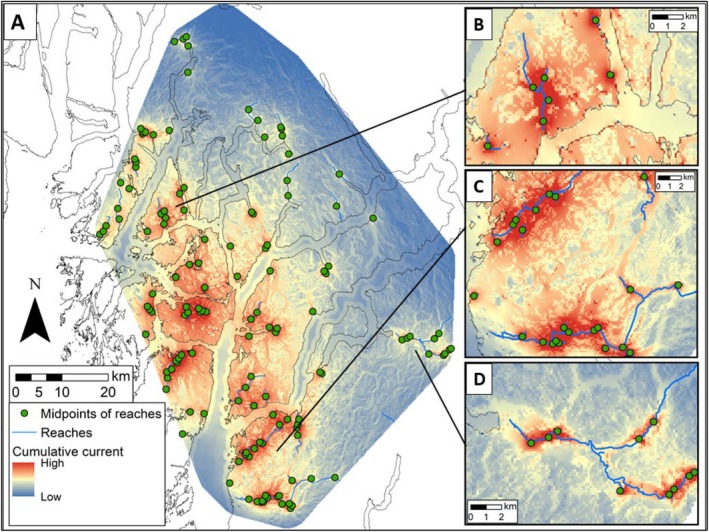
- Circuitscape current showed highest predicted connectivity among salmon reaches in the western islands and southern mainland; the eastern mountainous half had high intra-watershed connectivity but less inter-watershed connectivity.
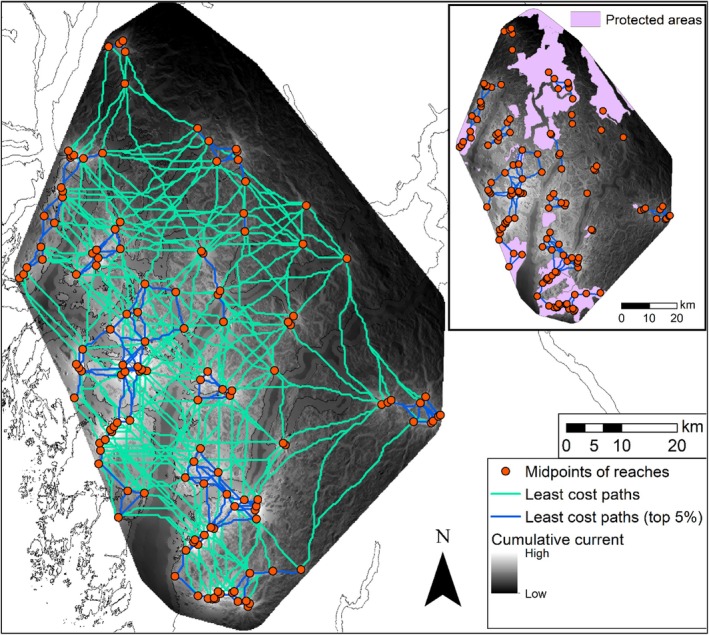
- Least cost path analysis identified 9045 paths; among the top 5% lowest-cost paths (n = 453), about 65% (422 km in accumulated length) occurred outside protected areas.
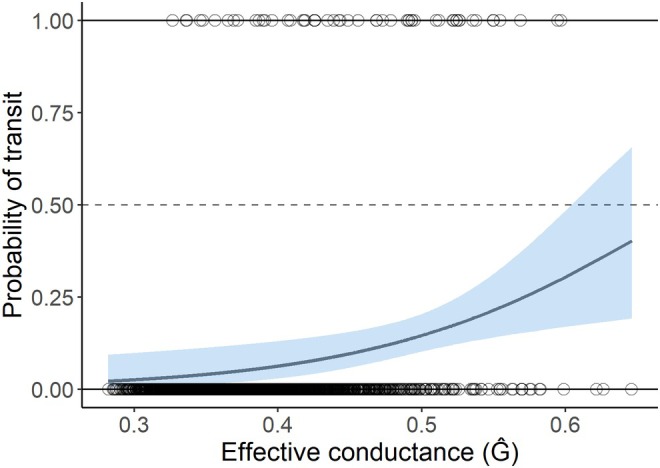
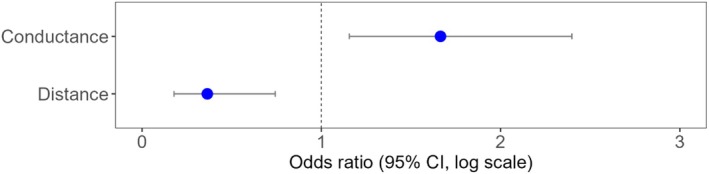
- Validation using genetic recapture data found that the probability of bear transit between hair snag site pairs was positively associated with effective conductance (odds ratio = 1.66, 95% CI 1.16–2.40, p = 0.006) and negatively associated with Euclidean distance (odds ratio = 0.36, 95% CI 0.18–0.74, p = 0.006).
Methods
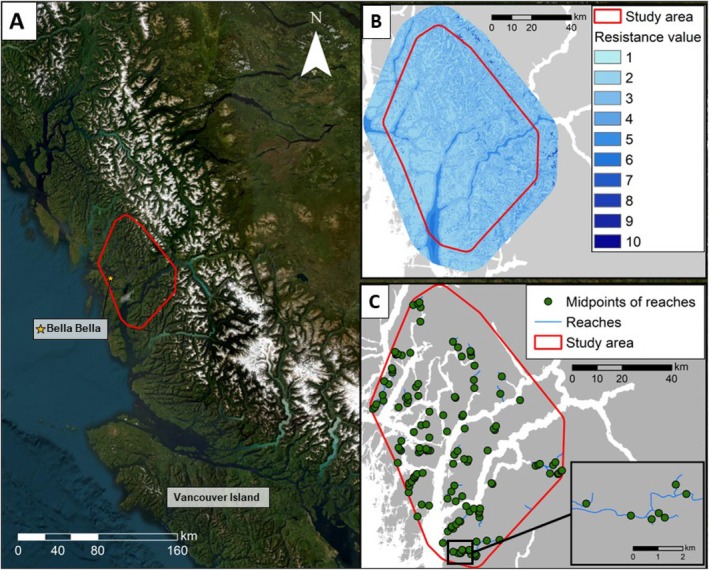
- Study area was 5618 km² in Haíɫzaqv Territory; 134 focal nodes represented midpoints of Pacific salmon reaches. A cumulative resistance surface at 150 m resolution was created by summing three equally weighted variables—terrain ruggedness, landcover, and water—parameterized from literature and Haíɫzaqv Knowledge.
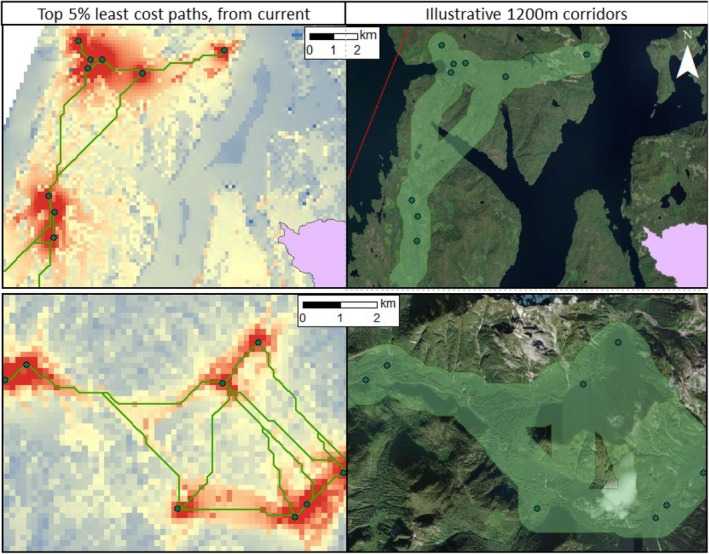
- Functional connectivity was modeled with Circuitscape in pairwise mode (584,260 cells; 9045 focal node pairs) and least cost paths in R; the top 5% LCPs were ranked and buffered at 1200 m to illustrate candidate corridors.
- Validation used genetic recapture data from 66 hair snag sites sampled 2015–2019; 2145 unique site pairs included 54 transited and 2091 not transited. Firth’s penalized-likelihood logistic regression tested transit probability against effective conductance and Euclidean distance.
Limitations
- Stated by the authors: movement assumptions (optimal LCP or random circuit theory) may be unrealistic; the static resistance surface aggregates within-season resource-wave dynamics; resistance parameterization was subjective and lacked telemetry or empirical movement data; validation inferred transits between sites rather than actual paths, and hair samples came from spring only, outside the salmon spawn period; reach midpoints may not capture precise spawning biomass; variables were generalized across species, age, sex, and did not account for competition.
- Evident from the text: the model is a preliminary spatial first step that does not incorporate temporal or fine-scale within-season dynamics, individual variation, or interspecific interactions, and validation relies on binary site-pair transits from a limited spring sampling window.
Model-written summary. Check it against the paper before relying on it.
Integrity signals
Registry
Cites
Statistics
Figures
Verification
Claims the paper makes
0 Valid · 1 Not valid · 41 Not checked · 34 Own results and interpretations
A result the paper reports from its own data — it cites no other source for it, so there is none to check. The quote shows it is in the paper.
In the paper
“From the identified LCP, we highlighted the top 5% with the lowest cost distances (e.g., the total accumulated cost) between nodes; about 65% of these top paths (422 km in accumulated length) occurred outside of protected areas.”
§ Modeling Functional Connectivity for Bears Among Spawning Salmon Waterways in Haíɫzaqv (Heiltsuk) Territory, Coastal British Columbia > Results > Functional Connectivity
plainn = 9,045- Asserted: passes — The authors put it forward as true.
- Checkable: passes — It can be checked against evidence.
- Load-bearing: passes — The paper’s conclusions depend on it.
- Based: passes — The paper gives a reason why it holds.
A result the paper reports from its own data — it cites no other source for it, so there is none to check. The quote shows it is in the paper.
In the paper
“Of all possible unique site pairs (n = 2145), 2091 were not transited (“no transit”) from 2015 to 2019, while 54 were transited (“transited”) at least once.”
§ Modeling Functional Connectivity for Bears Among Spawning Salmon Waterways in Haíɫzaqv (Heiltsuk) Territory, Coastal British Columbia > Methods > Validation of Cumulative Resistance Layer
plainn = 2,145- Asserted: passes — The authors put it forward as true.
- Checkable: passes — It can be checked against evidence.
- Load-bearing: passes — The paper’s conclusions depend on it.
- Based: passes — The paper gives a reason why it holds.
A result the paper reports from its own data — it cites no other source for it, so there is none to check. The quote shows it is in the paper.
In the paper
“Our 1200 m width corridors (Figure 4) highlighted possibilities for connecting multiple reaches within and across watersheds, based on the top pathways.”
§ Modeling Functional Connectivity for Bears Among Spawning Salmon Waterways in Haíɫzaqv (Heiltsuk) Territory, Coastal British Columbia > Results > Functional Connectivity
plainstates an associationn = 9,045- Asserted: passes — The authors put it forward as true.
- Checkable: passes — It can be checked against evidence.
- Load-bearing: passes — The paper’s conclusions depend on it.
- Based: passes — The paper gives a reason why it holds.
A result the paper states — it cites no source for it, so there is none to check. The quote shows it is in the paper.
In the paper
“By contrast, the more mountainous eastern half of the study area included areas of higher resistance, such as rugged terrain, snow, and ice.”
§ Modeling Functional Connectivity for Bears Among Spawning Salmon Waterways in Haíɫzaqv (Heiltsuk) Territory, Coastal British Columbia > Discussion > Functional Connectivity
plainstates an association- Asserted: passes — The authors put it forward as true.
- Checkable: passes — It can be checked against evidence.
- Load-bearing: passes — The paper’s conclusions depend on it.
- Based: passes — The paper gives a reason why it holds.
A result the paper reports from its own data — it cites no other source for it, so there is none to check. The quote shows it is in the paper.
In the paper
“Valleys of importance were identified throughout the coast mountains via constricted areas of high‐current density, which appeared to offer the primary routes of estimated connectivity.”
§ Modeling Functional Connectivity for Bears Among Spawning Salmon Waterways in Haíɫzaqv (Heiltsuk) Territory, Coastal British Columbia > Discussion > Functional Connectivity
hedgedstates an association- Asserted: passes — The authors put it forward as true.
- Checkable: passes — It can be checked against evidence.
- Load-bearing: passes — The paper’s conclusions depend on it.
- Based: passes — The paper gives a reason why it holds.
28 more claims
Create a free account to see all 76 claims and to verify the 66 references still open.
- It may state two separate claims as one. 20
- Probably not a substantial claim. 31
Self-check
Percentages, sums and reported differences re-computed from the paper’s own numbers.
Each contradiction between two passages listed here was confirmed by an independent check.
Rated minor: it would not touch a result — a value no result rests on, a p-value that stays on the same side of the significance level, or a conflict that is clerical, resolved elsewhere in the paper, or outside its own findings.
In the paper
§ Modeling Functional Connectivity for Bears Among Spawning Salmon Waterways in Haíɫzaqv (Heiltsuk) Territory, Coastal British Columbia > Methods > Focal Nodes
“In total, we defined 134 focal nodes representing salmon reaches within our study area (Figure 1C).”
§ Modeling Functional Connectivity for Bears Among Spawning Salmon Waterways in Haíɫzaqv (Heiltsuk) Territory, Coastal British Columbia > Methods > Functional Connectivity
“Our surface contained 584,260 cells and current was calculated between 9045 focal node pairs.”
Citations
Cites
R: A Language and Environment for Statistical Computing
R Core Team (2025) · doi:10.32614/r.manuals · Cited by 352,181
Bias reduction of maximum likelihood estimates
FIRTH, D. (1993) · Biometrika · doi:10.1093/biomet/80.1.27 · Cited by 5,035
Connectivity is a vital element of landscape structure
Taylor, P. D., Fahrig, L., Henein, K., & Merriam, G. (1993) · Oikos · doi:10.2307/3544927 · Cited by 2,568
USING CIRCUIT THEORY TO MODEL CONNECTIVITY IN ECOLOGY, EVOLUTION, AND CONSERVATION
McRae, B. H., Dickson, B. G., Keitt, T. H., & Shah, V. B. (2008) · Ecology · doi:10.1890/07-1861.1 · Cited by 2,244
A Terrain Ruggedness Index That Quantifies Topographic Heterogeneity
Riley, S. J., DeGloria, S. D., & Elliot, R. (1999) · Intermountain journal of sciences · Cited by 2,226
Venter, O., Sanderson, E. W., Magrach, A., Allan, J. R., Beher, J., Jones, K. R., Possingham, H. P., Laurance, W. F., Wood, P., Fekete, B. M., et al. (2016) · Nature Communications · doi:10.1038/ncomms12558 · Cited by 1,887
Ecosystems of British Columbia
Meidinger, D., & Pojar, J. (1991) · Cited by 1,723
On the usage and measurement of landscape connectivity
Tischendorf, L., & Fahrig, L. (2000) · Oikos · doi:10.1034/j.1600-0706.2000.900102.x · Cited by 1,236
Estimating landscape resistance to movement: a review
Zeller, K. A., McGarigal, K., & Whiteley, A. R. (2012) · Landscape Ecology · doi:10.1007/s10980-012-9737-0 · Cited by 1,007
Network thinking in ecology and evolution
PROULX, S., PROMISLOW, D., & PHILLIPS, P. (2005) · Trends in Ecology & Evolution · doi:10.1016/j.tree.2005.04.004 · Cited by 936
“Two‐Eyed Seeing”: An Indigenous framework to transform fisheries research and management
Reid, A. J., Eckert, L. E., Lane, J., Young, N., Hinch, S. G., Darimont, C. T., Cooke, S. J., Ban, N. C., & Marshall, A. (2021) · Fish and Fisheries · doi:10.1111/faf.12516 · Cited by 652
Self-citationGlobal forest loss disproportionately erodes biodiversity in intact landscapes
Betts, M. G., Wolf, C., Ripple, W. J., Phalan, B., Millers, K. A., Duarte, A., Butchart, S. H. M., & Levi, T. (2017) · Nature · doi:10.1038/nature23285 · Cited by 627
Gene Flow in Complex Landscapes: Testing Multiple Hypotheses with Causal Modeling
Cushman, S. A., McKelvey, K. S., Hayden, J., & Schwartz, M. K. (2006) · The American Naturalist · doi:10.1086/506976 · Cited by 590
Pacific Salmon in Aquatic and Terrestrial Ecosystems
GENDE, S. M., EDWARDS, R. T., WILLSON, M. F., & WIPFLI, M. S. (2002) · BioScience · doi:10.1641/0006-3568(2002)052[0917:psiaat]2.0.co;2 · Cited by 531
Hilderbrand, G. V., Schwartz, C. C., Robbins, C. T., Jacoby, M. E., Hanley, T. A., Arthur, S. M., & Servheen, C. W. (1999) · Canadian Journal of Zoology · doi:10.1139/cjz-77-1-132 · Cited by 516
The need for integrative approaches to understand and conserve migratory ungulates.
Bolger, D. T., Newmark, W. D., Morrison, T. A., & Doak, D. F. (2008) · Ecology Letters · doi:10.1111/j.1461-0248.2007.01109.x · Cited by 410
Dynamics of Understory Biomass in Sitka Spruce-Western Hemlock Forests of Southeast Alaska
Alaback, P. B. (1982) · Ecology · doi:10.2307/1940131 · Cited by 354
Gene flow between insular, coastal and interior populations of brown bears in Alaska
PAETKAU, D., SHIELDS, G. F., & STROBECK, C. (1998) · Molecular Ecology · doi:10.1046/j.1365-294x.1998.00440.x · Cited by 343
Human disturbance causes widespread disruption of animal movement
Doherty, T. S., Hays, G. C., & Driscoll, D. A. (2021) · Nature Ecology & Evolution · doi:10.1038/s41559-020-01380-1 · Cited by 291
Major components of grizzly bear diet across North America
Mowat, G., & Heard, D. C. (2006) · Canadian Journal of Zoology · doi:10.1139/z06-016 · Cited by 280
Zeller, K. A., Jennings, M. K., Vickers, T. W., Ernest, H. B., Cushman, S. A., & Boyce, W. M. (2018) · Diversity and Distributions · doi:10.1111/ddi.12742 · Cited by 248
Stopover ecology of a migratory ungulate: Ungulate stopover ecology
Sawyer, H., & Kauffman, M. J. (2011) · Journal of Animal Ecology · doi:10.1111/j.1365-2656.2011.01845.x · Cited by 240
Proctor, M. F., Paetkau, D., Mclellan, B. N., Stenhouse, G. B., Kendall, K. C., Mace, R. D., Kasworm, W. F., Servheen, C., Lausen, C. L., Gibeau, M. L., et al. (2012) · Wildlife Monographs · doi:10.1002/wmon.6 · Cited by 226
ESTIMATING GRIZZLY BEAR DISTRIBUTION AND ABUNDANCE RELATIVE TO HABITAT AND HUMAN INFLUENCE
APPS, C. D., McLELLAN, B. N., WOODS, J. G., & PROCTOR, M. F. (2004) · Journal of Wildlife Management · doi:10.2193/0022-541x(2004)068[0138:egbdaa]2.0.co;2 · Cited by 206
Nielsen, S. E., McDermid, G., Stenhouse, G. B., & Boyce, M. S. (2010) · Biological Conservation · doi:10.1016/j.biocon.2010.04.007 · Cited by 193
Biological corridors and connectivity
Cushman, S. A., McRae, B., Adriaensen, F., Beier, P., Shirley, M., & Zeller, K. (2013) · Key Topics in Conservation Biology 2 · doi:10.1002/9781118520178.ch21 · Cited by 179
Circuitscape: A Tool for Landscape Ecology
Shah, V. B., & McRae, B. (2008) · Proceedings of the Python in Science Conference · doi:10.25080/ewdj4033 · Cited by 176
Resource waves: phenological diversity enhances foraging opportunities for mobile consumers
Armstrong, J. B., Takimoto, G., Schindler, D. E., Hayes, M. M., & Kauffman, M. J. (2016) · Ecology · doi:10.1890/15-0554.1 · Cited by 173
The spatial and temporal components of functional connectivity in fragmented landscapes
Auffret, A. G., Plue, J., & Cousins, S. A. O. (2015) · AMBIO · doi:10.1007/s13280-014-0588-6 · Cited by 171
Schindler, D. E., Armstrong, J. B., Bentley, K. T., Jankowski, K. J., Lisi, P. J., & Payne, L. X. (2013) · Biology Letters · doi:10.1098/rsbl.2013.0048 · Cited by 168
Keeley, A. T. H., Beier, P., Creech, T. G., Jones, K., Jongman, R. H. G., Stonecipher, G., & Tabor, G. (2019) · Environmental Research Letters · doi:10.1088/1748-9326/ab3234 · Cited by 168
Circuitscape in Julia: High Performance Connectivity Modelling to Support Conservation Decisions
(2020) · JuliaCon Proceedings · doi:10.21105/jcon.00058 · Cited by 163
Adams, M. S., Carpenter, J., Housty, J. A., Neasloss, D., Paquet, P. C., Service, C., Walkus, J., & Darimont, C. T. (2014) · Ecology and Society · doi:10.5751/es-06569-190305 · Cited by 160
Self-citationNielsen, S. E., Boyce, M. S., Stenhouse, G. B., & Munro, R. (2002) · Cited by 157
The effect of map boundary on estimates of landscape resistance to animal movement
Koen, E. L., Garroway, C. J., Wilson, P. J., & Bowman, J. (2010) · PLoS ONE · doi:10.1371/journal.pone.0011785 · Cited by 148 · cited 1×
“We then clipped the final layer to the study area with a 10 km buffer to account for potential edge effects (Koen et al. 2010; Figure 1B).”
Matrix condition mediates the effects of habitat fragmentation on species extinction risk
Ramírez‐Delgado, J. P., Marco, M. D., Watson, J. E. M., Johnson, C. J., Rondinini, C., Llano, X. C., Arias, M., & Venter, O. (2022) · Nature Communications · doi:10.1038/s41467-022-28270-3 · Cited by 148
Panzacchi, M., Van Moorter, B., Strand, O., Saerens, M., Kivimäki, I., St. Clair, C. C., Herfindal, I., & Boitani, L. (2016) · Journal of Animal Ecology · doi:10.1111/1365-2656.12386 · Cited by 142
Identifying impediments to long‐distance mammal migrations
Seidler, R. G., Long, R. A., Berger, J., Bergen, S., & Beckmann, J. P. (2015) · Conservation Biology · doi:10.1111/cobi.12376 · Cited by 136
Kodiak brown bears surf the salmon red wave: direct evidence from GPS collared individuals
Deacy, W. W., Leacock, W. B., Armstrong, J. B., & Stanford, J. A. (2016) · Ecology · doi:10.1890/15-1060.1 · Cited by 135
Predicted Impact of Barriers to Migration on the Serengeti Wildebeest Population
Holdø, R. M., Fryxell, J. M., SINCLAIR, A. R. E., Dobson, A. P., & Holt, R. D. (2011) · PLoS ONE · doi:10.1371/journal.pone.0016370 · Cited by 125
Grizzly bear monitoring by the Heiltsuk people as a crucible for First Nation conservation practice
Housty, W. G., Noson, A., Scoville, G. W., Boulanger, J., Jeo, R. M., Darimont, C. T., & Filardi, C. E. (2014) · Ecology and Society · doi:10.5751/es-06668-190270 · Cited by 124
Self-citationIntroducing a ‘stochastic movement simulator’ for estimating habitat connectivity
Palmer, S. C. F., Coulon, A., & Travis, J. M. J. (2011) · Methods in Ecology and Evolution · doi:10.1111/j.2041-210x.2010.00073.x · Cited by 121
Grizzly Bear Habitat Selection in the Swan Mountains, Montana
Waller, J. S., & Mace, R. D. (1997) · Journal of Wildlife Management · doi:10.2307/3802100 · Cited by 113
Hardy, A. (2000) · Choice Reviews Online · doi:10.5860/choice.37-5742 · Cited by 108
Population-level resource selection by sympatric brown and American black bears in Alaska
Belant, J. L., Griffith, B., Zhang, Y., Follmann, E. H., & Adams, L. G. (2009) · Polar Biology · doi:10.1007/s00300-009-0682-6 · Cited by 101
Service, C. N., Adams, M. S., Artelle, K. A., Paquet, P., Grant, L. V., & Darimont, C. T. (2014) · PLoS ONE · doi:10.1371/journal.pone.0101595 · Cited by 91 · cited 4×
“…Management Department (HIRMD), with which we have worked for over a decade on wildlife projects (e.g., Adams et al. 2014; Housty et al. 2014; Service et al. 2014, 2019; Henson et al. 2021), our objectives were to (1) estimate functional connectivity among salmon reaches within and across…”
InfluentialSelf-citationRoever, C. L., Boyce, M. S., & Stenhouse, G. B. (2008) · Forest Ecology and Management · doi:10.1016/j.foreco.2008.06.040 · Cited by 91
Bryan, H. M., Darimont, C. T., Paquet, P. C., Wynne-Edwards, K. E., & Smits, J. E. G. (2013) · PLoS ONE · doi:10.1371/journal.pone.0080537 · Cited by 90
Self-citationShackelford, N., Standish, R. J., Ripple, W. J., & Starzomski, B. M. (2018) · Conservation Biology · doi:10.1111/cobi.13036 · Cited by 89
Proctor, M. F., McLellan, B. N., Stenhouse, G. B., Mowat, G., Lamb, C. T., & Boyce, M. S. (2020) · Ursus · doi:10.2192/ursus-d-18-00016.2 · Cited by 88
Habitats Selected by Grizzly Bears in a Multiple Use Landscape
McLellan, B. N., & Hovey, F. W. (2001) · The Journal of Wildlife Management · doi:10.2307/3803280 · Cited by 87
Validation of functional connectivity modeling: The Achilles’ heel of landscape connectivity mapping
Laliberté, J., & St-Laurent, M.-H. (2020) · Landscape and Urban Planning · doi:10.1016/j.landurbplan.2020.103878 · Cited by 86
Making habitat connectivity a reality
Keeley, A. T. H., Basson, G., Cameron, D. R., Heller, N. E., Huber, P. R., Schloss, C. A., Thorne, J. H., & Merenlender, A. M. (2018) · Conservation Biology · doi:10.1111/cobi.13158 · Cited by 82
Adams, M. S., Service, C. N., Bateman, A. W., Bourbonnais, M., Artelle, K. A., NELSON, T. A., Paquet, P. C., Levi, T., & Darimont, C. T. (2017) · Ecosphere · doi:10.1002/ecs2.1843 · Cited by 75
Self-citationCosgrove, A. J., McWhorter, T. J., & Maron, M. (2017) · Diversity and Distributions · doi:10.1111/ddi.12699 · Cited by 74
Logging and Wildfire Influence on Grizzly Bear Habitat in Northwestern Montana
Zager, P. E., Jonkel, C. J., & Habeck, J. R. (1983) · Ursus · doi:10.2307/3872529 · Cited by 73
Unnithan Kumar, S., Turnbull, J., Hartman Davies, O., Hodgetts, T., & Cushman, S. A. (2022) · Landscape Ecology · doi:10.1007/s10980-022-01504-x · Cited by 71
Land-Cover Change and the Future of the Apennine Brown Bear: A Perspective from the Past
Falcucci, A., Maiorano, L., Ciucci, P., Garton, E. O., & Boitani, L. (2008) · Journal of Mammalogy · doi:10.1644/07-mamm-a-229.1 · Cited by 69
A stochastic movement simulator improves estimates of landscape connectivity
Coulon, A., Aben, J., Palmer, S. C. F., Stevens, V. M., Callens, T., Strubbe, D., Lens, L., Matthysen, E., Baguette, M., & Travis, J. M. J. (2015) · Ecology · doi:10.1890/14-1690.1 · Cited by 65
Habitat suitability and connectivity for the brown bear (Ursus arctos) along the Iran-Iraq border
Almasieh, K., Rouhi, H., & Kaboodvandpour, S. (2019) · European Journal of Wildlife Research · doi:10.1007/s10344-019-1295-1 · Cited by 62
Surface‐water dynamics and land use influence landscape connectivity across a major dryland region
Bishop‐Taylor, R., Tulbure, M. G., & Broich, M. (2017) · Ecological Applications · doi:10.1002/eap.1507 · Cited by 62
Effective corridor width: linking the spatial ecology of wildlife with land use policy
Ford, A. T., Sunter, E. J., Fauvelle, C., Bradshaw, J. L., Ford, B., Hutchen, J., Phillipow, N., & Teichman, K. J. (2020) · European Journal of Wildlife Research · doi:10.1007/s10344-020-01385-y · Cited by 54
Lewis, J. (2021) · Journal of Archaeological Method and Theory · doi:10.1007/s10816-021-09522-w · Cited by 53
Wade, A. A., McKelvey, K. S., & Schwartz, M. K. (2015) · doi:10.2737/rmrs-gtr-333 · Cited by 51
Pearson, A. F. (2010) · Canadian Journal of Forest Research · doi:10.1139/x10-137 · Cited by 47
Osipova, L., Okello, M. M., Njumbi, S. J., Ngene, S., Western, D., Hayward, M. W., & Balkenhol, N. (2019) · Landscape Ecology · doi:10.1007/s10980-019-00811-0 · Cited by 44
Temperate and Boreal Rainforests of the Pacific Coast of North America
DellaSala, D. A., Moola, F. M., Alaback, P. B., Paquet, P. C., Schoen, J. W., & Noss, R. F. (2011) · Island Press/Center for Resource Economics eBooks · doi:10.5822/978-1-61091-008-8_2 · Cited by 40
Self-citationResponse of Deer to Secondary Forest Succession in Southeast Alaska
Wallmo, O. C., & Schoen, J. W. (1980) · Forest Science · doi:10.1093/forestscience/26.3.448 · Cited by 37
Quantifying energetic costs and defining energy landscapes experienced by grizzly bears
Carnahan, A. M., van Manen, F. T., Haroldson, M. A., Stenhouse, G. B., & Robbins, C. T. (2021) · Journal of Experimental Biology · doi:10.1242/jeb.241083 · Cited by 36
Four steps to strengthen connectivity modeling
Riordan‐Short, E., Pither, R., & Pither, J. (2023) · Ecography · doi:10.1111/ecog.06766 · Cited by 34
ALBERT, D. M., & SCHOEN, J. W. (2013) · Conservation Biology · doi:10.1111/cobi.12109 · Cited by 33
Kaszta, Ż., Cushman, S. A., & Slotow, R. (2021) · Frontiers in Ecology and Evolution · doi:10.3389/fevo.2021.553263 · Cited by 32
Are black bears a factor in the restoration of North American grizzly bear populations?
Mattson, D. J., Herrero, S., & Merrill, T. (2005) · Ursus · doi:10.2192/1537-6176(2005)016[0011:abbafi]2.0.co;2 · Cited by 31
Van Moorter, B., Kivimäki, I., Panzacchi, M., Saura, S., Brandão Niebuhr, B., Strand, O., & Saerens, M. (2023) · Ecology · doi:10.1002/ecy.4105 · Cited by 30
Resource selection by recolonizing American black bears in a fragmented forest landscape
Hiller, T. L., Belant, J. L., Beringer, J., & Tyre, A. J. (2015) · Ursus · doi:10.2192/ursus-d-15-00023.1 · Cited by 29
White, T. H., Bowman, J. L., Leopold, B. D., Jacobson, H. A., Smith, W. P., & Vilella, F. J. (2000) · Biological Conservation · doi:10.1016/s0006-3207(00)00024-0 · Cited by 29
Muñoz-Mendoza, C., D'Elía, G., Panzera, A., Méndez T., M. A., Villalobos-Leiva, A., Sites, J. W., & Victoriano, P. F. (2017) · Molecular Phylogenetics and Evolution · doi:10.1016/j.ympev.2017.08.016 · Cited by 28
Wirsing, A. J., Quinn, T. P., Cunningham, C. J., Adams, J. R., Craig, A. D., & Waits, L. P. (2018) · Ecology and Evolution · doi:10.1002/ece3.4431 · Cited by 27
Phenological tracking associated with increased salmon consumption by brown bears
Deacy, W. W., Erlenbach, J. A., Leacock, W. B., Stanford, J. A., Robbins, C. T., & Armstrong, J. B. (2018) · Scientific Reports · doi:10.1038/s41598-018-29425-3 · Cited by 27
Accelerating advances in landscape connectivity modelling with the ConScape library
Van Moorter, B., Kivimäki, I., Noack, A., Devooght, R., Panzacchi, M., Hall, K. R., Leleux, P., & Saerens, M. (2023) · Methods in Ecology and Evolution · doi:10.1111/2041-210x.13850 · Cited by 25
Grizzly bear response to fine spatial and temporal scale spring snow cover in Western Alberta
Berman, E. E., Coops, N. C., Kearney, S. P., & Stenhouse, G. B. (2019) · PLoS ONE · doi:10.1371/journal.pone.0215243 · Cited by 25
Henson, L. H., Balkenhol, N., Gustas, R., Adams, M., Walkus, J., Housty, W. G., Stronen, A. V., Moody, J., Service, C., Reece, D., et al. (2021) · Ecology and Society · doi:10.5751/es-12443-260307 · Cited by 24
Self-citationSalmonid species diversity predicts salmon consumption by terrestrial wildlife
Service, C. N., Bateman, A. W., Adams, M. S., Artelle, K. A., Reimchen, T. E., Paquet, P. C., & Darimont, C. T. (2019) · Journal of Animal Ecology · doi:10.1111/1365-2656.12932 · Cited by 23
Self-citationParrott, L., Kyle, C., Hayot-Sasson, V., Bouchard, C., & Cardille, J. A. (2019) · Ecosystems and People · doi:10.1080/26395916.2019.1649726 · Cited by 22
Githiru, M., Lens, L., Adriaensen, F., Mwang’ombe, J., & Matthysen, E. (2011) · Journal for Nature Conservation · doi:10.1016/j.jnc.2011.03.002 · Cited by 21
Deterministic, random, or in between? Inferring the randomness level of wildlife movements
Goicolea, T., Gastón, A., Cisneros-Araujo, P., García-Viñas, J. I., & Mateo-Sánchez, M. C. (2021) · Movement Ecology · doi:10.1186/s40462-021-00273-7 · Cited by 19
Barnes, V. G. (1990) · Bears: Their Biology and Management · doi:10.2307/3872933 · Cited by 18
Alaback, P. B., & Pacific Northwest Forest and Range Experiment Station (Portland, O. ). (1984) · University of Michigan Library Repository · Cited by 18
Deacy, W. W., Leacock, W. B., Stanford, J. A., & Armstrong, J. B. (2019) · Ecosphere · doi:10.1002/ecs2.2575 · Cited by 17
Towards robust corridors: a validation framework to improve corridor modeling
Poor, E. E., Scheick, B. K., Cox, J. J., Guthrie, J. M., & Mullinax, J. M. (2024) · Landscape Ecology · doi:10.1007/s10980-024-01971-4 · Cited by 14
Validating Connectivity Models: A Synthesis
Creech, T. G., Brennan, A., Faselt, J., Stabach, J. A., & Keeley, A. T. H. (2024) · Current Landscape Ecology Reports · doi:10.1007/s40823-024-00102-8 · Cited by 14
Climate-Wise Habitat Connectivity Takes Sustained Stakeholder Engagement
Gray, M., Micheli, E., Comendant, T., & Merenlender, A. (2020) · Land · doi:10.3390/land9110413 · Cited by 13
Home range and movements of female brown bears in southwestern Alaska
Collins, G. H., Kovach, S. D., & Hinkes, M. T. (2005) · Ursus · doi:10.2192/1537-6176(2005)016[0181:hramof]2.0.co;2 · Cited by 10
Contemporary genetic structure of brown bears (Ursus arctos) in a recently deglaciated landscape
Lewis, T. M., Pyare, S., & Hundertmark, K. J. (2015) · Journal of Biogeography · doi:10.1111/jbi.12524 · Cited by 9
Smith, T. S., Partridge, S. T., & Schoen, J. W. (2004) · The Canadian Field-Naturalist · doi:10.22621/cfn.v118i2.922 · Cited by 7
Space and Habitat Use by Black Bears in the Elwha Valley Prior to Dam Removal
Sager-Fradkin, K. A., Jenkins, K. J., Happe, P. J., Beecham, J. J., Wright, R. G., & Hoffman, R. A. (2008) · Northwest Science · doi:10.3955/0029-344x-82.s.i.164 · Cited by 7
Adams, M. S., Levi, T., Bourbonnais, M., Service, C. N., Artelle, K. A., Bryan, H. M., Paquet, P. C., NELSON, T. A., & Darimont, C. T. (2024) · Ecology and Evolution · doi:10.1002/ece3.11058 · Cited by 7
Self-citation(2006) · Medical Entomology and Zoology
Berman, E. (2019) · University of British Columbia · doi:10.14288/1.0376216
(1996) · Summit (Simon Fraser University)
Research works printed but not linked: 4
- Hatler, D. F., D. W. Nagorsen, and A. M. Beal. 2008. Carnivores of British Columbia. Royal BC Museum.
- Paquet, P. C., J. Wierzchowski, and C. Callaghan. 1996. “ Summary Report on the Effects of Human Activity on Gray Wolves in the Bow River Valley, Banff National Park, Alberta. Chapter 7.” In A Cumulative Effects Assessment and Futures Outlook for the Banff Bow Valley. Prepared for the Banff Bow Valley Study, edited by J. Green, C. Pacas, S. Bayley, and L. Cornwell. Department of Canadian Heritage.
- Riley, S. J., S. D. DeGloria, and R. Elliot. 1999. “ Index That Quantifies Topographic Heterogeneity.” Intermountain Journal of Sciences 5, no. 1–4: 23– 27.
- Rudnick, D., S. J. Ryan, P. Beier, et al. 2012. “ The Role of Landscape Connectivity in Planning and Implementing Conservation and Restoration Priorities.” Issues in Ecology 16: 1– 20.
Cited by
Still being checked.
Metadata
- Authors
- Mihalik, I., Bourbonnais, M., Housty, W., Starr, K., Paquet, P., & Darimont, C.
- Affiliations
- University of Victoria (CA)
- University of British Columbia, Okanagan Campus (CA)
- Heiltsuk Integrated Resource Management Department BC Canada
- Corresponding author
- Mihalik, Ilona
- Venue
- Ecology and Evolution
- Publisher
- Wiley
- Published
- 2025-07
- Volume
- 15
- Issue
- 7
- Pages
- e71579-e71579
- ISSN
- 2045-7758 (ISSN-L)
- PMC
- PMC12256931
- OpenAlex
- W4412409938
- Semantic Scholar
- 73af9a0660939c4b1f3c291763bbfeaea9327886
- Cited by
- 0
- References
- 100
- FWCI
- 0.00
- Type
- journal article
- Language
- en
- Open access
- gold
- doi.org
- Licence
- cc-by
- creativecommons.org/licenses/by/4.0/ (vor, 13 d)
- doi.wiley.com/10.1002/tdm_license_1.1 (tdm)
- Locations
- Ecology and Evolution (publishedVersion, cc-by)
- Europe PMC (PubMed Central) (publishedVersion, cc-by)
- PubMed Central (publishedVersion, cc-by)
- PubMed (publishedVersion)
- DOAJ (DOAJ: Directory of Open Access Journals) (submittedVersion)
- Funders
- Wilburforce Foundation
- Hakai Institute
- Raincoast Conservation Foundation
- Canadian Network for Research and Innovation in Machining Technology, Natural Sciences and Engineering Research Council of Canada (435683, PGS‐D Scholarship)
- Topics
- Physical Sciences › Environmental Science › Ecology › Wildlife-Road Interactions and Conservation
- Physical Sciences › Environmental Science › Ecology › Wildlife Ecology and Conservation
- Physical Sciences › Environmental Science › Ecology › Rangeland and Wildlife Management
- Keywords
- functional connectivity, grizzly bear, Ursus americanus, Pacific salmon, circuit theory, least-cost path, movement corridors, habitat management, indigenous knowledge, landscape planning, resistance surfaces, brown bear
About these checks
Registry, retraction, Cites and statistics results are computed, not judged, with one exception: a printed reference that no index lists is read once by a model before it counts as a citation error. Claims are extracted by a model and kept only when their quote appears verbatim in the text; each cited source is then checked, with a model’s help, for whether it says what the claim relies on. Those verdicts can be wrong — read the claim’s quote and the cited source before relying on one.
A language model drew the claims from the paper on 2026-11-23, under version 3 of the claim definition (model deepseek-v4.1-flash, prompt extract-v3).
A second model labelled each claim on 2026-11-23 (model jev-1.13-20260917, definition revision gold-guideline-v0.2).
Statistics and arithmetic are recomputed, not judged.
Confidence bands are shown only for fields calibrated on our annotated test set. None is calibrated yet, so no band is shown.
What counts as a claim ›How we measure confidence ›How we check this ›
Are you an author, or do you see a problem with this page? Request a review
Data sources
Bibliographic data: Semantic Scholar, OpenAlex, Crossref.
Contains information from the Semantic Scholar Academic Graph Datasets, made available under the ODC Attribution License (ODC-BY 1.0).
Semantic Scholar’s data is described in: Kinney, R., et al. (2023). The Semantic Scholar Open Data Platform. arXiv:2301.10140.
