

The DOI matches its Crossref record; 11 of the 11 references it cites were found in a registry or an index.
The role of anthropomorphism and racial homophily of virtual influencers in encouraging low-versus high-cost pro-environmental behaviors
Abstract
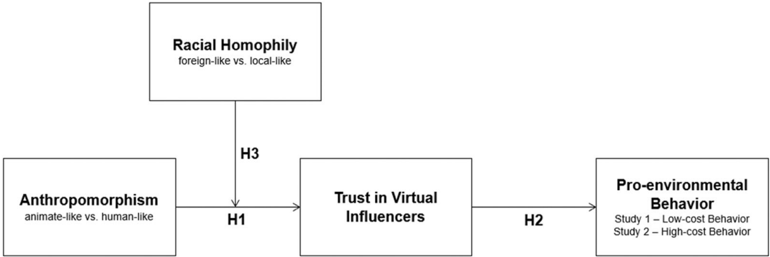
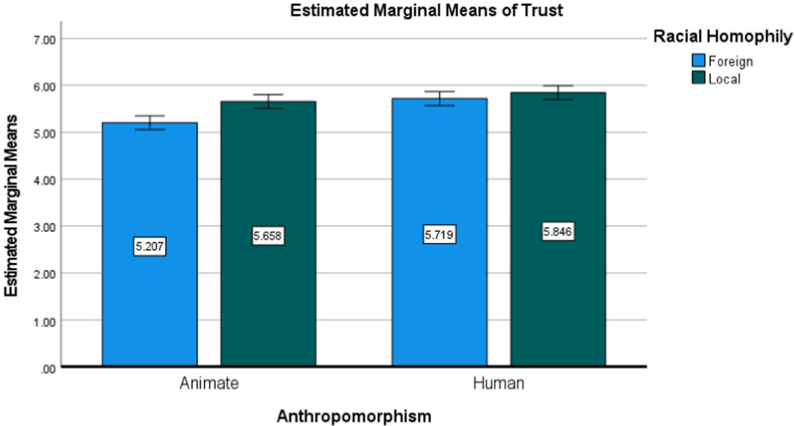
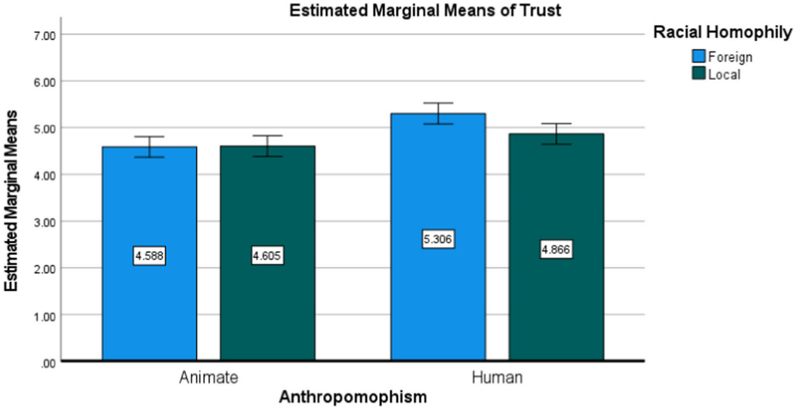
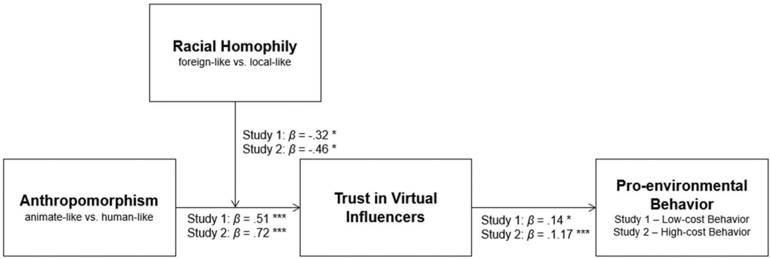
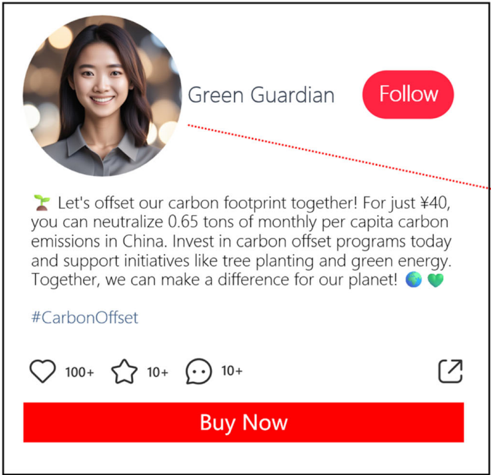
Virtual influencers have great potential to shape the audience's perception and motivate behavioral change. Drawing upon anthropomorphism theory and social identity theory, this paper examined the interaction effect of anthropomorphism and racial homophily of virtual influencers in shaping audiences' trust and subsequently pro‐environmental behaviors in low‐ and high‐cost contexts. Two online studies employing experimental materials generated by artificial intelligence were conducted. Study 1 revealed that high anthropomorphism (human‐like virtual influencers) and high racial homophily (local‐like virtual influencers) are more effective for eliciting trust in the context of low‐cost pro‐environmental behaviors. The findings also showed that low racial homophily (foreign‐like virtual influencers) would further weaken the trust level of a virtual influencer in low anthropomorphism (animate‐like virtual influencers). Study 2 aimed to replicate the findings from Study 1 in the context of high‐cost pro‐environmental behaviors. The findings showed that low racial homophily (foreign‐like virtual influencers) enhanced the trust in a high anthropomorphism (human‐like virtual influencers) virtual influencer. The moderated mediation analyses confirmed the hypothesized relationships in the proposed research model. This research advanced our understanding on the moderating role of racial homophily that serves as a cognitive shortcut for low‐cost and quick decisions. However, a low racial homophily (foreign‐like) virtual influencer would be more effective for high‐cost and symbolic pro‐environmental behaviors. These insights provide valuable guidance to businesses, marketers, and environmental advocates aiming to leverage virtual influencers for encouraging sustainability practices.
Overview
The claims and statistics of this paper haven’t been checked yet.
Run the check — free, no account needed. It reads the open-access text and checks the sources it cites.
Integrity signals
Registry
Cites
Statistics
Figures



























Verification
Claims the paper makes
The claims and statistics of this paper haven’t been checked yet.
Run the check — free, no account needed. It reads the open-access text and checks the sources it cites.
Claims other papers make about this one
Each is checked against this paper’s own text: does it say what the citing paper says it does?
In the citing paper
“Previous studies indicated that humans can form romantic relationships with AI tools, such as robots, virtual assistants and ChatGPT (Song et al., 2022;Chen et al., 2025;Wan et al., 2024)”
From I love you, my AI companion! Do you? Perspectives from the Triangular Theory of Love and Attachment Theory (2026) · cites this paper as Wan et al., 2024
Self-check
Percentages, sums and reported differences re-computed from the paper’s own numbers.
The self-check needs the paper’s full text.
Citations
Cites
The theory of planned behavior
Ajzen, I. (1991) · Organizational Behavior and Human Decision Processes · doi:10.1016/0749-5978(91)90020-t · Cited by 90,587
Statistical power analyses using G∗Power 3.1: tests for correlation and regression analyses
Faul, F., Erdfelder, E., Buchner, A., & Lang, A.-G. (2009) · Behavior Research Methods · doi:10.3758/brm.41.4.1149 · Cited by 37,615
On seeing human: A three-factor theory of anthropomorphism
Epley, N., Waytz, A., & Cacioppo, J. T. (2007) · Psychological Review · doi:10.1037/0033-295x.114.4.864 · Cited by 4,069
Ohanian, R. (1990) · Journal of Advertising · doi:10.1080/00913367.1990.10673191 · Cited by 4,043
The Influence of Source Credibility on Communication Effectiveness
Hovland, C. I., & Weiss, W. (1951) · Public Opinion Quarterly · doi:10.1086/266350 · Cited by 3,543
The Role of Live Streaming in Building Consumer Trust and Engagement with Social Commerce Sellers
Wongkitrungrueng, A., & Assarut, N. (2020) · Journal of Business Research · doi:10.1016/j.jbusres.2018.08.032 · Cited by 1,477
Examining Science Education in ChatGPT: An Exploratory Study of Generative Artificial Intelligence
Cooper, G. (2023) · Journal of Science Education and Technology · doi:10.1007/s10956-023-10039-y · Cited by 1,263
Almost human: Anthropomorphism increases trust resilience in cognitive agents.
de Visser, E. J., Monfort, S. S., McKendrick, R., Smith, M. A. B., McKnight, P. E., Krueger, F., & Parasuraman, R. (2016) · Journal of Experimental Psychology: Applied · doi:10.1037/xap0000092 · Cited by 614
van der Werff, E., Steg, L., & Keizer, K. (2013) · Global Environmental Change · doi:10.1016/j.gloenvcha.2013.07.018 · Cited by 541
Franke, C., Groeppel-Klein, A., & Müller, K. (2023) · Journal of Advertising · doi:10.1080/00913367.2022.2154721 · Cited by 408
Research works printed but not linked: 118
- 10.3390/ijerph192316013 · DOI
- 10.1016/j.jenvp.2010.02.003 · DOI
- 10.1037/pspp0000413 · DOI
- 10.4102/sajbm.v45i3.130 · DOI
- 10.3390/su12114348 · DOI
- 10.1016/j.ijhcs.2021.102694 · DOI · Paper page
- 10.1016/j.jbusres.2022.113567 · DOI
- 10.1108/INTR-11-2020-0638 · DOI
- 10.1007/s11747-020-00762-y · DOI · Paper page
- 10.1080/17524032.2022.2115525 · DOI
- 10.1002/mar.21549 · DOI
- 10.1016/j.jretconser.2021.102904 · DOI
- 10.1037/ppm0000082 · DOI
- 10.1080/15252019.2023.2236102 · DOI
- 10.1108/JCM-10-2019-3455 · DOI
- 10.1108/JFMM-08-2019-0157 · DOI
- 10.1016/j.techfore.2022.121550 · DOI
- 10.1016/j.jenvp.2021.101741 · DOI
- 10.1109/MCOM.001.2100786 · DOI
- 10.1086/722703 · DOI
- 10.1080/17524032.2022.2027801 · DOI
- 10.1177/1043463103154002 · DOI
- 10.1002/mar.21486 · DOI
- 10.1016/S0921-8890(02)00374-3 · DOI · Paper page
- Erba J., 2019, Exploring the role of ethnic and bi‐ethnic identities in advertisements targeting Chinese and Chinese‐American consumers using celebrity athletes, China Media Research; A Journal of Science and its Applications, 15, 67
- 10.1016/j.jbusres.2024.114520 · DOI
- 10.1002/ijop.12034 · DOI
- 10.1016/j.rser.2020.110039 · DOI
- 10.1108/INTR-02-2020-0078 · DOI
- 10.3390/su151814026 · DOI
- 10.1108/INTR-04-2021-0229 · DOI
- 10.1002/mar.21989 · DOI
- 10.1016/j.paid.2011.05.027 · DOI
- 10.3390/ijerph17061883 · DOI
- Hayes A. F., 2018, Introduction to mediation, moderation, and conditional process analysis: A regression‐based approach
- 10.1002/cb.1562 · DOI
- 10.1177/1746847717710738 · DOI
- Hofeditz L., 2022, Trust me, I'm an influencer!‐A comparison of perceived trust in human and virtual influencers, ECIS 2022 Research‐in‐Progress Papers, 27
- 10.1177/0003122417705656 · DOI
- 10.1016/j.resconrec.2020.104747 · DOI
- 10.1016/j.envsci.2018.07.016 · DOI
- 10.1080/02650487.2020.1836925 · DOI
- 10.1016/j.clrc.2021.100014 · DOI
- 10.1108/YC-05-2022-1529 · DOI
- 10.1016/j.jretconser.2023.103660 · DOI
- 10.1016/j.jort.2024.100745 · DOI
- 10.1080/00913367.1990.10673175 · DOI
- 10.4324/9781351153683-14 · DOI
- 10.1109/TTS.2020.3001312 · DOI · Paper page
- 10.1080/09640568.2021.1972797 · DOI
- 10.2501/JAR-2018-035 · DOI · Paper page
- 10.3389/fcomm.2023.1205610 · DOI
- 10.1016/j.jbusres.2021.05.024 · DOI · Paper page
- 10.1016/j.jbusres.2024.114611 · DOI
- 10.1016/j.clrc.2023.100105 · DOI
- 10.1111/ajpy.12271 · DOI
- Kuzminov M., 2023, Consumer trust and virtual influencers, Forbes
- 10.1016/j.jretconser.2019.102027 · DOI · Paper page
- 10.1111/ijcs.12956 · DOI
- 10.1016/j.jenvp.2016.10.004 · DOI
- 10.1177/0003122419846849 · DOI
- 10.1002/mar.21575 · DOI
- 10.3390/su16031133 · DOI
- 10.1016/j.jbusres.2022.06.040 · DOI
- 10.1016/j.renene.2023.119861 · DOI
- 10.1108/JPBM-03-2023-4418 · DOI
- 10.1016/j.jbusres.2014.09.021 · DOI
- 10.1080/02650487.2018.1548196 · DOI
- 10.1080/15252019.2018.1533501 · DOI · Paper page
- 10.1177/0272431612472259 · DOI
- 10.1146/annurev.soc.27.1.415 · DOI · Paper page
- 10.1111/ijcs.12630 · DOI
- 10.1038/s43016-020-00146-z · DOI
- Mori M., 1970, The Uncanny Valley: The original essay by Masahiro Mori, IEEE Spectrum, 6, 1
- 10.1108/JCM-10-2014-1179 · DOI
- 10.1108/EJM-12-2022-0915 · DOI
- 10.1109/CyberSecurity49315.2020.9138861 · DOI
- 10.1080/0267257X.2020.1791933 · DOI
- 10.1080/0267257X.2021.1912142 · DOI
- 10.1016/j.chb.2023.107771 · DOI
- 10.1108/JSM-01-2018-0045 · DOI
- 10.1016/j.intmar.2021.05.002 · DOI
- 10.1002/mar.21749 · DOI
- 10.1108/LHTN-03-2023-0043 · DOI
- 10.52631/jemds.v3i1.175 · DOI
- 10.1016/j.bushor.2022.08.002 · DOI
- 10.3390/ijerph19010277 · DOI
- 10.4324/9781003155249-12 · DOI
- 10.1016/j.chb.2023.107706 · DOI
- 10.1057/s41599-024-02698-y · DOI
- 10.1080/02650487.2022.2075636 · DOI
- 10.1108/EJM-03-2022-0176 · DOI
- 10.1109/MRA.2019.2927372 · DOI
- Tajfel H., 1978, Social categorization, social identity and social comparison, Differentiation Between Social Group: Studies in the social psychology of intergroup relations, 61
- 10.1016/j.gloenvcha.2017.12.001 · DOI
- 10.1080/00913367.2020.1810595 · DOI
- 10.1080/17543266.2021.1909662 · DOI
- 10.1016/j.resconrec.2003.11.001 · DOI
- 10.1016/j.gloenvcha.2018.02.009 · DOI
- 10.1016/j.jenvp.2016.03.004 · DOI
- 10.1016/j.trd.2022.103584 · DOI
- 10.1177/0013916519882773 · DOI
- 10.1080/02650487.2017.1348035 · DOI · Paper page
- 10.1016/j.jenvp.2013.11.006 · DOI
- 10.1108/JPBM-06-2019-2442 · DOI
- 10.1086/653658 · DOI
- 10.1080/09669582.2024.2336493 · DOI
- 10.1016/j.chb.2022.107614 · DOI
- 10.1016/j.jenvp.2021.101748 · DOI
- 10.1080/10496491.2022.2163041 · DOI
- 10.1080/15252019.2023.2189036 · DOI
- Yang P.‐C., 2020, HATSUKI: An anime character like robot figure platform with anime‐style expressions and imitation learning based action generation, 2020 29th IEEE International Conference on Robot and Human Interactive Communication (RO‐MAN)
- 10.1108/JHTI-04-2023-0268 · DOI
- 10.1016/j.jretconser.2023.103560 · DOI
- 10.1016/j.jretconser.2019.102010 · DOI
- 10.1177/0022242920985784 · DOI
- 10.1177/00222429231203699 · DOI
- 10.1016/j.jbusres.2019.01.055 · DOI
Cited by
Sorted by citations
Ng, P. M. L., Wan, C., Lee, D., Garnelo-Gomez, I., & Lau, M. M. (2026) · Internet Research · doi:10.1108/intr-11-2024-1783 · Cited by 27
Self-citation
Metadata
- Authors
- Wan, C., Lee, D., & Ng, P.
- Affiliations
- Edinburgh Business School Heriot‐Watt University Edinburgh UK
- School of Professional Education and Executive Development The Hong Kong Polytechnic University Hong Kong Hong Kong
- Venue
- Psychology & Marketing
- Publisher
- Wiley
- Published
- 2024-05-02
- Volume
- 41
- Issue
- 8
- Pages
- 1833-1853
- ISSN
- 0742-6046
- 1520-6793
- Cited by
- 85
- References
- 11
- Language
- en
About these checks
Registry, retraction, Cites and statistics results are computed, not judged, with one exception: a printed reference that no index lists is read once by a model before it counts as a citation error. Claims are extracted by a model and kept only when their quote appears verbatim in the text; each cited source is then checked, with a model’s help, for whether it says what the claim relies on. Those verdicts can be wrong — read the claim’s quote and the cited source before relying on one.
Statistics and arithmetic are recomputed, not judged.
Confidence bands are shown only for fields calibrated on our annotated test set. None is calibrated yet, so no band is shown.
What counts as a claim ›How we measure confidence ›How we check this ›
Are you an author, or do you see a problem with this page? Request a review
How to cite
Cite CoChat for the checks on this page, and the paper for its own findings.
- This page
- CoChat. (2026). Citation check: The role of anthropomorphism and racial homophily of virtual influencers in encouraging low-versus high-cost pro-environmental behaviors. https://app.cochat.ai/papers/10.1002/mar.22013
- The paper
- Wan, C., Lee, D., & Ng, P. (2024). The role of anthropomorphism and racial homophily of virtual influencers in encouraging low-versus high-cost pro-environmental behaviors. Psychology & Marketing. https://doi.org/10.1002/mar.22013
