

The DOI matches its Crossref record; 2 of the 2 references it cites were found in a registry or an index.
Subregion entropy for the doubly-holographic global black string
Abstract
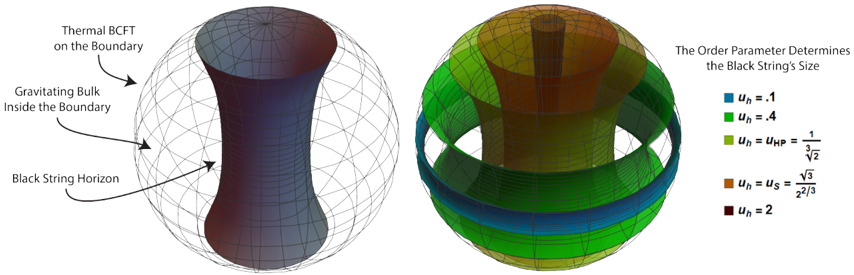
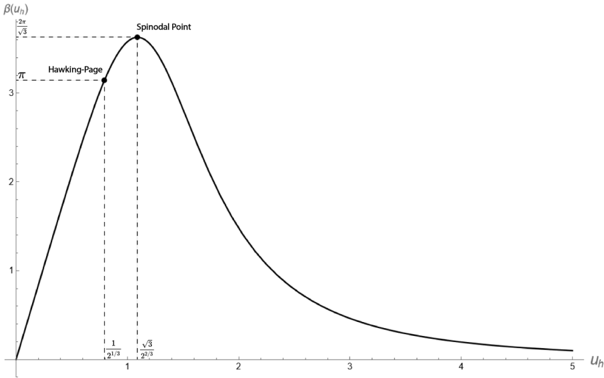
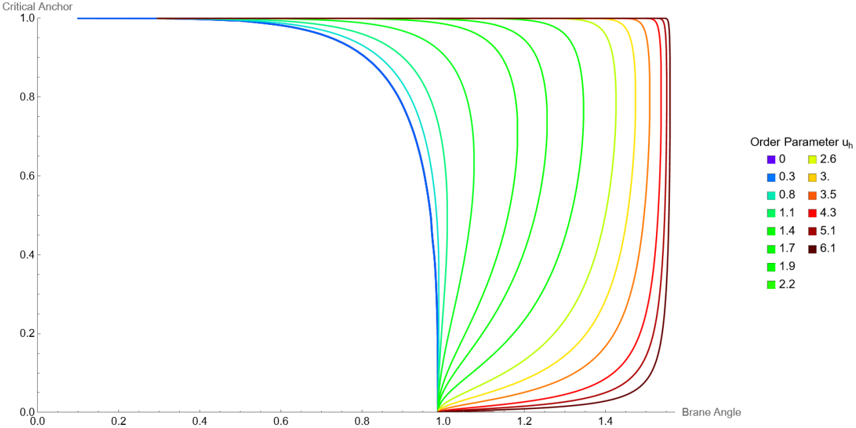
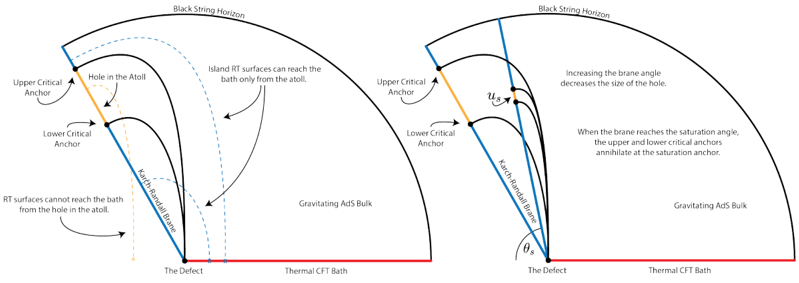
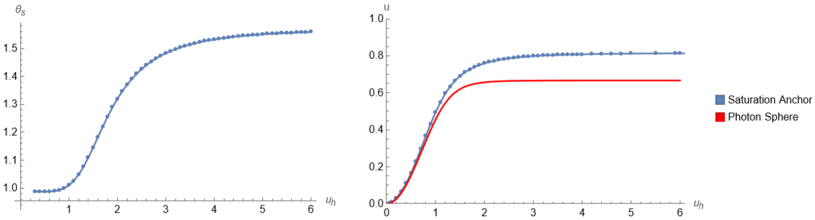
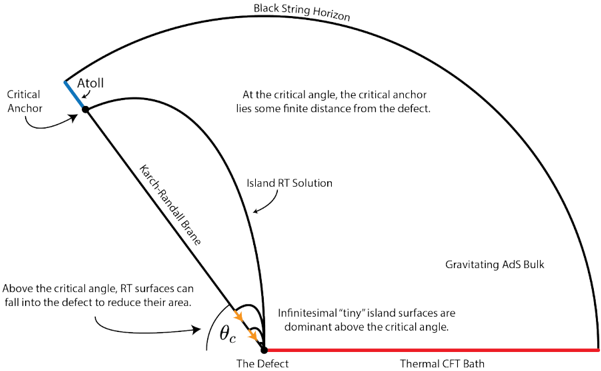
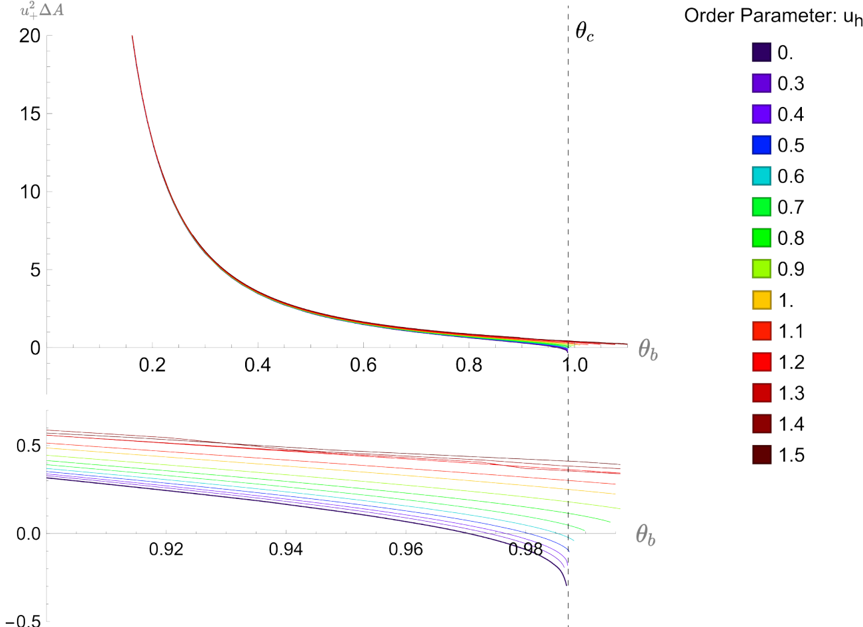
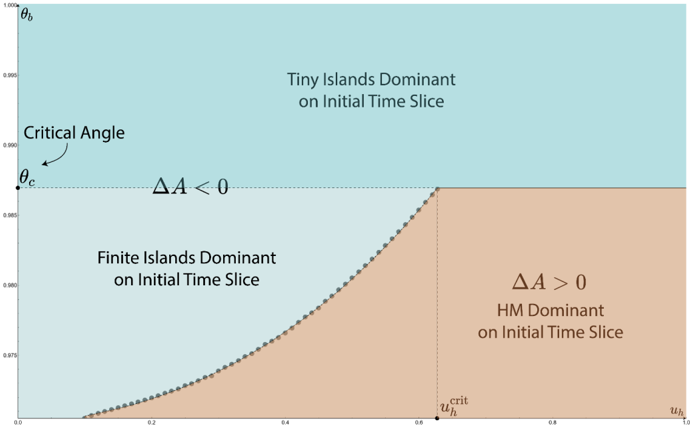
We study the growth of entanglement entropy in a doubly holographic model of gravity for a spherical AdS black hole. Compared to previous work, which was limited to the case of planar black holes, this introduces an extra scale to the problem. This allows us to analyze the interplay between the reorganization of entanglement entropy due to island formation and the onset of the Hawking-Page phase transition and to find the appearance of a new critical black hole radius unrelated to the thermodynamics. We also find that the geometry of the Ryu-Takayanagi surface capturing the physics of islands exhibits drastically different behavior than in the planar case.
Overview
The claims and statistics of this paper haven’t been checked yet.
Run the check — free, no account needed. It reads the open-access text and checks the sources it cites.
Integrity signals
Registry
Cites
Statistics
Figures
Verification
Claims the paper makes
The claims and statistics of this paper haven’t been checked yet.
Run the check — free, no account needed. It reads the open-access text and checks the sources it cites.
Claims other papers make about this one
Each is checked against this paper’s own text: does it say what the citing paper says it does?
The source backs part of the claim, not all of it — or backs it for a different population, condition or comparison.
In the citing paper
“By applying this doubly-holographic reasoning to higher-dimensional topological black holes [65], black strings [264,265], and de Sitter space [83,266], the prescription (7.6) yields unitary Page curves, except in cases where the horizon is extremal with a vanishing temperature.”
From Three-Dimensional Quantum Black Holes: A Primer (2024) · cites this paper as [265]
Experimental — accuracy not yet measured
Self-check
Percentages, sums and reported differences re-computed from the paper’s own numbers.
The self-check needs the paper’s full text.
Citations
Cites
Entanglement wedge reconstruction and the information paradox
Penington, G. (2020) · Journal of High Energy Physics · doi:10.1007/jhep09(2020)002 · Cited by 968 · cited 2×
“The RT prescription, which requires us to determine the minimal extremal surfaces Σ that are homologous to R [19, 31], leads directly to the formation of islands when these surfaces terminate on the end-of-the-world brane [4, 5].”
BackgroundThe Page curve of Hawking radiation from semiclassical geometry
Almheiri, A., Mahajan, R., Maldacena, J., & Zhao, Y. (2020) · Journal of High Energy Physics · doi:10.1007/jhep03(2020)149 · Cited by 898
Research works printed but not linked: 35
- J.M. Maldacena, The Large N limit of superconformal field theories and supergravity, Adv. Theor. Math. Phys. 2 (1998) 231 [Int. J. Theor. Phys. 38 (1999) 1113] [hep-th/9711200] [INSPIRE]. · DOI · Paper page
- S.S. Gubser, I.R. Klebanov and A.M. Polyakov, Gauge theory correlators from noncritical string theory, Phys. Lett. B 428 (1998) 105 [hep-th/9802109] [INSPIRE]. · DOI · Paper page
- E. Witten, Anti-de Sitter space and holography, Adv. Theor. Math. Phys. 2 (1998) 253 [hep-th/9802150] [INSPIRE]. · DOI · Paper page
- A. Almheiri, N. Engelhardt, D. Marolf and H. Maxfield, The entropy of bulk quantum fields and the entanglement wedge of an evaporating black hole, JHEP 12 (2019) 063 [arXiv:1905.08762] [INSPIRE]. · DOI · Paper page
- N. Engelhardt and A.C. Wall, Quantum Extremal Surfaces: Holographic Entanglement Entropy beyond the Classical Regime, JHEP 01 (2015) 073 [arXiv:1408.3203] [INSPIRE]. · DOI · Paper page
- S. Ryu and T. Takayanagi, Holographic derivation of entanglement entropy from AdS/CFT, Phys. Rev. Lett. 96 (2006) 181602 [hep-th/0603001] [INSPIRE]. · DOI · Paper page
- S. Ryu and T. Takayanagi, Aspects of Holographic Entanglement Entropy, JHEP 08 (2006) 045 [hep-th/0605073] [INSPIRE]. · DOI · Paper page
- V.E. Hubeny, M. Rangamani and T. Takayanagi, A Covariant holographic entanglement entropy proposal, JHEP 07 (2007) 062 [arXiv:0705.0016] [INSPIRE]. · DOI · Paper page
- T. Faulkner, A. Lewkowycz and J.M. Maldacena, Quantum corrections to holographic entanglement entropy, JHEP 11 (2013) 074 [arXiv:1307.2892] [INSPIRE]. · DOI · Paper page
- A. Lewkowycz and J.M. Maldacena, Generalized gravitational entropy, JHEP 08 (2013) 090 [arXiv:1304.4926] [INSPIRE]. · DOI · Paper page
- H.Z. Chen, R.C. Myers, D. Neuenfeld, I.A. Reyes and J. Sandor, Quantum Extremal Islands Made Easy. Part I. Entanglement on the Brane, JHEP 10 (2020) 166 [arXiv:2006.04851] [INSPIRE]. · DOI
- H.Z. Chen, R.C. Myers, D. Neuenfeld, I.A. Reyes and J. Sandor, Quantum Extremal Islands Made Easy. Part II. Black Holes on the Brane, JHEP 12 (2020) 025 [arXiv:2010.00018] [INSPIRE]. · DOI · Paper page
- H. Geng et al., Entanglement phase structure of a holographic BCFT in a black hole background, JHEP 05 (2022) 153 [arXiv:2112.09132] [INSPIRE]. · DOI · Paper page
- A. Karch and L. Randall, Locally localized gravity, JHEP 05 (2001) 008 [hep-th/0011156] [INSPIRE]. · DOI · Paper page
- L. Randall and R. Sundrum, An Alternative to compactification, Phys. Rev. Lett. 83 (1999) 4690 [hep-th/9906064] [INSPIRE]. · DOI · Paper page
- A. Karch and L. Randall, Open and closed string interpretation of SUSY CFT’s on branes with boundaries, JHEP 06 (2001) 063 [hep-th/0105132] [INSPIRE]. · DOI · Paper page
- T. Takayanagi, Holographic Dual of BCFT, Phys. Rev. Lett. 107 (2011) 101602 [arXiv:1105.5165] [INSPIRE]. · DOI · Paper page
- M. Fujita, T. Takayanagi and E. Tonni, Aspects of AdS/BCFT, JHEP 11 (2011) 043 [arXiv:1108.5152] [INSPIRE]. · DOI · Paper page
- J.V. Rocha, Evaporation of large black holes in AdS: coupling to the evaporon, JHEP 08 (2008) 075 [arXiv:0804.0055v3]. · DOI
- H. Geng et al., Information Transfer with a Gravitating Bath, SciPost Phys. 10 (2021) 103 [arXiv:2012.04671] [INSPIRE]. · DOI
- A. Almheiri, R. Mahajan and J.E. Santos, Entanglement islands in higher dimensions, SciPost Phys. 9 (2020) 001 [arXiv:1911.09666] [INSPIRE]. · DOI
- H. Geng and A. Karch, Massive islands, JHEP 09 (2020) 121 [arXiv:2006.02438] [INSPIRE]. · DOI · Paper page
- H. Geng, S. Lüst, R.K. Mishra and D. Wakeham, Holographic BCFTs and Communicating Black Holes, JHEP 08 (2021) 003 [arXiv:2104.07039] [INSPIRE]. · DOI
- E. Witten, Anti-de Sitter space, thermal phase transition, and confinement in gauge theories, Adv. Theor. Math. Phys. 2 (1998) 505 [hep-th/9803131] [INSPIRE]. · DOI · Paper page
- R. Gregory and R. Laflamme, Black strings and p-branes are unstable, Phys. Rev. Lett. 70 (1993) 2837 [hep-th/9301052] [INSPIRE]. · DOI · Paper page
- A. Chamblin and A. Karch, Hawking and Page on the brane, Phys. Rev. D 72 (2005) 066011 [hep-th/0412017] [INSPIRE]. · DOI · Paper page
- R. Gregory, S.F. Ross and R. Zegers, Classical and quantum gravity of brane black holes, JHEP 09 (2008) 029 [arXiv:0802.2037] [INSPIRE]. · DOI · Paper page
- T. Hirayama and G. Kang, Stable black strings in anti-de Sitter space, Phys. Rev. D 64 (2001) 064010 [hep-th/0104213] [INSPIRE]. · DOI · Paper page
- D. Marolf and J.E. Santos, Phases of Holographic Hawking Radiation on spatially compact spacetimes, JHEP 10 (2019) 250 [arXiv:1906.07681] [INSPIRE]. · DOI
- R. Emparan, D. Licht, R. Suzuki, M. Tomašević and B. Way, Black tsunamis and naked singularities in AdS, JHEP 02 (2022) 090 [arXiv:2112.07967] [INSPIRE]. · DOI · Paper page
- S.S. Gubser and I. Mitra, The Evolution of unstable black holes in anti-de Sitter space, JHEP 08 (2001) 018 [hep-th/0011127] [INSPIRE]. · DOI
- S.W. Hawking and D.N. Page, Thermodynamics of Black Holes in anti-de Sitter Space, Commun. Math. Phys. 87 (1983) 577 [INSPIRE]. · DOI · Paper page
- A. Almheiri, R. Mahajan and J.M. Maldacena, Islands outside the horizon, arXiv:1910.11077. · arXiv
- T. Hartman and J.M. Maldacena, Time Evolution of Entanglement Entropy from Black Hole Interiors, JHEP 05 (2013) 014 [arXiv:1303.1080] [INSPIRE]. · DOI · Paper page
- C. Perez-Pardavila, Entropy of radiation with dynamical gravity, JHEP 05 (2023) 038 [arXiv:2302.04279] [INSPIRE]. · DOI
Cited by
Sorted by citations
Three-Dimensional Quantum Black Holes: A Primer
Panella, E., Pedraza, J. F., & Svesko, A. (2024) · Universe · doi:10.3390/universe10090358 · Cited by 24
Metadata
- Authors
- Karch, A., Perez-Pardavila, C., Riojas, M., & Youssef, M.
- ORCID
- Youssef, Merna
- Venue
- Journal of High Energy Physics
- Published
- 2023-05-25
- Volume
- 2023
- Issue
- 5
- ISSN
- 1029-8479
- Cited by
- 7
- References
- 2
- Language
- en
About these checks
Registry, retraction, Cites and statistics results are computed, not judged, with one exception: a printed reference that no index lists is read once by a model before it counts as a citation error. Claims are extracted by a model and kept only when their quote appears verbatim in the text; each cited source is then checked, with a model’s help, for whether it says what the claim relies on. Those verdicts can be wrong — read the claim’s quote and the cited source before relying on one.
Statistics and arithmetic are recomputed, not judged.
Confidence bands are shown only for fields calibrated on our annotated test set. None is calibrated yet, so no band is shown.
What counts as a claim ›How we measure confidence ›How we check this ›
Are you an author, or do you see a problem with this page? Request a review
