

The Python’s Lunch: geometric obstructions to decoding Hawking radiation
Open accessThe DOI matches its Crossref record; 83 of the 83 references it cites were found in a registry or an index.
Abstract
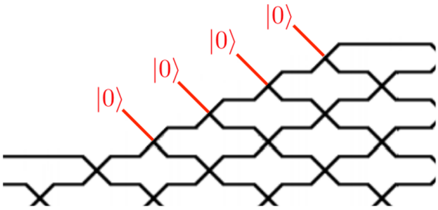
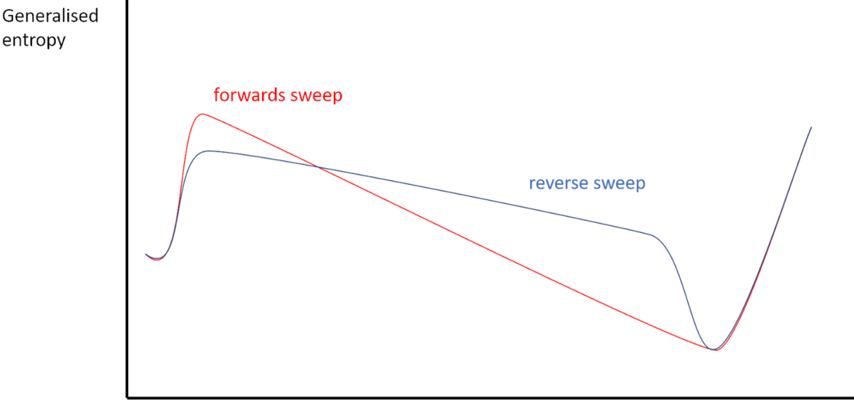
A bstract: According to Harlow and Hayden [ arXiv:1301.4504 ] the task of distilling information out of Hawking radiation appears to be computationally hard despite the fact that the quantum state of the black hole and its radiation is relatively un-complex. We trace this computational difficulty to a geometric obstruction in the Einstein-Rosen bridge connecting the black hole and its radiation. Inspired by tensor network models, we conjecture a precise formula relating the computational hardness of distilling information to geometric properties of the wormhole — specifically to the exponential of the difference in generalized entropies between the two non-minimal quantum extremal surfaces that constitute the obstruction. Due to its shape, we call this obstruction the ‘Python’s Lunch’, in analogy to the reptile’s postprandial bulge.
Overview
The claims and statistics of this paper haven’t been checked yet.
Free: it reads the open-access text and checks the first 5 claims that cite a source we can check. Create a free account to check every claim.
Integrity signals
Registry
Cites
Statistics
Figures






Verification
Claims the paper makes
The claims and statistics of this paper haven’t been checked yet.
Free: it reads the open-access text and checks the first 5 claims that cite a source we can check. Create a free account to check every claim.
Claims other papers make about this one
Each is checked against this paper’s own text: does it say what the citing paper says it does?
The source backs part of the claim, not all of it — or backs it for a different population, condition or comparison.
In the citing paper
“In fact, for evaporating black holes, there is good reason to think that it is exponentially complicated [65,66].”
From Replica wormholes and the black hole interior (2022) · cites this paper as [66]
Experimental — accuracy not yet measuredThe cited source says what the claim attributes to it.
In the citing paper
“A remarkable geometric way of capturing this complexity was proposed in [236] based on the generic existence of non-minimal extremal surfaces forming a Python-lunch geometry (sandwiched between minimal extremal surfaces or behind one of them) and interpreting this geometry in terms of tensor network constructions.”
From Holographic spacetime, black holes and quantum error correcting codes: a review (2022) · cites this paper as [236]
The cited source says what the claim attributes to it.
In the citing paper
“In all cases, the inher-ent chaos in microstate dynamics should connect the Python's lunch geometric mechanism of generating exponential complexity [236] in encoding with the pseudorandomness mechanism discussed in [258].”
From Holographic spacetime, black holes and quantum error correcting codes: a review (2022) · cites this paper as [236]
Self-check
Percentages, sums and reported differences re-computed from the paper’s own numbers.
The self-check needs the paper’s full text.
Citations
Cites
A fast quantum mechanical algorithm for database search
Grover, L. K. (1996) · Proceedings of the twenty-eighth annual ACM symposium on Theory of computing - STOC '96 · doi:10.1145/237814.237866 · Cited by 8,830 · cited 1×
“In the previous subsection we argued that we can decode Hawking radiation by projecting out m qubits, and provided a version of a Grover search [14, 15] that allows to do this”
Method(1988) · Elsevier eBooks · doi:10.1016/c2013-0-11200-7 · Cited by 5,131
Holographic Derivation of Entanglement Entropy from AdS/CFT
Ryu, S., & Takayanagi, T. (2006) · arXiv · doi:10.48550/arxiv.hep-th/0603001 · Cited by 4,321
Quantum Mechanics Helps in Searching for a Needle in a Haystack
Grover, L. K. (1997) · Physical Review Letters · doi:10.1103/physrevlett.79.325 · Cited by 4,306 · cited 1×
“where C TN NlogN. 4.3 Post-selection is Superpolynomial In the previous subsection we argued that we can decode Hawking radiation by projecting out mqubits, and provided a version of a Grover search [14, 15] that allows to do this projection with a unitary that has complexity p 2m. Can we rule out the possibility that…”
BackgroundInfluentialRyu, S., & Takayanagi, T. (2006) · Physical Review Letters · doi:10.1103/physrevlett.96.181602 · Cited by 4,302 · cited 1×
“However, the covariant surface that is analogous to the minimal cut through a tensor network is the HRT surface [23, 24, 25], the minimal area extremal surface homologous to one end of the wormhole.”
BackgroundA covariant holographic entanglement entropy proposal
Hubeny, V. E., Rangamani, M., & Takayanagi, T. (2007) · Journal of High Energy Physics · doi:10.1088/1126-6708/2007/07/062 · Cited by 1,822 · cited 1×
“However, the covariant surface that is analogous to the minimal cut through a tensor network is the HRT surface [23, 24, 25], the minimal area extremal surface homologous to one end of the wormhole.”
BackgroundA Covariant Holographic Entanglement Entropy Proposal
Hubeny, V. E., Rangamani, M., & Takayanagi, T. (2007) · arXiv · doi:10.48550/arxiv.0705.0016 · Cited by 1,822 · cited 1×
“However, the covariant surface that is analogous to the minimal cut through a tensor network is the HRT surface [23, 24, 25], the minimal area extremal surface homologous to one end of the wormhole.”
BackgroundAverage entropy of a subsystem
Page, D. N. (1993) · Physical Review Letters · doi:10.1103/physrevlett.71.1291 · Cited by 1,578 · cited 1×
“n we will see how a Python’s Lunch explains the exponential diculty of decoding Hawking radiation. After the Page time an evaporating black hole is maximally entangled with its own Hawking radiation [30]. Harlow and Hayden [1] asked how hard it is to isolate a degree of freedom r in the radiation that is entangled wit…”
BackgroundAverage Entropy of a Subsystem
Page, D. N. (1993) · arXiv · doi:10.48550/arxiv.gr-qc/9305007 · Cited by 1,578 · cited 1×
“n we will see how a Python’s Lunch explains the exponential diculty of decoding Hawking radiation. After the Page time an evaporating black hole is maximally entangled with its own Hawking radiation [30]. Harlow and Hayden [1] asked how hard it is to isolate a degree of freedom r in the radiation that is entangled wit…”
BackgroundBlack Holes: Complementarity or Firewalls?
Almheiri, A., Marolf, D., Polchinski, J., & Sully, J. (2012) · arXiv · doi:10.48550/arxiv.1207.3123 · Cited by 1,471
Research works printed but not linked: 2
- 23. U.S.A. (2019), pp. 193-204.
- 56. W.K. Allard, Notes on the theory of varifolds, in Théorie des variétés minimales et applications, Astérisque 154-155, Société Mathématique de France (1987), pp. 73-93 and online at http://www.numdam.org/item/AST 1987 154-155 73 0.
Cited by
Items 101–128 of 128
Probing the bubble interior with entanglement entropy and bulk-cone singularities
Auzzi, R., Baiguera, S., Guo, L., Nardelli, G., & Zenoni, N. (2026) · Journal of High Energy Physics · doi:10.1007/jhep02(2026)215 · Cited by 4
Aaronson, S., & Pollack, J. (2023) · Journal of High Energy Physics · doi:10.1007/jhep04(2023)037 · Cited by 5
Subsystem complexity and measurements in holography
Jian, S.-K., & Zhang, Y. (2024) · Journal of High Energy Physics · doi:10.1007/jhep05(2024)241 · Cited by 6
“The python’s lunch conjecture states that when there is another locally minimal surface apart from the globally minimal one, the complexity to reconstruct operators between these two surfaces (a region called the python’s lunch) is exponentially large [68].”
BackgroundSubregion duality, wedge classification and no global symmetries in AdS/CFT
Bao, N., Jiang, Y., & Naskar, J. (2025) · Journal of High Energy Physics · doi:10.1007/jhep01(2025)064 · Cited by 9
Warping wormholes with dust: a metric construction of the Python’s Lunch
Bao, N., Chatwin-Davies, A., & Remmen, G. N. (2023) · OSTI OAI (U.S. Department of Energy Office of Scientific and Technical Information) · doi:10.1007/jhep09%282020%29102 · Cited by 3
Constraints on physical computers in holographic spacetimes
Kubicki, A. M., May, A., & Pérez-García, D. (2024) · SciPost Physics · doi:10.21468/scipostphys.16.1.024 · Cited by 6
On infinite tensor networks, complementary recovery and type II factors
Chemissany, W., Gesteau, E., Jahn, A., Murphy, D., & Shaposhnik, L. (2025) · Journal of Physics A: Mathematical and Theoretical · doi:10.1088/1751-8121/ae0edd · Cited by 1
“Tensor networks have become an ubiquitous tool in modern physics, ranging from the description of ground states of many-body quantum-mechanical systems and topological phases of matter [1, 2] to the study of quantum information aspects of holographic dualities [3–9].”
Simple holography in general spacetimes
Raphael Bousso, A., & Tabor, E. (2025) · Journal of High Energy Physics · doi:10.1007/jhep10(2025)020 · Cited by 3
“Bottom : the entanglement wedge is to the right of the solid green lines.”
Gupta, D., Headrick, M., & Sasieta, M. (2025) · SciPost Physics · doi:10.21468/scipostphys.19.6.143 · Cited by 7
Detecting black hole microstates
Balasubramanian, V., Chan, W. K. L., & Murdia, C. (2026) · Physical review. D/Physical review. D. · doi:10.1103/yqts-ybrd · Cited by 3
Stabilizer complexity of Hawking radiation
Anonymous, Parrikar, O., Paul, S., & Rajgadia, H. (2026) · Physical review. D/Physical review. D. · doi:10.1103/49df-l9n4 · Cited by 6
Non-linear equation of motion for higher curvature semiclassical gravity
Kumar, N. (2025) · Physics Letters B · doi:10.1016/j.physletb.2025.139264 · Cited by 2
Estimating time in quantum chaotic systems and black holes
Tang, H., Vardhan, S., & Wang, J. (2025) · SciPost Physics · doi:10.21468/scipostphys.19.4.095 · Cited by 4
Structure of deformations in Jackiw–Teitelboim black holes with matter
Dongsu Bak, A., Kim, C., & Yi, S.-H. (2023) · Journal of the Korean Physical Society · doi:10.1007/s40042-023-00944-1 · Cited by 1
“There are, however, nontrivial behind-horizon degrees of freedom in the bulk such as Python’s degrees of freedom [12, 13, 14].”
BackgroundEntanglement of Initial State and Pseudo Entanglement WedgePreprint
Miyaji, M. (2021) · arXiv (Cornell University) · Cited by 2
Akers, C., & Penington, G. (2022) · SciPost Physics · doi:10.21468/scipost.report.4604
Akers, C., & Penington, G. (2022) · SciPost Physics · doi:10.21468/scipost.report.4464
(2023) · SciPost Physics · doi:10.21468/scipost.report.8094
Arora, G., Headrick, M., Lawrence, A., et al. (2024) · SciPost Physics · doi:10.21468/scipost.report.8874
Arora, G., Headrick, M., Lawrence, A., et al. (2024) · SciPost Physics · doi:10.21468/scipost.report.8927
Black Hole as an Information Mirror
Wang, X. (2025) · IntechOpen eBooks · doi:10.5772/intechopen.1009847 · Cited by 1
Many phases in a hairy box in three dimensions
Miyashita, S. (2025) · Universe · doi:10.3390/universe11070208
“This is where a new type of solution appears, which I will call “boson star-PL” saddle.”
Balasubramanian, V., & Yildirim, T. (2025) · Physical Review D · doi:10.1103/p7wt-47rj · Cited by 5
“As a result, most probes of the state should give universal responses and be unable to access the information encoded in the state [6, 9, 44, 45].”
Coarse-grained fixed-point tensor networks and holographic reflected entropy in 3D gravity
Bao, N., Chu, J., Jiang, Y., & March, J. (2026) · Journal of High Energy Physics · doi:10.1007/jhep02(2026)107 · Cited by 1
Holographic Absolutely Maximally Entangled States in Black Hole Interiors
Anegawa, T., & Tamaoka, K. (2025) · Physical Review Letters · doi:10.1103/w7nc-l9s5 · Cited by 4
Fortuity and complexity in a simple quark model
Fliss, J. R., Jejjala, V., & Parrikar, O. (2026) · Journal of High Energy Physics · doi:10.1007/jhep09(2026)040 · Cited by 4
Monogamous entanglement cheats at the price of complexity
Corbeel, A., & Verlinde, E. (2026) · International Journal of Modern Physics D · doi:10.1142/s021827182640002x
Reconstruction Support and Island Dominance in Black-Hole Information Recovery
Ding, H. (2026) · Quantum Reports · doi:10.3390/quantum8030090
Metadata
- Authors
- Brown, A. R., Gharibyan, H., Penington, G., & Susskind, L.
- Affiliations
- Google (United States) (US)
- California Institute of Technology (US)
- Stanford University (US)
- Corresponding author
- Gharibyan, Hrant
- Venue
- Journal of High Energy Physics
- Published
- 2020-08
- Volume
- 2020
- Issue
- 8
- ISSN
- 1029-8479 (ISSN-L)
- OpenAlex
- W2990791203
- Cited by
- 124
- References
- 70
- Citations by year
- 2026: 9 · 2025: 26 · 2024: 22 · 2023: 25 · 2022: 18 · 2021: 16 · 2020: 7
- FWCI
- 7.30
- Type
- journal article
- Language
- en
- Open access
- diamond
- doi.org
- Licence
- cc-by
- creativecommons.org/licenses/by/4.0 (tdm)
- creativecommons.org/licenses/by/4.0 (vor, 24 d)
- Locations
- Journal of High Energy Physics (publishedVersion, cc-by)
- arXiv (Cornell University) (submittedVersion)
- OSTI OAI (U.S. Department of Energy Office of Scientific and Technical Information) (submittedVersion)
- CaltechAUTHORS (California Institute of Technology) (submittedVersion, cc-by)
- DOAJ (DOAJ: Directory of Open Access Journals) (submittedVersion, cc-by-sa)
- arXiv (Cornell University)
- Funders
- National Science Foundation (1316699)
- U.S. Department of Energy (DESC0019380)
- Simons Foundation
- Air Force Office of Scientific Research (FA9550-, FA9550-16-1-0082, FA9550-16, -16-1-, FA9550-16-1)
- Topics
- Physical Sciences › Physics and Astronomy › Nuclear and High Energy Physics › Black Holes and Theoretical Physics
- Physical Sciences › Physics and Astronomy › Atomic and Molecular Physics, and Optics › Quantum many-body systems
- Physical Sciences › Physics and Astronomy › Nuclear and High Energy Physics › Noncommutative and Quantum Gravity Theories
- Keywords
- Hawking radiation, black holes, quantum extremal surfaces, generalized entropy, Einstein-Rosen bridge, wormholes, computational hardness, information distillation, tensor networks
About these checks
Registry, retraction, Cites and statistics results are computed, not judged, with one exception: a printed reference that no index lists is read once by a model before it counts as a citation error. Claims are extracted by a model and kept only when their quote appears verbatim in the text; each cited source is then checked, with a model’s help, for whether it says what the claim relies on. Those verdicts can be wrong — read the claim’s quote and the cited source before relying on one.
Statistics and arithmetic are recomputed, not judged.
Confidence bands are shown only for fields calibrated on our annotated test set. None is calibrated yet, so no band is shown.
What counts as a claim ›How we measure confidence ›How we check this ›
Are you an author, or do you see a problem with this page? Request a review
Data sources
Bibliographic data: Semantic Scholar, OpenAlex, Crossref.
Contains information from the Semantic Scholar Academic Graph Datasets, made available under the ODC Attribution License (ODC-BY 1.0).
Semantic Scholar’s data is described in: Kinney, R., et al. (2023). The Semantic Scholar Open Data Platform. arXiv:2301.10140.
