

The DOI matches its Crossref record; 81 of the 81 references it cites were found in a registry or an index.
The Python’s Lunch: geometric obstructions to decoding Hawking radiation
Open accessAbstract
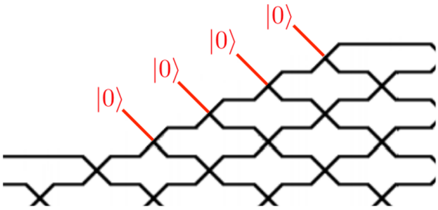
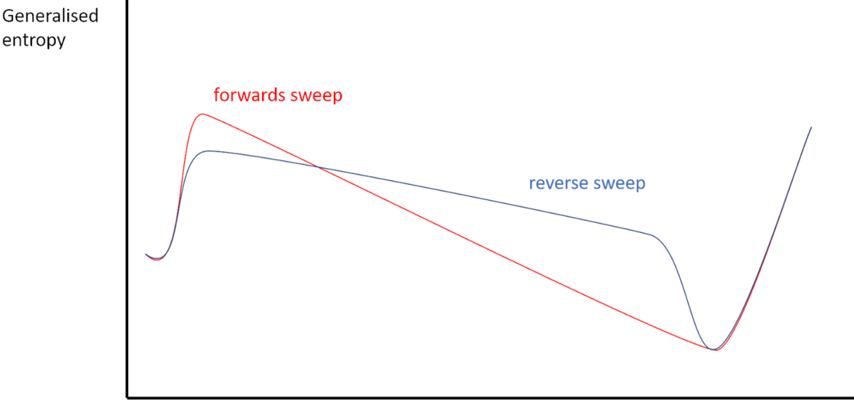
A bstract: According to Harlow and Hayden [ arXiv:1301.4504 ] the task of distilling information out of Hawking radiation appears to be computationally hard despite the fact that the quantum state of the black hole and its radiation is relatively un-complex. We trace this computational difficulty to a geometric obstruction in the Einstein-Rosen bridge connecting the black hole and its radiation. Inspired by tensor network models, we conjecture a precise formula relating the computational hardness of distilling information to geometric properties of the wormhole — specifically to the exponential of the difference in generalized entropies between the two non-minimal quantum extremal surfaces that constitute the obstruction. Due to its shape, we call this obstruction the ‘Python’s Lunch’, in analogy to the reptile’s postprandial bulge.
Overview
The claims and statistics of this paper haven’t been checked yet.
Free: it reads the open-access text and checks the first 5 claims that cite a source we can check. Create a free account to check every claim.
Integrity signals
Registry
Cites
Statistics
Figures






Verification
Claims the paper makes
The claims and statistics of this paper haven’t been checked yet.
Free: it reads the open-access text and checks the first 5 claims that cite a source we can check. Create a free account to check every claim.
Claims other papers make about this one
Each is checked against this paper’s own text: does it say what the citing paper says it does?
The source backs part of the claim, not all of it — or backs it for a different population, condition or comparison.
In the citing paper
“In fact, for evaporating black holes, there is good reason to think that it is exponentially complicated [65,66].”
From Replica wormholes and the black hole interior (2022) · cites this paper as [66]
Experimental — accuracy not yet measuredThe cited source says what the claim attributes to it.
In the citing paper
“A remarkable geometric way of capturing this complexity was proposed in [236] based on the generic existence of non-minimal extremal surfaces forming a Python-lunch geometry (sandwiched between minimal extremal surfaces or behind one of them) and interpreting this geometry in terms of tensor network constructions.”
From Holographic spacetime, black holes and quantum error correcting codes: a review (2022) · cites this paper as [236]
The cited source says what the claim attributes to it.
In the citing paper
“In all cases, the inher-ent chaos in microstate dynamics should connect the Python's lunch geometric mechanism of generating exponential complexity [236] in encoding with the pseudorandomness mechanism discussed in [258].”
From Holographic spacetime, black holes and quantum error correcting codes: a review (2022) · cites this paper as [236]
Self-check
Percentages, sums and reported differences re-computed from the paper’s own numbers.
The self-check needs the paper’s full text.
Citations
Cites
A fast quantum mechanical algorithm for database search
Grover, L. K. (1996) · Proceedings of the twenty-eighth annual ACM symposium on Theory of computing - STOC '96 · doi:10.1145/237814.237866 · Cited by 8,830 · cited 1×
“In the previous subsection we argued that we can decode Hawking radiation by projecting out m qubits, and provided a version of a Grover search [14, 15] that allows to do this”
Method(1988) · Elsevier eBooks · doi:10.1016/c2013-0-11200-7 · Cited by 5,131
Quantum Mechanics Helps in Searching for a Needle in a Haystack
Grover, L. K. (1997) · Physical Review Letters · doi:10.1103/physrevlett.79.325 · Cited by 4,306 · cited 1×
“where C TN NlogN. 4.3 Post-selection is Superpolynomial In the previous subsection we argued that we can decode Hawking radiation by projecting out mqubits, and provided a version of a Grover search [14, 15] that allows to do this projection with a unitary that has complexity p 2m. Can we rule out the possibility that…”
BackgroundInfluentialRyu, S., & Takayanagi, T. (2006) · Physical Review Letters · doi:10.1103/physrevlett.96.181602 · Cited by 4,302 · cited 1×
“However, the covariant surface that is analogous to the minimal cut through a tensor network is the HRT surface [23, 24, 25], the minimal area extremal surface homologous to one end of the wormhole.”
BackgroundA covariant holographic entanglement entropy proposal
Hubeny, V. E., Rangamani, M., & Takayanagi, T. (2007) · Journal of High Energy Physics · doi:10.1088/1126-6708/2007/07/062 · Cited by 1,822 · cited 1×
“However, the covariant surface that is analogous to the minimal cut through a tensor network is the HRT surface [23, 24, 25], the minimal area extremal surface homologous to one end of the wormhole.”
BackgroundA Covariant Holographic Entanglement Entropy Proposal
Hubeny, V. E., Rangamani, M., & Takayanagi, T. (2007) · arXiv · doi:10.48550/arxiv.0705.0016 · Cited by 1,822 · cited 1×
“However, the covariant surface that is analogous to the minimal cut through a tensor network is the HRT surface [23, 24, 25], the minimal area extremal surface homologous to one end of the wormhole.”
BackgroundAverage entropy of a subsystem
Page, D. N. (1993) · Physical Review Letters · doi:10.1103/physrevlett.71.1291 · Cited by 1,578 · cited 1×
“n we will see how a Python’s Lunch explains the exponential diculty of decoding Hawking radiation. After the Page time an evaporating black hole is maximally entangled with its own Hawking radiation [30]. Harlow and Hayden [1] asked how hard it is to isolate a degree of freedom r in the radiation that is entangled wit…”
BackgroundAverage Entropy of a Subsystem
Page, D. N. (1993) · arXiv · doi:10.48550/arxiv.gr-qc/9305007 · Cited by 1,578 · cited 1×
“n we will see how a Python’s Lunch explains the exponential diculty of decoding Hawking radiation. After the Page time an evaporating black hole is maximally entangled with its own Hawking radiation [30]. Harlow and Hayden [1] asked how hard it is to isolate a degree of freedom r in the radiation that is entangled wit…”
BackgroundBlack Holes: Complementarity or Firewalls?
Almheiri, A., Marolf, D., Polchinski, J., & Sully, J. (2012) · arXiv · doi:10.48550/arxiv.1207.3123 · Cited by 1,471
Strengths and Weaknesses of Quantum Computing
Bennett, C. H., Bernstein, E., Brassard, G., & Vazirani, U. (1997) · SIAM Journal on Computing · doi:10.1137/s0097539796300933 · Cited by 1,470
Research works printed but not linked: 1
- W.K. Allard, Notes on the theory of varifolds, in Théorie des variétés minimales et applications, Astérisque 154–155, Société Mathématique de France (1987), pp. 73–93 and online at http://www.numdam.org/item/AST_1987_154-155_73_0.
Cited by
Replica wormholes and the black hole interior
Penington, G., Shenker, S. H., Stanford, D., & Yang, Z. (2019) · arXiv · doi:10.48550/arxiv.1911.11977 · Cited by 809
“ch higher complexity, as a unitary operator, than the simple description (3.12) would suggest. In fact, for evaporating black holes, there is good reason to think that it is exponentially complicated [62, 63]. 3.4 Gravitational replica trick for the Petz map The above discussion of the Petz map motivates us to amend t…”
BackgroundInfluentialSelf-citationReplica wormholes and the black hole interior
Penington, G., Shenker, S. H., Stanford, D., & Yang, Z. (2022) · Journal of High Energy Physics · doi:10.1007/jhep03(2022)205 · Cited by 807
“ch higher complexity, as a unitary operator, than the simple description (3.12) would suggest. In fact, for evaporating black holes, there is good reason to think that it is exponentially complicated [62, 63]. 3.4 Gravitational replica trick for the Petz map The above discussion of the Petz map motivates us to amend t…”
BackgroundInfluentialSelf-citationThe entropy of Hawking radiation
Almheiri, A., Hartman, T., Maldacena, J., Shaghoulian, E., & Tajdini, A. (2021) · Reviews of Modern Physics · doi:10.1103/revmodphys.93.035002 · Cited by 706
“The actual quantum operations we would need to perform on the radiation are expected to be exceedingly complex, with a complexity that is (roughly) exponential in the black hole entropy [21,79].”
The entropy of Hawking radiation
Almheiri, A., Hartman, T., Maldacena, J., Shaghoulian, E., & Tajdini, A. (2020) · arXiv · doi:10.48550/arxiv.2006.06872 · Cited by 706
“The actual quantum operations we would need to perform on the radiation are expected to be exceedingly complex, with a complexity that is (roughly) exponential in the black hole entropy [21,79].”
Hartman, T., Jiang, Y., & Shaghoulian, E. (2020) · Journal of High Energy Physics · doi:10.1007/jhep11(2020)111 · Cited by 162
Large N algebras and generalized entropy
Chandrasekaran, V., Penington, G., & Witten, E. (2023) · Journal of High Energy Physics · doi:10.1007/jhep04(2023)009 · Cited by 237
“It was shown in [78] that, any time two spacelike-separated throats exist, there will always exist a third QES in between them that can be found by a so-called “maximinimax procedure.”
BackgroundSelf-citationHartman, T. (2023) · OSTI OAI (U.S. Department of Energy Office of Scientific and Technical Information) · doi:10.1007/jhep11%282020%29111 · Cited by 164
Quantum computational complexity from quantum information to black holes and back
Chapman, S., & Policastro, G. (2022) · The European Physical Journal C · doi:10.1140/epjc/s10052-022-10037-1 · Cited by 173
Complexity growth of operators in the SYK model and in JT gravity
Jian, S.-K., Swingle, B. G., & Xian, Z.-Y. (2021) · Journal of High Energy Physics · doi:10.1007/jhep03(2021)014 · Cited by 145
Reflected entropy for an evaporating black hole
Li, T., Chu, J., & Zhou, Y. (2020) · Journal of High Energy Physics · doi:10.1007/jhep11(2020)155 · Cited by 109
Including contributions from entanglement islands to the reflected entropy
Chandrasekaran, V., Miyaji, M., & Rath, P. (2020) · Physical review. D/Physical review. D. · doi:10.1103/physrevd.102.086009 · Cited by 102
Geometric secret sharing in a model of Hawking radiation
Balasubramanian, V. (2023) · OSTI OAI (U.S. Department of Energy Office of Scientific and Technical Information) · doi:10.1007/jhep01%282021%29177 · Cited by 111
The black hole interior from non-isometric codes and complexity
Akers, C., Engelhardt, N., Harlow, D., Penington, G., & Vardhan, S. (2024) · Journal of High Energy Physics · doi:10.1007/jhep06(2024)155 · Cited by 75
Self-citationGeometric secret sharing in a model of Hawking radiation
Balasubramanian, V., Kar, A., Parrikar, O., Sárosi, G., & Ugajin, T. (2021) · Journal of High Energy Physics · doi:10.1007/jhep01(2021)177 · Cited by 113
“is { 44 { also another extremal surface which controls the maximal cross section area of the wormhole { this was recently conjectured to be related to the restricted complexity of the boundary state [41]. C.1 Euclidean geometry We can put EOW branes in any legs of a multi-boundary wormhole. Let us restrict to the case…”
BackgroundInfluentialGeometric secret sharing in a model of Hawking radiation
Balasubramanian, V., Kar, A., Parrikar, O., Sárosi, G., & Ugajin, T. (2020) · arXiv · doi:10.48550/arxiv.2003.05448 · Cited by 81
“is { 44 { also another extremal surface which controls the maximal cross section area of the wormhole { this was recently conjectured to be related to the restricted complexity of the boundary state [41]. C.1 Euclidean geometry We can put EOW branes in any legs of a multi-boundary wormhole. Let us restrict to the case…”
BackgroundInfluentialEntanglement between two disjoint universes
Balasubramanian, V., Kar, A., & Ugajin, T. (2021) · Journal of High Energy Physics · doi:10.1007/jhep02(2021)136 · Cited by 94
“patch of and asymptotically AdS 2 black hole with temperature T= L 2ˇ : (3.12) 10Of course, if we have ˚ 0 >0, the Penrose diagram will be that of a maximally extended extremal AdS black hole (see [42] for a more detailed construction), but in this paper we will only be concerned with a single instance of the exten…”
BackgroundInfluentialThe central dogma and cosmological horizons
Shaghoulian, E. (2022) · Journal of High Energy Physics · doi:10.1007/jhep01(2022)132 · Cited by 108
“8 There are serious questions about such a construction which we will not address, foremost being the dynamical nature of the horizon and the properties (7)The maximinimax prescription of [61] is that on every Cauchy slice you perform a minimax procedure, which is to sweep through all spatial slicings of the Cauchy sl…”
InfluentialCauchy slice holography: a new AdS/CFT dictionary
Araujo-Regado, G., Khan, R., & Wall, A. C. (2023) · Journal of High Energy Physics · doi:10.1007/jhep03(2023)026 · Cited by 101
Entanglement between two disjoint universes
Balasubramanian, V. (2023) · OSTI OAI (U.S. Department of Energy Office of Scientific and Technical Information) · doi:10.1007/jhep02%282021%29136 · Cited by 82
Quantum minimal surfaces from quantum error correction
Akers, C., & Penington, G. (2022) · SciPost Physics · doi:10.21468/scipostphys.12.5.157 · Cited by 65
Self-citationA world without pythons would be so simple
Engelhardt, N., Penington, G., & Shahbazi-Moghaddam, A. (2021) · Classical and Quantum Gravity · doi:10.1088/1361-6382/ac2de5 · Cited by 64
“The claim of [6] was that any bulk operator with support in the interior of a Python’s lunch should be exponentiallydifficult to decode, with an exponentthat is controlled by the size of the bulge and grows as O (1 / G N ) in the semiclassical limit.”
InfluentialSelf-citationEntanglement in De Sitter space
Shaghoulian, E., & Susskind, L. (2022) · Journal of High Energy Physics · doi:10.1007/jhep08(2022)198 · Cited by 101
“The bulge between the horizons, which is a kind of Python’s Lunch [24], has its origin in the inflating property of de Sitter space.”
BackgroundSelf-citationQuantum extremal islands made easy. Part IV. Massive black holes on the brane
Grimaldi, G., Hernandez, J., & Myers, R. C. (2022) · Journal of High Energy Physics · doi:10.1007/jhep03(2022)136 · Cited by 72
Entanglement Wedge Reconstruction and the Information Paradox
Penington, G. (2019) · arXiv · doi:10.48550/arxiv.1905.08255 · Cited by 56
“The O(β) corrections are also the same in both calculations [56].”
ResultSelf-citationQuantum complexity in gravity, quantum field theory, and quantum information science
Baiguera, S., Balasubramanian, V., Caputa, P., Chapman, S., Haferkamp, J., Heller, M. P., & Halpern, N. Y. (2025) · Physics Reports · doi:10.1016/j.physrep.2025.11.001 · Cited by 150
Coarse graining pure states in AdS/CFT
Chandra, J., & Hartman, T. (2023) · Journal of High Energy Physics · doi:10.1007/jhep10(2023)030 · Cited by 83
“Pythons are related to regions of the bulk that are very complex to reconstruct from the boundary, and the area of the extremal surface quantifies this complexity [43,44].”
BackgroundMethodEntanglement wedges for gravitating regions
Bousso, R., & Penington, G. (2023) · Physical review. D/Physical review. D. · doi:10.1103/physrevd.107.086002 · Cited by 84
“If r is the Python’s Lunch [31] (dashed red) of an asymptotic region b, one can arrange that En(a ∪ b) 6⊃ En(b).”
BackgroundSelf-citationvon Neumann algebras in JT gravity
Kolchmeyer, D. K. (2023) · Journal of High Energy Physics · doi:10.1007/jhep06(2023)067 · Cited by 76
“It would be interesting to investigate questions related to the complexity of reconstruction and the role of nonminimal QESs in this context [46].”
BackgroundMicroscopic Origin of the Entropy of Black Holes in General Relativity
Balasubramanian, V., Lawrence, A., Magán, J. M., & Sasieta, M. (2024) · Physical Review X · doi:10.1103/physrevx.14.011024 · Cited by 164
“We will also compute the maximal transversal size of our Einstein-Rosen bridges, namely the sizes of their “pythons”[36].”
BackgroundMethodHolographic spacetime, black holes and quantum error correcting codes: a review
Kibe, T., Mandayam, P., & Mukhopadhyay, A. (2022) · The European Physical Journal C · doi:10.1140/epjc/s10052-022-10382-1 · Cited by 44
Topological shadows and complexity of islands in multiboundary wormholes
Bhattacharya, A., Chanda, A., Maulik, S., Northe, C., & Roy, S. (2021) · Journal of High Energy Physics · doi:10.1007/jhep02(2021)152 · Cited by 50
Island finder and entropy bound
Bousso, R., & Shahbazi-Moghaddam, A. (2021) · Physical Review D · doi:10.1103/physrevd.103.106005 · Cited by 44
“See also Appendix B of [27] for a related discussion.”
BackgroundFinding pythons in unexpected places
Engelhardt, N., Penington, G., & Shahbazi-Moghaddam, A. (2021) · Classical and Quantum Gravity · doi:10.1088/1361-6382/ac3e75 · Cited by 64
“We then invoke a result from [8, 31] (based on the ‘maximin’ construction [18, 32, 33]) that such surfaces contain a QES in their exterior.”
InfluentialSelf-citationIsland for gravitationally prepared state and pseudo entanglement wedge
Miyaji, M. (2021) · Journal of High Energy Physics · doi:10.1007/jhep12(2021)013 · Cited by 49
“We will discuss the difficulty of the reconstruction task by generalizing the Python’s lunch proposal [101] to pseudo entropy and give evidence of its exponential difficulty.”
BackgroundMethodCosmology from random entanglement
Antonini, S., Sasieta, M., & Swingle, B. (2023) · Journal of High Energy Physics · doi:10.1007/jhep11(2023)188 · Cited by 43
Subregion-subalgebra duality: Emergence of space and time in holography
Leutheusser, S., & Liu, H. (2025) · Physical review. D/Physical review. D. · doi:10.1103/physrevd.111.066021 · Cited by 128
Holographic measurement and bulk teleportation
Antonini, S., Bentsen, G. S., Cao, C., Harper, J., Jian, S.-K., & Swingle, B. G. (2022) · Journal of High Energy Physics · doi:10.1007/jhep12(2022)124 · Cited by 45
General bounds on holographic complexity
Engelhardt, N., & Folkestad, Å. (2022) · Journal of High Energy Physics · doi:10.1007/jhep01(2022)040 · Cited by 35
“non-unitary gates are allowed, or we can take this to compute the size of the circuit before including any postselection, and correct this by including the python’s lunch [7].”
BackgroundToward random tensor networks and holographic codes in CFT
Chandra, J., & Hartman, T. (2023) · Journal of High Energy Physics · doi:10.1007/jhep05(2023)109 · Cited by 55
“These geometries are examples of one-sided pythons [58], with the ‘lunch’ consisting of the region inside the apparent horizon.”
BackgroundFurther Evidence Against a Semiclassical Baby Universe in AdS/CFT
Engelhardt, N., & Gesteau, E. (2025) · arXiv · doi:10.48550/arxiv.2504.14586 · Cited by 28
“It would also be interesting to understand what happens to these arguments in the presence of a Python’s Lunch [31, 33–35], which violates the assumptions of Sec.”
Homology conditions for RT surfaces in double holography
Neuenfeld, D. (2022) · Classical and Quantum Gravity · doi:10.1088/1361-6382/ac51e7 · Cited by 25
“The region in the bulk that is not part of the outer wedge is called the (Python’s) lunch [83].”
InfluentialCanonical purification of evaporating black holes
Engelhardt, N., & Folkestad, Å. (2022) · Physical review. D/Physical review. D. · doi:10.1103/physrevd.105.086010 · Cited by 35
“The pre-Page canonical purification is highly complex (more than one scrambling time after black hole formation), a fact that may be seen geometrically from the existence of a nonminimal QES in the interior of the entanglement wedge [51].”
BackgroundMethodAlgebraic ER=EPR and complexity transfer
Engelhardt, N., & Liu, H. (2024) · Journal of High Energy Physics · doi:10.1007/jhep07(2024)013 · Cited by 51
“This can be done using the concept of complexity using ideas from [27–29, 32, 33, 54, 56], which we will discuss in detail in Sec.”
BackgroundMethodInfluentialIslands in the stream of Hawking radiation
Hollowood, T. J., Kumar, S. P., Legramandi, A., & Talwar, N. (2021) · Journal of High Energy Physics · doi:10.1007/jhep11(2021)067 · Cited by 25
Twice upon a time: timelike-separated quantum extremal surfaces
Engelhardt, N., Penington, G., & Shahbazi-Moghaddam, A. (2024) · Journal of High Energy Physics · doi:10.1007/jhep01(2024)033 · Cited by 26
“The Python’s Lunch conjecture for spacetimes with two throats [17]: the complexity C of reconstructing bulk operators in the lunch WO[γdessert] ∩ W ′ O[γaptz] using only the boundary state on B is(14)”
BackgroundMethodInfluentialSelf-citationSeeing behind black hole horizons in SYK
Gao, P., & Lamprou, L. (2022) · Journal of High Energy Physics · doi:10.1007/jhep06(2022)143 · Cited by 27
“[46, 47] and also [48]), where we could only apply the modular flow to atmosphere operators that are close to the probe [1], we can simply generalize above approach by including multiple probes with different worldlines to detect outgoing particles at different locations using the same inner product (5.”
Levine, A., Shahbazi-Moghaddam, A., & Soni, R. M. (2021) · Journal of High Energy Physics · doi:10.1007/jhep06(2021)134 · Cited by 21
Black hole and de Sitter microstructures from a semiclassical perspective
Murdia, C., Nomura, Y., & Ritchie, K. (2023) · Physical review. D/Physical review. D. · doi:10.1103/physrevd.107.026016 · Cited by 23
Quantum error correction in the black hole interior
Balasubramanian, V., Kar, A., Li, Y., & Parrikar, O. (2023) · Journal of High Energy Physics · doi:10.1007/jhep07(2023)189 · Cited by 24
“While our analysis here is limited to the specific example of the black hole interior, we propose that even for a more general entanglement wedge W (A) dual to a CFT subregion A, the encoding of semi-classical degrees of freedom in the python’s lunch [32, 34, 35] (i.”
BackgroundInfluentialShahbazi-Moghaddam, A. (2024) · Physical review. D/Physical review. D. · doi:10.1103/physrevd.109.066023 · Cited by 27
“This has important consequences for the reconstruction of the black hole interior [14, 15], and has further sharp-ened some proposed resolutions to the firewall paradox in evaporating black holes [16–18].”
BackgroundKnots, links, and long-range magic
Fliss, J. R. (2021) · Journal of High Energy Physics · doi:10.1007/jhep04(2021)090 · Cited by 27
Gravitational and gravitoscalar thermodynamics
Miyashita, S. (2021) · Journal of High Energy Physics · doi:10.1007/jhep09(2021)121 · Cited by 18
Complementarity and the unitarity of the black hole S-matrix
Kim, I. H., & Preskill, J. P. (2023) · Journal of High Energy Physics · doi:10.1007/jhep02(2023)233 · Cited by 27
“In fact we expect this unscrambler to have computational complexity which is exponential in log |B| [7, 11, 14, 21].”
BackgroundMiyaji, M., Ruan, S.-M., Shibuya, S., & Yano, K. (2025) · Journal of High Energy Physics · doi:10.1007/jhep06(2025)251 · Cited by 34
More of the bulk from extremal area variations
Bao, N., Cao, C., Fischetti, S., Pollack, J., & Zhong, Y. (2020) · Classical and Quantum Gravity · doi:10.1088/1361-6382/abcfd0 · Cited by 14
“say nothing about regions like the ‘bulge’ of the recently discussed ‘Python’s lunch’ geometries [50, 51], nor the interiors of ‘bag of gold’ geometries [52], which are not reached by boundaryanchored HRT surfaces.”
BackgroundEngelhardt, N., Folkestad, Å., Levine, A., Verheijden, E., & Yang, L. (2025) · Journal of High Energy Physics · doi:10.1007/jhep01(2025)122 · Cited by 26
Levine, A. (2023) · OSTI OAI (U.S. Department of Energy Office of Scientific and Technical Information) · doi:10.1007/jhep06%282021%29134 · Cited by 18
Bubbles of cosmology in AdS/CFT
Sahu, A., Simidzija, P., & Raamsdonk, M. V. (2023) · Journal of High Energy Physics · doi:10.1007/jhep11(2023)010 · Cited by 18
“According to the conjecture in [16] and [26], the reconstruction of local bulk physics from the Lorentzian CFT state is highly complex when the region of interest lies in a Python’s Lunch, that is, behind a non-minimal extremal surface.”
BackgroundDouble Holography as a Model for Black Hole ComplementarityPreprint
Neuenfeld, D. (2021) · arXiv (Cornell University) · Cited by 20
Holography abhors visible trapped surfaces
Engelhardt, N., & Folkestad, Å. (2021) · Journal of High Energy Physics · doi:10.1007/jhep07(2021)066 · Cited by 11
Non-isometry, state dependence and holography
Antonini, S., Balasubramanian, V., Bao, N., Cao, C., & Chemissany, W. (2025) · Journal of High Energy Physics · doi:10.1007/jhep02(2025)150 · Cited by 11
Non-isometric codes for the black hole interior from fundamental and effective dynamics
DeWolfe, O., & Higginbotham, K. (2023) · Journal of High Energy Physics · doi:10.1007/jhep09(2023)068 · Cited by 19
Euclidean wormholes for individual 2d CFTs
Chandra, J. (2024) · Journal of High Energy Physics · doi:10.1007/jhep04(2024)051 · Cited by 32
“Intuitively, this prescription amounts to coarse graining away the ‘python’s lunch’ [15] region in between the two horizons.”
BackgroundMethodMagnetic braneworlds: cosmology and wormholes
Antonini, S., & Bariuan, L. G. C. (2024) · Journal of High Energy Physics · doi:10.1007/jhep09(2024)070 · Cited by 15
Multipartite edge modes and tensor networks
Akers, C., Soni, R. M., & Wei, A. Y. (2024) · SciPost Physics Core · doi:10.21468/scipostphyscore.7.4.070 · Cited by 30
Quantum error correction from complexity in Brownian SYK
Balasubramanian, V., Kar, A., Li, Y., Parrikar, O., & Rajgadia, H. (2023) · Journal of High Energy Physics · doi:10.1007/jhep08(2023)071 · Cited by 14
“, it can be broken up into three regions: the causal wedge, the simple wedge [14, 15] and the python’s lunch [17].”
BackgroundPython’s lunches in Jackiw-Teitelboim gravity with matter
Dongsu Bak, A., Kim, C., Yi, S.-H., & Yoon, J. (2022) · Journal of High Energy Physics · doi:10.1007/jhep04(2022)175 · Cited by 11
Sectional curvatures distribution of complexity geometry
Wu, Q.-F. (2022) · Journal of High Energy Physics · doi:10.1007/jhep08(2022)197 · Cited by 8
Complexity of non-trivial sound speed in inflation
Liu, L.-H., & Li, A.-C. (2022) · Physics of the Dark Universe · doi:10.1016/j.dark.2022.101123 · Cited by 19
Sun, X., & Jian, S.-K. (2023) · Journal of High Energy Physics · doi:10.1007/jhep12(2023)157 · Cited by 13
Entanglement distillation toward minimal bond cut surface in tensor networks
Mori, T., Manabe, H., & Matsueda, H. (2022) · Physical review. D/Physical review. D. · doi:10.1103/physrevd.106.086008 · Cited by 15
Chen, L., Hung, L.-Y., Jiang, Y., & Lao, B.-X. (2025) · SciPost Physics · doi:10.21468/scipostphys.19.6.163 · Cited by 32
“It is also plausible that all holographic CFTs contain a universal sector that is related to sum over geometries.”
Geometric surprises in the Python's lunch conjecture
Arora, G., Headrick, M., Lawrence, A., Sasieta, M., & Wolfe, C. (2024) · SciPost Physics · doi:10.21468/scipostphys.16.6.152 · Cited by 10
“The simplest example [ 27 ] of a classical python occurs in vacuum AdS 3 .”
BackgroundMethodResultInfluentialMinimax surfaces and the holographic entropy cone
Grado-White, B., Grimaldi, G., Headrick, M., & Hubeny, V. E. (2025) · Journal of High Energy Physics · doi:10.1007/jhep05(2025)104 · Cited by 14
Zhao, Y. (2020) · Journal of High Energy Physics · doi:10.1007/jhep11(2020)038 · Cited by 9
Black hole information recovery in JT gravity
Gyongyosi, Z., Hollowood, T. J., Kumar, S. P., Legramandi, A., & Talwar, N. (2023) · Journal of High Energy Physics · doi:10.1007/jhep01(2023)139 · Cited by 9
“The procedure of shortening the bridge can be related to an off-shell sweep of the generalized entropy [47] SIO-SpRq with an ‘off-shell’ island IO-S whose end points are not necessary QES.”
BackgroundMethodResultInfluentialAntonini, S., Chen, C.-H., Maxfield, H., & Penington, G. (2025) · Journal of High Energy Physics · doi:10.1007/jhep10(2025)034 · Cited by 20
Self-citationDelicate windows into evaporating black holes
Craps, B., Hernandez, J., Khramtsov, M. A., & Knysh, M. (2023) · Journal of High Energy Physics · doi:10.1007/jhep02(2023)080 · Cited by 10
“A python’s lunch region is interesting because it is stated to be exponentially complex to reconstruct by the restricted complexity conjecture of [56].”
BackgroundBulk reconstruction and non-isometry in the backwards-forwards holographic black hole map
Oliver Dewolfe, A., & Higginbotham, K. (2024) · Journal of High Energy Physics · doi:10.1007/jhep06(2024)126 · Cited by 7
“…used to derive the quantum extremal surface (QES) formula [2–6], obtain the Page curve [7], realize a construction of the Python’s lunch [8–10], and provide a state-dependent reconstruction of interior operators [11], in a way consistent with expectations for the role of computational…”
MethodRecovering Infalling Information via String SpreadingPreprint
Mousatov, A., & Silverstein, E. M. (2020) · arXiv (Cornell University) · doi:10.48550/arxiv.2002.12377 · Cited by 10
“A complete calculation would determine the status of the putative nearhorizon region during this process; for recent comments on the nontriviality of this see [15].”
BackgroundOn tests for baby universes in AdS/CFT
Higginbotham, K. (2025) · Journal of High Energy Physics · doi:10.1007/jhep09(2025)038 · Cited by 14
Tensor networks for black hole interiors: non-isometries, quantum extremal surfaces, and wormholes
Bueller, G., Oliver Dewolfe, A., & Higginbotham, K. (2024) · Journal of High Energy Physics · doi:10.1007/jhep10(2024)012 · Cited by 8
“This is reminiscent of the “expandable space blimp” geometry introduced in [13]; see Fig.”
BackgroundMethodInfluentialThe quantum focusing conjecture and the improved energy condition
Ben-Dayan, I. (2024) · Journal of High Energy Physics · doi:10.1007/jhep02(2024)132 · Cited by 10
“This is a major breakthrough, especially since many of the interesting results derived using the original QFC still hold considering the restricted version [10, 17–24].”
BackgroundSubregion independence in gravity
Folkestad, Å. (2024) · Journal of High Energy Physics · doi:10.1007/jhep05(2024)300 · Cited by 15
Nonlocality induces isometry and factorisation in holography
Banerjee, S., Johanna Erdmenger, B., & Karl, J. (2025) · Physical review. D/Physical review. D. · doi:10.1103/tm45-3lz8 · Cited by 14
Superadditivity in large N field theories and performance of quantum tasks
Leutheusser, S., & Liu, H. (2025) · Physical review. D/Physical review. D. · doi:10.1103/4b64-nfs4 · Cited by 13
Universal Time Evolution of Holographic and Quantum Complexity
Miyaji, M., Ruan, S.-M., Shibuya, S., & Yano, K. (2026) · Physical Review Letters · doi:10.1103/fsdt-d3p9 · Cited by 13
Complementarity for a dynamical black hole
Concepcion, B., Nomura, Y., Ritchie, K., & Weiss, S. (2024) · Physical review. D/Physical review. D. · doi:10.1103/physrevd.110.086002 · Cited by 6
“Together with the fact that the O Γ ,x ( t r ) effectively commute with a class of simple operators acting on radiation—the feature arising from the involvement of complex horizon dynamics—this allows us to treat the past event represented by O Γ ,x ( t r ) as occurring in a spacelike separated…”
BackgroundModular flow in JT gravity and entanglement wedge reconstruction
Gao, P. (2024) · Journal of High Energy Physics · doi:10.1007/jhep06(2024)151 · Cited by 10
“This means that python’s lunch [36] is the complexity obstacle for the reconstruction to the deep bulk from the boundary.”
BackgroundRaphael Bousso, A., & Tabor, E. (2025) · Journal of High Energy Physics · doi:10.1007/jhep06(2025)240 · Cited by 9
“Our treatment is completely general, encompassing the “generalized” entanglement wedges in arbitrary (non-AdS) spacetimes [12, 13], from which the entanglement wedges of AdS boundary regions emerge as limiting cases [13].”
Li, R., Wang, X., Zhang, K., & Wang, J. (2024) · Physical review. D/Physical review. D. · doi:10.1103/physrevd.109.044005 · Cited by 9
“Recently, motivated by the theory of the quantum error correction [11, 12] and quantum computational complexity [13, 14], a holographic model of the black hole interior was proposed to resolve the black hole information puzzle [1].”
BackgroundKrylov Complexity of Purification
Das, R. N., & Mori, T. (2025) · Physical Review Letters · doi:10.1103/qgcx-wxpd · Cited by 16
A microscopic model of black hole evaporation in two dimensions
Gaikwad, A., Kaushal, A., Mandal, G., & Wadia, S. R. (2023) · Journal of High Energy Physics · doi:10.1007/jhep08(2023)171 · Cited by 4
“Note that the O(N2) repetitions are consistent with the polynomial form of unrestricted complexity [50], since our protocol involves the couplings which act both on the SYK and the bath.”
BackgroundFluctuation in the fidelity of information recovery from Hawking radiation
Miyaji, M., & Yano, K. (2024) · Physical review. D/Physical review. D. · doi:10.1103/physrevd.109.086011 · Cited by 3
Wormholes and factorization in exact effective theory
Hernández-Cuenca, S. (2025) · Journal of High Energy Physics · doi:10.1007/jhep05(2025)024 · Cited by 16
Relational bulk reconstruction from modular flow
Parrikar, O., Rajgadia, H., Singh, V., & Sorce, J. (2024) · Journal of High Energy Physics · doi:10.1007/jhep07(2024)138 · Cited by 8
The complexity of learning (pseudo)random dynamics of black holes and other chaotic systems
Yang, L., & Engelhardt, N. (2025) · Journal of High Energy Physics · doi:10.1007/jhep03(2025)153 · Cited by 25
“This perspective is supported by the Python’s Lunch proposal [16] that reconstruction of the region between the outermost QES and the minimal QES is exponentially complex.”
MethodWarping wormholes with dust: a metric construction of the Python’s Lunch
Bao, N., Chatwin-Davies, A., & Remmen, G. N. (2020) · Journal of High Energy Physics · doi:10.1007/jhep09(2020)102 · Cited by 3
“[10] and sketched in Fig.”
Probing the Page transition via approximate quantum error correction
Zhong, H. (2025) · Journal of High Energy Physics · doi:10.1007/jhep01(2025)086 · Cited by 6
Cryptographic tests of the python’s lunch conjecture
May, A., Pasterski, S., Waddell, C., & Xu, M. (2025) · SciPost Physics · doi:10.21468/scipostphys.19.4.084 · Cited by 5
Metadata
- Authors
- Brown, A. R., Gharibyan, H., Penington, G., & Susskind, L.
- Affiliations
- Google (United States) (US)
- California Institute of Technology (US)
- Stanford University (US)
- Corresponding author
- Gharibyan, Hrant
- Venue
- Journal of High Energy Physics
- Published
- 2020-08
- Volume
- 2020
- Issue
- 8
- ISSN
- 1029-8479 (ISSN-L)
- OpenAlex
- W2990791203
- Cited by
- 124
- References
- 70
- Citations by year
- 2026: 9 · 2025: 26 · 2024: 22 · 2023: 25 · 2022: 18 · 2021: 16 · 2020: 7
- FWCI
- 7.30
- Type
- journal article
- Language
- en
- Open access
- diamond
- doi.org
- Licence
- cc-by
- creativecommons.org/licenses/by/4.0 (tdm)
- creativecommons.org/licenses/by/4.0 (vor, 24 d)
- Locations
- Journal of High Energy Physics (publishedVersion, cc-by)
- arXiv (Cornell University) (submittedVersion)
- OSTI OAI (U.S. Department of Energy Office of Scientific and Technical Information) (submittedVersion)
- CaltechAUTHORS (California Institute of Technology) (submittedVersion, cc-by)
- DOAJ (DOAJ: Directory of Open Access Journals) (submittedVersion, cc-by-sa)
- arXiv (Cornell University)
- Funders
- National Science Foundation (1316699)
- U.S. Department of Energy (DESC0019380)
- Simons Foundation
- Air Force Office of Scientific Research (FA9550-, FA9550-16-1-0082, FA9550-16, -16-1-, FA9550-16-1)
- Topics
- Physical Sciences › Physics and Astronomy › Nuclear and High Energy Physics › Black Holes and Theoretical Physics
- Physical Sciences › Physics and Astronomy › Atomic and Molecular Physics, and Optics › Quantum many-body systems
- Physical Sciences › Physics and Astronomy › Nuclear and High Energy Physics › Noncommutative and Quantum Gravity Theories
- Keywords
- Hawking radiation, black holes, quantum extremal surfaces, generalized entropy, Einstein-Rosen bridge, wormholes, computational hardness, information distillation, tensor networks
About these checks
Registry, retraction, Cites and statistics results are computed, not judged, with one exception: a printed reference that no index lists is read once by a model before it counts as a citation error. Claims are extracted by a model and kept only when their quote appears verbatim in the text; each cited source is then checked, with a model’s help, for whether it says what the claim relies on. Those verdicts can be wrong — read the claim’s quote and the cited source before relying on one.
Statistics and arithmetic are recomputed, not judged.
Confidence bands are shown only for fields calibrated on our annotated test set. None is calibrated yet, so no band is shown.
What counts as a claim ›How we measure confidence ›How we check this ›
Are you an author, or do you see a problem with this page? Request a review
Data sources
Bibliographic data: Semantic Scholar, OpenAlex, Crossref.
Contains information from the Semantic Scholar Academic Graph Datasets, made available under the ODC Attribution License (ODC-BY 1.0).
Semantic Scholar’s data is described in: Kinney, R., et al. (2023). The Semantic Scholar Open Data Platform. arXiv:2301.10140.
