

The DOI matches its Crossref record; 11 of the 11 references it cites were found in a registry or an index.
Afternoon exercise is more efficacious than morning exercise at improving blood glucose levels in individuals with type 2 diabetes: a randomised crossover trial
Open accessAbstract
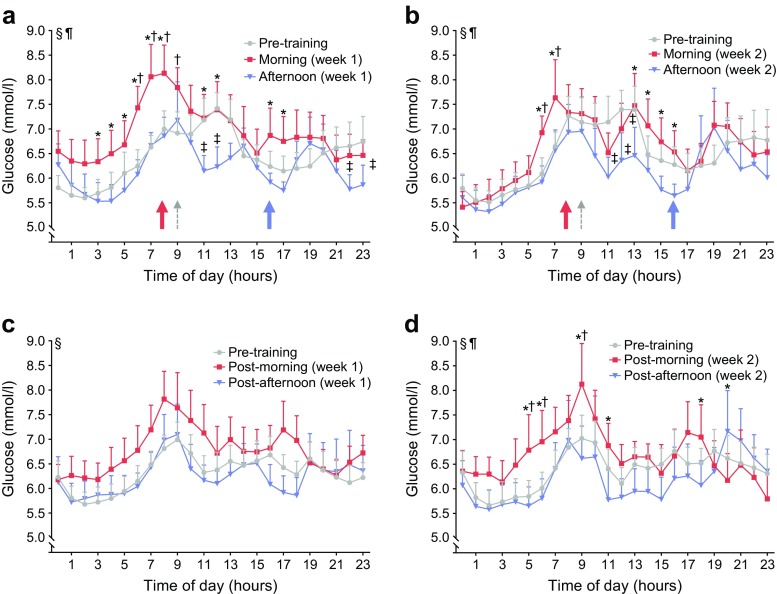
Exercise is recommended for the treatment and prevention of type 2 diabetes. However, the most effective time of day to achieve beneficial effects on health remains unknown. We aimed to determine whether exercise training at two distinct times of day would have differing effects on 24 h blood glucose levels in men with type 2 diabetes. Eleven men with type 2 diabetes underwent a randomised crossover trial. Inclusion criteria were 45–68 years of age and BMI between 23 and 33 kg/m 2 . Exclusion criteria were insulin treatment and presence of another systemic illness. Researchers were not blinded to the group assignment. The trial involved 2 weeks of either morning or afternoon high-intensity interval training (HIIT) (three sessions/week), followed by a 2 week wash-out period and a subsequent period of the opposite training regimen. Continuous glucose monitor (CGM)-based data were obtained. Morning HIIT increased CGM-based glucose concentration (6.9 ± 0.4 mmol/l; mean ± SEM for the exercise days during week 1) compared with either the pre-training period (6.4 ± 0.3 mmol/l) or afternoon HIIT (6.2 ± 0.3 mmol/l for the exercise days during week 1). Conversely, afternoon HIIT reduced the CGM-based glucose concentration compared with either the pre-training period or morning HIIT. Afternoon HIIT was associated with elevated thyroid-stimulating hormone (TSH; 1.9 ± 0.2 mU/l) and reduced T 4 (15.8 ± 0.7 pmol/l) concentrations compared with pre-training (1.4 ± 0.2 mU/l for TSH; 16.8 ± 0.6 pmol/l for T 4 ). TSH was also elevated after morning HIIT (1.7 ± 0.2 mU/l), whereas T 4 concentrations were unaltered. Afternoon HIIT was more efficacious than morning HIIT at improving blood glucose in men with type 2 diabetes. Strikingly, morning HIIT had an acute, deleterious effect, increasing blood glucose. However, studies of longer training regimens are warranted to establish the persistence of this adverse effect. Our data highlight the importance of optimising the timing of exercise when prescribing it as treatment for type 2 diabetes.
Overview
The claims and statistics of this paper haven’t been checked yet.
Run the check — free, no account needed. It reads the open-access text and checks the sources it cites.
Integrity signals
Registry
Cites
Statistics
Figures
Verification
Claims the paper makes
The claims and statistics of this paper haven’t been checked yet.
Run the check — free, no account needed. It reads the open-access text and checks the sources it cites.
Claims other papers make about this one
Each is checked against this paper’s own text: does it say what the citing paper says it does?
In the citing paper
“One study showed that afternoon exercise (i.e., high intensity interval training/HITT; individuals cycled at 75 rpm with a load of forced rest after 1 min, repeated six times with 1 min rest in between, three sessions/week, using continuous glucose monitoring, and recorded daily food intake) was found superior to morning exercise in improving glucose levels in T2DM [200].”
From Effects of diet, lifestyle, Chrononutrition and alternative dietary interventions on postprandial Glycemia and insulin resistance (2022) · cites this paper as [200]
Self-check
Percentages, sums and reported differences re-computed from the paper’s own numbers.
The self-check needs the paper’s full text.
Citations
Cites
Physiological adaptations to low-volume, high-intensity interval training in health and disease
Gibala, M. J., Little, J. P., MacDonald, M. J., & Hawley, J. A. (2012) · The Journal of Physiology · doi:10.1113/jphysiol.2011.224725 · Cited by 1,744
Circadian System and Glucose Metabolism: Implications for Physiology and Disease
Qian, J., & Scheer, F. A. J. L. (2016) · Trends in Endocrinology and Metabolism · doi:10.1016/j.tem.2016.03.005 · Cited by 370
Gillen, J. B., Little, J. P., Punthakee, Z., Tarnopolsky, M. A., Riddell, M. C., & Gibala, M. J. (2012) · Diabetes, Obesity and Metabolism · doi:10.1111/j.1463-1326.2012.01564.x · Cited by 272
Peake, J. M., Tan, S. J., Markworth, J. F., Broadbent, J. A., Skinner, T. L., & Cameron‐Smith, D. (2014) · American Journal of Physiology-Endocrinology and Metabolism · doi:10.1152/ajpendo.00276.2014 · Cited by 219
Demonstration of a day-night rhythm in human skeletal muscle oxidative capacity
van Moorsel, D., Hansen, J., Havekes, B., Scheer, F. A. J. L., Jörgensen, J. A., Hoeks, J., Schrauwen-Hinderling, V. B., Duez, H., Lefebvre, P., Schaper, N. C., et al. (2016) · Molecular Metabolism · doi:10.1016/j.molmet.2016.06.012 · Cited by 218
The Limits of Exercise Physiology: From Performance to Health
Gabriel, B. M., & Zierath, J. R. (2017) · Cell Metabolism · doi:10.1016/j.cmet.2017.04.018 · Cited by 193
Gómez, A. M., Giraldo, C. M. G., Aschner, P. J., Veloza, A., Múñoz, Ó., Rubio, C., & Vallejo, S. (2015) · Journal of Diabetes Science and Technology · doi:10.1177/1932296814566233 · Cited by 139
Yamanaka, Y., Hashimoto, S., Takasu, N. N., Tanahashi, Y., Nishide, S., Honma, S., & Honma, K. (2015) · American Journal of Physiology-Regulatory, Integrative and Comparative Physiology · doi:10.1152/ajpregu.00127.2015 · Cited by 137
Biorhythmic influences on functional capacity of human muscle and physiological responses
Deschenes, M. R., Kraemer, W. J., Bush, J. A., DOUGHTY, T. A., KIM, D., MULLEN, K. M., & RAMSEY, K. (1998) · Medicine & Science in Sports & Exercise · doi:10.1097/00005768-199809000-00008 · Cited by 90
Effect of intermittent high-intensity exercise on gastric emptying in man
Leiper, J. B., Broad, N., & Maughan, R. J. (2001) · Medicine & Science in Sports & Exercise · doi:10.1097/00005768-200108000-00005 · Cited by 81
Cited by
Sorted by citations
Items 101–200 of 277
Hetherington‐Rauth, M., Magalhães, J. P., Rosa, G. B., Correia, I. R., Carneiro, T., Oliveira, E. C., & Sardinha, L. B. (2022) · Diabetes Obesity and Metabolism · doi:10.1111/dom.14676 · Cited by 15
Riddell, M. C., Turner, L. V., & Patton, S. R. (2023) · Diabetes Spectrum · doi:10.2337/dsi22-0017 · Cited by 16
Piotrowska, K., Zgutka, K., Tkacz, M., & Tarnowski, M. (2023) · Antioxidants · doi:10.3390/antiox12081488 · Cited by 18
Liu, D., Zhang, Y., Wu, Q., Han, R., Cheng, D., Wu, L., Guo, J., Yu, X., Ge, W., Ni, J., et al. (2024) · Journal of Diabetes · doi:10.1111/1753-0407.13549 · Cited by 18
Xiao, Q., Feng, Q., Rutter, M. K., Albalak, G., Wang, H., & Noordam, R. (2025) · Diabetologia · doi:10.1007/s00125-025-06368-9 · Cited by 15
Paing, A. C., McMillan, K. A., Kirk, A. F., Collier, A., Hewitt, A., Dunstan, D. W., Owen, N. G., & CHASTIN, S. F. M. (2020) · Journal of science and medicine in sport · doi:10.1016/j.jsams.2020.06.003 · Cited by 15
Zhang, Y., Mika Kivimaki, B., Carrillo-Larco, R. M., Cheng, Y., Zhou, Y., Wang, H., Yuan, C., & Xu, X. (2024) · International Journal of Behavioral Nutrition and Physical Activity · doi:10.1186/s12966-024-01673-9 · Cited by 15
Li, Y., Peng, C., Zhang, M., Xie, L., Gao, J., Ying-ji, W., Gao, Y., & Hou, L. (2022) · Evidence-based Complementary and Alternative Medicine · doi:10.1155/2022/4291477 · Cited by 14
Mode, W. J. A., Slater, T., Pinkney, M. G., Hough, J., James, R. M., Varley, I., James, L. J., & Clayton, D. J. (2022) · Appetite · doi:10.1016/j.appet.2022.106422 · Cited by 15
RETRACTED: Cardiovascular Disease and Exercise: From Molecular Mechanisms to Clinical Applications
Wang, B., Gan, L., Deng, Y., Zhu, S., Li, G., Nasser, M. I., Liu, N., & Zhu, P. (2022) · Journal of Clinical Medicine · doi:10.3390/jcm11247511 · Cited by 16
RetractedFlis, M., Rodziewicz-Flis, E. A., Micielska, K., Kortas, J. A., Jaworska, J., Borkowska, A., Sansoni, V., Perego, S., Lombardi, G., & Ziemann, E. (2021) · Frontiers in Bioscience-Landmark · doi:10.52586/5015 · Cited by 16
Mastrototaro, L., & Roden, M. (2023) · PROTEOMICS · doi:10.1002/pmic.202300078 · Cited by 13
Short Sleep Duration Disrupts Glucose Metabolism: Can Exercise Turn Back the Clock?
Maloney, A., & Kanaley, J. A. (2024) · Exercise and Sport Sciences Reviews · doi:10.1249/jes.0000000000000339 · Cited by 14
Dighriri, A., Timraz, M., Rosaini, N. D., Alkhayl, F. F. A., Boyle, J. G., LOGAN, G. R. M., & Gray, S. R. (2024) · Chronobiology International · doi:10.1080/07420528.2024.2419867 · Cited by 13
High-resolution lifestyle profiling and metabolic subphenotypes of type 2 diabetes
Park, H., Metwally, A. A., Delfarah, A., Wu, Y., Perelman, D., Mayer, C., McGinity, C., Rodgar, M., Celli, A., McLaughlin, T., et al. (2025) · npj Digital Medicine · doi:10.1038/s41746-025-01728-6 · Cited by 12
Kerr, D. E., Abbasi, M., Bevier, W. C., GLANTZ, N. M., LAREZ, A. J., & Sabharwal, A. (2022) · Journal of Diabetes Science and Technology · doi:10.1177/19322968221105531 · Cited by 11
When should I run—the role of exercise timing in metabolic health
Kirchner, H., Weisner, L., & Wilms, B. (2023) · Acta Physiologica · doi:10.1111/apha.13953 · Cited by 12
Advances in circadian clock regulation of reproduction
Li, Y., Zhang, H., Wang, Y., Li, D., & Chen, H. (2023) · Advances in protein chemistry and structural biology · doi:10.1016/bs.apcsb.2023.02.008 · Cited by 13
Overview of Exercise Prescription for Diabetes Patients and Its Application in Japan
Sato, Y. (2020) · Journal of Science in Sport and Exercise · doi:10.1007/s42978-020-00061-6 · Cited by 13
Resetting Time: The Role of Exercise Timing in Circadian Reprogramming for Metabolic Health
Hesketh, S. J. (2025) · Obesities · doi:10.3390/obesities5030059 · Cited by 13
Kovynev, A., Ying, Z., Zhang, S., Olgiati, E., Lambooij, J. M., Visentin, C., Guigas, B., Ducarmon, Q. R., Rensen, P. C. N., & Schönke, M. (2024) · Journal of Pineal Research · doi:10.1111/jpi.70003 · Cited by 11
Chaix, A., & Panda, S. (2019) · Nature Reviews Endocrinology · doi:10.1038/s41574-019-0229-z · Cited by 11
Major Advances and Discoveries in Diabetes - 2019 in Review
Zierath, J. R. (2019) · Current Diabetes Reports · doi:10.1007/s11892-019-1255-x · Cited by 13
Andriessen, C., Schrauwen, P., & Hoeks, J. (2020) · International Journal of Obesity · doi:10.1038/s41366-020-00719-9 · Cited by 13
Personalising Exercise and Nutrition Behaviours in Diabetes Lifestyle Prevention
AlKhatib, A. H. (2020) · European Medical Journal · doi:10.33590/emj/19-00139 · Cited by 12
Exercise, Diet and Sleeping as Regenerative Medicine Adjuvants: Obesity and Ageing as Illustrations
Ghanemi, A., Yoshioka, M., & St‐Amand, J. (2022) · Medicines · doi:10.3390/medicines9010007 · Cited by 11
Sex and limb comparisons of neuromuscular function in the morning versus the evening
Augsburger, G., Soloveva, A., & Carr, J. C. (2022) · Physiological Reports · doi:10.14814/phy2.15260 · Cited by 11
Buckley, J., Riddell, M. C., Mellor, D. D., Bracken, R. M., Ross, M., Gerche, A. L., & Poirier, P. (2020) · British Journal of Sports Medicine · doi:10.1136/bjsports-2020-102446 · Cited by 11
Chang, C. R., Roach, L. A., Russell, B. M., & Francois, M. E. (2025) · Diabetes Research and Clinical Practice · doi:10.1016/j.diabres.2025.112072 · Cited by 11
Time Matters: An Insight into the Relationship Between Chrononutrition and Diabetes
López-Prieto, R. S., Romo-Romo, A., Gomez-Aviles, P., Sharma, S. S., Costilla-Orozco, X., Galán-Ramírez, G. A., & Almeda‐Valdés, P. (2024) · Revista de investigaci�n Cl�nica · doi:10.24875/ric.23000271 · Cited by 11
Stein, M. J., Weber, A., Bamberg, F., Baurecht, H., Berger, K., Bohmann, P., Brenner, H., Brummer, J., Dörr, M., Fischer, B., et al. (2025) · International Journal of Obesity · doi:10.1038/s41366-025-01721-9 · Cited by 13
Ma, T., Xie, Y. J., Bennett, T., & Lee, C. (2021) · Journal of Sports Sciences · doi:10.1080/02640414.2021.2009163 · Cited by 10
Nrf2 modulates the benefits of evening exercise in type 2 diabetes
Fasipe, B., & Laher, I. (2023) · Sports Medicine and Health Science · doi:10.1016/j.smhs.2023.09.001 · Cited by 11
Practical strategies to manage obesity in type 2 diabetes
Rodbard, H. W., Barnard-Kelly, K. D., Pfeiffer, A. F. H., Mauersberger, C., Schnell, O., & Giorgino, F. (2024) · Diabetes Obesity and Metabolism · doi:10.1111/dom.15556 · Cited by 10
Association of physical activity on blood glucose in individuals with type 2 diabetes
Wang, Y., Dzubur, E., James, R. A., Fakhouri, T. M., Brunning, S., Painter, S. L., Madan, A., & Shah, B. R. (2021) · Translational Behavioral Medicine · doi:10.1093/tbm/ibab159 · Cited by 11
Exercise in the Prevention and Treatment of Type 2 Diabetes
Kirwan, J. P., Heintz, E. C., Rebello, C. J., & Axelrod, C. L. (2023) · Comprehensive physiology · doi:10.1002/j.2040-4603.2023.tb00259.x · Cited by 9
Keller, M. J., Brady, A. J., Smith, J. A. B., Savikj, M., MacGregor, K. A., Jollet, M., Öberg, S., Nylén, C., Björnholm, M., Rickenlund, A. M., et al. (2025) · Diabetologia · doi:10.1007/s00125-025-06477-5 · Cited by 9
Hopkins, M., Beaulieu, K., & Finlayson, G. (2020) · Canadian Journal of Diabetes · doi:10.1016/j.jcjd.2020.10.018 · Cited by 8
Chang, C. R., Russell, B. M., Cyriac, T., & François, M. E. (2023) · Journal of Clinical Medicine · doi:10.3390/jcm12093237 · Cited by 10
Albalak, G., Noordam, R., van der Elst, M. J. T., Kervezee, L., Exadaktylos, V., van Bodegom, D., & van Heemst, D. (2024) · Trials · doi:10.1186/s13063-024-08310-7 · Cited by 8
Tailoring Exercise Prescription for Effective Diabetes Glucose Management
Lewis, C. J., Rafi, E., Dobbs, B., Barton, T., Hatipoğlu, B., & Malin, S. K. (2025) · The Journal of Clinical Endocrinology & Metabolism · doi:10.1210/clinem/dgae908 · Cited by 8
Exercise timing and circadian regulation of metabolism in type 2 diabetes
Hansen, S. S. K., Zierath, J. R., & Wallberg‐Henriksson, H. (2026) · Trends in Endocrinology and Metabolism · doi:10.1016/j.tem.2026.01.015 · Cited by 8
Al‐Ozairi, E., ElSamad, A., Kandari, J. A., Hamdan, Y., Taliping, D., & Gray, S. R. (2023) · Diabetes & Metabolic Syndrome Clinical Research & Reviews · doi:10.1016/j.dsx.2023.102845 · Cited by 9
Is overall and timing-specific physical activity associated with depression in older adults?
Chen, J., Lai, T., Lin, L.-J., Park, J., & Liao, Y. (2023) · Frontiers in Public Health · doi:10.3389/fpubh.2023.1241170 · Cited by 8
Zakharova, A. N., Кироненко, Т. А., Милованова, К. Г., Орлова, А. А., Dyakova, E. Y., Kalinnikova, J. G., Kabachkova, A. V., Chibalin, A., & Капилевич, Л. В. (2021) · Frontiers in Physiology · doi:10.3389/fphys.2021.709039 · Cited by 9
Marcotte‐Chénard, A., & Little, J. P. (2024) · Translational Exercise Biomedicine · doi:10.1515/teb-2024-2007 · Cited by 12
Štiglic, G., Wang, F., Sheikh, A., & Cilar, L. (2021) · Primary care diabetes · doi:10.1016/j.pcd.2021.04.008 · Cited by 14
Park, H., Metwally, A. A., Delfarah, A., Wu, Y., Perelman, D., Rodgar, M., Mayer, C., Celli, A., McLaughlin, T., Mignot, E. J.-M., et al. (2024) · medRxiv · doi:10.1101/2024.09.05.24312545 · Cited by 8
Zierath, J. R., Brady, A. J., MacGregor, K. A., de Zevallos, J. O., & Stocks, B. (2024) · Journal of sport and health science/Journal of Sport and Health Science · doi:10.1016/j.jshs.2024.100980 · Cited by 11
Jafari, A., & Kazemi, F. (2025) · Experimental Gerontology · doi:10.1016/j.exger.2025.112821 · Cited by 7
Bai, P., Shao, X., Chen, L., Zhou, S., Lin, Y., Liu, H., & Yu, P. (2024) · Scientific Reports · doi:10.1038/s41598-024-57082-2 · Cited by 6
The effect of different times of day for exercise on blood glucose fluctuations
Niu, W. C., Liu, C., Liu, K., Fang, W. J., Liu, X. Q., Liang, X. L., Yuan, H., Jia, H., Peng, H. F., Jiang, H., et al. (2024) · Primary care diabetes · doi:10.1016/j.pcd.2024.06.004 · Cited by 8
Panhuis, W. I. H., Kooijman, S., Brouwers, B., Verhoeven, A., Pronk, A. C. M., Streefland, T. C. M., Giera, M. A., Schrauwen, P., Rensen, P. C. N., & Schönke, M. (2020) · Obesity · doi:10.1002/oby.22799 · Cited by 8
Exercise benefits cardiovascular health: from molecular mechanisms to clinical implications
Zhang, X., Li, J., & Gao, F. (2021) · Scientia Sinica Vitae · doi:10.1360/ssv-2020-0359 · Cited by 8
Moghadam, M. S., Pahlavani, H. A., Daryanoosh, F., & Salesi, M. (2022) · Journal of Diabetes & Metabolic Disorders · doi:10.1007/s40200-022-01091-3 · Cited by 7
Association between circadian physical activity patterns and mortality in the UK Biobank
Stein, M. J., Baurecht, H., Sedlmeier, A. M., Konzok, J., Bohmann, P., Fontvieille, E., Peruchet‐Noray, L., Bowden, J., Friedenreich, C. M., Fervers, B., et al. (2023) · International Journal of Behavioral Nutrition and Physical Activity · doi:10.1186/s12966-023-01508-z · Cited by 7
Bouman, E. J., Slebe, R., Stenvers, D. J., Elders, P. J. M., Beulens, J. W. J., & Rutters, F. (2024) · Trials · doi:10.1186/s13063-024-08329-w · Cited by 9
Feng, Q., Albalak, G., van Dijk, K. W., van der Velde, J. H. P. M., Schoenke, M., Wang, H., Rutter, M. K., Xiao, Q., Noordam, R., & van Heemst, D. (2025) · Preventive Medicine · doi:10.1016/j.ypmed.2025.108312 · Cited by 5
Istiqomah, I. N., & Yuliyani, N. (2022) · BIMIKI (Berkala Ilmiah Mahasiswa Ilmu Keperawatan Indonesia) · doi:10.53345/bimiki.v10i1.196 · Cited by 6
The current landscape of exercise and female fertility research: a narrative review
Maher, R. A., Wadden, K. P., Fuller, D., Basset, F. A., Murphy, H. M., & McGowan, E. L. (2024) · Reproduction · doi:10.1530/rep-22-0317 · Cited by 6
Meo, S. A., Abukhalaf, A. A., Alomar, A. A., Sami, W., & Meo, A. S. (2021) · Pakistan Journal of Medical Sciences · doi:10.12669/pjms.37.4.4128 · Cited by 6
Exercise: it's only a matter of time
Saner, N. J., & Lee, M. J. (2020) · The Journal of Physiology · doi:10.1113/jp280366 · Cited by 5
Magalhães, J. P., Oliveira, E. C., Hetherington‐Rauth, M., Jesus, F., Rodrigues, M. C. D. F. S., Raposo, J. F., Ribeiro, R. T., Caetano, C. G., & Sardinha, L. B. (2024) · Trials · doi:10.1186/s13063-024-08335-y · Cited by 5
The role of circadian rhythm disruptions in the diabetes pathogenesis
Karadeniz, A. (2025) · Endocrine Regulations · doi:10.2478/enr-2025-0024 · Cited by 5
Amaravadi, S. K., Ferreira, A. D. S., & Vigário, P. D. S. (2025) · PLoS ONE · doi:10.1371/journal.pone.0336898 · Cited by 10
Lee, D. Y., Lee, J.-B., Jung, I., Park, S. J., Yu, J. H., Seo, J. A., Lee, H.-J., & Kim, N. H. (2026) · Metabolism · doi:10.1016/j.metabol.2026.156570 · Cited by 6
Bai, P., Zhou, S., Shao, X., Lin, Y., Liu, H., & Yu, P. (2024) · International Journal of Cardiology · doi:10.1016/j.ijcard.2024.131770 · Cited by 6
Iida, Y., Takeishi, S., Fushimi, N., Tanaka, K., Mori, A., & Sato, Y. (2020) · Diabetology International · doi:10.1007/s13340-020-00433-x · Cited by 5
Kim, H., Kimura, Y., Takahashi, M., Nakaoka, T., Yamada, Y., Ono, R., & Shibata, S. (2024) · European Journal of Applied Physiology · doi:10.1007/s00421-024-05526-y · Cited by 7
Fitzgerald, L. S., Bremner, S. N., Ward, S. R., Cho, Y., & Schenk, S. (2024) · Function · doi:10.1093/function/zqae035 · Cited by 5
Pedrosa, A., Furtado, G. E., Barros, M. P., Bachi, A. L. L., Ferreira, J. P., Sardão, V. A., Rama, L. M. P. L., & Teixeira, A. M. (2022) · Diabetology · doi:10.3390/diabetology4010002 · Cited by 5
Effects of Treadmill Running at Different Light Cycles in Mice with Metabolic Disorders
Zakharova, A. N., Милованова, К. Г., Орлова, А. А., Dyakova, E. Y., Kalinnikova, J. G., Kollantay, O. V., Shuvalov, I. Y., Chibalin, A., & Капилевич, Л. В. (2023) · International Journal of Molecular Sciences · doi:10.3390/ijms242015132 · Cited by 5
Thomas, J. V., Davy, B. M., Winett, R. A., Depner, C. M., Drummond, M. J., Estabrooks, P. A., Hardikar, S. S., Ou, Z., Shen, J., & Halliday, T. M. (2025) · Journal of Applied Physiology · doi:10.1152/japplphysiol.00507.2024 · Cited by 4
Feng, Q., Albalak, G., Ao, L., Xiao, Q., Wang, H., van der Velde, J. H. P. M., Jong, J. C. K., Rutter, M. K., PhD, C. E. M., Freeman, J. R., et al. (2026) · Diabetes Care · doi:10.2337/dc25-2095 · Cited by 4
Exercise time of day and blood pressure: Considering chronotype for precision health
Malin, S. K. (2024) · Journal of Human Hypertension · doi:10.1038/s41371-024-00929-y · Cited by 4
Andriessen, C., Rutters, F., Hoeks, J., Kalsbeek, A., Noordam, R., Rosendaal, F. R., van Heemst, D., Després, J., Raina, P. S., Campbell, D. J. T., et al. (2025) · Preventive Medicine Reports · doi:10.1016/j.pmedr.2025.103035 · Cited by 5
Ogando, P. H. M., Silveira-Rodrigues, J. G., Melo, B. P., Campos, B. T., Silva, A. D. C., Barbosa, E. G., Aleixo, I. M. S., & Soares, D. D. (2022) · Sport Sciences for Health · doi:10.1007/s11332-022-00931-2 · Cited by 4
Nakayama, N., Miyachi, M., Tamakoshi, K., Morikawa, S., Negi, K., Watanabe, K., Moriwaki, Y., & Hirai, M. (2021) · Journal of Clinical Nursing · doi:10.1111/jocn.16018 · Cited by 4
Chong, M. Y., Eussen, S. J. P. M., van der Velde, J. H. P. M., de Galan, B. E., Savelberg, H. H. C. M., Bosma, H., Bours, M. J. L., Weijenberg, M. P., & Koster, A. (2026) · Diabetes Obesity and Metabolism · doi:10.1111/dom.70438 · Cited by 3
Hidouri, S., Driss, T., Tagougui, S., Kammoun, N., Chtourou, H., & Hammouda, O. (2024) · Sensors · doi:10.3390/s24030909 · Cited by 5
Sevilla-Lorente, R., Mármol-Pérez, A., González‐García, P., Rodríguez-Miranda, M. D. L. N., Gallego, B. R., Aragón‐Vela, J., Galvez, J. M. M., Molina‐García, P., Alcántara, J. M. A., Garcia-Consuegra, J., et al. (2024) · Journal of sport and health science/Journal of Sport and Health Science · doi:10.1016/j.jshs.2024.101021 · Cited by 3
Snel, T., Krone, T., Kamstra, R. J. M., Eggink, H. M., Pijl, H., de Graaf, A. A., & de Hoogh, I. M. (2024) · BMJ Open Diabetes Research & Care · doi:10.1136/bmjdrc-2024-004506 · Cited by 3
Janbozorgi, M., Hosseinzadeh, M., Taheri, A., & Ghafaripur, S. (2024) · RESEARCH RESULTS IN BIOMEDICINE · doi:10.18413/2658-6533-2024-10-4-0-3 · Cited by 4
Animal Models of Exercise and Cardiometabolic Disease
Dong, G., RYAN, T. E., & Esser, K. A. (2025) · Circulation Research · doi:10.1161/circresaha.124.325704 · Cited by 4
Moriuchi, T., Otaki, Y., Satou, H., Chai, F., Hayashida, Y., Aikawa, R., Sugiyama, T., & Sode, K. (2021) · Journal of Diabetes Science and Technology · doi:10.1177/19322968211060865 · Cited by 3
Alimwenda, V. (2022) · Student s Journal of Health Research Africa · doi:10.51168/sjhrafrica.v3i12.259 · Cited by 3
Bailey, C. P., Qian, J., DiPietro, L., & Napolitano, M. A. (2023) · American Journal of Lifestyle Medicine · doi:10.1177/15598276231188007 · Cited by 3
Yang, L., & Friedenreich, C. M. (2022) · Preventive Medicine · doi:10.1016/j.ypmed.2022.107342 · Cited by 3
Editorial: Circadian rhythms and exercise in cardiometabolic health
Schönke, M., Esser, K. A., & Gabriel, B. M. (2023) · Frontiers in Endocrinology · doi:10.3389/fendo.2023.1180851 · Cited by 3
Rees, J., Walesiak, D., Thompson, R. B., Mager, D. R., Senior, P. A., & Boulé, N. G. (2024) · Medicine & Science in Sports & Exercise · doi:10.1249/mss.0000000000003552 · Cited by 2
Albalak, G., van Bodegom, D., Thangarajah, P., Giltay, E. J., van Heemst, D., & Noordam, R. (2025) · BMJ Public Health · doi:10.1136/bmjph-2024-002245 · Cited by 2
Circadian Rhythm and Muscle Function
Kim, H., & Shibata, S. (2025) · Advances in experimental medicine and biology · doi:10.1007/978-3-031-88361-3_6 · Cited by 2
Dighriri, A., Lithgow, H., Gabriel, B. M., Altuwrqi, M., Dunning, E., Johnston, L., Boyle, J. G., LOGAN, G. R. M., & Gray, S. R. (2025) · Experimental Physiology · doi:10.1113/ep093020 · Cited by 3
Fitzpatrick, R., Wilson, J. J., Davison, G. W., McMahon, G. E., Bleakley, C., & McClean, C. M. (2026) · Journal of Sports Sciences · doi:10.1080/02640414.2026.2637042 · Cited by 3
Lazić, A., & Trajković, N. (2026) · Reviews in Endocrine and Metabolic Disorders · doi:10.1007/s11154-026-10073-2 · Cited by 2
Petrie, M. A., Johnson, K. A., Dubey, O., & Shields, R. K. (2023) · Journal of Functional Morphology and Kinesiology · doi:10.3390/jfmk8030112 · Cited by 2
Treadmill training impacts the skeletal muscle molecular clock after ischemia stroke in rats
Mai, L., Yin, Y., & Qin, D. (2024) · Heliyon · doi:10.1016/j.heliyon.2024.e27430 · Cited by 2
Circadian rhythms in muscle health and diseases
Kelu, J. J. (2024) · International review of cytology · doi:10.1016/bs.ircmb.2024.10.002 · Cited by 2
Guo, H., Sun, Y., Gao, W., Liu, Y., Han, T., & Zhang, D. (2025) · BMC Public Health · doi:10.1186/s12889-025-21576-z · Cited by 2
Jalking, L., Launbo, N., Jensen, M. M., Pedersen, H., Blond, M. B., Gerstenberg, M. K., Finlayson, G., Beaulieu, K., Færch, K., Grunnet, L. G., et al. (2025) · BMJ Open · doi:10.1136/bmjopen-2024-092683 · Cited by 2
Metadata
- Authors
- Savikj, M., Gabriel, B. M., Alm, P. S., Smith, J., Caidahl, K., Björnholm, M., Fritz, T., Krook, A., Zierath, J. R., & Wallberg-Henriksson, H.
- Affiliations
- University of Oslo (NO)
- Karolinska Institutet (SE)
- Karolinska University Hospital (SE)
- University of Copenhagen (DK)
- ORCID
- Venue
- Diabetologia
- Published
- 2018-11-13
- Volume
- 62
- Issue
- 2
- Pages
- 233-237
- ISSN
- 0012-186X (ISSN-L)
- 1432-0428
- PMC
- PMC6323076
- OpenAlex
- W2901341108
- Cited by
- 277
- References
- 11
- Citations by year
- 2026: 37 · 2025: 37 · 2024: 54 · 2023: 43 · 2022: 43 · 2021: 22 · 2020: 27 · 2019: 13
- FWCI
- 10.63
- Type
- journal article
- Language
- en
- Open access
- hybrid
- doi.org
- Licence
- Locations
- Diabetologia (publishedVersion, cc-by)
- Europe PMC (PubMed Central) (publishedVersion, other-oa)
- PubMed Central (publishedVersion, cc-by)
- PubMed (publishedVersion)
- Research at the University of Copenhagen (University of Copenhagen) (publishedVersion, other-oa)
- Aberdeen University Research Archive (Aberdeen University) (submittedVersion)
- NORA - Norwegian Open Research Archives (submittedVersion, cc-by)
- Funders
- Swedish Heart Lung Foundation (20150423)
- Swedish Diabetes Foundation (DIA2012-082)
- Stockholm County Council (SLL20170159)
- Swedish Research Council (2015-00165)
- Wenner-Gren Foundation
- Strategic Research Program in Diabetes at Karolinska Institutet (2009-1068)
- Novo Nordisk Foundation (NNF14OC0011493)
- Topics
- Health Sciences › Medicine › Public Health, Environmental and Occupational Health › Physical Activity and Health
- Health Sciences › Medicine › Endocrinology, Diabetes and Metabolism › Diabetes Management and Research
- Health Sciences › Medicine › Physiology (medical) › Cardiovascular and exercise physiology
- Keywords
- type 2 diabetes, exercise timing, high-intensity interval training, blood glucose, continuous glucose monitoring, thyroid-stimulating hormone, thyroxine, morning exercise, exercise prescription
- MeSH terms
- Blood Glucose, Diabetes Mellitus, Type 2, Humans, Male, Middle Aged, Time Factors, Exercise, Treatment Outcome, Cross-Over Studies
About these checks
Registry, retraction, Cites and statistics results are computed, not judged, with one exception: a printed reference that no index lists is read once by a model before it counts as a citation error. Claims are extracted by a model and kept only when their quote appears verbatim in the text; each cited source is then checked, with a model’s help, for whether it says what the claim relies on. Those verdicts can be wrong — read the claim’s quote and the cited source before relying on one.
Statistics and arithmetic are recomputed, not judged.
Confidence bands are shown only for fields calibrated on our annotated test set. None is calibrated yet, so no band is shown.
What counts as a claim ›How we measure confidence ›How we check this ›
Are you an author, or do you see a problem with this page? Request a review
