

The DOI matches its Crossref record; 11 of the 11 references it cites were found in a registry or an index.
Afternoon exercise is more efficacious than morning exercise at improving blood glucose levels in individuals with type 2 diabetes: a randomised crossover trial
Open accessAbstract
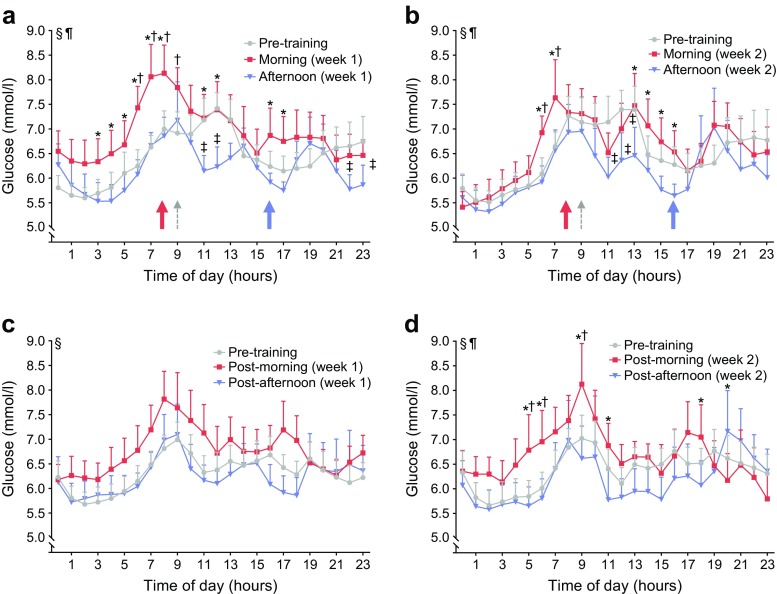
Exercise is recommended for the treatment and prevention of type 2 diabetes. However, the most effective time of day to achieve beneficial effects on health remains unknown. We aimed to determine whether exercise training at two distinct times of day would have differing effects on 24 h blood glucose levels in men with type 2 diabetes. Eleven men with type 2 diabetes underwent a randomised crossover trial. Inclusion criteria were 45–68 years of age and BMI between 23 and 33 kg/m 2 . Exclusion criteria were insulin treatment and presence of another systemic illness. Researchers were not blinded to the group assignment. The trial involved 2 weeks of either morning or afternoon high-intensity interval training (HIIT) (three sessions/week), followed by a 2 week wash-out period and a subsequent period of the opposite training regimen. Continuous glucose monitor (CGM)-based data were obtained. Morning HIIT increased CGM-based glucose concentration (6.9 ± 0.4 mmol/l; mean ± SEM for the exercise days during week 1) compared with either the pre-training period (6.4 ± 0.3 mmol/l) or afternoon HIIT (6.2 ± 0.3 mmol/l for the exercise days during week 1). Conversely, afternoon HIIT reduced the CGM-based glucose concentration compared with either the pre-training period or morning HIIT. Afternoon HIIT was associated with elevated thyroid-stimulating hormone (TSH; 1.9 ± 0.2 mU/l) and reduced T 4 (15.8 ± 0.7 pmol/l) concentrations compared with pre-training (1.4 ± 0.2 mU/l for TSH; 16.8 ± 0.6 pmol/l for T 4 ). TSH was also elevated after morning HIIT (1.7 ± 0.2 mU/l), whereas T 4 concentrations were unaltered. Afternoon HIIT was more efficacious than morning HIIT at improving blood glucose in men with type 2 diabetes. Strikingly, morning HIIT had an acute, deleterious effect, increasing blood glucose. However, studies of longer training regimens are warranted to establish the persistence of this adverse effect. Our data highlight the importance of optimising the timing of exercise when prescribing it as treatment for type 2 diabetes.
Overview
The claims and statistics of this paper haven’t been checked yet.
Run the check — free, no account needed. It reads the open-access text and checks the sources it cites.
Integrity signals
Registry
Cites
Statistics
Figures
Verification
Claims the paper makes
The claims and statistics of this paper haven’t been checked yet.
Run the check — free, no account needed. It reads the open-access text and checks the sources it cites.
Claims other papers make about this one
Each is checked against this paper’s own text: does it say what the citing paper says it does?
In the citing paper
“One study showed that afternoon exercise (i.e., high intensity interval training/HITT; individuals cycled at 75 rpm with a load of forced rest after 1 min, repeated six times with 1 min rest in between, three sessions/week, using continuous glucose monitoring, and recorded daily food intake) was found superior to morning exercise in improving glucose levels in T2DM [200].”
From Effects of diet, lifestyle, Chrononutrition and alternative dietary interventions on postprandial Glycemia and insulin resistance (2022) · cites this paper as [200]
Self-check
Percentages, sums and reported differences re-computed from the paper’s own numbers.
The self-check needs the paper’s full text.
Citations
Cites
Physiological adaptations to low-volume, high-intensity interval training in health and disease
Gibala, M. J., Little, J. P., MacDonald, M. J., & Hawley, J. A. (2012) · The Journal of Physiology · doi:10.1113/jphysiol.2011.224725 · Cited by 1,744
Circadian System and Glucose Metabolism: Implications for Physiology and Disease
Qian, J., & Scheer, F. A. J. L. (2016) · Trends in Endocrinology and Metabolism · doi:10.1016/j.tem.2016.03.005 · Cited by 370
Gillen, J. B., Little, J. P., Punthakee, Z., Tarnopolsky, M. A., Riddell, M. C., & Gibala, M. J. (2012) · Diabetes, Obesity and Metabolism · doi:10.1111/j.1463-1326.2012.01564.x · Cited by 272
Peake, J. M., Tan, S. J., Markworth, J. F., Broadbent, J. A., Skinner, T. L., & Cameron‐Smith, D. (2014) · American Journal of Physiology-Endocrinology and Metabolism · doi:10.1152/ajpendo.00276.2014 · Cited by 219
Demonstration of a day-night rhythm in human skeletal muscle oxidative capacity
van Moorsel, D., Hansen, J., Havekes, B., Scheer, F. A. J. L., Jörgensen, J. A., Hoeks, J., Schrauwen-Hinderling, V. B., Duez, H., Lefebvre, P., Schaper, N. C., et al. (2016) · Molecular Metabolism · doi:10.1016/j.molmet.2016.06.012 · Cited by 218
The Limits of Exercise Physiology: From Performance to Health
Gabriel, B. M., & Zierath, J. R. (2017) · Cell Metabolism · doi:10.1016/j.cmet.2017.04.018 · Cited by 193
Gómez, A. M., Giraldo, C. M. G., Aschner, P. J., Veloza, A., Múñoz, Ó., Rubio, C., & Vallejo, S. (2015) · Journal of Diabetes Science and Technology · doi:10.1177/1932296814566233 · Cited by 139
Yamanaka, Y., Hashimoto, S., Takasu, N. N., Tanahashi, Y., Nishide, S., Honma, S., & Honma, K. (2015) · American Journal of Physiology-Regulatory, Integrative and Comparative Physiology · doi:10.1152/ajpregu.00127.2015 · Cited by 137
Biorhythmic influences on functional capacity of human muscle and physiological responses
Deschenes, M. R., Kraemer, W. J., Bush, J. A., DOUGHTY, T. A., KIM, D., MULLEN, K. M., & RAMSEY, K. (1998) · Medicine & Science in Sports & Exercise · doi:10.1097/00005768-199809000-00008 · Cited by 90
Effect of intermittent high-intensity exercise on gastric emptying in man
Leiper, J. B., Broad, N., & Maughan, R. J. (2001) · Medicine & Science in Sports & Exercise · doi:10.1097/00005768-200108000-00005 · Cited by 81
Cited by
Sorted by citations
Items 201–277 of 277
Zhang, Q., Fu, L., Zhao, J. H., Chen, K., Tse, G., Lip, G. Y. H., & Liu, T. (2025) · European Journal of Preventive Cardiology · doi:10.1093/eurjpc/zwaf604 · Cited by 2
Chang, C. R., Astell‐Burt, T., Russell, B. M., & François, M. E. (2022) · BMJ Open · doi:10.1136/bmjopen-2021-057183 · Cited by 2
Kovynev, A., Ying, Z., Lambooij, J. M., van der Zande, H. J. P., Guigas, B., Rensen, P. C. N., & Schönke, M. (2023) · Journal of Clinical and Translational Hepatology · doi:10.14218/jcth.2023.00094 · Cited by 2
Braunsperger, A., Bauer, M., Brahim, C. B., Seep, L., Tischer, D., Peitzsch, M., Hasenauer, J., Figueroa, S. H., Worthmann, A., Heeren, J., et al. (2025) · Scientific Reports · doi:10.1038/s41598-025-85304-8 · Cited by 2
Ardakan, A. M., Farsani, Z. H., Heydari, Z., Ghahfarrokhi, S. H., & Raisi, Z. (2025) · Iranian Journal of Psychiatry and Behavioral Sciences · doi:10.5812/ijpbs-158682 · Cited by 1
The Multidimensional Impact of Exercise Timing on Health: A Systematic Review
Wang, W., Yu, W., Zhao, Y., & Ren, H. (2025) · International Journal of Sports Medicine · doi:10.1055/a-2684-9245 · Cited by 1
Codella, R., Bisio, A., Bassi, M., Minuto, N., Vichi, E., Gotti, D. J., Ruggeri, P., Maggi, D. C., & Faelli, E. L. (2025) · Journal of Endocrinological Investigation · doi:10.1007/s40618-025-02690-6 · Cited by 1
Chaudhry, B. A., Morrell, J. S., Cook, S. B., Goodwin, N. J., & Brian, M. S. (2026) · Journal of Exercise Science & Fitness · doi:10.1016/j.jesf.2026.200452 · Cited by 1
Marchesano, M., Silva, A. C., & Tassino, B. (2026) · Journal of Biological Rhythms · doi:10.1177/07487304261428332 · Cited by 1
Li, J., Yuan, J., Zhang, Y., Zeng, Q., & Ma, H. (2026) · Frontiers in Endocrinology · doi:10.3389/fendo.2026.1834479 · Cited by 1
Interaction of exercise and meal timing on blood glucose concentrations
Boulé, N. G., & Rees, J. (2023) · Current Opinion in Clinical Nutrition & Metabolic Care · doi:10.1097/mco.0000000000000936 · Cited by 1
Rodríguez-Muñoz, A., Martínez‐Montoro, J. I., Sojo-Rodriguez, B., Benítez‐Porres, J., de Albornoz-Gil, M. C., Carrasco-Fernández, L., Subiri-Verdugo, A., Molina-Ramos, A. I., Cobos-Díaz, A., Tinahones, F. J., et al. (2024) · Journal of the International Society of Sports Nutrition · doi:10.1080/15502783.2024.2433740 · Cited by 2
Circadian rhythms and exercise/physical activity
Takahashi, M., & Aoyama, S. (2020) · 体力科學 · doi:10.7600/jspfsm.69.351 · Cited by 1
Kamal, R. H., Wigati, K. W., & Lefi, A. (2020) · Majalah Biomorfologi · doi:10.20473/mbiom.v30i2.2020.39-44 · Cited by 1
Körperliche Aktivität und Diabetes mellitus Typ 2
Brinkmann, C. K. (2020) · Der Diabetologe · doi:10.1007/s11428-020-00704-w · Cited by 1
Precision Exercise and Physical Activity for Diabetes
Boulé, N. G., & Yardley, J. E. (2022) · Springer eBooks · doi:10.1007/978-3-030-98927-9_13 · Cited by 1
Toward Personalizing Exercise to Support Circadian Entrainment of Glycemia in Type 2 Diabetes
Russell, B. M., & François, M. E. (2020) · Medicine & Science in Sports & Exercise · doi:10.1249/mss.0000000000002265 · Cited by 1
HRT COOLING WATER SYSTEM MODIFICATIONS
McLain, H. A., Aven, R. E., & Robertson, R. C. (1956) · OSTI OAI (U.S. Department of Energy Office of Scientific and Technical Information) · Cited by 1
Diabetes Prevention With Lifestyle: Omics of Exercise and Nutrition Behaviors
AlKhatib, A. H. (2019) · Elsevier eBooks · doi:10.1016/b978-0-08-100596-5.22899-0
Novel aspects of exercise training to promote human metabolic health
Mancilla, R. (2022) · Research Publications (Maastricht University) · doi:10.26481/dis.20220210rm
Schuit, F. C. (2019) · Bohn Stafleu van Loghum eBooks · doi:10.1007/978-90-368-2358-6_12
Early but not late exercise training in mice exacerbates hepatic inflammation in early NAFLDPreprint
Kovynev, A., Ying, Z., Lambooij, J. M., Guigas, B., Rensen, P. C. N., & Schönke, M. (2022) · bioRxiv (Cold Spring Harbor Laboratory) · doi:10.1101/2022.11.28.518192
Association between circadian physical activity patterns and mortality in the UK BiobankPreprint
Stein, M. J., Baurecht, H., Sedlmeier, A. M., Konzok, J., Bohmann, P., Fontvieille, E., Peruchet‐Noray, L., Bowden, J., Friedenreich, C. M., Fervers, B., et al. (2022) · medRxiv · doi:10.1101/2022.12.05.22283101
Seth, S., Yangdon, K. S., & Gupta, S. (2023) · Critical Reviews in Physical and Rehabilitation Medicine · doi:10.1615/critrevphysrehabilmed.2023047343
A metabolically healthy lifestyle
Andriessen, C. (2023) · Research Publications (Maastricht University) · doi:10.26481/dis.20230706ca
Kim, H., Kimura, Y., Takahashi, M., Nakaoka, T., Yamada, Y., Ono, R., & Shibata, S. (2023) · Research Square · doi:10.21203/rs.3.rs-3271315/v1
Effects of high-intensity training on glycemic metabolism in type 2 diabetes mellitus
Santos, J. W. C., Cunha, R. M., & de Sousa, G. S. (2023) · Manual Therapy Posturology & Rehabilitation Journal · doi:10.17784/mtprehabjournal.2023.21.1275
Diabetes Mellitus Patients' Knowledge About Hypoglycemia and Initial Management of Hypoglycemia
Abiddin, A. H., & Anam, A. K. (2023) · Health Gate · doi:10.33846/hg1403
A 24-hour perspective on insulin resistance
Harmsen, J. (2023) · Research Publications (Maastricht University) · doi:10.26481/dis.20231213jh
Jayavel, A., Shivasekar, M., & Vinodhini, V. M. (2023) · International Journal of Kinesiology and Sports Science · doi:10.7575/aiac.ijkss.v.11n.4p.17
Cornélissen, G., Otsuka, K., & Hirota, T. (2024) · Royal Society of Chemistry eBooks · doi:10.1039/bk9781839167553-00001
Circadian Aspects of Skeletal Muscle Biology
Delezie, J., & Lamia, K. A. (2024) · Royal Society of Chemistry eBooks · doi:10.1039/bk9781839167553-00345
Murray, J., Bennett, H., Bezak, E., & Perry, R. (2024) · European Journal of Sport Science · doi:10.1002/ejsc.12047
Haslina, H. (2024) · COMSERVA Jurnal Penelitian dan Pengabdian Masyarakat · doi:10.59141/comserva.v4i4.1412
Lyons, K., Carrillo, B. P., Dasar, L. T., Ifeyinwa, O. P., & Gabriel, B. M. (2024) · medRxiv · doi:10.1101/2024.11.13.24317280
Xu, L., Li, K., & Zhong, V. W. (2024) · Journal of Sports Sciences · doi:10.1080/02640414.2024.2435734 · Cited by 1
A Review of the Relationship between Physical Activity and Cognitive Function
饶, 娇. (2024) · Advances in Social Sciences · doi:10.12677/ass.2024.13121089
Feng, Q., Albalak, G., van Dijk, K. W., van der Velde, J. H. P. M., Schoenke, M., Wang, H., Rutter, M. K., Xiao, Q., Noordam, R., & van Heemst, D. (2025) · SSRN Electronic Journal · doi:10.2139/ssrn.5125706
The effect of fasted versus post-meal HIIT on glycemic control in men with type 2 diabetes mellitus
Ahmed, A., Ahmed, M. S. M., Hegazy, M. M. A., & Ismail, S. M. (2025) · Sport Sciences for Health · doi:10.1007/s11332-025-01368-z
Bewegung? Metformin? Am besten beides!
Skurk, T. (2025) · Info Diabetologie · doi:10.1007/s15034-025-5102-7
Chen, X.-S., Liu, H., Wang, S., Fang, J., Han, Y.-X., Huang, F., Meng, J., Han, Y., Zou, H.-M., Gu, Q., et al. (2025) · doi:10.2196/preprints.76903
Wu, Q., Shi, B., Du, L., Jin, W., Chen, J., Xue, X., Pan, Y., Chen, S., Zhang, X., & He, Q. (2025) · International Journal of Obesity · doi:10.1038/s41366-025-01893-4
Mikulec, P., Kerknawi, K., Loch, E., Zagalska, M., & Turek, M. (2025) · International Journal of Innovative Technologies in Social Science · doi:10.31435/ijitss.3(47).2025.3985
Turner, L. V., Chen, C., Gao, P., Beck, S. E., Johnson, M. L., & Riddell, M. C. (2025) · Diabetes Technology and Obesity Medicine · doi:10.1177/29986702251393163
Müssig, K. (2025) · Info Diabetologie · doi:10.1007/s15034-025-5202-4
Stein, M. J., Baurecht, H., Sedlmeier, A. M., Konzok, J., Bohmann, P., Fontvieille, E., Peruchet‐Noray, L., Bowden, J., Friedenreich, C. M., Fervers, B., et al. (2024) · Figshare · doi:10.6084/m9.figshare.26614261
Stein, M. J., Baurecht, H., Bohmann, P., Fervers, B., Fontvieille, E., Freisling, H., Friedenreich, C. M., Konzok, J., Peruchet‐Noray, L., Sedlmeier, A. M., et al. (2024) · Figshare · doi:10.6084/m9.figshare.27049210
Sleep Disorders and Circadian Sleep Disruption in Cardiovascular–Kidney–Metabolic Syndrome
Crișan-Dabija, R. A., & Antal, A. Z. (2025) · Springer eBooks · doi:10.1007/978-3-032-11445-7_15
Osei, S. (2025) · International Journal of Sports Science and Physical Education · doi:10.11648/j.ijsspe.20251004.13
Exercise and Type 2 Diabetes Mellitus
Ahmed, A., & Ismail, S. M. (2026) · IntechOpen eBooks · doi:10.5772/intechopen.1011038 · Cited by 1
Kushioka, J., Sun, R., & Smuck, M. W. (2026) · Sensors · doi:10.3390/s26030982
Wang, J., Zeng, J., Yang, W., Chen, B., Fan, M., Zhang, X., Xing, Y., & Xu, S. (2026) · Metabolism and Target Organ Damage · doi:10.20517/mtod.2025.146
Time-of-day effects on post-exercise phosphoproteomic profiling in mouse hippocampus
Qian, P., Shen, J., Wang, F., Lu, Z., Cao, D., Li, L., Ma, F., Li, S., Liu, Z., Zhang, T., et al. (2026) · Frontiers in Cell and Developmental Biology · doi:10.3389/fcell.2026.1788597
Lee, D. Y., Lee, J.-B., Jung, I., Park, S. J., Yu, J. H., Seo, J. A., Lee, H.-J., & Kim, N. H. (2026) · Metabolism · doi:10.1016/j.metabol.2026.156604
Fillon, A. (2020) · theses.fr (ABES) · doi:10.70675/50aad462za2a1z400dz9d4fzf774bdf19915
Al‐Ozairi, E., Irshad, M., Alkandari, J., Al-Ozairi, A., Alroudhan, D., Alsaeed, D., Steenackers, N., der Schueren, B. V., & Gray, S. (2026) · Diabetes Metabolic Syndrome and Obesity · doi:10.2147/dmso.s570107
Impact of daylight saving time on physical activity patterns
Jeong, H., Katta, S., Wang, W. K., Volfovsky, A., & Dunn, J. (2026) · Nature Health · doi:10.1038/s44360-026-00115-z · Cited by 3
Jafari, A., & Beni, S. A. (2026) · Maturitas · doi:10.1016/j.maturitas.2026.109027
Nocturnal insulin resistance and reduced insulin availability in human MASLD
Luukkonen, P. K. (2026) · Journal of Hepatology · doi:10.1016/j.jhep.2026.05.014
Launbo, N., Jalking, L., Jensen, M. M., Beaulieu, K., Finlayson, G., Blond, M. B., Wiggers, A., Rungby, J., NILSSON, M., Albrechtsen, N. J. W., et al. (2026) · EBioMedicine · doi:10.1016/j.ebiom.2026.106353
Schwensfeier, L., & Brinkmann, C. K. (2026) · Sports · doi:10.3390/sports14070274
Timing the strain: skeletal muscle clock as regulator of physical activity
Kawano, I., & Asher, G. (2026) · npj Metabolic Health and Disease · doi:10.1038/s44324-026-00121-5
Wang, Y., Xu, C., & Tong, J. (2026) · Frontiers in Physiology · doi:10.3389/fphys.2026.1872652
Ghram, A., Diaz, J. L., Laukkanen, J. A., Kunutsor, S. K., Lippi, G., Terada, T., Covassin, N., Hautala, A. J., Kaddoura, R., Pescatello, L. S., et al. (2026) · Sleep Medicine Reviews · doi:10.1016/j.smrv.2026.102349
Exercise and physical activity interventions in type 2 diabetes mellitus
Su, W., Li, X., Gou, H., Yuan, L., Lin, L., Lin, X., Wang, X., Xiong, Y., & Luan, Y. (2026) · Frontiers in Endocrinology · doi:10.3389/fendo.2026.1887543
Wang, C., Kanaley, J. A., Chen, J., & Tan, J. (2026) · Frontiers in Physiology · doi:10.3389/fphys.2026.1907805
Wang, J., Chen, S., Zhang, Z., Yang, B., & Zhang, X. (2026) · Sports Medicine - Open · doi:10.1186/s40798-026-01089-8
Optimizing timing of exercise to improve metabolic outcomes in obesity and type 2 diabetes
Kotte, M., Joris Hoeks, J., Schrauwen, P., & van de Weijer, T. (2026) · npj Biological Timing and Sleep · doi:10.1038/s44323-026-00099-9
Liu, Y., Wu, Y., Gao, X., Zhang, Q., Jin, X., Lin, Z., Yang, X., Zheng, R., Du, L., Zhang, X., et al. (2026) · Photoacoustics · doi:10.1016/j.pacs.2026.100881
Campos, R. M. D. S., Souza, H. D. S., Favaron, C. M., Saborosa, G. P., Ferez, L. C., Tufik, S. B., Antunes, H. K. M., D’Almeida, V., & Mônico‐Neto, M. (2026) · Frontiers in Sleep · doi:10.3389/frsle.2026.1943600
Ostrowicz, K., Brzuchacz, D., Malinowski, A., Pelczar, A. K., Oczkowska, W., Marchewka, K., Ciesielska, J., Furtek, D., Bartosik, K., & Borkowska, J. (2026) · International Journal of Innovative Technologies in Social Science · doi:10.31435/ijitss.3(51).2026.6684
de Kam, S. S., Reed, T. D., Rutters, F., Campbell, D. N., Raina, P. S., de Mutsert, R., Després, J., Joris Hoeks, J., Blondin, D. P., Carpentier, A. C., et al. (2026) · Diabetologia · doi:10.1007/s00125-026-06871-7
Feng, X., & Savkin, A. V. (2026) · Applied Sciences · doi:10.3390/app162010007
Timing the effort: Chronobiological drivers of skeletal muscle adaptation and metabolic health
Aykora, E., Erbil, G., & Aykora, D. (2026) · Chronobiology International · doi:10.1080/07420528.2026.2750361
Chen, B., Cui, X., Feng, M., Qu, A., Wang, H., Zhang, H., & Zhang, L. (2026) · Public Health · doi:10.1016/j.puhe.2026.106517
Yang, M., Qian, X., Lin, W., & Yang, R. (2026) · Metabolites · doi:10.3390/metabo16110805
Akkaya, C. C., Eslami, Z., Moghanlou, A. E., Yönal, M., Mirghani, S. J., Demirli, A., & Taştan, Z. (2026) · Metabolites · doi:10.3390/metabo16110825
Metadata
- Authors
- Savikj, M., Gabriel, B. M., Alm, P. S., Smith, J., Caidahl, K., Björnholm, M., Fritz, T., Krook, A., Zierath, J. R., & Wallberg-Henriksson, H.
- Affiliations
- University of Oslo (NO)
- Karolinska Institutet (SE)
- Karolinska University Hospital (SE)
- University of Copenhagen (DK)
- ORCID
- Venue
- Diabetologia
- Published
- 2018-11-13
- Volume
- 62
- Issue
- 2
- Pages
- 233-237
- ISSN
- 0012-186X (ISSN-L)
- 1432-0428
- PMC
- PMC6323076
- OpenAlex
- W2901341108
- Cited by
- 277
- References
- 11
- Citations by year
- 2026: 37 · 2025: 37 · 2024: 54 · 2023: 43 · 2022: 43 · 2021: 22 · 2020: 27 · 2019: 13
- FWCI
- 10.63
- Type
- journal article
- Language
- en
- Open access
- hybrid
- doi.org
- Licence
- Locations
- Diabetologia (publishedVersion, cc-by)
- Europe PMC (PubMed Central) (publishedVersion, other-oa)
- PubMed Central (publishedVersion, cc-by)
- PubMed (publishedVersion)
- Research at the University of Copenhagen (University of Copenhagen) (publishedVersion, other-oa)
- Aberdeen University Research Archive (Aberdeen University) (submittedVersion)
- NORA - Norwegian Open Research Archives (submittedVersion, cc-by)
- Funders
- Swedish Heart Lung Foundation (20150423)
- Swedish Diabetes Foundation (DIA2012-082)
- Stockholm County Council (SLL20170159)
- Swedish Research Council (2015-00165)
- Wenner-Gren Foundation
- Strategic Research Program in Diabetes at Karolinska Institutet (2009-1068)
- Novo Nordisk Foundation (NNF14OC0011493)
- Topics
- Health Sciences › Medicine › Public Health, Environmental and Occupational Health › Physical Activity and Health
- Health Sciences › Medicine › Endocrinology, Diabetes and Metabolism › Diabetes Management and Research
- Health Sciences › Medicine › Physiology (medical) › Cardiovascular and exercise physiology
- Keywords
- type 2 diabetes, exercise timing, high-intensity interval training, blood glucose, continuous glucose monitoring, thyroid-stimulating hormone, thyroxine, morning exercise, exercise prescription
- MeSH terms
- Blood Glucose, Diabetes Mellitus, Type 2, Humans, Male, Middle Aged, Time Factors, Exercise, Treatment Outcome, Cross-Over Studies
About these checks
Registry, retraction, Cites and statistics results are computed, not judged, with one exception: a printed reference that no index lists is read once by a model before it counts as a citation error. Claims are extracted by a model and kept only when their quote appears verbatim in the text; each cited source is then checked, with a model’s help, for whether it says what the claim relies on. Those verdicts can be wrong — read the claim’s quote and the cited source before relying on one.
Statistics and arithmetic are recomputed, not judged.
Confidence bands are shown only for fields calibrated on our annotated test set. None is calibrated yet, so no band is shown.
What counts as a claim ›How we measure confidence ›How we check this ›
Are you an author, or do you see a problem with this page? Request a review
